Greek · Primordial deity · Certain
Uranus
Οὐρανός · Ouranos
Pronunciation: /uː.ra.nós/; English /ˈjuɹənəs/ and /ˈjɝənəs/ · oo-ra-NOSS, with raised pitch on NOSS; English YOOR-uh-nuhs or YUR-uh-nuhs
Research and editorial review by Cody Manes · Reviewed 2026-08-31
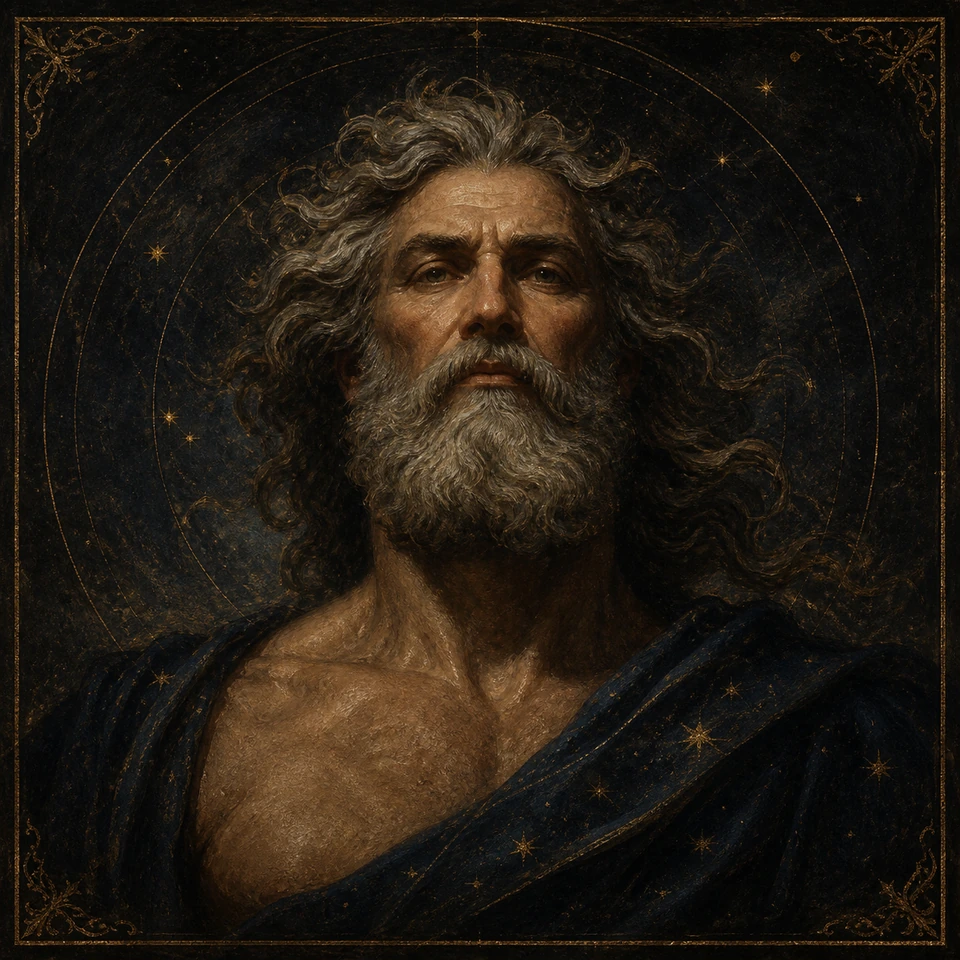
Stretching endlessly over the ancient world as the primordial Sky, Uranus fathered sweeping divine generations alongside Gaia. His violent downfall as the wounded predecessor triggered the first major mythological succession, cementing a legacy that eventually inspired a late Orphic hymn.
Overview
Before an Olympian throne exists, Earth bears a sky equal to herself. Hesiod’s Gaia brings forth starry Ouranos, a living expanse large enough to cover her on every side and to provide an enduring seat for the gods. Sky is not a blue ceiling placed above the world. He is body, boundary, parent, and early sovereign, pressed around Earth in a union that fills the cosmos with children.
The embrace becomes imprisonment. Ouranos hates the children born from Gaia and forces them back into her hidden depths. Birth reverses into confinement, and Gaia groans under the weight. She fashions a jagged sickle and asks her sons to answer their father’s cruelty. Fear closes every mouth except that of Cronus. Gaia hides him and waits for Sky to descend.
Cronus reaches from concealment, grips his father, and strikes. Blood falls onto Gaia and produces Erinyes, Giants, and Meliae. The severed generative flesh enters the sea, gathers foam, and begins Aphrodite’s Hesiodic birth. The wound ends one sovereignty but releases powers of vengeance, violence, trees, sexuality, and desire. Ouranos is defeated, yet his body continues to make the world.
Pseudo-Apollodorus widens the conspiracy. Earth persuades the Titans to attack Sky, Oceanus alone refuses, and Cronus still performs the mutilation. That collective account must remain separate from Hesiod’s scene, where Cronus alone answers and acts. Later genealogies widen the differences again. Plato inserts Oceanus and Tethys between the first Sky and the later pair Cronus and Rhea. Diodorus reports Cretan parentage alternatives. Pausanias preserves elder Muses as daughters of Uranus, a generation distinct from the younger Muses of Zeus and Mnemosyne.
The defeated father also speaks into the next crisis. Earth and Sky warn Cronus that a child will overthrow him. Cronus answers by swallowing the children Rhea bears, repeating confinement inside his own body. The ruler who struck his father carries the same fear forward, and Ouranos becomes prophetic witness to a succession he no longer governs.
Cult evidence is thinner but not empty. Orphic Hymn III addresses Heaven as an encircling, all-seeing divine parent and prescribes frankincense fumigation. The prayer gives real worship language, hymnic titles, and an offering, though no city, temple, priesthood, or annual festival. Frankincense belongs to this named late witness, not to an invented universal rite.
Material images remain difficult. A Pergamon Altar catalogue describes a powerful winged figure with owl masks among his feathers and says he may be Uranos. The question mark is essential. The Vatican Museums identify a personification of the Heavens on the Roman cuirass of Augustus from Prima Porta, but do not call that figure Greek Ouranos. No single ancient portrait type is secure enough to turn either monument into a universal image of the god.
The name itself requires care. LSJ and Smyth support a qualified Attic /uː.ra.nós/, approximately oo-ra-NOSS with raised final pitch. CMUdict gives two current American forms of Uranus. NASA’s Uranus is the seventh planet from the Sun, not the primordial god. Planetary science and modern astrology cannot be carried backward through a shared English spelling.
Canonical identity
Canonical Identity
Ouranos (Οὐρανός) is not merely a deity residing within the heavens; he is the primordial sky itself. In Hesiod's cosmology, Gaia does not birth a god to stand beneath a celestial dome, but rather brings forth the starry expanse as her equal, vast enough to envelop her entirely. He exists simultaneously as a physical body, a cosmic boundary, a primordial father, and an early sovereign whose fateful descent upon the Earth sets the stage for mythological history's first brutal ambush.
Linguistic Identity
The Liddell-Scott-Jones lexicon (LSJ) preserves οὐρανός with its traditional written accent, defining it strictly as sky or heaven. Following Smyth’s historical grammar, the fifth-century BC Attic pronunciation takes the form /uː.ra.nós/ (roughly oo-ra-NOSS), marked by a distinct raised pitch on the final syllable. This ancient articulation must be kept entirely separate from the modern American English Uranus (rendered by CMUdict as YOOR-uh-nuhs or YUR-uh-nuhs). These historical and contemporary forms represent separate linguistic realities that should never be conflated.
Sources and evidence
TEXTUAL · Supported
Hesiod makes starry Ouranos a divine Sky born from Gaia equal to herself and large enough to cover her on every side.
- Source
- Hesiod; edited and translated by Hugh G. Evelyn-White, Theogony (1914)
- Reviewed edition
- Hugh G. Evelyn-White edition and English translation in Hesiod, the Homeric Hymns and Homerica, 1914 · translated by Hugh G. Evelyn-White · edited by Hugh G. Evelyn-White · Perseus Digital Library / Scaife ATLAS
- Exact locator
- Entry Theogony · Line 116-128
- Scope
- Archaic Greece · Ancient Greece
- Authority
- Hesiod, Theogony
- Certainty
- Certain within the named witness
Earth bears a living Sky whose body and extent define the first divine landscape.
Open exact reviewed sourceSCHOLARLY INTERPRETATION · Supported
LSJ preserves οὐρανός with its written accent and the senses sky or heaven.
- Source
- Henry George Liddell and Robert Scott; Scaife ATLAS, οὐρανός, LSJ entry
- Reviewed edition
- LSJ digital entry οὐρανός, Scaife ATLAS URN lsj-n75954 · Tufts University
- Exact locator
- Entry LSJ οὐρανός · RecordUrl https://atlas.perseus.tufts.edu/dictionaries/entry/urn%3Acite2%3Ascaife-viewer%3Adictionaries.v1%3Alsj-n75954/
- Scope
- Classical Greece · Ancient Greece
- Authority
- LSJ historical lexicon
- Certainty
- Certain within the named witness
The lexicon fixes spelling, accent, inflection, and lexical range.
Open exact reviewed sourceSCHOLARLY INTERPRETATION · Supported
Smyth’s rules for ου, consonants, smooth breathing, syllables, and acute pitch support the qualified Attic reconstruction /uː.ra.nós/.
- Source
- Herbert Weir Smyth, A Greek Grammar for Colleges (1920)
- Reviewed edition
- Herbert Weir Smyth, A Greek Grammar for Colleges, American Book Company, 1920; Perseus text 1999.04.0007 · Perseus Digital Library
- Exact locator
- Entry A Greek Grammar for Colleges · Section §§1, 24, 150, and vowel rules for ου · RecordUrl https://www.perseus.tufts.edu/hopper/text?doc=Perseus:text:1999.04.0007
- Scope
- Classical Greece · Ancient Greece
- Authority
- Smyth historical Greek grammar
- Certainty
- Certain within the named witness
The readable guide approximates a pitch accent and does not turn it into modern stress.
Open exact reviewed sourceTEXTUAL · Supported
CMUdict gives two current General American pronunciations of Uranus: Y UW1 R AH0 N AH0 S and Y ER1 AH0 N AH0 S.
- Source
- CMUdict maintainers, CMU Pronouncing Dictionary, Uranus entries
- Reviewed edition
- Pinned CMUdict master wordlist revision 74790861f652b15e4ac49015a90074ad62a27690, lines 126377-126378 · Carnegie Mellon University project
- Exact locator
- Entry cmudict.dict · Section uranus and uranus(2) · RecordUrl https://github.com/cmusphinx/cmudict/blob/74790861f652b15e4ac49015a90074ad62a27690/cmudict.dict#L126377-L126378
- Scope
- Modern institutional astronomy
- Authority
- CMU Pronouncing Dictionary
- Certainty
- Certain within the named witness
These are English name pronunciations and do not replace the qualified Ancient Greek form.
Open exact reviewed source4 reviewed sources for this section
- Hesiod; edited and translated by Hugh G. Evelyn-White, Theogony (1914)Hesiod, the Homeric Hymns and Homerica, London and New York, 1914 · Perseus Digital Library / Scaife ATLAS
- Henry George Liddell and Robert Scott; Scaife ATLAS, οὐρανός, LSJ entryLSJ digital entry with exact headword, accent, senses, and citations · Tufts University
- Herbert Weir Smyth, A Greek Grammar for Colleges (1920)American Book Company, 1920; Perseus text 1999.04.0007 · Perseus Digital Library
- CMUdict maintainers, CMU Pronouncing Dictionary, Uranus entriesPinned master wordlist revision 74790861f652b15e4ac49015a90074ad62a27690 · Carnegie Mellon University project
Culture, tradition, period, and place
Ouranos first stands securely inside Archaic Greek theogonic poetry. Hesiod’s landscape is cosmic: Gaia below, starry Sky enclosing her, children forced into Earth’s hidden spaces, and the sea receiving the severed generative flesh. The later Library turns this poetry into ordered prose genealogy and broadens the assault into a collective Titan conspiracy.
Classical Plato changes the generation order. Republican-period Diodorus reports Cretan ancestry. The Hellenistic Pergamon frieze offers a tentatively identified winged figure. Imperial Pausanias distinguishes elder Muses, and the late Orphic hymn addresses Heaven through prayer and frankincense. These witnesses belong to different periods and places, and their differences are part of the history.
Place changes the kind of evidence that survives. Crete enters through Diodorus’s reported genealogies, Helicon through Pausanias’s Muse account, and Pergamon through a monumental image inside a divine battle. The Orphic hymn, by contrast, names no city at all. None of these settings can be expanded into a universal Greek cult center.
Sources and evidence
TEXTUAL · Supported
The Archaic Greek Theogony places Ouranos within the first ordering of Gaia, Sky, divine generations, and violent succession.
- Source
- Hesiod; edited and translated by Hugh G. Evelyn-White, Theogony (1914)
- Reviewed edition
- Hugh G. Evelyn-White edition and English translation in Hesiod, the Homeric Hymns and Homerica, 1914 · translated by Hugh G. Evelyn-White · edited by Hugh G. Evelyn-White · Perseus Digital Library / Scaife ATLAS
- Exact locator
- Entry Theogony · Line 116-206; 453-500
- Scope
- Archaic Greece · Ancient Greece
- Authority
- Hesiod, Theogony
- Certainty
- Certain within the named witness
The poem’s landscape is cosmic before it is civic.
Open exact reviewed sourceTEXTUAL · Supported
The later Library retells Earth and Sky’s children and makes the Titans except Oceanus collective attackers on Sky.
- Source
- Pseudo-Apollodorus; edited and translated by James G. Frazer, Library (1921)
- Reviewed edition
- James G. Frazer edition and English translation, Harvard University Press and William Heinemann, 1921 · translated by James G. Frazer · edited by James G. Frazer · Perseus Digital Library / Scaife ATLAS
- Exact locator
- Entry Library · Book 1 · Chapter 1 · Section 1-4
- Scope
- Greek religion under Roman imperial rule · Ancient Greece
- Authority
- Pseudo-Apollodorus, Library
- Certainty
- Certain within the named witness
The prose genealogy makes responsibility for the attack collective.
Open exact reviewed sourceTEXTUAL · Supported
A late Greek Orphic hymn addresses Heaven as an encircling deity and prescribes frankincense fumigation.
- Source
- Anonymous Orphic hymn poet; translated by Thomas Taylor, The Hymns of Orpheus (1792)
- Reviewed edition
- The Hymns of Orpheus, Thomas Taylor English translation, 1792 · translated by Thomas Taylor · Internet Archive
- Exact locator
- Hymn III, To Heaven · Page 116-117 · RecordUrl https://archive.org/download/dli.ministry.28841/16922.3759-The%2520Hymns%2520of%2520Orpheus%2520With%2520a%2520Preliminary%2520Dissertation%2520on%2520The%2520Life%2520and%2520Theology%2520of%2520Orpheusand_djvu.txt
- Scope
- Greek religion under Roman imperial rule · Ancient Greece
- Authority
- Orphic Hymn III in Taylor 1792 English translation
- Certainty
- Certain within the named witness
The hymn adds prayer and offering language without establishing a city or sanctuary.
Open exact reviewed sourceMATERIAL CULTURE · Supported
The Pergamon Altar catalogue dates a marble south-frieze figure tentatively called Uranos to the second quarter of the second century BC.
- Source
- Staatliche Museen zu Berlin, Antikensammlung; Volker Kästner, South frieze of the Altar: Aither and Uranos
- Reviewed edition
- English institutional catalogue metadata for Pergamon Altar south frieze, Inv. Pe. 1 A · Antikensammlung, Staatliche Museen zu Berlin
- Exact locator
- Entry South frieze of the Pergamon Altar · MuseumObjectId Pe. 1 A · RecordUrl https://artsandculture.google.com/asset/south-frieze-of-the-altar-aither-and-uranos-unknown/IQH35CYqBxV_fw?hl=en
- Scope
- Hellenistic Greek world · Pergamon
- Authority
- Staatliche Museen zu Berlin catalogue description
- Certainty
- Tentative object identification
The date, medium, inventory, and tentative wording stay together.
Open exact reviewed sourceTEXTUAL · Supported
Classical Plato places Uranus above the Oceanus and Tethys generation.
- Source
- Plato, Timaeus (1929)
- Reviewed edition
- R. G. Bury English translation, 1929 · Perseus Digital Library
- Exact locator
- Entry Timaeus · Section 40d-e · RecordUrl https://cts.perseids.org/read/greekLit/tlg0059/tlg031/perseus-eng2/37-56
- Scope
- Classical Greece · Ancient Greece
- Authority
- Plato, Timaeus, Bury 1929 English eng2
- Certainty
- Certain within the named witness
The philosophical genealogy makes Oceanus and Tethys parents of the next divine generation.
Open exact reviewed sourceTEXTUAL · Supported
Diodorus records Cretan reports about Titan ancestry during the Roman Republican period.
- Source
- Diodorus Siculus; translated by Charles Henry Oldfather, Library, Books 1-7 (1933)
- Reviewed edition
- Charles Henry Oldfather English translation, Loeb 1933 transcription of Library Books 1-7 · translated by Charles Henry Oldfather · ToposText
- Exact locator
- Entry Library · Book 5 · Chapter 66 · Section 1-3 · RecordUrl https://topostext.org/work/133
- Scope
- Roman Republican period · Crete
- Authority
- Diodorus Siculus, Library, Oldfather 1933 English
- Certainty
- Certain within the named witness
The Cretan reports retain their own place and period.
Open exact reviewed sourceTEXTUAL · Supported
Imperial-period Pausanias preserves a Heliconian genealogy of elder Muses as daughters of Uranus.
- Source
- Pausanias; Spiro Greek edition and Jones/Ormerod translation volumes, Description of Greece (1935)
- Reviewed edition
- W. H. S. Jones and H. A. Ormerod English translation volumes, 1918-1935 · translated by W. H. S. Jones and H. A. Ormerod, volume-dependent · Perseus Digital Library / Scaife ATLAS
- Exact locator
- Entry Description of Greece · Book 9 · Chapter 29 · Section 4
- Scope
- Greek religion under Roman imperial rule · Mount Helicon
- Authority
- Pausanias reporting Mimnermus, Jones and Ormerod English eng2
- Certainty
- Certain within the named witness
The elder genealogy is reported at Helicon without becoming a universal Muse genealogy.
Open exact reviewed source7 reviewed sources for this section
- Hesiod; edited and translated by Hugh G. Evelyn-White, Theogony (1914)Hesiod, the Homeric Hymns and Homerica, London and New York, 1914 · Perseus Digital Library / Scaife ATLAS
- Pseudo-Apollodorus; edited and translated by James G. Frazer, Library (1921)Harvard University Press and William Heinemann edition, 1921 · Perseus Digital Library / Scaife ATLAS
- Anonymous Orphic hymn poet; translated by Thomas Taylor, The Hymns of Orpheus (1792)Thomas Taylor English translation, 1792 · Internet Archive
- Staatliche Museen zu Berlin, Antikensammlung; Volker Kästner, South frieze of the Altar: Aither and UranosInstitutional collection metadata presented by Google Arts & Culture · Pergamonmuseum, Staatliche Museen zu Berlin
- Plato, Timaeus (1929)R. G. Bury English translation, 1929 · Perseus Digital Library
- Diodorus Siculus; translated by Charles Henry Oldfather, Library, Books 1-7 (1933)Charles Henry Oldfather English translation, Loeb Classical Library 1933 transcription · ToposText
- Pausanias; Spiro Greek edition and Jones/Ormerod translation volumes, Description of Greece (1935)Perseus CTS edition corpus, 1903-1935 · Perseus Digital Library / Scaife ATLAS
Historical development
Hesiod makes Ouranos both cosmic structure and dangerous father. He surrounds Gaia, generates Titans and monsters, blocks birth, suffers overthrow, produces new beings through his wound, and speaks again through the prophecy against Cronus. Pseudo-Apollodorus keeps the sequence but redistributes responsibility among nearly all the Titans.
Later genealogy becomes unstable. The Timaeus makes Oceanus and Tethys children of Uranus but parents of Cronus and Rhea. Diodorus reports Cretan alternatives in which the Titans descend either from Uranus and Ge or from a Curete and Titaea. Pausanias preserves elder daughters of Uranus within a Muse tradition. Orphic Hymn III then gives Heaven direct invocation, hymnic titles, frankincense, and prayer. The god moves from archaic cosmogony into philosophy, Cretan genealogy, Muse tradition, and liturgy without becoming one uniform cult figure.
This development is not a straight march from myth into worship. Plato rearranges ancestry for a philosophical genealogy, Diodorus reports competing local memories, Pausanias preserves a poetic distinction, and the hymn addresses the cosmic body in prayer. Each work changes what Ouranos does without erasing the violent father known to Hesiod.
Sources and evidence
TEXTUAL · Supported
Plato’s Timaeus makes Gaia and Uranus parents of Oceanus and Tethys, who then parent Cronus, Rhea, Phorcys, and the rest.
- Source
- Plato, Timaeus (1929)
- Reviewed edition
- R. G. Bury English translation, 1929 · Perseus Digital Library
- Exact locator
- Entry Timaeus · Section 40d-e · RecordUrl https://cts.perseids.org/read/greekLit/tlg0059/tlg031/perseus-eng2/37-56
- Scope
- Classical Greece · Ancient Greece
- Authority
- Plato, Timaeus, Bury 1929 English eng2
- Certainty
- Certain within the named witness
Oceanus and Tethys occupy an intermediate generation in this work.
Open exact reviewed sourceTEXTUAL · Supported
Diodorus preserves Cretan alternatives in which the Titans are children of Uranus and Ge or of a Curete and Titaea.
- Source
- Diodorus Siculus; translated by Charles Henry Oldfather, Library, Books 1-7 (1933)
- Reviewed edition
- Charles Henry Oldfather English translation, Loeb 1933 transcription of Library Books 1-7 · translated by Charles Henry Oldfather · ToposText
- Exact locator
- Entry Library · Book 5 · Chapter 66 · Section 1-3 · RecordUrl https://topostext.org/work/133
- Scope
- Roman Republican period · Crete
- Authority
- Diodorus Siculus, Library, Oldfather 1933 English
- Certainty
- Certain within the named witness
The alternative parentage remains a Cretan report rather than a universal correction.
Open exact reviewed sourceTEXTUAL · Supported
Pausanias reports Mimnermus’s distinction between elder Muses who are daughters of Uranus and younger Muses who are children of Zeus.
- Source
- Pausanias; Spiro Greek edition and Jones/Ormerod translation volumes, Description of Greece (1935)
- Reviewed edition
- W. H. S. Jones and H. A. Ormerod English translation volumes, 1918-1935 · translated by W. H. S. Jones and H. A. Ormerod, volume-dependent · Perseus Digital Library / Scaife ATLAS
- Exact locator
- Entry Description of Greece · Book 9 · Chapter 29 · Section 4
- Scope
- Greek religion under Roman imperial rule · Mount Helicon
- Authority
- Pausanias reporting Mimnermus, Jones and Ormerod English eng2
- Certainty
- Certain within the named witness
The report explicitly distinguishes elder and younger Muse generations.
Open exact reviewed sourceTEXTUAL · Supported
Orphic Hymn III turns Heaven into the recipient of direct invocation, frankincense, and a prayer for divine life.
- Source
- Anonymous Orphic hymn poet; translated by Thomas Taylor, The Hymns of Orpheus (1792)
- Reviewed edition
- The Hymns of Orpheus, Thomas Taylor English translation, 1792 · translated by Thomas Taylor · Internet Archive
- Exact locator
- Hymn III, To Heaven · Page 116-117 · RecordUrl https://archive.org/download/dli.ministry.28841/16922.3759-The%2520Hymns%2520of%2520Orpheus%2520With%2520a%2520Preliminary%2520Dissertation%2520on%2520The%2520Life%2520and%2520Theology%2520of%2520Orpheusand_djvu.txt
- Scope
- Greek religion under Roman imperial rule · Ancient Greece
- Authority
- Orphic Hymn III in Taylor 1792 English translation
- Certainty
- Certain within the named witness
The hymn adds worship and offering language to the earlier genealogies and succession stories.
Open exact reviewed sourceTEXTUAL · Supported
Hesiod presents Ouranos as cosmic enclosure, dangerous father, defeated ruler, generative wound, and prophetic voice in the next succession.
- Source
- Hesiod; edited and translated by Hugh G. Evelyn-White, Theogony (1914)
- Reviewed edition
- Hugh G. Evelyn-White edition and English translation in Hesiod, the Homeric Hymns and Homerica, 1914 · translated by Hugh G. Evelyn-White · edited by Hugh G. Evelyn-White · Perseus Digital Library / Scaife ATLAS
- Exact locator
- Entry Theogony · Line 116-206; 453-500
- Scope
- Archaic Greece · Ancient Greece
- Authority
- Hesiod, Theogony
- Certainty
- Certain within the named witness
The Archaic poem joins body, parentage, violence, aftermath, and prophecy.
Open exact reviewed sourceTEXTUAL · Supported
Pseudo-Apollodorus retains the succession but makes every Titan except Oceanus join the attack on Sky.
- Source
- Pseudo-Apollodorus; edited and translated by James G. Frazer, Library (1921)
- Reviewed edition
- James G. Frazer edition and English translation, Harvard University Press and William Heinemann, 1921 · translated by James G. Frazer · edited by James G. Frazer · Perseus Digital Library / Scaife ATLAS
- Exact locator
- Entry Library · Book 1 · Chapter 1 · Section 1-4
- Scope
- Greek religion under Roman imperial rule · Ancient Greece
- Authority
- Pseudo-Apollodorus, Library
- Certainty
- Certain within the named witness
The prose account distributes responsibility across nearly all the Titans.
Open exact reviewed source6 reviewed sources for this section
- Plato, Timaeus (1929)R. G. Bury English translation, 1929 · Perseus Digital Library
- Diodorus Siculus; translated by Charles Henry Oldfather, Library, Books 1-7 (1933)Charles Henry Oldfather English translation, Loeb Classical Library 1933 transcription · ToposText
- Pausanias; Spiro Greek edition and Jones/Ormerod translation volumes, Description of Greece (1935)Perseus CTS edition corpus, 1903-1935 · Perseus Digital Library / Scaife ATLAS
- Anonymous Orphic hymn poet; translated by Thomas Taylor, The Hymns of Orpheus (1792)Thomas Taylor English translation, 1792 · Internet Archive
- Hesiod; edited and translated by Hugh G. Evelyn-White, Theogony (1914)Hesiod, the Homeric Hymns and Homerica, London and New York, 1914 · Perseus Digital Library / Scaife ATLAS
- Pseudo-Apollodorus; edited and translated by James G. Frazer, Library (1921)Harvard University Press and William Heinemann edition, 1921 · Perseus Digital Library / Scaife ATLAS
Attested roles and historical themes
Roles, powers, and limits
Ouranos gives the first divine world its upper body and generative enclosure. With Gaia he fathers the Titan generation, Cyclopes, and Hundred-Handers. Yet fatherhood becomes refusal. He hates the children and presses them into Earth, forcing birth backward until Gaia groans beneath them and fashions the means of revolt.
Cronus ends his immediate sovereignty but not his force. Blood striking Gaia produces Erinyes, Giants, and Meliae. Flesh cast into the sea begins Aphrodite’s Hesiodic birth. Earth and Sky later warn Cronus that his own child will overthrow him. Ouranos therefore embodies creation that becomes confinement, authority broken by a child, and consequence that survives the ruler’s fall. His defeat is not a clean liberation: it opens another reign built on fear, swallowed children, and the expectation of renewed violence.
Sources and evidence
TEXTUAL · Supported
Ouranos hates the children born from Gaia and forces them into her hidden depths until Gaia fashions the sickle and calls on her sons.
- Source
- Hesiod; edited and translated by Hugh G. Evelyn-White, Theogony (1914)
- Reviewed edition
- Hugh G. Evelyn-White edition and English translation in Hesiod, the Homeric Hymns and Homerica, 1914 · translated by Hugh G. Evelyn-White · edited by Hugh G. Evelyn-White · Perseus Digital Library / Scaife ATLAS
- Exact locator
- Entry Theogony · Line 154-175
- Scope
- Archaic Greece · Ancient Greece
- Authority
- Hesiod, Theogony
- Certainty
- Certain within the named witness
Generation becomes bodily confinement and provokes the first succession crisis.
Open exact reviewed sourceTEXTUAL · Supported
Blood from Ouranos produces Erinyes, Giants, and Meliae, severed flesh produces Aphrodite’s sea birth, and Earth and Sky later warn Cronus about his child.
- Source
- Hesiod; edited and translated by Hugh G. Evelyn-White, Theogony (1914)
- Reviewed edition
- Hugh G. Evelyn-White edition and English translation in Hesiod, the Homeric Hymns and Homerica, 1914 · translated by Hugh G. Evelyn-White · edited by Hugh G. Evelyn-White · Perseus Digital Library / Scaife ATLAS
- Exact locator
- Entry Theogony · Line 176-206; 453-500
- Scope
- Archaic Greece · Ancient Greece
- Authority
- Hesiod, Theogony
- Certainty
- Certain within the named witness
The wounded sky continues to shape births and prophecy after losing power.
Open exact reviewed source1 reviewed source for this section
- Hesiod; edited and translated by Hugh G. Evelyn-White, Theogony (1914)Hesiod, the Homeric Hymns and Homerica, London and New York, 1914 · Perseus Digital Library / Scaife ATLAS
Epithets and titles
Theological Title
Father of all
Father of all
Greek-language Orphic hymn tradition · Late ancient collection, date qualifiedDirect English hymnic address in Taylor 1792, Hymn III, not a localized cult epithet.
1 reviewed source for this section
- Anonymous Orphic hymn poet; translated by Thomas Taylor, The Hymns of Orpheus (1792)Thomas Taylor English translation, 1792 · Internet Archive
Theological Title
All-seeing Heaven
All-seeing Heaven
Greek-language Orphic hymn tradition · Late ancient collection, date qualifiedDirect hymnic address limited to Orphic Hymn III.
1 reviewed source for this section
- Anonymous Orphic hymn poet; translated by Thomas Taylor, The Hymns of Orpheus (1792)Thomas Taylor English translation, 1792 · Internet Archive
Theological Title
Progenitor of Time
Progenitor of Time
Greek-language Orphic hymn tradition · Late ancient collection, date qualifiedTaylor’s English title phrase remains bound to Hymn III.
1 reviewed source for this section
- Anonymous Orphic hymn poet; translated by Thomas Taylor, The Hymns of Orpheus (1792)Thomas Taylor English translation, 1792 · Internet Archive
Worship and cult
Orphic Hymn III changes the ritual picture. Heaven is addressed directly as a great encircling power, father, guardian, all-seeing deity, and progenitor of Time. The speaker asks the god to be favorable and to crown the prayer with divine life. This is worshipful speech addressed to Heaven, not a modern inference from astronomy.
The hymn does not name a temple, priesthood, civic body, or city. Its late and difficult collection history also prevents it from standing for every Greek place and period. Its cosmic language makes enclosure devotional, turning the encircling Heaven into the god directly addressed. The hymn therefore preserves one historically bounded prayer and offering for Ouranos.
Sources and evidence
TEXTUAL · Supported
Orphic Hymn III addresses Heaven as a divine parent, guardian, all-seeing power, and recipient of prayer.
- Source
- Anonymous Orphic hymn poet; translated by Thomas Taylor, The Hymns of Orpheus (1792)
- Reviewed edition
- The Hymns of Orpheus, Thomas Taylor English translation, 1792 · translated by Thomas Taylor · Internet Archive
- Exact locator
- Hymn III, To Heaven · Page 116-117 · RecordUrl https://archive.org/download/dli.ministry.28841/16922.3759-The%2520Hymns%2520of%2520Orpheus%2520With%2520a%2520Preliminary%2520Dissertation%2520on%2520The%2520Life%2520and%2520Theology%2520of%2520Orpheusand_djvu.txt
- Scope
- Greek religion under Roman imperial rule · Ancient Greece
- Authority
- Orphic Hymn III in Taylor 1792 English translation
- Certainty
- Certain within the named witness
This is direct hymnic worship language, not a reconstructed temple liturgy.
Open exact reviewed source1 reviewed source for this section
- Anonymous Orphic hymn poet; translated by Thomas Taylor, The Hymns of Orpheus (1792)Thomas Taylor English translation, 1792 · Internet Archive
Temples, sanctuaries, and sacred places
Gaia is the first charged place in Ouranos’s story. He is born equal to Earth, covers her, joins with her, and forces their children into her depths. The sea becomes another place of consequence when severed flesh gathers foam around the forming Aphrodite. Earth and sea carry the violence into new life.
Neither cosmic location is an excavated sanctuary. The Orphic hymn names no city, and Pausanias’s elder-Muse notice does not give Ouranos a Heliconian temple. Pergamon preserves a possible image in a monumental frieze, not a sanctuary dedicated to him. The winged figure stands within a battle and faces a lion-headed opponent. Even if the tentative identification is right, presence in that larger program does not make the altar a temple of Ouranos. No independent Greek temple or pilgrimage center can be named from these witnesses.
Sources and evidence
TEXTUAL · Supported
Hesiod situates Ouranos around Gaia and casts the severed generative flesh into the sea where Aphrodite forms.
- Source
- Hesiod; edited and translated by Hugh G. Evelyn-White, Theogony (1914)
- Reviewed edition
- Hugh G. Evelyn-White edition and English translation in Hesiod, the Homeric Hymns and Homerica, 1914 · translated by Hugh G. Evelyn-White · edited by Hugh G. Evelyn-White · Perseus Digital Library / Scaife ATLAS
- Exact locator
- Entry Theogony · Line 116-128; 176-206
- Scope
- Archaic Greece · Ancient Greece
- Authority
- Hesiod, Theogony
- Certainty
- Certain within the named witness
Earth and sea are narrative cosmic places; no city sanctuary follows from them.
Open exact reviewed sourceTEXTUAL · Supported
Orphic Hymn III invokes Heaven but names no city, temple, sanctuary, priesthood, or pilgrimage place.
- Source
- Anonymous Orphic hymn poet; translated by Thomas Taylor, The Hymns of Orpheus (1792)
- Reviewed edition
- The Hymns of Orpheus, Thomas Taylor English translation, 1792 · translated by Thomas Taylor · Internet Archive
- Exact locator
- Hymn III, To Heaven · Page 116-117 · RecordUrl https://archive.org/download/dli.ministry.28841/16922.3759-The%2520Hymns%2520of%2520Orpheus%2520With%2520a%2520Preliminary%2520Dissertation%2520on%2520The%2520Life%2520and%2520Theology%2520of%2520Orpheusand_djvu.txt
- Scope
- Greek religion under Roman imperial rule · Ancient Greece
- Authority
- Orphic Hymn III in Taylor 1792 English translation
- Certainty
- Certain within the complete hymn
The prayer survives without a named institutional setting.
Open exact reviewed sourceTEXTUAL · Supported
Pausanias reports elder Muses as daughters of Uranus at Helicon without naming a sanctuary dedicated to Uranus.
- Source
- Pausanias; Spiro Greek edition and Jones/Ormerod translation volumes, Description of Greece (1935)
- Reviewed edition
- W. H. S. Jones and H. A. Ormerod English translation volumes, 1918-1935 · translated by W. H. S. Jones and H. A. Ormerod, volume-dependent · Perseus Digital Library / Scaife ATLAS
- Exact locator
- Entry Description of Greece · Book 9 · Chapter 29 · Section 4
- Scope
- Greek religion under Roman imperial rule · Mount Helicon
- Authority
- Pausanias reporting Mimnermus, Jones and Ormerod English eng2
- Certainty
- Certain within the cited passage
The genealogy does not establish a Heliconian temple of Uranus.
Open exact reviewed sourceMATERIAL CULTURE · Supported
The possible Uranos appears within the Pergamon Altar south frieze rather than in a monument catalogued as his own sanctuary.
- Source
- Staatliche Museen zu Berlin, Antikensammlung; Volker Kästner, South frieze of the Altar: Aither and Uranos
- Reviewed edition
- English institutional catalogue metadata for Pergamon Altar south frieze, Inv. Pe. 1 A · Antikensammlung, Staatliche Museen zu Berlin
- Exact locator
- Entry South frieze of the Pergamon Altar · MuseumObjectId Pe. 1 A · RecordUrl https://artsandculture.google.com/asset/south-frieze-of-the-altar-aither-and-uranos-unknown/IQH35CYqBxV_fw?hl=en
- Scope
- Hellenistic Greek world · Pergamon
- Authority
- Staatliche Museen zu Berlin catalogue description
- Certainty
- Tentative object identification
Presence within a larger monumental program does not create a dedicated cult center.
Open exact reviewed source4 reviewed sources for this section
- Hesiod; edited and translated by Hugh G. Evelyn-White, Theogony (1914)Hesiod, the Homeric Hymns and Homerica, London and New York, 1914 · Perseus Digital Library / Scaife ATLAS
- Anonymous Orphic hymn poet; translated by Thomas Taylor, The Hymns of Orpheus (1792)Thomas Taylor English translation, 1792 · Internet Archive
- Pausanias; Spiro Greek edition and Jones/Ormerod translation volumes, Description of Greece (1935)Perseus CTS edition corpus, 1903-1935 · Perseus Digital Library / Scaife ATLAS
- Staatliche Museen zu Berlin, Antikensammlung; Volker Kästner, South frieze of the Altar: Aither and UranosInstitutional collection metadata presented by Google Arts & Culture · Pergamonmuseum, Staatliche Museen zu Berlin
Festivals and processions
Orphic Hymn III gives invocation and fumigation but no calendar date, procession route, civic sponsor, sacrificial calendar, or recurring celebrant group. Its prayer and frankincense belong to a rite-bearing text without a named festival frame.
The distinction matters because repeated cosmic action is not automatically a seasonal drama. Within this complete hymn, Heaven receives worship without an annual date or public procession.
Sources and evidence
TEXTUAL · Supported
Orphic Hymn III gives invocation and frankincense but names no annual date, procession, civic calendar, or celebrant group.
- Source
- Anonymous Orphic hymn poet; translated by Thomas Taylor, The Hymns of Orpheus (1792)
- Reviewed edition
- The Hymns of Orpheus, Thomas Taylor English translation, 1792 · translated by Thomas Taylor · Internet Archive
- Exact locator
- Hymn III, To Heaven · Page 116-117 · RecordUrl https://archive.org/download/dli.ministry.28841/16922.3759-The%2520Hymns%2520of%2520Orpheus%2520With%2520a%2520Preliminary%2520Dissertation%2520on%2520The%2520Life%2520and%2520Theology%2520of%2520Orpheusand_djvu.txt
- Scope
- Greek religion under Roman imperial rule · Ancient Greece
- Authority
- Orphic Hymn III in Taylor 1792 English translation
- Certainty
- Certain within the complete hymn
A hymn and fumigation do not establish a recurring festival.
Open exact reviewed source1 reviewed source for this section
- Anonymous Orphic hymn poet; translated by Thomas Taylor, The Hymns of Orpheus (1792)Thomas Taylor English translation, 1792 · Internet Archive
Offerings, votives, and ritual evidence
The fumigation rubric of Orphic Hymn III names frankincense for Heaven. The offering belongs directly to that hymn, beside invocation of the encircling god and a prayer for divine life. Frankincense therefore has a real historical place in this late Orphic witness.
Hesiod’s sickle, blood, and sea foam are not human offerings. They are instruments and consequences of violence within the succession. The hymn’s frankincense must not be expanded into gemstones, metal tables, food offerings, or instructions for every period of Greek religion.
Sources and evidence
TEXTUAL · Supported
The fumigation rubric of Orphic Hymn III prescribes frankincense for Heaven.
- Source
- Anonymous Orphic hymn poet; translated by Thomas Taylor, The Hymns of Orpheus (1792)
- Reviewed edition
- The Hymns of Orpheus, Thomas Taylor English translation, 1792 · translated by Thomas Taylor · Internet Archive
- Exact locator
- Hymn III, To Heaven · Section Fumigation from Frankincense · Page 116 · RecordUrl https://archive.org/download/dli.ministry.28841/16922.3759-The%2520Hymns%2520of%2520Orpheus%2520With%2520a%2520Preliminary%2520Dissertation%2520on%2520The%2520Life%2520and%2520Theology%2520of%2520Orpheusand_djvu.txt
- Scope
- Greek religion under Roman imperial rule · Ancient Greece
- Authority
- Orphic Hymn III in Taylor 1792 English translation
- Certainty
- Certain within the named witness
The offering is exact to this hymn and is not presented as a universal Greek custom.
Open exact reviewed sourceTEXTUAL · Supported
Hesiod presents the sickle, blood, and sea foam as instruments and consequences of succession violence, not as offerings made to Ouranos.
- Source
- Hesiod; edited and translated by Hugh G. Evelyn-White, Theogony (1914)
- Reviewed edition
- Hugh G. Evelyn-White edition and English translation in Hesiod, the Homeric Hymns and Homerica, 1914 · translated by Hugh G. Evelyn-White · edited by Hugh G. Evelyn-White · Perseus Digital Library / Scaife ATLAS
- Exact locator
- Entry Theogony · Line 154-206
- Scope
- Archaic Greece · Ancient Greece
- Authority
- Hesiod, Theogony
- Certainty
- Certain within the named witness
The narrative materials remain distinct from human ritual gifts.
Open exact reviewed source2 reviewed sources for this section
- Anonymous Orphic hymn poet; translated by Thomas Taylor, The Hymns of Orpheus (1792)Thomas Taylor English translation, 1792 · Internet Archive
- Hesiod; edited and translated by Hugh G. Evelyn-White, Theogony (1914)Hesiod, the Homeric Hymns and Homerica, London and New York, 1914 · Perseus Digital Library / Scaife ATLAS
Iconography and material culture
Hesiod’s strongest images are bodily: starry Sky covering Earth, the jagged sickle in Cronus’s hand, blood falling upon Gaia, and severed flesh thrown into the sea. The sickle is crucial to the myth, but it belongs to Gaia’s plan and the attacker’s hand. It is not a cult object carried by Ouranos.
The Pergamon south frieze offers a dangerous but useful material edge. Its catalogue describes a powerful winged figure with owl masks among the feathers and says he may be Uranos. The question mark governs the whole identification, including every proposed attribute. A Roman comparison on Augustus from Prima Porta places a personification of the Heavens above a cosmic cuirass scene, but the Vatican Museums do not call him Greek Ouranos. Neither comparison justifies adding wings, owl masks, a sword, a globe, or imperial costume to every image of the god. These objects support humanized heaven imagery while leaving a unique Greek portrait type unresolved.
Sources and evidence
TEXTUAL · Supported
Hesiod’s material images for Ouranos are bodily and verbal: starry enclosure, the jagged sickle, blood on Gaia, and severed flesh in the sea.
- Source
- Hesiod; edited and translated by Hugh G. Evelyn-White, Theogony (1914)
- Reviewed edition
- Hugh G. Evelyn-White edition and English translation in Hesiod, the Homeric Hymns and Homerica, 1914 · translated by Hugh G. Evelyn-White · edited by Hugh G. Evelyn-White · Perseus Digital Library / Scaife ATLAS
- Exact locator
- Entry Theogony · Line 116-128; 154-206
- Scope
- Archaic Greece · Ancient Greece
- Authority
- Hesiod, Theogony
- Certainty
- Certain within the named witness
The sickle belongs to Gaia’s plan and Cronus’s hand, not to Ouranos as a cult tool.
Open exact reviewed sourceMATERIAL CULTURE · Supported
The Pergamon south-frieze catalogue describes a powerful winged figure with owl masks among the feathers and says that he may be Uranos.
- Source
- Staatliche Museen zu Berlin, Antikensammlung; Volker Kästner, South frieze of the Altar: Aither and Uranos
- Reviewed edition
- English institutional catalogue metadata for Pergamon Altar south frieze, Inv. Pe. 1 A · Antikensammlung, Staatliche Museen zu Berlin
- Exact locator
- Entry South frieze of the Pergamon Altar · MuseumObjectId Pe. 1 A · RecordUrl https://artsandculture.google.com/asset/south-frieze-of-the-altar-aither-and-uranos-unknown/IQH35CYqBxV_fw?hl=en
- Scope
- Hellenistic Greek world · Pergamon
- Authority
- Staatliche Museen zu Berlin catalogue description
- Certainty
- Tentative object identification
Wings and owl masks belong only to the possible figure on this named frieze.
Open exact reviewed sourceMATERIAL CULTURE · Supported
The Vatican Museums identify a personification of the Heavens at the top of the cosmic cuirass relief on Augustus from Prima Porta.
- Source
- Vatican Museums, Augustus from Prima Porta
- Reviewed edition
- Vatican Museums collection record, Augustus from Prima Porta, MV.2290.0.0 · Vatican Museums, Braccio Nuovo
- Exact locator
- Entry Augustus from Prima Porta · Section top of cuirass cosmic scene · RecordUrl https://www.museivaticani.va/content/museivaticani/en/collezioni/musei/braccio-nuovo/Augusto-di-Prima-Porta.html
- Scope
- Greek religion under Roman imperial rule · Rome
- Authority
- Official Vatican Museums object page
- Certainty
- Certain as a Roman Heavens personification
The Roman figure is not named Greek Ouranos by the museum.
Open exact reviewed source3 reviewed sources for this section
- Hesiod; edited and translated by Hugh G. Evelyn-White, Theogony (1914)Hesiod, the Homeric Hymns and Homerica, London and New York, 1914 · Perseus Digital Library / Scaife ATLAS
- Staatliche Museen zu Berlin, Antikensammlung; Volker Kästner, South frieze of the Altar: Aither and UranosInstitutional collection metadata presented by Google Arts & Culture · Pergamonmuseum, Staatliche Museen zu Berlin
- Vatican Museums, Augustus from Prima PortaOfficial Vatican Museums collection page for MV.2290.0.0 · Vatican Museums
Animals, plants, and embodied forms
Hesiod makes the Meliae arise from blood that falls from Ouranos onto Gaia. Their birth binds ash-tree nymphs to the wound’s aftermath, yet it does not make ash a universal sacred plant, offering, or emblem of Sky. Genealogy is not the same as cult correspondence.
The possible Pergamon Uranos has owl masks tucked among the feathers of his wings. This is a concrete animal image on one tentatively identified Hellenistic figure. It does not establish owls as a cult-wide sacred animal, an ordinary transformation form, or a universal attribute. The lion-headed giant beside the scene is an opponent, not another body of Ouranos.
Sources and evidence
TEXTUAL · Supported
Hesiod makes the Meliae arise from the blood of Ouranos received by Gaia.
- Source
- Hesiod; edited and translated by Hugh G. Evelyn-White, Theogony (1914)
- Reviewed edition
- Hugh G. Evelyn-White edition and English translation in Hesiod, the Homeric Hymns and Homerica, 1914 · translated by Hugh G. Evelyn-White · edited by Hugh G. Evelyn-White · Perseus Digital Library / Scaife ATLAS
- Exact locator
- Entry Theogony · Line 183-187
- Scope
- Archaic Greece · Ancient Greece
- Authority
- Hesiod, Theogony
- Certainty
- Certain within the named witness
A blood-born genealogy does not turn ash trees into a universal personal offering.
Open exact reviewed sourceMATERIAL CULTURE · Supported
The Pergamon catalogue places owl masks among the feathers of the winged figure tentatively called Uranos and a lion-headed giant among his opponents.
- Source
- Staatliche Museen zu Berlin, Antikensammlung; Volker Kästner, South frieze of the Altar: Aither and Uranos
- Reviewed edition
- English institutional catalogue metadata for Pergamon Altar south frieze, Inv. Pe. 1 A · Antikensammlung, Staatliche Museen zu Berlin
- Exact locator
- Entry South frieze of the Pergamon Altar · MuseumObjectId Pe. 1 A · RecordUrl https://artsandculture.google.com/asset/south-frieze-of-the-altar-aither-and-uranos-unknown/IQH35CYqBxV_fw?hl=en
- Scope
- Hellenistic Greek world · Pergamon
- Authority
- Staatliche Museen zu Berlin catalogue description
- Certainty
- Tentative object identification
Both animal details remain limited to the named frieze and its uncertain identification.
Open exact reviewed source2 reviewed sources for this section
- Hesiod; edited and translated by Hugh G. Evelyn-White, Theogony (1914)Hesiod, the Homeric Hymns and Homerica, London and New York, 1914 · Perseus Digital Library / Scaife ATLAS
- Staatliche Museen zu Berlin, Antikensammlung; Volker Kästner, South frieze of the Altar: Aither and UranosInstitutional collection metadata presented by Google Arts & Culture · Pergamonmuseum, Staatliche Museen zu Berlin
Relationships and genealogy
Gaia is both mother and partner of Ouranos in Hesiod. Together they produce six Titan sons and six Titan daughters, then the Cyclopes and Hundred-Handers. The same poem brings Aphrodite from the severed generative flesh of Ouranos. Pausanias adds elder Muse daughters. These kinships differ in manner and period, and Gaia’s motherhood of Sky remains distinct from her later union with him.
The family tree cannot be made singular. In the Timaeus, Oceanus and Tethys stand as parents of Cronus and Rhea rather than their siblings. Diodorus reports Cretan alternatives. Pausanias keeps the elder Muses separate from the younger children of Zeus and Mnemosyne. Nor does parentage make Ouranos an actor in every descendant’s later story. These incompatible genealogies remain visible instead of being averaged into one family.
Sources and evidence
TEXTUAL · Supported
Hesiod names Gaia and Ouranos as parents of six Titan sons and six Titan daughters, then names Cyclopes and Hundred-Handers.
- Source
- Hesiod; edited and translated by Hugh G. Evelyn-White, Theogony (1914)
- Reviewed edition
- Hugh G. Evelyn-White edition and English translation in Hesiod, the Homeric Hymns and Homerica, 1914 · translated by Hugh G. Evelyn-White · edited by Hugh G. Evelyn-White · Perseus Digital Library / Scaife ATLAS
- Exact locator
- Entry Theogony · Line 126-153
- Scope
- Archaic Greece · Ancient Greece
- Authority
- Hesiod, Theogony
- Certainty
- Certain within the named witness
The named generation preserves Gaia as both mother of Ouranos and mother with him.
Open exact reviewed sourceTEXTUAL · Supported
Plato places Oceanus and Tethys between Uranus and the generation of Cronus and Rhea.
- Source
- Plato, Timaeus (1929)
- Reviewed edition
- R. G. Bury English translation, 1929 · Perseus Digital Library
- Exact locator
- Entry Timaeus · Section 40d-e · RecordUrl https://cts.perseids.org/read/greekLit/tlg0059/tlg031/perseus-eng2/37-56
- Scope
- Classical Greece · Ancient Greece
- Authority
- Plato, Timaeus, Bury 1929 English eng2
- Certainty
- Certain within the named witness
This work makes Oceanus and Tethys children of Uranus and parents of Cronus and Rhea.
Open exact reviewed sourceTEXTUAL · Supported
Pausanias reports elder daughters of Uranus in the Muse tradition attributed to Mimnermus.
- Source
- Pausanias; Spiro Greek edition and Jones/Ormerod translation volumes, Description of Greece (1935)
- Reviewed edition
- W. H. S. Jones and H. A. Ormerod English translation volumes, 1918-1935 · translated by W. H. S. Jones and H. A. Ormerod, volume-dependent · Perseus Digital Library / Scaife ATLAS
- Exact locator
- Entry Description of Greece · Book 9 · Chapter 29 · Section 4
- Scope
- Greek religion under Roman imperial rule · Mount Helicon
- Authority
- Pausanias reporting Mimnermus, Jones and Ormerod English eng2
- Certainty
- Certain within the named witness
The relationship is limited to the reported elder generation.
Open exact reviewed sourceTEXTUAL · Supported
Hesiod makes Aphrodite arise from foam around the severed generative flesh of Ouranos.
- Source
- Hesiod; edited and translated by Hugh G. Evelyn-White, Theogony (1914)
- Reviewed edition
- Hugh G. Evelyn-White edition and English translation in Hesiod, the Homeric Hymns and Homerica, 1914 · translated by Hugh G. Evelyn-White · edited by Hugh G. Evelyn-White · Perseus Digital Library / Scaife ATLAS
- Exact locator
- Entry Theogony · Line 188-206
- Scope
- Archaic Greece · Ancient Greece
- Authority
- Hesiod, Theogony
- Certainty
- Certain within the named witness
This generative aftermath differs from ordinary birth by two named parents.
Open exact reviewed sourceTEXTUAL · Supported
Diodorus reports Cretan alternatives in which the Titans descend from Uranus and Ge or from a Curete and Titaea.
- Source
- Diodorus Siculus; translated by Charles Henry Oldfather, Library, Books 1-7 (1933)
- Reviewed edition
- Charles Henry Oldfather English translation, Loeb 1933 transcription of Library Books 1-7 · translated by Charles Henry Oldfather · ToposText
- Exact locator
- Entry Library · Book 5 · Chapter 66 · Section 1-3 · RecordUrl https://topostext.org/work/133
- Scope
- Roman Republican period · Crete
- Authority
- Diodorus Siculus, Library, Oldfather 1933 English
- Certainty
- Certain within the named witness
The Cretan passage preserves both parentage reports without choosing one.
Open exact reviewed source4 reviewed sources for this section
- Hesiod; edited and translated by Hugh G. Evelyn-White, Theogony (1914)Hesiod, the Homeric Hymns and Homerica, London and New York, 1914 · Perseus Digital Library / Scaife ATLAS
- Plato, Timaeus (1929)R. G. Bury English translation, 1929 · Perseus Digital Library
- Pausanias; Spiro Greek edition and Jones/Ormerod translation volumes, Description of Greece (1935)Perseus CTS edition corpus, 1903-1935 · Perseus Digital Library / Scaife ATLAS
- Diodorus Siculus; translated by Charles Henry Oldfather, Library, Books 1-7 (1933)Charles Henry Oldfather English translation, Loeb Classical Library 1933 transcription · ToposText
Actual myths and source variants
Ouranos enters the ancient narratives through birth and genealogy, violent overthrow, generative aftermath, prophecy, and the elder-Muse tradition. Hesiod and Pseudo-Apollodorus agree that Cronus performs the mutilation but disagree about the other Titans: Hesiod leaves the fearful brothers silent, while the Library makes all except Oceanus join the attack.
Plato and Diodorus preserve incompatible generation orders around the Titans. The wound continues into Aphrodite’s sea birth, and the warning to Cronus continues into the swallowed-children cycle. Pausanias adds elder Muses as daughters of Uranus. The defeated father is therefore not discarded after the ambush. His severed body creates, and his warning shapes the terror that leads Cronus to swallow his children. Castration, blood, fear, bodily confinement, and inherited retaliation drive the causation. Ouranos encloses, imprisons, descends, is cut, generates after injury, warns the next ruler, and anchors several incompatible genealogies.
Sources and evidence
TEXTUAL · Supported
In Hesiod, fear silences Gaia’s sons until Cronus alone accepts the ambush and uses the sickle against Ouranos.
- Source
- Hesiod; edited and translated by Hugh G. Evelyn-White, Theogony (1914)
- Reviewed edition
- Hugh G. Evelyn-White edition and English translation in Hesiod, the Homeric Hymns and Homerica, 1914 · translated by Hugh G. Evelyn-White · edited by Hugh G. Evelyn-White · Perseus Digital Library / Scaife ATLAS
- Exact locator
- Entry Theogony · Line 154-187
- Scope
- Archaic Greece · Ancient Greece
- Authority
- Hesiod, Theogony
- Certainty
- Certain within the named witness
The solitary response and violent act belong to this poetic telling.
Open exact reviewed sourceTEXTUAL · Supported
Pseudo-Apollodorus makes every Titan except Oceanus join the attack on Sky while Cronus performs the mutilation.
- Source
- Pseudo-Apollodorus; edited and translated by James G. Frazer, Library (1921)
- Reviewed edition
- James G. Frazer edition and English translation, Harvard University Press and William Heinemann, 1921 · translated by James G. Frazer · edited by James G. Frazer · Perseus Digital Library / Scaife ATLAS
- Exact locator
- Entry Library · Book 1 · Chapter 1 · Section 3-4
- Scope
- Greek religion under Roman imperial rule · Ancient Greece
- Authority
- Pseudo-Apollodorus, Library
- Certainty
- Certain within the named witness
Collective attack belongs to this prose account.
Open exact reviewed sourceTEXTUAL · Supported
Hesiod brings Aphrodite from foam around the severed generative flesh of Ouranos and carries her past Cythera to Cyprus.
- Source
- Hesiod; edited and translated by Hugh G. Evelyn-White, Theogony (1914)
- Reviewed edition
- Hugh G. Evelyn-White edition and English translation in Hesiod, the Homeric Hymns and Homerica, 1914 · translated by Hugh G. Evelyn-White · edited by Hugh G. Evelyn-White · Perseus Digital Library / Scaife ATLAS
- Exact locator
- Entry Theogony · Line 188-206
- Scope
- Archaic Greece · Ancient Greece
- Authority
- Hesiod, Theogony
- Certainty
- Certain within the named witness
This sea birth remains separate from the Zeus and Dione genealogy.
Open exact reviewed sourceTEXTUAL · Supported
Gaia and Ouranos warn Cronus that his own child will overthrow him, prompting the swallowing of Rhea’s children.
- Source
- Hesiod; edited and translated by Hugh G. Evelyn-White, Theogony (1914)
- Reviewed edition
- Hugh G. Evelyn-White edition and English translation in Hesiod, the Homeric Hymns and Homerica, 1914 · translated by Hugh G. Evelyn-White · edited by Hugh G. Evelyn-White · Perseus Digital Library / Scaife ATLAS
- Exact locator
- Entry Theogony · Line 453-500
- Scope
- Archaic Greece · Ancient Greece
- Authority
- Hesiod, Theogony
- Certainty
- Certain within the named witness
The defeated father remains a prophetic participant in the next succession.
Open exact reviewed sourceTEXTUAL · Supported
Pausanias gives Uranus a direct role as father of an elder Muse generation within the genealogy attributed to Mimnermus.
- Source
- Pausanias; Spiro Greek edition and Jones/Ormerod translation volumes, Description of Greece (1935)
- Reviewed edition
- W. H. S. Jones and H. A. Ormerod English translation volumes, 1918-1935 · translated by W. H. S. Jones and H. A. Ormerod, volume-dependent · Perseus Digital Library / Scaife ATLAS
- Exact locator
- Entry Description of Greece · Book 9 · Chapter 29 · Section 4
- Scope
- Greek religion under Roman imperial rule · Mount Helicon
- Authority
- Pausanias reporting Mimnermus, Jones and Ormerod English eng2
- Certainty
- Certain within the named witness
The elder Muse genealogy remains distinct from the younger children of Zeus and Mnemosyne.
Open exact reviewed sourceTEXTUAL · Supported
Plato makes Uranus father of Oceanus and Tethys, whose children include Cronus and Rhea.
- Source
- Plato, Timaeus (1929)
- Reviewed edition
- R. G. Bury English translation, 1929 · Perseus Digital Library
- Exact locator
- Entry Timaeus · Section 40d-e · RecordUrl https://cts.perseids.org/read/greekLit/tlg0059/tlg031/perseus-eng2/37-56
- Scope
- Classical Greece · Ancient Greece
- Authority
- Plato, Timaeus, Bury 1929 English eng2
- Certainty
- Certain within the named witness
This generation order remains a distinct philosophical genealogy.
Open exact reviewed sourceTEXTUAL · Supported
Diodorus preserves two Cretan accounts of Titan ancestry connected to Uranus.
- Source
- Diodorus Siculus; translated by Charles Henry Oldfather, Library, Books 1-7 (1933)
- Reviewed edition
- Charles Henry Oldfather English translation, Loeb 1933 transcription of Library Books 1-7 · translated by Charles Henry Oldfather · ToposText
- Exact locator
- Entry Library · Book 5 · Chapter 66 · Section 1-3 · RecordUrl https://topostext.org/work/133
- Scope
- Roman Republican period · Crete
- Authority
- Diodorus Siculus, Library, Oldfather 1933 English
- Certainty
- Certain within the named witness
Both Cretan ancestry reports remain present in the passage.
Open exact reviewed source5 reviewed sources for this section
- Hesiod; edited and translated by Hugh G. Evelyn-White, Theogony (1914)Hesiod, the Homeric Hymns and Homerica, London and New York, 1914 · Perseus Digital Library / Scaife ATLAS
- Pseudo-Apollodorus; edited and translated by James G. Frazer, Library (1921)Harvard University Press and William Heinemann edition, 1921 · Perseus Digital Library / Scaife ATLAS
- Pausanias; Spiro Greek edition and Jones/Ormerod translation volumes, Description of Greece (1935)Perseus CTS edition corpus, 1903-1935 · Perseus Digital Library / Scaife ATLAS
- Plato, Timaeus (1929)R. G. Bury English translation, 1929 · Perseus Digital Library
- Diodorus Siculus; translated by Charles Henry Oldfather, Library, Books 1-7 (1933)Charles Henry Oldfather English translation, Loeb Classical Library 1933 transcription · ToposText
Myth Library
Each myth gathers its attested participants into one source-grounded account, while distinct source traditions remain readable in their own variants.
Theogonic
Births and Parentages of Aphrodite
Hesiod brings Aphrodite from sea foam around the severed genitals of Uranus, while the Iliad calls her the daughter of Zeus and Dione. Hymn and painted pottery carry the sea arrival into new settings without resolving the two incompatible genealogies.
- Role in this profile
- primordial sky whose severed genitals produce the foam from which Aphrodite forms in Hesiod
- Place scope
- Cythera · Cyprus · Ancient Greece
- Witnesses
- 4
- Variants
- 4
Theogonic Succession
The Titans Overthrow Uranus
Hesiod makes Cronus the sole child who answers Gaia, while Pseudo-Apollodorus makes every Titan except Oceanus join the violent attack and thereby gives Theia only a collective role.
- Role in this profile
- father overthrown and mutilated by Cronus
- Place scope
- Ancient Greece
- Witnesses
- 2
- Variants
- 2
Divine Genealogy
The Birth of the First Titans
Gaia and Uranus bring forth twelve named Titans, whose shared birth establishes a generation without assigning every sibling the same deed or cosmic office.
- Role in this profile
- father of the Titan generation
- Place scope
- Ancient Greece
- Witnesses
- 4
- Variants
- 4
Theogony
Cronus Overthrows Ouranos
Gaia arms Cronus with a jagged sickle, and he ambushes Ouranos, severs the old sky ruler's power, and opens the Greek succession cycle whose violent consequences include Aphrodite's sea-birth.
- Role in this profile
- sky father overthrown and castrated by Cronus
- Place scope
- Ancient Greece
- Witnesses
- 2
- Variants
- 2
Theogony
Cronus and the Swallowed Children
Cronus swallows five children born by Rhea, but she hides Zeus and gives Cronus a wrapped stone; Zeus survives, the children return, and the feared succession begins.
- Role in this profile
- prophetic father who warns that Cronus will be overthrown by his child
- Place scope
- Ancient Greece · Crete · Olympia · Arcadia
- Witnesses
- 4
- Variants
- 4
Divine Birth And Genealogy
The Birth and Naming of the Muses
Mnemosyne bears nine Muses to Zeus in Hesiod, while later Greek witnesses preserve an ordered genealogy and materially different Heliconian traditions of three Muses, nine names, and elder or younger generations.
- Role in this profile
- father of an elder Muse generation in a tradition reported by Pausanias
- Place scope
- Pieria · Boeotia
- Witnesses
- 3
- Variants
- 3
Equivalences, syncretisms, and identity boundaries
Greek Ouranos remains distinct from the Roman figure called the Heavens on Augustus’s cuirass. Similar cosmic function does not prove that names, cults, or images are interchangeable. The Vatican object identifies a Roman personification of the Heavens and stops there.
NASA’s Uranus is the seventh planet from the Sun. The shared English spelling creates a real namesake boundary, but the physical planet is not the primordial deity. Modern astronomical and astrological meanings cannot be transferred into archaic Greek religion through the shared name.
Sources and evidence
TEXTUAL · Supported
NASA identifies Uranus as the seventh planet from the Sun, a physical planet distinct from the Greek divine Sky.
- Source
- National Aeronautics and Space Administration, Uranus
- Reviewed edition
- NASA Science, Uranus official solar-system page · National Aeronautics and Space Administration
- Exact locator
- Entry Uranus · Section About Planet Uranus · RecordUrl https://science.nasa.gov/uranus/
- Scope
- Modern institutional astronomy · Global astronomical observation
- Authority
- NASA Science
- Certainty
- Certain within the named witness
Shared English spelling does not transfer planetary or astrological properties to Ouranos.
Open exact reviewed sourceMATERIAL CULTURE · Supported
The Vatican Roman cuirass relief names a personification of the Heavens without identifying it as Greek Ouranos.
- Source
- Vatican Museums, Augustus from Prima Porta
- Reviewed edition
- Vatican Museums collection record, Augustus from Prima Porta, MV.2290.0.0 · Vatican Museums, Braccio Nuovo
- Exact locator
- Entry Augustus from Prima Porta · Section top of cuirass cosmic scene · RecordUrl https://www.museivaticani.va/content/museivaticani/en/collezioni/musei/braccio-nuovo/Augusto-di-Prima-Porta.html
- Scope
- Greek religion under Roman imperial rule · Rome
- Authority
- Official Vatican Museums object page
- Certainty
- Certain within the named witness
Roman visual comparison does not establish identity equivalence.
Open exact reviewed source2 reviewed sources for this section
- National Aeronautics and Space Administration, UranusNASA Science solar-system overview · National Aeronautics and Space Administration
- Vatican Museums, Augustus from Prima PortaOfficial Vatican Museums collection page for MV.2290.0.0 · Vatican Museums
Correspondence index
The strongest direct associations are exact and limited by named witness and historical setting. Hesiod gives the living starry Sky. Orphic Hymn III gives frankincense fumigation. The possible Pergamon Uranos carries owl masks among wing feathers, but only within a tentative object identification. Meliae from blood, enclosure around Gaia, the sickle used by Cronus, vast ancestry, confinement, and rupture remain contextual narrative images.
No zodiac sign, gemstone, sacred metal, fixed ritual color, Classical element, weekday, moon phase, compass point, or festival is named. The hymn gives both incense and an offering, but it does not produce a complete correspondence table. Later astrological and magical promises remain outside the named ancient witnesses.
Direct ancient correspondences
| Category | Direct correspondence | How and why | Evidence boundary |
|---|---|---|---|
| celestial-body | Primordial living Sky, not planet UranusDirect historical association | Hesiod makes starry Ouranos the divine sky born to cover Gaia. | Ancient Literary The divine identity remains separate from the seventh planet. 1 reviewed source for this section
|
| incense-perfume | Frankincense in Orphic Hymn IIIDirect historical association | The hymn’s rubric explicitly prescribes frankincense fumigation for Heaven. | Ancient Literary The association is exact to this late Orphic witness. 1 reviewed source for this section
|
| offering-ritual-material | Frankincense fumigation in Orphic Hymn IIIDirect historical association | Frankincense accompanies the direct invocation and prayer to Heaven. | Ancient Literary The hymn does not establish a universal Greek offering list. 1 reviewed source for this section
|
Contextual evidence, not a general correspondence
| Category | Direct correspondence | How and why | Evidence boundary |
|---|---|---|---|
| plant-tree | Meliae born from the blood of OuranosContextual evidence only | Hesiod brings the Meliae from blood received by Gaia. | Ancient Literary The blood-born genealogy does not make ash a universal sacred plant or offering. 1 reviewed source for this section
|
| animal-embodied-form | Owl masks on the tentative Pergamon UranosContextual evidence only | The possible winged Uranos has owl masks among his feathers on the Pergamon south frieze. | Ancient Material This named object does not establish an ordinary transformation, cult-wide sacred animal, or universal attribute. 1 reviewed source for this section
|
| direction-place | Enclosure around Gaia on every sideContextual evidence only | Ouranos covers Earth on every side rather than ruling one compass point. | Ancient Literary The image is cosmic enclosure, not a directional assignment. 1 reviewed source for this section
|
| ritual-object-symbol-tool | Jagged sickle used by CronusContextual evidence only | Gaia fashions the weapon and Cronus wields it against Ouranos. | Ancient Literary The attacker’s instrument is not a universal emblem or ritual tool of Sky. 1 reviewed source for this section
|
| intention-magical-power | Vastness, ancestry, confinement, rupture, and consequenceContextual evidence only | These themes recur through the body, acts, wound, and prophecy of Ouranos. | Ancient Literary No promise of control over weather, planets, fertility, or another person follows. 1 reviewed source for this section
|
8 expected categories currently not evidenced
zodiac · Not evidenced
No zodiac sign in the named witnesses
Theogony 116-206 names no zodiac sign for Ouranos.
- Layer
- Research Boundary
- Scope
- Sky identity alone does not create a zodiac rulership.
1 reviewed source for this section
- Hesiod; edited and translated by Hugh G. Evelyn-White, Theogony (1914)Hesiod, the Homeric Hymns and Homerica, London and New York, 1914 · Perseus Digital Library / Scaife ATLAS
gemstone-crystal-mineral · Not evidenced
No personal stone or crystal in the named witnesses
Theogony 116-206 gives no gemstone, crystal, or mineral to Ouranos.
- Layer
- Research Boundary
- Scope
- Cosmic scale and starry language do not supply a mineral correspondence.
1 reviewed source for this section
- Hesiod; edited and translated by Hugh G. Evelyn-White, Theogony (1914)Hesiod, the Homeric Hymns and Homerica, London and New York, 1914 · Perseus Digital Library / Scaife ATLAS
metal-material · Not evidenced
No sacred metal assigned to Ouranos
The sickle belongs to Gaia’s plan and Cronus’s attack.
- Layer
- Research Boundary
- Scope
- An aggressor’s weapon does not become the victim’s sacred metal.
1 reviewed source for this section
- Hesiod; edited and translated by Hugh G. Evelyn-White, Theogony (1914)Hesiod, the Homeric Hymns and Homerica, London and New York, 1914 · Perseus Digital Library / Scaife ATLAS
color · Not evidenced
No fixed ritual color in the named witnesses
Hesiod’s starry language does not prescribe a color.
- Layer
- Research Boundary
- Scope
- The blue-black palette of the painted portrait is modern art direction.
1 reviewed source for this section
- Hesiod; edited and translated by Hugh G. Evelyn-White, Theogony (1914)Hesiod, the Homeric Hymns and Homerica, London and New York, 1914 · Perseus Digital Library / Scaife ATLAS
classical-element · Not evidenced
No four-element assignment in the named witness
Hesiod presents living Sky, not one member of a four-element system.
- Layer
- Research Boundary
- Scope
- Sky cannot be silently converted into Classical air.
1 reviewed source for this section
- Hesiod; edited and translated by Hugh G. Evelyn-White, Theogony (1914)Hesiod, the Homeric Hymns and Homerica, London and New York, 1914 · Perseus Digital Library / Scaife ATLAS
weekday · Not evidenced
No weekday in the named witness
Theogony 116-206 names no weekday for Ouranos.
- Layer
- Research Boundary
- Scope
- No planetary weekday may be borrowed through the English namesake.
1 reviewed source for this section
- Hesiod; edited and translated by Hugh G. Evelyn-White, Theogony (1914)Hesiod, the Homeric Hymns and Homerica, London and New York, 1914 · Perseus Digital Library / Scaife ATLAS
moon-phase · Not evidenced
No moon phase in the named witness
Theogony 116-206 names no lunar phase for Ouranos.
- Layer
- Research Boundary
- Scope
- A celestial setting is not lunar rulership.
1 reviewed source for this section
- Hesiod; edited and translated by Hugh G. Evelyn-White, Theogony (1914)Hesiod, the Homeric Hymns and Homerica, London and New York, 1914 · Perseus Digital Library / Scaife ATLAS
festival-time · Not evidenced
No recurring festival in Orphic Hymn III
The hymn gives prayer and fumigation but no annual date or procession.
- Layer
- Research Boundary
- Scope
- A rite-bearing hymn is not automatically a civic festival.
1 reviewed source for this section
- Anonymous Orphic hymn poet; translated by Thomas Taylor, The Hymns of Orpheus (1792)Thomas Taylor English translation, 1792 · Internet Archive
Sources and evidence
TEXTUAL · Supported
Theogony 116-128 makes the living starry Sky the identity itself, not the later planet.
- Source
- Hesiod; edited and translated by Hugh G. Evelyn-White, Theogony (1914)
- Reviewed edition
- Hugh G. Evelyn-White edition and English translation in Hesiod, the Homeric Hymns and Homerica, 1914 · translated by Hugh G. Evelyn-White · edited by Hugh G. Evelyn-White · Perseus Digital Library / Scaife ATLAS
- Exact locator
- Entry Theogony · Line 116-206
- Scope
- Archaic Greece · Ancient Greece
- Authority
- Hesiod, Theogony
- Certainty
- Certain within the named witness
The ancient divine identity is distinct from the later planet bearing the English name.
Open exact reviewed sourceTEXTUAL · Supported
Theogony 116-206 names no zodiac sign for Ouranos.
- Source
- Hesiod; edited and translated by Hugh G. Evelyn-White, Theogony (1914)
- Reviewed edition
- Hugh G. Evelyn-White edition and English translation in Hesiod, the Homeric Hymns and Homerica, 1914 · translated by Hugh G. Evelyn-White · edited by Hugh G. Evelyn-White · Perseus Digital Library / Scaife ATLAS
- Exact locator
- Entry Theogony · Line 116-206
- Scope
- Archaic Greece · Ancient Greece
- Authority
- Hesiod, Theogony
- Certainty
- Certain within the named witness
No zodiac mechanism or sign enters the cited theogony.
Open exact reviewed sourceTEXTUAL · Supported
Theogony 116-206 names no personal stone, crystal, or mineral correspondence.
- Source
- Hesiod; edited and translated by Hugh G. Evelyn-White, Theogony (1914)
- Reviewed edition
- Hugh G. Evelyn-White edition and English translation in Hesiod, the Homeric Hymns and Homerica, 1914 · translated by Hugh G. Evelyn-White · edited by Hugh G. Evelyn-White · Perseus Digital Library / Scaife ATLAS
- Exact locator
- Entry Theogony · Line 116-206
- Scope
- Archaic Greece · Ancient Greece
- Authority
- Hesiod, Theogony
- Certainty
- Certain within the named witness
Cosmic scale is not converted into a mineral prescription.
Open exact reviewed sourceTEXTUAL · Supported
Theogony 154-187 gives the sickle to Gaia and Cronus, not a sacred metal to Ouranos.
- Source
- Hesiod; edited and translated by Hugh G. Evelyn-White, Theogony (1914)
- Reviewed edition
- Hugh G. Evelyn-White edition and English translation in Hesiod, the Homeric Hymns and Homerica, 1914 · translated by Hugh G. Evelyn-White · edited by Hugh G. Evelyn-White · Perseus Digital Library / Scaife ATLAS
- Exact locator
- Entry Theogony · Line 116-206
- Scope
- Archaic Greece · Ancient Greece
- Authority
- Hesiod, Theogony
- Certainty
- Certain within the named witness
Ownership and use of the weapon remain with Gaia and Cronus.
Open exact reviewed sourceTEXTUAL · Supported
Theogony 183-187 makes the Meliae blood-born without prescribing ash as a personal offering.
- Source
- Hesiod; edited and translated by Hugh G. Evelyn-White, Theogony (1914)
- Reviewed edition
- Hugh G. Evelyn-White edition and English translation in Hesiod, the Homeric Hymns and Homerica, 1914 · translated by Hugh G. Evelyn-White · edited by Hugh G. Evelyn-White · Perseus Digital Library / Scaife ATLAS
- Exact locator
- Entry Theogony · Line 116-206
- Scope
- Archaic Greece · Ancient Greece
- Authority
- Hesiod, Theogony
- Certainty
- Certain within the named witness
The Meliae are genealogical consequences of blood, not a plant rite.
Open exact reviewed sourceMATERIAL CULTURE · Supported
The tentative Pergamon figure carries owl masks among his wing feathers, an object-bound image rather than a universal sacred animal.
- Source
- Staatliche Museen zu Berlin, Antikensammlung; Volker Kästner, South frieze of the Altar: Aither and Uranos
- Reviewed edition
- English institutional catalogue metadata for Pergamon Altar south frieze, Inv. Pe. 1 A · Antikensammlung, Staatliche Museen zu Berlin
- Exact locator
- Entry South frieze of the Pergamon Altar · MuseumObjectId Pe. 1 A · RecordUrl https://artsandculture.google.com/asset/south-frieze-of-the-altar-aither-and-uranos-unknown/IQH35CYqBxV_fw?hl=en
- Scope
- Hellenistic Greek world · Pergamon
- Authority
- Staatliche Museen zu Berlin catalogue description
- Certainty
- Tentative object identification
The owl masks remain attached to one uncertain Hellenistic identification.
Open exact reviewed sourceTEXTUAL · Supported
Starry language in Theogony 116-128 does not name a fixed ritual color.
- Source
- Hesiod; edited and translated by Hugh G. Evelyn-White, Theogony (1914)
- Reviewed edition
- Hugh G. Evelyn-White edition and English translation in Hesiod, the Homeric Hymns and Homerica, 1914 · translated by Hugh G. Evelyn-White · edited by Hugh G. Evelyn-White · Perseus Digital Library / Scaife ATLAS
- Exact locator
- Entry Theogony · Line 116-206
- Scope
- Archaic Greece · Ancient Greece
- Authority
- Hesiod, Theogony
- Certainty
- Certain within the named witness
Poetic stars do not turn the painted portrait’s palette into an ancient ritual color.
Open exact reviewed sourceTEXTUAL · Supported
Theogony names Sky as a divine body but does not assign one of the later four Classical elements.
- Source
- Hesiod; edited and translated by Hugh G. Evelyn-White, Theogony (1914)
- Reviewed edition
- Hugh G. Evelyn-White edition and English translation in Hesiod, the Homeric Hymns and Homerica, 1914 · translated by Hugh G. Evelyn-White · edited by Hugh G. Evelyn-White · Perseus Digital Library / Scaife ATLAS
- Exact locator
- Entry Theogony · Line 116-206
- Scope
- Archaic Greece · Ancient Greece
- Authority
- Hesiod, Theogony
- Certainty
- Certain within the named witness
Divine Sky and philosophical air remain separate categories here.
Open exact reviewed sourceTEXTUAL · Supported
Theogony 116-206 names no weekday for Ouranos.
- Source
- Hesiod; edited and translated by Hugh G. Evelyn-White, Theogony (1914)
- Reviewed edition
- Hugh G. Evelyn-White edition and English translation in Hesiod, the Homeric Hymns and Homerica, 1914 · translated by Hugh G. Evelyn-White · edited by Hugh G. Evelyn-White · Perseus Digital Library / Scaife ATLAS
- Exact locator
- Entry Theogony · Line 116-206
- Scope
- Archaic Greece · Ancient Greece
- Authority
- Hesiod, Theogony
- Certainty
- Certain within the named witness
The later planetary namesake cannot create an ancient weekday.
Open exact reviewed sourceTEXTUAL · Supported
Theogony 116-206 names no lunar phase for Ouranos.
- Source
- Hesiod; edited and translated by Hugh G. Evelyn-White, Theogony (1914)
- Reviewed edition
- Hugh G. Evelyn-White edition and English translation in Hesiod, the Homeric Hymns and Homerica, 1914 · translated by Hugh G. Evelyn-White · edited by Hugh G. Evelyn-White · Perseus Digital Library / Scaife ATLAS
- Exact locator
- Entry Theogony · Line 116-206
- Scope
- Archaic Greece · Ancient Greece
- Authority
- Hesiod, Theogony
- Certainty
- Certain within the named witness
Nothing in the cited passage gives lunar timing to Ouranos.
Open exact reviewed sourceTEXTUAL · Supported
Ouranos covers Gaia on every side rather than ruling one compass point.
- Source
- Hesiod; edited and translated by Hugh G. Evelyn-White, Theogony (1914)
- Reviewed edition
- Hugh G. Evelyn-White edition and English translation in Hesiod, the Homeric Hymns and Homerica, 1914 · translated by Hugh G. Evelyn-White · edited by Hugh G. Evelyn-White · Perseus Digital Library / Scaife ATLAS
- Exact locator
- Entry Theogony · Line 116-206
- Scope
- Archaic Greece · Ancient Greece
- Authority
- Hesiod, Theogony
- Certainty
- Certain within the named witness
Enclosure on every side defeats a one-direction assignment.
Open exact reviewed sourceTEXTUAL · Supported
Orphic Hymn III gives prayer and fumigation but no recurring festival date or procession.
- Source
- Anonymous Orphic hymn poet; translated by Thomas Taylor, The Hymns of Orpheus (1792)
- Reviewed edition
- The Hymns of Orpheus, Thomas Taylor English translation, 1792 · translated by Thomas Taylor · Internet Archive
- Exact locator
- Hymn III, To Heaven · Page 116-117 · RecordUrl https://archive.org/download/dli.ministry.28841/16922.3759-The%2520Hymns%2520of%2520Orpheus%2520With%2520a%2520Preliminary%2520Dissertation%2520on%2520The%2520Life%2520and%2520Theology%2520of%2520Orpheusand_djvu.txt
- Scope
- Greek religion under Roman imperial rule · Ancient Greece
- Authority
- Orphic Hymn III in Taylor 1792 English translation
- Certainty
- Certain within the named witness
Invocation and fumigation survive without an annual civic calendar.
Open exact reviewed sourceTEXTUAL · Supported
Orphic Hymn III explicitly prescribes frankincense fumigation for Heaven.
- Source
- Anonymous Orphic hymn poet; translated by Thomas Taylor, The Hymns of Orpheus (1792)
- Reviewed edition
- The Hymns of Orpheus, Thomas Taylor English translation, 1792 · translated by Thomas Taylor · Internet Archive
- Exact locator
- Hymn III, To Heaven · Page 116-117 · RecordUrl https://archive.org/download/dli.ministry.28841/16922.3759-The%2520Hymns%2520of%2520Orpheus%2520With%2520a%2520Preliminary%2520Dissertation%2520on%2520The%2520Life%2520and%2520Theology%2520of%2520Orpheusand_djvu.txt
- Scope
- Greek religion under Roman imperial rule · Ancient Greece
- Authority
- Orphic Hymn III in Taylor 1792 English translation
- Certainty
- Certain within the named witness
Frankincense is direct only within the named Orphic hymn.
Open exact reviewed sourceTEXTUAL · Supported
The same hymn makes frankincense fumigation a direct offering in the rite it describes.
- Source
- Anonymous Orphic hymn poet; translated by Thomas Taylor, The Hymns of Orpheus (1792)
- Reviewed edition
- The Hymns of Orpheus, Thomas Taylor English translation, 1792 · translated by Thomas Taylor · Internet Archive
- Exact locator
- Hymn III, To Heaven · Page 116-117 · RecordUrl https://archive.org/download/dli.ministry.28841/16922.3759-The%2520Hymns%2520of%2520Orpheus%2520With%2520a%2520Preliminary%2520Dissertation%2520on%2520The%2520Life%2520and%2520Theology%2520of%2520Orpheusand_djvu.txt
- Scope
- Greek religion under Roman imperial rule · Ancient Greece
- Authority
- Orphic Hymn III in Taylor 1792 English translation
- Certainty
- Certain within the named witness
The fumigation is historical ritual matter, not a complete offering table.
Open exact reviewed sourceTEXTUAL · Supported
The jagged sickle is the aggressor’s instrument in Theogony 154-187, not a universal emblem carried by Ouranos.
- Source
- Hesiod; edited and translated by Hugh G. Evelyn-White, Theogony (1914)
- Reviewed edition
- Hugh G. Evelyn-White edition and English translation in Hesiod, the Homeric Hymns and Homerica, 1914 · translated by Hugh G. Evelyn-White · edited by Hugh G. Evelyn-White · Perseus Digital Library / Scaife ATLAS
- Exact locator
- Entry Theogony · Line 116-206
- Scope
- Archaic Greece · Ancient Greece
- Authority
- Hesiod, Theogony
- Certainty
- Certain within the named witness
The sickle explains the assault and never appears as Ouranos’s carried object.
Open exact reviewed sourceTEXTUAL · Supported
Theogony makes vastness, ancestry, confinement, rupture, and generational consequence narrative themes without promising magical control.
- Source
- Hesiod; edited and translated by Hugh G. Evelyn-White, Theogony (1914)
- Reviewed edition
- Hugh G. Evelyn-White edition and English translation in Hesiod, the Homeric Hymns and Homerica, 1914 · translated by Hugh G. Evelyn-White · edited by Hugh G. Evelyn-White · Perseus Digital Library / Scaife ATLAS
- Exact locator
- Entry Theogony · Line 116-206
- Scope
- Archaic Greece · Ancient Greece
- Authority
- Hesiod, Theogony
- Certainty
- Certain within the named witness
Narrative themes remain distinct from promises of personal magical command.
Open exact reviewed source3 reviewed sources for this section
- Hesiod; edited and translated by Hugh G. Evelyn-White, Theogony (1914)Hesiod, the Homeric Hymns and Homerica, London and New York, 1914 · Perseus Digital Library / Scaife ATLAS
- Staatliche Museen zu Berlin, Antikensammlung; Volker Kästner, South frieze of the Altar: Aither and UranosInstitutional collection metadata presented by Google Arts & Culture · Pergamonmuseum, Staatliche Museen zu Berlin
- Anonymous Orphic hymn poet; translated by Thomas Taylor, The Hymns of Orpheus (1792)Thomas Taylor English translation, 1792 · Internet Archive
Later reception and living significance
NASA identifies Uranus as the seventh planet from the Sun. That astronomical body is a namesake, not the god’s modern body. Current English pronunciations recorded by CMUdict belong to the shared name and do not carry the planet’s properties back into Greek myth.
Later cosmic art also needs restraint. The Roman Prima Porta cuirass humanizes the Heavens without naming Greek Ouranos. The Hellenistic Pergamon figure may be Uranos, but the catalogue keeps the identification tentative. These later material comparisons show how heaven could receive human form without establishing one fixed ancient portrait of Ouranos.
Sources and evidence
TEXTUAL · Supported
NASA’s planet Uranus is a modern astronomical namesake and remains a separate entity from Greek Ouranos.
- Source
- National Aeronautics and Space Administration, Uranus
- Reviewed edition
- NASA Science, Uranus official solar-system page · National Aeronautics and Space Administration
- Exact locator
- Entry Uranus · Section About Planet Uranus · RecordUrl https://science.nasa.gov/uranus/
- Scope
- Modern institutional astronomy · Global astronomical observation
- Authority
- NASA Science
- Certainty
- Certain within the named witness
The namesake boundary blocks modern planetary astrology from becoming ancient deity evidence.
Open exact reviewed sourceMATERIAL CULTURE · Supported
The Roman Prima Porta figure shows that later cosmic art could humanize the Heavens without identifying that figure as Greek Ouranos.
- Source
- Vatican Museums, Augustus from Prima Porta
- Reviewed edition
- Vatican Museums collection record, Augustus from Prima Porta, MV.2290.0.0 · Vatican Museums, Braccio Nuovo
- Exact locator
- Entry Augustus from Prima Porta · Section top of cuirass cosmic scene · RecordUrl https://www.museivaticani.va/content/museivaticani/en/collezioni/musei/braccio-nuovo/Augusto-di-Prima-Porta.html
- Scope
- Greek religion under Roman imperial rule · Rome
- Authority
- Official Vatican Museums object page
- Certainty
- Certain within the named witness
The comparison preserves Roman cultural and object boundaries.
Open exact reviewed sourceTEXTUAL · Supported
CMUdict gives two current General American pronunciations for the English name Uranus.
- Source
- CMUdict maintainers, CMU Pronouncing Dictionary, Uranus entries
- Reviewed edition
- Pinned CMUdict master wordlist revision 74790861f652b15e4ac49015a90074ad62a27690, lines 126377-126378 · Carnegie Mellon University project
- Exact locator
- Entry cmudict.dict · Section uranus and uranus(2) · RecordUrl https://github.com/cmusphinx/cmudict/blob/74790861f652b15e4ac49015a90074ad62a27690/cmudict.dict#L126377-L126378
- Scope
- Modern institutional astronomy
- Authority
- CMU Pronouncing Dictionary
- Certainty
- Certain within the named witness
The modern English forms belong to the shared name, not the ancient Greek sound.
Open exact reviewed sourceMATERIAL CULTURE · Supported
The Pergamon catalogue retains only a tentative identification of its winged south-frieze figure as Uranos.
- Source
- Staatliche Museen zu Berlin, Antikensammlung; Volker Kästner, South frieze of the Altar: Aither and Uranos
- Reviewed edition
- English institutional catalogue metadata for Pergamon Altar south frieze, Inv. Pe. 1 A · Antikensammlung, Staatliche Museen zu Berlin
- Exact locator
- Entry South frieze of the Pergamon Altar · MuseumObjectId Pe. 1 A · RecordUrl https://artsandculture.google.com/asset/south-frieze-of-the-altar-aither-and-uranos-unknown/IQH35CYqBxV_fw?hl=en
- Scope
- Hellenistic Greek world · Pergamon
- Authority
- Staatliche Museen zu Berlin catalogue description
- Certainty
- Tentative object identification
The later comparison does not establish a fixed portrait type.
Open exact reviewed source4 reviewed sources for this section
- National Aeronautics and Space Administration, UranusNASA Science solar-system overview · National Aeronautics and Space Administration
- Vatican Museums, Augustus from Prima PortaOfficial Vatican Museums collection page for MV.2290.0.0 · Vatican Museums
- CMUdict maintainers, CMU Pronouncing Dictionary, Uranus entriesPinned master wordlist revision 74790861f652b15e4ac49015a90074ad62a27690 · Carnegie Mellon University project
- Staatliche Museen zu Berlin, Antikensammlung; Volker Kästner, South frieze of the Altar: Aither and UranosInstitutional collection metadata presented by Google Arts & Culture · Pergamonmuseum, Staatliche Museen zu Berlin
Evidence, conflicts, and research gaps
The surviving voices disagree in meaningful ways. Hesiod gives twelve sibling Titans; Plato places Oceanus and Tethys one generation above Cronus and Rhea; Diodorus reports Cretan alternatives; Pausanias gives Uranus elder Muse daughters. Hesiod isolates Cronus’s answer to Gaia, while Pseudo-Apollodorus widens the attack to nearly all the Titans. Each difference changes kinship or responsibility.
The late Orphic hymn secures frankincense, prayer, and hymnic titles, but no temple, priesthood, civic festival, or sanctuary. Material culture remains equally qualified. Pergamon offers a possible Uranos, and Prima Porta offers a Roman Heavens figure, yet neither fixes a unique Greek portrait. The surviving imbalance is itself historically important: poetry and hymn preserve a formidable divine body more clearly than archaeology preserves an agreed face. Further object identifications, localized cult evidence, and accountable living practice remain open without diminishing the force of the attested Sky.
Sources and evidence
TEXTUAL · Supported
In Timaeus 40d-e, Oceanus and Tethys stand as children of Uranus and parents of Cronus and Rhea.
- Source
- Plato, Timaeus (1929)
- Reviewed edition
- R. G. Bury English translation, 1929 · Perseus Digital Library
- Exact locator
- Entry Timaeus · Section 40d-e · RecordUrl https://cts.perseids.org/read/greekLit/tlg0059/tlg031/perseus-eng2/37-56
- Scope
- Classical Greece · Ancient Greece
- Authority
- Plato, Timaeus, Bury 1929 English eng2
- Certainty
- Certain within the named witness
This work gives Oceanus and Tethys an intermediate generational position.
Open exact reviewed sourceTEXTUAL · Supported
Hesiod gives twelve sibling Titans and makes Cronus the only son who answers Gaia and attacks Ouranos.
- Source
- Hesiod; edited and translated by Hugh G. Evelyn-White, Theogony (1914)
- Reviewed edition
- Hugh G. Evelyn-White edition and English translation in Hesiod, the Homeric Hymns and Homerica, 1914 · translated by Hugh G. Evelyn-White · edited by Hugh G. Evelyn-White · Perseus Digital Library / Scaife ATLAS
- Exact locator
- Entry Theogony · Line 132-187
- Scope
- Archaic Greece · Ancient Greece
- Authority
- Hesiod, Theogony
- Certainty
- Certain within the named witness
Sibling genealogy and solitary action belong together in this poem.
Open exact reviewed sourceTEXTUAL · Supported
Diodorus preserves two Cretan alternatives for Titan ancestry rather than repeating one universal genealogy.
- Source
- Diodorus Siculus; translated by Charles Henry Oldfather, Library, Books 1-7 (1933)
- Reviewed edition
- Charles Henry Oldfather English translation, Loeb 1933 transcription of Library Books 1-7 · translated by Charles Henry Oldfather · ToposText
- Exact locator
- Entry Library · Book 5 · Chapter 66 · Section 1-3 · RecordUrl https://topostext.org/work/133
- Scope
- Roman Republican period · Crete
- Authority
- Diodorus Siculus, Library, Oldfather 1933 English
- Certainty
- Certain within the named witness
The alternatives remain tied to their Cretan report.
Open exact reviewed sourceTEXTUAL · Supported
Pausanias preserves elder Muses as daughters of Uranus beside a younger Muse generation.
- Source
- Pausanias; Spiro Greek edition and Jones/Ormerod translation volumes, Description of Greece (1935)
- Reviewed edition
- W. H. S. Jones and H. A. Ormerod English translation volumes, 1918-1935 · translated by W. H. S. Jones and H. A. Ormerod, volume-dependent · Perseus Digital Library / Scaife ATLAS
- Exact locator
- Entry Description of Greece · Book 9 · Chapter 29 · Section 4
- Scope
- Greek religion under Roman imperial rule · Mount Helicon
- Authority
- Pausanias reporting Mimnermus, Jones and Ormerod English eng2
- Certainty
- Certain within the named witness
The elder daughters complicate any single Muse genealogy.
Open exact reviewed sourceTEXTUAL · Supported
Pseudo-Apollodorus makes the Titans except Oceanus collective attackers on Sky.
- Source
- Pseudo-Apollodorus; edited and translated by James G. Frazer, Library (1921)
- Reviewed edition
- James G. Frazer edition and English translation, Harvard University Press and William Heinemann, 1921 · translated by James G. Frazer · edited by James G. Frazer · Perseus Digital Library / Scaife ATLAS
- Exact locator
- Entry Library · Book 1 · Chapter 1 · Section 3-4
- Scope
- Greek religion under Roman imperial rule · Ancient Greece
- Authority
- Pseudo-Apollodorus, Library
- Certainty
- Certain within the named witness
The prose account assigns collective responsibility while retaining Cronus as the mutilator.
Open exact reviewed sourceMATERIAL CULTURE · Supported
The Pergamon catalogue says only that its winged south-frieze figure may be Uranos.
- Source
- Staatliche Museen zu Berlin, Antikensammlung; Volker Kästner, South frieze of the Altar: Aither and Uranos
- Reviewed edition
- English institutional catalogue metadata for Pergamon Altar south frieze, Inv. Pe. 1 A · Antikensammlung, Staatliche Museen zu Berlin
- Exact locator
- Entry South frieze of the Pergamon Altar · MuseumObjectId Pe. 1 A · RecordUrl https://artsandculture.google.com/asset/south-frieze-of-the-altar-aither-and-uranos-unknown/IQH35CYqBxV_fw?hl=en
- Scope
- Hellenistic Greek world · Pergamon
- Authority
- Staatliche Museen zu Berlin catalogue description
- Certainty
- Tentative object identification
The uncertain identification cannot establish a unique portrait type.
Open exact reviewed sourceMATERIAL CULTURE · Supported
The Vatican page identifies a Roman personification of the Heavens on the Prima Porta cuirass without naming Greek Ouranos.
- Source
- Vatican Museums, Augustus from Prima Porta
- Reviewed edition
- Vatican Museums collection record, Augustus from Prima Porta, MV.2290.0.0 · Vatican Museums, Braccio Nuovo
- Exact locator
- Entry Augustus from Prima Porta · Section top of cuirass cosmic scene · RecordUrl https://www.museivaticani.va/content/museivaticani/en/collezioni/musei/braccio-nuovo/Augusto-di-Prima-Porta.html
- Scope
- Greek religion under Roman imperial rule · Rome
- Authority
- Official Vatican Museums object page
- Certainty
- Certain within the named witness
The Roman comparison remains distinct from the tentative Greek identification.
Open exact reviewed sourceTEXTUAL · Supported
Orphic Hymn III establishes frankincense and prayer for Heaven but does not name a temple, priesthood, annual festival, or civic sanctuary.
- Source
- Anonymous Orphic hymn poet; translated by Thomas Taylor, The Hymns of Orpheus (1792)
- Reviewed edition
- The Hymns of Orpheus, Thomas Taylor English translation, 1792 · translated by Thomas Taylor · Internet Archive
- Exact locator
- Hymn III, To Heaven · Page 116-117 · RecordUrl https://archive.org/download/dli.ministry.28841/16922.3759-The%2520Hymns%2520of%2520Orpheus%2520With%2520a%2520Preliminary%2520Dissertation%2520on%2520The%2520Life%2520and%2520Theology%2520of%2520Orpheusand_djvu.txt
- Scope
- Greek religion under Roman imperial rule · Ancient Greece
- Authority
- Orphic Hymn III in Taylor 1792 English translation
- Certainty
- Certain within the complete hymn
The hymn preserves an offering while leaving institutional cult history unknown.
Open exact reviewed source8 reviewed sources for this section
- Plato, Timaeus (1929)R. G. Bury English translation, 1929 · Perseus Digital Library
- Hesiod; edited and translated by Hugh G. Evelyn-White, Theogony (1914)Hesiod, the Homeric Hymns and Homerica, London and New York, 1914 · Perseus Digital Library / Scaife ATLAS
- Diodorus Siculus; translated by Charles Henry Oldfather, Library, Books 1-7 (1933)Charles Henry Oldfather English translation, Loeb Classical Library 1933 transcription · ToposText
- Pausanias; Spiro Greek edition and Jones/Ormerod translation volumes, Description of Greece (1935)Perseus CTS edition corpus, 1903-1935 · Perseus Digital Library / Scaife ATLAS
- Pseudo-Apollodorus; edited and translated by James G. Frazer, Library (1921)Harvard University Press and William Heinemann edition, 1921 · Perseus Digital Library / Scaife ATLAS
- Staatliche Museen zu Berlin, Antikensammlung; Volker Kästner, South frieze of the Altar: Aither and UranosInstitutional collection metadata presented by Google Arts & Culture · Pergamonmuseum, Staatliche Museen zu Berlin
- Vatican Museums, Augustus from Prima PortaOfficial Vatican Museums collection page for MV.2290.0.0 · Vatican Museums
- Anonymous Orphic hymn poet; translated by Thomas Taylor, The Hymns of Orpheus (1792)Thomas Taylor English translation, 1792 · Internet Archive
Direct connections and evidence
Explicit Source
Hesiod makes Aphrodite arise from the severed generative body of Uranus
Source-scoped birth genealogy; it conflicts with the Homeric Zeus and Dione parentage and is not selected as a universal default.
1 attestation · high confidence
- Hesiod; edited and translated by Hugh G. Evelyn-White, TheogonyHugh G. Evelyn-White edition and English translation in Hesiod, the Homeric Hymns and Homerica, 1914 · translated by Hugh G. Evelyn-White · edited by Hugh G. Evelyn-White · Perseus Digital Library / Scaife ATLAS · Archaic Greece · Cyprus · Entry Theogony · Line 176-206
Explicit Source
Hesiod and Pseudo-Apollodorus name Uranus as father of Coeus
Direct genealogy; the divine father Uranus remains distinct from the planet of the same name.
2 attestations · high confidence
- Hesiod; edited and translated by Hugh G. Evelyn-White, TheogonyHugh G. Evelyn-White edition and English translation in Hesiod, the Homeric Hymns and Homerica, 1914 · translated by Hugh G. Evelyn-White · edited by Hugh G. Evelyn-White · Perseus Digital Library / Scaife ATLAS · Archaic Greece · Ancient Greece · Entry Theogony · Line 132-138
- Pseudo-Apollodorus; edited and translated by James G. Frazer, LibraryJames G. Frazer edition and English translation, Harvard University Press and William Heinemann, 1921 · translated by James G. Frazer · edited by James G. Frazer · Perseus Digital Library / Scaife ATLAS · Greek religion under Roman imperial rule · Ancient Greece · Book 1 · Chapter 1 · Section 3
Cross Source
Hesiod and Pseudo-Apollodorus name Ouranos or Sky as Crius’ father
The Greek father Ouranos is displayed through the existing Latinized Uranus identity.
2 attestations · high confidence
- Hesiod; edited and translated by Hugh G. Evelyn-White, TheogonyHugh G. Evelyn-White edition and English translation in Hesiod, the Homeric Hymns and Homerica, 1914 · translated by Hugh G. Evelyn-White · edited by Hugh G. Evelyn-White · Perseus Digital Library / Scaife ATLAS · Archaic Greece · Ancient Greece · Entry Theogony · Line 132-138
- Pseudo-Apollodorus; edited and translated by James G. Frazer, LibraryJames G. Frazer edition and English translation, Harvard University Press and William Heinemann, 1921 · translated by James G. Frazer · edited by James G. Frazer · Perseus Digital Library / Scaife ATLAS · Greek religion under Roman imperial rule · Ancient Greece · Entry Library · Book 1 · Chapter 1 · Section 3
Explicit Source
Hesiod names Ouranos as Cronus' father
Ouranos is the Greek sky father attacked by Cronus and remains distinct from Roman Caelus.
1 attestation · high confidence
- Hesiod; edited and translated by Hugh G. Evelyn-White, TheogonyHugh G. Evelyn-White edition and English translation in Hesiod, the Homeric Hymns and Homerica, 1914 · translated by Hugh G. Evelyn-White · edited by Hugh G. Evelyn-White · Perseus Digital Library / Scaife ATLAS · Archaic Greece · Ancient Greece · Entry Theogony · Line 132-138
Explicit Source
Hesiod says Gaia bears Uranus without a partner
Primordial generation precedes their later union.
1 attestation · high confidence
- Hesiod; edited and translated by Hugh G. Evelyn-White, TheogonyHugh G. Evelyn-White edition and English translation in Hesiod, the Homeric Hymns and Homerica, 1914 · translated by Hugh G. Evelyn-White · edited by Hugh G. Evelyn-White · Perseus Digital Library / Scaife ATLAS · Archaic Greece · Ancient Greece · Entry Theogony · Line 126-127
Explicit Source
Gaia and Uranus produce the older divine generations
Their union produces Titans, Cyclopes, and Hundred-Handers.
1 attestation · high confidence
- Hesiod; edited and translated by Hugh G. Evelyn-White, TheogonyHugh G. Evelyn-White edition and English translation in Hesiod, the Homeric Hymns and Homerica, 1914 · translated by Hugh G. Evelyn-White · edited by Hugh G. Evelyn-White · Perseus Digital Library / Scaife ATLAS · Archaic Greece · Ancient Greece · Entry Theogony · Line 132-153
Explicit Source
Hesiod names Hyperion as a son of Uranus
Hesiodic descent from starry Uranus only; no planet or sky rulership follows from the name.
1 attestation · high confidence
- Hesiod; edited and translated by Hugh G. Evelyn-White, TheogonyHugh G. Evelyn-White edition and English translation in Hesiod, the Homeric Hymns and Homerica, 1914 · translated by Hugh G. Evelyn-White · edited by Hugh G. Evelyn-White · Perseus Digital Library / Scaife ATLAS · Archaic Greece · Ancient Greece · Entry Theogony · Line 132-138
Explicit Source
Hesiod names Iapetus among the children of Uranus
Parentage only; descent does not create planetary or sky rulership.
1 attestation · high confidence
- Hesiod; edited and translated by Hugh G. Evelyn-White, TheogonyHugh G. Evelyn-White edition and English translation in Hesiod, the Homeric Hymns and Homerica, 1914 · translated by Hugh G. Evelyn-White · edited by Hugh G. Evelyn-White · Perseus Digital Library / Scaife ATLAS · Archaic Greece · Ancient Greece · Entry Theogony · Line 132-138
Explicit Source
Hesiod names Mnemosyne among the children of Uranus
Parentage only; it does not establish sky or planetary rulership.
1 attestation · high confidence
- Hesiod; edited and translated by Hugh G. Evelyn-White, TheogonyHugh G. Evelyn-White edition and English translation in Hesiod, the Homeric Hymns and Homerica, 1914 · translated by Hugh G. Evelyn-White · edited by Hugh G. Evelyn-White · Perseus Digital Library / Scaife ATLAS · Archaic Greece · Ancient Greece · Entry Theogony · Line 132-138
Explicit Source
Pausanias reports Mimnermus’s elder Muses as daughters of Uranus
Conflicting elder genealogy only; it does not replace Hesiod’s younger nine daughters of Zeus and Mnemosyne.
1 attestation · high confidence
- Pausanias; Spiro Greek edition and Jones/Ormerod translation volumes, Description of GreeceW. H. S. Jones and H. A. Ormerod English translation volumes, 1918-1935 · translated by W. H. S. Jones and H. A. Ormerod, volume-dependent · Perseus Digital Library / Scaife ATLAS · Greek religion under Roman imperial rule · Mount Helicon · Book 9 · Chapter 29 · Section 4
Explicit Source
Hesiod names Oceanus as a child of Uranus
Uranus’s fatherhood places Oceanus among the first Titan sons.
1 attestation · high confidence
- Hesiod; edited and translated by Hugh G. Evelyn-White, TheogonyHugh G. Evelyn-White edition and English translation in Hesiod, the Homeric Hymns and Homerica, 1914 · translated by Hugh G. Evelyn-White · edited by Hugh G. Evelyn-White · Perseus Digital Library / Scaife ATLAS · Archaic Greece · Ancient Greece · Entry Theogony · Line 132-138
Explicit Source
Hesiod and Pseudo-Apollodorus name Uranus as Phoebe’s father
The divine father remains distinct from the planet Uranus.
2 attestations · high confidence
- Hesiod; edited and translated by Hugh G. Evelyn-White, TheogonyHugh G. Evelyn-White edition and English translation in Hesiod, the Homeric Hymns and Homerica, 1914 · translated by Hugh G. Evelyn-White · edited by Hugh G. Evelyn-White · Perseus Digital Library / Scaife ATLAS · Archaic Greece · Ancient Greece · Entry Theogony · Line 132-138
- Pseudo-Apollodorus; edited and translated by James G. Frazer, LibraryJames G. Frazer edition and English translation, Harvard University Press and William Heinemann, 1921 · translated by James G. Frazer · edited by James G. Frazer · Perseus Digital Library / Scaife ATLAS · Greek religion under Roman imperial rule · Ancient Greece · Book 1 · Chapter 1 · Section 3
Explicit Source
Hesiod names Ouranos as Rhea’s father
The Greek Ouranos relationship does not create an astrological association.
1 attestation · high confidence
- Hesiod; edited and translated by Hugh G. Evelyn-White, TheogonyHugh G. Evelyn-White edition and English translation in Hesiod, the Homeric Hymns and Homerica, 1914 · translated by Hugh G. Evelyn-White · edited by Hugh G. Evelyn-White · Perseus Digital Library / Scaife ATLAS · Archaic Greece · Ancient Greece · Entry Theogony · Line 132-138
Explicit Source
Hesiod names Tethys as a child of Uranus
Uranus’s fatherhood places Tethys in the first Titan generation.
1 attestation · high confidence
- Hesiod; edited and translated by Hugh G. Evelyn-White, TheogonyHugh G. Evelyn-White edition and English translation in Hesiod, the Homeric Hymns and Homerica, 1914 · translated by Hugh G. Evelyn-White · edited by Hugh G. Evelyn-White · Perseus Digital Library / Scaife ATLAS · Archaic Greece · Ancient Greece · Entry Theogony · Line 132-138
Explicit Source
Hesiod names Theia as a daughter of Uranus
Genealogy does not create planetary or sky rulership.
1 attestation · high confidence
- Hesiod; edited and translated by Hugh G. Evelyn-White, TheogonyHugh G. Evelyn-White edition and English translation in Hesiod, the Homeric Hymns and Homerica, 1914 · translated by Hugh G. Evelyn-White · edited by Hugh G. Evelyn-White · Perseus Digital Library / Scaife ATLAS · Archaic Greece · Ancient Greece · Entry Theogony · Line 132-138
Explicit Source
Themis is a daughter of Ouranos
Ouranos is the Greek sky father and remains distinct from Roman Caelus.
2 attestations · high confidence
- Hesiod; edited and translated by Hugh G. Evelyn-White, TheogonyHugh G. Evelyn-White edition and English translation in Hesiod, the Homeric Hymns and Homerica, 1914 · translated by Hugh G. Evelyn-White · edited by Hugh G. Evelyn-White · Perseus Digital Library / Scaife ATLAS · Archaic Greece · Ancient Greece · Entry Theogony · Line 132-138
- Pseudo-Apollodorus; edited and translated by James G. Frazer, LibraryJames G. Frazer edition and English translation, Harvard University Press and William Heinemann, 1921 · translated by James G. Frazer · edited by James G. Frazer · Perseus Digital Library / Scaife ATLAS · Greek religion under Roman imperial rule · Ancient Greece · Entry Library · Book 1 · Chapter 1 · Section 3
Archive scope and classification
- Figure classification
- Primordial deity, God or goddess · certain
- Pantheon or tradition shelf
- Greek
- Cultures
- Greek
- Traditions
- Ancient Greek religion
- Periods
- Archaic Greece, Classical Greece, Hellenistic Greek world, Roman Republican period, Greek religion under Roman imperial rule
- Places
- Ancient Greece, Crete, Pergamon, Mount Helicon
Greek literary, hymnic, genealogical, and qualified material witnesses establish the primordial sky identity and its changing traditions; the planet, Roman heaven figure, and tentative Pergamon identification remain bounded.
Reviewed sources
- Hesiod; edited and translated by Hugh G. Evelyn-White, Theogony (1914)Hesiod, the Homeric Hymns and Homerica, London and New York, 1914 · Perseus Digital Library / Scaife ATLAS
- Pseudo-Apollodorus; edited and translated by James G. Frazer, Library (1921)Harvard University Press and William Heinemann edition, 1921 · Perseus Digital Library / Scaife ATLAS
- Pausanias; Spiro Greek edition and Jones/Ormerod translation volumes, Description of Greece (1935)Perseus CTS edition corpus, 1903-1935 · Perseus Digital Library / Scaife ATLAS
- Vatican Museums, Augustus from Prima PortaOfficial Vatican Museums collection page for MV.2290.0.0 · Vatican Museums
- Anonymous Orphic hymn poet; translated by Thomas Taylor, The Hymns of Orpheus (1792)Thomas Taylor English translation, 1792 · Internet Archive
- Herbert Weir Smyth, A Greek Grammar for Colleges (1920)American Book Company, 1920; Perseus text 1999.04.0007 · Perseus Digital Library
- Diodorus Siculus; translated by Charles Henry Oldfather, Library, Books 1-7 (1933)Charles Henry Oldfather English translation, Loeb Classical Library 1933 transcription · ToposText
- Plato, Timaeus (1929)R. G. Bury English translation, 1929 · Perseus Digital Library
- CMUdict maintainers, CMU Pronouncing Dictionary, Uranus entriesPinned master wordlist revision 74790861f652b15e4ac49015a90074ad62a27690 · Carnegie Mellon University project
- Henry George Liddell and Robert Scott; Scaife ATLAS, οὐρανός, LSJ entryLSJ digital entry with exact headword, accent, senses, and citations · Tufts University
- National Aeronautics and Space Administration, UranusNASA Science solar-system overview · National Aeronautics and Space Administration
- Staatliche Museen zu Berlin, Antikensammlung; Volker Kästner, South frieze of the Altar: Aither and UranosInstitutional collection metadata presented by Google Arts & Culture · Pergamonmuseum, Staatliche Museen zu Berlin