
Greek · Titan or Titaness · Certain
Mnemosyne
Μνημοσύνη · Mnēmosúnē
Pronunciation: /mnɛː.mo.sý.nɛː/ · mnay-mo-SU-nay
Research and editorial review by Cody Manes · Reviewed 2026-08-30
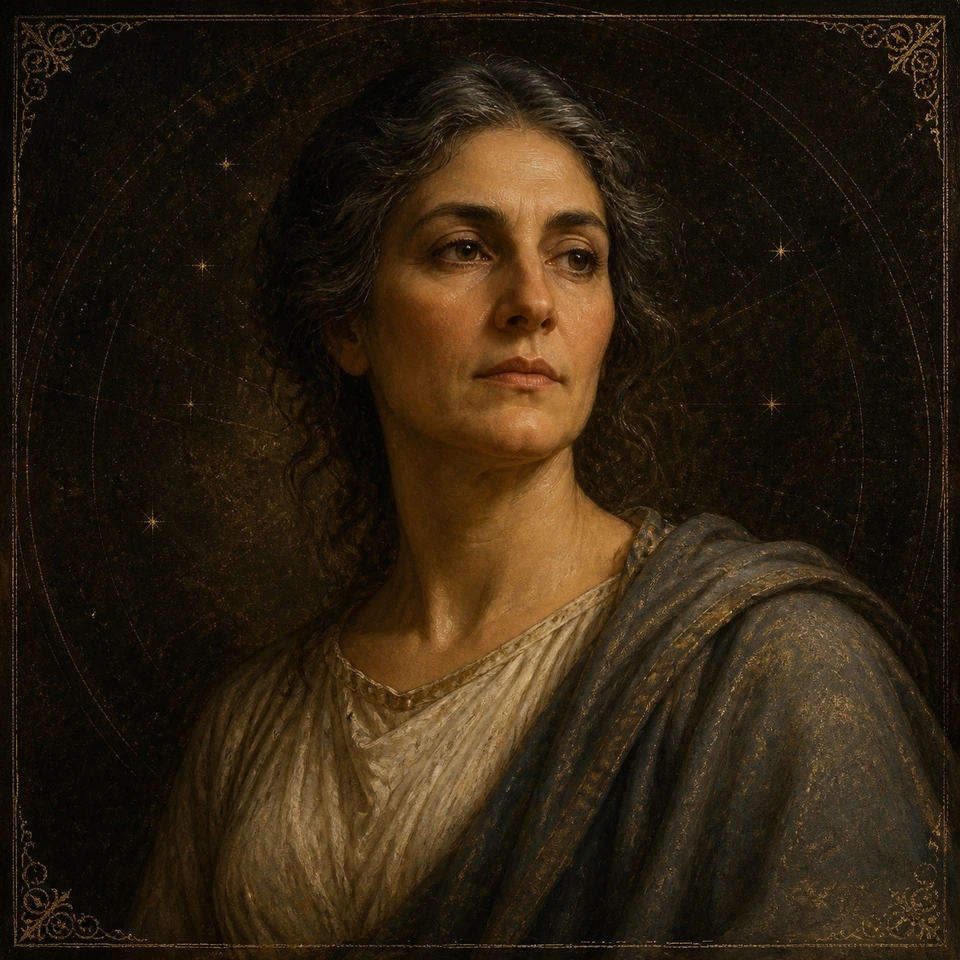
Anchoring the fragile continuity of the past, the first-generation Titaness Mnemosyne serves as the absolute personification of Memory. She brought forth the Muses and maintains a deeply specific historical footprint across localized oracular, funerary, and visual evidence.
Overview
Mnemosyne’s mastery is the making of memory durable in song. Hesiod places her among the elder children of Gaia and starry Ouranos, then returns to her when Zeus joins her for nine nights and she bears the nine Muses in Pieria. Her daughters do not merely decorate poetry. Their voices preserve the deeds of gods and earlier people, and their song can give a grieving listener a brief rest from present sorrow.
The nine-night cadence matters because it binds conception, number, and naming. Clio, Euterpe, Thalia, Melpomene, Terpsichore, Erato, Polyhymnia, Urania, and Calliope enter as a complete company. Memory stands behind praise and lineage, allowing names and deeds to survive the moment in which they were spoken. This dignity is narrower and stronger than the vacant modern image of a passive memory bank. Mnemosyne is a Titaness with a family and source history, not a generic promise of perfect recall.
Homeric Hymn 4 gives a compact musical honor. Hermes honors Mnemosyne first, calls her mother of the Muses, and is said to be of her following. The hymn does not turn those clauses into rule over every art, and it does not provide a transferable priestly order. Its force lies in the three clauses it actually preserves: honor, maternity, and affiliation within divine song.
Pausanias records different Muse traditions side by side. At Helicon, one account knows Melete, Mneme, and Aoede, Practice, Memory, and Song. Another credits Pierus with establishing nine Muses and giving them the names familiar in Pausanias’s day, without listing those names. A further distinction makes elder Muses daughters of Uranus and younger Muses children of Zeus. Mneme is not another spelling of Mnemosyne, and these local genealogies are not silently converted into daughters of the Titaness.
Pausanias also reports images named Mnemosyne or Memory at Athens and Tegea. At Lebadeia, however, his water of Memory and chair of Memory belong to the consultation of Trophonios. An inquirer drinks after Forgetfulness, descends, returns shaken, answers the priests, and later records what was heard or seen. The passage makes remembrance the passage from overwhelming encounter back into speech, but it does not explicitly identify the water or chair as a manifestation of Mnemosyne.
A Greek gold tablet from Petelia carries Memory into an afterlife itinerary. British Museum object 1843,0724.3 directs its owner away from one spring and toward the Lake of Memory. The museum dates the tablet to the third or second century BC and its later pendant case to the second or third century AD, and says the inscription is sometimes described as Orphic. The object does not name Mnemosyne, portray her, or make gold her sacred metal.
The secure portrait is therefore concrete but bounded: elder Titaness, mother of the Muses, honored within Hymn 4, and named among later images. Lebadeian and Petelian Memory remain powerful neighboring contexts without being forced into direct cult identity. No sacred animal, plant, zodiac sign, weekday, incense, universal offering, or independent festival emerges from these witnesses. What endures is the oldest mastery the poetry gives her: memory made speakable, singable, and resistant to oblivion.
Canonical identity
Canonical Identity
In mythic narratives and cultic descriptions, Mnemosyne stands as a distinct, named Titaness and the direct divine personification of Memory. It is crucial that the abstract concept of memory, the personified goddess herself, and Mneme (from Pausanias’s specific three-Muse tradition) remain historically separated rather than collapsed into a single, undifferentiated figure.
Linguistic Identity
Mnemosyne is the conventional English adaptation of the Greek Μνημοσύνη, transliterated precisely as Mnēmosúnē. A qualified fifth-century BC Attic reconstruction suggests the pronunciation /mnɛː.mo.sý.nɛː/, roughly mnay-mo-SU-nay. This English approximation fails to capture the ancient pitch accent, the upsilon, or the long vowels. The Greek word also functions identically as a common noun meaning memory.
Sources and evidence
TEXTUAL · Supported
The Greek form is Μνημοσύνη, transliterated Mnēmosúnē, with a qualified fifth-century BC Attic reconstruction /mnɛː.mo.sý.nɛː/.
- Source
- Wiktionary contributors, Μνημοσύνη
- Reviewed edition
- Permanent revision 88825106 of Μνημοσύνη · Wiktionary
- Exact locator
- Entry μνημοσύνη · Section Ancient Greek pronunciation, noun, and proper noun
- Scope
- Classical Greece · Attica
- Authority
- Wiktionary contributors, permanent revision 88825106
- Certainty
- Qualified historical reconstruction
The guide mnay-mo-SU-nay is approximate and cannot reproduce ancient vowel quality or pitch accent.
Open exact reviewed sourceTEXTUAL · Supported
The same Greek word can denote memory as a common noun and Mnemosyne as the divine proper name; grammatical identity does not erase the distinction between concept and figure.
- Source
- Wiktionary contributors, Μνημοσύνη
- Reviewed edition
- Permanent revision 88825106 of Μνημοσύνη · Wiktionary
- Exact locator
- Entry μνημοσύνη · Section Ancient Greek noun and proper noun
- Scope
- Classical Greece · Attica
- Authority
- Wiktionary contributors, permanent revision 88825106
- Certainty
- Secure lexical distinction
The abstract noun, the Titaness, and the Muse Mneme remain separately described.
Open exact reviewed sourceTEXTUAL · Supported
Hesiod names Mnemosyne among the daughters of Gaia and starry Uranus in the first Titan generation.
- Source
- Hesiod; edited and translated by Hugh G. Evelyn-White, Theogony (1914)
- Reviewed edition
- Hugh G. Evelyn-White edition and English translation in Hesiod, the Homeric Hymns and Homerica, 1914 · translated by Hugh G. Evelyn-White · edited by Hugh G. Evelyn-White · Perseus Digital Library / Scaife ATLAS
- Exact locator
- Entry Theogony · Line 132-138
- Scope
- Archaic Greece · Ancient Greece
- Authority
- Hesiod, Theogony
- Certainty
- Certain within the named witness
The cited ancient literary witness supports this identity point at entry Theogony, line 132-138.
Open exact reviewed source2 reviewed sources for this section
- Wiktionary contributors, ΜνημοσύνηPermanent revision 88825106 of the Ancient Greek proper-noun entry · Wiktionary
- Hesiod; edited and translated by Hugh G. Evelyn-White, Theogony (1914)Hesiod, the Homeric Hymns and Homerica, London and New York, 1914 · Perseus Digital Library / Scaife ATLAS
Culture, tradition, period, and place
Mnemosyne belongs to Greek religious and poetic traditions attested across long spans and several regions. Hesiod’s Archaic poem gives the Titan genealogy and the Pierian birth of the Muses. A later Greek mythographic compilation preserves the same parentage of the nine daughters. These literary genealogies do not describe one uniform civic cult.
By the second century AD, Pausanias encountered named images at Athens and Tegea, Muse traditions at Helicon, and the waters and chair of Memory in the Trophonios consultation at Lebadeia. The Petelia gold tablet, made centuries earlier in the Hellenistic period and found in southern Italy, belongs to a funerary setting. Pieria, Boeotia, Arcadia, Attica, and Petelia are distinct contexts, not interchangeable points on a single ritual map.
Sources and evidence
TEXTUAL · Supported
Hesiod’s Archaic Greek poem supplies Mnemosyne’s first-generation genealogy and the birth of the nine Muses.
- Source
- Hesiod; edited and translated by Hugh G. Evelyn-White, Theogony (1914)
- Reviewed edition
- Hugh G. Evelyn-White edition and English translation in Hesiod, the Homeric Hymns and Homerica, 1914 · translated by Hugh G. Evelyn-White · edited by Hugh G. Evelyn-White · Perseus Digital Library / Scaife ATLAS
- Exact locator
- Entry Theogony · Line 53-80; 132-138; 915-917
- Scope
- Archaic Greece · Ancient Greece
- Authority
- Hesiod, Theogony
- Certainty
- Certain within the named witness
The cited ancient poetic witness supports this culture period place point at entry Theogony, line 53-80; 132-138; 915-917.
Open exact reviewed sourceTEXTUAL · Supported
Pausanias preserves distinct second-century AD local evidence at Athens, Tegea, Helicon, and Lebadeia rather than a single uniform Greek cult.
- Source
- Pausanias; Spiro Greek edition and Jones/Ormerod translation volumes, Description of Greece (1935)
- Reviewed edition
- W. H. S. Jones and H. A. Ormerod English translation volumes, 1918-1935 · translated by W. H. S. Jones and H. A. Ormerod, volume-dependent · Perseus Digital Library / Scaife ATLAS
- Exact locator
- Entry Description of Greece · Section 1.2.5; 8.47.3; 9.29.2-4; 9.39.5-14
- Scope
- Greek religion under Roman imperial rule · Ancient Greece
- Authority
- Pausanias, Description of Greece, Jones and Ormerod English eng2 component
- Certainty
- Secure within reported local settings
The cited ancient periegetic witness supports this culture period place point at entry Description of Greece, section 1.2.5; 8.47.3; 9.29.2-4; 9.39.5-14.
Open exact reviewed sourceTEXTUAL · Supported
Pseudo-Apollodorus preserves the nine-Muse genealogy in a Greek mythographic compilation transmitted under Roman imperial conditions.
- Source
- Pseudo-Apollodorus; edited and translated by James G. Frazer, Library (1921)
- Reviewed edition
- James G. Frazer edition and English translation, Harvard University Press and William Heinemann, 1921 · translated by James G. Frazer · edited by James G. Frazer · Perseus Digital Library / Scaife ATLAS
- Exact locator
- Entry Library · Book 1 · Chapter 3 · Section 1
- Scope
- Greek religion under Roman imperial rule · Ancient Greece
- Authority
- Pseudo-Apollodorus, Library
- Certainty
- Certain within the named witness
The later prose ordering remains distinct from Hesiod’s Archaic poetic scene.
Open exact reviewed sourceMATERIAL CULTURE · Supported
The Petelia gold tablet brings Hellenistic Greek funerary evidence from southern Italy into the history of religious memory.
- Source
- British Museum, tablet; pendant; case, museum number 1843,0724.3
- Reviewed edition
- British Museum collection record: tablet; pendant; case 1843,0724.3 · British Museum
- Exact locator
- MuseumObjectId 1843,0724.3 · Section Production date, findspot, and inscription
- Scope
- Hellenistic Greek world · Petelia (historic), southern Italy
- Authority
- British Museum
- Certainty
- Secure object context
The southern Italian object remains separate from the Boeotian oracle and from the Pierian birth setting.
Open exact reviewed source4 reviewed sources for this section
- Hesiod; edited and translated by Hugh G. Evelyn-White, Theogony (1914)Hesiod, the Homeric Hymns and Homerica, London and New York, 1914 · Perseus Digital Library / Scaife ATLAS
- Pseudo-Apollodorus; edited and translated by James G. Frazer, Library (1921)Harvard University Press and William Heinemann edition, 1921 · Perseus Digital Library / Scaife ATLAS
- Pausanias; Spiro Greek edition and Jones/Ormerod translation volumes, Description of Greece (1935)Perseus CTS edition corpus, 1903-1935 · Perseus Digital Library / Scaife ATLAS
- British Museum, tablet; pendant; case, museum number 1843,0724.3British Museum collection record for object 1843,0724.3 · British Museum
Historical development
Hesiod first places Mnemosyne in the Titan generation, then gives her a distinct lineage through the Muses. Nine nights with Zeus lead to nine daughters in Pieria. Their song carries praise, genealogy, and relief from grief. Homeric Hymn 4 makes the bond audible when Hermes honors Mnemosyne first, calls her mother of the Muses, and is said to be of her following.
Later witnesses broaden the history of religious memory without creating one continuous institution. The Petelia gold tablet sets a Lake of Memory inside a funerary itinerary, but never names the Titaness. Pausanias reports images named Mnemosyne or Memory and a Boeotian oracle where an encounter must survive descent, fear, questioning, and inscription. Poetry, object, image, and consultation remain distinct forms of evidence rather than chapters of a single centralized cult.
Sources and evidence
TEXTUAL · Supported
Hesiod links Mnemosyne’s nine-night union with Zeus to the birth of nine Muses in Pieria and later restates their parentage.
- Source
- Hesiod; edited and translated by Hugh G. Evelyn-White, Theogony (1914)
- Reviewed edition
- Hugh G. Evelyn-White edition and English translation in Hesiod, the Homeric Hymns and Homerica, 1914 · translated by Hugh G. Evelyn-White · edited by Hugh G. Evelyn-White · Perseus Digital Library / Scaife ATLAS
- Exact locator
- Entry Theogony · Line 53-80; 915-917
- Scope
- Archaic Greece · Pieria
- Authority
- Hesiod, Theogony
- Certainty
- Certain within the named witness
The cited ancient poetic witness supports this historical development point at entry Theogony, line 53-80; 915-917.
Open exact reviewed sourceMATERIAL CULTURE · Supported
The Hellenistic Petelia gold tablet gives material form to a funerary instruction concerning the Lake of Memory.
- Source
- British Museum, tablet; pendant; case, museum number 1843,0724.3
- Reviewed edition
- British Museum collection record: tablet; pendant; case 1843,0724.3 · British Museum
- Exact locator
- MuseumObjectId 1843,0724.3 · Section Object details, production date, findspot, and inscription
- Scope
- Hellenistic Greek world · Petelia (historic), southern Italy
- Authority
- British Museum
- Certainty
- Secure object-level identification; religious label qualified
The accessioned object concerns Memory in an afterlife itinerary but does not depict or name the Titaness Mnemosyne.
Open exact reviewed sourceTEXTUAL · Supported
Homeric Hymn 4 has Hermes honor Mnemosyne first, names her mother of the Muses, and says Maia’s son was of her following.
- Source
- Anonymous Homeric Hymns; edited and translated by Hugh G. Evelyn-White, Homeric Hymns (1914)
- Reviewed edition
- Hugh G. Evelyn-White English translation of Homeric Hymn 4, To Hermes, 1914 · translated by Hugh G. Evelyn-White · edited by Hugh G. Evelyn-White · Perseus Digital Library / Scaife ATLAS
- Exact locator
- Entry Homeric Hymn 4 to Hermes · Line 429-433
- Scope
- Archaic Greece · Ancient Greece
- Authority
- Homeric Hymn 4 to Hermes, Hugh G. Evelyn-White 1914 English eng2 component
- Certainty
- Secure within the hymn
The hymn supplies a source-bounded musical honor and affiliation, not a separate institutional biography.
Open exact reviewed sourceTEXTUAL · Supported
Pausanias’s second-century AD descriptions preserve image, variant, and oracular settings that differ from the earlier genealogical poems.
- Source
- Pausanias; Spiro Greek edition and Jones/Ormerod translation volumes, Description of Greece (1935)
- Reviewed edition
- W. H. S. Jones and H. A. Ormerod English translation volumes, 1918-1935 · translated by W. H. S. Jones and H. A. Ormerod, volume-dependent · Perseus Digital Library / Scaife ATLAS
- Exact locator
- Entry Description of Greece · Section 1.2.5; 8.47.3; 9.29.2-4; 9.39.5-14
- Scope
- Greek religion under Roman imperial rule · Ancient Greece
- Authority
- Pausanias, Description of Greece, Jones and Ormerod English eng2 component
- Certainty
- Secure as reported local evidence
The settings are historically later and geographically distinct.
Open exact reviewed source4 reviewed sources for this section
- Hesiod; edited and translated by Hugh G. Evelyn-White, Theogony (1914)Hesiod, the Homeric Hymns and Homerica, London and New York, 1914 · Perseus Digital Library / Scaife ATLAS
- Anonymous Homeric Hymns; edited and translated by Hugh G. Evelyn-White, Homeric Hymns (1914)Hesiod, the Homeric Hymns and Homerica, London and New York, 1914 · Perseus Digital Library / Scaife ATLAS
- British Museum, tablet; pendant; case, museum number 1843,0724.3British Museum collection record for object 1843,0724.3 · British Museum
- Pausanias; Spiro Greek edition and Jones/Ormerod translation volumes, Description of Greece (1935)Perseus CTS edition corpus, 1903-1935 · Perseus Digital Library / Scaife ATLAS
Attested roles and historical themes
Roles, powers, and limits
Mnemosyne’s secure roles are first-generation Titaness, mother of the Muses, and divine Memory within the genealogical and hymnic witnesses. In Hesiod, her daughters make divine and human deeds singable. Their art can interrupt grief for a time, yet the poem does not make their mother a healer of every illness or an infallible giver of factual recall.
Homeric Hymn 4 joins honor, Muse maternity, and Hermes’s place in her following. It does not grant Mnemosyne omniscience, prophecy on demand, mastery of dreams, or a universal magical guarantee. The waters and chair at Lebadeia and the Lake of Memory at Petelia belong to separate local and funerary contexts whose texts do not explicitly identify them as the Titaness.
Sources and evidence
TEXTUAL · Supported
Hesiod presents Mnemosyne as mother of the Muses, whose song brings relief from grief and a temporary forgetting of troubles.
- Source
- Hesiod; edited and translated by Hugh G. Evelyn-White, Theogony (1914)
- Reviewed edition
- Hugh G. Evelyn-White edition and English translation in Hesiod, the Homeric Hymns and Homerica, 1914 · translated by Hugh G. Evelyn-White · edited by Hugh G. Evelyn-White · Perseus Digital Library / Scaife ATLAS
- Exact locator
- Entry Theogony · Line 53-103
- Scope
- Archaic Greece · Pieria
- Authority
- Hesiod, Theogony
- Certainty
- Secure within the poem
The passage links memory, inspired song, and relief without promising therapeutic or magical results.
Open exact reviewed sourceTEXTUAL · Supported
Homeric Hymn 4 has Hermes honor Mnemosyne first, calls her mother of the Muses, and says Maia’s son was of her following.
- Source
- Anonymous Homeric Hymns; edited and translated by Hugh G. Evelyn-White, Homeric Hymns (1914)
- Reviewed edition
- Hugh G. Evelyn-White English translation of Homeric Hymn 4, To Hermes, 1914 · translated by Hugh G. Evelyn-White · edited by Hugh G. Evelyn-White · Perseus Digital Library / Scaife ATLAS
- Exact locator
- Entry Homeric Hymn 4 to Hermes · Line 429-433
- Scope
- Archaic Greece · Ancient Greece
- Authority
- Homeric Hymn 4 to Hermes, Hugh G. Evelyn-White 1914 English eng2 component
- Certainty
- Secure within the hymn
The hymn gives all three clauses; it does not say that she is honored first because the Muses belong to her.
Open exact reviewed source2 reviewed sources for this section
- Hesiod; edited and translated by Hugh G. Evelyn-White, Theogony (1914)Hesiod, the Homeric Hymns and Homerica, London and New York, 1914 · Perseus Digital Library / Scaife ATLAS
- Anonymous Homeric Hymns; edited and translated by Hugh G. Evelyn-White, Homeric Hymns (1914)Hesiod, the Homeric Hymns and Homerica, London and New York, 1914 · Perseus Digital Library / Scaife ATLAS
Epithets and titles
Geographic Epithet
Ruler over Eleuther’s hills
She who rules over the hills of Eleuther
Eleuther’s heights in Hesiod’s poetic geography · Archaic Greek poetic witnessHesiod Theogony 53-55; retained as a source-scoped geographic phrase, not expanded into a universal cult title.
1 reviewed source for this section
- Hesiod; edited and translated by Hugh G. Evelyn-White, Theogony (1914)Hesiod, the Homeric Hymns and Homerica, London and New York, 1914 · Perseus Digital Library / Scaife ATLAS
Poetic Epithet
Beautiful-haired
Beautiful-haired Mnemosyne
Greek hexameter tradition · Archaic Greek poetic witnessHesiod Theogony 915-917; poetic description only, with no iconographic hairstyle inferred.
1 reviewed source for this section
- Hesiod; edited and translated by Hugh G. Evelyn-White, Theogony (1914)Hesiod, the Homeric Hymns and Homerica, London and New York, 1914 · Perseus Digital Library / Scaife ATLAS
Worship and cult
Homeric Hymn 4 preserves literary honor to Mnemosyne: Hermes honors her first, calls her mother of the Muses, and belongs to her following. Pausanias later reports an image of Mnemosyne or Memory among divine company at Athens and images of the Muses and Memory at Tegea. These traces support recognition of a divine figure without yielding a priesthood, sacrificial calendar, or temple economy devoted to her alone.
Lebadeia belongs to the consultation of Trophonios. Its water and chair are named for Memory, but Pausanias does not explicitly equate either with the Titaness. The local sequence remains important evidence for sacred remembrance while resisting conversion into a general Mnemosyne initiation.
Sources and evidence
TEXTUAL · Supported
Homeric Hymn 4 preserves a literary scene in which Hermes honors Mnemosyne first, calls her mother of the Muses, and is said to be of her following.
- Source
- Anonymous Homeric Hymns; edited and translated by Hugh G. Evelyn-White, Homeric Hymns (1914)
- Reviewed edition
- Hugh G. Evelyn-White English translation of Homeric Hymn 4, To Hermes, 1914 · translated by Hugh G. Evelyn-White · edited by Hugh G. Evelyn-White · Perseus Digital Library / Scaife ATLAS
- Exact locator
- Entry Homeric Hymn 4 to Hermes · Line 429-433
- Scope
- Archaic Greece · Ancient Greece
- Authority
- Homeric Hymn 4 to Hermes, Hugh G. Evelyn-White 1914 English eng2 component
- Certainty
- Secure literary action; broader cult protocol unknown
The hymn scene is not treated as proof of a priesthood, temple calendar, or universal ritual order.
Open exact reviewed sourceRITUAL ATTESTED · Supported
Memory functions within the consultation of Trophonios at Lebadeia through named water, a chair, priestly questioning, and the preservation of the returned experience.
- Source
- Pausanias; Spiro Greek edition and Jones/Ormerod translation volumes, Description of Greece (1935)
- Reviewed edition
- W. H. S. Jones and H. A. Ormerod English translation volumes, 1918-1935 · translated by W. H. S. Jones and H. A. Ormerod, volume-dependent · Perseus Digital Library / Scaife ATLAS
- Exact locator
- Entry Description of Greece · Book 9 · Chapter 39 · Section 8; 13-14
- Scope
- Greek religion under Roman imperial rule · Lebadeia
- Authority
- Pausanias, Description of Greece, Jones and Ormerod English eng2 component
- Certainty
- Secure within local testimony
This supports a local sacred function within Trophonios’s oracle, not a free-standing universal initiation.
Open exact reviewed source2 reviewed sources for this section
- Anonymous Homeric Hymns; edited and translated by Hugh G. Evelyn-White, Homeric Hymns (1914)Hesiod, the Homeric Hymns and Homerica, London and New York, 1914 · Perseus Digital Library / Scaife ATLAS
- Pausanias; Spiro Greek edition and Jones/Ormerod translation volumes, Description of Greece (1935)Perseus CTS edition corpus, 1903-1935 · Perseus Digital Library / Scaife ATLAS
Temples, sanctuaries, and sacred places
At Athens, Pausanias lists an image of Mnemosyne or Memory with Zeus, the Muses, Apollo, and Athena Paeonia. At Tegea, he describes images of the Muses and Memory in connection with the temple of Athena Alea. The reports place the name among divine images but do not preserve a free-standing Mnemosyne sanctuary with a complete ritual staff.
Lebadeia in Boeotia offers a different sacred geography. The inquirer approaches Trophonios through preparation, waters of Forgetfulness and Memory, descent, return, and questioning on the chair of Memory. The passage does not call the water or chair the Titaness. Pieria belongs to Hesiod’s Muse-birth narrative, and Petelia to an accessioned funerary object, not to documented temples of Mnemosyne.
Sources and evidence
MATERIAL CULTURE · Supported
Pausanias reports images of Zeus, Mnemosyne, the Muses, Apollo, and Athena Paeonia in an Athenian setting.
- Source
- Pausanias; Spiro Greek edition and Jones/Ormerod translation volumes, Description of Greece (1935)
- Reviewed edition
- W. H. S. Jones and H. A. Ormerod English translation volumes, 1918-1935 · translated by W. H. S. Jones and H. A. Ormerod, volume-dependent · Perseus Digital Library / Scaife ATLAS
- Exact locator
- Entry Description of Greece · Book 1 · Chapter 2 · Section 5
- Scope
- Greek religion under Roman imperial rule · Athens
- Authority
- Pausanias, Description of Greece, Jones and Ormerod English eng2 component
- Certainty
- Secure as Pausanias’s report
The passage confirms an image and divine company but gives no individualized attributes for Mnemosyne.
Open exact reviewed sourceMATERIAL CULTURE · Supported
At Tegea, Pausanias describes images of the Muses and Memory associated with the temple of Athena Alea.
- Source
- Pausanias; Spiro Greek edition and Jones/Ormerod translation volumes, Description of Greece (1935)
- Reviewed edition
- W. H. S. Jones and H. A. Ormerod English translation volumes, 1918-1935 · translated by W. H. S. Jones and H. A. Ormerod, volume-dependent · Perseus Digital Library / Scaife ATLAS
- Exact locator
- Entry Description of Greece · Book 8 · Chapter 47 · Section 3
- Scope
- Greek religion under Roman imperial rule · Tegea
- Authority
- Pausanias, Description of Greece, Jones and Ormerod English eng2 component
- Certainty
- Secure as Pausanias’s report
The description does not supply a separate Mnemosyne sanctuary or portrait attributes.
Open exact reviewed sourceRITUAL ATTESTED · Supported
Pausanias places the waters of Forgetfulness and Memory within the controlled consultation sequence of Trophonios at Lebadeia.
- Source
- Pausanias; Spiro Greek edition and Jones/Ormerod translation volumes, Description of Greece (1935)
- Reviewed edition
- W. H. S. Jones and H. A. Ormerod English translation volumes, 1918-1935 · translated by W. H. S. Jones and H. A. Ormerod, volume-dependent · Perseus Digital Library / Scaife ATLAS
- Exact locator
- Entry Description of Greece · Book 9 · Chapter 39 · Section 8
- Scope
- Greek religion under Roman imperial rule · Lebadeia
- Authority
- Pausanias, Description of Greece, Jones and Ormerod English eng2 component
- Certainty
- Secure within local testimony
The cited ancient periegetic witness supports this sacred places point at entry Description of Greece, book 9, chapter 39, section 8.
Open exact reviewed source1 reviewed source for this section
- Pausanias; Spiro Greek edition and Jones/Ormerod translation volumes, Description of Greece (1935)Perseus CTS edition corpus, 1903-1935 · Perseus Digital Library / Scaife ATLAS
Festivals and processions
No named festival, procession, sacred month, seasonal feast, athletic contest, or recurring civic date dedicated specifically to Mnemosyne appears in the reviewed passages. The Muses’ birth after nine nights is narrative duration, not a nine-day festival calendar.
Muse festivals, poetic competitions, and the rites of Trophonios need their own evidence before being called festivals of Mnemosyne. The surviving local traces warrant reverence and further research, but they do not supply a transferable annual schedule.
Sources and evidence
TEXTUAL · Supported
The reviewed Pausanian passages name images and a local consultation sequence but do not name a festival, procession, sacred month, or recurring feast dedicated specifically to Mnemosyne.
- Source
- Pausanias; Spiro Greek edition and Jones/Ormerod translation volumes, Description of Greece (1935)
- Reviewed edition
- W. H. S. Jones and H. A. Ormerod English translation volumes, 1918-1935 · translated by W. H. S. Jones and H. A. Ormerod, volume-dependent · Perseus Digital Library / Scaife ATLAS
- Exact locator
- Entry Description of Greece · Section 1.2.5; 8.47.3; 9.39.5-14
- Scope
- Greek religion under Roman imperial rule · Ancient Greece
- Authority
- Pausanias, Description of Greece, Jones and Ormerod English eng2 component
- Certainty
- Not evidenced in reviewed passages
This is a bounded evidence gap, not proof that no local observance ever existed.
Open exact reviewed source1 reviewed source for this section
- Pausanias; Spiro Greek edition and Jones/Ormerod translation volumes, Description of Greece (1935)Perseus CTS edition corpus, 1903-1935 · Perseus Digital Library / Scaife ATLAS
Offerings, votives, and ritual evidence
Pausanias describes an ordered movement at Lebadeia. The inquirer drinks from Forgetfulness, then from Memory, descends, returns shaken, sits on the chair of Memory, answers the priests, and later dedicates a tablet recording what was heard or seen. Remembrance is enacted as recovery and testimony after contact with an overwhelming sacred place.
This is historical drinking within the controlled oracle of Trophonios, not a modern recipe or a rite assigned explicitly to the Titaness. No source here identifies the water’s composition or authorizes imitation. The Petelia gold tablet is funerary equipment for its owner, not an offering to Mnemosyne. No securely attested food, incense, libation, flower, or sacrificial animal for her alone appears in these witnesses.
Sources and evidence
RITUAL ATTESTED · Supported
The Lebadeian inquirer drinks first from Forgetfulness and then from Memory so that the later descent can be remembered.
- Source
- Pausanias; Spiro Greek edition and Jones/Ormerod translation volumes, Description of Greece (1935)
- Reviewed edition
- W. H. S. Jones and H. A. Ormerod English translation volumes, 1918-1935 · translated by W. H. S. Jones and H. A. Ormerod, volume-dependent · Perseus Digital Library / Scaife ATLAS
- Exact locator
- Entry Description of Greece · Book 9 · Chapter 39 · Section 8
- Scope
- Greek religion under Roman imperial rule · Lebadeia
- Authority
- Pausanias, Description of Greece, Jones and Ormerod English eng2 component
- Certainty
- Secure within local testimony
The historical action is not a modern ingestion recommendation and does not establish a universal water correspondence.
Open exact reviewed sourceRITUAL ATTESTED · Supported
After the ascent, Trophonios’s priests seat the inquirer on the chair of Memory and ask what was seen and learned; the account is later written on a dedicated tablet.
- Source
- Pausanias; Spiro Greek edition and Jones/Ormerod translation volumes, Description of Greece (1935)
- Reviewed edition
- W. H. S. Jones and H. A. Ormerod English translation volumes, 1918-1935 · translated by W. H. S. Jones and H. A. Ormerod, volume-dependent · Perseus Digital Library / Scaife ATLAS
- Exact locator
- Entry Description of Greece · Book 9 · Chapter 39 · Section 13-14
- Scope
- Greek religion under Roman imperial rule · Lebadeia
- Authority
- Pausanias, Description of Greece, Jones and Ormerod English eng2 component
- Certainty
- Secure within local testimony
The cited ancient periegetic witness supports this offerings and ritual point at entry Description of Greece, book 9, chapter 39, section 13-14.
Open exact reviewed sourceMATERIAL CULTURE · Supported
The Petelia gold tablet is funerary equipment inscribed for the dead and is not identified by the museum as an offering to Mnemosyne.
- Source
- British Museum, tablet; pendant; case, museum number 1843,0724.3
- Reviewed edition
- British Museum collection record: tablet; pendant; case 1843,0724.3 · British Museum
- Exact locator
- MuseumObjectId 1843,0724.3 · Section Object type, materials, and inscription
- Scope
- Hellenistic Greek world · Petelia (historic), southern Italy
- Authority
- British Museum
- Certainty
- Secure object function; divine recipient not named
Its gold and text remain object-specific evidence rather than an offering prescription.
Open exact reviewed source2 reviewed sources for this section
- Pausanias; Spiro Greek edition and Jones/Ormerod translation volumes, Description of Greece (1935)Perseus CTS edition corpus, 1903-1935 · Perseus Digital Library / Scaife ATLAS
- British Museum, tablet; pendant; case, museum number 1843,0724.3British Museum collection record for object 1843,0724.3 · British Museum
Iconography and material culture
Pausanias saw images named Mnemosyne or Memory at Athens and Tegea, but he does not describe their face, age, hands, garment, posture, or attribute. No book, scroll, stylus, lyre, water vessel, laurel, or visible group of Muses can be treated as her secure universal emblem from those lines.
The Petelia gold tablet is a different kind of witness. Its Greek text directs the owner toward the Lake of Memory, but it neither names nor portrays Mnemosyne. The preserved portrait therefore remains a modern archive image, not a reconstruction of a known ancient statue. Its restraint marks the distance between ancient image reports and an unrecovered individual iconographic type.
Sources and evidence
MATERIAL CULTURE · Supported
Pausanias confirms images named as Mnemosyne or Memory at Athens and Tegea but supplies no distinctive dress, tool, animal, or bodily attribute.
- Source
- Pausanias; Spiro Greek edition and Jones/Ormerod translation volumes, Description of Greece (1935)
- Reviewed edition
- W. H. S. Jones and H. A. Ormerod English translation volumes, 1918-1935 · translated by W. H. S. Jones and H. A. Ormerod, volume-dependent · Perseus Digital Library / Scaife ATLAS
- Exact locator
- Entry Description of Greece · Section 1.2.5; 8.47.3
- Scope
- Greek religion under Roman imperial rule · Ancient Greece
- Authority
- Pausanias, Description of Greece, Jones and Ormerod English eng2 component
- Certainty
- Secure image presence; visual attributes not described
The cited ancient periegetic witness supports this symbols point at entry Description of Greece, section 1.2.5; 8.47.3.
Open exact reviewed sourceMATERIAL CULTURE · Supported
British Museum object 1843,0724.3 is a Greek-inscribed gold tablet from Petelia, dated to the third or second century BC, that directs a dead person toward the Lake of Memory.
- Source
- British Museum, tablet; pendant; case, museum number 1843,0724.3
- Reviewed edition
- British Museum collection record: tablet; pendant; case 1843,0724.3 · British Museum
- Exact locator
- MuseumObjectId 1843,0724.3 · Section Object details and inscription
- Scope
- Hellenistic Greek world · Petelia (historic), southern Italy
- Authority
- British Museum
- Certainty
- Secure object, material, date range, provenance, and inscription
The gold tablet is textual funerary equipment, not an image of Mnemosyne or proof that gold was offered to her.
Open exact reviewed source2 reviewed sources for this section
- Pausanias; Spiro Greek edition and Jones/Ormerod translation volumes, Description of Greece (1935)Perseus CTS edition corpus, 1903-1935 · Perseus Digital Library / Scaife ATLAS
- British Museum, tablet; pendant; case, museum number 1843,0724.3British Museum collection record for object 1843,0724.3 · British Museum
Animals, plants, and embodied forms
No sacred animal, plant, tree, hybrid body, disguise, or transformation belongs securely to Mnemosyne in Hesiod’s passages. Creatures and plants associated with Apollo, individual Muses, poetry, or later arts do not pass automatically to their mother.
Her literary identity rests instead on genealogy, song, and the preservation of names. Supplying borrowed fauna or flora would obscure that evidence rather than enrich it.
Sources and evidence
TEXTUAL · Supported
No reviewed passage assigns Mnemosyne a sacred animal, plant, transformation, or hybrid body.
- Source
- Hesiod; edited and translated by Hugh G. Evelyn-White, Theogony (1914)
- Reviewed edition
- Hugh G. Evelyn-White edition and English translation in Hesiod, the Homeric Hymns and Homerica, 1914 · translated by Hugh G. Evelyn-White · edited by Hugh G. Evelyn-White · Perseus Digital Library / Scaife ATLAS
- Exact locator
- Entry Theogony · Line 53-103; 132-138; 915-917
- Scope
- Archaic Greece · Ancient Greece
- Authority
- Hesiod, Theogony
- Certainty
- Not evidenced in reviewed passages
The laurel and instruments of other poetic divinities are not transferred to her.
Open exact reviewed source1 reviewed source for this section
- Hesiod; edited and translated by Hugh G. Evelyn-White, Theogony (1914)Hesiod, the Homeric Hymns and Homerica, London and New York, 1914 · Perseus Digital Library / Scaife ATLAS
Relationships and genealogy
Gaia and Uranus are Mnemosyne’s parents in Hesiod. The same birth list places her among Oceanus, Coeus, Crius, Hyperion, Iapetus, Cronus, Theia, Rhea, Themis, Phoebe, and Tethys. That complete generation matters more than a selective list of famous Titan brothers.
Zeus joins with Mnemosyne over nine nights, and she bears the nine Muses in Pieria. Hesiod names each daughter, and Pseudo-Apollodorus preserves the same parents and familiar nine names in a different order. Their family relation belongs to the collective and to each named daughter; no sister is interchangeable with the whole company. Pausanias’s elder daughters of Uranus and three-Muse trio remain alternate Muse traditions, not extra children silently assigned to Mnemosyne.
Sources and evidence
TEXTUAL · Supported
Hesiod names Gaia and Uranus as Mnemosyne’s parents and places her among twelve first-generation Titans.
- Source
- Hesiod; edited and translated by Hugh G. Evelyn-White, Theogony (1914)
- Reviewed edition
- Hugh G. Evelyn-White edition and English translation in Hesiod, the Homeric Hymns and Homerica, 1914 · translated by Hugh G. Evelyn-White · edited by Hugh G. Evelyn-White · Perseus Digital Library / Scaife ATLAS
- Exact locator
- Entry Theogony · Line 132-138
- Scope
- Archaic Greece · Ancient Greece
- Authority
- Hesiod, Theogony
- Certainty
- Certain within the named witness
The cited ancient literary witness supports this family and relationships point at entry Theogony, line 132-138.
Open exact reviewed sourceTEXTUAL · Supported
Hesiod makes Zeus Mnemosyne’s partner over nine nights and names the nine Muses as their daughters.
- Source
- Hesiod; edited and translated by Hugh G. Evelyn-White, Theogony (1914)
- Reviewed edition
- Hugh G. Evelyn-White edition and English translation in Hesiod, the Homeric Hymns and Homerica, 1914 · translated by Hugh G. Evelyn-White · edited by Hugh G. Evelyn-White · Perseus Digital Library / Scaife ATLAS
- Exact locator
- Entry Theogony · Line 53-80; 915-917
- Scope
- Archaic Greece · Pieria
- Authority
- Hesiod, Theogony
- Certainty
- Certain within the named witness
The cited ancient literary witness supports this family and relationships point at entry Theogony, line 53-80; 915-917.
Open exact reviewed sourceTEXTUAL · Supported
Pseudo-Apollodorus likewise makes Zeus and Mnemosyne parents of Calliope, Clio, Melpomene, Euterpe, Erato, Terpsichore, Urania, Thalia, and Polymnia.
- Source
- Pseudo-Apollodorus; edited and translated by James G. Frazer, Library (1921)
- Reviewed edition
- James G. Frazer edition and English translation, Harvard University Press and William Heinemann, 1921 · translated by James G. Frazer · edited by James G. Frazer · Perseus Digital Library / Scaife ATLAS
- Exact locator
- Entry Library · Book 1 · Chapter 3 · Section 1
- Scope
- Greek religion under Roman imperial rule · Ancient Greece
- Authority
- Pseudo-Apollodorus, Library
- Certainty
- Certain within the named witness
The cited ancient mythographic witness supports this family and relationships point at entry Library, book 1, chapter 3, section 1.
Open exact reviewed source2 reviewed sources for this section
- Hesiod; edited and translated by Hugh G. Evelyn-White, Theogony (1914)Hesiod, the Homeric Hymns and Homerica, London and New York, 1914 · Perseus Digital Library / Scaife ATLAS
- Pseudo-Apollodorus; edited and translated by James G. Frazer, Library (1921)Harvard University Press and William Heinemann edition, 1921 · Perseus Digital Library / Scaife ATLAS
Actual myths and source variants
Two narratives meet the inclusion threshold. The birth of the first Titans establishes Mnemosyne as daughter of Gaia and Uranus among twelve named siblings. The birth and naming of the Muses gives her an active place in cosmic and poetic continuity: nine nights with Zeus, nine daughters in Pieria, and songs able to carry praise and ease grief.
Pseudo-Apollodorus confirms Zeus and Mnemosyne as parents but presents the daughters as an ordered genealogical list. Pausanias preserves traditions that do not fit neatly inside Hesiod’s account: Melete, Mneme, and Aoede as three early Muses; Pierus as the one who established nine familiar names; and elder Muses from Uranus distinguished from younger children of Zeus. These are retained as source-specific alternatives. They are not forced into a single birth scene.
Sources and evidence
TEXTUAL · Supported
Hesiod’s Muse-birth narrative joins nine nights with Zeus, the birth of nine daughters in Pieria, and the social power of their song.
- Source
- Hesiod; edited and translated by Hugh G. Evelyn-White, Theogony (1914)
- Reviewed edition
- Hugh G. Evelyn-White edition and English translation in Hesiod, the Homeric Hymns and Homerica, 1914 · translated by Hugh G. Evelyn-White · edited by Hugh G. Evelyn-White · Perseus Digital Library / Scaife ATLAS
- Exact locator
- Entry Theogony · Line 53-103
- Scope
- Archaic Greece · Pieria
- Authority
- Hesiod, Theogony
- Certainty
- Certain within the named witness
The cited ancient poetic witness supports this mythology overview point at entry Theogony, line 53-103.
Open exact reviewed sourceTEXTUAL · Supported
Pseudo-Apollodorus retells the Muse genealogy as a compact list of nine daughters born to Zeus and Mnemosyne.
- Source
- Pseudo-Apollodorus; edited and translated by James G. Frazer, Library (1921)
- Reviewed edition
- James G. Frazer edition and English translation, Harvard University Press and William Heinemann, 1921 · translated by James G. Frazer · edited by James G. Frazer · Perseus Digital Library / Scaife ATLAS
- Exact locator
- Entry Library · Book 1 · Chapter 3 · Section 1
- Scope
- Greek religion under Roman imperial rule · Ancient Greece
- Authority
- Pseudo-Apollodorus, Library
- Certainty
- Certain within the named witness
The later list confirms parentage without importing Hesiod’s nine-night scene.
Open exact reviewed sourceTEXTUAL · Supported
Pausanias reports a Heliconian trio named Practice, Memory, and Song, a tradition in which Pierus established nine names, and a distinction between elder daughters of Uranus and younger children of Zeus.
- Source
- Pausanias; Spiro Greek edition and Jones/Ormerod translation volumes, Description of Greece (1935)
- Reviewed edition
- W. H. S. Jones and H. A. Ormerod English translation volumes, 1918-1935 · translated by W. H. S. Jones and H. A. Ormerod, volume-dependent · Perseus Digital Library / Scaife ATLAS
- Exact locator
- Entry Description of Greece · Book 9 · Chapter 29 · Section 2-4
- Scope
- Greek religion under Roman imperial rule · Boeotia
- Authority
- Pausanias, Description of Greece, Jones and Ormerod English eng2 component
- Certainty
- Secure as reported variants
Mneme, whose name means Memory, is not silently identified with the Titaness Mnemosyne.
Open exact reviewed source3 reviewed sources for this section
- Hesiod; edited and translated by Hugh G. Evelyn-White, Theogony (1914)Hesiod, the Homeric Hymns and Homerica, London and New York, 1914 · Perseus Digital Library / Scaife ATLAS
- Pseudo-Apollodorus; edited and translated by James G. Frazer, Library (1921)Harvard University Press and William Heinemann edition, 1921 · Perseus Digital Library / Scaife ATLAS
- Pausanias; Spiro Greek edition and Jones/Ormerod translation volumes, Description of Greece (1935)Perseus CTS edition corpus, 1903-1935 · Perseus Digital Library / Scaife ATLAS
Myth Library
Each myth gathers its attested participants into one source-grounded account, while distinct source traditions remain readable in their own variants.
Divine Birth And Genealogy
The Birth and Naming of the Muses
Mnemosyne bears nine Muses to Zeus in Hesiod, while later Greek witnesses preserve an ordered genealogy and materially different Heliconian traditions of three Muses, nine names, and elder or younger generations.
- Role in this profile
- mother of the nine Muses in Hesiod and Pseudo-Apollodorus
- Place scope
- Pieria · Boeotia
- Witnesses
- 3
- Variants
- 3
Divine Genealogy
The Birth of the First Titans
Gaia and Uranus bring forth twelve named Titans, whose shared birth establishes a generation without assigning every sibling the same deed or cosmic office.
- Role in this profile
- first-generation Titan born from Gaia and Ouranos
- Place scope
- Ancient Greece
- Witnesses
- 4
- Variants
- 4
Equivalences, syncretisms, and identity boundaries
Mnemosyne is not identical to the collective Muses or to any one of her nine daughters. She is also not silently the Muse Mneme. Pausanias places Mneme with Melete and Aoede in a three-Muse tradition, and the shared meaning of memory does not supply an identification statement.
The common noun mnēmosynē and the goddess’s name share form. The Lebadeian water and chair of Memory and the Petelia Lake of Memory use the same religious language in other settings, but their sources do not explicitly identify them as the Titaness. No Roman equivalence, fused cult form, or later occult persona is established here.
Sources and evidence
TEXTUAL · Supported
Pausanias’s Mneme belongs to a reported trio of Muses with Melete and Aoede; the passage does not identify Mneme as Mnemosyne.
- Source
- Pausanias; Spiro Greek edition and Jones/Ormerod translation volumes, Description of Greece (1935)
- Reviewed edition
- W. H. S. Jones and H. A. Ormerod English translation volumes, 1918-1935 · translated by W. H. S. Jones and H. A. Ormerod, volume-dependent · Perseus Digital Library / Scaife ATLAS
- Exact locator
- Entry Description of Greece · Book 9 · Chapter 29 · Section 2
- Scope
- Greek religion under Roman imperial rule · Boeotia
- Authority
- Pausanias, Description of Greece, Jones and Ormerod English eng2 component
- Certainty
- Secure distinction in the passage
The cited ancient periegetic witness supports this syncretism point at entry Description of Greece, book 9, chapter 29, section 2.
Open exact reviewed sourceTEXTUAL · Supported
The common noun mnēmosynē and the proper name Mnemosyne share form and meaning, but lexical overlap does not merge every personified or localized Memory into the Titaness.
- Source
- Wiktionary contributors, Μνημοσύνη
- Reviewed edition
- Permanent revision 88825106 of Μνημοσύνη · Wiktionary
- Exact locator
- Entry μνημοσύνη · Section Ancient Greek noun and proper noun
- Scope
- Classical Greece · Attica
- Authority
- Wiktionary contributors, permanent revision 88825106
- Certainty
- Secure lexical distinction
Grammar establishes the noun-name relationship without resolving later local identifications.
Open exact reviewed source2 reviewed sources for this section
- Pausanias; Spiro Greek edition and Jones/Ormerod translation volumes, Description of Greece (1935)Perseus CTS edition corpus, 1903-1935 · Perseus Digital Library / Scaife ATLAS
- Wiktionary contributors, ΜνημοσύνηPermanent revision 88825106 of the Ancient Greek proper-noun entry · Wiktionary
Correspondence index
Memory, remembrance, and song are direct historical themes in Hesiod because Mnemosyne bears the Muses whose voices preserve deeds and ease grief. This attested bond describes divine identity and poetic causation, not a guaranteed magical result.
Water is contextual at Lebadeia, where Forgetfulness and Memory are contrasting stations in Trophonios’s consultation. Gold is contextual at Petelia because it carries a funerary text about the Lake of Memory. Neither passage explicitly identifies its local Memory with Mnemosyne, and neither creates a universal element, metal, direction, or ritual tool. No planet, zodiac sign, stone, plant, animal, color, weekday, moon phase, festival time, incense, or offering is securely assigned.
Direct ancient correspondences
| Category | Direct correspondence | How and why | Evidence boundary |
|---|---|---|---|
| intention-magical-power | Memory, remembrance, and songDirect historical association | Hesiod makes Mnemosyne mother of the Muses whose song preserves deeds and gives rest from grief. | Ancient Cultic Direct in the Hesiodic Muse genealogy; Lebadeian and Petelian Memory remain separate contextual evidence. 1 reviewed source for this section
|
Contextual evidence, not a general correspondence
| Category | Direct correspondence | How and why | Evidence boundary |
|---|---|---|---|
| metal-material | Gold tablet at PeteliaContextual evidence only | British Museum object 1843,0724.3 is a Hellenistic inscribed gold tablet directing the dead toward the Lake of Memory. | Ancient Material Object-specific funerary material; not a universal sacred metal or offering to Mnemosyne. 1 reviewed source for this section
|
| classical-element | Water in the Lebadeia consultation sequenceContextual evidence only | Pausanias places contrasting waters of Forgetfulness and Memory before the descent to Trophonios. | Ancient Cultic Local ritual sequence only; not a universal elemental rulership or modern ingestion instruction. 1 reviewed source for this section
|
| direction-place | Lebadeia and the Petelia Lake of MemoryContextual evidence only | Lebadeia is the setting of remembered oracular descent, while the Petelia inscription directs the dead toward a Lake of Memory. | Ancient Cultic Two named contexts in different regions and centuries; neither becomes a universal ritual direction. 2 reviewed sources for this section
|
| ritual-object-symbol-tool | Inscribed Petelia gold tabletContextual evidence only | The small inscribed tablet carries directions concerning the Lake of Memory for the deceased. | Ancient Material A specific funerary object, not a universal tool, talisman recipe, or portrait attribute. 1 reviewed source for this section
|
11 expected categories currently not evidenced
celestial-body · Not evidenced
No celestial body evidenced
Hesiod, the Petelia gold leaf, and the Lebadeian account give Mnemosyne no planet, star, constellation, or lunar rulership.
- Layer
- Research Boundary
- Scope
- No planet, star, constellation, or moon is assigned in the reviewed witnesses.
zodiac · Not evidenced
No zodiac sign evidenced
Her surviving Greek literary, ritual, and material evidence supplies no zodiac sign.
- Layer
- Research Boundary
- Scope
- No zodiac rulership follows from Titan ancestry, the Muses, or memory language.
gemstone-crystal-mineral · Not evidenced
No stone or mineral evidenced
The Petelia gold leaf is a funerary text-bearing object, not evidence for a crystal or gemstone correspondence.
- Layer
- Research Boundary
- Scope
- The Petelia artifact is gold tablet, not a gemstone assignment.
plant-tree · Not evidenced
No plant or tree evidenced
No named plant belongs to Mnemosyne in the cited passages.
- Layer
- Research Boundary
- Scope
- No plant is assigned to Mnemosyne in the reviewed passages.
animal-embodied-form · Not evidenced
No animal or embodied form evidenced
The cited witnesses give Mnemosyne no animal, bird, hybrid body, or transformation.
- Layer
- Research Boundary
- Scope
- No animal, hybrid, or transformation belongs securely to her.
color · Not evidenced
No ritual color evidenced
Gold describes the Petelia tablet's material, not a ritual color assigned to Mnemosyne.
- Layer
- Research Boundary
- Scope
- The portrait palette and the gold tablet material do not establish a color correspondence.
weekday · Not evidenced
No weekday evidenced
No ancient calendar evidence here links Mnemosyne to a weekday.
- Layer
- Research Boundary
- Scope
- No calendrical day is assigned by the reviewed witnesses.
moon-phase · Not evidenced
No moon phase evidenced
The surviving witnesses give no lunar phase or lunar-timing practice.
- Layer
- Research Boundary
- Scope
- No lunar phase follows from the Muse genealogy or funerary memory imagery.
festival-time · Not evidenced
No festival time evidenced
No dated festival or seasonal observance for Mnemosyne appears in the cited sources.
- Layer
- Research Boundary
- Scope
- Nine nights in the birth narrative do not establish a nine-day festival.
incense-perfume · Not evidenced
No incense or perfume evidenced
No incense, perfume, or fumigation is named for her in these witnesses.
- Layer
- Research Boundary
- Scope
- No burning substance or scent is named for Mnemosyne.
offering-ritual-material · Not evidenced
No offering material evidenced
The cited evidence supplies no offering formula or ritual material for Mnemosyne.
- Layer
- Research Boundary
- Scope
- The Lebadeian waters are procedural and the Petelia tablet is funerary equipment, not an offering to her.
Sources and evidence
RITUAL ATTESTED · Supported
Water belongs to the local Lebadeian consultation sequence because one water causes forgetting and another preserves remembrance; it is not presented as Mnemosyne’s universal classical element.
- Source
- Pausanias; Spiro Greek edition and Jones/Ormerod translation volumes, Description of Greece (1935)
- Reviewed edition
- W. H. S. Jones and H. A. Ormerod English translation volumes, 1918-1935 · translated by W. H. S. Jones and H. A. Ormerod, volume-dependent · Perseus Digital Library / Scaife ATLAS
- Exact locator
- Entry Description of Greece · Book 9 · Chapter 39 · Section 8
- Scope
- Greek religion under Roman imperial rule · Lebadeia
- Authority
- Pausanias, Description of Greece, Jones and Ormerod English eng2 component
- Certainty
- Secure local context only
The cited ancient periegetic witness supports this correspondences point at entry Description of Greece, book 9, chapter 39, section 8.
Open exact reviewed sourceMATERIAL CULTURE · Supported
Gold is the material of the Petelia inscribed tablet, not a general metal assigned to Mnemosyne in ancient worship.
- Source
- British Museum, tablet; pendant; case, museum number 1843,0724.3
- Reviewed edition
- British Museum collection record: tablet; pendant; case 1843,0724.3 · British Museum
- Exact locator
- MuseumObjectId 1843,0724.3 · Section Materials and inscription
- Scope
- Hellenistic Greek world · Petelia (historic), southern Italy
- Authority
- British Museum
- Certainty
- Secure artifact context only
The cited official museum object catalog supports this correspondences point at museumObjectId 1843,0724.3, section Materials and inscription.
Open exact reviewed source3 reviewed sources for this section
- Hesiod; edited and translated by Hugh G. Evelyn-White, Theogony (1914)Hesiod, the Homeric Hymns and Homerica, London and New York, 1914 · Perseus Digital Library / Scaife ATLAS
- Pausanias; Spiro Greek edition and Jones/Ormerod translation volumes, Description of Greece (1935)Perseus CTS edition corpus, 1903-1935 · Perseus Digital Library / Scaife ATLAS
- British Museum, tablet; pendant; case, museum number 1843,0724.3British Museum collection record for object 1843,0724.3 · British Museum
Later reception and living significance
No named public contemporary devotional community or rite centered specifically on Mnemosyne was fully reviewed. Her ancient scenes nevertheless remain available to present-day Pagan reflection without pretending that a new practice is an unchanged survival.
Hesiod’s song preserves names and gives grief a pause. The dead owner of the Petelia tablet seeks the right water. An inquirer returning from Trophonios must bring what was heard or seen back into speech. A contemporary devotee may receive those images as living religious meaning, while keeping each ancient setting, witness, and uncertainty intact.
Sources and evidence
TEXTUAL · Supported
The conventional English proper name Mnemosyne continues the Ancient Greek form, while modern pronunciation and spelling cannot reproduce every feature of reconstructed Attic speech.
- Source
- Wiktionary contributors, Μνημοσύνη
- Reviewed edition
- Permanent revision 88825106 of Μνημοσύνη · Wiktionary
- Exact locator
- Entry μνημοσύνη · Section Ancient Greek pronunciation and proper noun
- Scope
- Classical Greece · Attica
- Authority
- Wiktionary contributors, permanent revision 88825106
- Certainty
- Qualified historical reconstruction
The cited collaborative historical lexicon supports this modern reception point at entry μνημοσύνη, section Ancient Greek pronunciation and proper noun.
Open exact reviewed sourceTEXTUAL · Supported
Hesiod’s link between Mnemosyne, the Muses, praise, and relief from grief supplies an ancient foundation for later reflection on remembrance and art.
- Source
- Hesiod; edited and translated by Hugh G. Evelyn-White, Theogony (1914)
- Reviewed edition
- Hugh G. Evelyn-White edition and English translation in Hesiod, the Homeric Hymns and Homerica, 1914 · translated by Hugh G. Evelyn-White · edited by Hugh G. Evelyn-White · Perseus Digital Library / Scaife ATLAS
- Exact locator
- Entry Theogony · Line 53-103
- Scope
- Archaic Greece · Pieria
- Authority
- Hesiod, Theogony
- Certainty
- Secure ancient theme; later applications require their own sources
The poem supports the historical theme without becoming a modern therapeutic claim.
Open exact reviewed sourceRITUAL ATTESTED · Supported
Pausanias’s returned inquirer must remember and speak after descent, a historical image that later readers may receive without reproducing the oracle’s procedure.
- Source
- Pausanias; Spiro Greek edition and Jones/Ormerod translation volumes, Description of Greece (1935)
- Reviewed edition
- W. H. S. Jones and H. A. Ormerod English translation volumes, 1918-1935 · translated by W. H. S. Jones and H. A. Ormerod, volume-dependent · Perseus Digital Library / Scaife ATLAS
- Exact locator
- Entry Description of Greece · Book 9 · Chapter 39 · Section 8; 13-14
- Scope
- Greek religion under Roman imperial rule · Lebadeia
- Authority
- Pausanias, Description of Greece, Jones and Ormerod English eng2 component
- Certainty
- Secure local testimony; modern use remains reception
The ancient sequence is described rather than offered as a contemporary instruction.
Open exact reviewed sourceMATERIAL CULTURE · Supported
The Petelia leaf places memory within a Hellenistic hope for right passage after death, while its exact community label remains qualified.
- Source
- British Museum, tablet; pendant; case, museum number 1843,0724.3
- Reviewed edition
- British Museum collection record: tablet; pendant; case 1843,0724.3 · British Museum
- Exact locator
- MuseumObjectId 1843,0724.3 · Section Inscription and curatorial description
- Scope
- Hellenistic Greek world · Petelia (historic), southern Italy
- Authority
- British Museum
- Certainty
- Secure object context; interpretive label qualified
The artifact can inform reception only with its date, place, and funerary purpose intact.
Open exact reviewed source4 reviewed sources for this section
- Wiktionary contributors, ΜνημοσύνηPermanent revision 88825106 of the Ancient Greek proper-noun entry · Wiktionary
- Hesiod; edited and translated by Hugh G. Evelyn-White, Theogony (1914)Hesiod, the Homeric Hymns and Homerica, London and New York, 1914 · Perseus Digital Library / Scaife ATLAS
- Pausanias; Spiro Greek edition and Jones/Ormerod translation volumes, Description of Greece (1935)Perseus CTS edition corpus, 1903-1935 · Perseus Digital Library / Scaife ATLAS
- British Museum, tablet; pendant; case, museum number 1843,0724.3British Museum collection record for object 1843,0724.3 · British Museum
Evidence, conflicts, and research gaps
Hesiod supplies the Titan genealogy and the strongest Muse-birth narrative. Pseudo-Apollodorus confirms the parentage in later mythography. Homeric Hymn 4 preserves honor, Muse maternity, and Hermes’s affiliation. Pausanias supplies image reports, competing Muse traditions, and the Memory sequence at Lebadeia. British Museum object 1843,0724.3 supplies accessioned material evidence for an afterlife Lake of Memory, while the lexical entry supports a qualified pronunciation and noun-name boundary.
The images at Athens and Tegea lack descriptive attributes, and no securely individualized surviving portrait was established. No independent Mnemosyne temple administration, priesthood, festival calendar, offering list, sacred animal, plant, or broad iconographic type was found in these witnesses. The museum says the Petelia inscription is sometimes described as Orphic, so that label remains qualified. Ancient pronunciation still needs an academic phonology cross-check, and broader epigraphic and archaeological review may refine the cult picture.
The most important variance lies among constructions of the Muses. Hesiod and Pseudo-Apollodorus make the familiar nine daughters of Mnemosyne and Zeus. Pausanias preserves a trio, a naming intervention by Pierus, and elder Muses linked to Uranus. The accounts remain side by side, and none is made to speak words supplied by another.
Sources and evidence
TEXTUAL · Supported
Pausanias establishes named images and the Lebadeian Memory sequence but does not provide a complete independent Mnemosyne priesthood, festival calendar, offering tariff, or iconographic type.
- Source
- Pausanias; Spiro Greek edition and Jones/Ormerod translation volumes, Description of Greece (1935)
- Reviewed edition
- W. H. S. Jones and H. A. Ormerod English translation volumes, 1918-1935 · translated by W. H. S. Jones and H. A. Ormerod, volume-dependent · Perseus Digital Library / Scaife ATLAS
- Exact locator
- Entry Description of Greece · Section 1.2.5; 8.47.3; 9.39.5-14
- Scope
- Greek religion under Roman imperial rule · Ancient Greece
- Authority
- Pausanias, Description of Greece, Jones and Ormerod English eng2 component
- Certainty
- Qualified synthesis from surviving evidence
The cited source-bounded evidence review supports this sources and research gaps point at entry Description of Greece, section 1.2.5; 8.47.3; 9.39.5-14.
Open exact reviewed sourceMATERIAL CULTURE · Supported
The British Museum says the Petelia gold tablet is sometimes described as Orphic, so the object is not treated here as proof of a single, universally agreed Orphic system.
- Source
- British Museum, tablet; pendant; case, museum number 1843,0724.3
- Reviewed edition
- British Museum collection record: tablet; pendant; case 1843,0724.3 · British Museum
- Exact locator
- MuseumObjectId 1843,0724.3 · Section Curatorial description
- Scope
- Hellenistic Greek world · Petelia (historic), southern Italy
- Authority
- British Museum
- Certainty
- Secure museum qualification
The cited official museum object catalog supports this sources and research gaps point at museumObjectId 1843,0724.3, section Curatorial description.
Open exact reviewed source6 reviewed sources for this section
- Hesiod; edited and translated by Hugh G. Evelyn-White, Theogony (1914)Hesiod, the Homeric Hymns and Homerica, London and New York, 1914 · Perseus Digital Library / Scaife ATLAS
- Pseudo-Apollodorus; edited and translated by James G. Frazer, Library (1921)Harvard University Press and William Heinemann edition, 1921 · Perseus Digital Library / Scaife ATLAS
- Anonymous Homeric Hymns; edited and translated by Hugh G. Evelyn-White, Homeric Hymns (1914)Hesiod, the Homeric Hymns and Homerica, London and New York, 1914 · Perseus Digital Library / Scaife ATLAS
- Pausanias; Spiro Greek edition and Jones/Ormerod translation volumes, Description of Greece (1935)Perseus CTS edition corpus, 1903-1935 · Perseus Digital Library / Scaife ATLAS
- Wiktionary contributors, ΜνημοσύνηPermanent revision 88825106 of the Ancient Greek proper-noun entry · Wiktionary
- British Museum, tablet; pendant; case, museum number 1843,0724.3British Museum collection record for object 1843,0724.3 · British Museum
Direct connections and evidence
Explicit Source
Hesiod names Iapetus and Mnemosyne in the same generation born from Gaia and Ouranos
Sibling genealogy only; it transfers no office, deed, cult, or correspondence between the two figures.
1 attestation · high confidence
- Hesiod; edited and translated by Hugh G. Evelyn-White, TheogonyHugh G. Evelyn-White edition and English translation in Hesiod, the Homeric Hymns and Homerica, 1914 · translated by Hugh G. Evelyn-White · edited by Hugh G. Evelyn-White · Perseus Digital Library / Scaife ATLAS · Archaic Greece · Ancient Greece · Entry Theogony · Line 132-138
Explicit Source
Hesiod names Mnemosyne among the children of Gaia
Parentage only; it does not create an earth-element correspondence.
1 attestation · high confidence
- Hesiod; edited and translated by Hugh G. Evelyn-White, TheogonyHugh G. Evelyn-White edition and English translation in Hesiod, the Homeric Hymns and Homerica, 1914 · translated by Hugh G. Evelyn-White · edited by Hugh G. Evelyn-White · Perseus Digital Library / Scaife ATLAS · Archaic Greece · Ancient Greece · Entry Theogony · Line 132-138
Explicit Source
Hesiod names Mnemosyne among the children of Uranus
Parentage only; it does not establish sky or planetary rulership.
1 attestation · high confidence
- Hesiod; edited and translated by Hugh G. Evelyn-White, TheogonyHugh G. Evelyn-White edition and English translation in Hesiod, the Homeric Hymns and Homerica, 1914 · translated by Hugh G. Evelyn-White · edited by Hugh G. Evelyn-White · Perseus Digital Library / Scaife ATLAS · Archaic Greece · Ancient Greece · Entry Theogony · Line 132-138
Explicit Source
Hesiod joins Zeus and Mnemosyne over nine nights as parents of the Muses
Source-specific union and parentage; it does not imply an independently attested joint cult.
1 attestation · high confidence
- Hesiod; edited and translated by Hugh G. Evelyn-White, TheogonyHugh G. Evelyn-White edition and English translation in Hesiod, the Homeric Hymns and Homerica, 1914 · translated by Hugh G. Evelyn-White · edited by Hugh G. Evelyn-White · Perseus Digital Library / Scaife ATLAS · Archaic Greece · Pieria · Entry Theogony · Line 53-80; 915-917
Explicit Source
Hesiod names the nine Muses as daughters of Mnemosyne
Collective daughter relation; alternate Muse counts and parentages remain source-scoped.
1 attestation · high confidence
- Hesiod; edited and translated by Hugh G. Evelyn-White, TheogonyHugh G. Evelyn-White edition and English translation in Hesiod, the Homeric Hymns and Homerica, 1914 · translated by Hugh G. Evelyn-White · edited by Hugh G. Evelyn-White · Perseus Digital Library / Scaife ATLAS · Archaic Greece · Pieria · Entry Theogony · Line 53-80; 915-917
Explicit Source
Hesiod names Mnemosyne and Oceanus in the same generation born from Gaia and Ouranos
Sibling genealogy only; it transfers no office, deed, cult, or correspondence between the two figures.
1 attestation · high confidence
- Hesiod; edited and translated by Hugh G. Evelyn-White, TheogonyHugh G. Evelyn-White edition and English translation in Hesiod, the Homeric Hymns and Homerica, 1914 · translated by Hugh G. Evelyn-White · edited by Hugh G. Evelyn-White · Perseus Digital Library / Scaife ATLAS · Archaic Greece · Ancient Greece · Entry Theogony · Line 132-138
Explicit Source
Hesiod names Mnemosyne and Coeus in the same generation born from Gaia and Ouranos
Sibling genealogy only; it transfers no office, deed, cult, or correspondence between the two figures.
1 attestation · high confidence
- Hesiod; edited and translated by Hugh G. Evelyn-White, TheogonyHugh G. Evelyn-White edition and English translation in Hesiod, the Homeric Hymns and Homerica, 1914 · translated by Hugh G. Evelyn-White · edited by Hugh G. Evelyn-White · Perseus Digital Library / Scaife ATLAS · Archaic Greece · Ancient Greece · Entry Theogony · Line 132-138
Explicit Source
Hesiod names Mnemosyne and Crius in the same generation born from Gaia and Ouranos
Sibling genealogy only; it transfers no office, deed, cult, or correspondence between the two figures.
1 attestation · high confidence
- Hesiod; edited and translated by Hugh G. Evelyn-White, TheogonyHugh G. Evelyn-White edition and English translation in Hesiod, the Homeric Hymns and Homerica, 1914 · translated by Hugh G. Evelyn-White · edited by Hugh G. Evelyn-White · Perseus Digital Library / Scaife ATLAS · Archaic Greece · Ancient Greece · Entry Theogony · Line 132-138
Explicit Source
Hesiod names Mnemosyne and Hyperion in the same generation born from Gaia and Ouranos
Sibling genealogy only; it transfers no office, deed, cult, or correspondence between the two figures.
1 attestation · high confidence
- Hesiod; edited and translated by Hugh G. Evelyn-White, TheogonyHugh G. Evelyn-White edition and English translation in Hesiod, the Homeric Hymns and Homerica, 1914 · translated by Hugh G. Evelyn-White · edited by Hugh G. Evelyn-White · Perseus Digital Library / Scaife ATLAS · Archaic Greece · Ancient Greece · Entry Theogony · Line 132-138
Explicit Source
Hesiod names Mnemosyne and Cronus in the same generation born from Gaia and Ouranos
Sibling genealogy only; it transfers no office, deed, cult, or correspondence between the two figures.
1 attestation · high confidence
- Hesiod; edited and translated by Hugh G. Evelyn-White, TheogonyHugh G. Evelyn-White edition and English translation in Hesiod, the Homeric Hymns and Homerica, 1914 · translated by Hugh G. Evelyn-White · edited by Hugh G. Evelyn-White · Perseus Digital Library / Scaife ATLAS · Archaic Greece · Ancient Greece · Entry Theogony · Line 132-138
Explicit Source
Hesiod names Mnemosyne and Theia in the same generation born from Gaia and Ouranos
Sibling genealogy only; it transfers no office, deed, cult, or correspondence between the two figures.
1 attestation · high confidence
- Hesiod; edited and translated by Hugh G. Evelyn-White, TheogonyHugh G. Evelyn-White edition and English translation in Hesiod, the Homeric Hymns and Homerica, 1914 · translated by Hugh G. Evelyn-White · edited by Hugh G. Evelyn-White · Perseus Digital Library / Scaife ATLAS · Archaic Greece · Ancient Greece · Entry Theogony · Line 132-138
Explicit Source
Hesiod names Mnemosyne and Rhea in the same generation born from Gaia and Ouranos
Sibling genealogy only; it transfers no office, deed, cult, or correspondence between the two figures.
1 attestation · high confidence
- Hesiod; edited and translated by Hugh G. Evelyn-White, TheogonyHugh G. Evelyn-White edition and English translation in Hesiod, the Homeric Hymns and Homerica, 1914 · translated by Hugh G. Evelyn-White · edited by Hugh G. Evelyn-White · Perseus Digital Library / Scaife ATLAS · Archaic Greece · Ancient Greece · Entry Theogony · Line 132-138
Explicit Source
Hesiod names Mnemosyne and Themis in the same generation born from Gaia and Ouranos
Sibling genealogy only; it transfers no office, deed, cult, or correspondence between the two figures.
1 attestation · high confidence
- Hesiod; edited and translated by Hugh G. Evelyn-White, TheogonyHugh G. Evelyn-White edition and English translation in Hesiod, the Homeric Hymns and Homerica, 1914 · translated by Hugh G. Evelyn-White · edited by Hugh G. Evelyn-White · Perseus Digital Library / Scaife ATLAS · Archaic Greece · Ancient Greece · Entry Theogony · Line 132-138
Explicit Source
Hesiod names Mnemosyne and Phoebe in the same generation born from Gaia and Ouranos
Sibling genealogy only; it transfers no office, deed, cult, or correspondence between the two figures.
1 attestation · high confidence
- Hesiod; edited and translated by Hugh G. Evelyn-White, TheogonyHugh G. Evelyn-White edition and English translation in Hesiod, the Homeric Hymns and Homerica, 1914 · translated by Hugh G. Evelyn-White · edited by Hugh G. Evelyn-White · Perseus Digital Library / Scaife ATLAS · Archaic Greece · Ancient Greece · Entry Theogony · Line 132-138
Explicit Source
Hesiod names Mnemosyne and Tethys in the same generation born from Gaia and Ouranos
Sibling genealogy only; it transfers no office, deed, cult, or correspondence between the two figures.
1 attestation · high confidence
- Hesiod; edited and translated by Hugh G. Evelyn-White, TheogonyHugh G. Evelyn-White edition and English translation in Hesiod, the Homeric Hymns and Homerica, 1914 · translated by Hugh G. Evelyn-White · edited by Hugh G. Evelyn-White · Perseus Digital Library / Scaife ATLAS · Archaic Greece · Ancient Greece · Entry Theogony · Line 132-138
Archive scope and classification
- Figure classification
- Titan or Titaness, Divine personification, God or goddess · certain
- Pantheon or tradition shelf
- Greek
- Cultures
- Greek
- Traditions
- Ancient Greek religion
- Periods
- Archaic Greece, Hellenistic Greek world, Greek religion under Roman imperial rule
- Places
- Ancient Greece, Pieria, Athens, Tegea, Lebadeia, Petelia (historic), southern Italy
Greek poetry and mythography support Titan identity, genealogy, Muse maternity, and hymnic honor. Pausanian Memory settings and the Petelia Lake remain contextual unless a source explicitly identifies them with the Titaness.
Reviewed sources
- Hesiod; edited and translated by Hugh G. Evelyn-White, Theogony (1914)Hesiod, the Homeric Hymns and Homerica, London and New York, 1914 · Perseus Digital Library / Scaife ATLAS
- Anonymous Homeric Hymns; edited and translated by Hugh G. Evelyn-White, Homeric Hymns (1914)Hesiod, the Homeric Hymns and Homerica, London and New York, 1914 · Perseus Digital Library / Scaife ATLAS
- Pseudo-Apollodorus; edited and translated by James G. Frazer, Library (1921)Harvard University Press and William Heinemann edition, 1921 · Perseus Digital Library / Scaife ATLAS
- Pausanias; Spiro Greek edition and Jones/Ormerod translation volumes, Description of Greece (1935)Perseus CTS edition corpus, 1903-1935 · Perseus Digital Library / Scaife ATLAS
- Wiktionary contributors, ΜνημοσύνηPermanent revision 88825106 of the Ancient Greek proper-noun entry · Wiktionary
- British Museum, tablet; pendant; case, museum number 1843,0724.3British Museum collection record for object 1843,0724.3 · British Museum