
Greek · God or goddess · Certain
Persephone
Περσεφόνη · Persephone
Pronunciation: Ancient vocalization unresolved
Research and editorial review by Cody Manes · Reviewed 2026-08-30
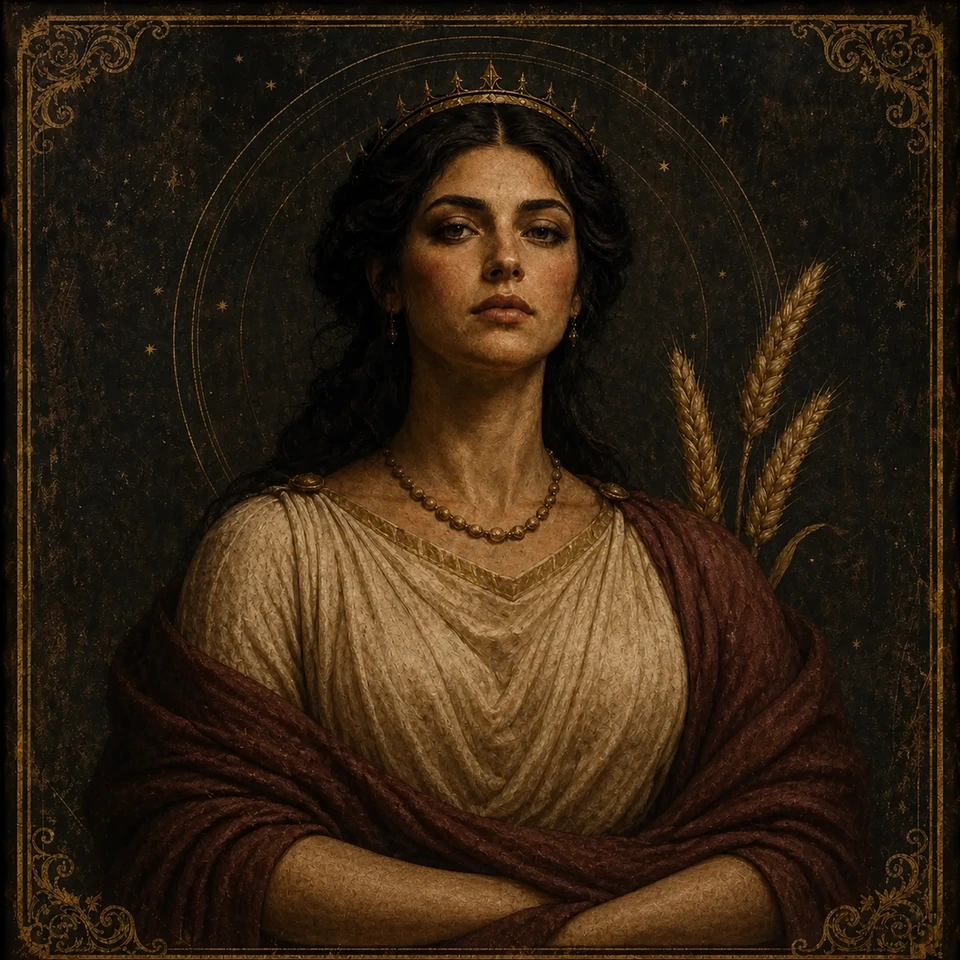
Balancing the vibrant return of spring with the absolute finality of the grave, Persephone wields formidable authority over underworld shades. As the daughter of Demeter and Zeus, she claims profound cultic importance as the Kore of the secretive Eleusinian rites.
Overview
Persephone rises from the underworld on an Attic vessel, looking back as Hermes leads her upward. Her hair falls long beneath a fillet. Three ears of grain stand in her hand. Another painter gives the ascending goddess a crown and necklace. These are not portraits of an innocent spring child wandering into darkness. They show an adult deity crossing the boundary with regalia, memory, and authority.
The Homeric Hymn to Demeter begins with violence. Persephone gathers flowers when the earth opens and Hades drives out. He seizes her with Zeus's consent while she cries to her father and the gods. Demeter searches, reaches Eleusis, and finally withholds growth until famine threatens mortals and the divine honors sustained by sacrifice. The settlement comes only under that pressure. Hades obeys the order to release Persephone, then secretly puts pomegranate seed in her mouth so that she cannot remain above for the whole year.
Persephone tells Demeter what happened. Her account names the seizure and the seed, leaving no basis in this witness for a willing elopement. Mother and daughter reunite, Rhea carries Zeus's terms, and growth returns. Hecate becomes Persephone's attendant and companion. Demeter teaches solemn rites at Eleusis, and the hymn announces their blessed gravity without exposing a complete initiation.
Pseudo-Apollodorus preserves a harsher variant detail. Persephone swallows a seed without foreseeing the consequence. Ascalaphus reports it, Demeter puts a heavy rock upon him, and Heracles later rolls that rock away. The later mythographer also gives Persephone a third of the year below, while the hymn assigns a third of the seasons below and two parts with the gods. The witnesses stand side by side. Their differences are not smoothed into a single arithmetic.
The Odyssey meets Persephone after queenship is already established. Circe says the goddess allows Tiresias to retain understanding among the dead. During Odysseus's visit she sends wives and daughters of heroes toward him, then remains the feared power who might send the Gorgon's head. Permission, ordering, and mortal terror reveal who governs the shades even when she does not appear bodily.
Other stories refuse to leave that authority abstract. In the Theognidean corpus, Sisyphus achieves what no other dead person has managed: his persuasive words move Persephone, and he returns to sunlight. The poem does not include the later tale of an unburied body or a deceived wife, so those details do not enter this account. Pseudo-Apollodorus gives another transgression when Theseus and Pirithous descend to win Persephone for Pirithous. Hades seats them on the Chair of Forgetfulness, where they grow fast. Heracles later frees Theseus but cannot free Pirithous.
Heracles' Cerberus labor intersects that captivity without swallowing it. Persephone's direct action in the labor comes when Heracles wrestles the underworld herdsman Menoetes and breaks his ribs. She asks that the man be spared. The queen who inspires dread can also intercede. Hades still controls the hound's release, and Heracles must master Cerberus without weapons before returning him below.
A different divided year belongs to Adonis. Aphrodite hides the infant in a chest entrusted to Persephone. Persephone opens it, refuses to return him, and receives a share of his year after Zeus judges the dispute. Here she is custodian and claimant, not abducted daughter. Blending the two annual divisions would erase the difference between suffering coercion and exercising authority.
Near Triphylian Pylos, Strabo records the short, violent tale of Minthe. The nymph becomes Hades' concubine, Kore tramples her, and she is transformed into garden mint. A mountain keeps her name beside a precinct of Hades and a grove of Demeter. The passage does not say that Persephone performs the transformation herself, nor does it make mint a universal offering. It preserves a local rivalry written into a landscape.
Cult evidence gives the Two Goddesses public weight. An Athenian decree regulates wheat and barley first fruits for Demeter and Kore at Eleusis. In Laconia, a wooden image of the Maid travels from Helos to a sanctuary of Demeter Eleusinian on stated days. Kore belongs to Persephone's Greek cultic identity. Arcadian Despoina does not automatically do so, and Roman Proserpina remains separate.
Persephone is daughter and queen, returning and resident below, honored with Demeter and powerful among the dead. She can be seized, bargained over, and bound to a divided year without becoming passive in every other source. Her sovereignty does not sanitize the abduction. Her return does not erase the underworld. Her later violence and judgment do not rewrite the coercion she endured.
Canonical identity
Canonical Identity
Persephone rules as the underworld queen beside Hades and exists as the returning daughter of Demeter and Zeus, prominently invoked as Kore (the Maid or Daughter) within the cult of the Two Goddesses. Hesiod confirms this parentage and records that Hades abducted her with the explicit consent of Zeus. The Homeric Hymn details the severe human cost of this act: Persephone screams, Demeter searches desperately, and the final resolution stems entirely from divine coercion rather than courtship. Kore functions as a vital title for the sovereign queen, not as a separate, harmless younger self. She must be kept strictly separate from Roman Proserpina and the Arcadian Despoina, whom Pausanias describes as a completely different child born to Demeter and Poseidon.
Linguistic Identity
Persephone originates from the Greek Περσεφόνη. Because no confident ancient pronunciation is currently available, none is supplied.
Sources and evidence
TEXTUAL · Supported
Hesiod names Persephone as daughter of Zeus and Demeter and says Hades carried her away with Zeus’s consent.
- Source
- Hesiod; edited and translated by Hugh G. Evelyn-White, Theogony (1914)
- Reviewed edition
- Hugh G. Evelyn-White edition and English translation in Hesiod, the Homeric Hymns and Homerica, 1914 · translated by Hugh G. Evelyn-White · edited by Hugh G. Evelyn-White · Perseus Digital Library / Scaife ATLAS
- Exact locator
- Entry Theogony · Line 912-914
- Scope
- Archaic Greece · Ancient Greece
- Authority
- Hesiod, Theogony
- Certainty
- High
This compact genealogy secures parentage and the coercive marriage sequence.
Open exact reviewed sourceTEXTUAL · Supported
Pausanias distinguishes the Arcadian Mistress born to Demeter and Poseidon from Persephone, whose rape he mentions separately.
- Source
- Pausanias; Spiro Greek edition and Jones/Ormerod translation volumes, Description of Greece (1935)
- Reviewed edition
- W. H. S. Jones and H. A. Ormerod English translation volumes, 1918-1935 · translated by W. H. S. Jones and H. A. Ormerod, volume-dependent · Perseus Digital Library / Scaife ATLAS
- Exact locator
- Entry Description of Greece · Book 8 · Chapter 42 · Section 1-2
- Scope
- Greek religion under Roman imperial rule · Arcadia
- Authority
- Pausanias, Description of Greece
- Certainty
- High
The passage prevents Despoina from being treated as a transparent synonym for Persephone.
Open exact reviewed source2 reviewed sources for this section
- Hesiod; edited and translated by Hugh G. Evelyn-White, Theogony (1914)Hesiod, the Homeric Hymns and Homerica, London and New York, 1914 · Perseus Digital Library / Scaife ATLAS
- Pausanias; Spiro Greek edition and Jones/Ormerod translation volumes, Description of Greece (1935)Perseus CTS edition corpus, 1903-1935 · Perseus Digital Library / Scaife ATLAS
Culture, tradition, period, and place
Evidence for Persephone crosses several Greek settings without becoming one universal theology. Archaic hexameter supplies the Eleusinian seizure and return, Hesiodic genealogy, and the Odyssey's underworld queen. Classical Attica gives civic first-fruit administration and painted ascent scenes. Laconia preserves a local procession of the Maid's wooden image. The later mythographic corpus assigns her active roles in the stories of Adonis, Ascalaphus, Theseus, Pirithous, Heracles, and Cerberus.
Strabo anchors the Minthe tale near Triphylian Pylos in Elis, beside a precinct of Hades and a grove of Demeter. That local geography matters because the transformation is not a free-floating herbal correspondence. It is a place-bound etiological story. Contemporary Hellenic polytheist practice belongs to another period and must identify itself as modern. Eleusis, Laconia, Arcadia, Elis, and the poetic underworld are related contexts, not interchangeable scenery.
Sources and evidence
TEXTUAL · Supported
The Homeric Hymn to Demeter places Persephone’s seizure, return, divided residence, and the teaching of rites within the Eleusinian narrative.
- Source
- Anonymous Homeric Hymns; edited and translated by Hugh G. Evelyn-White, Homeric Hymns (1914)
- Reviewed edition
- Hugh G. Evelyn-White English translation of Homeric Hymn 2, To Demeter, 1914 · translated by Hugh G. Evelyn-White · edited by Hugh G. Evelyn-White · Perseus Digital Library / Scaife ATLAS
- Exact locator
- Hymn Homeric Hymn 2 to Demeter · Line 1-32; 347-403; 425-482
- Scope
- Archaic Greece · Eleusis
- Authority
- Homeric Hymn to Demeter, Evelyn-White 1914
- Certainty
- High
The hymn roots these events in the Eleusinian sacred landscape.
Open exact reviewed sourceTEXTUAL · Supported
The Odyssey presents Persephone as a governing power among the dead through Tiresias’s mind, the movement of shades, and Odysseus’s fear.
- Source
- Homer; translated by A. T. Murray, Odyssey (1919)
- Reviewed edition
- A. T. Murray English translation, London: William Heinemann; New York: G. P. Putnam's Sons, 1919 · translated by A. T. Murray · Perseus Digital Library / Scaife ATLAS
- Exact locator
- Entry Odyssey · Book 10-11 · Line 10.488-495; 11.225-332; 11.630-635
- Scope
- Archaic Greece · Greek underworld
- Authority
- Homer, Odyssey
- Certainty
- High
The epic evidence establishes underworld authority rather than a local cult practice.
Open exact reviewed sourceTEXTUAL · Supported
Pseudo-Apollodorus preserves the later Greek mythographic custody dispute in which Persephone refuses to return Adonis and receives part of his year.
- Source
- Pseudo-Apollodorus; edited and translated by James G. Frazer, Library (1921)
- Reviewed edition
- James G. Frazer edition and English translation, Harvard University Press and William Heinemann, 1921 · translated by James G. Frazer · edited by James G. Frazer · Perseus Digital Library / Scaife ATLAS
- Exact locator
- Entry Library · Book 3 · Chapter 14 · Section 4
- Scope
- Greek religion under Roman imperial rule · Ancient Greece
- Authority
- Pseudo-Apollodorus, Library
- Certainty
- High
The Adonis custody narrative is later mythography and remains separate from the Eleusinian cycle.
Open exact reviewed sourceTEXTUAL · Supported
Pausanias reports a Laconian procession carrying a wooden image of the Maid from Helos to a sanctuary of Demeter Eleusinian on stated days.
- Source
- Pausanias; Spiro Greek edition and Jones/Ormerod translation volumes, Description of Greece (1935)
- Reviewed edition
- W. H. S. Jones and H. A. Ormerod English translation volumes, 1918-1935 · translated by W. H. S. Jones and H. A. Ormerod, volume-dependent · Perseus Digital Library / Scaife ATLAS
- Exact locator
- Entry Description of Greece · Book 3 · Chapter 20 · Section 7
- Scope
- Greek religion under Roman imperial rule · Laconia
- Authority
- Pausanias, Description of Greece
- Certainty
- High
The procession is a local Laconian practice.
Open exact reviewed sourceINSCRIPTIONAL · Supported
I Eleusis 28a regulates wheat and barley first fruits for the Two Goddesses at Eleusis.
- Source
- Attic Inscriptions Online editorial committee, Attic Inscriptions Online
- Reviewed edition
- I Eleusis 28a / IG I3 78a, On the first-fruits at Eleusis; English translation by Stephen Lambert and Robin Osborne · translated by Stephen Lambert and Robin Osborne · Attic Inscriptions Online
- Exact locator
- InscriptionId I Eleusis 28a / IG I3 78a · RecordUrl https://atticinscriptions.com/inscription/IEleus/28a
- Scope
- Classical Greece · Eleusis
- Authority
- Attic Inscriptions Online, I Eleusis 28a
- Certainty
- High
The decree provides exact civic and cult geography.
Open exact reviewed sourceMATERIAL CULTURE · Supported
British Museum 1848,0619.3 (B261), dated about 510-500 BC, catalogues Persephone returning from Hades with grain and adult dress.
- Source
- British Museum, British Museum Collection
- Reviewed edition
- British Museum object record 1848,0619.3 (B261), Attic black-figure neck-amphora · British Museum
- Exact locator
- MuseumObjectId 1848,0619.3 (B261) · RecordUrl https://www.britishmuseum.org/collection/object/G_1848-0619-3
- Scope
- Archaic Greece · Attica
- Authority
- British Museum collection catalogue
- Certainty
- High
The official catalogue description names the figure and attributes; no further visual detail is added.
Open exact reviewed sourceMATERIAL CULTURE · Supported
Metropolitan Museum 28.57.23, dated about 440 BC, identifies Persephone ascending on an Attic red-figure bell-krater.
- Source
- The Metropolitan Museum of Art, Open Access Collection and Collection API
- Reviewed edition
- Metropolitan Museum of Art object 252973, accession 28.57.23, terracotta red-figure bell-krater · The Metropolitan Museum of Art
- Exact locator
- MuseumObjectId 28.57.23 · RecordUrl https://www.metmuseum.org/art/collection/search/252973
- Scope
- Classical Greece · Attica
- Authority
- Metropolitan Museum of Art collection catalogue
- Certainty
- High
The museum catalogue identifies the figure, date, crown, and necklace.
Open exact reviewed sourceTEXTUAL · Supported
Hellenion’s public schedule names a shared September libation for Demeter and Persephone in contemporary Hellenic polytheist practice.
- Source
- Hellenion, Monthly Libations
- Reviewed edition
- Live first-party community practice page reviewed 2026-08-29 · Hellenion
- Exact locator
- Page Monthly Libations · Entry September, Demeter and Persephone
- Scope
- Contemporary living religion · International online religious community
- Authority
- Hellenion, Monthly Libations
- Certainty
- High
This is a modern first-party community practice, not ancient evidence.
Open exact reviewed sourceTEXTUAL · Supported
Strabo places the Minthe tale near Triphylian Pylos in Elis, beside a precinct of Hades and a grove of Demeter.
- Source
- Strabo; translated by H. L. Jones, Geography, Book 8 (1924)
- Reviewed edition
- H. L. Jones edition and translation, Geography, Volume IV, 1924 · translated by H. L. Jones · edited by H. L. Jones · Perseus Digital Library / Scaife ATLAS
- Exact locator
- Entry Geography · Book 8 · Chapter 3 · Section 14
- Scope
- Greek religion under Roman imperial rule · Triphylian Pylos and Mount Minthe
- Authority
- Strabo, Geography
- Certainty
- High
The geographical witness binds the myth to one local landscape.
Open exact reviewed source9 reviewed sources for this section
- Anonymous Homeric Hymns; edited and translated by Hugh G. Evelyn-White, Homeric Hymns (1914)Hesiod, the Homeric Hymns and Homerica, London and New York, 1914 · Perseus Digital Library / Scaife ATLAS
- Homer; translated by A. T. Murray, Odyssey (1919)A. T. Murray English translation, London: William Heinemann; New York: G. P. Putnam's Sons, 1919 · Perseus Digital Library / Scaife ATLAS
- Pseudo-Apollodorus; edited and translated by James G. Frazer, Library (1921)Harvard University Press and William Heinemann edition, 1921 · Perseus Digital Library / Scaife ATLAS
- Pausanias; Spiro Greek edition and Jones/Ormerod translation volumes, Description of Greece (1935)Perseus CTS edition corpus, 1903-1935 · Perseus Digital Library / Scaife ATLAS
- Attic Inscriptions Online editorial committee, Attic Inscriptions OnlineContinuously updated scholarly digital corpus · British School at Athens
- British Museum, British Museum CollectionLive official museum collection · British Museum
- The Metropolitan Museum of Art, Open Access Collection and Collection APILive collection data and eligible public-domain images · The Metropolitan Museum of Art
- Hellenion, Monthly LibationsLive official community practice page · Hellenion
- Strabo; translated by H. L. Jones, Geography, Book 8 (1924)Loeb Classical Library, Volume IV, 1924 · Perseus Digital Library / Scaife ATLAS
Historical development
The earliest witnesses do not present one simple seasonal maiden. Hesiod fixes Persephone's parentage and Zeus's consent to her removal. The Homeric Hymn builds a long crisis of seizure, famine, negotiation, return, and solemn rites. The Odyssey assumes that queenship is already established: Persephone preserves Tiresias's understanding, moves companies of shades, and remains the power Odysseus fears when he ends his descent.
Classical civic and material records give the goddess a public body. The Eleusinian first-fruits decree joins Demeter and Kore to regulated wheat and barley. Attic vessels show an adult, crowned or filleted goddess ascending with grain. The Theognidean corpus makes Sisyphus's impossible return depend on persuading Persephone. Later mythography preserves her custody claim over Adonis, the pomegranate witness Ascalaphus, her mercy toward Menoetes, and the punishment of Pirithous. Strabo makes Kore the violent agent in Minthe's local transformation. Pausanias then preserves regional worship and identity boundaries centuries after the Archaic poems. These layers accumulate, but they do not erase one another.
Sources and evidence
TEXTUAL · Supported
The Homeric Hymn joins Persephone’s coerced seizure and return to famine, restored growth, and the establishment of Eleusinian rites.
- Source
- Anonymous Homeric Hymns; edited and translated by Hugh G. Evelyn-White, Homeric Hymns (1914)
- Reviewed edition
- Hugh G. Evelyn-White English translation of Homeric Hymn 2, To Demeter, 1914 · translated by Hugh G. Evelyn-White · edited by Hugh G. Evelyn-White · Perseus Digital Library / Scaife ATLAS
- Exact locator
- Hymn Homeric Hymn 2 to Demeter · Line 1-32; 347-403; 425-482
- Scope
- Archaic Greece · Eleusis
- Authority
- Homeric Hymn to Demeter, Evelyn-White 1914
- Certainty
- High
The hymn preserves multiple roles without reducing Persephone to a seasonal ornament.
Open exact reviewed sourceTEXTUAL · Supported
The Odyssey reveals Persephone’s established underworld sovereignty through her control of Tiresias and other shades.
- Source
- Homer; translated by A. T. Murray, Odyssey (1919)
- Reviewed edition
- A. T. Murray English translation, London: William Heinemann; New York: G. P. Putnam's Sons, 1919 · translated by A. T. Murray · Perseus Digital Library / Scaife ATLAS
- Exact locator
- Entry Odyssey · Book 10-11 · Line 10.488-495; 11.225-332; 11.630-635
- Scope
- Archaic Greece · Greek underworld
- Authority
- Homer, Odyssey
- Certainty
- High
Epic sovereignty is distinct from later mythographic action.
Open exact reviewed sourceTEXTUAL · Supported
Later mythography gives Persephone an active custody claim over Adonis and a share of his divided year.
- Source
- Pseudo-Apollodorus; edited and translated by James G. Frazer, Library (1921)
- Reviewed edition
- James G. Frazer edition and English translation, Harvard University Press and William Heinemann, 1921 · translated by James G. Frazer · edited by James G. Frazer · Perseus Digital Library / Scaife ATLAS
- Exact locator
- Entry Library · Book 3 · Chapter 14 · Section 4
- Scope
- Greek religion under Roman imperial rule · Ancient Greece
- Authority
- Pseudo-Apollodorus, Library
- Certainty
- High
This later development is not merged with her own divided residence.
Open exact reviewed sourceTEXTUAL · Supported
Pausanias preserves both a local Laconian Kore procession and an Arcadian distinction between Despoina and Persephone.
- Source
- Pausanias; Spiro Greek edition and Jones/Ormerod translation volumes, Description of Greece (1935)
- Reviewed edition
- W. H. S. Jones and H. A. Ormerod English translation volumes, 1918-1935 · translated by W. H. S. Jones and H. A. Ormerod, volume-dependent · Perseus Digital Library / Scaife ATLAS
- Exact locator
- Entry Description of Greece · Book 3 and 8 · Chapter 20 and 42 · Section 3.20.7; 8.42.1-2
- Scope
- Greek religion under Roman imperial rule · Ancient Greece
- Authority
- Pausanias, Description of Greece
- Certainty
- High
The combined claim remains explicitly split between Laconia and Arcadia.
Open exact reviewed sourceINSCRIPTIONAL · Supported
The fifth-century BC Eleusinian first-fruits decree binds the Two Goddesses to civic agricultural administration.
- Source
- Attic Inscriptions Online editorial committee, Attic Inscriptions Online
- Reviewed edition
- I Eleusis 28a / IG I3 78a, On the first-fruits at Eleusis; English translation by Stephen Lambert and Robin Osborne · translated by Stephen Lambert and Robin Osborne · Attic Inscriptions Online
- Exact locator
- InscriptionId I Eleusis 28a / IG I3 78a · RecordUrl https://atticinscriptions.com/inscription/IEleus/28a
- Scope
- Classical Greece · Eleusis
- Authority
- Attic Inscriptions Online, I Eleusis 28a
- Certainty
- High
The inscription adds civic evidence to literary tradition.
Open exact reviewed sourceMATERIAL CULTURE · Supported
British Museum B261 catalogues an Archaic Attic return image with adult dress and grain ears.
- Source
- British Museum, British Museum Collection
- Reviewed edition
- British Museum object record 1848,0619.3 (B261), Attic black-figure neck-amphora · British Museum
- Exact locator
- MuseumObjectId 1848,0619.3 (B261) · RecordUrl https://www.britishmuseum.org/collection/object/G_1848-0619-3
- Scope
- Archaic Greece · Attica
- Authority
- British Museum collection catalogue
- Certainty
- High
The official catalogue description names the object and attributes; no further visual detail is added.
Open exact reviewed sourceMATERIAL CULTURE · Supported
The Met bell-krater shows a Classical Attic ascent image of Persephone wearing crown and necklace.
- Source
- The Metropolitan Museum of Art, Open Access Collection and Collection API
- Reviewed edition
- Metropolitan Museum of Art object 252973, accession 28.57.23, terracotta red-figure bell-krater · The Metropolitan Museum of Art
- Exact locator
- MuseumObjectId 28.57.23 · RecordUrl https://www.metmuseum.org/art/collection/search/252973
- Scope
- Classical Greece · Attica
- Authority
- Metropolitan Museum of Art collection catalogue
- Certainty
- High
The full official object record supports the named visual attributes.
Open exact reviewed sourceTEXTUAL · Supported
Theognis 699-718 makes Sisyphus return from Hades after his persuasive words move Persephone.
- Source
- Theognis; edited and translated by J. M. Edmonds, Elegy and Iambus, Volume I: The Elegiac Poems of Theognis (1931)
- Reviewed edition
- J. M. Edmonds edition and English translation, Elegy and Iambus, Volume I, 1931 · translated by J. M. Edmonds · edited by J. M. Edmonds · Perseus Digital Library
- Exact locator
- Entry The Elegiac Poems of Theognis · Line 699-718
- Scope
- Archaic Greece · Greek underworld
- Authority
- Theognis, Elegiac Poems
- Certainty
- High
The passage names Persephone as the authority persuaded and does not supply the later burial-ruse narrative.
Open exact reviewed sourceTEXTUAL · Supported
Strabo 8.3.14 preserves a local tale in which Kore tramples Minthe and the nymph becomes garden mint.
- Source
- Strabo; translated by H. L. Jones, Geography, Book 8 (1924)
- Reviewed edition
- H. L. Jones edition and translation, Geography, Volume IV, 1924 · translated by H. L. Jones · edited by H. L. Jones · Perseus Digital Library / Scaife ATLAS
- Exact locator
- Entry Geography · Book 8 · Chapter 3 · Section 14
- Scope
- Greek religion under Roman imperial rule · Triphylian Pylos and Mount Minthe
- Authority
- Strabo, Geography
- Certainty
- High
The passage does not say that Kore personally performs the transformation.
Open exact reviewed source9 reviewed sources for this section
- Anonymous Homeric Hymns; edited and translated by Hugh G. Evelyn-White, Homeric Hymns (1914)Hesiod, the Homeric Hymns and Homerica, London and New York, 1914 · Perseus Digital Library / Scaife ATLAS
- Homer; translated by A. T. Murray, Odyssey (1919)A. T. Murray English translation, London: William Heinemann; New York: G. P. Putnam's Sons, 1919 · Perseus Digital Library / Scaife ATLAS
- Pseudo-Apollodorus; edited and translated by James G. Frazer, Library (1921)Harvard University Press and William Heinemann edition, 1921 · Perseus Digital Library / Scaife ATLAS
- Pausanias; Spiro Greek edition and Jones/Ormerod translation volumes, Description of Greece (1935)Perseus CTS edition corpus, 1903-1935 · Perseus Digital Library / Scaife ATLAS
- Attic Inscriptions Online editorial committee, Attic Inscriptions OnlineContinuously updated scholarly digital corpus · British School at Athens
- British Museum, British Museum CollectionLive official museum collection · British Museum
- The Metropolitan Museum of Art, Open Access Collection and Collection APILive collection data and eligible public-domain images · The Metropolitan Museum of Art
- Theognis; edited and translated by J. M. Edmonds, Elegy and Iambus, Volume I: The Elegiac Poems of Theognis (1931)Loeb Classical Library 258, 1931 · Perseus Digital Library
- Strabo; translated by H. L. Jones, Geography, Book 8 (1924)Loeb Classical Library, Volume IV, 1924 · Perseus Digital Library / Scaife ATLAS
Attested roles and historical themes
Roles, powers, and limits
Persephone's powers are enacted under pressure. In the hymn she is the seized daughter whose return becomes the condition for ending famine, yet the settlement also confirms residence and honor below. In the Odyssey she can preserve a dead seer's mind, summon women from among the shades, and stand behind the threat that drives Odysseus away. In Theognis, even Sisyphus's cunning must pass through her judgment before he returns to sunlight.
Later witnesses give sharper actions. She opens the chest containing Adonis, refuses to surrender him, and receives a share of his year. Kore tramples Minthe in Strabo's Elis tale, though the passage does not say that she personally performs the plant transformation. During Heracles' descent, Persephone asks that the injured herdsman Menoetes be spared. These acts show custody, judgment, violence, mercy, and underworld jurisdiction. They do not make her a generic ruler of romance, spring, mediumship, resurrection, or every dead soul.
Sources and evidence
TEXTUAL · Supported
The hymn presents Persephone as returning daughter and underworld queen whose residence is divided after coercion and famine.
- Source
- Anonymous Homeric Hymns; edited and translated by Hugh G. Evelyn-White, Homeric Hymns (1914)
- Reviewed edition
- Hugh G. Evelyn-White English translation of Homeric Hymn 2, To Demeter, 1914 · translated by Hugh G. Evelyn-White · edited by Hugh G. Evelyn-White · Perseus Digital Library / Scaife ATLAS
- Exact locator
- Hymn Homeric Hymn 2 to Demeter · Line 347-403; 425-470
- Scope
- Archaic Greece · Eleusis
- Authority
- Homeric Hymn to Demeter, Evelyn-White 1914
- Certainty
- High
Her divided residence is imposed, not a freely chosen seasonal office.
Open exact reviewed sourceTEXTUAL · Supported
Circe tells Odysseus that Persephone granted the dead Tiresias mind and understanding while other shades move like shadows.
- Source
- Homer; translated by A. T. Murray, Odyssey (1919)
- Reviewed edition
- A. T. Murray English translation, London: William Heinemann; New York: G. P. Putnam's Sons, 1919 · translated by A. T. Murray · Perseus Digital Library / Scaife ATLAS
- Exact locator
- Entry Odyssey · Book 10 · Line 488-495
- Scope
- Archaic Greece · Ancient Greece
- Authority
- Homer, Odyssey
- Certainty
- High
The privilege belongs to Tiresias and shows Persephone’s authority among the dead; it is not a general promise of necromancy.
Open exact reviewed sourceTEXTUAL · Supported
In the Odyssey, Persephone sends the wives and daughters of heroes toward Odysseus, and he later fears she may send the Gorgon’s head.
- Source
- Homer; translated by A. T. Murray, Odyssey (1919)
- Reviewed edition
- A. T. Murray English translation, London: William Heinemann; New York: G. P. Putnam's Sons, 1919 · translated by A. T. Murray · Perseus Digital Library / Scaife ATLAS
- Exact locator
- Entry Odyssey · Book 11 · Line 225-332; 630-635
- Scope
- Archaic Greece · Ancient Greece
- Authority
- Homer, Odyssey
- Certainty
- High
Persephone acts as an unseen sovereign power during the encounter with the dead.
Open exact reviewed sourceTEXTUAL · Supported
In the Adonis tale Persephone opens the chest, refuses Aphrodite’s demand, and receives a share of the divided year.
- Source
- Pseudo-Apollodorus; edited and translated by James G. Frazer, Library (1921)
- Reviewed edition
- James G. Frazer edition and English translation, Harvard University Press and William Heinemann, 1921 · translated by James G. Frazer · edited by James G. Frazer · Perseus Digital Library / Scaife ATLAS
- Exact locator
- Entry Library · Book 3 · Chapter 14 · Section 4
- Scope
- Greek religion under Roman imperial rule · Ancient Greece
- Authority
- Pseudo-Apollodorus, Library
- Certainty
- High
This active custody role differs from Persephone’s coerced Eleusinian residence.
Open exact reviewed sourceTEXTUAL · Supported
Theognis presents Persephone as the underworld authority whom Sisyphus must persuade before returning to sunlight.
- Source
- Theognis; edited and translated by J. M. Edmonds, Elegy and Iambus, Volume I: The Elegiac Poems of Theognis (1931)
- Reviewed edition
- J. M. Edmonds edition and English translation, Elegy and Iambus, Volume I, 1931 · translated by J. M. Edmonds · edited by J. M. Edmonds · Perseus Digital Library
- Exact locator
- Entry The Elegiac Poems of Theognis · Line 699-718
- Scope
- Archaic Greece · Greek underworld
- Authority
- Theognis, Elegiac Poems
- Certainty
- High
The claim is limited to the persuasion and return named in the poem.
Open exact reviewed sourceTEXTUAL · Supported
Strabo says Kore tramples Minthe after the nymph becomes Hades’ concubine.
- Source
- Strabo; translated by H. L. Jones, Geography, Book 8 (1924)
- Reviewed edition
- H. L. Jones edition and translation, Geography, Volume IV, 1924 · translated by H. L. Jones · edited by H. L. Jones · Perseus Digital Library / Scaife ATLAS
- Exact locator
- Entry Geography · Book 8 · Chapter 3 · Section 14
- Scope
- Greek religion under Roman imperial rule · Triphylian Pylos and Mount Minthe
- Authority
- Strabo, Geography
- Certainty
- High
Violence is explicit; the agent of transformation is left unstated.
Open exact reviewed sourceTEXTUAL · Supported
During Heracles’ descent, Persephone asks that Menoetes be spared after Heracles breaks his ribs.
- Source
- Pseudo-Apollodorus; edited and translated by James G. Frazer, Library (1921)
- Reviewed edition
- James G. Frazer edition and English translation, Harvard University Press and William Heinemann, 1921 · translated by James G. Frazer · edited by James G. Frazer · Perseus Digital Library / Scaife ATLAS
- Exact locator
- Entry Library · Book 2 · Chapter 5 · Section 12
- Scope
- Greek religion under Roman imperial rule · Greek underworld
- Authority
- Pseudo-Apollodorus, Library
- Certainty
- High
This is Persephone’s direct action in the Cerberus labor.
Open exact reviewed source5 reviewed sources for this section
- Anonymous Homeric Hymns; edited and translated by Hugh G. Evelyn-White, Homeric Hymns (1914)Hesiod, the Homeric Hymns and Homerica, London and New York, 1914 · Perseus Digital Library / Scaife ATLAS
- Homer; translated by A. T. Murray, Odyssey (1919)A. T. Murray English translation, London: William Heinemann; New York: G. P. Putnam's Sons, 1919 · Perseus Digital Library / Scaife ATLAS
- Pseudo-Apollodorus; edited and translated by James G. Frazer, Library (1921)Harvard University Press and William Heinemann edition, 1921 · Perseus Digital Library / Scaife ATLAS
- Theognis; edited and translated by J. M. Edmonds, Elegy and Iambus, Volume I: The Elegiac Poems of Theognis (1931)Loeb Classical Library 258, 1931 · Perseus Digital Library
- Strabo; translated by H. L. Jones, Geography, Book 8 (1924)Loeb Classical Library, Volume IV, 1924 · Perseus Digital Library / Scaife ATLAS
Epithets and titles
Cult Epithet
Kore
Κόρη · Maiden or Daughter
Eleusis and Laconian Eleusinian practice · Classical cult evidence through Pausanias’s Roman-imperial accountThe title belongs to shared cult with Demeter and does not make Arcadian Despoina an alias.
2 reviewed sources for this section
- Pausanias; Spiro Greek edition and Jones/Ormerod translation volumes, Description of Greece (1935)Perseus CTS edition corpus, 1903-1935 · Perseus Digital Library / Scaife ATLAS
- Attic Inscriptions Online editorial committee, Attic Inscriptions OnlineContinuously updated scholarly digital corpus · British School at Athens
Poetic Epithet
Dread Persephone
Dread Persephone
Greek epic underworld narrative · Archaic poetic witnessThe Odyssey uses fear language when Odysseus imagines the Gorgon may be sent against him.
1 reviewed source for this section
- Homer; translated by A. T. Murray, Odyssey (1919)A. T. Murray English translation, London: William Heinemann; New York: G. P. Putnam's Sons, 1919 · Perseus Digital Library / Scaife ATLAS
Worship and cult
At Eleusis, Persephone is honored with Demeter as Kore, one of the Two Goddesses. The Homeric Hymn ends by naming solemn rites and blessed participation while refusing to expose a complete initiation. That boundary is part of the evidence. A fifth-century BC Athenian decree then shows civic machinery around the cult, regulating wheat and barley first fruits rather than offering a private devotional recipe.
Pausanias records another practice in Laconia. On stated days, a wooden image of the Maid traveled from Helos to a sanctuary of Demeter Eleusinian. The movement joins object, route, local calendar, and sanctuary. It does not authorize the same procession elsewhere. Strabo's Triphylian landscape supplies a precinct of Hades and a grove of Demeter near Mount Minthe, but he does not name a separate Persephone sanctuary there. Modern Hellenic worship must likewise be reported through accountable communities, not projected backward into antiquity.
Sources and evidence
TEXTUAL · Supported
The hymn links Persephone’s return to Demeter’s restoration of growth and the teaching of solemn rites at Eleusis.
- Source
- Anonymous Homeric Hymns; edited and translated by Hugh G. Evelyn-White, Homeric Hymns (1914)
- Reviewed edition
- Hugh G. Evelyn-White English translation of Homeric Hymn 2, To Demeter, 1914 · translated by Hugh G. Evelyn-White · edited by Hugh G. Evelyn-White · Perseus Digital Library / Scaife ATLAS
- Exact locator
- Hymn Homeric Hymn 2 to Demeter · Line 470-482
- Scope
- Archaic Greece · Eleusis
- Authority
- Homeric Hymn to Demeter, Evelyn-White 1914
- Certainty
- High
The public poem announces the rites and their gravity without disclosing or authorizing a reconstructed initiation.
Open exact reviewed sourceINSCRIPTIONAL · Supported
A classical Athenian decree regulates first fruits for Demeter and Kore at Eleusis.
- Source
- Attic Inscriptions Online editorial committee, Attic Inscriptions Online
- Reviewed edition
- I Eleusis 28a / IG I3 78a, On the first-fruits at Eleusis; English translation by Stephen Lambert and Robin Osborne · translated by Stephen Lambert and Robin Osborne · Attic Inscriptions Online
- Exact locator
- InscriptionId I Eleusis 28a / IG I3 78a · RecordUrl https://atticinscriptions.com/inscription/IEleus/28a
- Scope
- Classical Greece · Eleusis
- Authority
- Attic Inscriptions Online, I Eleusis 28a
- Certainty
- High
The decree shows civic administration and shared religious honor.
Open exact reviewed sourceTEXTUAL · Supported
Pausanias reports that on stated days people brought a wooden image of the Maid, daughter of Demeter, from Helos to a Laconian sanctuary of Demeter Eleusinian.
- Source
- Pausanias; Spiro Greek edition and Jones/Ormerod translation volumes, Description of Greece (1935)
- Reviewed edition
- W. H. S. Jones and H. A. Ormerod English translation volumes, 1918-1935 · translated by W. H. S. Jones and H. A. Ormerod, volume-dependent · Perseus Digital Library / Scaife ATLAS
- Exact locator
- Entry Description of Greece · Book 3 · Chapter 20 · Section 7
- Scope
- Greek religion under Roman imperial rule · Laconia
- Authority
- Pausanias, Description of Greece
- Certainty
- High
The rite is locally Laconian and does not establish one procession for every cult of Kore.
Open exact reviewed source3 reviewed sources for this section
- Anonymous Homeric Hymns; edited and translated by Hugh G. Evelyn-White, Homeric Hymns (1914)Hesiod, the Homeric Hymns and Homerica, London and New York, 1914 · Perseus Digital Library / Scaife ATLAS
- Attic Inscriptions Online editorial committee, Attic Inscriptions OnlineContinuously updated scholarly digital corpus · British School at Athens
- Pausanias; Spiro Greek edition and Jones/Ormerod translation volumes, Description of Greece (1935)Perseus CTS edition corpus, 1903-1935 · Perseus Digital Library / Scaife ATLAS
Temples, sanctuaries, and sacred places
Eleusis is the strongest sacred center in the reviewed evidence. The hymn places Demeter's grief, temple demand, famine, reunion, restored growth, and teaching of rites within its landscape. The Rharian plain and the civic first-fruit system make that landscape agricultural and political as well as mythic. The surviving public poem does not yield the inner performance of initiation, and no modern reconstruction can claim that silence as evidence.
Laconia preserves a different sacred route, from Helos to a sanctuary of Demeter Eleusinian, carrying the wooden Kore image on locally stated days. Near Triphylian Pylos, Strabo sets Mount Minthe beside a revered precinct of Hades and a grove of Demeter. The mountain holds the memory of Minthe's punishment, but the text does not turn every mint patch into a sanctuary. The Greek underworld is a narrative realm of Persephone's authority. It is not a compass point, a cave type, or a license to assign every cemetery to her.
Sources and evidence
TEXTUAL · Supported
The hymn places Demeter’s temple demand, the reunion, restored growth on the Rharian plain, and the teaching of rites at Eleusis.
- Source
- Anonymous Homeric Hymns; edited and translated by Hugh G. Evelyn-White, Homeric Hymns (1914)
- Reviewed edition
- Hugh G. Evelyn-White English translation of Homeric Hymn 2, To Demeter, 1914 · translated by Hugh G. Evelyn-White · edited by Hugh G. Evelyn-White · Perseus Digital Library / Scaife ATLAS
- Exact locator
- Hymn Homeric Hymn 2 to Demeter · Line 270-300; 425-482
- Scope
- Archaic Greece · Eleusis
- Authority
- Homeric Hymn to Demeter, Evelyn-White 1914
- Certainty
- High
Eleusis is a cult landscape, while the hymn does not disclose a full initiation.
Open exact reviewed sourceINSCRIPTIONAL · Supported
I Eleusis 28a anchors the first-fruit system for the Two Goddesses at Eleusis.
- Source
- Attic Inscriptions Online editorial committee, Attic Inscriptions Online
- Reviewed edition
- I Eleusis 28a / IG I3 78a, On the first-fruits at Eleusis; English translation by Stephen Lambert and Robin Osborne · translated by Stephen Lambert and Robin Osborne · Attic Inscriptions Online
- Exact locator
- InscriptionId I Eleusis 28a / IG I3 78a · RecordUrl https://atticinscriptions.com/inscription/IEleus/28a
- Scope
- Classical Greece · Eleusis
- Authority
- Attic Inscriptions Online, I Eleusis 28a
- Certainty
- High
The inscription places the civic first fruits within the sanctuary at Eleusis.
Open exact reviewed sourceTEXTUAL · Supported
A Laconian sanctuary of Demeter Eleusinian receives the Maid’s wooden image from Helos on stated days.
- Source
- Pausanias; Spiro Greek edition and Jones/Ormerod translation volumes, Description of Greece (1935)
- Reviewed edition
- W. H. S. Jones and H. A. Ormerod English translation volumes, 1918-1935 · translated by W. H. S. Jones and H. A. Ormerod, volume-dependent · Perseus Digital Library / Scaife ATLAS
- Exact locator
- Entry Description of Greece · Book 3 · Chapter 20 · Section 7
- Scope
- Greek religion under Roman imperial rule · Laconia
- Authority
- Pausanias, Description of Greece
- Certainty
- High
The sacred-place claim is local and does not generalize every underworld landscape.
Open exact reviewed sourceTEXTUAL · Supported
Strabo places Mount Minthe near a revered precinct of Hades and a grove of Demeter by Triphylian Pylos.
- Source
- Strabo; translated by H. L. Jones, Geography, Book 8 (1924)
- Reviewed edition
- H. L. Jones edition and translation, Geography, Volume IV, 1924 · translated by H. L. Jones · edited by H. L. Jones · Perseus Digital Library / Scaife ATLAS
- Exact locator
- Entry Geography · Book 8 · Chapter 3 · Section 14
- Scope
- Greek religion under Roman imperial rule · Triphylian Pylos and Mount Minthe
- Authority
- Strabo, Geography
- Certainty
- High
The passage does not name a separate sanctuary of Persephone.
Open exact reviewed source4 reviewed sources for this section
- Anonymous Homeric Hymns; edited and translated by Hugh G. Evelyn-White, Homeric Hymns (1914)Hesiod, the Homeric Hymns and Homerica, London and New York, 1914 · Perseus Digital Library / Scaife ATLAS
- Attic Inscriptions Online editorial committee, Attic Inscriptions OnlineContinuously updated scholarly digital corpus · British School at Athens
- Pausanias; Spiro Greek edition and Jones/Ormerod translation volumes, Description of Greece (1935)Perseus CTS edition corpus, 1903-1935 · Perseus Digital Library / Scaife ATLAS
- Strabo; translated by H. L. Jones, Geography, Book 8 (1924)Loeb Classical Library, Volume IV, 1924 · Perseus Digital Library / Scaife ATLAS
Festivals and processions
The Eleusinian rites are publicly named and deliberately guarded. The hymn can proclaim their gravity and the blessed condition of those who have seen them without publishing a transferable script. The first-fruits decree supplies a different kind of public evidence: measured agricultural obligations, civic authorities, and the Two Goddesses as recipients. These records teach institutional weight without pretending to restore every ceremony.
Pausanias gives stated days for the Laconian journey of the Maid's image, yet he does not provide a universal date that can be moved into a modern calendar. Hellenion's shared September libation for Demeter and Persephone is an openly contemporary observance by one Hellenic polytheist organization. Its existence is evidence for that community's practice. It is not the ancient birthday of Persephone, the fixed date of her descent, or a rule for every living devotee.
Sources and evidence
TEXTUAL · Supported
The Homeric Hymn announces solemn Eleusinian rites and blessed participation without disclosing a complete initiatory performance.
- Source
- Anonymous Homeric Hymns; edited and translated by Hugh G. Evelyn-White, Homeric Hymns (1914)
- Reviewed edition
- Hugh G. Evelyn-White English translation of Homeric Hymn 2, To Demeter, 1914 · translated by Hugh G. Evelyn-White · edited by Hugh G. Evelyn-White · Perseus Digital Library / Scaife ATLAS
- Exact locator
- Hymn Homeric Hymn 2 to Demeter · Line 470-482
- Scope
- Archaic Greece · Eleusis
- Authority
- Homeric Hymn to Demeter, Evelyn-White 1914
- Certainty
- High
The public poem supports the gravity and secrecy boundary, not a reconstructed ritual manual.
Open exact reviewed sourceINSCRIPTIONAL · Supported
The Eleusinian decree regulates public agricultural first fruits for the Two Goddesses.
- Source
- Attic Inscriptions Online editorial committee, Attic Inscriptions Online
- Reviewed edition
- I Eleusis 28a / IG I3 78a, On the first-fruits at Eleusis; English translation by Stephen Lambert and Robin Osborne · translated by Stephen Lambert and Robin Osborne · Attic Inscriptions Online
- Exact locator
- InscriptionId I Eleusis 28a / IG I3 78a · RecordUrl https://atticinscriptions.com/inscription/IEleus/28a
- Scope
- Classical Greece · Eleusis
- Authority
- Attic Inscriptions Online, I Eleusis 28a
- Certainty
- High
This is civic offering evidence rather than a complete festival calendar.
Open exact reviewed sourceTEXTUAL · Supported
Pausanias gives stated days for the Laconian movement of the Maid’s image without supplying a transferable universal date.
- Source
- Pausanias; Spiro Greek edition and Jones/Ormerod translation volumes, Description of Greece (1935)
- Reviewed edition
- W. H. S. Jones and H. A. Ormerod English translation volumes, 1918-1935 · translated by W. H. S. Jones and H. A. Ormerod, volume-dependent · Perseus Digital Library / Scaife ATLAS
- Exact locator
- Entry Description of Greece · Book 3 · Chapter 20 · Section 7
- Scope
- Greek religion under Roman imperial rule · Laconia
- Authority
- Pausanias, Description of Greece
- Certainty
- High
The timing remains local and non-Gregorian.
Open exact reviewed sourceTEXTUAL · Supported
Hellenion schedules a shared September libation for Demeter and Persephone.
- Source
- Hellenion, Monthly Libations
- Reviewed edition
- Live first-party community practice page reviewed 2026-08-29 · Hellenion
- Exact locator
- Page Monthly Libations · Entry September, Demeter and Persephone
- Scope
- Contemporary living religion · International online religious community
- Authority
- Hellenion, Monthly Libations
- Certainty
- High
The contemporary month is not backdated as an ancient festival date.
Open exact reviewed source4 reviewed sources for this section
- Anonymous Homeric Hymns; edited and translated by Hugh G. Evelyn-White, Homeric Hymns (1914)Hesiod, the Homeric Hymns and Homerica, London and New York, 1914 · Perseus Digital Library / Scaife ATLAS
- Attic Inscriptions Online editorial committee, Attic Inscriptions OnlineContinuously updated scholarly digital corpus · British School at Athens
- Pausanias; Spiro Greek edition and Jones/Ormerod translation volumes, Description of Greece (1935)Perseus CTS edition corpus, 1903-1935 · Perseus Digital Library / Scaife ATLAS
- Hellenion, Monthly LibationsLive official community practice page · Hellenion
Offerings, votives, and ritual evidence
The clearest offering evidence is public, agricultural, and measured. The Eleusinian decree regulates wheat and barley first fruits for the Two Goddesses. It belongs to a civic sanctuary system with officials and prescribed shares, not to a timeless list of ingredients for solitary use. Grain ears on Attic pottery reinforce agricultural identity and returning ascent, but painted attributes do not prescribe what a reader should burn, eat, bury, or pour.
The pomegranate belongs first to a coercive narrative. In the hymn, Hades secretly puts seed in Persephone's mouth before release. Pseudo-Apollodorus says she swallows a seed without foreseeing the consequence, and Ascalaphus reports it. Neither witness presents the seed as an offering to Persephone. Hellenion's modern libation is supported only as that community's current practice. No incense, blood rite, intoxicant, burial deposit, or initiatory action is reconstructed from the surviving sources.
Sources and evidence
INSCRIPTIONAL · Supported
A fifth-century BC Athenian decree regulates first-fruit portions of wheat and barley for the Two Goddesses at Eleusis.
- Source
- Attic Inscriptions Online editorial committee, Attic Inscriptions Online
- Reviewed edition
- I Eleusis 28a / IG I3 78a, On the first-fruits at Eleusis; English translation by Stephen Lambert and Robin Osborne · translated by Stephen Lambert and Robin Osborne · Attic Inscriptions Online
- Exact locator
- InscriptionId I Eleusis 28a / IG I3 78a · RecordUrl https://atticinscriptions.com/inscription/IEleus/28a
- Scope
- Classical Greece · Eleusis
- Authority
- Attic Inscriptions Online, I Eleusis 28a
- Certainty
- High
The civic system supports shared Demeter and Kore worship but not a timeless private offering recipe.
Open exact reviewed sourceTEXTUAL · Supported
Hades secretly puts pomegranate seed in Persephone’s mouth before release; the hymn does not present the seed as an offering to her.
- Source
- Anonymous Homeric Hymns; edited and translated by Hugh G. Evelyn-White, Homeric Hymns (1914)
- Reviewed edition
- Hugh G. Evelyn-White English translation of Homeric Hymn 2, To Demeter, 1914 · translated by Hugh G. Evelyn-White · edited by Hugh G. Evelyn-White · Perseus Digital Library / Scaife ATLAS
- Exact locator
- Hymn Homeric Hymn 2 to Demeter · Line 370-403; 425-433
- Scope
- Archaic Greece · Greek underworld
- Authority
- Homeric Hymn to Demeter, Evelyn-White 1914
- Certainty
- High
The seed is a coercive narrative condition, not ritual prescription.
Open exact reviewed sourceMATERIAL CULTURE · Supported
British Museum B261 catalogues Persephone holding three grain ears in a return scene.
- Source
- British Museum, British Museum Collection
- Reviewed edition
- British Museum object record 1848,0619.3 (B261), Attic black-figure neck-amphora · British Museum
- Exact locator
- MuseumObjectId 1848,0619.3 (B261) · RecordUrl https://www.britishmuseum.org/collection/object/G_1848-0619-3
- Scope
- Archaic Greece · Attica
- Authority
- British Museum collection catalogue
- Certainty
- High
A painted attribute does not by itself prescribe an offering.
Open exact reviewed source3 reviewed sources for this section
- Attic Inscriptions Online editorial committee, Attic Inscriptions OnlineContinuously updated scholarly digital corpus · British School at Athens
- Anonymous Homeric Hymns; edited and translated by Hugh G. Evelyn-White, Homeric Hymns (1914)Hesiod, the Homeric Hymns and Homerica, London and New York, 1914 · Perseus Digital Library / Scaife ATLAS
- British Museum, British Museum CollectionLive official museum collection · British Museum
Iconography and material culture
Two Attic vessels keep Persephone's return physical. British Museum B261 identifies her rising from Hades in long chiton and himation, with long hair, a fillet, and three ears of grain. The Metropolitan Museum bell-krater identifies another ascent and gives the goddess a crown and necklace. Both are adult images of motion between realms. Neither makes a skull, black gown, crescent moon, crystal, or occult seal necessary.
The portrait shown here combines only the securely described crown or fillet, necklace, dress, mantle, and grain. The pomegranate remains scene-specific because the best-known early account makes it an instrument of coercion. Mint belongs here only through Strabo's local story of a punished nymph, not as a universal emblem carried by the goddess. The Chair of Forgetfulness belongs to Theseus and Pirithous in Pseudo-Apollodorus. Objects and plants retain the exact narrative that gives them meaning.
Sources and evidence
MATERIAL CULTURE · Supported
British Museum 1848,0619.3 (B261) shows Persephone returning from Hades with long tresses, fillet, long chiton and himation, and three ears of grain.
- Source
- British Museum, British Museum Collection
- Reviewed edition
- British Museum object record 1848,0619.3 (B261), Attic black-figure neck-amphora · British Museum
- Exact locator
- MuseumObjectId 1848,0619.3 (B261) · RecordUrl https://www.britishmuseum.org/collection/object/G_1848-0619-3
- Scope
- Archaic Greece · Attica
- Authority
- British Museum collection catalogue
- Certainty
- High
The catalog notes heavy restoration, so the claim remains confined to the official identification and described attributes.
Open exact reviewed sourceMATERIAL CULTURE · Supported
Metropolitan Museum accession 28.57.23 identifies Persephone ascending from the underworld wearing a crown and necklace on an Attic red-figure bell-krater.
- Source
- The Metropolitan Museum of Art, Open Access Collection and Collection API
- Reviewed edition
- Metropolitan Museum of Art object 252973, accession 28.57.23, terracotta red-figure bell-krater · The Metropolitan Museum of Art
- Exact locator
- MuseumObjectId 28.57.23 · RecordUrl https://www.metmuseum.org/art/collection/search/252973
- Scope
- Classical Greece · Attica
- Authority
- Metropolitan Museum of Art collection catalogue
- Certainty
- High
The object supports return, crown, necklace, and adult divine appearance without licensing a copied pose.
Open exact reviewed sourceTEXTUAL · Supported
The pomegranate seed is forced into the release sequence in the hymn and remains a scene-specific condition rather than a universal visual attribute.
- Source
- Anonymous Homeric Hymns; edited and translated by Hugh G. Evelyn-White, Homeric Hymns (1914)
- Reviewed edition
- Hugh G. Evelyn-White English translation of Homeric Hymn 2, To Demeter, 1914 · translated by Hugh G. Evelyn-White · edited by Hugh G. Evelyn-White · Perseus Digital Library / Scaife ATLAS
- Exact locator
- Hymn Homeric Hymn 2 to Demeter · Line 370-403; 425-433
- Scope
- Archaic Greece · Greek underworld
- Authority
- Homeric Hymn to Demeter, Evelyn-White 1914
- Certainty
- High
The profile portrait omits the seed to avoid making one coercive episode her universal emblem.
Open exact reviewed source3 reviewed sources for this section
- British Museum, British Museum CollectionLive official museum collection · British Museum
- The Metropolitan Museum of Art, Open Access Collection and Collection APILive collection data and eligible public-domain images · The Metropolitan Museum of Art
- Anonymous Homeric Hymns; edited and translated by Hugh G. Evelyn-White, Homeric Hymns (1914)Hesiod, the Homeric Hymns and Homerica, London and New York, 1914 · Perseus Digital Library / Scaife ATLAS
Animals, plants, and embodied forms
Grain is the strongest plant complex. Three grain ears appear in the British Museum return image, while wheat and barley are named in the Eleusinian first-fruit decree. Flowers belong to the opening of the abduction hymn, and pomegranate seed binds the return settlement. Each has a different evidentiary role: image attribute, civic offering, narrative setting, or coercive condition.
Mint is now included with a hard boundary. Strabo says that Minthe became Hades' concubine, was trampled by Kore, and was transformed into garden mint near the Triphylian mountain bearing her name. The passage does not make mint a medicine, an offering, or Persephone's universal sacred plant. No animal is securely assigned in the reviewed record. Cerberus belongs to Hades' guarded realm and Heracles' labor, not to a devotional animal correspondence for Persephone.
Sources and evidence
MATERIAL CULTURE · Supported
British Museum B261 catalogues three grain ears in Persephone’s hand in the return scene.
- Source
- British Museum, British Museum Collection
- Reviewed edition
- British Museum object record 1848,0619.3 (B261), Attic black-figure neck-amphora · British Museum
- Exact locator
- MuseumObjectId 1848,0619.3 (B261) · RecordUrl https://www.britishmuseum.org/collection/object/G_1848-0619-3
- Scope
- Archaic Greece · Attica
- Authority
- British Museum collection catalogue
- Certainty
- High
The attribute is object-bound and does not establish medicine or a universal offering.
Open exact reviewed sourceINSCRIPTIONAL · Supported
I Eleusis 28a specifies wheat and barley first fruits for the Two Goddesses.
- Source
- Attic Inscriptions Online editorial committee, Attic Inscriptions Online
- Reviewed edition
- I Eleusis 28a / IG I3 78a, On the first-fruits at Eleusis; English translation by Stephen Lambert and Robin Osborne · translated by Stephen Lambert and Robin Osborne · Attic Inscriptions Online
- Exact locator
- InscriptionId I Eleusis 28a / IG I3 78a · RecordUrl https://atticinscriptions.com/inscription/IEleus/28a
- Scope
- Classical Greece · Eleusis
- Authority
- Attic Inscriptions Online, I Eleusis 28a
- Certainty
- High
The plants belong to a civic cult system at Eleusis.
Open exact reviewed sourceTEXTUAL · Supported
The hymn places flower gathering before Persephone’s seizure and pomegranate seed within the coerced return settlement.
- Source
- Anonymous Homeric Hymns; edited and translated by Hugh G. Evelyn-White, Homeric Hymns (1914)
- Reviewed edition
- Hugh G. Evelyn-White English translation of Homeric Hymn 2, To Demeter, 1914 · translated by Hugh G. Evelyn-White · edited by Hugh G. Evelyn-White · Perseus Digital Library / Scaife ATLAS
- Exact locator
- Hymn Homeric Hymn 2 to Demeter · Line 1-32; 370-403; 425-433
- Scope
- Archaic Greece · Ancient Greece
- Authority
- Homeric Hymn to Demeter, Evelyn-White 1914
- Certainty
- High
Narrative plants do not automatically become sacred species or medicines.
Open exact reviewed sourceTEXTUAL · Supported
Strabo says Minthe was transformed into garden mint after Kore trampled her.
- Source
- Strabo; translated by H. L. Jones, Geography, Book 8 (1924)
- Reviewed edition
- H. L. Jones edition and translation, Geography, Volume IV, 1924 · translated by H. L. Jones · edited by H. L. Jones · Perseus Digital Library / Scaife ATLAS
- Exact locator
- Entry Geography · Book 8 · Chapter 3 · Section 14
- Scope
- Greek religion under Roman imperial rule · Triphylian Pylos and Mount Minthe
- Authority
- Strabo, Geography
- Certainty
- High
The plant belongs to a local etiological myth, not a medical or offering prescription.
Open exact reviewed source4 reviewed sources for this section
- British Museum, British Museum CollectionLive official museum collection · British Museum
- Attic Inscriptions Online editorial committee, Attic Inscriptions OnlineContinuously updated scholarly digital corpus · British School at Athens
- Anonymous Homeric Hymns; edited and translated by Hugh G. Evelyn-White, Homeric Hymns (1914)Hesiod, the Homeric Hymns and Homerica, London and New York, 1914 · Perseus Digital Library / Scaife ATLAS
- Strabo; translated by H. L. Jones, Geography, Book 8 (1924)Loeb Classical Library, Volume IV, 1924 · Perseus Digital Library / Scaife ATLAS
Relationships and genealogy
Hesiod names Demeter and Zeus as Persephone's parents. Hades becomes her husband and grants honors below, but the marriage follows seizure with Zeus's consent. The Homeric Hymn does not describe a willing elopement. Persephone's own report preserves the violence and the forced seed. Family language cannot be used to remove responsibility from Zeus or consent from a story that does not give it.
Hecate hears Persephone's cry, guides Demeter toward Helios, and later becomes Persephone's attendant and companion. That is a narrative relationship, not motherhood or identity. Aphrodite is a rival custodian in the Adonis story. Minthe is a local rival attached to Hades in Strabo. Sisyphus is a petitioner who persuades Persephone. Pirithous is an aggressor seeking to take her as a bride. Heracles meets her as an underworld queen capable of intercession. These relationships differ in kind and cannot be treated as one kind of bond.
Sources and evidence
TEXTUAL · Supported
Hesiod names Persephone as daughter of Zeus and Demeter and says Hades carried her away with Zeus’s consent.
- Source
- Hesiod; edited and translated by Hugh G. Evelyn-White, Theogony (1914)
- Reviewed edition
- Hugh G. Evelyn-White edition and English translation in Hesiod, the Homeric Hymns and Homerica, 1914 · translated by Hugh G. Evelyn-White · edited by Hugh G. Evelyn-White · Perseus Digital Library / Scaife ATLAS
- Exact locator
- Entry Theogony · Line 912-914
- Scope
- Archaic Greece · Ancient Greece
- Authority
- Hesiod, Theogony
- Certainty
- High
Parentage and coercive removal occur in the same compact genealogy.
Open exact reviewed sourceTEXTUAL · Supported
The hymn makes Zeus the consenting father, Hades the abductor and husband, and Hecate the hearer who later becomes Persephone’s attendant and companion.
- Source
- Anonymous Homeric Hymns; edited and translated by Hugh G. Evelyn-White, Homeric Hymns (1914)
- Reviewed edition
- Hugh G. Evelyn-White English translation of Homeric Hymn 2, To Demeter, 1914 · translated by Hugh G. Evelyn-White · edited by Hugh G. Evelyn-White · Perseus Digital Library / Scaife ATLAS
- Exact locator
- Hymn Homeric Hymn 2 to Demeter · Line 1-32; 52-90; 425-440
- Scope
- Archaic Greece · Ancient Greece
- Authority
- Homeric Hymn to Demeter, Evelyn-White 1914
- Certainty
- High
The marriage follows seizure; Hecate’s narrative companionship is not converted into genealogy.
Open exact reviewed sourceTEXTUAL · Supported
In the Adonis account Aphrodite and Persephone are rival custodians, and Zeus judges their dispute.
- Source
- Pseudo-Apollodorus; edited and translated by James G. Frazer, Library (1921)
- Reviewed edition
- James G. Frazer edition and English translation, Harvard University Press and William Heinemann, 1921 · translated by James G. Frazer · edited by James G. Frazer · Perseus Digital Library / Scaife ATLAS
- Exact locator
- Entry Library · Book 3 · Chapter 14 · Section 4
- Scope
- Greek religion under Roman imperial rule · Ancient Greece
- Authority
- Pseudo-Apollodorus, Library
- Certainty
- High
Custody rivalry and adjudication are not kinship or cult partnership.
Open exact reviewed source3 reviewed sources for this section
- Hesiod; edited and translated by Hugh G. Evelyn-White, Theogony (1914)Hesiod, the Homeric Hymns and Homerica, London and New York, 1914 · Perseus Digital Library / Scaife ATLAS
- Anonymous Homeric Hymns; edited and translated by Hugh G. Evelyn-White, Homeric Hymns (1914)Hesiod, the Homeric Hymns and Homerica, London and New York, 1914 · Perseus Digital Library / Scaife ATLAS
- Pseudo-Apollodorus; edited and translated by James G. Frazer, Library (1921)Harvard University Press and William Heinemann edition, 1921 · Perseus Digital Library / Scaife ATLAS
Actual myths and source variants
Seven source-secure narratives preserve Persephone's major surviving actions. The Eleusinian cycle follows flower gathering, seizure, Demeter's search, famine, release, the seed, divided residence, renewed growth, and the teaching of rites. Pseudo-Apollodorus adds Ascalaphus as the witness against Persephone, a detail absent from the hymn. The Odyssey gives a separate underworld sequence in which her will governs Tiresias, companies of shades, and Odysseus's fear.
The Adonis story makes Persephone custodian and claimant rather than captive. Theognis gives Sisyphus an unprecedented return because his words persuade her. Strabo's Minthe tale makes Kore trample a local rival before the nymph becomes mint. Pseudo-Apollodorus separates the compact of Theseus and Pirithous, their descent to obtain Persephone for Pirithous, and their binding on the Chair of Forgetfulness. Heracles' later Cerberus labor continues that captivity story, but Persephone's direct action in the labor is her request that Menoetes be spared.
The annual divisions in the Eleusinian and Adonis stories are not one romance told twice. The Orpheus story also remains confined to its sources: the Greek Pseudo-Apollodorus witness names the underworld ruler in singular terms, while the explicit royal pair belongs to Latin variants. Fragmentary eschatological allusions cannot become a complete narrative until their exact text and contested interpretation receive dedicated review.
Sources and evidence
TEXTUAL · Supported
The Homeric Hymn to Demeter says Hades seized Persephone with Zeus’s consent, obeyed Zeus’s order to release her but forced the pomegranate seed, and Zeus’s later settlement assigned her a divided residence.
- Source
- Anonymous Homeric Hymns; edited and translated by Hugh G. Evelyn-White, Homeric Hymns (1914)
- Reviewed edition
- Hugh G. Evelyn-White English translation of Homeric Hymn 2, To Demeter, 1914 · translated by Hugh G. Evelyn-White · edited by Hugh G. Evelyn-White · Perseus Digital Library / Scaife ATLAS
- Exact locator
- Hymn Homeric Hymn 2 to Demeter · Line 1-32; 347-403; 425-470
- Scope
- Archaic Greece · Eleusis
- Authority
- Homeric Hymn to Demeter, Evelyn-White 1914
- Certainty
- High
The hymn preserves her cries, her report to Demeter, coercion, return, and underworld queenship without turning the seed into a cheerful love token.
Open exact reviewed sourceTEXTUAL · Supported
The Odyssey shows Persephone’s underworld sovereignty through Tiresias’s retained understanding, ordered shades, and the threat Odysseus fears.
- Source
- Homer; translated by A. T. Murray, Odyssey (1919)
- Reviewed edition
- A. T. Murray English translation, London: William Heinemann; New York: G. P. Putnam's Sons, 1919 · translated by A. T. Murray · Perseus Digital Library / Scaife ATLAS
- Exact locator
- Entry Odyssey · Book 10-11 · Line 10.488-495; 11.225-332; 11.630-635
- Scope
- Archaic Greece · Greek underworld
- Authority
- Homer, Odyssey
- Certainty
- High
The goddess governs without a visible entrance into the scene.
Open exact reviewed sourceTEXTUAL · Supported
Pseudo-Apollodorus says Persephone opens the chest holding infant Adonis, refuses to return him to Aphrodite, and receives a share of his divided year after Zeus judges the dispute.
- Source
- Pseudo-Apollodorus; edited and translated by James G. Frazer, Library (1921)
- Reviewed edition
- James G. Frazer edition and English translation, Harvard University Press and William Heinemann, 1921 · translated by James G. Frazer · edited by James G. Frazer · Perseus Digital Library / Scaife ATLAS
- Exact locator
- Entry Library · Book 3 · Chapter 14 · Section 4
- Scope
- Greek religion under Roman imperial rule · Ancient Greece
- Authority
- Pseudo-Apollodorus, Library
- Certainty
- High
This custody narrative is distinct from the Eleusinian division of Persephone’s own residence.
Open exact reviewed sourceTEXTUAL · Supported
Pseudo-Apollodorus says Theseus and Pirithous are confined after attempting to seize Persephone; Heracles frees Theseus but cannot free Pirithous.
- Source
- Pseudo-Apollodorus; edited and translated by James G. Frazer, Library (1921)
- Reviewed edition
- James G. Frazer edition and English translation, Harvard University Press and William Heinemann, 1921 · translated by James G. Frazer · edited by James G. Frazer · Perseus Digital Library / Scaife ATLAS
- Exact locator
- Entry Library · Book 2 · Chapter 5 · Section 12
- Scope
- Greek religion under Roman imperial rule · Greek underworld
- Authority
- Pseudo-Apollodorus, Library
- Certainty
- High
Persephone is the target of Pirithous’s attempted seizure in the Greek underworld; Taenarum is Heracles’ descent route, not the locality of the confinement proposition.
Open exact reviewed sourceTEXTUAL · Supported
Theognis 699-718 preserves Sisyphus’s singular return from Hades through persuasion of Persephone.
- Source
- Theognis; edited and translated by J. M. Edmonds, Elegy and Iambus, Volume I: The Elegiac Poems of Theognis (1931)
- Reviewed edition
- J. M. Edmonds edition and English translation, Elegy and Iambus, Volume I, 1931 · translated by J. M. Edmonds · edited by J. M. Edmonds · Perseus Digital Library
- Exact locator
- Entry The Elegiac Poems of Theognis · Line 699-718
- Scope
- Archaic Greece · Greek underworld
- Authority
- Theognis, Elegiac Poems
- Certainty
- High
Later explanations of his request are not imported into this witness.
Open exact reviewed sourceTEXTUAL · Supported
Strabo 8.3.14 preserves the Minthe rivalry, Kore’s trampling, and the nymph’s transformation into mint.
- Source
- Strabo; translated by H. L. Jones, Geography, Book 8 (1924)
- Reviewed edition
- H. L. Jones edition and translation, Geography, Volume IV, 1924 · translated by H. L. Jones · edited by H. L. Jones · Perseus Digital Library / Scaife ATLAS
- Exact locator
- Entry Geography · Book 8 · Chapter 3 · Section 14
- Scope
- Greek religion under Roman imperial rule · Triphylian Pylos and Mount Minthe
- Authority
- Strabo, Geography
- Certainty
- High
This is a distinct local etiological narrative.
Open exact reviewed sourceTEXTUAL · Supported
Pseudo-Apollodorus says Ascalaphus reports Persephone’s pomegranate seed, Demeter places a rock upon him, and Heracles later rolls it away.
- Source
- Pseudo-Apollodorus; edited and translated by James G. Frazer, Library (1921)
- Reviewed edition
- James G. Frazer edition and English translation, Harvard University Press and William Heinemann, 1921 · translated by James G. Frazer · edited by James G. Frazer · Perseus Digital Library / Scaife ATLAS
- Exact locator
- Entry Library · Book 1 and 2 · Chapter 1.5 and 2.5 · Section 1.5.3; 2.5.12
- Scope
- Greek religion under Roman imperial rule · Greek underworld
- Authority
- Pseudo-Apollodorus, Library
- Certainty
- High
The Ascalaphus detail is a later variant inside the Eleusinian return cycle.
Open exact reviewed sourceTEXTUAL · Supported
Pseudo-Apollodorus says Theseus and Pirithous descend to win Persephone for Pirithous and are bound to the Chair of Forgetfulness.
- Source
- Pseudo-Apollodorus; edited and translated by James G. Frazer, Library (1921)
- Reviewed edition
- James G. Frazer edition and English translation, Harvard University Press and William Heinemann, 1921 · translated by James G. Frazer · edited by James G. Frazer · Perseus Digital Library / Scaife ATLAS
- Exact locator
- Entry Epitome and Library · Book E and 2 · Chapter E.1 and 2.5 · Section E.1.23-24; 2.5.12
- Scope
- Greek religion under Roman imperial rule · Greek underworld
- Authority
- Pseudo-Apollodorus, Epitome and Library
- Certainty
- High
The attempted seizure is a distinct narrative whose rescue continuation meets the Cerberus labor.
Open exact reviewed source5 reviewed sources for this section
- Anonymous Homeric Hymns; edited and translated by Hugh G. Evelyn-White, Homeric Hymns (1914)Hesiod, the Homeric Hymns and Homerica, London and New York, 1914 · Perseus Digital Library / Scaife ATLAS
- Homer; translated by A. T. Murray, Odyssey (1919)A. T. Murray English translation, London: William Heinemann; New York: G. P. Putnam's Sons, 1919 · Perseus Digital Library / Scaife ATLAS
- Pseudo-Apollodorus; edited and translated by James G. Frazer, Library (1921)Harvard University Press and William Heinemann edition, 1921 · Perseus Digital Library / Scaife ATLAS
- Theognis; edited and translated by J. M. Edmonds, Elegy and Iambus, Volume I: The Elegiac Poems of Theognis (1931)Loeb Classical Library 258, 1931 · Perseus Digital Library
- Strabo; translated by H. L. Jones, Geography, Book 8 (1924)Loeb Classical Library, Volume IV, 1924 · Perseus Digital Library / Scaife ATLAS
Myth Library
Each myth gathers its attested participants into one source-grounded account, while distinct source traditions remain readable in their own variants.
Hymnic Cycle
Demeter, Persephone, and the Eleusinian Settlement
Persephone gathers flowers with Tyche and other divine companions before she is seized by Hades with Zeus's consent, and Demeter's search brings her to Eleusis. After an interrupted attempt to make Demophon deathless, Demeter reveals herself, demands a temple, and withholds the seed until famine forces divine negotiation. Hades obeys the release order but secretly puts pomegranate seed in Persephone’s mouth; Zeus then assigns her a divided residence, and Hecate becomes her companion before Demeter teaches the Eleusinian rites.
- Role in this profile
- abducted daughter, returning Kore, and underworld queen whose divided residence forms the settlement
- Place scope
- Eleusis · Attica
- Witnesses
- 2
- Variants
- 2
Custody Death And Ritual Reception
Adonis Between Aphrodite and Persephone
Pseudo-Apollodorus preserves competing parentages, then follows Panyasis: Aphrodite's anger drives Smyrna toward her father Thias, a nurse conceals their incest for twelve nights, and Smyrna becomes the myrrh tree from which Adonis is born. Aphrodite hides the infant with Persephone, Zeus divides his year when Persephone refuses to return him, and Artemis's anger brings his boar death. Theocritus and Ovid reshape the later mourning in Alexandrian and Roman settings.
- Role in this profile
- goddess entrusted with the infant who refuses to return him after opening the chest
- Place scope
- Ancient Greece · Alexandria in Egypt
- Witnesses
- 3
- Variants
- 3
Underworld Encounter And Divine Sovereignty
Persephone Governs the Shades
During Odysseus’s encounter with the dead, Persephone grants Tiresias understanding, sends heroic women forward, and remains the feared authority behind his retreat.
- Role in this profile
- preserves Tiresias’s understanding, sends heroic women forward, and remains the power Odysseus fears at the end
- Place scope
- Ancient Greece
- Witnesses
- 1
- Variants
- 1
Escape From Death
Sisyphus Persuades Persephone
Theognis says that Sisyphus’s persuasive cunning moves Persephone and returns him from Hades, an escape the poem declares without equal among the dead.
- Role in this profile
- underworld queen whose decision permits Sisyphus to return to sunlight
- Place scope
- Greek underworld
- Witnesses
- 1
- Variants
- 1
Attempted Abduction And Punishment
Theseus, Pirithous, and the Attempt on Persephone
Theseus and Pirithous pledge to marry daughters of Zeus, descend to obtain Persephone for Pirithous, and are fixed to the Chair of Forgetfulness; Pirithous remains when Heracles later reaches them.
- Role in this profile
- underworld queen whom Pirithous and Theseus descend to obtain without her consent
- Place scope
- Greek underworld
- Witnesses
- 2
- Variants
- 1
Heroic Descent
Heracles and Cerberus
For his final labor, Heracles descends through Taenarum, encounters the captives Theseus and Pirithous, spares Menoetes at Persephone’s request, and brings Cerberus above only after Hades imposes weaponless mastery as the condition.
- Role in this profile
- underworld queen who asks Heracles to spare Menoetes after the herdsman is injured
- Place scope
- Taenarum in Laconia
- Witnesses
- 1
- Variants
- 1
Local Etiological Transformation
Minthe and Kore
Strabo locates a mountain named for Minthe near Triphylian Pylos and records that the nymph became Hades’ concubine, was trampled by Kore, and became garden mint.
- Role in this profile
- goddess who tramples Minthe
- Place scope
- Triphylian Pylos and Mount Minthe
- Witnesses
- 1
- Variants
- 1
Equivalences, syncretisms, and identity boundaries
Persephone and Kore belong to one Greek identity in the reviewed evidence: queen below, daughter returning, and Maid within the shared cult of the Two Goddesses. Arcadian Despoina does not collapse into that identity. Pausanias distinguishes the Mistress born to Demeter and Poseidon from Persephone, whose seizure causes Demeter's later grief.
Roman Proserpina requires a separate Latin profile and source chain. A later translation's Latinizing vocabulary cannot erase a Greek work's language and tradition or authorize a Greek and Roman merger. Shared underworld roles do not establish identity with foreign queens of the dead. Modern maiden-mother-crone schemes, astrology, tarot, and generalized shadow-work language are later systems. They are not ancient equivalence evidence.
Sources and evidence
TEXTUAL · Supported
At Phigalia, Pausanias reports that Demeter bore the Mistress to Poseidon and then separately grieved over the rape of Persephone.
- Source
- Pausanias; Spiro Greek edition and Jones/Ormerod translation volumes, Description of Greece (1935)
- Reviewed edition
- W. H. S. Jones and H. A. Ormerod English translation volumes, 1918-1935 · translated by W. H. S. Jones and H. A. Ormerod, volume-dependent · Perseus Digital Library / Scaife ATLAS
- Exact locator
- Entry Description of Greece · Book 8 · Chapter 42 · Section 1-2
- Scope
- Greek religion under Roman imperial rule · Arcadia
- Authority
- Pausanias, Description of Greece
- Certainty
- High
The sequence keeps Arcadian Despoina distinct from Persephone rather than making Mistress a transparent alias.
Open exact reviewed source1 reviewed source for this section
- Pausanias; Spiro Greek edition and Jones/Ormerod translation volumes, Description of Greece (1935)Perseus CTS edition corpus, 1903-1935 · Perseus Digital Library / Scaife ATLAS
Correspondence index
Direct associations now include Eleusis, Demeter, Hades, Kore, returning ascent, underworld queenship, grain ears, wheat and barley first fruits, the pomegranate seed within the coerced settlement, authority over shades, and mint within one Triphylian punishment tale. Each remains attached to its source, place, and kind of evidence.
Mint is not promoted to a universal offering or medicine. The pomegranate is not converted from coercive device into a romantic gift. No planet, zodiac sign, gemstone, metal, canonical color, classical element, weekday, moon phase, incense, or canonical animal is established by the reviewed primary and material record. Hellenion's September libation belongs to one modern organization. It cannot be backdated as an ancient calendar law or generalized to every present-day worshipper.
Direct ancient correspondences
| Category | Direct correspondence | How and why | Evidence boundary |
|---|---|---|---|
| plant-tree | Grain ears, wheat, barley, the coerced pomegranate seed, and mint in the Triphylian Minthe taleDirect historical association | Grain appears in Attic imagery and civic first fruits, pomegranate seed creates the hymn’s coerced return condition, and mint belongs to Strabo’s local punishment story. | Ancient Cultic The seed is not an offering in the abduction story, and the local mint etiological tale establishes neither medicine nor a universal sacred plant. 4 reviewed sources for this section
|
| direction-place | Eleusis, the underworld, one Laconian procession route, and Triphylian PylosDirect historical association | Eleusis anchors shared cult, the underworld anchors queenship, Helos preserves a local image journey, and Strabo binds Minthe’s tale to the Triphylian landscape. | Ancient Cultic These places do not create a compass direction or make every cave, grave, or mint patch her sanctuary. 4 reviewed sources for this section
|
| modern-offerings | Eleusinian wheat and barley first fruitsDirect historical association | The Athenian decree regulates portions for the Two Goddesses. | Ancient Cultic A civic first-fruit system is not a timeless private recipe. 1 reviewed source for this section
|
Contextual evidence, not a general correspondence
| Category | Direct correspondence | How and why | Evidence boundary |
|---|---|---|---|
| festival-time | September shared libation in Hellenion practiceContextual evidence only | Hellenion schedules Demeter and Persephone in September. | Modern Public The modern month is not an ancient universal descent or return date. 1 reviewed source for this section
|
| ritual-object-symbol-tool | Wooden Kore image and grain-bearing return imagesContextual evidence only | Pausanias describes the local wooden image journey, while Attic vessels show return and grain. | Ancient Material These objects remain tied to their Laconian and Attic contexts. 3 reviewed sources for this section
|
| intention-magical-power | Return, sovereignty, grief, boundaries, and relations with the deadContextual evidence only | The hymn and Odyssey make these themes visible through action. | Ancient Literary Modern reflection cannot promise safe spirit contact, resurrection, fertility, or control of another person. 2 reviewed sources for this section
|
10 expected categories currently not evidenced
celestial-body · Not evidenced
No celestial body
No planet or star is securely assigned.
- Layer
- Research Boundary
- Scope
- The Attic ascent scenes and cited texts supply no planetary or stellar sign.
zodiac · Not evidenced
No zodiac sign
No zodiac rulership is established.
- Layer
- Research Boundary
- Scope
- The divided year and returning ascent do not place Persephone in a zodiacal scheme.
gemstone-crystal-mineral · Not evidenced
No gemstone or mineral
No stone is securely attached to ancient cult here.
- Layer
- Research Boundary
- Scope
- The vessels and Eleusinian evidence name no gemstone, crystal, or mineral.
metal-material · Not evidenced
No canonical metal
No metal is securely assigned.
- Layer
- Research Boundary
- Scope
- Vessel materials support particular images; they do not establish a sacred-metal rule.
animal · Not evidenced
No canonical animal
No animal is securely assigned.
- Layer
- Research Boundary
- Scope
- The cited witnesses give Persephone no canonical animal or embodied form.
color · Not evidenced
No canonical color
Attic vessel palettes and described clothing do not establish a canonical cult color.
- Layer
- Research Boundary
- Scope
- Vessel palettes and described clothing do not establish a canonical cult color.
classical-element · Not evidenced
No classical element
Underworld and agricultural roles do not establish earth-element rulership.
- Layer
- Research Boundary
- Scope
- Underworld and agricultural roles do not create formal earth-element rulership.
weekday · Not evidenced
No weekday
No weekday is securely linked.
- Layer
- Research Boundary
- Scope
- The ancient rites and one modern September observance supply no weekday.
moon-phase · Not evidenced
No moon phase
No lunar phase is securely linked.
- Layer
- Research Boundary
- Scope
- Divided residence is not evidence for a lunar-phase calendar.
incense-perfume · Not evidenced
No incense or resin
No fumigant is securely specified.
- Layer
- Research Boundary
- Scope
- The hymn, decree, procession, and vase records name no incense, resin, perfume, or fumigation.
Sources and evidence
TEXTUAL · Supported
The hymn directly associates Persephone with coercive seizure, return, divided residence, Demeter, Hades, Eleusis, pomegranate seed, and renewed growth.
- Source
- Anonymous Homeric Hymns; edited and translated by Hugh G. Evelyn-White, Homeric Hymns (1914)
- Reviewed edition
- Hugh G. Evelyn-White English translation of Homeric Hymn 2, To Demeter, 1914 · translated by Hugh G. Evelyn-White · edited by Hugh G. Evelyn-White · Perseus Digital Library / Scaife ATLAS
- Exact locator
- Hymn Homeric Hymn 2 to Demeter · Line 1-32; 347-403; 425-482
- Scope
- Archaic Greece · Eleusis
- Authority
- Homeric Hymn to Demeter, Evelyn-White 1914
- Certainty
- High
These are narrative and cultic associations, not automatic modern magical rulerships.
Open exact reviewed sourceTEXTUAL · Supported
The Odyssey directly associates Persephone with authority over Tiresias and other shades in the Greek underworld.
- Source
- Homer; translated by A. T. Murray, Odyssey (1919)
- Reviewed edition
- A. T. Murray English translation, London: William Heinemann; New York: G. P. Putnam's Sons, 1919 · translated by A. T. Murray · Perseus Digital Library / Scaife ATLAS
- Exact locator
- Entry Odyssey · Book 10-11 · Line 10.488-495; 11.225-332; 11.630-635
- Scope
- Archaic Greece · Greek underworld
- Authority
- Homer, Odyssey
- Certainty
- High
The association does not promise safe spirit communication.
Open exact reviewed sourceTEXTUAL · Supported
Pausanias directly associates Kore with the local Laconian image procession from Helos.
- Source
- Pausanias; Spiro Greek edition and Jones/Ormerod translation volumes, Description of Greece (1935)
- Reviewed edition
- W. H. S. Jones and H. A. Ormerod English translation volumes, 1918-1935 · translated by W. H. S. Jones and H. A. Ormerod, volume-dependent · Perseus Digital Library / Scaife ATLAS
- Exact locator
- Entry Description of Greece · Book 3 · Chapter 20 · Section 7
- Scope
- Greek religion under Roman imperial rule · Laconia
- Authority
- Pausanias, Description of Greece
- Certainty
- High
The place and procession remain locally bounded.
Open exact reviewed sourceINSCRIPTIONAL · Supported
The Eleusinian decree directly associates the Two Goddesses with regulated wheat and barley first fruits.
- Source
- Attic Inscriptions Online editorial committee, Attic Inscriptions Online
- Reviewed edition
- I Eleusis 28a / IG I3 78a, On the first-fruits at Eleusis; English translation by Stephen Lambert and Robin Osborne · translated by Stephen Lambert and Robin Osborne · Attic Inscriptions Online
- Exact locator
- InscriptionId I Eleusis 28a / IG I3 78a · RecordUrl https://atticinscriptions.com/inscription/IEleus/28a
- Scope
- Classical Greece · Eleusis
- Authority
- Attic Inscriptions Online, I Eleusis 28a
- Certainty
- High
This is civic cult evidence, not a timeless private offering recipe.
Open exact reviewed sourceMATERIAL CULTURE · Supported
British Museum B261 directly associates Persephone’s return image with adult dress, fillet, and grain ears.
- Source
- British Museum, British Museum Collection
- Reviewed edition
- British Museum object record 1848,0619.3 (B261), Attic black-figure neck-amphora · British Museum
- Exact locator
- MuseumObjectId 1848,0619.3 (B261) · RecordUrl https://www.britishmuseum.org/collection/object/G_1848-0619-3
- Scope
- Archaic Greece · Attica
- Authority
- British Museum collection catalogue
- Certainty
- High
The correspondence remains confined to the catalogue description.
Open exact reviewed sourceTEXTUAL · Supported
Hellenion directly associates Persephone with its shared September libation to Demeter and Persephone.
- Source
- Hellenion, Monthly Libations
- Reviewed edition
- Live first-party community practice page reviewed 2026-08-29 · Hellenion
- Exact locator
- Page Monthly Libations · Entry September, Demeter and Persephone
- Scope
- Contemporary living religion · International online religious community
- Authority
- Hellenion, Monthly Libations
- Certainty
- High
This is one modern organization’s practice and is not backdated.
Open exact reviewed sourceTEXTUAL · Supported
Strabo directly associates Kore with mint only through the Triphylian story of Minthe’s punishment and transformation.
- Source
- Strabo; translated by H. L. Jones, Geography, Book 8 (1924)
- Reviewed edition
- H. L. Jones edition and translation, Geography, Volume IV, 1924 · translated by H. L. Jones · edited by H. L. Jones · Perseus Digital Library / Scaife ATLAS
- Exact locator
- Entry Geography · Book 8 · Chapter 3 · Section 14
- Scope
- Greek religion under Roman imperial rule · Triphylian Pylos and Mount Minthe
- Authority
- Strabo, Geography
- Certainty
- High
The association remains local and narrative.
Open exact reviewed source7 reviewed sources for this section
- Anonymous Homeric Hymns; edited and translated by Hugh G. Evelyn-White, Homeric Hymns (1914)Hesiod, the Homeric Hymns and Homerica, London and New York, 1914 · Perseus Digital Library / Scaife ATLAS
- Homer; translated by A. T. Murray, Odyssey (1919)A. T. Murray English translation, London: William Heinemann; New York: G. P. Putnam's Sons, 1919 · Perseus Digital Library / Scaife ATLAS
- Pausanias; Spiro Greek edition and Jones/Ormerod translation volumes, Description of Greece (1935)Perseus CTS edition corpus, 1903-1935 · Perseus Digital Library / Scaife ATLAS
- Attic Inscriptions Online editorial committee, Attic Inscriptions OnlineContinuously updated scholarly digital corpus · British School at Athens
- British Museum, British Museum CollectionLive official museum collection · British Museum
- Hellenion, Monthly LibationsLive official community practice page · Hellenion
- Strabo; translated by H. L. Jones, Geography, Book 8 (1924)Loeb Classical Library, Volume IV, 1924 · Perseus Digital Library / Scaife ATLAS
Later reception and living significance
Hellenion's shared September libation gives one accountable public example of Persephone in contemporary Hellenic polytheist practice. It establishes that organization's own schedule and no more. Living devotion is not a single global practice, and protected, initiatory, lineage-based, or private knowledge is not converted into instructions for strangers.
The ancient record resists two common modern reductions. First, the Homeric Hymn preserves abduction, Zeus's consent, Persephone's grief, and the forced seed. It does not support a freely chosen romantic descent. Second, the Odyssey, Theognis, Strabo, and Pseudo-Apollodorus show a queen who judges, directs, refuses, tramples, and intercedes. She is not merely an emblem of spring innocence. Modern art and ritual may engage these tensions, but they must identify their own date and community instead of passing later synthesis off as ancient consensus.
Sources and evidence
TEXTUAL · Supported
Hellenion schedules a shared September libation to Demeter and Persephone for members participating from their own locations.
- Source
- Hellenion, Monthly Libations
- Reviewed edition
- Live first-party community practice page reviewed 2026-08-29 · Hellenion
- Exact locator
- Page Monthly Libations · Entry September, Demeter and Persephone
- Scope
- Contemporary living religion · International online religious community
- Authority
- Hellenion, Monthly Libations
- Certainty
- High
This establishes one accountable organization’s current communal practice only.
Open exact reviewed sourceTEXTUAL · Supported
Persephone’s own report in the hymn preserves the seizure and pomegranate seed without turning coercion into consent.
- Source
- Anonymous Homeric Hymns; edited and translated by Hugh G. Evelyn-White, Homeric Hymns (1914)
- Reviewed edition
- Hugh G. Evelyn-White English translation of Homeric Hymn 2, To Demeter, 1914 · translated by Hugh G. Evelyn-White · edited by Hugh G. Evelyn-White · Perseus Digital Library / Scaife ATLAS
- Exact locator
- Hymn Homeric Hymn 2 to Demeter · Line 425-433
- Scope
- Archaic Greece · Eleusis
- Authority
- Homeric Hymn to Demeter, Evelyn-White 1914
- Certainty
- High
Ancient coercion remains visible when the figure is received in modern practice.
Open exact reviewed sourceTEXTUAL · Supported
The Odyssey preserves Persephone’s sovereignty through her power over the dead.
- Source
- Homer; translated by A. T. Murray, Odyssey (1919)
- Reviewed edition
- A. T. Murray English translation, London: William Heinemann; New York: G. P. Putnam's Sons, 1919 · translated by A. T. Murray · Perseus Digital Library / Scaife ATLAS
- Exact locator
- Entry Odyssey · Book 10-11 · Line 10.488-495; 11.225-332; 11.630-635
- Scope
- Archaic Greece · Greek underworld
- Authority
- Homer, Odyssey
- Certainty
- High
Ancient underworld authority is not reduced to modern seasonal symbolism.
Open exact reviewed source3 reviewed sources for this section
- Hellenion, Monthly LibationsLive official community practice page · Hellenion
- Anonymous Homeric Hymns; edited and translated by Hugh G. Evelyn-White, Homeric Hymns (1914)Hesiod, the Homeric Hymns and Homerica, London and New York, 1914 · Perseus Digital Library / Scaife ATLAS
- Homer; translated by A. T. Murray, Odyssey (1919)A. T. Murray English translation, London: William Heinemann; New York: G. P. Putnam's Sons, 1919 · Perseus Digital Library / Scaife ATLAS
Evidence, conflicts, and research gaps
Distinct witnesses keep these traditions from being fused. Homeric Hymn 2 controls the Eleusinian crisis. Hesiod controls the compact genealogy and Zeus's consent. Odyssey 10 and 11 control Persephone's authority over Tiresias and the shades. Theognis 699-718 controls Sisyphus's persuasion. Pseudo-Apollodorus controls the Adonis custody dispute, Ascalaphus, Theseus and Pirithous, the Chair of Forgetfulness, Menoetes, and Cerberus. Strabo 8.3.14 controls the Triphylian Minthe tale. Pausanias controls the Laconian procession and Arcadian Despoina boundary. The inscription and Attic vessels supply civic and material evidence.
Important limits remain visible. The Eleusinian initiation is not reconstructed. Ancient pronunciation is unresolved. Sicilian cult, funerary inscriptions, philosophical reception, fragmentary eschatological allusions, and local epithets remain unsettled until exact primary or material evidence is reviewed. Late Orphic hymns give additional titles and genealogical claims that must be read in a secure Greek edition before any relationship can be stated. Roman Proserpina and Latin Orpheus variants remain separate. These are unresolved questions, not excuses to fill silence with modern occult tables.
Sources and evidence
TEXTUAL · Supported
The Homeric Hymn to Demeter follows the Eleusinian seizure, famine, return, divided residence, and rites as one continuous crisis.
- Source
- Anonymous Homeric Hymns; edited and translated by Hugh G. Evelyn-White, Homeric Hymns (1914)
- Reviewed edition
- Hugh G. Evelyn-White English translation of Homeric Hymn 2, To Demeter, 1914 · translated by Hugh G. Evelyn-White · edited by Hugh G. Evelyn-White · Perseus Digital Library / Scaife ATLAS
- Exact locator
- Hymn Homeric Hymn 2 to Demeter · Line 1-495
- Scope
- Archaic Greece · Eleusis
- Authority
- Homeric Hymn to Demeter, Evelyn-White 1914
- Certainty
- High
The poem joins the crisis to Eleusis while withholding a complete account of initiation.
Open exact reviewed sourceTEXTUAL · Supported
Hesiod names Persephone’s parents and Zeus’s consent to her removal in Theogony 912-914.
- Source
- Hesiod; edited and translated by Hugh G. Evelyn-White, Theogony (1914)
- Reviewed edition
- Hugh G. Evelyn-White edition and English translation in Hesiod, the Homeric Hymns and Homerica, 1914 · translated by Hugh G. Evelyn-White · edited by Hugh G. Evelyn-White · Perseus Digital Library / Scaife ATLAS
- Exact locator
- Entry Theogony · Line 912-914
- Scope
- Archaic Greece · Ancient Greece
- Authority
- Hesiod, Theogony
- Certainty
- High
Three lines establish kinship and consent, not a cult history.
Open exact reviewed sourceTEXTUAL · Supported
In books 10 and 11, the Odyssey reveals Persephone’s underworld sovereignty through Tiresias, the gathered shades, and Odysseus’s fear.
- Source
- Homer; translated by A. T. Murray, Odyssey (1919)
- Reviewed edition
- A. T. Murray English translation, London: William Heinemann; New York: G. P. Putnam's Sons, 1919 · translated by A. T. Murray · Perseus Digital Library / Scaife ATLAS
- Exact locator
- Entry Odyssey · Book 10-11 · Line 10.488-495; 11.225-332; 11.630-635
- Scope
- Archaic Greece · Greek underworld
- Authority
- Homer, Odyssey
- Certainty
- High
The passages establish epic authority, not universal modern practice.
Open exact reviewed sourceTEXTUAL · Supported
Pseudo-Apollodorus recounts the Adonis custody dispute in Library 3.14.4 and Pirithous’s attempted seizure of Persephone in Library 2.5.12.
- Source
- Pseudo-Apollodorus; edited and translated by James G. Frazer, Library (1921)
- Reviewed edition
- James G. Frazer edition and English translation, Harvard University Press and William Heinemann, 1921 · translated by James G. Frazer · edited by James G. Frazer · Perseus Digital Library / Scaife ATLAS
- Exact locator
- Entry Library · Book 2 and 3 · Chapter 2.5 and 3.14 · Section 2.5.12; 3.14.4
- Scope
- Greek religion under Roman imperial rule · Ancient Greece
- Authority
- Pseudo-Apollodorus, Library
- Certainty
- High
Both episodes belong to later Greek mythography.
Open exact reviewed sourceTEXTUAL · Supported
Pausanias describes the Laconian Kore procession at 3.20.7 and distinguishes Arcadian Despoina from Persephone at 8.42.1-2.
- Source
- Pausanias; Spiro Greek edition and Jones/Ormerod translation volumes, Description of Greece (1935)
- Reviewed edition
- W. H. S. Jones and H. A. Ormerod English translation volumes, 1918-1935 · translated by W. H. S. Jones and H. A. Ormerod, volume-dependent · Perseus Digital Library / Scaife ATLAS
- Exact locator
- Entry Description of Greece · Book 3 and 8 · Chapter 20 and 42 · Section 3.20.7; 8.42.1-2
- Scope
- Greek religion under Roman imperial rule · Ancient Greece
- Authority
- Pausanias, Description of Greece
- Certainty
- High
The two local traditions remain distinct.
Open exact reviewed sourceINSCRIPTIONAL · Supported
I Eleusis 28a records the classical civic first fruits offered to the Two Goddesses.
- Source
- Attic Inscriptions Online editorial committee, Attic Inscriptions Online
- Reviewed edition
- I Eleusis 28a / IG I3 78a, On the first-fruits at Eleusis; English translation by Stephen Lambert and Robin Osborne · translated by Stephen Lambert and Robin Osborne · Attic Inscriptions Online
- Exact locator
- InscriptionId I Eleusis 28a / IG I3 78a · RecordUrl https://atticinscriptions.com/inscription/IEleus/28a
- Scope
- Classical Greece · Eleusis
- Authority
- Attic Inscriptions Online, I Eleusis 28a
- Certainty
- High
The decree names regulated wheat and barley portions.
Open exact reviewed sourceMATERIAL CULTURE · Supported
The British Museum catalogue identifies 1848,0619.3 as an Archaic return image of Persephone and names its principal attributes.
- Source
- British Museum, British Museum Collection
- Reviewed edition
- British Museum object record 1848,0619.3 (B261), Attic black-figure neck-amphora · British Museum
- Exact locator
- MuseumObjectId 1848,0619.3 (B261) · RecordUrl https://www.britishmuseum.org/collection/object/G_1848-0619-3
- Scope
- Archaic Greece · Attica
- Authority
- British Museum collection catalogue
- Certainty
- High
The catalogue description is the limit; no unlisted visual detail is added.
Open exact reviewed sourceMATERIAL CULTURE · Supported
The Metropolitan Museum identifies 28.57.23 as a Classical ascent image of Persephone with crown and necklace.
- Source
- The Metropolitan Museum of Art, Open Access Collection and Collection API
- Reviewed edition
- Metropolitan Museum of Art object 252973, accession 28.57.23, terracotta red-figure bell-krater · The Metropolitan Museum of Art
- Exact locator
- MuseumObjectId 28.57.23 · RecordUrl https://www.metmuseum.org/art/collection/search/252973
- Scope
- Classical Greece · Attica
- Authority
- Metropolitan Museum of Art collection catalogue
- Certainty
- High
The museum record identifies the ascent, crown, and necklace.
Open exact reviewed sourceTEXTUAL · Supported
Hellenion’s public schedule names a shared September libation for Demeter and Persephone.
- Source
- Hellenion, Monthly Libations
- Reviewed edition
- Live first-party community practice page reviewed 2026-08-29 · Hellenion
- Exact locator
- Page Monthly Libations · Entry September, Demeter and Persephone
- Scope
- Contemporary living religion · International online religious community
- Authority
- Hellenion, Monthly Libations
- Certainty
- High
One organization’s public practice does not establish universal devotion.
Open exact reviewed sourceTEXTUAL · Supported
Theognis 699-718 is the controlling witness for Sisyphus persuading Persephone and returning from Hades.
- Source
- Theognis; edited and translated by J. M. Edmonds, Elegy and Iambus, Volume I: The Elegiac Poems of Theognis (1931)
- Reviewed edition
- J. M. Edmonds edition and English translation, Elegy and Iambus, Volume I, 1931 · translated by J. M. Edmonds · edited by J. M. Edmonds · Perseus Digital Library
- Exact locator
- Entry The Elegiac Poems of Theognis · Line 699-718
- Scope
- Archaic Greece · Greek underworld
- Authority
- Theognis, Elegiac Poems
- Certainty
- High
The corpus attribution is reported conservatively and no later ruse is added.
Open exact reviewed sourceTEXTUAL · Supported
Strabo 8.3.14 is the controlling witness for the local Minthe tale and its Triphylian geography.
- Source
- Strabo; translated by H. L. Jones, Geography, Book 8 (1924)
- Reviewed edition
- H. L. Jones edition and translation, Geography, Volume IV, 1924 · translated by H. L. Jones · edited by H. L. Jones · Perseus Digital Library / Scaife ATLAS
- Exact locator
- Entry Geography · Book 8 · Chapter 3 · Section 14
- Scope
- Greek religion under Roman imperial rule · Triphylian Pylos and Mount Minthe
- Authority
- Strabo, Geography
- Certainty
- High
The exact section and H. L. Jones edition are registered.
Open exact reviewed source11 reviewed sources for this section
- Anonymous Homeric Hymns; edited and translated by Hugh G. Evelyn-White, Homeric Hymns (1914)Hesiod, the Homeric Hymns and Homerica, London and New York, 1914 · Perseus Digital Library / Scaife ATLAS
- Hesiod; edited and translated by Hugh G. Evelyn-White, Theogony (1914)Hesiod, the Homeric Hymns and Homerica, London and New York, 1914 · Perseus Digital Library / Scaife ATLAS
- Homer; translated by A. T. Murray, Odyssey (1919)A. T. Murray English translation, London: William Heinemann; New York: G. P. Putnam's Sons, 1919 · Perseus Digital Library / Scaife ATLAS
- Pseudo-Apollodorus; edited and translated by James G. Frazer, Library (1921)Harvard University Press and William Heinemann edition, 1921 · Perseus Digital Library / Scaife ATLAS
- Pausanias; Spiro Greek edition and Jones/Ormerod translation volumes, Description of Greece (1935)Perseus CTS edition corpus, 1903-1935 · Perseus Digital Library / Scaife ATLAS
- Attic Inscriptions Online editorial committee, Attic Inscriptions OnlineContinuously updated scholarly digital corpus · British School at Athens
- British Museum, British Museum CollectionLive official museum collection · British Museum
- The Metropolitan Museum of Art, Open Access Collection and Collection APILive collection data and eligible public-domain images · The Metropolitan Museum of Art
- Hellenion, Monthly LibationsLive official community practice page · Hellenion
- Theognis; edited and translated by J. M. Edmonds, Elegy and Iambus, Volume I: The Elegiac Poems of Theognis (1931)Loeb Classical Library 258, 1931 · Perseus Digital Library
- Strabo; translated by H. L. Jones, Geography, Book 8 (1924)Loeb Classical Library, Volume IV, 1924 · Perseus Digital Library / Scaife ATLAS
Direct connections and evidence
Explicit Source
Hesiod names Persephone as Demeter's daughter
Hesiod names Persephone as the daughter of Demeter and Zeus.
1 attestation · high confidence
- Hesiod; edited and translated by Hugh G. Evelyn-White, TheogonyHugh G. Evelyn-White edition and English translation in Hesiod, the Homeric Hymns and Homerica, 1914 · translated by Hugh G. Evelyn-White · edited by Hugh G. Evelyn-White · Perseus Digital Library / Scaife ATLAS · Archaic Greece · Ancient Greece · Entry Theogony · Line 912-914
Explicit Source
The Homeric Hymn presents Persephone as Hades’ wife after coercive seizure
The marriage relation does not erase the hymn’s coercion, Persephone’s grief, or Demeter’s resistance.
1 attestation · high confidence
- Anonymous Homeric Hymns; edited and translated by Hugh G. Evelyn-White, Homeric HymnsHugh G. Evelyn-White English translation of Homeric Hymn 2, To Demeter, 1914 · translated by Hugh G. Evelyn-White · edited by Hugh G. Evelyn-White · Perseus Digital Library / Scaife ATLAS · Archaic Greece · Ancient Greece · Hymn Homeric Hymn 2 to Demeter · Line 1-39, 340-374, 398-469
Explicit Source
Hesiod names Persephone as Zeus’s daughter
Zeus’s paternity is joined to his consent to the abduction.
1 attestation · high confidence
- Hesiod; edited and translated by Hugh G. Evelyn-White, TheogonyHugh G. Evelyn-White edition and English translation in Hesiod, the Homeric Hymns and Homerica, 1914 · translated by Hugh G. Evelyn-White · edited by Hugh G. Evelyn-White · Perseus Digital Library / Scaife ATLAS · Archaic Greece · Ancient Greece · Entry Theogony · Line 912-914
Archive scope and classification
- Figure classification
- God or goddess · certain
- Pantheon or tradition shelf
- Greek
- Cultures
- Greek
- Traditions
- Ancient Greek religion
- Periods
- Archaic Greece, Classical Greece, Greek religion under Roman imperial rule, Contemporary living religion
- Places
- Ancient Greece, Eleusis, Attica, Laconia, Arcadia, Triphylian Pylos and Mount Minthe
Persephone is the Greek daughter of Demeter and Zeus, coerced wife of Hades, returning Kore, and sovereign among the dead. Arcadian Despoina and Roman Proserpina remain distinct unless evidence establishes a dated identification.
Reviewed sources
- Hesiod; edited and translated by Hugh G. Evelyn-White, Theogony (1914)Hesiod, the Homeric Hymns and Homerica, London and New York, 1914 · Perseus Digital Library / Scaife ATLAS
- Anonymous Homeric Hymns; edited and translated by Hugh G. Evelyn-White, Homeric Hymns (1914)Hesiod, the Homeric Hymns and Homerica, London and New York, 1914 · Perseus Digital Library / Scaife ATLAS
- Homer; translated by A. T. Murray, Odyssey (1919)A. T. Murray English translation, London: William Heinemann; New York: G. P. Putnam's Sons, 1919 · Perseus Digital Library / Scaife ATLAS
- Pseudo-Apollodorus; edited and translated by James G. Frazer, Library (1921)Harvard University Press and William Heinemann edition, 1921 · Perseus Digital Library / Scaife ATLAS
- Pausanias; Spiro Greek edition and Jones/Ormerod translation volumes, Description of Greece (1935)Perseus CTS edition corpus, 1903-1935 · Perseus Digital Library / Scaife ATLAS
- Attic Inscriptions Online editorial committee, Attic Inscriptions OnlineContinuously updated scholarly digital corpus · British School at Athens
- The Metropolitan Museum of Art, Open Access Collection and Collection APILive collection data and eligible public-domain images · The Metropolitan Museum of Art
- British Museum, British Museum CollectionLive official museum collection · British Museum
- Hellenion, Monthly LibationsLive official community practice page · Hellenion
- Strabo; translated by H. L. Jones, Geography, Book 8 (1924)Loeb Classical Library, Volume IV, 1924 · Perseus Digital Library / Scaife ATLAS
- Theognis; edited and translated by J. M. Edmonds, Elegy and Iambus, Volume I: The Elegiac Poems of Theognis (1931)Loeb Classical Library 258, 1931 · Perseus Digital Library