Greek · God or goddess · Certain
Hades
ᾍδης · Hā́idēs
Pronunciation: /háːi̯.dɛːs/ · HYE-dehss
Research and editorial review by Cody Manes · Reviewed 2026-08-31
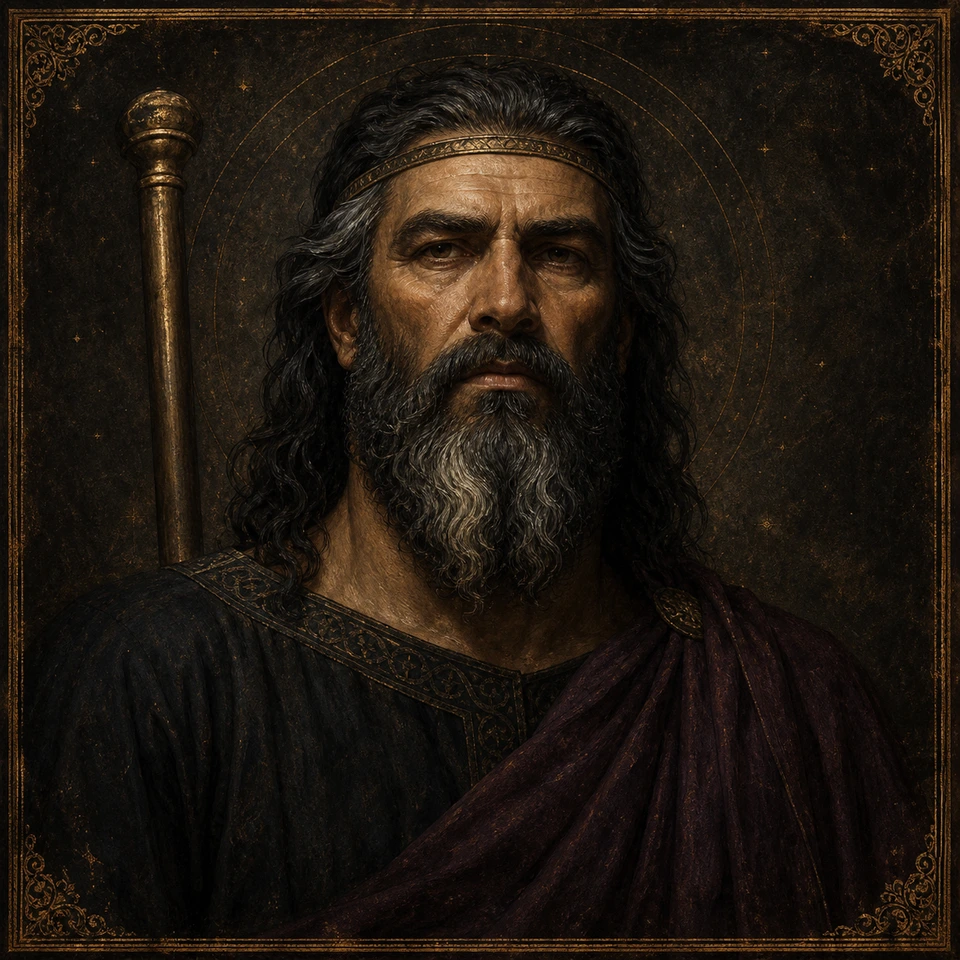
Receiving the misty darkness by cosmic lot, Hades reigns over the ancient underworld as the son of Cronus and Rhea. He binds Persephone in a coercive marriage tradition and commands local worship under the names Plouton and Clymenus.
Overview
Hades is easier to recognize than to see clearly. The English name covers Greek ᾍδης, Hā́idēs, a divine ruler and the realm beneath his authority. Archaic poetry does not make him death itself. Thanatos remains a separate figure. Nor does the Iliad give him the whole earth. Poseidon recalls a division by lot: Zeus receives the sky, Poseidon the sea, and Hades the misty darkness, while earth and Olympus remain common.
His story begins inside the violent family of Cronus and Rhea. Cronus swallows Hades with four siblings in the hope of defeating succession. Zeus survives, the swallowed children return, and the younger gods make war on the Titans. Pseudo-Apollodorus adds a memorable weapon gift before the battle: the Cyclopes give Hades a helmet. After victory, the three brothers receive their shares. The ruler below is therefore neither an alien invader nor an exile from the Greek divine family. He stands inside its central struggle for order.
The Homeric Hymn to Demeter gives him his longest and most difficult early role. With Zeus’s consent, Hades rises from the opened earth and carries Persephone away while she cries out. The seizure is coercive. Demeter’s search ends not in resignation but in famine severe enough to threaten mortal life and the gods’ honors. Hermes descends with Zeus’s command. Hades agrees to release Persephone, then gives her pomegranate seed so that she cannot remain above forever. The settlement divides her residence, restores growth, and leaves the violence that began it fully visible.
Other myths test the borders of his kingdom. Heracles wounds Hades at Pylos, sending the suffering god to Olympus for Paean’s treatment. In the Cerberus labor, Hades grants permission only if Heracles masters the guardian without weapons. Orpheus gains a conditional release for Eurydice and loses her when he turns too soon. These are not stories of an all-powerful devil. They are stories of jurisdiction, injury, negotiation, and exceptional passage.
Cult evidence is scarce compared with poetry, but it is real. Pausanias describes a temple and enclosure at Elis opened once each year, with entry limited to the priest. At Hermione, sacrifice is made to Clymenus, whom Pausanias identifies as a title of the king beneath the earth. Nearby are precincts called Clymenus, Pluto, and the Acherusian Lake. Near Argos, wooden images of Kore, Plouton, and Demeter stand together in a sanctuary.
Art gives this ruler a human royal form. A British Museum amphora shows a mature bearded god seated in fillet, long chiton, himation, and with a sceptre as Persephone returns. An Apulian hydria at the Met gives his chariot the central place in the abduction. Pausanias describes Plouton holding a key on the table by Colotes. These objects are far removed from horns, pitchforks, fire, and skull-strewn fantasy.
Greek Plouton belongs to the god’s historical development, especially where wealth, the earth, Demeter, and Kore come forward. It should not be confused with the planet Pluto or used to erase Roman Dis Pater and Orcus. Later art, literature, and living devotion require their own accountable sources; ancient grief, wealth, marriage, and death themes are not evidence for a single modern practice. The clearest account keeps the god’s names, places, coercive myths, rare cult, and present evidence limits in honest tension.
Canonical identity
Canonical Identity
Hades commands the ancient underworld, bearing the dual identity of the divine king and the geographic realm he rules. Literary context dictates whether a poet is referring to the god, the location, or a deliberate thematic overlap between the two. He is absolutely distinct from Thanatos, the actual personification of death, and he must not be conflated with the Christian Devil or the medieval concept of Hell. While the Greek Plouton is deeply tied to his historical development, the Roman figures Pluto, Dis Pater, and Orcus operate within their own independent religious frameworks. The Homeric Hymn applies the titles Aidoneus and Polydegmon (Host or Receiver of Many), and Pausanias identifies Clymenus as a specific local title used at Hermione.
Linguistic Identity
Hades derives from the Greek ᾍδης, transliterated as Hāidēs. A qualified fifth-century BC Attic reconstruction estimates the pronunciation as /háːi̯.dɛːs/ (approximately HYE-dehss). This guide serves strictly as an approximation, as English cannot flawlessly reproduce the original vowel length, diphthong, or specific pitch contour.
Sources and evidence
TEXTUAL · Supported
The Greek headword is ᾍδης, transliterated Hā́idēs, with a qualified fifth-century BC Attic reconstruction /háːi̯.dɛːs/.
- Source
- Wiktionary contributors, ᾍδης
- Reviewed edition
- Live entry for ᾍδης reviewed 2026-08-30 · Wiktionary
- Exact locator
- Entry ᾍδης · Section Ancient Greek pronunciation
- Scope
- Classical Greece · Attica
- Authority
- collaborative historical lexicon
- Certainty
- Qualified historical reconstruction
The readable guide cannot reproduce vowel length, diphthong, or pitch accent exactly.
Open exact reviewed sourceTEXTUAL · Supported
Ancient Greek Hades can name the divine ruler or the underworld realm, and the Iliadic context determines which sense is active.
- Source
- Homer; Monro and Allen Greek edition with edition-specific translations, Iliad (1920)
- Reviewed edition
- Monro and Allen Greek edition represented by the Perseus CTS corpus, Oxford, 1908-1920 · edited by David Binning Monro and Thomas William Allen · Perseus Digital Library / Scaife ATLAS
- Exact locator
- Book 15 · Line 187-193
- Scope
- Archaic Greece · Ancient Greece
- Authority
- primary epic witness
- Certainty
- Certain within the named witness
The god and his allotted realm are related without becoming interchangeable in every sentence.
Open exact reviewed sourceTEXTUAL · Supported
The Homeric Hymn to Demeter calls Hades Polydegmon, Host or Receiver of Many, and Aidoneus.
- Source
- Anonymous Homeric Hymns; edited and translated by Hugh G. Evelyn-White, Homeric Hymns (1914)
- Reviewed edition
- Hugh G. Evelyn-White edition and English translation in Hesiod, the Homeric Hymns and Homerica, 1914 · translated by Hugh G. Evelyn-White · edited by Hugh G. Evelyn-White · Perseus Digital Library / Scaife ATLAS
- Exact locator
- Hymn Homeric Hymn 2 to Demeter · Line 9-18, 31-39, 84-87
- Scope
- Archaic Greece · Ancient Greece
- Authority
- primary hymnic witness
- Certainty
- Certain within the named witness
These are hymnic forms and titles, not separate divine identities.
Open exact reviewed source5 reviewed sources for this section
- Wiktionary contributors, ᾍδηςLive collaborative lexical entry reviewed 2026-08-30 · Wiktionary
- Homer; Monro and Allen Greek edition with edition-specific translations, Iliad (1920)Perseus CTS edition corpus; Greek edition, Oxford, 1908-1920 · Perseus Digital Library / Scaife ATLAS
- Anonymous Homeric Hymns; edited and translated by Hugh G. Evelyn-White, Homeric Hymns (1914)Hesiod, the Homeric Hymns and Homerica, London and New York, 1914 · Perseus Digital Library / Scaife ATLAS
- Pausanias; Spiro Greek edition and Jones/Ormerod translation volumes, Description of Greece (1935)Perseus CTS edition corpus, 1903-1935 · Perseus Digital Library / Scaife ATLAS
- Karolina Sekita, The Figure of Hades/Plouton in Greek Beliefs of the Archaic and Classical Periods (2015)Doctoral thesis, University of Oxford, 2015 · Oxford University Research Archive
Culture, tradition, period, and place
Hades belongs to ancient Greek religion across a long, uneven body of evidence. Archaic epic gives genealogy, jurisdiction, injury, and divine conflict. The Homeric Hymn to Demeter makes him Persephone’s abductor, husband, and the ruler whose settlement is broken open by Demeter’s famine. Archaic and Classical pottery gives him an adult royal body. Later mythography gathers descents by Heracles and Orpheus, while Pausanias preserves local cult landscapes centuries after the early poems.
Place changes the god’s presentation. Elis has a precinct and temple with rare access. Hermione names Clymenus and Pluto near Demeter Chthonia and an Acherusian landscape. Argive Mysia groups wooden images of Demeter, Kore, and Plouton. Taenarum becomes a descent point in the Cerberus labor. None of these places supplies a universal map of the dead or one uniform Hades cult.
Sources and evidence
TEXTUAL · Supported
Hades is attested in Archaic epic and hymn, Archaic and Classical visual culture, later mythography, and Roman-period descriptions of Greek cult.
- Source
- Pausanias; Spiro Greek edition and Jones/Ormerod translation volumes, Description of Greece (1935)
- Reviewed edition
- Spiro Greek edition and Jones/Ormerod English volumes represented by the Perseus CTS corpus, 1903-1935 · translated by W. H. S. Jones and H. A. Ormerod, volume-dependent · edited by Friedrich Spiro for the Greek edition · Perseus Digital Library / Scaife ATLAS
- Exact locator
- Book 2 and 6 · Chapter 18, 35, and 25 · Section 2.18.3; 2.35.9-10; 6.25.2-3
- Scope
- Greek religion under Roman imperial rule · Ancient Greece
- Authority
- ancient regional cult witness
- Certainty
- Composite diachronic scope supported by the cited primary and material witnesses
Each local or chronological form remains source-specific.
Open exact reviewed source7 reviewed sources for this section
- Hesiod; edited and translated by Hugh G. Evelyn-White, Theogony (1914)Hesiod, the Homeric Hymns and Homerica, London and New York, 1914 · Perseus Digital Library / Scaife ATLAS
- Homer; Monro and Allen Greek edition with edition-specific translations, Iliad (1920)Perseus CTS edition corpus; Greek edition, Oxford, 1908-1920 · Perseus Digital Library / Scaife ATLAS
- Anonymous Homeric Hymns; edited and translated by Hugh G. Evelyn-White, Homeric Hymns (1914)Hesiod, the Homeric Hymns and Homerica, London and New York, 1914 · Perseus Digital Library / Scaife ATLAS
- Pausanias; Spiro Greek edition and Jones/Ormerod translation volumes, Description of Greece (1935)Perseus CTS edition corpus, 1903-1935 · Perseus Digital Library / Scaife ATLAS
- Pseudo-Apollodorus; edited and translated by James G. Frazer, Library (1921)Harvard University Press and William Heinemann edition, 1921 · Perseus Digital Library / Scaife ATLAS
- British Museum, British Museum CollectionLive official museum collection · British Museum
- The Metropolitan Museum of Art, Open Access Collection and Collection APILive collection data and eligible public-domain images · The Metropolitan Museum of Art
Historical development
Archaic poetry does not introduce a horned lord of punishment. It introduces a son of Cronus, a wounded god capable of suffering, and a brother whose allotted share is the misty darkness. The Demeter hymn then builds a marriage crisis around him. Its many-name diction and the title Receiver of Many already show that naming this ruler could carry weight.
Classical and later evidence expands the range. Plouton language brings wealth and the earth into view, local titles such as Clymenus appear in cult, and artworks give the ruler a sceptre, a key, a throne, or a place beside Persephone. Sekita’s specialist study argues that Hades and Plouton belong to the same Greek divine history while preserving shifts of name, cult, and imagery. Pausanias and Pseudo-Apollodorus are later witnesses, valuable precisely because they show what endured and what changed.
Sources and evidence
TEXTUAL · Supported
Sekita argues from literary, epigraphic, cultic, and material evidence that Hades and Plouton are historically connected forms of the Greek underworld ruler, with Plouton carrying a strong earth-and-wealth emphasis.
- Source
- Karolina Sekita, The Figure of Hades/Plouton in Greek Beliefs of the Archaic and Classical Periods (2015)
- Reviewed edition
- Karolina Sekita, University of Oxford doctoral thesis, 2015 · Oxford University Research Archive
- Exact locator
- Entry Repository abstract and item description
- Scope
- Modern classical scholarship
- Authority
- specialist modern scholarship
- Certainty
- Specialist thesis claim, retained as a scholarly interpretation
This modern interpretation does not erase local name, period, or iconographic differences.
Open exact reviewed sourceRITUAL ATTESTED · Supported
At Hermione, Pausanias interprets Clymenus as a title of the ruler beneath the earth and reports sacrifice at the title’s temple.
- Source
- Pausanias; Spiro Greek edition and Jones/Ormerod translation volumes, Description of Greece (1935)
- Reviewed edition
- Spiro Greek edition and Jones/Ormerod English volumes represented by the Perseus CTS corpus, 1903-1935 · translated by W. H. S. Jones and H. A. Ormerod, volume-dependent · edited by Friedrich Spiro for the Greek edition · Perseus Digital Library / Scaife ATLAS
- Exact locator
- Book 2 · Chapter 35 · Section 9-10
- Scope
- Greek religion under Roman imperial rule · Hermione in the Argolid
- Authority
- ancient regional cult witness
- Certainty
- Certain within the named witness
The interpretation is explicitly Pausanias’s and remains attached to Hermione.
Open exact reviewed source8 reviewed sources for this section
- Hesiod; edited and translated by Hugh G. Evelyn-White, Theogony (1914)Hesiod, the Homeric Hymns and Homerica, London and New York, 1914 · Perseus Digital Library / Scaife ATLAS
- Homer; Monro and Allen Greek edition with edition-specific translations, Iliad (1920)Perseus CTS edition corpus; Greek edition, Oxford, 1908-1920 · Perseus Digital Library / Scaife ATLAS
- Anonymous Homeric Hymns; edited and translated by Hugh G. Evelyn-White, Homeric Hymns (1914)Hesiod, the Homeric Hymns and Homerica, London and New York, 1914 · Perseus Digital Library / Scaife ATLAS
- Pausanias; Spiro Greek edition and Jones/Ormerod translation volumes, Description of Greece (1935)Perseus CTS edition corpus, 1903-1935 · Perseus Digital Library / Scaife ATLAS
- Pseudo-Apollodorus; edited and translated by James G. Frazer, Library (1921)Harvard University Press and William Heinemann edition, 1921 · Perseus Digital Library / Scaife ATLAS
- Karolina Sekita, The Figure of Hades/Plouton in Greek Beliefs of the Archaic and Classical Periods (2015)Doctoral thesis, University of Oxford, 2015 · Oxford University Research Archive
- British Museum, British Museum CollectionLive official museum collection · British Museum
- The Metropolitan Museum of Art, Open Access Collection and Collection APILive collection data and eligible public-domain images · The Metropolitan Museum of Art
Attested roles and historical themes
Roles, powers, and limits
Hades rules the underworld portion allotted to him. Poseidon’s Iliadic speech gives him the misty darkness, but keeps earth and Olympus common. The hymn calls him ruler over the departed. Descent stories show that his authority includes permission, refusal, and conditions: Cerberus may be taken only under stated terms, and Eurydice may rise only if Orpheus obeys the command attached to her release.
His power is not limitless. Demeter’s withdrawal forces Zeus to negotiate Persephone’s return. Heracles can wound him, and Paean can heal him. Hades receives the dead but is not Thanatos and does not personally kill every mortal. He does not automatically govern every funeral, ghost, curse, treasure, or act of divination. Ancient severity and inescapability are not the same thing as a moral empire of evil.
Sources and evidence
TEXTUAL · Supported
Poseidon’s Iliadic speech gives Hades the misty darkness by lot, while earth and Olympus remain common to the three brothers.
- Source
- Homer; Monro and Allen Greek edition with edition-specific translations, Iliad (1920)
- Reviewed edition
- Monro and Allen Greek edition represented by the Perseus CTS corpus, Oxford, 1908-1920 · edited by David Binning Monro and Thomas William Allen · Perseus Digital Library / Scaife ATLAS
- Exact locator
- Book 15 · Line 187-193
- Scope
- Archaic Greece · Ancient Greece
- Authority
- primary epic witness
- Certainty
- Certain within the named witness
The passage defines a jurisdiction, not universal authority over earth or death.
Open exact reviewed sourceTEXTUAL · Supported
Hermes addresses Hades as ruler over the departed when demanding Persephone’s return.
- Source
- Anonymous Homeric Hymns; edited and translated by Hugh G. Evelyn-White, Homeric Hymns (1914)
- Reviewed edition
- Hugh G. Evelyn-White edition and English translation in Hesiod, the Homeric Hymns and Homerica, 1914 · translated by Hugh G. Evelyn-White · edited by Hugh G. Evelyn-White · Perseus Digital Library / Scaife ATLAS
- Exact locator
- Hymn Homeric Hymn 2 to Demeter · Line 334-359
- Scope
- Archaic Greece · Ancient Greece
- Authority
- primary hymnic witness
- Certainty
- Certain within the named witness
Rule over the dead is not the same identity as Thanatos, the personification of death.
Open exact reviewed source3 reviewed sources for this section
- Homer; Monro and Allen Greek edition with edition-specific translations, Iliad (1920)Perseus CTS edition corpus; Greek edition, Oxford, 1908-1920 · Perseus Digital Library / Scaife ATLAS
- Anonymous Homeric Hymns; edited and translated by Hugh G. Evelyn-White, Homeric Hymns (1914)Hesiod, the Homeric Hymns and Homerica, London and New York, 1914 · Perseus Digital Library / Scaife ATLAS
- Pseudo-Apollodorus; edited and translated by James G. Frazer, Library (1921)Harvard University Press and William Heinemann edition, 1921 · Perseus Digital Library / Scaife ATLAS
Epithets and titles
Poetic Epithet
Polydegmon
Πολυδέγμων · Host or Receiver of Many
Archaic Greek hymnic tradition · Archaic GreekA title used within the Demeter hymn’s underworld diction.
1 reviewed source for this section
- Anonymous Homeric Hymns; edited and translated by Hugh G. Evelyn-White, Homeric Hymns (1914)Hesiod, the Homeric Hymns and Homerica, London and New York, 1914 · Perseus Digital Library / Scaife ATLAS
Cult Epithet
Clymenus
Κλύμενος · Renowned One
Hermione in the Argolid · Cult known through Pausanias’s second-century AD descriptionPausanias interprets this as a title of the king beneath the earth and reports sacrifice at the temple.
1 reviewed source for this section
- Pausanias; Spiro Greek edition and Jones/Ormerod translation volumes, Description of Greece (1935)Perseus CTS edition corpus, 1903-1935 · Perseus Digital Library / Scaife ATLAS
Worship and cult
Direct worship is locally visible even though the literary god is far more abundant than his surviving temples. At Elis, Pausanias saw both a sacred enclosure and a temple. It opened once a year, and only the priest entered. The unusual restriction belongs to that Elean sanctuary and should be allowed to remain unusual.
Hermione gives another texture. A temple of Clymenus stood opposite Demeter Chthonia’s sanctuary, and sacrifice was made there. Pausanias understood the title as belonging to the king beneath the earth. Near Argos, a sanctuary of Mysian Demeter held images of Kore, Plouton, and Demeter. These places prevent the old claim that Hades received no cult, yet they do not authorize invented private rites or a single Greek rule for approaching him.
Sources and evidence
RITUAL ATTESTED · Supported
Pausanias reports a sacred enclosure and temple of Hades at Elis, opened once each year and entered only by the priest.
- Source
- Pausanias; Spiro Greek edition and Jones/Ormerod translation volumes, Description of Greece (1935)
- Reviewed edition
- Spiro Greek edition and Jones/Ormerod English volumes represented by the Perseus CTS corpus, 1903-1935 · translated by W. H. S. Jones and H. A. Ormerod, volume-dependent · edited by Friedrich Spiro for the Greek edition · Perseus Digital Library / Scaife ATLAS
- Exact locator
- Book 6 · Chapter 25 · Section 2-3
- Scope
- Greek religion under Roman imperial rule · Elis
- Authority
- ancient regional cult witness
- Certainty
- Certain within the named witness
This local restriction cannot be generalized to every Greek place or rite.
Open exact reviewed sourceRITUAL ATTESTED · Supported
Pausanias says the Hermionians sacrifice to Clymenus at a temple opposite Demeter Chthonia’s sanctuary.
- Source
- Pausanias; Spiro Greek edition and Jones/Ormerod translation volumes, Description of Greece (1935)
- Reviewed edition
- Spiro Greek edition and Jones/Ormerod English volumes represented by the Perseus CTS corpus, 1903-1935 · translated by W. H. S. Jones and H. A. Ormerod, volume-dependent · edited by Friedrich Spiro for the Greek edition · Perseus Digital Library / Scaife ATLAS
- Exact locator
- Book 2 · Chapter 35 · Section 9
- Scope
- Greek religion under Roman imperial rule · Hermione in the Argolid
- Authority
- ancient regional cult witness
- Certainty
- Certain within the named witness
Clymenus is treated as a local underworld-ruler title in this passage.
Open exact reviewed source1 reviewed source for this section
- Pausanias; Spiro Greek edition and Jones/Ormerod translation volumes, Description of Greece (1935)Perseus CTS edition corpus, 1903-1935 · Perseus Digital Library / Scaife ATLAS
Temples, sanctuaries, and sacred places
Elis offers the clearest named temple of Hades in the surviving description. Its enclosure, annual opening, priestly boundary, and local story tie divine presence to one community. Hermione offers a different sacred cluster: Clymenus, Pluto, Demeter Chthonia, the Acherusian Lake, and a chasm through which local tradition said Heracles brought up the hound.
At Argive Mysia, Plouton stands in cultic company with Demeter and Kore. Taenarum belongs to the later Cerberus narrative as a place of descent. The palace below, Erebus, gates, rivers, and darkness are poetic geography, not archaeological coordinates. A cave or chasm can carry local underworld meaning without proving that every opening in the earth was dedicated to Hades.
Sources and evidence
MATERIAL CULTURE · Supported
Near Argos, Pausanias saw a sanctuary of Mysian Demeter containing wooden images of Kore, Plouton, and Demeter.
- Source
- Pausanias; Spiro Greek edition and Jones/Ormerod translation volumes, Description of Greece (1935)
- Reviewed edition
- Spiro Greek edition and Jones/Ormerod English volumes represented by the Perseus CTS corpus, 1903-1935 · translated by W. H. S. Jones and H. A. Ormerod, volume-dependent · edited by Friedrich Spiro for the Greek edition · Perseus Digital Library / Scaife ATLAS
- Exact locator
- Book 2 · Chapter 18 · Section 3
- Scope
- Greek religion under Roman imperial rule · Ancient Greece
- Authority
- ancient regional cult witness
- Certainty
- Certain within the named witness
The grouped images establish local cult presence without making all three figures interchangeable.
Open exact reviewed sourceTEXTUAL · Supported
Pausanias reports fenced places at Hermione named for Clymenus, Pluto, and the Acherusian Lake, with a chasm connected to Heracles’ ascent with the hound.
- Source
- Pausanias; Spiro Greek edition and Jones/Ormerod translation volumes, Description of Greece (1935)
- Reviewed edition
- Spiro Greek edition and Jones/Ormerod English volumes represented by the Perseus CTS corpus, 1903-1935 · translated by W. H. S. Jones and H. A. Ormerod, volume-dependent · edited by Friedrich Spiro for the Greek edition · Perseus Digital Library / Scaife ATLAS
- Exact locator
- Book 2 · Chapter 35 · Section 10
- Scope
- Greek religion under Roman imperial rule · Hermione in the Argolid
- Authority
- ancient regional cult witness
- Certainty
- Certain within the named witness
The geography is local and combines cult place with local myth.
Open exact reviewed source2 reviewed sources for this section
- Pausanias; Spiro Greek edition and Jones/Ormerod translation volumes, Description of Greece (1935)Perseus CTS edition corpus, 1903-1935 · Perseus Digital Library / Scaife ATLAS
- Pseudo-Apollodorus; edited and translated by James G. Frazer, Library (1921)Harvard University Press and William Heinemann edition, 1921 · Perseus Digital Library / Scaife ATLAS
Festivals and processions
The annual opening of the Elean temple is the one securely timed observance here. Pausanias tells us recurrence and restriction, but not a full procession, public feast, or calendar script. Silence about those details matters. It keeps one rare opening from growing into an imaginary pan-Hellenic festival.
Hermione celebrated Demeter Chthonia, and Eleusis centered Demeter and Kore. Hades or Plouton could stand within their cultic worlds without every rite becoming a festival to him. Modern autumn dates, Halloween comparisons, and fixed underworld seasons require named contemporary communities and cannot be passed off as ancient practice.
Sources and evidence
RITUAL ATTESTED · Supported
The Elean temple’s yearly opening supplies a precise recurring observance, but Pausanias gives no procession or full festival script for Hades.
- Source
- Pausanias; Spiro Greek edition and Jones/Ormerod translation volumes, Description of Greece (1935)
- Reviewed edition
- Spiro Greek edition and Jones/Ormerod English volumes represented by the Perseus CTS corpus, 1903-1935 · translated by W. H. S. Jones and H. A. Ormerod, volume-dependent · edited by Friedrich Spiro for the Greek edition · Perseus Digital Library / Scaife ATLAS
- Exact locator
- Book 6 · Chapter 25 · Section 2
- Scope
- Greek religion under Roman imperial rule · Elis
- Authority
- ancient regional cult witness
- Certainty
- Certain within the named witness
Annual recurrence is secure; further ceremonial detail is not.
Open exact reviewed source1 reviewed source for this section
- Pausanias; Spiro Greek edition and Jones/Ormerod translation volumes, Description of Greece (1935)Perseus CTS edition corpus, 1903-1935 · Perseus Digital Library / Scaife ATLAS
Offerings, votives, and ritual evidence
Pausanias attests sacrifice to Clymenus at Hermione and priestly access at Elis, but the selected passages do not name a universal list of foods, drinks, incense, colors, or dangerous actions for Hades. The proper boundary is narrow: sacrifice existed in a local cult, while its substances and full performance remain unspecified here.
The pomegranate seed is a deed inside the Demeter hymn. Hades gives it to Persephone so that she will not remain forever above. It is not described as an offering made to him. Coins for the dead, black animals, funerary meals, curse tablets, and libations all require their own evidence before they can be placed in his hands. A descent story is not a ritual manual.
Sources and evidence
RITUAL ATTESTED · Supported
The Elean and Hermionian passages attest priestly access and sacrifice but do not name a universal Hades offering menu.
- Source
- Pausanias; Spiro Greek edition and Jones/Ormerod translation volumes, Description of Greece (1935)
- Reviewed edition
- Spiro Greek edition and Jones/Ormerod English volumes represented by the Perseus CTS corpus, 1903-1935 · translated by W. H. S. Jones and H. A. Ormerod, volume-dependent · edited by Friedrich Spiro for the Greek edition · Perseus Digital Library / Scaife ATLAS
- Exact locator
- Book 2 and 6 · Chapter 35 and 25 · Section 2.35.9; 6.25.2
- Scope
- Greek religion under Roman imperial rule · Ancient Greece
- Authority
- ancient regional cult witness
- Certainty
- Secure negative limit on the cited passages
No food, incense, mineral, or dangerous practice is supplied beyond what the passages actually state.
Open exact reviewed source2 reviewed sources for this section
- Pausanias; Spiro Greek edition and Jones/Ormerod translation volumes, Description of Greece (1935)Perseus CTS edition corpus, 1903-1935 · Perseus Digital Library / Scaife ATLAS
- Anonymous Homeric Hymns; edited and translated by Hugh G. Evelyn-White, Homeric Hymns (1914)Hesiod, the Homeric Hymns and Homerica, London and New York, 1914 · Perseus Digital Library / Scaife ATLAS
Iconography and material culture
Ancient art presents a ruler, not a devil. British Museum amphora 1848,0619.3 shows the underworld god seated with beard, long tresses, fillet, embroidered chiton, himation, and sceptre as Persephone returns. The Met’s Apulian hydria 07.128.1 places his chariot at the center of the abduction amid Zeus, Demeter, Hecate, Athena, Aphrodite, and Eros.
Pausanias describes a key held by Plouton on the gold-and-ivory table made by Colotes. Sceptre and key can therefore be historically grounded when their object and date are named. Cerberus belongs to narrative guardianship. A horn of plenty belongs especially to Plouton’s developing imagery and needs its own dated object. Pitchforks, flames, skull thrones, red skin, and horns belong to much later infernal conventions.
Sources and evidence
MATERIAL CULTURE · Supported
British Museum amphora 1848,0619.3 presents the underworld ruler seated, mature and bearded, in fillet, long chiton, himation, and with a sceptre.
- Source
- British Museum, British Museum Collection
- Reviewed edition
- Live record-level official museum collection · British Museum
- Exact locator
- MuseumObjectId 1848,0619.3 (B261) · RecordUrl https://www.britishmuseum.org/collection/object/G_1848-0619-3
- Scope
- Archaic Greece · Attica
- Authority
- institutional museum description
- Certainty
- Certain within the named witness
The object supports ruler iconography and a return-of-Persephone scene.
Open exact reviewed sourceMATERIAL CULTURE · Supported
The Met’s Apulian hydria 07.128.1, about 340-330 BC, places Hades’ chariot prominently in the abduction of Persephone amid named gods.
- Source
- The Metropolitan Museum of Art, Open Access Collection and Collection API
- Reviewed edition
- Live collection records and API; eligible Open Access objects only · The Metropolitan Museum of Art
- Exact locator
- MuseumObjectId 07.128.1 · RecordUrl https://www.metmuseum.org/art/collection/search/247597
- Scope
- Classical Greece · Ancient Greece
- Authority
- institutional museum description
- Certainty
- Certain within the named witness
This South Italian vessel gives a later visual formulation of the abduction narrative.
Open exact reviewed sourceMATERIAL CULTURE · Supported
Pausanias describes Pluto holding a key in the gold-and-ivory table made by Colotes at Olympia.
- Source
- Pausanias; Spiro Greek edition and Jones/Ormerod translation volumes, Description of Greece (1935)
- Reviewed edition
- Spiro Greek edition and Jones/Ormerod English volumes represented by the Perseus CTS corpus, 1903-1935 · translated by W. H. S. Jones and H. A. Ormerod, volume-dependent · edited by Friedrich Spiro for the Greek edition · Perseus Digital Library / Scaife ATLAS
- Exact locator
- Book 5 · Chapter 20 · Section 3
- Scope
- Greek religion under Roman imperial rule · Elis
- Authority
- ancient regional cult witness
- Certainty
- Certain within the named witness
The key belongs to this identified artwork and should not be projected onto every depiction.
Open exact reviewed source4 reviewed sources for this section
- British Museum, British Museum CollectionLive official museum collection · British Museum
- The Metropolitan Museum of Art, Open Access Collection and Collection APILive collection data and eligible public-domain images · The Metropolitan Museum of Art
- Pausanias; Spiro Greek edition and Jones/Ormerod translation volumes, Description of Greece (1935)Perseus CTS edition corpus, 1903-1935 · Perseus Digital Library / Scaife ATLAS
- Pseudo-Apollodorus; edited and translated by James G. Frazer, Library (1921)Harvard University Press and William Heinemann edition, 1921 · Perseus Digital Library / Scaife ATLAS
Animals, plants, and embodied forms
Cerberus is the guardian whom Heracles must master under Hades’ condition. That makes the hound central to a major descent story, but it does not establish every dog as sacred to Hades. No source used here gives the god an animal embodiment or a universal sacred species.
Narcissus opens the abduction scene, and pomegranate seed secures Persephone’s continuing return below. Both are powerful narrative plants. Neither becomes a general Hades offering merely by proximity. Cypress, poplar, mint, asphodel, grain, and other funerary or underworld plants need direct local or ritual evidence before they enter an ancient correspondence.
Sources and evidence
TEXTUAL · Supported
Pseudo-Apollodorus says Hades permits Heracles to take Cerberus only if the hero masters the guardian without weapons.
- Source
- Pseudo-Apollodorus; edited and translated by James G. Frazer, Library (1921)
- Reviewed edition
- James G. Frazer edition and English translation, Harvard University Press and William Heinemann, 1921 · translated by James G. Frazer · edited by James G. Frazer · Perseus Digital Library / Scaife ATLAS
- Exact locator
- Book 2 · Chapter 5 · Section 12
- Scope
- Greek religion under Roman imperial rule · Taenarum in Laconia
- Authority
- ancient mythographic synthesis
- Certainty
- Certain within the named witness
Cerberus is a mythic guardian, not proof that all dogs were sacred to Hades.
Open exact reviewed sourceTEXTUAL · Supported
In the Homeric Hymn, Hades secretly gives Persephone pomegranate seed before her return so that she will not remain above forever.
- Source
- Anonymous Homeric Hymns; edited and translated by Hugh G. Evelyn-White, Homeric Hymns (1914)
- Reviewed edition
- Hugh G. Evelyn-White edition and English translation in Hesiod, the Homeric Hymns and Homerica, 1914 · translated by Hugh G. Evelyn-White · edited by Hugh G. Evelyn-White · Perseus Digital Library / Scaife ATLAS
- Exact locator
- Hymn Homeric Hymn 2 to Demeter · Line 360-374, 398-413
- Scope
- Archaic Greece · Ancient Greece
- Authority
- primary hymnic witness
- Certainty
- Certain within the named witness
The seed drives the residence settlement; the hymn does not present it as an offering made to Hades.
Open exact reviewed source2 reviewed sources for this section
- Pseudo-Apollodorus; edited and translated by James G. Frazer, Library (1921)Harvard University Press and William Heinemann edition, 1921 · Perseus Digital Library / Scaife ATLAS
- Anonymous Homeric Hymns; edited and translated by Hugh G. Evelyn-White, Homeric Hymns (1914)Hesiod, the Homeric Hymns and Homerica, London and New York, 1914 · Perseus Digital Library / Scaife ATLAS
Relationships and genealogy
Hesiod makes Hades a child of Cronus and Rhea. His siblings are Hestia, Demeter, Hera, Poseidon, and Zeus. Cronus swallows the children, Rhea saves Zeus, and the recovered siblings become the younger coalition in the succession war. The Iliadic division later gives Zeus sky, Poseidon sea, and Hades the misty darkness.
Persephone is his wife and queen in the Demeter hymn, but the marriage begins in seizure with Zeus’s consent and Persephone’s cries. Demeter’s grief and famine force the return settlement. Hermes becomes the envoy who leads Persephone upward. Cerberus is a guardian, not a child. Heracles, Orpheus, Theseus, and Pirithous meet Hades through particular acts of descent, challenge, petition, or punishment rather than permanent companionship.
Sources and evidence
TEXTUAL · Supported
Hesiod names Hades among the children of Rhea and Cronus, beside Hestia, Demeter, Hera, Poseidon, and Zeus.
- Source
- Hesiod; edited and translated by Hugh G. Evelyn-White, Theogony (1914)
- Reviewed edition
- Hugh G. Evelyn-White edition and English translation in Hesiod, the Homeric Hymns and Homerica, 1914 · translated by Hugh G. Evelyn-White · edited by Hugh G. Evelyn-White · Perseus Digital Library / Scaife ATLAS
- Exact locator
- Entry Theogony · Line 453-458
- Scope
- Archaic Greece · Ancient Greece
- Authority
- primary literary witness
- Certainty
- Certain within the named witness
The genealogy establishes kinship but does not transfer one sibling’s functions to another.
Open exact reviewed sourceTEXTUAL · Supported
The Homeric Hymn presents Persephone as Hades’ unwillingly taken wife and later underworld queen within the negotiated settlement.
- Source
- Anonymous Homeric Hymns; edited and translated by Hugh G. Evelyn-White, Homeric Hymns (1914)
- Reviewed edition
- Hugh G. Evelyn-White edition and English translation in Hesiod, the Homeric Hymns and Homerica, 1914 · translated by Hugh G. Evelyn-White · edited by Hugh G. Evelyn-White · Perseus Digital Library / Scaife ATLAS
- Exact locator
- Hymn Homeric Hymn 2 to Demeter · Line 1-39, 340-374, 398-469
- Scope
- Archaic Greece · Ancient Greece
- Authority
- primary hymnic witness
- Certainty
- Certain within the named witness
Marriage language does not remove the poem’s explicit coercion and grief.
Open exact reviewed source4 reviewed sources for this section
- Hesiod; edited and translated by Hugh G. Evelyn-White, Theogony (1914)Hesiod, the Homeric Hymns and Homerica, London and New York, 1914 · Perseus Digital Library / Scaife ATLAS
- Homer; Monro and Allen Greek edition with edition-specific translations, Iliad (1920)Perseus CTS edition corpus; Greek edition, Oxford, 1908-1920 · Perseus Digital Library / Scaife ATLAS
- Anonymous Homeric Hymns; edited and translated by Hugh G. Evelyn-White, Homeric Hymns (1914)Hesiod, the Homeric Hymns and Homerica, London and New York, 1914 · Perseus Digital Library / Scaife ATLAS
- Pseudo-Apollodorus; edited and translated by James G. Frazer, Library (1921)Harvard University Press and William Heinemann edition, 1921 · Perseus Digital Library / Scaife ATLAS
Actual myths and source variants
Seven narratives show different edges of Hades. Cronus swallows him in the succession cycle. Pseudo-Apollodorus gives him the Cyclopes’ helmet before the Titans fall. The Iliad gives the three brothers their shares. The Demeter hymn makes Hades the violent agent of abduction and a party to the divided residence that follows. Heracles later wounds him at Pylos in a brief epic allusion.
Two descents test his jurisdiction. Heracles may bring Cerberus above only after accepting the weaponless condition, and the guardian must return. Orpheus wins a conditional release for Eurydice but looks back too soon. These stories do not form a single seamless biography. Hesiod leaves the mechanism of the swallowed children’s recovery unnamed, Pseudo-Apollodorus adds a drug and a helmet, and the Demeter hymn preserves a long coercive crisis that later retellings often soften.
Sources and evidence
TEXTUAL · Supported
The Homeric Hymn makes Hades Persephone’s abductor and states that Zeus consented to the seizure.
- Source
- Anonymous Homeric Hymns; edited and translated by Hugh G. Evelyn-White, Homeric Hymns (1914)
- Reviewed edition
- Hugh G. Evelyn-White edition and English translation in Hesiod, the Homeric Hymns and Homerica, 1914 · translated by Hugh G. Evelyn-White · edited by Hugh G. Evelyn-White · Perseus Digital Library / Scaife ATLAS
- Exact locator
- Hymn Homeric Hymn 2 to Demeter · Line 1-39
- Scope
- Archaic Greece · Ancient Greece
- Authority
- primary hymnic witness
- Certainty
- Certain within the named witness
The act is not rewritten as consensual courtship.
Open exact reviewed sourceTEXTUAL · Supported
Pseudo-Apollodorus records Orpheus persuading the ruler below to release Eurydice under a condition that Orpheus breaks.
- Source
- Pseudo-Apollodorus; edited and translated by James G. Frazer, Library (1921)
- Reviewed edition
- James G. Frazer edition and English translation, Harvard University Press and William Heinemann, 1921 · translated by James G. Frazer · edited by James G. Frazer · Perseus Digital Library / Scaife ATLAS
- Exact locator
- Book 1 · Chapter 3 · Section 2
- Scope
- Greek religion under Roman imperial rule · Ancient Greece
- Authority
- ancient mythographic synthesis
- Certainty
- Certain within the named witness
This concise Greek account remains separate from expanded Latin variants.
Open exact reviewed sourceTEXTUAL · Supported
In the Iliad, Heracles wounds Hades at Pylos, and Hades travels to Olympus where Paean treats the wound.
- Source
- Homer; Monro and Allen Greek edition with edition-specific translations, Iliad (1920)
- Reviewed edition
- Monro and Allen Greek edition represented by the Perseus CTS corpus, Oxford, 1908-1920 · edited by David Binning Monro and Thomas William Allen · Perseus Digital Library / Scaife ATLAS
- Exact locator
- Book 5 · Line 395-404
- Scope
- Archaic Greece · Ancient Greece
- Authority
- primary epic witness
- Certainty
- Certain within the named witness
The compressed allusion does not identify the battle with the Cerberus labor.
Open exact reviewed sourceTEXTUAL · Supported
Hades is one of the five children swallowed by Cronus and later brought up when Zeus overturns his father’s plan.
- Source
- Hesiod; edited and translated by Hugh G. Evelyn-White, Theogony (1914)
- Reviewed edition
- Hugh G. Evelyn-White edition and English translation in Hesiod, the Homeric Hymns and Homerica, 1914 · translated by Hugh G. Evelyn-White · edited by Hugh G. Evelyn-White · Perseus Digital Library / Scaife ATLAS
- Exact locator
- Entry Theogony · Line 453-500
- Scope
- Archaic Greece · Ancient Greece
- Authority
- primary literary witness
- Certainty
- Certain within the named witness
Hesiod names the siblings and recovery but does not name the drug found in later mythography.
Open exact reviewed sourceTEXTUAL · Supported
Pseudo-Apollodorus says the Cyclopes give Hades a helmet before the gods defeat the Titans.
- Source
- Pseudo-Apollodorus; edited and translated by James G. Frazer, Library (1921)
- Reviewed edition
- James G. Frazer edition and English translation, Harvard University Press and William Heinemann, 1921 · translated by James G. Frazer · edited by James G. Frazer · Perseus Digital Library / Scaife ATLAS
- Exact locator
- Book 1 · Chapter 2 · Section 1
- Scope
- Greek religion under Roman imperial rule · Ancient Greece
- Authority
- ancient mythographic synthesis
- Certainty
- Certain within the named witness
The weapon gift belongs to this later mythographic version of the Titanomachy.
Open exact reviewed source4 reviewed sources for this section
- Hesiod; edited and translated by Hugh G. Evelyn-White, Theogony (1914)Hesiod, the Homeric Hymns and Homerica, London and New York, 1914 · Perseus Digital Library / Scaife ATLAS
- Homer; Monro and Allen Greek edition with edition-specific translations, Iliad (1920)Perseus CTS edition corpus; Greek edition, Oxford, 1908-1920 · Perseus Digital Library / Scaife ATLAS
- Anonymous Homeric Hymns; edited and translated by Hugh G. Evelyn-White, Homeric Hymns (1914)Hesiod, the Homeric Hymns and Homerica, London and New York, 1914 · Perseus Digital Library / Scaife ATLAS
- Pseudo-Apollodorus; edited and translated by James G. Frazer, Library (1921)Harvard University Press and William Heinemann edition, 1921 · Perseus Digital Library / Scaife ATLAS
Myth Library
Each myth gathers its attested participants into one source-grounded account, while distinct source traditions remain readable in their own variants.
Theogony
Cronus and the Swallowed Children
Cronus swallows five children born by Rhea, but she hides Zeus and gives Cronus a wrapped stone; Zeus survives, the children return, and the feared succession begins.
- Role in this profile
- swallowed son of Cronus and Rhea who returns with his divine siblings
- Place scope
- Ancient Greece · Crete · Olympia · Arcadia
- Witnesses
- 4
- Variants
- 4
Hymnic Cycle
Demeter, Persephone, and the Eleusinian Settlement
Persephone gathers flowers with Tyche and other divine companions before she is seized by Hades with Zeus's consent, and Demeter's search brings her to Eleusis. After an interrupted attempt to make Demophon deathless, Demeter reveals herself, demands a temple, and withholds the seed until famine forces divine negotiation. Hades obeys the release order but secretly puts pomegranate seed in Persephone’s mouth; Zeus then assigns her a divided residence, and Hecate becomes her companion before Demeter teaches the Eleusinian rites.
- Role in this profile
- abductor and underworld husband who gives Persephone pomegranate seed before her return
- Place scope
- Eleusis · Attica
- Witnesses
- 2
- Variants
- 2
Cosmic Allotment
Division of the Cosmos
In the Iliad, Poseidon recalls how the three sons of Cronus cast lots: Zeus received the sky, Poseidon the sea, and Hades the misty darkness, while earth and Olympus remained common to all.
- Role in this profile
- brother who receives the misty darkness by lot
- Place scope
- Ancient Greece
- Witnesses
- 1
- Variants
- 1
Heroic Descent
Heracles and Cerberus
For his final labor, Heracles descends through Taenarum, encounters the captives Theseus and Pirithous, spares Menoetes at Persephone’s request, and brings Cerberus above only after Hades imposes weaponless mastery as the condition.
- Role in this profile
- underworld ruler who permits the capture of Cerberus only under a weaponless condition
- Place scope
- Taenarum in Laconia
- Witnesses
- 1
- Variants
- 1
Compressed Epic Allusion
Heracles Wounds Hades at Pylos
Dione recalls how Heracles struck Hades with an arrow at Pylos. The wounded god went to Olympus, where Paean eased the divine injury with healing substances.
- Role in this profile
- underworld ruler wounded by Heracles who seeks healing on Olympus
- Place scope
- Ancient Greece
- Witnesses
- 1
- Variants
- 1
Descent And Failed Return
Orpheus and Eurydice in the Underworld
Orpheus descends among the dead and gains a conditional release for Eurydice, but loses her when the condition is broken. Pseudo-Apollodorus gives a compressed Greek account, while Virgil and Ovid develop materially different Latin versions of the death, appeal, command, backward look, and aftermath.
- Role in this profile
- Greek underworld ruler persuaded to allow Eurydice's conditional return
- Place scope
- Ancient Greece
- Witnesses
- 1
- Variants
- 1
Cosmic
The Titanomachy and Fall of the Titans
The children of Cronus fight the Titans for ten years; Gaia's counsel brings the Hundred-Handers into Zeus' alliance, and their force breaks the older generation and ends Cronus' reign.
- Role in this profile
- younger god armed with the Cyclopes’ helmet before the Titans are defeated
- Place scope
- Ancient Greece
- Witnesses
- 2
- Variants
- 2
Attempted Abduction And Punishment
Theseus, Pirithous, and the Attempt on Persephone
Theseus and Pirithous pledge to marry daughters of Zeus, descend to obtain Persephone for Pirithous, and are fixed to the Chair of Forgetfulness; Pirithous remains when Heracles later reaches them.
- Role in this profile
- underworld ruler who seats the intruders on the Chair of Forgetfulness
- Place scope
- Greek underworld
- Witnesses
- 2
- Variants
- 1
Local Etiological Transformation
Minthe and Kore
Strabo locates a mountain named for Minthe near Triphylian Pylos and records that the nymph became Hades’ concubine, was trampled by Kore, and became garden mint.
- Role in this profile
- underworld ruler whose concubinage with Minthe provokes the rivalry
- Place scope
- Triphylian Pylos and Mount Minthe
- Witnesses
- 1
- Variants
- 1
Capture Of Death And Mortal Escape
Sisyphus Binds Thanatos
Sisyphus binds Thanatos and halts human death until the captive power is freed, with Hades and Ares preserved as conflicting release agents.
- Role in this profile
- frees Thanatos in the ToposText translation and later releases Sisyphus to seek unpaid funerary dues
- Place scope
- Corinth
- Witnesses
- 2
- Variants
- 2
Heroic Labor Cycle
The Twelve Labors of Heracles
Pseudo-Apollodorus orders ten commands into twelve credited labors after Eurystheus rejects the Hydra and Augean tasks. The cycle depends on companions, divine conditions, bargaining, travel, strategy, and violence as much as bodily strength.
- Role in this profile
- permits Cerberus to be taken only without weapons
- Place scope
- Ancient Greece
- Witnesses
- 1
- Variants
- 1
Equivalences, syncretisms, and identity boundaries
Greek Hades and Greek Plouton belong to one underworld ruler’s historical development, but their emphases can differ. Hades can evoke the unseen ruler and his realm. Plouton, the wealthy one, becomes prominent in cult and art tied to earth, abundance, Demeter, and Kore. Clymenus is a local title at Hermione, not a separate universal god in Pausanias’s interpretation.
Roman Pluto, Dis Pater, and Orcus are not casual aliases for every Greek passage. Historical translation or equation can connect them while their language and cult remain Roman. Hades is not Thanatos, Satan, Hel, Osiris, Ereshkigal, or any other figure simply because death or an underworld appears nearby. Similar office does not prove identity.
Sources and evidence
TEXTUAL · Supported
Modern specialist scholarship treats Hades and Plouton as historically connected Greek forms whose naming and emphases shift by context, rather than as two unrelated gods or a timeless single label.
- Source
- Karolina Sekita, The Figure of Hades/Plouton in Greek Beliefs of the Archaic and Classical Periods (2015)
- Reviewed edition
- Karolina Sekita, University of Oxford doctoral thesis, 2015 · Oxford University Research Archive
- Exact locator
- Entry Repository abstract and item description
- Scope
- Modern classical scholarship
- Authority
- specialist modern scholarship
- Certainty
- Interpretive modern synthesis
Roman Pluto, Dis Pater, and Orcus still require separate historical treatment.
Open exact reviewed source2 reviewed sources for this section
- Karolina Sekita, The Figure of Hades/Plouton in Greek Beliefs of the Archaic and Classical Periods (2015)Doctoral thesis, University of Oxford, 2015 · Oxford University Research Archive
- Pausanias; Spiro Greek edition and Jones/Ormerod translation volumes, Description of Greece (1935)Perseus CTS edition corpus, 1903-1935 · Perseus Digital Library / Scaife ATLAS
Correspondence index
The securely grounded ancient associations are narrower than popular lists suggest. Hades has the underworld as allotted jurisdiction. Elis, Hermione, and the Argive sanctuary are historical cult places. The sceptre and the key have named material witnesses. The annual Elean opening supplies a local time. Cerberus, narcissus, and pomegranate belong to specific narratives and remain contextual.
No reviewed ancient or accountable contemporary source fixes a planet, zodiac sign, gemstone, metal, ritual color, Classical element, weekday, moon phase, compass direction, incense, offering substance, or universal magical intention. Darkness does not automatically mean black candles or a new moon. Plouton’s wealth does not automatically mean coins, gold, or prosperity workings.
Direct ancient correspondences
| Category | Direct correspondence | How and why | Evidence boundary |
|---|---|---|---|
| direction-place | Elis and Hermione as local cult placesDirect historical association | Pausanias documents Hades or his local titles at Elis and Hermione. | Ancient Cultic These are named places, not a universal compass direction. 1 reviewed source for this section
|
| festival-time | Yearly opening at ElisDirect historical association | The temple at Elis opened once each year with entry restricted to the priest. | Ancient Cultic The date and a fuller festival program are not supplied. 1 reviewed source for this section
|
| ritual-object-symbol-tool | Sceptre and key in named material witnessesDirect historical association | An Attic amphora gives the ruler a sceptre, and Pausanias describes Plouton holding a key on the table by Colotes. | Ancient Material Each attribute remains tied to its object and date. 2 reviewed sources for this section
|
Contextual evidence, not a general correspondence
| Category | Direct correspondence | How and why | Evidence boundary |
|---|---|---|---|
| plant-tree | Pomegranate and narcissus in narrative contextContextual evidence only | Pomegranate seed and narcissus shape the Persephone narrative. | Ancient Literary They remain contextual-only because the hymn does not call them sacred plants or offerings to Hades. 1 reviewed source for this section
|
| animal-embodied-form | Cerberus as narrative guardianContextual evidence only | Cerberus guards the underworld and is taken only under Hades’ condition. | Ancient Literary The guardian does not make domestic dogs a universal sacred species or embodied form of the god. 1 reviewed source for this section
|
| offering-ritual-material | Local sacrifice attested, substances unresolvedContextual evidence only | Pausanias reports sacrifice to Clymenus at Hermione without naming a universal offering substance. | Ancient Cultic Pomegranate, coins, funerary goods, and black animals are not silently reassigned to Hades. 1 reviewed source for this section
|
10 expected categories currently not evidenced
celestial-body · Not evidenced
No celestial body evidenced
No ancient or accountable contemporary source assigns Hades a planet or star.
- Layer
- Research Boundary
- Scope
- Roman Pluto and the dwarf planet Pluto are later namesakes, not Greek divine identity.
zodiac · Not evidenced
No zodiac sign evidenced
No zodiac sign is securely assigned to Hades.
- Layer
- Research Boundary
- Scope
- Underworld rulership does not create Scorpio or any other sign by resemblance.
gemstone-crystal-mineral · Not evidenced
No gemstone, crystal, or mineral evidenced
No stone or mineral is dedicated to Hades in the reviewed evidence.
- Layer
- Research Boundary
- Scope
- Subterranean location and Plouton’s wealth do not establish obsidian, onyx, coal, or precious metals.
metal-material · Not evidenced
No sacred metal evidenced
No metal is consecrated to Hades in the named ancient witnesses.
- Layer
- Research Boundary
- Scope
- The key and sceptre are object forms; their materials do not become universal rules.
color · Not evidenced
No ritual color evidenced
No ancient ritual or material witness fixes a color for Hades.
- Layer
- Research Boundary
- Scope
- Darkness in epic cannot become a black-color prescription.
classical-element · Not evidenced
No Classical element evidenced
No source assigns earth, air, fire, or water as a formal Hades correspondence.
- Layer
- Research Boundary
- Scope
- The underworld is a jurisdiction, not automatically the Classical element earth.
weekday · Not evidenced
No weekday evidenced
No weekday is securely assigned to Hades.
- Layer
- Research Boundary
- Scope
- A modern planetary weekday cannot be inferred through Roman names.
moon-phase · Not evidenced
No moon phase evidenced
No lunar phase is securely assigned to Hades.
- Layer
- Research Boundary
- Scope
- The misty darkness of his share does not imply the new moon.
incense-perfume · Not evidenced
No incense or perfume evidenced
No aromatic substance is assigned to Hades in the reviewed evidence.
- Layer
- Research Boundary
- Scope
- Incense in nearby cults cannot be inherited without direct support.
intention-magical-power · Not evidenced
No universal magical intention evidenced
No accountable source fixes death magic, wealth work, shadow work, curses, necromancy, or ancestor work as a universal Hades office.
- Layer
- Research Boundary
- Scope
- Personal devotion must remain personal or community-specific.
Sources and evidence
TEXTUAL · Supported
The strongest direct associations in the reviewed ancient evidence are Hades’ underworld jurisdiction, local cult places, ruler imagery, the sceptre, the key on one artwork, and the yearly Elean opening.
- Source
- Pausanias; Spiro Greek edition and Jones/Ormerod translation volumes, Description of Greece (1935)
- Reviewed edition
- Spiro Greek edition and Jones/Ormerod English volumes represented by the Perseus CTS corpus, 1903-1935 · translated by W. H. S. Jones and H. A. Ormerod, volume-dependent · edited by Friedrich Spiro for the Greek edition · Perseus Digital Library / Scaife ATLAS
- Exact locator
- Book 2, 5, and 6 · Chapter 18, 20, 35, and 25 · Section 2.18.3; 2.35.9-10; 5.20.3; 6.25.2-3
- Scope
- Greek religion under Roman imperial rule · Ancient Greece
- Authority
- ancient regional cult witness
- Certainty
- Supported for the named local and material contexts
Narrative flowers, fruit, and animals remain contextual unless independent cult evidence establishes more.
Open exact reviewed source8 reviewed sources for this section
- Hesiod; edited and translated by Hugh G. Evelyn-White, Theogony (1914)Hesiod, the Homeric Hymns and Homerica, London and New York, 1914 · Perseus Digital Library / Scaife ATLAS
- Homer; Monro and Allen Greek edition with edition-specific translations, Iliad (1920)Perseus CTS edition corpus; Greek edition, Oxford, 1908-1920 · Perseus Digital Library / Scaife ATLAS
- Anonymous Homeric Hymns; edited and translated by Hugh G. Evelyn-White, Homeric Hymns (1914)Hesiod, the Homeric Hymns and Homerica, London and New York, 1914 · Perseus Digital Library / Scaife ATLAS
- Pausanias; Spiro Greek edition and Jones/Ormerod translation volumes, Description of Greece (1935)Perseus CTS edition corpus, 1903-1935 · Perseus Digital Library / Scaife ATLAS
- Pseudo-Apollodorus; edited and translated by James G. Frazer, Library (1921)Harvard University Press and William Heinemann edition, 1921 · Perseus Digital Library / Scaife ATLAS
- Karolina Sekita, The Figure of Hades/Plouton in Greek Beliefs of the Archaic and Classical Periods (2015)Doctoral thesis, University of Oxford, 2015 · Oxford University Research Archive
- British Museum, British Museum CollectionLive official museum collection · British Museum
- The Metropolitan Museum of Art, Open Access Collection and Collection APILive collection data and eligible public-domain images · The Metropolitan Museum of Art
Later reception and living significance
Two ancient narratives offer very different foundations for later reception. Orpheus asks the ruler below for a conditional return and loses Eurydice when he turns too soon. Persephone’s seizure instead drives Demeter’s search, famine, divine negotiation, and a divided residence. These witnesses establish ancient stories, not a survey of later opera, poetry, theater, song, games, film, or visual art. Specific later works and trends require sources from their own periods.
Sekita’s study is modern scholarship about the historical development of Hades and Plouton, not testimony for contemporary devotion. No accountable public community has attested a broadly shared modern rite, offering pattern, or magical system. Living practice and modern artistic reception therefore remain explicit research gaps, while the ancient coercion, local cult restrictions, and separate Greek death figures remain visible.
Sources and evidence
TEXTUAL · Supported
Pseudo-Apollodorus preserves concise Greek accounts of Orpheus’s conditional descent and Heracles’s Cerberus labor; later reception requires evidence from its own period.
- Source
- Pseudo-Apollodorus; edited and translated by James G. Frazer, Library (1921)
- Reviewed edition
- James G. Frazer edition and English translation, Harvard University Press and William Heinemann, 1921 · translated by James G. Frazer · edited by James G. Frazer · Perseus Digital Library / Scaife ATLAS
- Exact locator
- Book 1 and 2 · Chapter 3 and 5 · Section 1.3.2 and 2.5.12
- Scope
- Greek religion under Roman imperial rule · Ancient Greece
- Authority
- ancient mythographic synthesis
- Certainty
- Supported for the ancient narrative foundations
The ancient witness does not support claims about modern artistic trends or contemporary devotional practice.
Open exact reviewed source4 reviewed sources for this section
- Homer; Monro and Allen Greek edition with edition-specific translations, Iliad (1920)Perseus CTS edition corpus; Greek edition, Oxford, 1908-1920 · Perseus Digital Library / Scaife ATLAS
- Anonymous Homeric Hymns; edited and translated by Hugh G. Evelyn-White, Homeric Hymns (1914)Hesiod, the Homeric Hymns and Homerica, London and New York, 1914 · Perseus Digital Library / Scaife ATLAS
- Pseudo-Apollodorus; edited and translated by James G. Frazer, Library (1921)Harvard University Press and William Heinemann edition, 1921 · Perseus Digital Library / Scaife ATLAS
- Karolina Sekita, The Figure of Hades/Plouton in Greek Beliefs of the Archaic and Classical Periods (2015)Doctoral thesis, University of Oxford, 2015 · Oxford University Research Archive
Evidence, conflicts, and research gaps
The strongest evidence comes from exact ancient passages and accessioned objects. Hesiod supplies genealogy and succession. The Iliad supplies allotted jurisdiction and the Pylos wound. The Demeter hymn supplies the abduction, marriage crisis, pomegranate, and negotiated return. Pseudo-Apollodorus supplies the helmet, Cerberus, and Orpheus in later mythographic form. Pausanias supplies named cult places and material attributes. The British Museum and Met objects give dated bodies and scenes.
Important questions remain open. The pronunciation is a qualified reconstruction. Hades, Plouton, Clymenus, and the realm-name overlap differently by text and place. Sekita’s agricultural emphasis is a significant modern argument, not a substitute for each ancient witness. No inscriptional corpus was fully extracted here, no complete regional sanctuary inventory was established, and no accountable public modern community source fixed a shared devotional or magical system.
Sources and evidence
TEXTUAL · Supported
The source tradition distinguishes Hades as a god, Hades as a place, Greek Plouton, local Clymenus, and later Roman equivalents in ways that require context rather than a single flattened identity.
- Source
- Karolina Sekita, The Figure of Hades/Plouton in Greek Beliefs of the Archaic and Classical Periods (2015)
- Reviewed edition
- Karolina Sekita, University of Oxford doctoral thesis, 2015 · Oxford University Research Archive
- Exact locator
- Entry Repository abstract and item description
- Scope
- Modern classical scholarship
- Authority
- specialist modern scholarship
- Certainty
- Specialist synthesis supported by named ancient witnesses
Exact local names and functions remain attached to their own sources.
Open exact reviewed source9 reviewed sources for this section
- Wiktionary contributors, ᾍδηςLive collaborative lexical entry reviewed 2026-08-30 · Wiktionary
- Homer; Monro and Allen Greek edition with edition-specific translations, Iliad (1920)Perseus CTS edition corpus; Greek edition, Oxford, 1908-1920 · Perseus Digital Library / Scaife ATLAS
- Anonymous Homeric Hymns; edited and translated by Hugh G. Evelyn-White, Homeric Hymns (1914)Hesiod, the Homeric Hymns and Homerica, London and New York, 1914 · Perseus Digital Library / Scaife ATLAS
- Pausanias; Spiro Greek edition and Jones/Ormerod translation volumes, Description of Greece (1935)Perseus CTS edition corpus, 1903-1935 · Perseus Digital Library / Scaife ATLAS
- Karolina Sekita, The Figure of Hades/Plouton in Greek Beliefs of the Archaic and Classical Periods (2015)Doctoral thesis, University of Oxford, 2015 · Oxford University Research Archive
- British Museum, British Museum CollectionLive official museum collection · British Museum
- The Metropolitan Museum of Art, Open Access Collection and Collection APILive collection data and eligible public-domain images · The Metropolitan Museum of Art
- Pseudo-Apollodorus; edited and translated by James G. Frazer, Library (1921)Harvard University Press and William Heinemann edition, 1921 · Perseus Digital Library / Scaife ATLAS
- Hesiod; edited and translated by Hugh G. Evelyn-White, Theogony (1914)Hesiod, the Homeric Hymns and Homerica, London and New York, 1914 · Perseus Digital Library / Scaife ATLAS
Direct connections and evidence
Explicit Source
Cronus is Hades’ father
Direct parent-child relationship only; no underworld role transfers to Cronus.
1 attestation · high confidence
- Hesiod; edited and translated by Hugh G. Evelyn-White, TheogonyHugh G. Evelyn-White edition and English translation in Hesiod, the Homeric Hymns and Homerica, 1914 · translated by Hugh G. Evelyn-White · edited by Hugh G. Evelyn-White · Perseus Digital Library / Scaife ATLAS · Archaic Greece · Ancient Greece · Entry Theogony · Line 453-458
Explicit Source
Hades is a son of Rhea
Hesiod names Rhea as Hades’ mother, and her resistance to Cronus enables the siblings’ eventual recovery.
1 attestation · high confidence
- Hesiod; edited and translated by Hugh G. Evelyn-White, TheogonyHugh G. Evelyn-White edition and English translation in Hesiod, the Homeric Hymns and Homerica, 1914 · translated by Hugh G. Evelyn-White · edited by Hugh G. Evelyn-White · Perseus Digital Library / Scaife ATLAS · Archaic Greece · Ancient Greece · Entry Theogony · Line 453-458
Explicit Source
Hades and Zeus are brothers whose shares are divided by lot
The Iliadic brothers hold different allotted shares; Zeus’s sky does not include Hades’ underworld jurisdiction.
1 attestation · high confidence
- Homer; Monro and Allen Greek edition with edition-specific translations, IliadMonro and Allen Greek edition represented by the Perseus CTS corpus, Oxford, 1908-1920 · edited by David Binning Monro and Thomas William Allen · Perseus Digital Library / Scaife ATLAS · Archaic Greece · Ancient Greece · Book 15 · Line 187-193
Explicit Source
Hades and Poseidon are brothers whose shares are divided by lot
Poseidon names Hades as a brother when distinguishing sea from the misty darkness and keeping earth and Olympus common.
1 attestation · high confidence
- Homer; Monro and Allen Greek edition with edition-specific translations, IliadMonro and Allen Greek edition represented by the Perseus CTS corpus, Oxford, 1908-1920 · edited by David Binning Monro and Thomas William Allen · Perseus Digital Library / Scaife ATLAS · Archaic Greece · Ancient Greece · Book 15 · Line 187-193
Explicit Source
The Homeric Hymn presents Persephone as Hades’ wife after coercive seizure
The marriage relation does not erase the hymn’s coercion, Persephone’s grief, or Demeter’s resistance.
1 attestation · high confidence
- Anonymous Homeric Hymns; edited and translated by Hugh G. Evelyn-White, Homeric HymnsHugh G. Evelyn-White English translation of Homeric Hymn 2, To Demeter, 1914 · translated by Hugh G. Evelyn-White · edited by Hugh G. Evelyn-White · Perseus Digital Library / Scaife ATLAS · Archaic Greece · Ancient Greece · Hymn Homeric Hymn 2 to Demeter · Line 1-39, 340-374, 398-469
Explicit Source
Hesiod names Hera and Hades in the same sibling generation of Cronus and Rhea
Theogony 453-458 gives Hera and Hades the same parents; the relationship does not imply shared cult or correspondence.
1 attestation · high confidence
- Hesiod; edited and translated by Hugh G. Evelyn-White, TheogonyHugh G. Evelyn-White edition and English translation in Hesiod, the Homeric Hymns and Homerica, 1914 · translated by Hugh G. Evelyn-White · edited by Hugh G. Evelyn-White · Perseus Digital Library / Scaife ATLAS · Archaic Greece · Ancient Greece · Entry Theogony · Line 453-458
Archive scope and classification
- Figure classification
- God or goddess · certain
- Pantheon or tradition shelf
- Greek
- Cultures
- Greek
- Traditions
- Ancient Greek religion
- Periods
- Archaic Greece, Classical Greece, Greek religion under Roman imperial rule
- Places
- Ancient Greece, Elis, Hermione in the Argolid
Identity, names, local cult, source-scoped myths, genealogy, material evidence, limits, correspondence gaps, and living reception have been reviewed.
Reviewed sources
- Hesiod; edited and translated by Hugh G. Evelyn-White, Theogony (1914)Hesiod, the Homeric Hymns and Homerica, London and New York, 1914 · Perseus Digital Library / Scaife ATLAS
- Anonymous Homeric Hymns; edited and translated by Hugh G. Evelyn-White, Homeric Hymns (1914)Hesiod, the Homeric Hymns and Homerica, London and New York, 1914 · Perseus Digital Library / Scaife ATLAS
- Homer; Monro and Allen Greek edition with edition-specific translations, Iliad (1920)Perseus CTS edition corpus; Greek edition, Oxford, 1908-1920 · Perseus Digital Library / Scaife ATLAS
- Pseudo-Apollodorus; edited and translated by James G. Frazer, Library (1921)Harvard University Press and William Heinemann edition, 1921 · Perseus Digital Library / Scaife ATLAS
- Pausanias; Spiro Greek edition and Jones/Ormerod translation volumes, Description of Greece (1935)Perseus CTS edition corpus, 1903-1935 · Perseus Digital Library / Scaife ATLAS
- The Metropolitan Museum of Art, Open Access Collection and Collection APILive collection data and eligible public-domain images · The Metropolitan Museum of Art
- British Museum, British Museum CollectionLive official museum collection · British Museum
- Wiktionary contributors, ᾍδηςLive collaborative lexical entry reviewed 2026-08-30 · Wiktionary
- Karolina Sekita, The Figure of Hades/Plouton in Greek Beliefs of the Archaic and Classical Periods (2015)Doctoral thesis, University of Oxford, 2015 · Oxford University Research Archive