
Greek · God or goddess · Certain
Demeter
Δημήτηρ · Demeter
Pronunciation: /dɛː.mɛ̌ː.tɛːr/ · deh-meh-TEHR, with long vowels and reconstructed Attic pitch
Research and editorial review by Cody Manes · Reviewed 2026-08-30
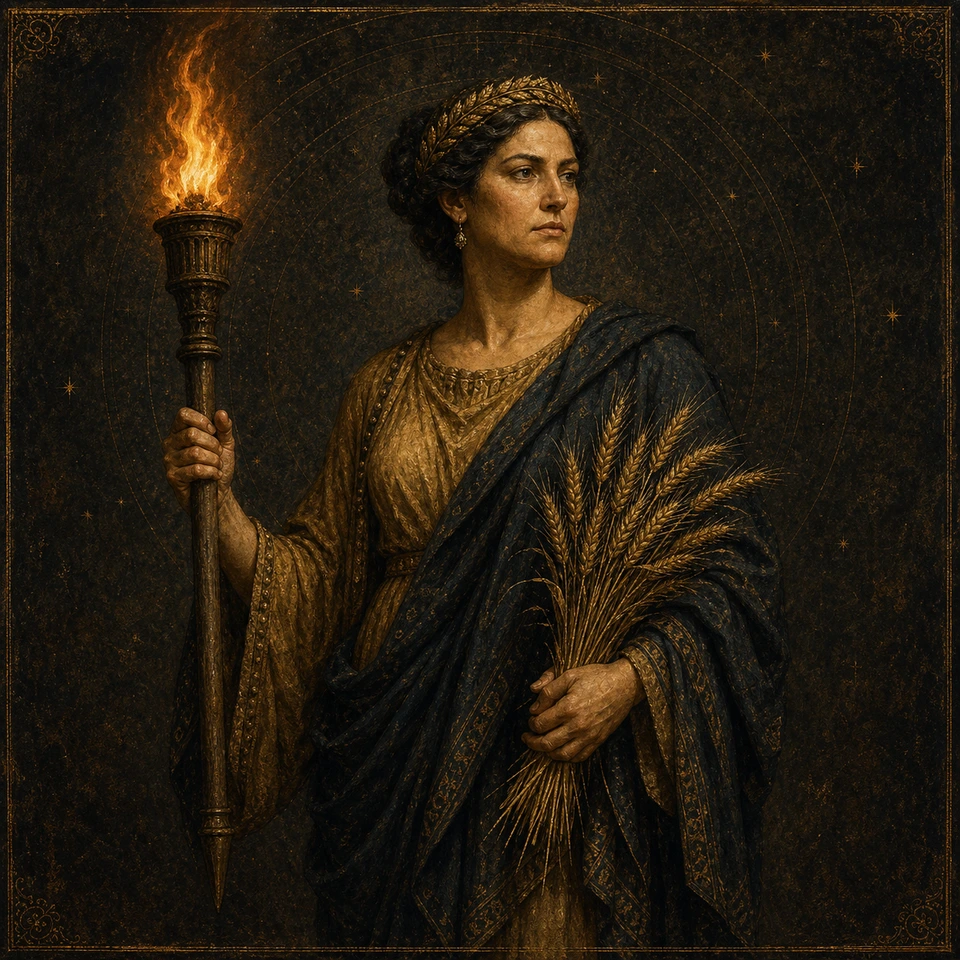
Rooted deeply in the rhythms of cultivated grain, Demeter exercises profound authority over divine motherhood and civic first fruits. Her monumental presence is preserved across ancient poetry, stone inscriptions, and the secretive Eleusinian rites that defined her sanctuary worship.
Overview
The seed does not rise. At Eleusis, Demeter sits apart in the temple she commanded the people to build, and the ploughed earth gives mortals nothing. Famine spreads toward the altars as well as the houses, because hungry communities cannot keep feeding the gods. The Homeric Hymn makes the crisis the work of a grieving mother who refuses to let divine business continue after Zeus consents to the seizure of her daughter.
Persephone had been gathering flowers when the earth opened and Hades drove out in his chariot. Demeter heard the cry but did not see the abduction. She searched with torches, questioned Hecate and Helios, rejected the company of the gods, and came at last to Eleusis disguised as an old woman. In the house of Celeus and Metaneira she nursed Demophon and tried to burn away his mortality by a hidden divine treatment. Metaneira interrupted in terror. Demeter rose in revealed splendor, rebuked the household, and demanded a temple and altar.
Only then does the hymn reach the barren fields. Zeus sends one god after another with gifts, but Demeter will not yield until Persephone returns. Hermes descends, Hades gives Persephone pomegranate seed before releasing her, and mother and daughter meet with joy shadowed by a divided future. Persephone will spend part of the year below. Demeter restores growth and teaches solemn rites to named Eleusinian leaders. The poem announces the blessing attached to initiation while leaving the hidden experience hidden.
Classical Athens carried that bond into public life. An inscription regulates first fruits of wheat and barley for Demeter and Kore, drawing communities, officials, grain, sacrifice, and sanctuary administration into one act. The road from Athens to Eleusis, the procession, and the public preparations could be seen. The innermost initiatory acts could not. Demeter's worship also reached far beyond Eleusis, and no single sanctuary explains her everywhere.
In Arcadia, Pausanias found traditions of Demeter Erinys at Thelpusa and Black Demeter at Phigalia. Both tell of Poseidon's pursuit and sexual assault, yet they differ in offspring, landscape, image, and cult. Callimachus gives another dangerous Demeter when Erysichthon cuts her grove and receives hunger that consumes a household. Homer and Hesiod preserve the brief union of Demeter and Iasion in a thrice-ploughed field, but only Homer tells of Zeus killing Iasion and only Hesiod names Crete and their son Plutus.
Ancient objects keep the goddess physical. A named Attic vessel gives her grain ears, a torch, long garments, and a stephane. A silver coin from Metapontion joins her head with barley. These are dated Greek images, not a timeless costume. Roman Ceres, Arcadian Despoina, and Persephone as Kore retain their own identities. Modern devotional practice forms a later layer: Hellenion now names Demeter and Persephone together in a September libation, without claiming that a Classical ceremony has survived unchanged.
Canonical identity
Canonical Identity
Demeter is an ancient Greek goddess whose foundational worship intricately binds together cultivated grain, divine motherhood, civic sustenance, Eleusinian initiation, and highly localized power. Her canonical identity remains strictly bounded; Kore operates as a title for Persephone, not as an alternate name for Demeter herself. Similarly, Despoina represents a separate Arcadian goddess whose true private name Pausanias deliberately withheld. While the Roman Ceres eventually functioned as Demeter's major Roman counterpart, the Greek and Roman cult histories evolved independently and must be kept distinct.
Linguistic Identity
Her ancient Greek name is Δημήτηρ, officially transliterated as Dēmḗtēr. A qualified reconstruction for fifth-century BC Attic speech indicates /dɛː.mɛ̌ː.tɛːr/ (approximately deh-meh-TEHR), featuring long vowels and a pitch movement fundamentally different from ordinary English stress. This specific sound reflects only one dialect and period rather than the entirety of ancient Greek speakers. The Homeric Hymn also refers to her by the poetic name Deo, a title securely attached to her despite ongoing scholarly disputes regarding Demeter's deeper etymological origins.
Sources and evidence
TEXTUAL · Supported
The hymn names Demeter and also addresses her as Deo, while retaining Persephone as her daughter.
- Source
- Anonymous Homeric Hymns; edited and translated by Hugh G. Evelyn-White, Homeric Hymns (1914)
- Reviewed edition
- Hugh G. Evelyn-White edition and English translation in Hesiod, the Homeric Hymns and Homerica, 1914 · translated by Hugh G. Evelyn-White · edited by Hugh G. Evelyn-White · Perseus Digital Library / Scaife ATLAS
- Exact locator
- Hymn Homeric Hymn 2 to Demeter · Line 1-3 and 485-495
- Scope
- Archaic Greece · Eleusis
- Authority
- ancient Greek hymnic witness
- Certainty
- Secure for the forms in this hymn
Deo is source-scoped and is not treated as proof of one universal etymology or pronunciation.
Open exact reviewed sourceTEXTUAL · Supported
The Greek form Δημήτηρ has a qualified fifth-century BC Attic reconstruction /dɛː.mɛ̌ː.tɛːr/.
- Source
- Wiktionary contributors, Δημήτηρ
- Reviewed edition
- Wiktionary live revision reviewed 2026-08-30 · Wiktionary
- Exact locator
- Entry Δημήτηρ · Section Ancient Greek pronunciation
- Scope
- Classical Greece · Attica
- Authority
- institutional or lexical reference
- Certainty
- Qualified
The reconstruction belongs to fifth-century BC Attic and does not erase dialect or period variation.
Open exact reviewed source2 reviewed sources for this section
- Anonymous Homeric Hymns; edited and translated by Hugh G. Evelyn-White, Homeric Hymns (1914)Hesiod, the Homeric Hymns and Homerica, London and New York, 1914 · Perseus Digital Library / Scaife ATLAS
- Attic Inscriptions Online editorial committee, Attic Inscriptions OnlineContinuously updated scholarly digital corpus · British School at Athens
Culture, tradition, period, and place
Demeter appears across Greek-speaking communities from archaic poetry through Hellenistic literature and imperial-period descriptions of older sanctuaries. The Homeric Hymn gives an early poetic frame centered on Eleusis. Fifth-century BC Attic inscriptions show civic administration and offerings to Demeter and Kore. Painted pottery and coinage give securely identified images. Pausanias preserves local Arcadian traditions in the second century AD, long after the Classical age but while their sanctuaries still shaped the landscape.
The geography matters. Athens and Eleusis organized the Mysteries within Attic civic religion. Thelpusa and Phigalia told different Arcadian stories under the titles Erinys and Melaina. Hesiod places Demeter and Iasion in Crete, while Homer leaves the field unnamed. Continuity of her name does not mean that every community performed the same rites, taught the same genealogy, or pictured the same divine form.
6 reviewed sources for this section
- Anonymous Homeric Hymns; edited and translated by Hugh G. Evelyn-White, Homeric Hymns (1914)Hesiod, the Homeric Hymns and Homerica, London and New York, 1914 · Perseus Digital Library / Scaife ATLAS
- Attic Inscriptions Online editorial committee, Attic Inscriptions OnlineContinuously updated scholarly digital corpus · British School at Athens
- Pausanias; Spiro Greek edition and Jones/Ormerod translation volumes, Description of Greece (1935)Perseus CTS edition corpus, 1903-1935 · Perseus Digital Library / Scaife ATLAS
- Callimachus; translated by Alexander William Mair, Hymn VI to Demeter (1921)Callimachus, Hymns and Epigrams, Loeb Classical Library, 1921 · ToposText / Aikaterini Laskaridis Foundation
- Homer; translated by A. T. Murray, Odyssey (1919)A. T. Murray English translation, London: William Heinemann; New York: G. P. Putnam's Sons, 1919 · Perseus Digital Library / Scaife ATLAS
- Hesiod; edited and translated by Hugh G. Evelyn-White, Theogony (1914)Hesiod, the Homeric Hymns and Homerica, London and New York, 1914 · Perseus Digital Library / Scaife ATLAS
Historical development
Archaic poetry already holds several Demeters at once. Hesiod places her among the children of Cronus and Rhea and makes her the mother of Persephone by Zeus. The Homeric Hymn presents a mother who can stop cultivation, compel negotiation among the gods, reveal herself at Eleusis, and establish rites. This is not a simple movement from a field spirit into a later civic goddess. Divine kinship, agriculture, ritual authority, and danger already stand together.
Classical decrees expose the institutional strength behind the poetry: grain moved as first fruits, officials supervised sacred obligations, and Eleusis stood within Athenian power. Hellenistic poets recast inherited tales, as Callimachus does with Erysichthon. Pausanias later preserves regional titles, caves, images, and explanations that cannot be projected backward as universal origins. Demeter endured through local reinvention rather than one unbroken, identical ceremony.
Sources and evidence
TEXTUAL · Supported
Pausanias preserves distinct Arcadian traditions of Demeter Erinys at Thelpusa and Black Demeter at Phigalia, each attached to its own place and story.
- Source
- Pausanias; Spiro Greek edition and Jones/Ormerod translation volumes, Description of Greece (1935)
- Reviewed edition
- Spiro Greek edition and Jones/Ormerod English volumes represented by the Perseus CTS corpus, 1903-1935 · translated by W. H. S. Jones and H. A. Ormerod, volume-dependent · edited by Friedrich Spiro for the Greek edition · Perseus Digital Library / Scaife ATLAS
- Exact locator
- Book 8 · Chapter 25 and 42 · Section 8.25.4-10; 8.42.1-7
- Scope
- Greek religion under Roman imperial rule · Arcadia
- Authority
- ancient regional travel and cult witness
- Certainty
- Secure as Pausanias's second-century report; earlier chronology varies
The local forms are not universal names for Demeter and are not merged with the separate Arcadian Despoina.
Open exact reviewed source4 reviewed sources for this section
- Anonymous Homeric Hymns; edited and translated by Hugh G. Evelyn-White, Homeric Hymns (1914)Hesiod, the Homeric Hymns and Homerica, London and New York, 1914 · Perseus Digital Library / Scaife ATLAS
- Attic Inscriptions Online editorial committee, Attic Inscriptions OnlineContinuously updated scholarly digital corpus · British School at Athens
- Pausanias; Spiro Greek edition and Jones/Ormerod translation volumes, Description of Greece (1935)Perseus CTS edition corpus, 1903-1935 · Perseus Digital Library / Scaife ATLAS
- Callimachus; translated by Alexander William Mair, Hymn VI to Demeter (1921)Callimachus, Hymns and Epigrams, Loeb Classical Library, 1921 · ToposText / Aikaterini Laskaridis Foundation
Attested roles and historical themes
Roles, powers, and limits
Demeter's clearest power is visible when she withdraws it. In the Homeric Hymn she keeps seed beneath the earth until famine threatens mortals and the honors offered to the gods. When Persephone returns under a negotiated settlement, Demeter restores growth. Grain is therefore not a soft emblem of abundance alone. It is the food on which households, cities, sacrifices, and divine order depend, and the goddess can make its absence politically unbearable.
She is also a mother, a giver of Eleusinian rites, a recipient of civic first fruits, and a fierce guardian of sacred boundaries. Her treatment of Demophon reaches toward freedom from mortal death but fails when Metaneira interrupts. Callimachus shows her punishing a man who threatens her disguised presence and cuts her grove. None of these texts grants her undifferentiated control over every plant, season, or private hope. Her powers take form through named acts and places.
Sources and evidence
TEXTUAL · Supported
Demeter withholds seed and growth until the resulting famine threatens mortals and the honors paid to the gods.
- Source
- Anonymous Homeric Hymns; edited and translated by Hugh G. Evelyn-White, Homeric Hymns (1914)
- Reviewed edition
- Hugh G. Evelyn-White edition and English translation in Hesiod, the Homeric Hymns and Homerica, 1914 · translated by Hugh G. Evelyn-White · edited by Hugh G. Evelyn-White · Perseus Digital Library / Scaife ATLAS
- Exact locator
- Hymn Homeric Hymn 2 to Demeter · Line 299-333
- Scope
- Archaic Greece · Ancient Greece
- Authority
- ancient Greek hymnic witness
- Certainty
- Secure within this narrative
The episode supports agricultural and divine-honor functions, not modern weather or prosperity guarantees.
Open exact reviewed source3 reviewed sources for this section
- Anonymous Homeric Hymns; edited and translated by Hugh G. Evelyn-White, Homeric Hymns (1914)Hesiod, the Homeric Hymns and Homerica, London and New York, 1914 · Perseus Digital Library / Scaife ATLAS
- Callimachus; translated by Alexander William Mair, Hymn VI to Demeter (1921)Callimachus, Hymns and Epigrams, Loeb Classical Library, 1921 · ToposText / Aikaterini Laskaridis Foundation
- Attic Inscriptions Online editorial committee, Attic Inscriptions OnlineContinuously updated scholarly digital corpus · British School at Athens
Epithets and titles
Cult Epithet
Erinys
Ἐρινύς · Fury or wrathful one
Thelpusa, Arcadia · Reported by Pausanias in the second century ADA Thelpusan local title tied to its own Poseidon story.
1 reviewed source for this section
- Pausanias; Spiro Greek edition and Jones/Ormerod translation volumes, Description of Greece (1935)Perseus CTS edition corpus, 1903-1935 · Perseus Digital Library / Scaife ATLAS
Cult Epithet
Melaina
Μέλαινα · Black
Phigalia, Arcadia · Reported by Pausanias in the second century ADA Phigalian local title and image tradition, not a universal color assignment.
1 reviewed source for this section
- Pausanias; Spiro Greek edition and Jones/Ormerod translation volumes, Description of Greece (1935)Perseus CTS edition corpus, 1903-1935 · Perseus Digital Library / Scaife ATLAS
Worship and cult
A visitor approaching Eleusis entered a sanctuary world of road, procession, officials, sacrifices, grain, temples, and guarded thresholds. Public preparation belonged to civic life. Initiation promised a blessed condition in the Homeric Hymn, yet the poem does not reveal a complete ceremony. The distinction is essential: Demeter's cult was both publicly administered and deliberately secret in its innermost experience.
The inscriptional first-fruits system shows communities sending wheat and barley to Demeter and Kore under Athenian regulation. Pausanias encountered different worship in Arcadia, where a cave, a river, unusual images, and local titles carried stories unlike the Eleusinian hymn. Demeter's cult cannot be reduced either to a harvest rite or to one imagined version of the Mysteries.
Sources and evidence
RITUAL ATTESTED · Supported
The hymn states that Demeter teaches rites to named Eleusinian leaders and marks blessed participation without revealing a ritual script.
- Source
- Anonymous Homeric Hymns; edited and translated by Hugh G. Evelyn-White, Homeric Hymns (1914)
- Reviewed edition
- Hugh G. Evelyn-White edition and English translation in Hesiod, the Homeric Hymns and Homerica, 1914 · translated by Hugh G. Evelyn-White · edited by Hugh G. Evelyn-White · Perseus Digital Library / Scaife ATLAS
- Exact locator
- Hymn Homeric Hymn 2 to Demeter · Line 470-482
- Scope
- Archaic Greece · Eleusis
- Authority
- ancient Greek hymnic witness
- Certainty
- Secure for the hymn's public statement
The source acknowledges rites and their significance but does not authorize invented initiatory details.
Open exact reviewed source4 reviewed sources for this section
- Anonymous Homeric Hymns; edited and translated by Hugh G. Evelyn-White, Homeric Hymns (1914)Hesiod, the Homeric Hymns and Homerica, London and New York, 1914 · Perseus Digital Library / Scaife ATLAS
- Attic Inscriptions Online editorial committee, Attic Inscriptions OnlineContinuously updated scholarly digital corpus · British School at Athens
- Kiki Karoglou, Mystery Cults in the Greek and Roman World (2013)Heilbrunn Timeline of Art History essay, 2013 · The Metropolitan Museum of Art
- Pausanias; Spiro Greek edition and Jones/Ormerod translation volumes, Description of Greece (1935)Perseus CTS edition corpus, 1903-1935 · Perseus Digital Library / Scaife ATLAS
Temples, sanctuaries, and sacred places
Eleusis binds landscape to narrative. The hymn places Demeter's arrival, divine revelation, temple demand, famine, reconciliation, and gift of rites there. The Sacred Way connected the sanctuary with Athens, and Classical decrees drew other communities into its economy of first fruits. Eleusis was local and pan-Hellenic at once, rooted in its own ground while receiving people and offerings from farther away.
Arcadia preserves other sacred geographies. At Thelpusa, the river Ladon and Demeter Erinys belong to the aftermath of Poseidon's pursuit. At Phigalia, Black Demeter withdraws into a cave, and the local image takes an extraordinary equine form. Crete appears in Hesiod's Iasion story, but a poetic setting alone does not prove a Demeter sanctuary at the unnamed field.
5 reviewed sources for this section
- Anonymous Homeric Hymns; edited and translated by Hugh G. Evelyn-White, Homeric Hymns (1914)Hesiod, the Homeric Hymns and Homerica, London and New York, 1914 · Perseus Digital Library / Scaife ATLAS
- Attic Inscriptions Online editorial committee, Attic Inscriptions OnlineContinuously updated scholarly digital corpus · British School at Athens
- Pausanias; Spiro Greek edition and Jones/Ormerod translation volumes, Description of Greece (1935)Perseus CTS edition corpus, 1903-1935 · Perseus Digital Library / Scaife ATLAS
- Homer; translated by A. T. Murray, Odyssey (1919)A. T. Murray English translation, London: William Heinemann; New York: G. P. Putnam's Sons, 1919 · Perseus Digital Library / Scaife ATLAS
- Hesiod; edited and translated by Hugh G. Evelyn-White, Theogony (1914)Hesiod, the Homeric Hymns and Homerica, London and New York, 1914 · Perseus Digital Library / Scaife ATLAS
Festivals and processions
The Great Mysteries brought movement from Athens toward Eleusis, communal preparation, sacrifice, and initiation into a shared festival complex. The road, gatherings, and public rites belonged to visible civic religion. What happened at the guarded center was not written down as a full script, and later guesses cannot replace what participants chose not to disclose.
Demeter's festival life was broader than Eleusis. The Thesmophoria was a major festival for Demeter in Greek cities, but its local calendars, participants, and ritual details varied. A full treatment needs direct editions for each place rather than one composite reconstruction. The evidence here therefore gives the Eleusinian festival its secure contours and leaves the region-by-region Thesmophoria comparison open.
3 reviewed sources for this section
- Kiki Karoglou, Mystery Cults in the Greek and Roman World (2013)Heilbrunn Timeline of Art History essay, 2013 · The Metropolitan Museum of Art
- Attic Inscriptions Online editorial committee, Attic Inscriptions OnlineContinuously updated scholarly digital corpus · British School at Athens
- Anonymous Homeric Hymns; edited and translated by Hugh G. Evelyn-White, Homeric Hymns (1914)Hesiod, the Homeric Hymns and Homerica, London and New York, 1914 · Perseus Digital Library / Scaife ATLAS
Offerings, votives, and ritual evidence
Wheat and barley reached Demeter and Kore as regulated first fruits at Eleusis. The inscription places grain in baskets, storehouses, civic decisions, and sacred finance rather than in an abstract list of offerings. The gift fed a relationship among cultivators, communities, sanctuary officials, and the Two Goddesses. Its exact obligations belong to fifth-century BC Attica.
Torches move through another layer of practice and memory. Demeter carries them while searching for Persephone, and Attic art places a torch in her hand beside grain ears. Sacrifice and public preparation surrounded the Mysteries, while the hidden acts remain unknown. Ancient first fruits illuminate a civic cult; they do not become a timeless private recipe by simple repetition.
Sources and evidence
INSCRIPTIONAL · Supported
A fifth-century BC Athenian decree regulates first-fruit portions of wheat and barley for the Two Goddesses at Eleusis.
- Source
- Attic Inscriptions Online editorial committee, Attic Inscriptions Online
- Reviewed edition
- Continuously updated record-level editions and English translations · British School at Athens
- Exact locator
- InscriptionId I Eleusis 28a / IG I3 78a · RecordUrl https://atticinscriptions.com/inscription/IEleus/28a
- Scope
- Classical Greece · Eleusis
- Authority
- scholarly epigraphic edition
- Certainty
- Secure for the decree and its named recipients
The decree supports a civic offering system, not a timeless private offering prescription.
Open exact reviewed source3 reviewed sources for this section
- Attic Inscriptions Online editorial committee, Attic Inscriptions OnlineContinuously updated scholarly digital corpus · British School at Athens
- Anonymous Homeric Hymns; edited and translated by Hugh G. Evelyn-White, Homeric Hymns (1914)Hesiod, the Homeric Hymns and Homerica, London and New York, 1914 · Perseus Digital Library / Scaife ATLAS
- British Museum, British Museum CollectionLive official museum collection · British Museum
Iconography and material culture
On an Attic red-figure vessel of about 500 to 480 BC, an inscription names Demeter. She wears a long chiton, patterned mantle, arranged hair, and a stephane, and she carries grain ears with a torch. The written name secures the identification, allowing dress and objects to speak with unusual clarity. A silver stater from Metapontion later places Demeter's head in a grain wreath and barley on the reverse.
Other ancient images may enthrone her, pair her with Persephone, give her a sceptre, or place her within Eleusinian scenes. No single object establishes a universal costume. Grain and torch are strong because named and cataloged Greek objects support them. Cornucopiae, poppies, serpents, and later classicizing forms need their own dated witnesses before they can bear the same weight.
Sources and evidence
MATERIAL CULTURE · Supported
A name-inscribed Attic skyphos shows Demeter with grain ears, a torch, long chiton, mantle, and stephane.
- Source
- British Museum, British Museum Collection
- Reviewed edition
- Live record-level official museum collection · British Museum
- Exact locator
- MuseumObjectId 1873,0820.375 (E140) · RecordUrl https://www.britishmuseum.org/collection/object/G_1873-0820-375
- Scope
- Archaic Greece · Attica
- Authority
- institutional museum catalog
- Certainty
- Secure for cataloged identity and attributes
The object supports dated attributes, not a universal magical symbol list.
Open exact reviewed source2 reviewed sources for this section
- British Museum, British Museum CollectionLive official museum collection · British Museum
- The Metropolitan Museum of Art, Open Access Collection and Collection APILive collection data and eligible public-domain images · The Metropolitan Museum of Art
Animals, plants, and embodied forms
Wheat and barley are the strongest plants in Demeter's cult. They appear in the Eleusinian first-fruits decree, in the grain ears carried by a named Demeter, and on the Metapontion coin. These are cultivated foods shaped by sowing, labor, storage, law, sacrifice, and hunger. Their force comes from the human work and civic dependence surrounding them.
Horses enter through Arcadian narrative. Demeter becomes a mare while trying to escape Poseidon, who becomes a stallion; Thelpusa names Arion, and Phigalia connects an equine-headed image with Black Demeter. This is powerful local evidence, not proof that the horse held the same status in every Demeter cult. The narcissus belongs to Persephone's fatal flower gathering and remains part of that scene rather than a direct offering to her mother.
4 reviewed sources for this section
- Attic Inscriptions Online editorial committee, Attic Inscriptions OnlineContinuously updated scholarly digital corpus · British School at Athens
- British Museum, British Museum CollectionLive official museum collection · British Museum
- Anonymous Homeric Hymns; edited and translated by Hugh G. Evelyn-White, Homeric Hymns (1914)Hesiod, the Homeric Hymns and Homerica, London and New York, 1914 · Perseus Digital Library / Scaife ATLAS
- Pausanias; Spiro Greek edition and Jones/Ormerod translation volumes, Description of Greece (1935)Perseus CTS edition corpus, 1903-1935 · Perseus Digital Library / Scaife ATLAS
Relationships and genealogy
Hesiod names Demeter among the children of Cronus and Rhea. The same poem makes Persephone the daughter of Demeter and Zeus, then states that Hades carried her away with Zeus's consent. The Homeric Hymn gives that family crisis its full emotional and cosmic scale. The taking is coercive, not a courtship softened by later retelling.
Other relationships stay within their own tellings. Homer remembers Demeter and Iasion together in a thrice-ploughed field, followed by Zeus killing Iasion. Hesiod instead names Crete and their son Plutus. Arcadian traditions make Poseidon the pursuer and assailant of Demeter, with Arion or Despoina attached to different local versions. No smooth family tree can erase those differences.
Sources and evidence
TEXTUAL · Supported
The Odyssey recounts Demeter's union with Iasion in a thrice-ploughed field and Zeus's killing of Iasion with a thunderbolt.
- Source
- Homer; translated by A. T. Murray, Odyssey (1919)
- Reviewed edition
- A. T. Murray English translation, London: William Heinemann; New York: G. P. Putnam's Sons, 1919 · translated by A. T. Murray · Perseus Digital Library / Scaife ATLAS
- Exact locator
- Book 5 · Line 125-128
- Scope
- Archaic Greece
- Authority
- ancient Greek epic witness
- Certainty
- Secure within the Odyssey's account
The episode does not establish one universal consort relationship across Demeter's cults.
Open exact reviewed sourceTEXTUAL · Supported
Hesiod names Demeter among the children borne by Rhea to Cronus.
- Source
- Hesiod; edited and translated by Hugh G. Evelyn-White, Theogony (1914)
- Reviewed edition
- Hugh G. Evelyn-White edition and English translation in Hesiod, the Homeric Hymns and Homerica, 1914 · translated by Hugh G. Evelyn-White · edited by Hugh G. Evelyn-White · Perseus Digital Library / Scaife ATLAS
- Exact locator
- Entry Theogony · Line 453-467
- Scope
- Archaic Greece · Ancient Greece
- Authority
- primary textual witness
- Certainty
- High
The passage supports both parent relationships.
Open exact reviewed sourceTEXTUAL · Supported
Hesiod names Persephone as the daughter of Demeter and Zeus and says Aidoneus carried her away with Zeus's consent.
- Source
- Hesiod; edited and translated by Hugh G. Evelyn-White, Theogony (1914)
- Reviewed edition
- Hugh G. Evelyn-White edition and English translation in Hesiod, the Homeric Hymns and Homerica, 1914 · translated by Hugh G. Evelyn-White · edited by Hugh G. Evelyn-White · Perseus Digital Library / Scaife ATLAS
- Exact locator
- Entry Theogony · Line 912-914
- Scope
- Archaic Greece · Ancient Greece
- Authority
- primary textual witness
- Certainty
- High
Parentage and coercive removal remain part of the same brief genealogical passage.
Open exact reviewed source4 reviewed sources for this section
- Anonymous Homeric Hymns; edited and translated by Hugh G. Evelyn-White, Homeric Hymns (1914)Hesiod, the Homeric Hymns and Homerica, London and New York, 1914 · Perseus Digital Library / Scaife ATLAS
- Hesiod; edited and translated by Hugh G. Evelyn-White, Theogony (1914)Hesiod, the Homeric Hymns and Homerica, London and New York, 1914 · Perseus Digital Library / Scaife ATLAS
- Homer; translated by A. T. Murray, Odyssey (1919)A. T. Murray English translation, London: William Heinemann; New York: G. P. Putnam's Sons, 1919 · Perseus Digital Library / Scaife ATLAS
- Pausanias; Spiro Greek edition and Jones/Ormerod translation volumes, Description of Greece (1935)Perseus CTS edition corpus, 1903-1935 · Perseus Digital Library / Scaife ATLAS
Actual myths and source variants
The longest Demeter story begins with Persephone reaching for a flower and ends only after the fields fail, gods negotiate, and rites are taught at Eleusis. Beside it stand three very different narratives. In Arcadia, Poseidon's pursuit drives Demeter into equine form, anger, withdrawal, and locally distinct offspring traditions. In Callimachus, Erysichthon fells sacred trees and finds that hunger can consume wealth faster than an axe consumes wood. In Homer and Hesiod, the union with Iasion is compressed into a few charged lines.
Each tale keeps its own scale and voice. Hymn, genealogy, epic aside, Hellenistic punishment narrative, and Pausanias's local reports do not combine into a seamless biography. Their contradictions carry historical meaning. They show how different communities and poets used Demeter to think about grain, violated boundaries, family power, sexual coercion, mortality, and the cost of divine anger.
Sources and evidence
TEXTUAL · Supported
Callimachus tells how Demeter punishes Erysichthon's destruction of her sacred grove with consuming hunger.
- Source
- Callimachus; translated by Alexander William Mair, Hymn VI to Demeter (1921)
- Reviewed edition
- Alexander William Mair English translation in Callimachus, Hymns and Epigrams, 1921 · translated by Alexander William Mair · edited by Alexander William Mair · ToposText / Aikaterini Laskaridis Foundation
- Exact locator
- Hymn Hymn VI to Demeter · Line 24-117
- Scope
- Hellenistic Greek world
- Authority
- Hellenistic Greek poetic witness
- Certainty
- Secure within Callimachus's version
This Hellenistic telling remains distinct from later Latin versions.
Open exact reviewed source5 reviewed sources for this section
- Anonymous Homeric Hymns; edited and translated by Hugh G. Evelyn-White, Homeric Hymns (1914)Hesiod, the Homeric Hymns and Homerica, London and New York, 1914 · Perseus Digital Library / Scaife ATLAS
- Pausanias; Spiro Greek edition and Jones/Ormerod translation volumes, Description of Greece (1935)Perseus CTS edition corpus, 1903-1935 · Perseus Digital Library / Scaife ATLAS
- Callimachus; translated by Alexander William Mair, Hymn VI to Demeter (1921)Callimachus, Hymns and Epigrams, Loeb Classical Library, 1921 · ToposText / Aikaterini Laskaridis Foundation
- Homer; translated by A. T. Murray, Odyssey (1919)A. T. Murray English translation, London: William Heinemann; New York: G. P. Putnam's Sons, 1919 · Perseus Digital Library / Scaife ATLAS
- Hesiod; edited and translated by Hugh G. Evelyn-White, Theogony (1914)Hesiod, the Homeric Hymns and Homerica, London and New York, 1914 · Perseus Digital Library / Scaife ATLAS
Myth Library
Each myth gathers its attested participants into one source-grounded account, while distinct source traditions remain readable in their own variants.
Hymnic Cycle
Demeter, Persephone, and the Eleusinian Settlement
Persephone gathers flowers with Tyche and other divine companions before she is seized by Hades with Zeus's consent, and Demeter's search brings her to Eleusis. After an interrupted attempt to make Demophon deathless, Demeter reveals herself, demands a temple, and withholds the seed until famine forces divine negotiation. Hades obeys the release order but secretly puts pomegranate seed in Persephone’s mouth; Zeus then assigns her a divided residence, and Hecate becomes her companion before Demeter teaches the Eleusinian rites.
- Role in this profile
- mother whose search, withdrawal, famine, negotiation, and institution of rites drive the narrative
- Place scope
- Eleusis · Attica
- Witnesses
- 2
- Variants
- 2
Regional Variant Cluster
Demeter and Poseidon in Arcadia
Pausanias preserves two Arcadian traditions in which Poseidon pursues Demeter. The Thelpusan account explains Demeter Erinys and the birth of the horse Arion, while the Phigalian account belongs to Black Demeter, her withdrawal into a cave, famine, the birth of the distinct goddess Despoina, and rites attached to a local image.
- Role in this profile
- pursued goddess whose equine disguise, anger, withdrawal, and local titles shape both Arcadian variants
- Place scope
- Thelpusa · Phigalia
- Witnesses
- 1
- Variants
- 2
Sacred Boundary
Demeter and Erysichthon
In Callimachus's hymn, Erysichthon cuts Demeter's sacred grove despite warnings. The goddess appears in disguise, confronts him, and punishes the desecration with hunger that no amount of food can satisfy, consuming his household's wealth and leaving his family to conceal his ruin.
- Role in this profile
- guardian of the sacred grove who warns in disguise and punishes desecration with relentless hunger
- Witnesses
- 1
- Variants
- 1
Epic Genealogy
Demeter and Iasion
Homer and Hesiod preserve brief but distinct accounts of Demeter's union with Iasion in a thrice-ploughed field. The Odyssey says Zeus kills Iasion after learning of the union, while Hesiod locates the encounter in Crete and names Plutus as their son.
- Role in this profile
- goddess who joins Iasion in a thrice-ploughed field
- Place scope
- Crete
- Witnesses
- 2
- Variants
- 2
Theogony
Cronus and the Swallowed Children
Cronus swallows five children born by Rhea, but she hides Zeus and gives Cronus a wrapped stone; Zeus survives, the children return, and the feared succession begins.
- Role in this profile
- swallowed daughter of Cronus and Rhea who returns with the divine siblings
- Place scope
- Ancient Greece · Crete · Olympia · Arcadia
- Witnesses
- 4
- Variants
- 4
Equivalences, syncretisms, and identity boundaries
Greek Demeter and Roman Ceres were compared and translated across Greek and Roman worlds, but comparison did not erase their languages, priesthoods, festivals, political settings, or images. Ceres remains a Roman goddess with her own civic history. Isis, Cybele, and other mother or grain goddesses are not alternate names for Demeter merely because later authors or modern readers notice resemblance.
The boundaries inside Greek religion are just as important. Erinys and Melaina are local titles of Demeter at Thelpusa and Phigalia, anchored in particular stories and sanctuaries. Kore names Persephone in Eleusinian worship. Despoina remains a distinct Arcadian goddess. Shared motherhood, descent, fertility, or grain imagery cannot by itself prove identity.
2 reviewed sources for this section
- Pausanias; Spiro Greek edition and Jones/Ormerod translation volumes, Description of Greece (1935)Perseus CTS edition corpus, 1903-1935 · Perseus Digital Library / Scaife ATLAS
- Attic Inscriptions Online editorial committee, Attic Inscriptions OnlineContinuously updated scholarly digital corpus · British School at Athens
Correspondence index
Demeter's strongest associations begin with things that ancient hands moved and used: wheat, barley, first fruits, torches, sanctuaries, processions, and locally embodied horse forms. Black belongs securely to Demeter Melaina at Phigalia, but not as a color imposed on every cult. Eleusis is a place of worship, not a compass direction. The Mysteries are a historical festival and initiatory complex, not a generic seasonal spell.
The evidence falls into four layers: direct cult practice, securely identified imagery, details confined to one local story, and categories for which no support survives here. No ancient witness in this group assigns Demeter a planet, zodiac sign, gemstone, metal, classical element, weekday, moon phase, incense, or universal magical intention. Agricultural cycles may inspire later practice, but they do not automatically create those systems.
Direct ancient correspondences
| Category | Direct correspondence | How and why | Evidence boundary |
|---|---|---|---|
| plant-tree | Wheat and barleyDirect historical association | An Athenian decree sends first fruits of wheat and barley to Demeter and Kore, while Greek art identifies Demeter with grain ears. | Ancient Cultic Classical Attica, Eleusis, and securely identified Greek imagery. 2 reviewed sources for this section
|
| animal-embodied-form | Mare and stallion formsDirect historical association | Arcadian accounts place Demeter and Poseidon in equine form and connect the stories with Arion or an equine-headed local image. | Ancient Literary Thelpusa and Phigalia only, not every Demeter cult. 1 reviewed source for this section
|
| color | Black, under the title MelainaDirect historical association | At Phigalia, Black Demeter belongs to a local withdrawal story, cave sanctuary, and unusual image. | Ancient Cultic A Phigalian title, not a universal color assignment. 1 reviewed source for this section
|
| direction-place | EleusisDirect historical association | The Homeric Hymn, inscriptions, sanctuary history, and procession place Eleusis at the center of Demeter and Kore worship. | Ancient Cultic A cult place, not a compass direction. 3 reviewed sources for this section
|
| festival-time | Eleusinian MysteriesDirect historical association | Demeter gives rites in the hymn, and later evidence preserves public preparation, procession, sacrifice, and guarded initiation at Eleusis. | Ancient Cultic The public festival is historical; the hidden experience is not reconstructed. 3 reviewed sources for this section
|
| offering-ritual-material | First fruits of wheat and barleyDirect historical association | The Eleusinian decree regulates cereal first fruits for the Two Goddesses as a civic and sanctuary obligation. | Ancient Cultic Fifth-century BC Attic administration, not a timeless private prescription. 2 reviewed sources for this section
|
| ritual-object-symbol-tool | TorchDirect historical association | Demeter carries torches in her search, and a name-inscribed Attic vessel places a torch in her hand. | Ancient Material Archaic hymn and Attic imagery, with meanings tied to search and cult. 2 reviewed sources for this section
|
9 expected categories currently not evidenced
celestial-body · Not evidenced
No celestial body attested
The ancient witnesses used here do not give Demeter rule over the Sun, Moon, or a planet.
- Layer
- Research Boundary
- Scope
- Agricultural power does not establish celestial rulership.
zodiac · Not evidenced
No zodiac sign attested
No ancient or accountable later witness here assigns Demeter to a zodiac sign.
- Layer
- Research Boundary
- Scope
- Any astrological assignment requires a named later system.
gemstone-crystal-mineral · Not evidenced
No gemstone or mineral attested
The texts, inscription, and objects used here do not connect Demeter with a gemstone or mineral.
- Layer
- Research Boundary
- Scope
- Earth and grain imagery cannot supply a crystal by analogy.
metal-material · Not evidenced
No metal attested
No metal is assigned to Demeter in the evidence used here.
- Layer
- Research Boundary
- Scope
- Agricultural implements are not automatically divine correspondences.
classical-element · Not evidenced
No classical element attested
No witness here places Demeter inside a four-element scheme.
- Layer
- Research Boundary
- Scope
- Cultivated earth does not by itself establish the element earth.
weekday · Not evidenced
No weekday attested
No weekday belongs to Demeter in the evidence used here.
- Layer
- Research Boundary
- Scope
- A weekday cannot be inferred through an unattested planetary chain.
moon-phase · Not evidenced
No moon phase attested
Persephone divides her year, but no passage turns that division into a lunar phase.
- Layer
- Research Boundary
- Scope
- The Eleusinian settlement is not a moon-phase calendar.
incense-perfume · Not evidenced
No incense or perfume attested
No incense, resin, or perfume is assigned to Demeter in this evidence.
- Layer
- Research Boundary
- Scope
- Mystery language cannot support an invented fumigation recipe.
intention-magical-power · Not evidenced
No universal magical intention attested
Ancient roles in grain, motherhood, punishment, and initiation do not form a universal spell-purpose list.
- Layer
- Research Boundary
- Scope
- Later devotional intentions require their own accountable testimony.
Sources and evidence
INSCRIPTIONAL · Supported
A fifth-century BC Athenian decree regulates first-fruit portions of wheat and barley for the Two Goddesses at Eleusis.
- Source
- Attic Inscriptions Online editorial committee, Attic Inscriptions Online
- Reviewed edition
- Continuously updated record-level editions and English translations · British School at Athens
- Exact locator
- InscriptionId I Eleusis 28a / IG I3 78a · RecordUrl https://atticinscriptions.com/inscription/IEleus/28a
- Scope
- Classical Greece · Eleusis
- Authority
- scholarly epigraphic edition
- Certainty
- Secure for the decree and its named recipients
The decree supports a civic offering system, not a timeless private offering prescription.
Open exact reviewed sourceMATERIAL CULTURE · Supported
A name-inscribed Attic skyphos shows Demeter with grain ears, a torch, long chiton, mantle, and stephane.
- Source
- British Museum, British Museum Collection
- Reviewed edition
- Live record-level official museum collection · British Museum
- Exact locator
- MuseumObjectId 1873,0820.375 (E140) · RecordUrl https://www.britishmuseum.org/collection/object/G_1873-0820-375
- Scope
- Archaic Greece · Attica
- Authority
- institutional museum catalog
- Certainty
- Secure for cataloged identity and attributes
The object supports dated attributes, not a universal magical symbol list.
Open exact reviewed source4 reviewed sources for this section
- Attic Inscriptions Online editorial committee, Attic Inscriptions OnlineContinuously updated scholarly digital corpus · British School at Athens
- British Museum, British Museum CollectionLive official museum collection · British Museum
- Anonymous Homeric Hymns; edited and translated by Hugh G. Evelyn-White, Homeric Hymns (1914)Hesiod, the Homeric Hymns and Homerica, London and New York, 1914 · Perseus Digital Library / Scaife ATLAS
- Kiki Karoglou, Mystery Cults in the Greek and Roman World (2013)Heilbrunn Timeline of Art History essay, 2013 · The Metropolitan Museum of Art
Later reception and living significance
Demeter continues through translations, paintings, stage work, scholarship, archaeology, and contemporary Pagan devotion. These later encounters often emphasize motherhood, ecological loss, harvest, or Persephone's divided year. Each emphasis belongs to its own time. None should be projected backward as the single ancient meaning of the goddess.
Hellenion offers one accountable contemporary example. The organization schedules a shared September libation to Demeter and Persephone for members participating from different locations. That practice documents Hellenion's present religious life. It does not claim uninterrupted survival of the Eleusinian Mysteries or speak for every Hellenic polytheist.
Sources and evidence
TEXTUAL · Supported
Hellenion schedules a shared September libation to Demeter and Persephone for members participating from their own locations.
- Source
- Hellenion, Monthly Libations
- Reviewed edition
- Live first-party community practice page reviewed 2026-08-29 · Hellenion
- Exact locator
- Page Monthly Libations · Entry September, Demeter and Persephone
- Scope
- Contemporary living religion · International online religious community
- Authority
- accountable living-tradition organization
- Certainty
- High
This establishes Hellenion's present communal practice only.
Open exact reviewed source2 reviewed sources for this section
- Kiki Karoglou, Mystery Cults in the Greek and Roman World (2013)Heilbrunn Timeline of Art History essay, 2013 · The Metropolitan Museum of Art
- Anonymous Homeric Hymns; edited and translated by Hugh G. Evelyn-White, Homeric Hymns (1914)Hesiod, the Homeric Hymns and Homerica, London and New York, 1914 · Perseus Digital Library / Scaife ATLAS
Evidence, conflicts, and research gaps
The Homeric Hymn supplies the fullest early narrative, Hesiod and Homer preserve genealogy and the Iasion episode, Callimachus tells Erysichthon, and Pausanias carries local Arcadian testimony. The Attic first-fruits decree gives public cult administration. Cataloged Greek pottery and coinage give dated material form. These witnesses agree on Demeter's weight while disagreeing about place, offspring, sequence, and local identity.
Important work remains. The Thesmophoria needs a direct, region-by-region festival study. Demeter's reception in Roman Ceres, later philosophy, and modern devotional communities deserves separate expansion. Ancient pronunciation varies by dialect and century, so the Attic reconstruction remains qualified. The secret acts at Eleusis are not recoverable as a complete ceremony, and that absence must remain an absence.
4 reviewed sources for this section
- Anonymous Homeric Hymns; edited and translated by Hugh G. Evelyn-White, Homeric Hymns (1914)Hesiod, the Homeric Hymns and Homerica, London and New York, 1914 · Perseus Digital Library / Scaife ATLAS
- Attic Inscriptions Online editorial committee, Attic Inscriptions OnlineContinuously updated scholarly digital corpus · British School at Athens
- Pausanias; Spiro Greek edition and Jones/Ormerod translation volumes, Description of Greece (1935)Perseus CTS edition corpus, 1903-1935 · Perseus Digital Library / Scaife ATLAS
- British Museum, British Museum CollectionLive official museum collection · British Museum
Direct connections and evidence
Explicit Source
Cronus and Rhea are parents of Demeter
Genealogy does not transfer Demeter's agricultural roles to Cronus.
1 attestation · high confidence
- Hesiod; edited and translated by Hugh G. Evelyn-White, TheogonyHugh G. Evelyn-White edition and English translation in Hesiod, the Homeric Hymns and Homerica, 1914 · translated by Hugh G. Evelyn-White · edited by Hugh G. Evelyn-White · Perseus Digital Library / Scaife ATLAS · Archaic Greece · Ancient Greece · Entry Theogony · Line 453-458
Explicit Source
Hesiod names Cronus as Demeter's father
Hesiod names Demeter among the children of Cronus and Rhea.
1 attestation · high confidence
- Hesiod; edited and translated by Hugh G. Evelyn-White, TheogonyHugh G. Evelyn-White edition and English translation in Hesiod, the Homeric Hymns and Homerica, 1914 · translated by Hugh G. Evelyn-White · edited by Hugh G. Evelyn-White · Perseus Digital Library / Scaife ATLAS · Archaic Greece · Ancient Greece · Entry Theogony · Line 453-467
Explicit Source
Hesiod names Rhea as Demeter's mother
Hesiod names Demeter among the children of Cronus and Rhea.
1 attestation · high confidence
- Hesiod; edited and translated by Hugh G. Evelyn-White, TheogonyHugh G. Evelyn-White edition and English translation in Hesiod, the Homeric Hymns and Homerica, 1914 · translated by Hugh G. Evelyn-White · edited by Hugh G. Evelyn-White · Perseus Digital Library / Scaife ATLAS · Archaic Greece · Ancient Greece · Entry Theogony · Line 453-467
Explicit Source
Hesiod names Persephone as Demeter's daughter
Hesiod names Persephone as the daughter of Demeter and Zeus.
1 attestation · high confidence
- Hesiod; edited and translated by Hugh G. Evelyn-White, TheogonyHugh G. Evelyn-White edition and English translation in Hesiod, the Homeric Hymns and Homerica, 1914 · translated by Hugh G. Evelyn-White · edited by Hugh G. Evelyn-White · Perseus Digital Library / Scaife ATLAS · Archaic Greece · Ancient Greece · Entry Theogony · Line 912-914
Explicit Source
Hesiod names Hera and Demeter in the same sibling generation of Cronus and Rhea
Theogony 453-458 gives Hera and Demeter the same parents; the relationship does not imply shared cult or correspondence.
1 attestation · high confidence
- Hesiod; edited and translated by Hugh G. Evelyn-White, TheogonyHugh G. Evelyn-White edition and English translation in Hesiod, the Homeric Hymns and Homerica, 1914 · translated by Hugh G. Evelyn-White · edited by Hugh G. Evelyn-White · Perseus Digital Library / Scaife ATLAS · Archaic Greece · Ancient Greece · Entry Theogony · Line 453-458
Explicit Source
Hesiod names Poseidon and Demeter in the same sibling generation of Cronus and Rhea
Theogony 453-458 gives the same parents; siblinghood creates no automatic cult or correspondence.
1 attestation · high confidence
- Hesiod; edited and translated by Hugh G. Evelyn-White, TheogonyHugh G. Evelyn-White edition and English translation in Hesiod, the Homeric Hymns and Homerica, 1914 · translated by Hugh G. Evelyn-White · edited by Hugh G. Evelyn-White · Perseus Digital Library / Scaife ATLAS · Archaic Greece · Ancient Greece · Entry Theogony · Line 453-458
Archive scope and classification
- Figure classification
- God or goddess · certain
- Pantheon or tradition shelf
- Greek
- Cultures
- Greek
- Traditions
- Ancient Greek religion
- Periods
- Archaic Greece, Classical Greece, Hellenistic Greek world, Greek religion under Roman imperial rule, Contemporary living religion
- Places
- Ancient Greece, Attica, Athens, Eleusis, Arcadia, Thelpusa, Phigalia, Crete
The completed account preserves Eleusinian public and initiatory limits, Arcadian local forms, four major narratives, securely identified objects, modern public practice, and the distinct identities of Ceres, Kore, and Despoina.
Reviewed sources
- Hesiod; edited and translated by Hugh G. Evelyn-White, Theogony (1914)Hesiod, the Homeric Hymns and Homerica, London and New York, 1914 · Perseus Digital Library / Scaife ATLAS
- Anonymous Homeric Hymns; edited and translated by Hugh G. Evelyn-White, Homeric Hymns (1914)Hesiod, the Homeric Hymns and Homerica, London and New York, 1914 · Perseus Digital Library / Scaife ATLAS
- Homer; translated by A. T. Murray, Odyssey (1919)A. T. Murray English translation, London: William Heinemann; New York: G. P. Putnam's Sons, 1919 · Perseus Digital Library / Scaife ATLAS
- Pseudo-Apollodorus; edited and translated by James G. Frazer, Library (1921)Harvard University Press and William Heinemann edition, 1921 · Perseus Digital Library / Scaife ATLAS
- Pausanias; Spiro Greek edition and Jones/Ormerod translation volumes, Description of Greece (1935)Perseus CTS edition corpus, 1903-1935 · Perseus Digital Library / Scaife ATLAS
- Attic Inscriptions Online editorial committee, Attic Inscriptions OnlineContinuously updated scholarly digital corpus · British School at Athens
- The Metropolitan Museum of Art, Open Access Collection and Collection APILive collection data and eligible public-domain images · The Metropolitan Museum of Art
- British Museum, British Museum CollectionLive official museum collection · British Museum
- Hellenion, Monthly LibationsLive official community practice page · Hellenion
- Callimachus; translated by Alexander William Mair, Hymn VI to Demeter (1921)Callimachus, Hymns and Epigrams, Loeb Classical Library, 1921 · ToposText / Aikaterini Laskaridis Foundation
- Kiki Karoglou, Mystery Cults in the Greek and Roman World (2013)Heilbrunn Timeline of Art History essay, 2013 · The Metropolitan Museum of Art
- Wiktionary contributors, ΔημήτηρLive collaborative lexical entry reviewed 2026-08-30 · Wiktionary