
Greek · Divine personification · Certain
Tyche
Τύχη · Tyche
Pronunciation: /tý.kʰɛː/ · TÜ-kheh
Research and editorial review by Cody Manes · Reviewed 2026-08-31
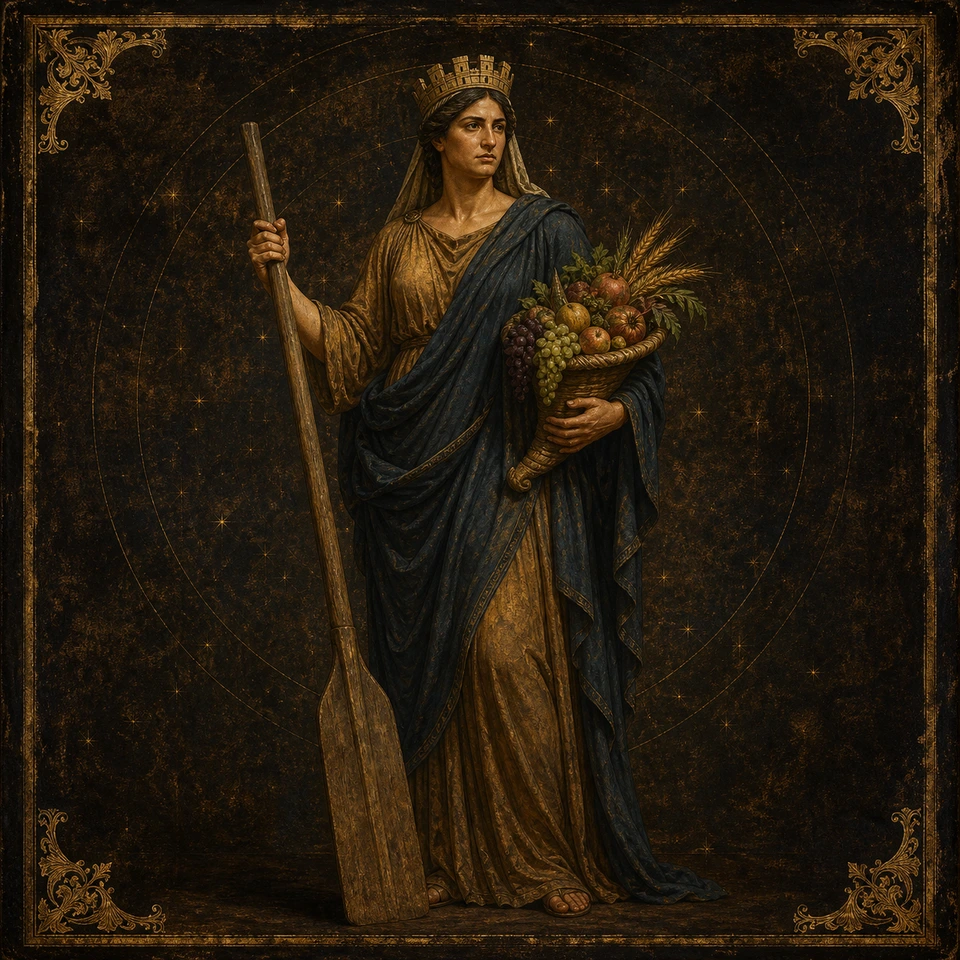
Dictating the wildly unpredictable shifts of fate, Tyche stands as the supreme personification of changing outcome. Appearing in various Greek sources as a fable speaker and fiercely protective civic guardian, she frequently bears a mural crown to signify her authority over city destinies.
Overview
A ship turns. War breaks without warning. An assembly waits on counsel. Pindar's Olympian 12 places all three movements under one uncertain hand. He calls on Savior Tyche, daughter of Zeus Eleutherios, to guard Himera. Hope is never stable in the ode. It rises, breaks, and changes direction before knowledge can harden into certainty. This is civic danger made divine, not the smiling luck of a charm shop and not a promise that desire will be rewarded.
An older genealogy gives another origin. Hesiod names Tyche among the Oceanid daughters of Oceanus and Tethys. The Homeric Hymn to Demeter places her among the divine companions gathering flowers with Persephone before Hades erupts from the earth. She neither causes the seizure nor prevents it. Her presence is brief, exact, and limited to the meadow company. These archaic witnesses do not yet give the full city-crowned figure known from later art.
The genealogies refuse agreement. Hesiod makes Oceanus and Tethys her parents; Pindar calls her a daughter of Zeus. Plutarch preserves an Alcman fragment that makes her sister of Eunomia and Peitho and daughter of Promatheia. A late Orphic hymn identifies her through Artemis and Eubouleus in its own theological language. None of these claims may erase the others. Pausanias reports a Theban image in which Tyche holds Plutus and says the artists could be understood as making her his mother or nurse. The sculpture gives visible form to fortune nurturing wealth, but it does not settle a universal family tree.
Across Greek cities Tyche received sanctuaries, temples, altars, and monumental bodies. Pausanias saw her at Megara, Corinth, Pharae, Olympia, Elis, Thebes, Smyrna, and Lebadeia. Each notice belongs to a local setting. At Lebadeia, preparation for the oracle of Trophonius included residence in a building sacred to Agathe Tyche and Daimon Agathos. At Olympia an altar bore the name of Good Fortune. These facts establish worship without yielding a single rite for every place.
Material evidence makes the civic figure physical. A mural crown raises walls above her forehead. Heavy drapery gives weight to the body. Rudder and cornucopia place uncertain passage and sustaining plenty in her hands. Getty statue 96.AA.49 preserves the crown and dress. Its separately attached left arm probably held a cornucopia, while the right hand likely held a rudder, so neither attribute survives there as certainty. British Museum coin 1839,0919.565 shows the turreted, veiled goddess holding both objects. Bupalus gave the Smyrna image a heavenly sphere and Amaltheia's horn. No planet follows from the sphere, and no ritual recipe follows from the horn.
Two Greek fables sharpen the injustice of blaming her. In one, a farmer finds gold and thanks Earth until Tyche appears to claim the gift and warn that he will accuse her when it is lost. In another, she wakes a traveler sleeping beside a well because his death would be blamed on her. The surviving fable collection is composite and late in transmission. It does not license an archaic biography of Aesop. A late Orphic hymn contributes a different boundary: its heading names frankincense fumigation for Tyche. That incense is direct evidence for this hymn, not a universal perfume table.
Greek Tyche remains distinct from Roman Fortuna even when English translators use Fortune for both. Wheel, blindfold, gambling die, lottery token, zodiac sign, money spell, and universal prosperity rite are not established by the Greek witnesses gathered here. Her historical force is harder and more civic. She stands where a city, ship, household, or traveler learns that control was never absolute. Her images do not erase danger with abundance, and her prayers do not promise mastery over chance. They give unstable outcome a name, a body, and a place inside public life, without pretending that uncertainty can be domesticated by human desire alone.
Canonical identity
Canonical Identity
Tyche functions as both a deity and the absolute divine personification of unstable human expectation and changing outcome. Greek objects and witnesses define her through deeply localized cult images, the cornucopia, the rudder, the mural crown, civic prayers, and conflicting parentage (Hesiod names her among the Oceanids, while Pindar invokes Savior Tyche as the daughter of Zeus Eleutherios). No Roman source in this corpus creates an equivalence between her and Fortuna. Astronomical bodies, gambling emblems, blindfolds, and wheels all possess their own dated histories and cannot simply be dragged backward to overwrite ancient Tyche.
Linguistic Identity
Tyche derives from the Greek Τύχη. The qualified fifth-century BC Attic pronunciation is /tý.kʰɛː/, rendered for modern readers as TÜ-kheh. This serves strictly as a historical reconstruction, not as a single guaranteed sound utilized by every ancient Greek century and city.
Sources and evidence
SCHOLARLY INTERPRETATION · Supported
LSJ preserves τύχη [ῠ], ἡ and the proper divine name Τύχη.
- Source
- Henry George Liddell and Robert Scott; Scaife ATLAS, τύχη and Τύχη, LSJ entry
- Reviewed edition
- LSJ digital entry τύχη, Scaife ATLAS URN lsj-n106094 · Tufts University
- Exact locator
- Entry LSJ τύχη [ῠ], ἡ and proper Τύχη · RecordUrl https://atlas.perseus.tufts.edu/dictionaries/entry/urn%3Acite2%3Ascaife-viewer%3Adictionaries.v1%3Alsj-n106094/
- Scope
- Classical Greece · Attica
- Authority
- LSJ historical lexicon
- Certainty
- qualified
The lexical entry fixes spelling, gender, and short upsilon, not every historical pronunciation.
Open exact reviewed sourceSCHOLARLY INTERPRETATION · Supported
A qualified fifth-century BC Attic reconstruction of Τύχη is /tý.kʰɛː/.
- Source
- Herbert Weir Smyth, A Greek Grammar for Colleges (1920)
- Reviewed edition
- Herbert Weir Smyth, A Greek Grammar for Colleges, American Book Company, 1920; Perseus text 1999.04.0007 · Perseus Digital Library
- Exact locator
- Entry A Greek Grammar for Colleges · Section §§1, 24, 26, 150 · RecordUrl https://www.perseus.tufts.edu/hopper/text?doc=Perseus:text:1999.04.0007
- Scope
- Classical Greece · Attica
- Authority
- Smyth historical Greek grammar
- Certainty
- secure within the cited witness
Rules are applied to the independently registered LSJ headword and remain a period-specific reconstruction.
Open exact reviewed source4 reviewed sources for this section
- Henry George Liddell and Robert Scott; Scaife ATLAS, τύχη and Τύχη, LSJ entryLSJ digital entry with exact headword, gender, quantity mark, meanings, and personified uses · Tufts University
- Herbert Weir Smyth, A Greek Grammar for Colleges (1920)American Book Company, 1920; Perseus text 1999.04.0007 · Perseus Digital Library
- Hesiod; edited and translated by Hugh G. Evelyn-White, Theogony (1914)Hesiod, the Homeric Hymns and Homerica, London and New York, 1914 · Perseus Digital Library / Scaife ATLAS
- Pindar; translated by Diane Arnson Svarlien, Odes of Pindar (1990)1990 translation hosted by the Perseus Digital Library · Tufts University
Culture, tradition, period, and place
Tyche’s surviving landscape runs from archaic genealogy and hymn to classical Sicilian victory song, Hellenistic civic imagery, and Pausanias’s second-century AD journey through Greek sanctuaries. Hesiod and the Demeter hymn place her among Oceanids. Pindar gives her a civic prayer at Himera. Later images make her the embodied fortune of cities.
Pausanias finds her at Megara, Corinth, Pharae, Olympia, Elis, Thebes, Smyrna, and Lebadeia. Those local settings do not dissolve into one timeless cult. A sanctuary, altar, oracle-house association, and city-crowned image each speak from a particular place.
The fables add no secure cult center or early date. Their Greek text survives through a composite transmission represented here by Chambry's scholarly edition. The late Orphic hymn also belongs to its own ritual-poetic horizon. Neither may be carried backward into Hesiod's world or used to make every city practice identical.
6 reviewed sources for this section
- Hesiod; edited and translated by Hugh G. Evelyn-White, Theogony (1914)Hesiod, the Homeric Hymns and Homerica, London and New York, 1914 · Perseus Digital Library / Scaife ATLAS
- Anonymous Homeric Hymns; edited and translated by Hugh G. Evelyn-White, Homeric Hymns (1914)Hesiod, the Homeric Hymns and Homerica, London and New York, 1914 · Perseus Digital Library / Scaife ATLAS
- Pindar; translated by Diane Arnson Svarlien, Odes of Pindar (1990)1990 translation hosted by the Perseus Digital Library · Tufts University
- Pausanias; Spiro Greek edition and Jones/Ormerod translation volumes, Description of Greece (1935)Perseus CTS edition corpus, 1903-1935 · Perseus Digital Library / Scaife ATLAS
- Anonymous Greek fable tradition; edited by Émile Chambry; digital edition by Chloé Laruelle and Sorbonne Université, Aesopi Fabulae (2019)Émile Chambry Greek edition, 1925-1926; Sorbonne Université digital edition, 2019 · Sorbonne Université
- Anonymous Orphic hymn poet; translated by Thomas Taylor, The Hymns of Orpheus (1792)Thomas Taylor English translation, 1792 · Internet Archive
Historical development
The earliest literary Tyche in this account is a named Oceanid daughter. In the Demeter hymn she is still one member of a divine company, present in the meadow before Persephone is taken. Pindar gives her a sharper public presence: Savior Tyche guards Himera and steers ships, wars, and councils while hopes turn one way and then another.
Hellenistic and later civic art supplies the monumental body. The mural crown makes a city visible upon the goddess. Rudder and cornucopia translate uncertain passage and sustaining plenty into held objects. Pausanias’s many sanctuaries show that literary personification and local worship could coexist without becoming identical everywhere.
The later evidence does more than repeat the archaic name. Pindar makes Tyche answer the exposure of a colony to war, sea travel, and deliberation. Hellenistic and imperial images place civic architecture on her body. The fables turn the charge of misfortune into dialogue, giving the goddess a voice against human blame. The Orphic hymn draws her into a late theological system whose Artemis identification and Eubouleus descent are not Hesiod's genealogy.
8 reviewed sources for this section
- Hesiod; edited and translated by Hugh G. Evelyn-White, Theogony (1914)Hesiod, the Homeric Hymns and Homerica, London and New York, 1914 · Perseus Digital Library / Scaife ATLAS
- Anonymous Homeric Hymns; edited and translated by Hugh G. Evelyn-White, Homeric Hymns (1914)Hesiod, the Homeric Hymns and Homerica, London and New York, 1914 · Perseus Digital Library / Scaife ATLAS
- Pindar; translated by Diane Arnson Svarlien, Odes of Pindar (1990)1990 translation hosted by the Perseus Digital Library · Tufts University
- Pausanias; Spiro Greek edition and Jones/Ormerod translation volumes, Description of Greece (1935)Perseus CTS edition corpus, 1903-1935 · Perseus Digital Library / Scaife ATLAS
- J. Paul Getty Trust, Getty Open Content ProgramLive museum collection and open-content program · J. Paul Getty Museum
- British Museum, British Museum CollectionLive official museum collection · British Museum
- Anonymous Greek fable tradition; edited by Émile Chambry; digital edition by Chloé Laruelle and Sorbonne Université, Aesopi Fabulae (2019)Émile Chambry Greek edition, 1925-1926; Sorbonne Université digital edition, 2019 · Sorbonne Université
- Anonymous Orphic hymn poet; translated by Thomas Taylor, The Hymns of Orpheus (1792)Thomas Taylor English translation, 1792 · Internet Archive
Attested roles and historical themes
Roles, powers, and limits
Pindar’s Tyche can guard a city and steer ships, war, and political counsel. The ode does not promise that she abolishes uncertainty. Its world is unstable precisely because hopes shift and outcomes arrive beyond confident prediction. Her power is therefore felt in passage, public danger, decision, and reversal.
The mural crown intensifies the civic role, but it does not turn every city goddess into Tyche. The cornucopia can signify abundance, yet no source here makes Tyche a universal dispenser of wealth. The heavenly sphere on Bupalus’s image does not confer planetary rulership.
The two fables expose a further limit. Tyche gives or protects, yet mortals credit another power for a gain and reserve Tyche's name for disaster. She is not omnipotent in these scenes. She argues about attribution. The traveler can fall through his own heedlessness, and the farmer can misname the source of his discovery.
Sources and evidence
TEXTUAL · Supported
Pindar invokes Savior Tyche, daughter of Zeus Eleutherios, and asks her to guard Himera.
- Source
- Pindar; translated by Diane Arnson Svarlien, Odes of Pindar (1990)
- Reviewed edition
- Diane Arnson Svarlien English translation, 1990 · translated by Diane Arnson Svarlien · Tufts University
- Exact locator
- Entry Olympian 12 · Line 1-6
- Scope
- Classical Greece · Himera in Sicily
- Authority
- Pindar, Olympian 12
- Certainty
- secure
The civic protection and Zeus parentage belong to this ode’s prayer and remain source-scoped.
Open exact reviewed sourceTEXTUAL · Supported
Pindar says Tyche steers swift ships, sudden wars, and assemblies of counsel, while human hopes turn unpredictably.
- Source
- Pindar; translated by Diane Arnson Svarlien, Odes of Pindar (1990)
- Reviewed edition
- Diane Arnson Svarlien English translation, 1990 · translated by Diane Arnson Svarlien · Tufts University
- Exact locator
- Entry Olympian 12 · Line 1-12
- Scope
- Classical Greece · Himera in Sicily
- Authority
- Pindar, Olympian 12
- Certainty
- secure
The steering language supports changing outcomes and civic action, not unlimited control of fate.
Open exact reviewed source2 reviewed sources for this section
- Pindar; translated by Diane Arnson Svarlien, Odes of Pindar (1990)1990 translation hosted by the Perseus Digital Library · Tufts University
- Anonymous Greek fable tradition; edited by Émile Chambry; digital edition by Chloé Laruelle and Sorbonne Université, Aesopi Fabulae (2019)Émile Chambry Greek edition, 1925-1926; Sorbonne Université digital edition, 2019 · Sorbonne Université
Epithets and titles
Poetic Epithet
Savior Tyche
Σώτειρα Τύχα · Savior Tyche
Himera in Sicily · Fifth century BCPindar invokes this form while praying for Himera’s protection.
1 reviewed source for this section
- Pindar; translated by Diane Arnson Svarlien, Odes of Pindar (1990)1990 translation hosted by the Perseus Digital Library · Tufts University
Cult Epithet
Agathe Tyche
Ἀγαθὴ Τύχη · Good Fortune
Olympia and Lebadeia · Greek religion under Roman imperial rulePausanias names an altar at Olympia and sacred lodging at Lebadeia under this form.
1 reviewed source for this section
- Pausanias; Spiro Greek edition and Jones/Ormerod translation volumes, Description of Greece (1935)Perseus CTS edition corpus, 1903-1935 · Perseus Digital Library / Scaife ATLAS
Worship and cult
The cult evidence is broad and local. Pausanias reports a temple at Corinth, a temple and ancient image at Pharae, a sanctuary with a colossal composite image at Elis, and other sacred sites across the Greek world. His account is late, but it is direct testimony that Tyche received more than literary attention.
These notices rarely preserve priesthood, sacrifice, calendar, or the words of prayer. Pindar’s appeal to Savior Tyche at Himera is a public poetic prayer, not a complete ritual manual. The appropriate historical conclusion is substantial civic and local worship with unevenly surviving practice.
The Orphic hymn is direct but narrow ritual evidence. Its heading calls for frankincense fumigation, and the poem invokes abundance in a late theological voice. The hymn does not supply a civic calendar, priestly office, or universal temple liturgy. Its Artemis identification remains inside that hymn tradition.
Sources and evidence
RITUAL ATTESTED · Supported
At Pharae in Messenia, Pausanias reports a temple and ancient image of Tyche.
- Source
- Pausanias; Spiro Greek edition and Jones/Ormerod translation volumes, Description of Greece (1935)
- Reviewed edition
- W. H. S. Jones and H. A. Ormerod English translation volumes, 1918-1935 · translated by W. H. S. Jones and H. A. Ormerod, volume-dependent · Perseus Digital Library / Scaife ATLAS
- Exact locator
- Book 4 · Chapter 30 · Section 4
- Scope
- Greek religion under Roman imperial rule · Pharae in Messenia
- Authority
- Pausanias, Description of Greece
- Certainty
- secure
The witness supports a local cult place but supplies no complete ritual calendar.
Open exact reviewed sourceRITUAL ATTESTED · Supported
At Elis, Pausanias reports a sanctuary of Tyche with a colossal gilded wooden image whose face and extremities were white marble.
- Source
- Pausanias; Spiro Greek edition and Jones/Ormerod translation volumes, Description of Greece (1935)
- Reviewed edition
- W. H. S. Jones and H. A. Ormerod English translation volumes, 1918-1935 · translated by W. H. S. Jones and H. A. Ormerod, volume-dependent · Perseus Digital Library / Scaife ATLAS
- Exact locator
- Book 6 · Chapter 25 · Section 4
- Scope
- Greek religion under Roman imperial rule · Elis
- Authority
- Pausanias, Description of Greece
- Certainty
- secure
The passage also places a shrine of Sosipolis within the sanctuary, which does not make the two figures identical.
Open exact reviewed source3 reviewed sources for this section
- Pausanias; Spiro Greek edition and Jones/Ormerod translation volumes, Description of Greece (1935)Perseus CTS edition corpus, 1903-1935 · Perseus Digital Library / Scaife ATLAS
- Pindar; translated by Diane Arnson Svarlien, Odes of Pindar (1990)1990 translation hosted by the Perseus Digital Library · Tufts University
- Anonymous Orphic hymn poet; translated by Thomas Taylor, The Hymns of Orpheus (1792)Thomas Taylor English translation, 1792 · Internet Archive
Temples, sanctuaries, and sacred places
Megara had a sanctuary and an image attributed to Praxiteles. Corinth had a temple with a standing Parian-marble image. Pharae preserved a temple and an image already considered ancient by Pausanias’s day. Elis held a sanctuary with a colossal gilded wooden body and marble face and extremities.
At Olympia, an altar honored Agathe Tyche. At Lebadeia, a building sacred to Agathe Tyche and Daimon Agathos sheltered a petitioner during purification before the descent to Trophonius. These sites show different local functions rather than a single central sanctuary controlling all Tyche worship.
Himera enters through prayer rather than excavation in this account. Pindar asks Savior Tyche to protect the city, making the location essential to the poem's force. Smyrna and Thebes survive through descriptions of images; Olympia and Lebadeia preserve ritual settings. A city named in one kind of evidence must not be made to supply the missing details of another.
Sources and evidence
RITUAL ATTESTED · Supported
Pausanias saw a sanctuary of Tyche at Megara and attributed its image to Praxiteles.
- Source
- Pausanias; Spiro Greek edition and Jones/Ormerod translation volumes, Description of Greece (1935)
- Reviewed edition
- W. H. S. Jones and H. A. Ormerod English translation volumes, 1918-1935 · translated by W. H. S. Jones and H. A. Ormerod, volume-dependent · Perseus Digital Library / Scaife ATLAS
- Exact locator
- Book 1 · Chapter 43 · Section 6
- Scope
- Greek religion under Roman imperial rule · Megara
- Authority
- Pausanias, Description of Greece
- Certainty
- secure
This is a second-century AD witness to a local sanctuary and attributed image.
Open exact reviewed sourceRITUAL ATTESTED · Supported
Pausanias describes a temple of Tyche at Corinth with a standing image of Parian marble.
- Source
- Pausanias; Spiro Greek edition and Jones/Ormerod translation volumes, Description of Greece (1935)
- Reviewed edition
- W. H. S. Jones and H. A. Ormerod English translation volumes, 1918-1935 · translated by W. H. S. Jones and H. A. Ormerod, volume-dependent · Perseus Digital Library / Scaife ATLAS
- Exact locator
- Book 2 · Chapter 2 · Section 8
- Scope
- Greek religion under Roman imperial rule · Corinth
- Authority
- Pausanias, Description of Greece
- Certainty
- secure
The material and location are explicit in the travel account.
Open exact reviewed source2 reviewed sources for this section
- Pausanias; Spiro Greek edition and Jones/Ormerod translation volumes, Description of Greece (1935)Perseus CTS edition corpus, 1903-1935 · Perseus Digital Library / Scaife ATLAS
- Pindar; translated by Diane Arnson Svarlien, Odes of Pindar (1990)1990 translation hosted by the Perseus Digital Library · Tufts University
Festivals and processions
No securely named Tyche festival or procession is established by these witnesses. Pindar’s Olympian ode celebrates an athletic victory and prays to Tyche for Himera, but the poem’s occasion is not automatically her annual feast. Pausanias’s sanctuaries and altar likewise do not supply a month or recurring civic route.
The omission leaves the calendar open. No month, season, or recurring civic route can be supplied without a specific historical witness.
The fables contain no festival, and the Orphic hymn supplies no dated annual feast. Incense in a hymn heading is not a calendar. The silence matters because modern calendars often assign convenient days to deities without an ancient civic witness.
4 reviewed sources for this section
- Pindar; translated by Diane Arnson Svarlien, Odes of Pindar (1990)1990 translation hosted by the Perseus Digital Library · Tufts University
- Pausanias; Spiro Greek edition and Jones/Ormerod translation volumes, Description of Greece (1935)Perseus CTS edition corpus, 1903-1935 · Perseus Digital Library / Scaife ATLAS
- Anonymous Greek fable tradition; edited by Émile Chambry; digital edition by Chloé Laruelle and Sorbonne Université, Aesopi Fabulae (2019)Émile Chambry Greek edition, 1925-1926; Sorbonne Université digital edition, 2019 · Sorbonne Université
- Anonymous Orphic hymn poet; translated by Thomas Taylor, The Hymns of Orpheus (1792)Thomas Taylor English translation, 1792 · Internet Archive
Offerings, votives, and ritual evidence
An altar of Agathe Tyche at Olympia is direct ritual evidence, while dedicated temples and cult images show costly civic attention. At Lebadeia, sacred lodging associated with Agathe Tyche formed one stage in purification before consultation of Trophonius. The action belongs to that Boeotian oracle and cannot be detached as a universal Tyche rite.
The local sanctuary notices do not specify a standard food, drink, coin, die, or gambling stake for Tyche. The cornucopia is an iconographic attribute, not an instruction to fill one. Historical devotion is visible in sacred structures and images even where the contents of offerings are lost.
Frankincense is the one named fumigant. It appears in the heading of Taylor's Hymn LXXI, corresponding to modern Hymn 72. The fact is secure within that accessed edition and hymn, but its scope is not limitless. It must not be rewritten as a timeless instruction for every Tyche sanctuary.
Sources and evidence
RITUAL ATTESTED · Supported
Pausanias lists an altar of Agathe Tyche at Olympia among the altars of the sanctuary.
- Source
- Pausanias; Spiro Greek edition and Jones/Ormerod translation volumes, Description of Greece (1935)
- Reviewed edition
- W. H. S. Jones and H. A. Ormerod English translation volumes, 1918-1935 · translated by W. H. S. Jones and H. A. Ormerod, volume-dependent · Perseus Digital Library / Scaife ATLAS
- Exact locator
- Book 5 · Chapter 15 · Section 5
- Scope
- Greek religion under Roman imperial rule · Olympia
- Authority
- Pausanias, Description of Greece
- Certainty
- secure
The altar is direct ritual evidence; no universal offering recipe is supplied.
Open exact reviewed sourceRITUAL ATTESTED · Supported
Before consulting Trophonius at Lebadeia, a petitioner stayed in a building sacred to Agathe Tyche and Daimon Agathos during purification.
- Source
- Pausanias; Spiro Greek edition and Jones/Ormerod translation volumes, Description of Greece (1935)
- Reviewed edition
- W. H. S. Jones and H. A. Ormerod English translation volumes, 1918-1935 · translated by W. H. S. Jones and H. A. Ormerod, volume-dependent · Perseus Digital Library / Scaife ATLAS
- Exact locator
- Book 9 · Chapter 39 · Section 4
- Scope
- Greek religion under Roman imperial rule · Lebadeia
- Authority
- Pausanias, Description of Greece
- Certainty
- secure
This local oracular preparation is contextual ritual evidence, not a general Tyche rite.
Open exact reviewed sourceTEXTUAL · Supported
The Tyche hymn specifies fumigation from frankincense.
- Source
- Anonymous Orphic hymn poet; translated by Thomas Taylor, The Hymns of Orpheus (1792)
- Reviewed edition
- The Hymns of Orpheus, Thomas Taylor English translation, 1792 · translated by Thomas Taylor · Internet Archive
- Exact locator
- Hymn LXXI, To Fortune; modern numbering 72 · Page 203
- Scope
- Greek religion under Roman imperial rule · Ancient Greece
- Authority
- Orphic Hymn to Tyche, Taylor 1792 English edition
- Certainty
- secure within the cited witness
The incense is direct for this late hymn tradition only; Taylor is the accessed English translation.
Open exact reviewed source2 reviewed sources for this section
- Pausanias; Spiro Greek edition and Jones/Ormerod translation volumes, Description of Greece (1935)Perseus CTS edition corpus, 1903-1935 · Perseus Digital Library / Scaife ATLAS
- Anonymous Orphic hymn poet; translated by Thomas Taylor, The Hymns of Orpheus (1792)Thomas Taylor English translation, 1792 · Internet Archive
Iconography and material culture
The Hellenistic civic body is tall-crowned and veiled. Getty object 96.AA.49 preserves the mural crown and drapery; its cornucopia and rudder are reconstructed and must remain labeled as such. British Museum coin 1839,0919.565 shows a turreted, veiled Tyche with rudder in the right hand and cornucopia in the left.
Pausanias describes other local choices. Bupalus’s Smyrna image set a heavenly sphere upon her head and the horn of Amaltheia in her hand. At Thebes she carried the child Plutus, whom Pausanias says the artists treated as son or foster child. Neither scene proves a universal family tree or celestial rulership.
Any later portrait that joins mural crown, steering oar, and a woven horn of grain and fruit is an interpretation assembled from separate ancient witnesses. It cannot replace the ancient objects. The Getty catalogue's careful uncertainty and the British Museum coin's exact accession remain the historical ground.
Sources and evidence
MATERIAL CULTURE · Supported
Pausanias attributes a Smyrna image of Tyche to Bupalus, with a heavenly sphere on her head and the horn of Amaltheia in her hand.
- Source
- Pausanias; Spiro Greek edition and Jones/Ormerod translation volumes, Description of Greece (1935)
- Reviewed edition
- W. H. S. Jones and H. A. Ormerod English translation volumes, 1918-1935 · translated by W. H. S. Jones and H. A. Ormerod, volume-dependent · Perseus Digital Library / Scaife ATLAS
- Exact locator
- Book 4 · Chapter 30 · Section 6
- Scope
- Greek religion under Roman imperial rule · Smyrna
- Authority
- Pausanias, Description of Greece
- Certainty
- secure
The sphere is an attribute of this image, not evidence that Tyche is a planet.
Open exact reviewed sourceMATERIAL CULTURE · Supported
In the Theban sanctuary, Tyche carried the child Plutus; Pausanias says the artists meant her as mother or nurse.
- Source
- Pausanias; Spiro Greek edition and Jones/Ormerod translation volumes, Description of Greece (1935)
- Reviewed edition
- W. H. S. Jones and H. A. Ormerod English translation volumes, 1918-1935 · translated by W. H. S. Jones and H. A. Ormerod, volume-dependent · Perseus Digital Library / Scaife ATLAS
- Exact locator
- Book 9 · Chapter 16 · Section 2
- Scope
- Greek religion under Roman imperial rule · Thebes in Boeotia
- Authority
- Pausanias, Description of Greece
- Certainty
- secure
The image offers two interpretations and does not establish a secure genealogy.
Open exact reviewed sourceMATERIAL CULTURE · Supported
Getty identifies statue 96.AA.49 by its turreted mural crown and says the separately attached left arm probably held a cornucopia while the right hand likely held a rudder.
- Source
- J. Paul Getty Trust, Getty Open Content Program
- Reviewed edition
- Live collection records; exact Open Content objects only · J. Paul Getty Museum
- Exact locator
- MuseumObjectId 96.AA.49 · RecordUrl https://www.getty.edu/art/collection/object/1HC2NG · Entry Statue of Tyche, current object description
- Scope
- Hellenistic Greek world · Ancient Greece
- Authority
- J. Paul Getty Museum, statuette 96.AA.49
- Certainty
- secure
The mural crown and drapery are preserved. Cornucopia and rudder are catalogue reconstructions of likely attributes, not surviving or modern replacement objects.
Open exact reviewed sourceMATERIAL CULTURE · Supported
British Museum coin 1839,0919.565 shows turreted and veiled Tyche holding a rudder and cornucopia.
- Source
- British Museum, British Museum Collection
- Reviewed edition
- Live record-level official museum collection · British Museum
- Exact locator
- MuseumObjectId 1839,0919.565 · RecordUrl https://www.britishmuseum.org/collection/object/C_1839-0919-565
- Scope
- Roman Republican period · Laodicea ad Mare
- Authority
- British Museum, coin 1839,0919.565
- Certainty
- secure
The coin secures a civic image at Laodicea ad Mare after 47 BC and is not made universal to every Tyche cult.
Open exact reviewed source3 reviewed sources for this section
- Pausanias; Spiro Greek edition and Jones/Ormerod translation volumes, Description of Greece (1935)Perseus CTS edition corpus, 1903-1935 · Perseus Digital Library / Scaife ATLAS
- J. Paul Getty Trust, Getty Open Content ProgramLive museum collection and open-content program · J. Paul Getty Museum
- British Museum, British Museum CollectionLive official museum collection · British Museum
Animals, plants, and embodied forms
Tyche appears as a fully embodied goddess, not an animal, plant, or disembodied cloud of luck. Veil, chiton, himation, mural crown, rudder, and cornucopia belong to human-form civic iconography. The fruit and grain implied by a cornucopia do not make one species her sacred plant.
No sacred animal, transformed body, tree, flower, or herb is securely assigned here. Persephone’s flower meadow is the setting of another goddess’s seizure, and Tyche’s presence among the companions does not transfer the narcissus or meadow flowers to her.
Grapes, fruit, and grain can visualize abundance inside a later cornucopia, but no one species becomes sacred without a source. The same rule prevents the narcissus from transferring out of Persephone's seizure narrative and onto Tyche merely because she was present in the meadow company.
3 reviewed sources for this section
- Anonymous Homeric Hymns; edited and translated by Hugh G. Evelyn-White, Homeric Hymns (1914)Hesiod, the Homeric Hymns and Homerica, London and New York, 1914 · Perseus Digital Library / Scaife ATLAS
- J. Paul Getty Trust, Getty Open Content ProgramLive museum collection and open-content program · J. Paul Getty Museum
- British Museum, British Museum CollectionLive official museum collection · British Museum
Relationships and genealogy
Hesiod names Tyche among daughters of Oceanus and Tethys. Pindar addresses her as a daughter of Zeus Eleutherios. These are incompatible parentages, so each remains attached to its own poem. Oceanus and Tethys form one genealogical pair; Zeus forms the other claim.
The Theban image of Tyche holding Plutus does not settle a new genealogy. Pausanias reports that the artists could be understood as making her his mother or nurse. Persephone is a meadow companion in the hymn, not a sister established by that scene alone.
Another genealogy survives through quotation. In On the Fortune of the Romans, Plutarch cites Alcman for Tyche as sister of Eunomia and Peitho and daughter of Promatheia. The later witness and fragmentary transmission must remain visible. The late Orphic hymn intensifies the conflict again. Taylor's translation calls Tyche Fortune, joins her with Trivia and Diana, and speaks of Pluto as father; the underlying Greek identifies Artemis and descent from Eubouleus. Neither genealogy may be folded into the Hesiodic or Pindaric parentage.
Sources and evidence
TEXTUAL · Supported
Hesiod names Tyche among the Oceanid daughters born to Oceanus and Tethys.
- Source
- Hesiod; edited and translated by Hugh G. Evelyn-White, Theogony (1914)
- Reviewed edition
- Hugh G. Evelyn-White English translation in Hesiod, the Homeric Hymns and Homerica, Loeb Classical Library, 1914, Perseus eng1 component · translated by Hugh G. Evelyn-White · edited by Hugh G. Evelyn-White · Perseus Digital Library
- Exact locator
- Entry Theogony · Line 337-370
- Scope
- Archaic Greece · Ancient Greece
- Authority
- Hesiod, Theogony
- Certainty
- secure
This genealogy conflicts with Pindar’s address to Tyche as a daughter of Zeus and is not harmonized with it.
Open exact reviewed sourceTEXTUAL · Supported
Plutarch preserves an Alcman fragment that makes Tyche sister of Eunomia and Peitho and daughter of Promatheia.
- Source
- Plutarch; translated by Frank Cole Babbitt, On the Fortune of the Romans (1936)
- Reviewed edition
- Plutarch, Moralia IV, On the Fortune of the Romans, Frank Cole Babbitt English translation, Loeb Classical Library, 1936 · translated by Frank Cole Babbitt · LacusCurtius, University of Chicago
- Exact locator
- Entry On the Fortune of the Romans · Section 4, 318B; printed page 333 · RecordUrl https://penelope.uchicago.edu/Thayer/E/Roman/Texts/Plutarch/Moralia/Fortuna_Romanorum*.html
- Scope
- Archaic Greece · Sparta
- Authority
- Alcman fragment preserved by Plutarch
- Certainty
- secure as Plutarch's attribution and wording; original performance context lost
The Roman essay is a later transmission witness. Its surrounding Fortuna narrative is not evidence for Greek Tyche.
Open exact reviewed source6 reviewed sources for this section
- Hesiod; edited and translated by Hugh G. Evelyn-White, Theogony (1914)Hesiod, the Homeric Hymns and Homerica, London and New York, 1914 · Perseus Digital Library / Scaife ATLAS
- Plutarch; translated by Frank Cole Babbitt, On the Fortune of the Romans (1936)Loeb Classical Library, Moralia volume IV, Babbitt English translation, 1936 · LacusCurtius, University of Chicago
- Pindar; translated by Diane Arnson Svarlien, Odes of Pindar (1990)1990 translation hosted by the Perseus Digital Library · Tufts University
- Anonymous Homeric Hymns; edited and translated by Hugh G. Evelyn-White, Homeric Hymns (1914)Hesiod, the Homeric Hymns and Homerica, London and New York, 1914 · Perseus Digital Library / Scaife ATLAS
- Pausanias; Spiro Greek edition and Jones/Ormerod translation volumes, Description of Greece (1935)Perseus CTS edition corpus, 1903-1935 · Perseus Digital Library / Scaife ATLAS
- Anonymous Orphic hymn poet; translated by Thomas Taylor, The Hymns of Orpheus (1792)Thomas Taylor English translation, 1792 · Internet Archive
Actual myths and source variants
Tyche has no long independent adventure in the cited early poems. Her narrative presence survives inside two shared scenes. Hesiod’s genealogy names her among the immense Oceanid company. The Demeter hymn lets Persephone remember Tyche among the companions picking flowers before the earth opens and Hades carries her away.
Those appearances matter because they anchor her within older divine kinship before classical civic poetry gives her a more active public voice. Pindar’s steering of ships, war, and council is a divine role within praise and prayer, not a missing epic episode to be expanded with invented action.
The fables are short but genuine narratives. The farmer digs, finds gold, crowns Earth, and is corrected by Tyche. The traveler sleeps at a well's edge, and Tyche wakes him before a fall can be blamed on her. Their action is not grand divine combat, yet it gives the goddess speech, motive, and conflict. Each tale remains separate because each can be read independently and each survives with multiple textual recensions.
Sources and evidence
TEXTUAL · Supported
In Persephone’s account of her seizure, Tyche is one of the named Oceanid companions gathering flowers in the meadow.
- Source
- Anonymous Homeric Hymns; edited and translated by Hugh G. Evelyn-White, Homeric Hymns (1914)
- Reviewed edition
- Hugh G. Evelyn-White English translation of Homeric Hymn 2, To Demeter, 1914 · translated by Hugh G. Evelyn-White · edited by Hugh G. Evelyn-White · Perseus Digital Library / Scaife ATLAS
- Exact locator
- Hymn Homeric Hymn 2 to Demeter · Line 415-430
- Scope
- Archaic Greece · Ancient Greece
- Authority
- Homeric Hymn to Demeter
- Certainty
- secure
Tyche is a named companion before the seizure, not a rescuer or cause of it.
Open exact reviewed sourceTEXTUAL · Supported
In Chambry 84, Tyche corrects a farmer who credits Earth for gold and warns that he would blame Tyche if it vanished.
- Source
- Anonymous Greek fable tradition; edited by Émile Chambry; digital edition by Chloé Laruelle and Sorbonne Université, Aesopi Fabulae (2019)
- Reviewed edition
- Émile Chambry, Aesopi Fabulae, 1925-1926; Sorbonne Université Labex OBVIL digital edition, 2019 · edited by Émile Chambry; digital edition by Chloé Laruelle · Sorbonne Université
- Exact locator
- Entry Γεωργὸς καὶ τύχη · Section Chambry 84; Perry 61; recensions 84.1-84.3
- Scope
- Modern classical scholarship · Ancient Greece
- Authority
- Anonymous Greek fable tradition, Chambry edition
- Certainty
- secure within the cited witness
The exact Greek recensions are read; no archaic authorship or tale date is asserted.
Open exact reviewed sourceTEXTUAL · Supported
In Chambry 262, Tyche wakes a traveler sleeping beside a well so that his fall will not be blamed on her.
- Source
- Anonymous Greek fable tradition; edited by Émile Chambry; digital edition by Chloé Laruelle and Sorbonne Université, Aesopi Fabulae (2019)
- Reviewed edition
- Émile Chambry, Aesopi Fabulae, 1925-1926; Sorbonne Université Labex OBVIL digital edition, 2019 · edited by Émile Chambry; digital edition by Chloé Laruelle · Sorbonne Université
- Exact locator
- Entry Ὁδοιπόρος καὶ Τύχη / Ἄνθρωπος καὶ Τύχη · Section Chambry 262; Perry 174; recensions 262.1-262.6
- Scope
- Modern classical scholarship · Ancient Greece
- Authority
- Anonymous Greek fable tradition, Chambry edition
- Certainty
- secure within the cited witness
Traveler and man titles are preserved as recension differences; no archaic authorship or tale date is asserted.
Open exact reviewed source4 reviewed sources for this section
- Anonymous Homeric Hymns; edited and translated by Hugh G. Evelyn-White, Homeric Hymns (1914)Hesiod, the Homeric Hymns and Homerica, London and New York, 1914 · Perseus Digital Library / Scaife ATLAS
- Anonymous Greek fable tradition; edited by Émile Chambry; digital edition by Chloé Laruelle and Sorbonne Université, Aesopi Fabulae (2019)Émile Chambry Greek edition, 1925-1926; Sorbonne Université digital edition, 2019 · Sorbonne Université
- Hesiod; edited and translated by Hugh G. Evelyn-White, Theogony (1914)Hesiod, the Homeric Hymns and Homerica, London and New York, 1914 · Perseus Digital Library / Scaife ATLAS
- Pindar; translated by Diane Arnson Svarlien, Odes of Pindar (1990)1990 translation hosted by the Perseus Digital Library · Tufts University
Myth Library
Each myth gathers its attested participants into one source-grounded account, while distinct source traditions remain readable in their own variants.
Divine Genealogy
Oceanus and Tethys Parent the Rivers and Oceanids
Oceanus and Tethys become parents of divine rivers and the many Oceanid daughters, with Hesiod naming Tyche among the daughters.
- Role in this profile
- appears by name among the Oceanid daughters of Oceanus and Tethys in Hesiod’s catalogue
- Place scope
- Ancient Greece
- Witnesses
- 2
- Variants
- 2
Hymnic Cycle
Demeter, Persephone, and the Eleusinian Settlement
Persephone gathers flowers with Tyche and other divine companions before she is seized by Hades with Zeus's consent, and Demeter's search brings her to Eleusis. After an interrupted attempt to make Demophon deathless, Demeter reveals herself, demands a temple, and withholds the seed until famine forces divine negotiation. Hades obeys the release order but secretly puts pomegranate seed in Persephone’s mouth; Zeus then assigns her a divided residence, and Hecate becomes her companion before Demeter teaches the Eleusinian rites.
- Role in this profile
- gathers flowers with Persephone and the divine companions before Hades arrives
- Place scope
- Eleusis · Attica
- Witnesses
- 2
- Variants
- 2
Divine Fable
The Farmer and Tyche
A farmer discovers gold while digging, honors Earth for the gift, and hears Tyche warn that he will blame her if the treasure is lost.
- Role in this profile
- appears to claim the gift of gold and expose the farmer’s readiness to blame her for a later loss
- Place scope
- Ancient Greece
- Witnesses
- 1
- Variants
- 1
Divine Fable
The Traveler and Tyche
Tyche wakes a traveler sleeping beside a well and says that his own heedlessness would otherwise be blamed on her.
- Role in this profile
- wakes the sleeper before a fall and rejects blame for danger created by human heedlessness
- Place scope
- Ancient Greece
- Witnesses
- 1
- Variants
- 1
Equivalences, syncretisms, and identity boundaries
The Greek sources identify Tyche through her Oceanid and Zeus parentage variants, civic prayer at Himera, sanctuaries, and local images. No surviving Greek witness establishes a Roman equivalence, so Fortuna remains a separate research question rather than an automatic equivalent.
At Lebadeia, Agathe Tyche shares a purification setting with Daimon Agathos, but spatial association does not merge them. The heavenly sphere on Bupalus’s Smyrna image also belongs to that local sculpture and does not turn Tyche into a planet. Every broader equivalence needs its own cultural and historical witness.
The Orphic hymn's Artemis identification is not a license to merge the goddesses. It belongs to a late hymn's theological diction. Greek Tyche and Roman Fortuna likewise remain separately addressable. Translation through the word Fortune records language, not identity.
2 reviewed sources for this section
- Pausanias; Spiro Greek edition and Jones/Ormerod translation volumes, Description of Greece (1935)Perseus CTS edition corpus, 1903-1935 · Perseus Digital Library / Scaife ATLAS
- Anonymous Orphic hymn poet; translated by Thomas Taylor, The Hymns of Orpheus (1792)Thomas Taylor English translation, 1792 · Internet Archive
Correspondence index
The strongest positive connections are historical and concrete: civic places, a mural crown, a rudder, a cornucopia, altars, sanctuaries, and the shifting outcomes named by Pindar. Each belongs to a poem, city, object, or cult setting.
No planet, zodiac sign, gemstone, sacred metal, plant, animal, color, classical element, weekday, moon phase, incense, or festival date is securely established here. A wheel, blindfold, die, lottery token, or modern money charm cannot be imported into ancient Greek practice by resemblance alone.
Frankincense now stands apart from the absent modern tables because the hymn names it. The mural crown, rudder, cornucopia, sphere, altar, sacred lodging, and named cities likewise remain tied to exact texts or objects. No zodiac, weekday, crystal, moon phase, or guaranteed luck-working follows from them.
Direct ancient correspondences
| Category | Direct correspondence | How and why | Evidence boundary |
|---|---|---|---|
| direction-place | Himera and locally attested sacred placesDirect historical association | Pindar asks Tyche to guard Himera, while Pausanias names sanctuaries and ritual settings across several Greek cities. | Ancient Cultic The connection is geographic and civic, not a compass direction. 2 reviewed sources for this section
|
| incense-perfume | Frankincense in the Orphic Hymn to TycheDirect historical association | The hymn heading explicitly names frankincense as its fumigation for Tyche. | Ancient Cultic This is secure for the late Orphic hymn tradition only, not a universal incense for every Tyche sanctuary. 1 reviewed source for this section
|
| offering-ritual-material | Altars, cult images, and sacred lodgingDirect historical association | Pausanias attests an Olympia altar, dedicated images, and a Lebadeian purification setting. | Ancient Cultic These local forms are secure, while a universal offering substance remains unknown. 1 reviewed source for this section
|
| ritual-object-symbol-tool | Mural crown, rudder, and cornucopiaDirect historical association | Museum objects and Pausanias establish the mural crown, rudder, cornucopia, and local sphere in specific images. | Ancient Material The wheel and blindfold are not present in this ancient material evidence. 3 reviewed sources for this section
|
Contextual evidence, not a general correspondence
| Category | Direct correspondence | How and why | Evidence boundary |
|---|---|---|---|
| celestial-body | Heavenly sphere on the Smyrna imageContextual evidence only | Bupalus’s image placed a heavenly sphere on Tyche’s head; the object does not identify her as a planet. | Ancient Material This attribute belongs to the Smyrna image and does not establish celestial rulership. 1 reviewed source for this section
|
| metal-material | Gilding on the colossal Elis imageContextual evidence only | Pausanias describes gilded wood and white marble in one local cult image, not a sacred metal for Tyche. | Ancient Material Gold belongs to the manufacture of the Elis image rather than a transferable ritual rule. 1 reviewed source for this section
|
| intention-magical-power | Civic protection and unstable outcomesContextual evidence only | Pindar prays for Tyche’s guardianship and says she steers ships, war, and assemblies amid reversals of hope. | Ancient Literary The ode supports prayer and reflection, not a promise of guaranteed luck. 1 reviewed source for this section
|
9 expected categories currently not evidenced
zodiac · Not evidenced
No zodiac sign
No zodiac rulership appears across the cited literary, cultic, material, or lexical evidence.
- Layer
- Research Boundary
- Scope
- A sign pairing needs a dated Tyche-specific authority.
11 reviewed sources for this section
- Hesiod; edited and translated by Hugh G. Evelyn-White, Theogony (1914)Hesiod, the Homeric Hymns and Homerica, London and New York, 1914 · Perseus Digital Library / Scaife ATLAS
- Anonymous Homeric Hymns; edited and translated by Hugh G. Evelyn-White, Homeric Hymns (1914)Hesiod, the Homeric Hymns and Homerica, London and New York, 1914 · Perseus Digital Library / Scaife ATLAS
- Pindar; translated by Diane Arnson Svarlien, Odes of Pindar (1990)1990 translation hosted by the Perseus Digital Library · Tufts University
- Pausanias; Spiro Greek edition and Jones/Ormerod translation volumes, Description of Greece (1935)Perseus CTS edition corpus, 1903-1935 · Perseus Digital Library / Scaife ATLAS
- J. Paul Getty Trust, Getty Open Content ProgramLive museum collection and open-content program · J. Paul Getty Museum
- British Museum, British Museum CollectionLive official museum collection · British Museum
- Henry George Liddell and Robert Scott; Scaife ATLAS, τύχη and Τύχη, LSJ entryLSJ digital entry with exact headword, gender, quantity mark, meanings, and personified uses · Tufts University
- Herbert Weir Smyth, A Greek Grammar for Colleges (1920)American Book Company, 1920; Perseus text 1999.04.0007 · Perseus Digital Library
- Anonymous Orphic hymn poet; translated by Thomas Taylor, The Hymns of Orpheus (1792)Thomas Taylor English translation, 1792 · Internet Archive
- Anonymous Greek fable tradition; edited by Émile Chambry; digital edition by Chloé Laruelle and Sorbonne Université, Aesopi Fabulae (2019)Émile Chambry Greek edition, 1925-1926; Sorbonne Université digital edition, 2019 · Sorbonne Université
- Plutarch; translated by Frank Cole Babbitt, On the Fortune of the Romans (1936)Loeb Classical Library, Moralia volume IV, Babbitt English translation, 1936 · LacusCurtius, University of Chicago
gemstone-crystal-mineral · Not evidenced
No gemstone or crystal
No stone, crystal, or mineral is linked to Tyche in the cited corpus.
- Layer
- Research Boundary
- Scope
- Mural crowns and marble cult images do not turn building materials into personal gems.
11 reviewed sources for this section
- Hesiod; edited and translated by Hugh G. Evelyn-White, Theogony (1914)Hesiod, the Homeric Hymns and Homerica, London and New York, 1914 · Perseus Digital Library / Scaife ATLAS
- Anonymous Homeric Hymns; edited and translated by Hugh G. Evelyn-White, Homeric Hymns (1914)Hesiod, the Homeric Hymns and Homerica, London and New York, 1914 · Perseus Digital Library / Scaife ATLAS
- Pindar; translated by Diane Arnson Svarlien, Odes of Pindar (1990)1990 translation hosted by the Perseus Digital Library · Tufts University
- Pausanias; Spiro Greek edition and Jones/Ormerod translation volumes, Description of Greece (1935)Perseus CTS edition corpus, 1903-1935 · Perseus Digital Library / Scaife ATLAS
- J. Paul Getty Trust, Getty Open Content ProgramLive museum collection and open-content program · J. Paul Getty Museum
- British Museum, British Museum CollectionLive official museum collection · British Museum
- Henry George Liddell and Robert Scott; Scaife ATLAS, τύχη and Τύχη, LSJ entryLSJ digital entry with exact headword, gender, quantity mark, meanings, and personified uses · Tufts University
- Herbert Weir Smyth, A Greek Grammar for Colleges (1920)American Book Company, 1920; Perseus text 1999.04.0007 · Perseus Digital Library
- Anonymous Orphic hymn poet; translated by Thomas Taylor, The Hymns of Orpheus (1792)Thomas Taylor English translation, 1792 · Internet Archive
- Anonymous Greek fable tradition; edited by Émile Chambry; digital edition by Chloé Laruelle and Sorbonne Université, Aesopi Fabulae (2019)Émile Chambry Greek edition, 1925-1926; Sorbonne Université digital edition, 2019 · Sorbonne Université
- Plutarch; translated by Frank Cole Babbitt, On the Fortune of the Romans (1936)Loeb Classical Library, Moralia volume IV, Babbitt English translation, 1936 · LacusCurtius, University of Chicago
plant-tree · Not evidenced
No identified sacred plant
No plant or tree is established as sacred to Tyche in the cited evidence.
- Layer
- Research Boundary
- Scope
- Fruit and grain in a cornucopia do not identify one botanical species.
11 reviewed sources for this section
- Hesiod; edited and translated by Hugh G. Evelyn-White, Theogony (1914)Hesiod, the Homeric Hymns and Homerica, London and New York, 1914 · Perseus Digital Library / Scaife ATLAS
- Anonymous Homeric Hymns; edited and translated by Hugh G. Evelyn-White, Homeric Hymns (1914)Hesiod, the Homeric Hymns and Homerica, London and New York, 1914 · Perseus Digital Library / Scaife ATLAS
- Pindar; translated by Diane Arnson Svarlien, Odes of Pindar (1990)1990 translation hosted by the Perseus Digital Library · Tufts University
- Pausanias; Spiro Greek edition and Jones/Ormerod translation volumes, Description of Greece (1935)Perseus CTS edition corpus, 1903-1935 · Perseus Digital Library / Scaife ATLAS
- J. Paul Getty Trust, Getty Open Content ProgramLive museum collection and open-content program · J. Paul Getty Museum
- British Museum, British Museum CollectionLive official museum collection · British Museum
- Henry George Liddell and Robert Scott; Scaife ATLAS, τύχη and Τύχη, LSJ entryLSJ digital entry with exact headword, gender, quantity mark, meanings, and personified uses · Tufts University
- Herbert Weir Smyth, A Greek Grammar for Colleges (1920)American Book Company, 1920; Perseus text 1999.04.0007 · Perseus Digital Library
- Anonymous Orphic hymn poet; translated by Thomas Taylor, The Hymns of Orpheus (1792)Thomas Taylor English translation, 1792 · Internet Archive
- Anonymous Greek fable tradition; edited by Émile Chambry; digital edition by Chloé Laruelle and Sorbonne Université, Aesopi Fabulae (2019)Émile Chambry Greek edition, 1925-1926; Sorbonne Université digital edition, 2019 · Sorbonne Université
- Plutarch; translated by Frank Cole Babbitt, On the Fortune of the Romans (1936)Loeb Classical Library, Moralia volume IV, Babbitt English translation, 1936 · LacusCurtius, University of Chicago
animal-embodied-form · Not evidenced
No canonical animal
Tyche appears in human divine form, and the cited sources assign no sacred animal.
- Layer
- Research Boundary
- Scope
- No animal emblem follows from generalized fortune symbolism.
11 reviewed sources for this section
- Hesiod; edited and translated by Hugh G. Evelyn-White, Theogony (1914)Hesiod, the Homeric Hymns and Homerica, London and New York, 1914 · Perseus Digital Library / Scaife ATLAS
- Anonymous Homeric Hymns; edited and translated by Hugh G. Evelyn-White, Homeric Hymns (1914)Hesiod, the Homeric Hymns and Homerica, London and New York, 1914 · Perseus Digital Library / Scaife ATLAS
- Pindar; translated by Diane Arnson Svarlien, Odes of Pindar (1990)1990 translation hosted by the Perseus Digital Library · Tufts University
- Pausanias; Spiro Greek edition and Jones/Ormerod translation volumes, Description of Greece (1935)Perseus CTS edition corpus, 1903-1935 · Perseus Digital Library / Scaife ATLAS
- J. Paul Getty Trust, Getty Open Content ProgramLive museum collection and open-content program · J. Paul Getty Museum
- British Museum, British Museum CollectionLive official museum collection · British Museum
- Henry George Liddell and Robert Scott; Scaife ATLAS, τύχη and Τύχη, LSJ entryLSJ digital entry with exact headword, gender, quantity mark, meanings, and personified uses · Tufts University
- Herbert Weir Smyth, A Greek Grammar for Colleges (1920)American Book Company, 1920; Perseus text 1999.04.0007 · Perseus Digital Library
- Anonymous Orphic hymn poet; translated by Thomas Taylor, The Hymns of Orpheus (1792)Thomas Taylor English translation, 1792 · Internet Archive
- Anonymous Greek fable tradition; edited by Émile Chambry; digital edition by Chloé Laruelle and Sorbonne Université, Aesopi Fabulae (2019)Émile Chambry Greek edition, 1925-1926; Sorbonne Université digital edition, 2019 · Sorbonne Université
- Plutarch; translated by Frank Cole Babbitt, On the Fortune of the Romans (1936)Loeb Classical Library, Moralia volume IV, Babbitt English translation, 1936 · LacusCurtius, University of Chicago
color · Not evidenced
No canonical color
The ancient texts and objects establish no prescribed color for Tyche.
- Layer
- Research Boundary
- Scope
- Pigment and garment colors vary by object and reconstruction.
11 reviewed sources for this section
- Hesiod; edited and translated by Hugh G. Evelyn-White, Theogony (1914)Hesiod, the Homeric Hymns and Homerica, London and New York, 1914 · Perseus Digital Library / Scaife ATLAS
- Anonymous Homeric Hymns; edited and translated by Hugh G. Evelyn-White, Homeric Hymns (1914)Hesiod, the Homeric Hymns and Homerica, London and New York, 1914 · Perseus Digital Library / Scaife ATLAS
- Pindar; translated by Diane Arnson Svarlien, Odes of Pindar (1990)1990 translation hosted by the Perseus Digital Library · Tufts University
- Pausanias; Spiro Greek edition and Jones/Ormerod translation volumes, Description of Greece (1935)Perseus CTS edition corpus, 1903-1935 · Perseus Digital Library / Scaife ATLAS
- J. Paul Getty Trust, Getty Open Content ProgramLive museum collection and open-content program · J. Paul Getty Museum
- British Museum, British Museum CollectionLive official museum collection · British Museum
- Henry George Liddell and Robert Scott; Scaife ATLAS, τύχη and Τύχη, LSJ entryLSJ digital entry with exact headword, gender, quantity mark, meanings, and personified uses · Tufts University
- Herbert Weir Smyth, A Greek Grammar for Colleges (1920)American Book Company, 1920; Perseus text 1999.04.0007 · Perseus Digital Library
- Anonymous Orphic hymn poet; translated by Thomas Taylor, The Hymns of Orpheus (1792)Thomas Taylor English translation, 1792 · Internet Archive
- Anonymous Greek fable tradition; edited by Émile Chambry; digital edition by Chloé Laruelle and Sorbonne Université, Aesopi Fabulae (2019)Émile Chambry Greek edition, 1925-1926; Sorbonne Université digital edition, 2019 · Sorbonne Université
- Plutarch; translated by Frank Cole Babbitt, On the Fortune of the Romans (1936)Loeb Classical Library, Moralia volume IV, Babbitt English translation, 1936 · LacusCurtius, University of Chicago
classical-element · Not evidenced
No classical element
No fire, air, water, or earth rulership is established for Tyche.
- Layer
- Research Boundary
- Scope
- A rudder and ship language do not make water her universal element.
11 reviewed sources for this section
- Hesiod; edited and translated by Hugh G. Evelyn-White, Theogony (1914)Hesiod, the Homeric Hymns and Homerica, London and New York, 1914 · Perseus Digital Library / Scaife ATLAS
- Anonymous Homeric Hymns; edited and translated by Hugh G. Evelyn-White, Homeric Hymns (1914)Hesiod, the Homeric Hymns and Homerica, London and New York, 1914 · Perseus Digital Library / Scaife ATLAS
- Pindar; translated by Diane Arnson Svarlien, Odes of Pindar (1990)1990 translation hosted by the Perseus Digital Library · Tufts University
- Pausanias; Spiro Greek edition and Jones/Ormerod translation volumes, Description of Greece (1935)Perseus CTS edition corpus, 1903-1935 · Perseus Digital Library / Scaife ATLAS
- J. Paul Getty Trust, Getty Open Content ProgramLive museum collection and open-content program · J. Paul Getty Museum
- British Museum, British Museum CollectionLive official museum collection · British Museum
- Henry George Liddell and Robert Scott; Scaife ATLAS, τύχη and Τύχη, LSJ entryLSJ digital entry with exact headword, gender, quantity mark, meanings, and personified uses · Tufts University
- Herbert Weir Smyth, A Greek Grammar for Colleges (1920)American Book Company, 1920; Perseus text 1999.04.0007 · Perseus Digital Library
- Anonymous Orphic hymn poet; translated by Thomas Taylor, The Hymns of Orpheus (1792)Thomas Taylor English translation, 1792 · Internet Archive
- Anonymous Greek fable tradition; edited by Émile Chambry; digital edition by Chloé Laruelle and Sorbonne Université, Aesopi Fabulae (2019)Émile Chambry Greek edition, 1925-1926; Sorbonne Université digital edition, 2019 · Sorbonne Université
- Plutarch; translated by Frank Cole Babbitt, On the Fortune of the Romans (1936)Loeb Classical Library, Moralia volume IV, Babbitt English translation, 1936 · LacusCurtius, University of Chicago
weekday · Not evidenced
No weekday
No weekday belongs to the cited Greek or material evidence.
- Layer
- Research Boundary
- Scope
- A day requires a dated planetary calendar or occult table that names Tyche.
11 reviewed sources for this section
- Hesiod; edited and translated by Hugh G. Evelyn-White, Theogony (1914)Hesiod, the Homeric Hymns and Homerica, London and New York, 1914 · Perseus Digital Library / Scaife ATLAS
- Anonymous Homeric Hymns; edited and translated by Hugh G. Evelyn-White, Homeric Hymns (1914)Hesiod, the Homeric Hymns and Homerica, London and New York, 1914 · Perseus Digital Library / Scaife ATLAS
- Pindar; translated by Diane Arnson Svarlien, Odes of Pindar (1990)1990 translation hosted by the Perseus Digital Library · Tufts University
- Pausanias; Spiro Greek edition and Jones/Ormerod translation volumes, Description of Greece (1935)Perseus CTS edition corpus, 1903-1935 · Perseus Digital Library / Scaife ATLAS
- J. Paul Getty Trust, Getty Open Content ProgramLive museum collection and open-content program · J. Paul Getty Museum
- British Museum, British Museum CollectionLive official museum collection · British Museum
- Henry George Liddell and Robert Scott; Scaife ATLAS, τύχη and Τύχη, LSJ entryLSJ digital entry with exact headword, gender, quantity mark, meanings, and personified uses · Tufts University
- Herbert Weir Smyth, A Greek Grammar for Colleges (1920)American Book Company, 1920; Perseus text 1999.04.0007 · Perseus Digital Library
- Anonymous Orphic hymn poet; translated by Thomas Taylor, The Hymns of Orpheus (1792)Thomas Taylor English translation, 1792 · Internet Archive
- Anonymous Greek fable tradition; edited by Émile Chambry; digital edition by Chloé Laruelle and Sorbonne Université, Aesopi Fabulae (2019)Émile Chambry Greek edition, 1925-1926; Sorbonne Université digital edition, 2019 · Sorbonne Université
- Plutarch; translated by Frank Cole Babbitt, On the Fortune of the Romans (1936)Loeb Classical Library, Moralia volume IV, Babbitt English translation, 1936 · LacusCurtius, University of Chicago
moon-phase · Not evidenced
No moon phase
No lunar phase is attached to Tyche in the cited corpus.
- Layer
- Research Boundary
- Scope
- Changing fortune is not evidence for waxing or waning moon rites.
11 reviewed sources for this section
- Hesiod; edited and translated by Hugh G. Evelyn-White, Theogony (1914)Hesiod, the Homeric Hymns and Homerica, London and New York, 1914 · Perseus Digital Library / Scaife ATLAS
- Anonymous Homeric Hymns; edited and translated by Hugh G. Evelyn-White, Homeric Hymns (1914)Hesiod, the Homeric Hymns and Homerica, London and New York, 1914 · Perseus Digital Library / Scaife ATLAS
- Pindar; translated by Diane Arnson Svarlien, Odes of Pindar (1990)1990 translation hosted by the Perseus Digital Library · Tufts University
- Pausanias; Spiro Greek edition and Jones/Ormerod translation volumes, Description of Greece (1935)Perseus CTS edition corpus, 1903-1935 · Perseus Digital Library / Scaife ATLAS
- J. Paul Getty Trust, Getty Open Content ProgramLive museum collection and open-content program · J. Paul Getty Museum
- British Museum, British Museum CollectionLive official museum collection · British Museum
- Henry George Liddell and Robert Scott; Scaife ATLAS, τύχη and Τύχη, LSJ entryLSJ digital entry with exact headword, gender, quantity mark, meanings, and personified uses · Tufts University
- Herbert Weir Smyth, A Greek Grammar for Colleges (1920)American Book Company, 1920; Perseus text 1999.04.0007 · Perseus Digital Library
- Anonymous Orphic hymn poet; translated by Thomas Taylor, The Hymns of Orpheus (1792)Thomas Taylor English translation, 1792 · Internet Archive
- Anonymous Greek fable tradition; edited by Émile Chambry; digital edition by Chloé Laruelle and Sorbonne Université, Aesopi Fabulae (2019)Émile Chambry Greek edition, 1925-1926; Sorbonne Université digital edition, 2019 · Sorbonne Université
- Plutarch; translated by Frank Cole Babbitt, On the Fortune of the Romans (1936)Loeb Classical Library, Moralia volume IV, Babbitt English translation, 1936 · LacusCurtius, University of Chicago
festival-time · Not evidenced
No secure festival date
Pindar’s victory ode and Pausanias’s sacred sites supply no named Tyche month, feast, or procession.
- Layer
- Research Boundary
- Scope
- The athletic occasion cannot be converted into Tyche’s annual calendar.
11 reviewed sources for this section
- Hesiod; edited and translated by Hugh G. Evelyn-White, Theogony (1914)Hesiod, the Homeric Hymns and Homerica, London and New York, 1914 · Perseus Digital Library / Scaife ATLAS
- Anonymous Homeric Hymns; edited and translated by Hugh G. Evelyn-White, Homeric Hymns (1914)Hesiod, the Homeric Hymns and Homerica, London and New York, 1914 · Perseus Digital Library / Scaife ATLAS
- Pindar; translated by Diane Arnson Svarlien, Odes of Pindar (1990)1990 translation hosted by the Perseus Digital Library · Tufts University
- Pausanias; Spiro Greek edition and Jones/Ormerod translation volumes, Description of Greece (1935)Perseus CTS edition corpus, 1903-1935 · Perseus Digital Library / Scaife ATLAS
- J. Paul Getty Trust, Getty Open Content ProgramLive museum collection and open-content program · J. Paul Getty Museum
- British Museum, British Museum CollectionLive official museum collection · British Museum
- Henry George Liddell and Robert Scott; Scaife ATLAS, τύχη and Τύχη, LSJ entryLSJ digital entry with exact headword, gender, quantity mark, meanings, and personified uses · Tufts University
- Herbert Weir Smyth, A Greek Grammar for Colleges (1920)American Book Company, 1920; Perseus text 1999.04.0007 · Perseus Digital Library
- Anonymous Orphic hymn poet; translated by Thomas Taylor, The Hymns of Orpheus (1792)Thomas Taylor English translation, 1792 · Internet Archive
- Anonymous Greek fable tradition; edited by Émile Chambry; digital edition by Chloé Laruelle and Sorbonne Université, Aesopi Fabulae (2019)Émile Chambry Greek edition, 1925-1926; Sorbonne Université digital edition, 2019 · Sorbonne Université
- Plutarch; translated by Frank Cole Babbitt, On the Fortune of the Romans (1936)Loeb Classical Library, Moralia volume IV, Babbitt English translation, 1936 · LacusCurtius, University of Chicago
5 reviewed sources for this section
- Pindar; translated by Diane Arnson Svarlien, Odes of Pindar (1990)1990 translation hosted by the Perseus Digital Library · Tufts University
- Pausanias; Spiro Greek edition and Jones/Ormerod translation volumes, Description of Greece (1935)Perseus CTS edition corpus, 1903-1935 · Perseus Digital Library / Scaife ATLAS
- J. Paul Getty Trust, Getty Open Content ProgramLive museum collection and open-content program · J. Paul Getty Museum
- British Museum, British Museum CollectionLive official museum collection · British Museum
- Anonymous Orphic hymn poet; translated by Thomas Taylor, The Hymns of Orpheus (1792)Thomas Taylor English translation, 1792 · Internet Archive
Later reception and living significance
The ancient poems, Pausanian sanctuaries, Getty statuette, and British Museum coin establish the historical ground for later interpretation: conflicting divine parentage, civic guardianship, mural crown, rudder, cornucopia, and local worship. They do not document contemporary Hellenic or Pagan devotion.
Modern religious practice, later Fortune imagery, gambling symbolism, literature, art, games, and other media require dated community or reception sources before they can be described positively. In their absence, the ancient evidence remains clear while the modern landscape stays open.
Modern images often turn Tyche into a generalized luck emblem. The historical boundary is stricter. A city-crowned goddess steering passage and carrying abundance is not a casino mascot, and the lack of an accountable public community source here prevents generic devotional instructions from being attributed to living Hellenic practice.
4 reviewed sources for this section
- Pindar; translated by Diane Arnson Svarlien, Odes of Pindar (1990)1990 translation hosted by the Perseus Digital Library · Tufts University
- Pausanias; Spiro Greek edition and Jones/Ormerod translation volumes, Description of Greece (1935)Perseus CTS edition corpus, 1903-1935 · Perseus Digital Library / Scaife ATLAS
- J. Paul Getty Trust, Getty Open Content ProgramLive museum collection and open-content program · J. Paul Getty Museum
- British Museum, British Museum CollectionLive official museum collection · British Museum
Evidence, conflicts, and research gaps
Hesiod, the Demeter hymn, Pindar, and Pausanias provide the literary foundation. The Getty statuette and British Museum coin provide object-level controls for the civic crown, veil, rudder, and cornucopia. Their rights differ: modern translations and museum pages are used as exact references, while the pronunciation entry is CC BY-SA and remains qualified.
Important limits survive. Tyche’s parentage conflicts by source. Pausanias reports many sacred sites but seldom preserves their full rites. No secure universal festival, offering list, sacred animal, sacred plant, or ancient occult table is established. The present-day devotional landscape also lacks an accountable public community witness here, so modern practice remains partial rather than generalized.
The Tyche hymn explicitly names frankincense within its own ritual-poetic setting. Chambry 84 and 262 preserve separate narratives because Tyche acts and speaks in both. Plutarch preserves the Alcman genealogy only as a later quotation, so its transmission cannot be hidden. Remaining gaps include local priesthoods, full festival calendars, sanctuary-specific offerings beyond the named evidence, and the exact development from early personification to the many city-specific Hellenistic forms.
11 reviewed sources for this section
- Hesiod; edited and translated by Hugh G. Evelyn-White, Theogony (1914)Hesiod, the Homeric Hymns and Homerica, London and New York, 1914 · Perseus Digital Library / Scaife ATLAS
- Anonymous Homeric Hymns; edited and translated by Hugh G. Evelyn-White, Homeric Hymns (1914)Hesiod, the Homeric Hymns and Homerica, London and New York, 1914 · Perseus Digital Library / Scaife ATLAS
- Pindar; translated by Diane Arnson Svarlien, Odes of Pindar (1990)1990 translation hosted by the Perseus Digital Library · Tufts University
- Pausanias; Spiro Greek edition and Jones/Ormerod translation volumes, Description of Greece (1935)Perseus CTS edition corpus, 1903-1935 · Perseus Digital Library / Scaife ATLAS
- J. Paul Getty Trust, Getty Open Content ProgramLive museum collection and open-content program · J. Paul Getty Museum
- British Museum, British Museum CollectionLive official museum collection · British Museum
- Henry George Liddell and Robert Scott; Scaife ATLAS, τύχη and Τύχη, LSJ entryLSJ digital entry with exact headword, gender, quantity mark, meanings, and personified uses · Tufts University
- Herbert Weir Smyth, A Greek Grammar for Colleges (1920)American Book Company, 1920; Perseus text 1999.04.0007 · Perseus Digital Library
- Anonymous Orphic hymn poet; translated by Thomas Taylor, The Hymns of Orpheus (1792)Thomas Taylor English translation, 1792 · Internet Archive
- Anonymous Greek fable tradition; edited by Émile Chambry; digital edition by Chloé Laruelle and Sorbonne Université, Aesopi Fabulae (2019)Émile Chambry Greek edition, 1925-1926; Sorbonne Université digital edition, 2019 · Sorbonne Université
- Plutarch; translated by Frank Cole Babbitt, On the Fortune of the Romans (1936)Loeb Classical Library, Moralia volume IV, Babbitt English translation, 1936 · LacusCurtius, University of Chicago
Direct connections and evidence
Explicit Source
Oceanus is Tyche’s father in Hesiod
Hesiod’s fatherhood claim belongs to the Oceanid catalogue and does not erase Pindar’s Zeus parentage.
1 attestation · high confidence
- Hesiod; edited and translated by Hugh G. Evelyn-White, TheogonyHugh G. Evelyn-White English translation in Hesiod, the Homeric Hymns and Homerica, Loeb Classical Library, 1914, Perseus eng1 component · translated by Hugh G. Evelyn-White · edited by Hugh G. Evelyn-White · Perseus Digital Library · Archaic Greece · Ancient Greece · Entry Theogony · Line 337-370
Explicit Source
Tethys is Tyche’s mother in Hesiod
Hesiod names Tethys as Tyche’s mother within the Oceanid family; Pindar preserves a different fatherhood tradition.
1 attestation · high confidence
- Hesiod; edited and translated by Hugh G. Evelyn-White, TheogonyHugh G. Evelyn-White English translation in Hesiod, the Homeric Hymns and Homerica, Loeb Classical Library, 1914, Perseus eng1 component · translated by Hugh G. Evelyn-White · edited by Hugh G. Evelyn-White · Perseus Digital Library · Archaic Greece · Ancient Greece · Entry Theogony · Line 337-370
Explicit Source
Zeus Eleutherios is Tyche’s father in Pindar
Pindar’s parentage is preserved beside Hesiod’s Oceanid genealogy rather than blended with it.
1 attestation · high confidence
- Pindar; translated by Diane Arnson Svarlien, Odes of PindarDiane Arnson Svarlien English translation, 1990 · translated by Diane Arnson Svarlien · Tufts University · Classical Greece · Himera in Sicily · Entry Olympian 12 · Line 1-6
Archive scope and classification
- Figure classification
- Divine personification, God or goddess · certain
- Pantheon or tradition shelf
- Greek
- Cultures
- Greek
- Traditions
- Ancient Greek religion
- Periods
- Archaic Greece, Classical Greece, Hellenistic Greek world, Greek religion under Roman imperial rule
- Places
- Ancient Greece, Himera in Sicily, Megara, Corinth, Pharae in Messenia, Olympia, Elis, Thebes in Boeotia, Smyrna, Lebadeia, Laodicea ad Mare
Complete evidence-led profile with source-separated genealogy, cult, iconography, fables, and strict Greek Tyche versus Roman Fortuna boundary.
Reviewed sources
- Hesiod; edited and translated by Hugh G. Evelyn-White, Theogony (1914)Hesiod, the Homeric Hymns and Homerica, London and New York, 1914 · Perseus Digital Library / Scaife ATLAS
- Anonymous Homeric Hymns; edited and translated by Hugh G. Evelyn-White, Homeric Hymns (1914)Hesiod, the Homeric Hymns and Homerica, London and New York, 1914 · Perseus Digital Library / Scaife ATLAS
- Pausanias; Spiro Greek edition and Jones/Ormerod translation volumes, Description of Greece (1935)Perseus CTS edition corpus, 1903-1935 · Perseus Digital Library / Scaife ATLAS
- J. Paul Getty Trust, Getty Open Content ProgramLive museum collection and open-content program · J. Paul Getty Museum
- British Museum, British Museum CollectionLive official museum collection · British Museum
- Pindar; translated by Diane Arnson Svarlien, Odes of Pindar (1990)1990 translation hosted by the Perseus Digital Library · Tufts University
- Anonymous Orphic hymn poet; translated by Thomas Taylor, The Hymns of Orpheus (1792)Thomas Taylor English translation, 1792 · Internet Archive
- Herbert Weir Smyth, A Greek Grammar for Colleges (1920)American Book Company, 1920; Perseus text 1999.04.0007 · Perseus Digital Library
- Anonymous Greek fable tradition; edited by Émile Chambry; digital edition by Chloé Laruelle and Sorbonne Université, Aesopi Fabulae (2019)Émile Chambry Greek edition, 1925-1926; Sorbonne Université digital edition, 2019 · Sorbonne Université
- Henry George Liddell and Robert Scott; Scaife ATLAS, τύχη and Τύχη, LSJ entryLSJ digital entry with exact headword, gender, quantity mark, meanings, and personified uses · Tufts University
- Plutarch; translated by Frank Cole Babbitt, On the Fortune of the Romans (1936)Loeb Classical Library, Moralia volume IV, Babbitt English translation, 1936 · LacusCurtius, University of Chicago