
Greek · Titan or Titaness · Certain
Oceanus
Ὠκεανός · Okeanos
Pronunciation: Ancient vocalization unresolved
Research and editorial review by Cody Manes · Reviewed 2026-08-30
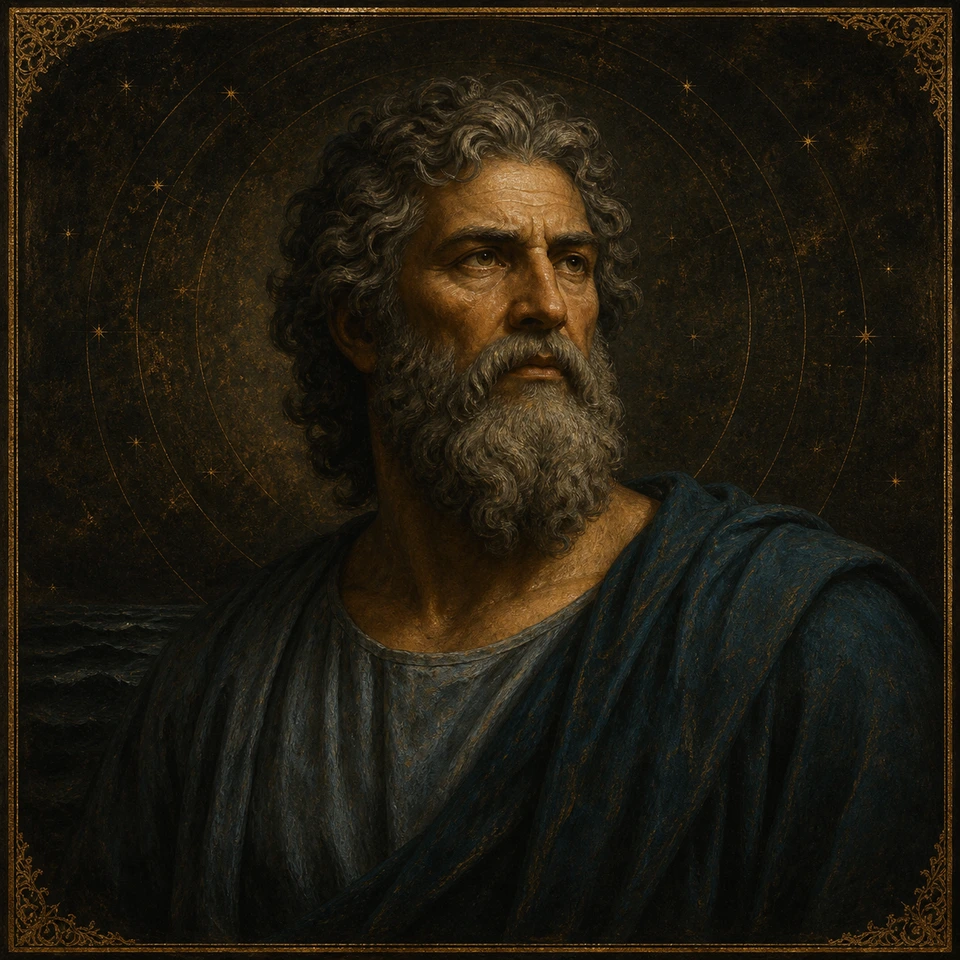
Flowing perpetually as an earth-encircling river, the vast Titan Oceanus fathered countless aquatic deities and Oceanids alongside his partner Tethys. He uniquely abstained from the violent generational conflicts, notably standing as the lone refuser during the mythic assault on Uranus recorded by Pseudo-Apollodorus.
Overview
At the rim of Achilles’s shield, beyond cities, fields, cattle, dancers, constellations, earth, sea, and sky, Hephaestus lays down the great current of Oceanus. The river closes the bronze world like a moving boundary. It is neither a blue patch on a modern globe nor the saltwater kingdom ruled by Poseidon. Archaic poetry imagines a current flowing around the inhabited earth and back into itself, a river deep enough to feed every river, spring, well, and even the sea in Homer’s account.
Hesiod gives this cosmic water a place in a divine family. Gaia and Uranus bear the first Titans, with Oceanus named first among the sons. Tethys becomes his partner, and their children pour inward through the world as rivers and Oceanids. The catalogue is not a decorative list. It turns the ring at the world’s edge into the generative source of named waters, each child remaining a distinct divine being with a course and history of its own.
The Iliad preserves a different reach. Hera tells Aphrodite that Oceanus and Tethys received her from Rhea and raised her in their house. She says the old pair are estranged and that she intends to reconcile them. The audience already knows that Hera is constructing a pretext so she can borrow Aphrodite’s power and deceive Zeus. Fosterage and quarrel therefore survive inside a cunning speech, not as a neutral family chronicle.
Pseudo-Apollodorus gives Oceanus a decisive refusal. Gaia persuades her Titan sons to attack Uranus, but Oceanus alone stands aside. Cronus takes the sickle and performs the mutilation. Hesiod’s scene is incompatible in its emphasis: fear silences the sons until Cronus alone answers, and Oceanus receives no individual response. The contrast matters. Later mythography remembers an explicit act of abstention where the earlier poem leaves him unnamed.
Greek tragedy kept reshaping the river-god. Aeschylean Prometheus Bound brings him onstage as an aged counselor who leaves the current bearing his own name and crosses the world in a marvelous chariot. Euripides could imagine the current as bull-headed arms circling the earth. Vase painting had already given him a place among the gods at the wedding of Peleus and Thetis. These forms do not collapse into one fixed portrait. They show poets and painters finding different bodies for a power whose first image was geographical.
Roman material culture carried the name through another transformation. British Museum registration 1844,1109.1 identifies a third-century AD fountain-basin mosaic from Carthage as Oceanus. In Roman Britain, hybrid marine figures often combine traits, but Witts concludes that most disputed provincial examples probably represent Neptune rather than Oceanus. Much later, the Trevi Fountain placed Oceanus at the center of eighteenth-century papal Rome, where scholarly interpretation connects him with the encompassing force of water and the image of universal rule.
Formal cult is far harder to trace than cosmography or art. Jennifer Larson describes Okeanos as important in popular cosmology while noting that such primordial gods rarely received formal cult attention. Roman Britain yields exceptional and carefully local evidence, including an altar from the Tyne context discussed in later scholarship. This does not justify a universal sanctuary, priesthood, festival, or offering system. Oceanus endures most clearly as boundary, ancestor, dramatic character, and repeatedly reimagined body of water.
Canonical identity
Canonical Identity
Oceanus functions simultaneously as a first-generation Titan within Hesiodic genealogy and as the generative, deep-flowing divine river that encircles the epic cosmography of the world. Hesiod explicitly places him among the children of Uranus and Gaia, and pairs him with Tethys as the parent to the Oceanids and global rivers. He is absolutely distinct from Pontus and Poseidon, and his name must not be flattened into the modern geographical definition of "the ocean". The Iliad positions him as the source of the sea rather than a synonym for it, proving that shared aquatic domains do not erase separate divine identities.
Linguistic Identity
Oceanus derives from the Greek Ὠκεανός, conventionally transliterated as Okeanos. Because a highly confident ancient pronunciation remains unresolved, the Greek form is preserved without a fabricated phonetic guide.
Sources and evidence
TEXTUAL · Supported
Hesiod names Oceanus first among the Titan children born to Gaia and Uranus.
- Source
- Hesiod; edited and translated by Hugh G. Evelyn-White, Theogony (1914)
- Reviewed edition
- Hugh G. Evelyn-White edition and English translation in Hesiod, the Homeric Hymns and Homerica, 1914 · translated by Hugh G. Evelyn-White · edited by Hugh G. Evelyn-White · Perseus Digital Library / Scaife ATLAS
- Exact locator
- Entry Theogony · Line 132-138
- Scope
- Archaic Greece · Ancient Greece
- Authority
- Hesiod, Theogony, Evelyn-White translation
- Certainty
- High
The claim remains limited to the named passage and the exact reviewed edition.
Open exact reviewed sourceTEXTUAL · Supported
The Iliad calls deep-flowing Oceanus the source of rivers, sea, springs, and wells, defining a cosmic river rather than Poseidon’s sea office.
- Source
- Homer; Monro and Allen Greek edition with edition-specific translations, Iliad (1920)
- Reviewed edition
- A. T. Murray English translation, volumes I-II, 1924-1925 · translated by A. T. Murray · Perseus Digital Library / Scaife ATLAS
- Exact locator
- Entry Iliad · Book 21 · Line 195-197
- Scope
- Archaic Greece · Ancient Greece
- Authority
- Homer, Iliad, A. T. Murray 1924-1925 English eng3
- Certainty
- High
The claim remains limited to the named passage and the exact reviewed edition.
Open exact reviewed source2 reviewed sources for this section
- Hesiod; edited and translated by Hugh G. Evelyn-White, Theogony (1914)Hesiod, the Homeric Hymns and Homerica, London and New York, 1914 · Perseus Digital Library / Scaife ATLAS
- Homer; Monro and Allen Greek edition with edition-specific translations, Iliad (1920)Perseus CTS edition corpus; Greek edition, Oxford, 1908-1920 · Perseus Digital Library / Scaife ATLAS
Culture, tradition, period, and place
Archaic Greek poetry locates Oceanus at the edge of the human world and inside the ancestry of its waters. The shield of Achilles makes the boundary visible as a current around the rim. Hera’s speech imagines the household of Oceanus and Tethys at the ends of the fruitful earth. Hesiod carries that far water inward by naming rivers and Oceanids as their children.
Later witnesses rearrange the same figure. Pseudo-Apollodorus writes Oceanus into a prose succession story and an explicit refusal. Greek tragedy turns the encircling current into an actor who can enter the stage. Roman Carthage supplies a third-century AD fountain-basin mosaic, while Roman Britain gives locally distinctive images and rare inscriptions. These places mark reception, not one continuous cult center.
Sources and evidence
TEXTUAL · Supported
Theogony places Oceanus in Archaic Greek Titan genealogy and names his river and Oceanid children with Tethys.
- Source
- Hesiod; edited and translated by Hugh G. Evelyn-White, Theogony (1914)
- Reviewed edition
- Hugh G. Evelyn-White edition and English translation in Hesiod, the Homeric Hymns and Homerica, 1914 · translated by Hugh G. Evelyn-White · edited by Hugh G. Evelyn-White · Perseus Digital Library / Scaife ATLAS
- Exact locator
- Entry Theogony · Line 132-138; 337-370
- Scope
- Archaic Greece · Ancient Greece
- Authority
- Hesiod, Theogony, Evelyn-White translation
- Certainty
- High
The claim remains limited to the named passage and the exact reviewed edition.
Open exact reviewed sourceTEXTUAL · Supported
The Iliad places Oceanus at the world’s edge, inside Hera’s fosterage story, and on the rim of Achilles’s shield.
- Source
- Homer; Monro and Allen Greek edition with edition-specific translations, Iliad (1920)
- Reviewed edition
- A. T. Murray English translation, volumes I-II, 1924-1925 · translated by A. T. Murray · Perseus Digital Library / Scaife ATLAS
- Exact locator
- Entry Iliad · Book 14; 18 · Line 14.200-210; 18.607-608
- Scope
- Archaic Greece · Ancient Greece
- Authority
- Homer, Iliad, A. T. Murray 1924-1925 English eng3
- Certainty
- High
The claim remains limited to the named passage and the exact reviewed edition.
Open exact reviewed sourceTEXTUAL · Supported
The later Library arranges Oceanus in prose genealogy, names his children with Tethys, and singles out his refusal to attack Uranus.
- Source
- Pseudo-Apollodorus; edited and translated by James G. Frazer, Library (1921)
- Reviewed edition
- James G. Frazer edition and English translation, Harvard University Press and William Heinemann, 1921 · translated by James G. Frazer · edited by James G. Frazer · Perseus Digital Library / Scaife ATLAS
- Exact locator
- Entry Library · Book 1 · Chapter 1-2 · Section 1.1.3-4; 1.2.2
- Scope
- Greek religion under Roman imperial rule · Ancient Greece
- Authority
- Pseudo-Apollodorus, Library, Frazer translation
- Certainty
- High
The claim remains limited to the named passage and the exact reviewed edition.
Open exact reviewed sourceMATERIAL CULTURE · Supported
British Museum registration 1844,1109.1 identifies a Roman Imperial third-century AD Oceanus mosaic panel from a fountain basin excavated at Carthage.
- Source
- British Museum, Mosaic panel from a fountain basin: the sea-god Oceanus (1844,1109.1)
- Reviewed edition
- British Museum object record 1844,1109.1, mosaic panel from a fountain basin depicting Oceanus, excavated at Carthage, 3rd century AD · British Museum
- Exact locator
- MuseumObjectId 1844,1109.1 · RecordUrl https://www.britishmuseum.org/collection/object/G_1844-1109-1
- Scope
- Greek religion under Roman imperial rule · Carthage
- Authority
- British Museum object catalogue 1844,1109.1
- Certainty
- Secure for the named catalogue fields
Claim is limited to the indexed catalogue fields named above.
Open exact reviewed sourceTEXTUAL · Supported
Homeric Hymn 31 places Ocean at the boundary toward which Helios drives his descending chariot.
- Source
- Anonymous Homeric Hymns; edited and translated by Hugh G. Evelyn-White, Homeric Hymns (1914)
- Reviewed edition
- Hugh G. Evelyn-White English translation of Homeric Hymn 31 to Helios, 1914 · translated by Hugh G. Evelyn-White · edited by Hugh G. Evelyn-White · Perseus Digital Library / Scaife ATLAS
- Exact locator
- Entry Homeric Hymn 31 to Helios · Hymn 31 · Line 1-15a
- Scope
- Archaic Greece · Ancient Greece
- Authority
- Homeric Hymn 31 to Helios, Hugh G. Evelyn-White 1914 English eng2
- Certainty
- High
The claim remains limited to the named passage and the exact reviewed edition.
Open exact reviewed sourceTEXTUAL · Supported
Pausanias reports a place-bounded Athenian genealogy in which Ocean was father of the Nemesis worshipped at Rhamnous.
- Source
- Pausanias; Spiro Greek edition and Jones/Ormerod translation volumes, Description of Greece (1935)
- Reviewed edition
- W. H. S. Jones and H. A. Ormerod English translation volumes, 1918-1935 · translated by W. H. S. Jones and H. A. Ormerod, volume-dependent · Perseus Digital Library / Scaife ATLAS
- Exact locator
- Entry Description of Greece · Book 7 · Chapter 5 · Section 3
- Scope
- Greek religion under Roman imperial rule · Rhamnous
- Authority
- Pausanias, Description of Greece, Jones and Ormerod 1918-1935 English eng2
- Certainty
- High
The claim remains limited to the named passage and the exact reviewed edition.
Open exact reviewed sourceSCHOLARLY INTERPRETATION · Supported
Macías Otero traces Greek tragedy’s transformation of Oceanus from an encircling current into a speaking and moving dramatic figure.
- Source
- Sara Macías Otero, Océano en la tragedia griega (2025)
- Reviewed edition
- Agua y Territorio 26, 2025, pages 65-77 · ILC, CCHS, CSIC
- Exact locator
- Page 65-77
- Scope
- Ancient Greek diachrony · Ancient Greece
- Authority
- Peer-reviewed classical scholarship on Greek tragedy
- Certainty
- High within the named source scope
The interpretation remains source-specific and does not combine distinct tragic embodiments into one fixed portrait.
Open exact reviewed sourceSCHOLARLY INTERPRETATION · Supported
Witts documents locally distinctive Oceanus and Neptune imagery and rare inscriptions in Roman Britain.
- Source
- Patricia Witts, Neptune and Oceanus in Romano-British Mosaics: A Special Case? (2025)
- Reviewed edition
- Journal of Mosaic Research 18, 2025, pages 413-430 · Journal of Mosaic Research
- Exact locator
- Page 413-421
- Scope
- Greek religion under Roman imperial rule · Roman Britain
- Authority
- Modern scholarship on Romano-British mosaics
- Certainty
- High within the named source scope
The conclusion is object- and region-specific and does not define Greek Oceanus universally.
Open exact reviewed source8 reviewed sources for this section
- Hesiod; edited and translated by Hugh G. Evelyn-White, Theogony (1914)Hesiod, the Homeric Hymns and Homerica, London and New York, 1914 · Perseus Digital Library / Scaife ATLAS
- Homer; Monro and Allen Greek edition with edition-specific translations, Iliad (1920)Perseus CTS edition corpus; Greek edition, Oxford, 1908-1920 · Perseus Digital Library / Scaife ATLAS
- Pseudo-Apollodorus; edited and translated by James G. Frazer, Library (1921)Harvard University Press and William Heinemann edition, 1921 · Perseus Digital Library / Scaife ATLAS
- British Museum, Mosaic panel from a fountain basin: the sea-god Oceanus (1844,1109.1)Live official British Museum collection record, publication date not stated · British Museum
- Anonymous Homeric Hymns; edited and translated by Hugh G. Evelyn-White, Homeric Hymns (1914)Hesiod, the Homeric Hymns and Homerica, London and New York, 1914 · Perseus Digital Library / Scaife ATLAS
- Pausanias; Spiro Greek edition and Jones/Ormerod translation volumes, Description of Greece (1935)Perseus CTS edition corpus, 1903-1935 · Perseus Digital Library / Scaife ATLAS
- Sara Macías Otero, Océano en la tragedia griega (2025)Agua y Territorio 26, pages 65-77 · ILC, CCHS, CSIC
- Patricia Witts, Neptune and Oceanus in Romano-British Mosaics: A Special Case? (2025)Journal of Mosaic Research 18, pages 413-430 · Journal of Mosaic Research
Historical development
The oldest surviving image is cosmic rather than portrait-like. Oceanus bounds a worked world and supplies its waters. Kirk, Raven, and Schofield show how the circular, back-flowing river belonged to an early Greek world picture, while warning that proposals about its Near Eastern background remain comparisons rather than certainty.
Hesiod draws the river into genealogy; the Iliad makes him a source, boundary, foster father in Hera’s story, and metalwork at the shield’s edge. Pseudo-Apollodorus later singles out his refusal in the assault on Uranus. Macías Otero traces another shift in tragedy, where the current can acquire a bull-headed body or separate from the god who rules it. Roman mosaicists then make Oceanus a monumental face within aquatic decoration and fountain architecture.
Sources and evidence
TEXTUAL · Supported
Hesiod’s Archaic poem preserves Oceanus as Titan son and generative partner of Tethys.
- Source
- Hesiod; edited and translated by Hugh G. Evelyn-White, Theogony (1914)
- Reviewed edition
- Hugh G. Evelyn-White edition and English translation in Hesiod, the Homeric Hymns and Homerica, 1914 · translated by Hugh G. Evelyn-White · edited by Hugh G. Evelyn-White · Perseus Digital Library / Scaife ATLAS
- Exact locator
- Entry Theogony · Line 132-138; 337-370
- Scope
- Archaic Greece · Ancient Greece
- Authority
- Hesiod, Theogony, Evelyn-White translation
- Certainty
- High
The claim remains limited to the named passage and the exact reviewed edition.
Open exact reviewed sourceTEXTUAL · Supported
The Iliad preserves Oceanus as cosmic boundary, water source, and a named figure in Hera’s deceptive family account.
- Source
- Homer; Monro and Allen Greek edition with edition-specific translations, Iliad (1920)
- Reviewed edition
- A. T. Murray English translation, volumes I-II, 1924-1925 · translated by A. T. Murray · Perseus Digital Library / Scaife ATLAS
- Exact locator
- Entry Iliad · Book 14; 18; 21 · Line 14.200-210; 14.300-304; 18.607-608; 21.195-197
- Scope
- Archaic Greece · Ancient Greece
- Authority
- Homer, Iliad, A. T. Murray 1924-1925 English eng3
- Certainty
- High
The claim remains limited to the named passage and the exact reviewed edition.
Open exact reviewed sourceTEXTUAL · Supported
Pseudo-Apollodorus’s later mythography makes Oceanus the sole Titan brother who refuses the attack on Uranus.
- Source
- Pseudo-Apollodorus; edited and translated by James G. Frazer, Library (1921)
- Reviewed edition
- James G. Frazer edition and English translation, Harvard University Press and William Heinemann, 1921 · translated by James G. Frazer · edited by James G. Frazer · Perseus Digital Library / Scaife ATLAS
- Exact locator
- Entry Library · Book 1 · Chapter 1 · Section 1.1.4
- Scope
- Greek religion under Roman imperial rule · Ancient Greece
- Authority
- Pseudo-Apollodorus, Library, Frazer translation
- Certainty
- High
The claim remains limited to the named passage and the exact reviewed edition.
Open exact reviewed sourceMATERIAL CULTURE · Supported
Registration 1844,1109.1 documents a Roman Imperial Oceanus mosaic from Carthage centuries after the Archaic poems.
- Source
- British Museum, Mosaic panel from a fountain basin: the sea-god Oceanus (1844,1109.1)
- Reviewed edition
- British Museum object record 1844,1109.1, mosaic panel from a fountain basin depicting Oceanus, excavated at Carthage, 3rd century AD · British Museum
- Exact locator
- MuseumObjectId 1844,1109.1 · RecordUrl https://www.britishmuseum.org/collection/object/G_1844-1109-1
- Scope
- Greek religion under Roman imperial rule · Carthage
- Authority
- British Museum object catalogue 1844,1109.1
- Certainty
- Secure for the named catalogue fields
Claim is limited to the indexed catalogue fields named above.
Open exact reviewed sourceTEXTUAL · Supported
Homeric Hymn 31 preserves Ocean as the boundary of Helios’s daily downward course.
- Source
- Anonymous Homeric Hymns; edited and translated by Hugh G. Evelyn-White, Homeric Hymns (1914)
- Reviewed edition
- Hugh G. Evelyn-White English translation of Homeric Hymn 31 to Helios, 1914 · translated by Hugh G. Evelyn-White · edited by Hugh G. Evelyn-White · Perseus Digital Library / Scaife ATLAS
- Exact locator
- Entry Homeric Hymn 31 to Helios · Hymn 31 · Line 1-15a
- Scope
- Archaic Greece · Ancient Greece
- Authority
- Homeric Hymn 31 to Helios, Hugh G. Evelyn-White 1914 English eng2
- Certainty
- High
The claim remains limited to the named passage and the exact reviewed edition.
Open exact reviewed sourceTEXTUAL · Supported
Pausanias preserves a later local genealogy that makes Ocean father of Rhamnousian Nemesis while keeping Smyrna’s Night genealogy distinct.
- Source
- Pausanias; Spiro Greek edition and Jones/Ormerod translation volumes, Description of Greece (1935)
- Reviewed edition
- W. H. S. Jones and H. A. Ormerod English translation volumes, 1918-1935 · translated by W. H. S. Jones and H. A. Ormerod, volume-dependent · Perseus Digital Library / Scaife ATLAS
- Exact locator
- Entry Description of Greece · Book 7 · Chapter 5 · Section 3
- Scope
- Greek religion under Roman imperial rule · Ancient Greece
- Authority
- Pausanias, Description of Greece, Jones and Ormerod 1918-1935 English eng2
- Certainty
- High
The claim remains limited to the named passage and the exact reviewed edition.
Open exact reviewed sourceSCHOLARLY INTERPRETATION · Supported
Kirk, Raven, and Schofield explain the Homeric Okeanos as a circular, back-flowing river surrounding the earth and supplying the waters enclosed within it.
- Source
- G. S. Kirk, J. E. Raven, and M. Schofield, The Presocratic Philosophers (1983)
- Reviewed edition
- Second edition, Cambridge University Press, 1983, selected printed pages 9-11 · Cambridge University Press
- Exact locator
- Page 9-11
- Scope
- Archaic Greece · Ancient Greece
- Authority
- Modern classical scholarship on early Greek cosmography
- Certainty
- High within the named source scope
The comparative interpretation remains qualified and does not establish direct borrowing.
Open exact reviewed sourceSCHOLARLY INTERPRETATION · Supported
Macías Otero traces historically distinct tragic embodiments of Oceanus, including bull-headed current, dramatic counselor, and hybrid creature-chariot imagery.
- Source
- Sara Macías Otero, Océano en la tragedia griega (2025)
- Reviewed edition
- Agua y Territorio 26, 2025, pages 65-77 · ILC, CCHS, CSIC
- Exact locator
- Page 65-77
- Scope
- Ancient Greek diachrony · Ancient Greece
- Authority
- Peer-reviewed classical scholarship on Greek tragedy
- Certainty
- High within the named source scope
The interpretation remains source-specific and does not combine distinct tragic embodiments into one fixed portrait.
Open exact reviewed sourceSCHOLARLY INTERPRETATION · Supported
Witts places later Oceanus and Neptune mosaic imagery within the specific visual history of Roman Britain.
- Source
- Patricia Witts, Neptune and Oceanus in Romano-British Mosaics: A Special Case? (2025)
- Reviewed edition
- Journal of Mosaic Research 18, 2025, pages 413-430 · Journal of Mosaic Research
- Exact locator
- Page 413-421
- Scope
- Greek religion under Roman imperial rule · Roman Britain
- Authority
- Modern scholarship on Romano-British mosaics
- Certainty
- High within the named source scope
The conclusion is object- and region-specific and does not define Greek Oceanus universally.
Open exact reviewed source9 reviewed sources for this section
- Hesiod; edited and translated by Hugh G. Evelyn-White, Theogony (1914)Hesiod, the Homeric Hymns and Homerica, London and New York, 1914 · Perseus Digital Library / Scaife ATLAS
- Homer; Monro and Allen Greek edition with edition-specific translations, Iliad (1920)Perseus CTS edition corpus; Greek edition, Oxford, 1908-1920 · Perseus Digital Library / Scaife ATLAS
- Pseudo-Apollodorus; edited and translated by James G. Frazer, Library (1921)Harvard University Press and William Heinemann edition, 1921 · Perseus Digital Library / Scaife ATLAS
- British Museum, Mosaic panel from a fountain basin: the sea-god Oceanus (1844,1109.1)Live official British Museum collection record, publication date not stated · British Museum
- Anonymous Homeric Hymns; edited and translated by Hugh G. Evelyn-White, Homeric Hymns (1914)Hesiod, the Homeric Hymns and Homerica, London and New York, 1914 · Perseus Digital Library / Scaife ATLAS
- Pausanias; Spiro Greek edition and Jones/Ormerod translation volumes, Description of Greece (1935)Perseus CTS edition corpus, 1903-1935 · Perseus Digital Library / Scaife ATLAS
- G. S. Kirk, J. E. Raven, and M. Schofield, The Presocratic Philosophers (1983)Second edition, Cambridge University Press, pages 9-11 · Cambridge University Press
- Sara Macías Otero, Océano en la tragedia griega (2025)Agua y Territorio 26, pages 65-77 · ILC, CCHS, CSIC
- Patricia Witts, Neptune and Oceanus in Romano-British Mosaics: A Special Case? (2025)Journal of Mosaic Research 18, pages 413-430 · Journal of Mosaic Research
Attested roles and historical themes
Roles, powers, and limits
Oceanus surrounds, generates, and marks passage. On Achilles’s shield his current closes the cosmos. In Iliad 21, ordinary rivers, springs, wells, and the sea flow from him. With Tethys, he fathers a multitude of distinct waters and nymphs. These are not the actions of an Olympian admiral commanding ships; they belong to an older geography of origin and limit.
The Library adds a personal boundary. Oceanus refuses the attack that the other Titan brothers join, even though Cronus alone performs the mutilation. That act belongs to the later mythographer. Hesiod does not name Oceanus as either attacker or refuser. Neither source expands Oceanus beyond the recorded source, boundary, genealogy, and refusal into another marine deity’s separate offices.
Sources and evidence
TEXTUAL · Supported
The Iliad presents Oceanus as deep-flowing source and as the enclosing outer current on Achilles’s shield.
- Source
- Homer; Monro and Allen Greek edition with edition-specific translations, Iliad (1920)
- Reviewed edition
- A. T. Murray English translation, volumes I-II, 1924-1925 · translated by A. T. Murray · Perseus Digital Library / Scaife ATLAS
- Exact locator
- Entry Iliad · Book 18; 21 · Line 18.607-608; 21.195-197
- Scope
- Archaic Greece · Ancient Greece
- Authority
- Homer, Iliad, A. T. Murray 1924-1925 English eng3
- Certainty
- High
The claim remains limited to the named passage and the exact reviewed edition.
Open exact reviewed sourceTEXTUAL · Supported
Hesiod makes Oceanus and Tethys parents of distinct rivers and Oceanids on a world-filling scale.
- Source
- Hesiod; edited and translated by Hugh G. Evelyn-White, Theogony (1914)
- Reviewed edition
- Hugh G. Evelyn-White edition and English translation in Hesiod, the Homeric Hymns and Homerica, 1914 · translated by Hugh G. Evelyn-White · edited by Hugh G. Evelyn-White · Perseus Digital Library / Scaife ATLAS
- Exact locator
- Entry Theogony · Line 337-370
- Scope
- Archaic Greece · Ancient Greece
- Authority
- Hesiod, Theogony, Evelyn-White translation
- Certainty
- High
The claim remains limited to the named passage and the exact reviewed edition.
Open exact reviewed sourceTEXTUAL · Supported
The Library assigns Oceanus an individual limit when he refuses the assault joined by the other Titan brothers.
- Source
- Pseudo-Apollodorus; edited and translated by James G. Frazer, Library (1921)
- Reviewed edition
- James G. Frazer edition and English translation, Harvard University Press and William Heinemann, 1921 · translated by James G. Frazer · edited by James G. Frazer · Perseus Digital Library / Scaife ATLAS
- Exact locator
- Entry Library · Book 1 · Chapter 1 · Section 1.1.4
- Scope
- Greek religion under Roman imperial rule · Ancient Greece
- Authority
- Pseudo-Apollodorus, Library, Frazer translation
- Certainty
- High
The claim remains limited to the named passage and the exact reviewed edition.
Open exact reviewed source3 reviewed sources for this section
- Homer; Monro and Allen Greek edition with edition-specific translations, Iliad (1920)Perseus CTS edition corpus; Greek edition, Oxford, 1908-1920 · Perseus Digital Library / Scaife ATLAS
- Hesiod; edited and translated by Hugh G. Evelyn-White, Theogony (1914)Hesiod, the Homeric Hymns and Homerica, London and New York, 1914 · Perseus Digital Library / Scaife ATLAS
- Pseudo-Apollodorus; edited and translated by James G. Frazer, Library (1921)Harvard University Press and William Heinemann edition, 1921 · Perseus Digital Library / Scaife ATLAS
Epithets and titles
No securely localized cult epithet is established; source, encircling river, and Titan are roles or classifications rather than titles.
3 reviewed sources for this section
- Hesiod; edited and translated by Hugh G. Evelyn-White, Theogony (1914)Hesiod, the Homeric Hymns and Homerica, London and New York, 1914 · Perseus Digital Library / Scaife ATLAS
- Homer; Monro and Allen Greek edition with edition-specific translations, Iliad (1920)Perseus CTS edition corpus; Greek edition, Oxford, 1908-1920 · Perseus Digital Library / Scaife ATLAS
- Pseudo-Apollodorus; edited and translated by James G. Frazer, Library (1921)Harvard University Press and William Heinemann edition, 1921 · Perseus Digital Library / Scaife ATLAS
Worship and cult
Oceanus mattered deeply without leaving the dense civic institutions known for many Olympian gods. Larson notes that Okeanos and several other primordial powers rarely received formal cult attention, yet remained important within Greek religious cosmology. The distinction is crucial: rarity of documented formal cult is not religious insignificance, and it is not proof that no local act of honor ever occurred.
Roman Britain preserves exceptional local evidence. Witts discusses paired Neptune and Oceanus altars from the River Tyne and relates their setting to travel across the waters around Britain. That evidence belongs to its Roman provincial place and period. It does not establish a pan-Greek priesthood, a universal sacrifice, or one rite repeated across the Mediterranean.
Sources and evidence
TEXTUAL · Supported
The reviewed Iliad passages describe cosmography and epic action, not a temple, priesthood, sacrifice, or household rite for Oceanus.
- Source
- Homer; Monro and Allen Greek edition with edition-specific translations, Iliad (1920)
- Reviewed edition
- A. T. Murray English translation, volumes I-II, 1924-1925 · translated by A. T. Murray · Perseus Digital Library / Scaife ATLAS
- Exact locator
- Entry Iliad · Book 14 · Line 200-210
- Scope
- Archaic Greece · Ancient Greece
- Authority
- Homer, Iliad, A. T. Murray 1924-1925 English eng3
- Certainty
- High
The claim remains limited to the named passage and the exact reviewed edition.
Open exact reviewed sourceMATERIAL CULTURE · Supported
The indexed catalogue classifies 1844,1109.1 as part of a fountain basin, not as a Greek temple dedication.
- Source
- British Museum, Mosaic panel from a fountain basin: the sea-god Oceanus (1844,1109.1)
- Reviewed edition
- British Museum object record 1844,1109.1, mosaic panel from a fountain basin depicting Oceanus, excavated at Carthage, 3rd century AD · British Museum
- Exact locator
- MuseumObjectId 1844,1109.1 · RecordUrl https://www.britishmuseum.org/collection/object/G_1844-1109-1
- Scope
- Greek religion under Roman imperial rule · Carthage
- Authority
- British Museum object catalogue 1844,1109.1
- Certainty
- Secure for the named catalogue fields
Claim is limited to the indexed catalogue fields named above.
Open exact reviewed sourceSCHOLARLY INTERPRETATION · Supported
Larson distinguishes rare formal cult attention for Okeanos and several primordial powers from Okeanos’s continuing importance in popular cosmology.
- Source
- Jennifer Larson, Understanding Greek Religion: A Cognitive Approach (2016)
- Reviewed edition
- Routledge 2016, chapter 1, What is Greek religion?, selected printed pages 26-28 · Kent State University
- Exact locator
- Page 26
- Scope
- Archaic Greece · Ancient Greece
- Authority
- Modern scholarship on Greek religion
- Certainty
- High within the named source scope
The conclusion concerns the rarity of formal cult evidence, not religious insignificance or proof of total absence.
Open exact reviewed sourceSCHOLARLY INTERPRETATION · Supported
Witts treats Roman evidence for Oceanus as rare and discusses the Tyne altar in the specific context of Roman Britain and travel across Ocean’s stream.
- Source
- Patricia Witts, Neptune and Oceanus in Romano-British Mosaics: A Special Case? (2025)
- Reviewed edition
- Journal of Mosaic Research 18, 2025, pages 413-430 · Journal of Mosaic Research
- Exact locator
- Page 419-420
- Scope
- Greek religion under Roman imperial rule · Roman Britain
- Authority
- Modern scholarship on Romano-British mosaics
- Certainty
- High within the named source scope
The conclusion is object- and region-specific and does not define Greek Oceanus universally.
Open exact reviewed source4 reviewed sources for this section
- Homer; Monro and Allen Greek edition with edition-specific translations, Iliad (1920)Perseus CTS edition corpus; Greek edition, Oxford, 1908-1920 · Perseus Digital Library / Scaife ATLAS
- British Museum, Mosaic panel from a fountain basin: the sea-god Oceanus (1844,1109.1)Live official British Museum collection record, publication date not stated · British Museum
- Jennifer Larson, Understanding Greek Religion: A Cognitive Approach (2016)Routledge, chapter 1, What is Greek religion?, pages 1-31 · Kent State University
- Patricia Witts, Neptune and Oceanus in Romano-British Mosaics: A Special Case? (2025)Journal of Mosaic Research 18, pages 413-430 · Journal of Mosaic Research
Temples, sanctuaries, and sacred places
The most persistent sacred geography is the far boundary itself. Hera claims she will travel to the ends of the fruitful earth to reach Oceanus and Tethys. The shield of Achilles transforms that remote current into the rim of a crafted cosmos. Macías Otero shows Greek tragedy preserving Oceanus as a remote current while bringing the personified figure across that distance into dramatic action.
No single Greek sanctuary can stand in for that immense geography. Carthage is the excavated provenance of a later Roman mosaic, not an Archaic cult center. The Tyne altar belongs to Roman Britain. Each place shows how communities received the name, but neither licenses the invention of an Oceanus temple network.
Sources and evidence
TEXTUAL · Supported
Hera locates Oceanus and Tethys at the ends of the fruitful earth, while the shield places Oceanus at a crafted cosmic rim rather than a named sanctuary.
- Source
- Homer; Monro and Allen Greek edition with edition-specific translations, Iliad (1920)
- Reviewed edition
- A. T. Murray English translation, volumes I-II, 1924-1925 · translated by A. T. Murray · Perseus Digital Library / Scaife ATLAS
- Exact locator
- Entry Iliad · Book 14; 18 · Line 14.200-210; 18.607-608
- Scope
- Archaic Greece · Ancient Greece
- Authority
- Homer, Iliad, A. T. Murray 1924-1925 English eng3
- Certainty
- High
The claim remains limited to the named passage and the exact reviewed edition.
Open exact reviewed sourceMATERIAL CULTURE · Supported
The indexed record gives Carthage as the excavated provenance of the later mosaic, not an Archaic Greek sanctuary.
- Source
- British Museum, Mosaic panel from a fountain basin: the sea-god Oceanus (1844,1109.1)
- Reviewed edition
- British Museum object record 1844,1109.1, mosaic panel from a fountain basin depicting Oceanus, excavated at Carthage, 3rd century AD · British Museum
- Exact locator
- MuseumObjectId 1844,1109.1 · RecordUrl https://www.britishmuseum.org/collection/object/G_1844-1109-1
- Scope
- Greek religion under Roman imperial rule · Carthage
- Authority
- British Museum object catalogue 1844,1109.1
- Certainty
- Secure for the named catalogue fields
Claim is limited to the indexed catalogue fields named above.
Open exact reviewed sourceSCHOLARLY INTERPRETATION · Supported
Macías Otero shows Greek tragedy preserving Oceanus as a remote current while bringing the personified figure across that distance into dramatic action.
- Source
- Sara Macías Otero, Océano en la tragedia griega (2025)
- Reviewed edition
- Agua y Territorio 26, 2025, pages 65-77 · ILC, CCHS, CSIC
- Exact locator
- Page 65-77
- Scope
- Ancient Greek diachrony · Ancient Greece
- Authority
- Peer-reviewed classical scholarship on Greek tragedy
- Certainty
- High within the named source scope
The interpretation remains source-specific and does not combine distinct tragic embodiments into one fixed portrait.
Open exact reviewed sourceSCHOLARLY INTERPRETATION · Supported
Witts locates the paired Neptune and Oceanus altar evidence in Roman Britain’s River Tyne context.
- Source
- Patricia Witts, Neptune and Oceanus in Romano-British Mosaics: A Special Case? (2025)
- Reviewed edition
- Journal of Mosaic Research 18, 2025, pages 413-430 · Journal of Mosaic Research
- Exact locator
- Page 419-420
- Scope
- Greek religion under Roman imperial rule · Roman Britain
- Authority
- Modern scholarship on Romano-British mosaics
- Certainty
- High within the named source scope
The conclusion is object- and region-specific and does not define Greek Oceanus universally.
Open exact reviewed source4 reviewed sources for this section
- Homer; Monro and Allen Greek edition with edition-specific translations, Iliad (1920)Perseus CTS edition corpus; Greek edition, Oxford, 1908-1920 · Perseus Digital Library / Scaife ATLAS
- British Museum, Mosaic panel from a fountain basin: the sea-god Oceanus (1844,1109.1)Live official British Museum collection record, publication date not stated · British Museum
- Sara Macías Otero, Océano en la tragedia griega (2025)Agua y Territorio 26, pages 65-77 · ILC, CCHS, CSIC
- Patricia Witts, Neptune and Oceanus in Romano-British Mosaics: A Special Case? (2025)Journal of Mosaic Research 18, pages 413-430 · Journal of Mosaic Research
Festivals and processions
No named annual festival, calendar month, or civic procession for Oceanus emerges from the ancient texts and scholarship used here. Hesiod’s river catalogue is genealogy. Hera’s proposed journey is a lie told during war. The procession painted by Sophilos represents the divine guests at the wedding of Peleus and Thetis, not a festival devoted to Oceanus.
The absence of a named festival in this corpus should remain narrow. It does not become a claim that every Greek city was silent. It means that no public calendar can be responsibly reconstructed from these witnesses, and no modern date should be presented as an ancient continuation.
Sources and evidence
TEXTUAL · Supported
Hesiod’s river and Oceanid catalogue is genealogy and supplies no Oceanus festival, month, or procession.
- Source
- Hesiod; edited and translated by Hugh G. Evelyn-White, Theogony (1914)
- Reviewed edition
- Hugh G. Evelyn-White edition and English translation in Hesiod, the Homeric Hymns and Homerica, 1914 · translated by Hugh G. Evelyn-White · edited by Hugh G. Evelyn-White · Perseus Digital Library / Scaife ATLAS
- Exact locator
- Entry Theogony · Line 337-370
- Scope
- Archaic Greece · Ancient Greece
- Authority
- Hesiod, Theogony, Evelyn-White translation
- Certainty
- High
The claim remains limited to the named passage and the exact reviewed edition.
Open exact reviewed sourceTEXTUAL · Supported
Hera’s proposed journey is a false cover and Achilles’s shield is epic craftsmanship; neither passage supplies an Oceanus festival.
- Source
- Homer; Monro and Allen Greek edition with edition-specific translations, Iliad (1920)
- Reviewed edition
- A. T. Murray English translation, volumes I-II, 1924-1925 · translated by A. T. Murray · Perseus Digital Library / Scaife ATLAS
- Exact locator
- Entry Iliad · Book 14 · Line 200-210
- Scope
- Archaic Greece · Ancient Greece
- Authority
- Homer, Iliad, A. T. Murray 1924-1925 English eng3
- Certainty
- High
The claim remains limited to the named passage and the exact reviewed edition.
Open exact reviewed sourceSCHOLARLY INTERPRETATION · Supported
Larson identifies Sophilos’s painted Okeanos near Tethys as a guest in the wedding procession of Peleus and Thetis, not as evidence for an Oceanus festival.
- Source
- Jennifer Larson, Understanding Greek Religion: A Cognitive Approach (2016)
- Reviewed edition
- Routledge 2016, chapter 1, What is Greek religion?, selected printed pages 26-28 · Kent State University
- Exact locator
- Page 27-28
- Scope
- Archaic Greece · Attica
- Authority
- Modern scholarship on Greek religion
- Certainty
- High within the named source scope
The conclusion concerns the rarity of formal cult evidence, not religious insignificance or proof of total absence.
Open exact reviewed source3 reviewed sources for this section
- Hesiod; edited and translated by Hugh G. Evelyn-White, Theogony (1914)Hesiod, the Homeric Hymns and Homerica, London and New York, 1914 · Perseus Digital Library / Scaife ATLAS
- Homer; Monro and Allen Greek edition with edition-specific translations, Iliad (1920)Perseus CTS edition corpus; Greek edition, Oxford, 1908-1920 · Perseus Digital Library / Scaife ATLAS
- Jennifer Larson, Understanding Greek Religion: A Cognitive Approach (2016)Routledge, chapter 1, What is Greek religion?, pages 1-31 · Kent State University
Offerings, votives, and ritual evidence
The surviving material assembled here supplies no secure Greek offering list, sacrificial rule, votive formula, or ritual implement for Oceanus. Water appears as his body, boundary, ancestry, and later architectural setting, but those meanings are not instructions. A fountain basin bearing his image does not prove that its water served as a libation to him.
Roman Britain’s Tyne evidence shows that local dedication could occur, yet the precise provincial context must remain visible. It cannot support a universal practice. Modern offerings likewise require accountable contemporary evidence from the community and period in which they are given. None is converted from poetic imagery here.
Sources and evidence
TEXTUAL · Supported
Theogony 337-370 names descendants of Oceanus and Tethys but gives no offering, sacrifice, libation rule, or votive formula.
- Source
- Hesiod; edited and translated by Hugh G. Evelyn-White, Theogony (1914)
- Reviewed edition
- Hugh G. Evelyn-White edition and English translation in Hesiod, the Homeric Hymns and Homerica, 1914 · translated by Hugh G. Evelyn-White · edited by Hugh G. Evelyn-White · Perseus Digital Library / Scaife ATLAS
- Exact locator
- Entry Theogony · Line 337-370
- Scope
- Archaic Greece · Ancient Greece
- Authority
- Hesiod, Theogony, Evelyn-White translation
- Certainty
- High
The claim remains limited to the named passage and the exact reviewed edition.
Open exact reviewed sourceMATERIAL CULTURE · Supported
The indexed object type is a fountain-basin mosaic and does not by itself establish a libation rite.
- Source
- British Museum, Mosaic panel from a fountain basin: the sea-god Oceanus (1844,1109.1)
- Reviewed edition
- British Museum object record 1844,1109.1, mosaic panel from a fountain basin depicting Oceanus, excavated at Carthage, 3rd century AD · British Museum
- Exact locator
- MuseumObjectId 1844,1109.1 · RecordUrl https://www.britishmuseum.org/collection/object/G_1844-1109-1
- Scope
- Greek religion under Roman imperial rule · Carthage
- Authority
- British Museum object catalogue 1844,1109.1
- Certainty
- Secure for the named catalogue fields
Claim is limited to the indexed catalogue fields named above.
Open exact reviewed sourceSCHOLARLY INTERPRETATION · Supported
Witts’s Tyne evidence establishes a local Roman provincial dedication, not a universal Greek or modern offering practice.
- Source
- Patricia Witts, Neptune and Oceanus in Romano-British Mosaics: A Special Case? (2025)
- Reviewed edition
- Journal of Mosaic Research 18, 2025, pages 413-430 · Journal of Mosaic Research
- Exact locator
- Page 419-420
- Scope
- Greek religion under Roman imperial rule · Roman Britain
- Authority
- Modern scholarship on Romano-British mosaics
- Certainty
- High within the named source scope
The conclusion is object- and region-specific and does not define Greek Oceanus universally.
Open exact reviewed source3 reviewed sources for this section
- Hesiod; edited and translated by Hugh G. Evelyn-White, Theogony (1914)Hesiod, the Homeric Hymns and Homerica, London and New York, 1914 · Perseus Digital Library / Scaife ATLAS
- British Museum, Mosaic panel from a fountain basin: the sea-god Oceanus (1844,1109.1)Live official British Museum collection record, publication date not stated · British Museum
- Patricia Witts, Neptune and Oceanus in Romano-British Mosaics: A Special Case? (2025)Journal of Mosaic Research 18, pages 413-430 · Journal of Mosaic Research
Iconography and material culture
Epic gives Oceanus a magnificent abstract form: the current around the outer rim of Achilles’s shield. The band is part of Hephaestus’s metalwork, a boundary around the represented world, not a portable occult diagram. Sophilos later paints Okeanos as a river god walking near Tethys in the wedding procession of Peleus and Thetis.
Tragedy permits other bodies. Macías Otero discusses Euripides’ bull-headed description and the fully anthropomorphic counselor of Prometheus Bound. Roman imagery adds bearded heads and crustacean claws, but Witts concludes that most disputed hybrid Romano-British figures probably represent Neptune, even where individual features overlap with Oceanus. No single horn, trident, claw, vehicle, or facial type is therefore safe as a universal attribute across all periods.
Sources and evidence
TEXTUAL · Supported
Hephaestus places the great might of Oceanus around the outermost rim of Achilles’s shield.
- Source
- Homer; Monro and Allen Greek edition with edition-specific translations, Iliad (1920)
- Reviewed edition
- A. T. Murray English translation, volumes I-II, 1924-1925 · translated by A. T. Murray · Perseus Digital Library / Scaife ATLAS
- Exact locator
- Entry Iliad · Book 18 · Line 607-608
- Scope
- Archaic Greece · Ancient Greece
- Authority
- Homer, Iliad, A. T. Murray 1924-1925 English eng3
- Certainty
- High
The claim remains limited to the named passage and the exact reviewed edition.
Open exact reviewed sourceMATERIAL CULTURE · Supported
The indexed catalogue identifies 1844,1109.1 as a Roman Imperial mosaic panel representing Oceanus in a fountain-basin context.
- Source
- British Museum, Mosaic panel from a fountain basin: the sea-god Oceanus (1844,1109.1)
- Reviewed edition
- British Museum object record 1844,1109.1, mosaic panel from a fountain basin depicting Oceanus, excavated at Carthage, 3rd century AD · British Museum
- Exact locator
- MuseumObjectId 1844,1109.1 · RecordUrl https://www.britishmuseum.org/collection/object/G_1844-1109-1
- Scope
- Greek religion under Roman imperial rule · Carthage
- Authority
- British Museum object catalogue 1844,1109.1
- Certainty
- Secure for the named catalogue fields
Claim is limited to the indexed catalogue fields named above.
Open exact reviewed sourceSCHOLARLY INTERPRETATION · Supported
Larson identifies Okeanos as a river god walking near Tethys in Sophilos’s painted wedding procession for Peleus and Thetis.
- Source
- Jennifer Larson, Understanding Greek Religion: A Cognitive Approach (2016)
- Reviewed edition
- Routledge 2016, chapter 1, What is Greek religion?, selected printed pages 26-28 · Kent State University
- Exact locator
- Page 27-28
- Scope
- Archaic Greece · Attica
- Authority
- Modern scholarship on Greek religion
- Certainty
- High within the named source scope
The conclusion concerns the rarity of formal cult evidence, not religious insignificance or proof of total absence.
Open exact reviewed sourceSCHOLARLY INTERPRETATION · Supported
Macías Otero traces distinct tragic embodiments, including Euripides’ bull-headed current, the anthropomorphic counselor in Prometheus Bound, and the play’s hybrid creature-chariot imagery, without treating them as a timeless sacred animal.
- Source
- Sara Macías Otero, Océano en la tragedia griega (2025)
- Reviewed edition
- Agua y Territorio 26, 2025, pages 65-77 · ILC, CCHS, CSIC
- Exact locator
- Page 69-76
- Scope
- Ancient Greek diachrony · Ancient Greece
- Authority
- Peer-reviewed classical scholarship on Greek tragedy
- Certainty
- High within the named source scope
The interpretation remains source-specific and does not combine distinct tragic embodiments into one fixed portrait.
Open exact reviewed sourceSCHOLARLY INTERPRETATION · Supported
Witts concludes that most disputed hybrid Romano-British figures probably represent Neptune, while showing that individual claws or a trident cannot identify every provincial figure in isolation.
- Source
- Patricia Witts, Neptune and Oceanus in Romano-British Mosaics: A Special Case? (2025)
- Reviewed edition
- Journal of Mosaic Research 18, 2025, pages 413-430 · Journal of Mosaic Research
- Exact locator
- Page 419-420
- Scope
- Greek religion under Roman imperial rule · Roman Britain
- Authority
- Modern scholarship on Romano-British mosaics
- Certainty
- High within the named source scope
The conclusion is object- and region-specific and does not define Greek Oceanus universally.
Open exact reviewed source5 reviewed sources for this section
- Homer; Monro and Allen Greek edition with edition-specific translations, Iliad (1920)Perseus CTS edition corpus; Greek edition, Oxford, 1908-1920 · Perseus Digital Library / Scaife ATLAS
- British Museum, Mosaic panel from a fountain basin: the sea-god Oceanus (1844,1109.1)Live official British Museum collection record, publication date not stated · British Museum
- Jennifer Larson, Understanding Greek Religion: A Cognitive Approach (2016)Routledge, chapter 1, What is Greek religion?, pages 1-31 · Kent State University
- Sara Macías Otero, Océano en la tragedia griega (2025)Agua y Territorio 26, pages 65-77 · ILC, CCHS, CSIC
- Patricia Witts, Neptune and Oceanus in Romano-British Mosaics: A Special Case? (2025)Journal of Mosaic Research 18, pages 413-430 · Journal of Mosaic Research
Animals, plants, and embodied forms
No sacred plant is securely attached to Oceanus in the sources used here. His river children and Oceanid daughters are divine kin, not botanical emblems. The same caution applies to embodied creatures. Neither the ancient genealogy nor the indexed Carthage catalogue establishes a universal sacred animal for Oceanus.
Euripides’ bull-headed language belongs to a particular tragic image and a debated line of interpretation. It does not prove that a bull was offered to Oceanus everywhere or that he regularly transformed into one. A creature becomes a direct association only when a dated text, object, or rite establishes the relationship.
Sources and evidence
TEXTUAL · Supported
Hesiod’s genealogy names rivers and Oceanids but assigns Oceanus no sacred animal, plant, or bodily transformation in these lines.
- Source
- Hesiod; edited and translated by Hugh G. Evelyn-White, Theogony (1914)
- Reviewed edition
- Hugh G. Evelyn-White edition and English translation in Hesiod, the Homeric Hymns and Homerica, 1914 · translated by Hugh G. Evelyn-White · edited by Hugh G. Evelyn-White · Perseus Digital Library / Scaife ATLAS
- Exact locator
- Entry Theogony · Line 337-370
- Scope
- Archaic Greece · Ancient Greece
- Authority
- Hesiod, Theogony, Evelyn-White translation
- Certainty
- High
The claim remains limited to the named passage and the exact reviewed edition.
Open exact reviewed sourceMATERIAL CULTURE · Supported
The indexed accession metadata establishes the Oceanus identification and fountain-basin context without establishing a universal sacred animal or plant.
- Source
- British Museum, Mosaic panel from a fountain basin: the sea-god Oceanus (1844,1109.1)
- Reviewed edition
- British Museum object record 1844,1109.1, mosaic panel from a fountain basin depicting Oceanus, excavated at Carthage, 3rd century AD · British Museum
- Exact locator
- MuseumObjectId 1844,1109.1 · RecordUrl https://www.britishmuseum.org/collection/object/G_1844-1109-1
- Scope
- Greek religion under Roman imperial rule · Carthage
- Authority
- British Museum object catalogue 1844,1109.1
- Certainty
- Secure for the named catalogue fields
Claim is limited to the indexed catalogue fields named above.
Open exact reviewed sourceSCHOLARLY INTERPRETATION · Supported
Macías Otero treats Euripides’ bull-headed current and other hybrid forms as source-specific tragic iconography rather than a universal sacred animal or routine transformation.
- Source
- Sara Macías Otero, Océano en la tragedia griega (2025)
- Reviewed edition
- Agua y Territorio 26, 2025, pages 65-77 · ILC, CCHS, CSIC
- Exact locator
- Page 69-76
- Scope
- Ancient Greek diachrony · Ancient Greece
- Authority
- Peer-reviewed classical scholarship on Greek tragedy
- Certainty
- High within the named source scope
The interpretation remains source-specific and does not combine distinct tragic embodiments into one fixed portrait.
Open exact reviewed source3 reviewed sources for this section
- Hesiod; edited and translated by Hugh G. Evelyn-White, Theogony (1914)Hesiod, the Homeric Hymns and Homerica, London and New York, 1914 · Perseus Digital Library / Scaife ATLAS
- British Museum, Mosaic panel from a fountain basin: the sea-god Oceanus (1844,1109.1)Live official British Museum collection record, publication date not stated · British Museum
- Sara Macías Otero, Océano en la tragedia griega (2025)Agua y Territorio 26, pages 65-77 · ILC, CCHS, CSIC
Relationships and genealogy
Gaia and Uranus are Oceanus’s parents in Hesiod’s Titan genealogy. Tethys is his partner. Their children include named rivers and Oceanids whose individuality should not disappear inside their parents’ magnitude. The family creates a map of flowing water without reducing every river to an alias of Oceanus.
Hera’s speech gives the couple another role. She says that Rhea entrusted her to Oceanus and Tethys, who raised her lovingly, and that the pair later became estranged. Because she tells the story while deceiving Aphrodite and Zeus, the fosterage and quarrel remain reported family history inside her stratagem.
Pausanias preserves a local contrast. Athenians called Ocean father of the Nemesis at Rhamnous, while Smyrnaeans made Night mother of their two Nemeses. These genealogies remain attached to their places and witnesses rather than forced into one family tree.
Sources and evidence
TEXTUAL · Supported
Gaia and Uranus are Oceanus’s parents, while Tethys is his partner and mother with him of rivers and Oceanids in Hesiod.
- Source
- Hesiod; edited and translated by Hugh G. Evelyn-White, Theogony (1914)
- Reviewed edition
- Hugh G. Evelyn-White edition and English translation in Hesiod, the Homeric Hymns and Homerica, 1914 · translated by Hugh G. Evelyn-White · edited by Hugh G. Evelyn-White · Perseus Digital Library / Scaife ATLAS
- Exact locator
- Entry Theogony · Line 132-138; 337-370
- Scope
- Archaic Greece · Ancient Greece
- Authority
- Hesiod, Theogony, Evelyn-White translation
- Certainty
- High
The claim remains limited to the named passage and the exact reviewed edition.
Open exact reviewed sourceTEXTUAL · Supported
Hera says Oceanus and Tethys raised her and later became estranged, but both statements belong to her deceptive plan.
- Source
- Homer; Monro and Allen Greek edition with edition-specific translations, Iliad (1920)
- Reviewed edition
- A. T. Murray English translation, volumes I-II, 1924-1925 · translated by A. T. Murray · Perseus Digital Library / Scaife ATLAS
- Exact locator
- Entry Iliad · Book 14 · Line 200-210; 300-304
- Scope
- Archaic Greece · Ancient Greece
- Authority
- Homer, Iliad, A. T. Murray 1924-1925 English eng3
- Certainty
- High
The claim remains limited to the named passage and the exact reviewed edition.
Open exact reviewed sourceTEXTUAL · Supported
The Library confirms Oceanus’s Titan parentage and the children he has with Tethys in its own prose order.
- Source
- Pseudo-Apollodorus; edited and translated by James G. Frazer, Library (1921)
- Reviewed edition
- James G. Frazer edition and English translation, Harvard University Press and William Heinemann, 1921 · translated by James G. Frazer · edited by James G. Frazer · Perseus Digital Library / Scaife ATLAS
- Exact locator
- Entry Library · Book 1 · Chapter 1-2 · Section 1.1.3; 1.2.2
- Scope
- Greek religion under Roman imperial rule · Ancient Greece
- Authority
- Pseudo-Apollodorus, Library, Frazer translation
- Certainty
- High
The claim remains limited to the named passage and the exact reviewed edition.
Open exact reviewed sourceTEXTUAL · Supported
Pausanias says that Athenians called Ocean father of the Nemesis in Rhamnous, while Smyrnaeans named Night as mother of their two Nemeses.
- Source
- Pausanias; Spiro Greek edition and Jones/Ormerod translation volumes, Description of Greece (1935)
- Reviewed edition
- W. H. S. Jones and H. A. Ormerod English translation volumes, 1918-1935 · translated by W. H. S. Jones and H. A. Ormerod, volume-dependent · Perseus Digital Library / Scaife ATLAS
- Exact locator
- Entry Description of Greece · Book 7 · Chapter 5 · Section 3
- Scope
- Greek religion under Roman imperial rule · Ancient Greece
- Authority
- Pausanias, Description of Greece, Jones and Ormerod 1918-1935 English eng2
- Certainty
- High
The claim remains limited to the named passage and the exact reviewed edition.
Open exact reviewed source4 reviewed sources for this section
- Hesiod; edited and translated by Hugh G. Evelyn-White, Theogony (1914)Hesiod, the Homeric Hymns and Homerica, London and New York, 1914 · Perseus Digital Library / Scaife ATLAS
- Homer; Monro and Allen Greek edition with edition-specific translations, Iliad (1920)Perseus CTS edition corpus; Greek edition, Oxford, 1908-1920 · Perseus Digital Library / Scaife ATLAS
- Pseudo-Apollodorus; edited and translated by James G. Frazer, Library (1921)Harvard University Press and William Heinemann edition, 1921 · Perseus Digital Library / Scaife ATLAS
- Pausanias; Spiro Greek edition and Jones/Ormerod translation volumes, Description of Greece (1935)Perseus CTS edition corpus, 1903-1935 · Perseus Digital Library / Scaife ATLAS
Actual myths and source variants
Six shared narratives give Oceanus an active or indispensable role. He is born among the first Titans and, with Tethys, fathers rivers and Oceanids. In Pseudo-Apollodorus’s overthrow of Uranus he alone refuses the brothers’ assault, while Hesiod leaves his individual answer unstated.
The Iliad places him inside Hera’s deception on Mount Ida as the foster father she claims to visit and the estranged partner she claims to reconcile. Homeric Hymn 31 makes Ocean the boundary toward which Helios drives at day’s end. In the tenth labor, Heracles crosses Ocean in the golden vessel borrowed from Helios and returns it after bringing Geryon’s cattle to Tartessus. Each tale keeps its own witness, chronology, and limits.
Sources and evidence
TEXTUAL · Supported
Hesiod secures Oceanus’s birth among the first Titans and his vast family with Tethys.
- Source
- Hesiod; edited and translated by Hugh G. Evelyn-White, Theogony (1914)
- Reviewed edition
- Hugh G. Evelyn-White edition and English translation in Hesiod, the Homeric Hymns and Homerica, 1914 · translated by Hugh G. Evelyn-White · edited by Hugh G. Evelyn-White · Perseus Digital Library / Scaife ATLAS
- Exact locator
- Entry Theogony · Line 132-138; 337-370
- Scope
- Archaic Greece · Ancient Greece
- Authority
- Hesiod, Theogony, Evelyn-White translation
- Certainty
- High
The claim remains limited to the named passage and the exact reviewed edition.
Open exact reviewed sourceTEXTUAL · Supported
Pseudo-Apollodorus makes Oceanus the lone refuser when the other Titan brothers attack Uranus.
- Source
- Pseudo-Apollodorus; edited and translated by James G. Frazer, Library (1921)
- Reviewed edition
- James G. Frazer edition and English translation, Harvard University Press and William Heinemann, 1921 · translated by James G. Frazer · edited by James G. Frazer · Perseus Digital Library / Scaife ATLAS
- Exact locator
- Entry Library · Book 1 · Chapter 1 · Section 1.1.4
- Scope
- Greek religion under Roman imperial rule · Ancient Greece
- Authority
- Pseudo-Apollodorus, Library, Frazer translation
- Certainty
- High
The claim remains limited to the named passage and the exact reviewed edition.
Open exact reviewed sourceTEXTUAL · Supported
Inside Hera’s Ida stratagem, she names Oceanus and Tethys as estranged foster parents whom she falsely proposes to reconcile.
- Source
- Homer; Monro and Allen Greek edition with edition-specific translations, Iliad (1920)
- Reviewed edition
- A. T. Murray English translation, volumes I-II, 1924-1925 · translated by A. T. Murray · Perseus Digital Library / Scaife ATLAS
- Exact locator
- Entry Iliad · Book 14 · Line 200-210; 300-304
- Scope
- Archaic Greece · Ancient Greece
- Authority
- Homer, Iliad, A. T. Murray 1924-1925 English eng3
- Certainty
- High
The claim remains limited to the named passage and the exact reviewed edition.
Open exact reviewed sourceTEXTUAL · Supported
Homeric Hymn 31 makes Ocean the boundary toward which Helios drives the descending golden-yoked chariot.
- Source
- Anonymous Homeric Hymns; edited and translated by Hugh G. Evelyn-White, Homeric Hymns (1914)
- Reviewed edition
- Hugh G. Evelyn-White English translation of Homeric Hymn 31 to Helios, 1914 · translated by Hugh G. Evelyn-White · edited by Hugh G. Evelyn-White · Perseus Digital Library / Scaife ATLAS
- Exact locator
- Entry Homeric Hymn 31 to Helios · Hymn 31 · Line 1-15a
- Scope
- Archaic Greece · Ancient Greece
- Authority
- Homeric Hymn 31 to Helios, Hugh G. Evelyn-White 1914 English eng2
- Certainty
- High
The claim remains limited to the named passage and the exact reviewed edition.
Open exact reviewed sourceTEXTUAL · Supported
Pausanias preserves the Athenian local claim that Ocean was father of Rhamnousian Nemesis.
- Source
- Pausanias; Spiro Greek edition and Jones/Ormerod translation volumes, Description of Greece (1935)
- Reviewed edition
- W. H. S. Jones and H. A. Ormerod English translation volumes, 1918-1935 · translated by W. H. S. Jones and H. A. Ormerod, volume-dependent · Perseus Digital Library / Scaife ATLAS
- Exact locator
- Entry Description of Greece · Book 7 · Chapter 5 · Section 3
- Scope
- Greek religion under Roman imperial rule · Rhamnous
- Authority
- Pausanias, Description of Greece, Jones and Ormerod 1918-1935 English eng2
- Certainty
- High
The claim remains limited to the named passage and the exact reviewed edition.
Open exact reviewed sourceTEXTUAL · Supported
Pseudo-Apollodorus has Heracles cross Ocean in Helios’s golden vessel and return it after bringing Geryon’s cattle to Tartessus.
- Source
- Pseudo-Apollodorus; edited and translated by James G. Frazer, Library (1921)
- Reviewed edition
- James G. Frazer edition and English translation, Harvard University Press and William Heinemann, 1921 · translated by James G. Frazer · edited by James G. Frazer · Perseus Digital Library / Scaife ATLAS
- Exact locator
- Entry Library · Book 2 · Chapter 5 · Section 2.5.10
- Scope
- Greek religion under Roman imperial rule · Ancient Greece
- Authority
- Pseudo-Apollodorus, Library, Frazer translation
- Certainty
- High
The claim remains limited to the named passage and the exact reviewed edition.
Open exact reviewed source5 reviewed sources for this section
- Hesiod; edited and translated by Hugh G. Evelyn-White, Theogony (1914)Hesiod, the Homeric Hymns and Homerica, London and New York, 1914 · Perseus Digital Library / Scaife ATLAS
- Pseudo-Apollodorus; edited and translated by James G. Frazer, Library (1921)Harvard University Press and William Heinemann edition, 1921 · Perseus Digital Library / Scaife ATLAS
- Homer; Monro and Allen Greek edition with edition-specific translations, Iliad (1920)Perseus CTS edition corpus; Greek edition, Oxford, 1908-1920 · Perseus Digital Library / Scaife ATLAS
- Anonymous Homeric Hymns; edited and translated by Hugh G. Evelyn-White, Homeric Hymns (1914)Hesiod, the Homeric Hymns and Homerica, London and New York, 1914 · Perseus Digital Library / Scaife ATLAS
- Pausanias; Spiro Greek edition and Jones/Ormerod translation volumes, Description of Greece (1935)Perseus CTS edition corpus, 1903-1935 · Perseus Digital Library / Scaife ATLAS
Myth Library
Each myth gathers its attested participants into one source-grounded account, while distinct source traditions remain readable in their own variants.
Divine Genealogy
The Birth of the First Titans
Gaia and Uranus bring forth twelve named Titans, whose shared birth establishes a generation without assigning every sibling the same deed or cosmic office.
- Role in this profile
- enters as the first-named Titan son of Gaia and Uranus
- Place scope
- Ancient Greece
- Witnesses
- 4
- Variants
- 4
Theogonic Succession
The Titans Overthrow Uranus
Hesiod makes Cronus the sole child who answers Gaia, while Pseudo-Apollodorus makes every Titan except Oceanus join the violent attack and thereby gives Theia only a collective role.
- Role in this profile
- alone refuses to join the Titan brothers’ attack on Uranus in Pseudo-Apollodorus
- Place scope
- Ancient Greece
- Witnesses
- 2
- Variants
- 2
Divine Genealogy
Oceanus and Tethys Parent the Rivers and Oceanids
Oceanus and Tethys become parents of divine rivers and the many Oceanid daughters, with Hesiod naming Tyche among the daughters.
- Role in this profile
- joins Tethys and fathers the rivers and Oceanid daughters
- Place scope
- Ancient Greece
- Witnesses
- 2
- Variants
- 2
Epic
Hera Beguiles Zeus on Ida
Hera borrows Aphrodite’s embroidered zone, bargains with Sleep, and draws Zeus into love and sleep on Mount Ida so Poseidon can aid the Achaeans.
- Role in this profile
- Named by Hera as foster father and estranged partner within her false reconciliation story
- Place scope
- Mount Ida in the Troad
- Witnesses
- 1
- Variants
- 1
Hymnic Divine Course
Helios Crosses the Sky
Helios rises in radiance, drives his stallions to heaven’s height, sees gods and mortals below, and descends again toward Ocean.
- Role in this profile
- cosmic boundary toward which the descending chariot is driven
- Place scope
- Ancient Greece
- Witnesses
- 1
- Variants
- 1
Heroic Journey Episode
Heracles and the Golden Cup of Helios
Scorched on the western road, Heracles aims his bow at Helios; the Sun admires his daring and lends him the golden vessel that carries the hero across Ocean toward Geryon.
- Role in this profile
- world-encircling water crossed in the golden vessel
- Place scope
- Ancient Greece
- Witnesses
- 1
- Variants
- 1
Tragic Bondage And Prophecy
Prometheus Bound and the Secret of Zeus
Prometheus Bound stages the divine culture hero chained at a remote crag, defending his gifts to mortals, prophesying Io's road, and withholding the secret of a marriage that could threaten Zeus.
- Role in this profile
- visitor who urges accommodation with Zeus
- Place scope
- Ancient Greece
- Witnesses
- 1
- Variants
- 3
Reported Divine Fosterage And Estrangement
Oceanus and Tethys Foster Hera
Hera says Oceanus and Tethys raised her, then uses their estrangement as a false explanation for leaving Olympus.
- Role in this profile
- is named by Hera as her foster father and as a partner now estranged from Tethys
- Place scope
- Ancient Greece
- Witnesses
- 1
- Variants
- 1
Equivalences, syncretisms, and identity boundaries
Oceanus remains distinct from Poseidon, Pontus, Nereus, Triton, Proteus, and every modern ocean basin. Shared water does not erase different parents, partners, actions, cult histories, or visual attributes. The Roman spelling Oceanus can continue the Greek figure without making every Roman sea god identical to him.
Romano-British mosaics demand special care. Witts shows that claws normally associated with Oceanus can appear with Neptune’s trident, while an inscription at Frampton names Neptune. Individual attributes remain unsafe identifiers, although Witts concludes that most disputed hybrid Romano-British examples probably represent Neptune. The overlap belongs to provincial reception, not to a permission to merge the two records. Identification must follow the complete object, inscription, context, and scholarly argument.
Sources and evidence
TEXTUAL · Supported
The Iliad distinguishes deep-flowing Oceanus from the sea and from ordinary rivers, preventing a merger with Poseidon or a modern ocean basin.
- Source
- Homer; Monro and Allen Greek edition with edition-specific translations, Iliad (1920)
- Reviewed edition
- A. T. Murray English translation, volumes I-II, 1924-1925 · translated by A. T. Murray · Perseus Digital Library / Scaife ATLAS
- Exact locator
- Entry Iliad · Book 21 · Line 195-197
- Scope
- Archaic Greece · Ancient Greece
- Authority
- Homer, Iliad, A. T. Murray 1924-1925 English eng3
- Certainty
- High
The claim remains limited to the named passage and the exact reviewed edition.
Open exact reviewed sourceMATERIAL CULTURE · Supported
The Roman Imperial catalogue identity Oceanus continues the name in a Carthage object without defining Archaic Greek iconography.
- Source
- British Museum, Mosaic panel from a fountain basin: the sea-god Oceanus (1844,1109.1)
- Reviewed edition
- British Museum object record 1844,1109.1, mosaic panel from a fountain basin depicting Oceanus, excavated at Carthage, 3rd century AD · British Museum
- Exact locator
- MuseumObjectId 1844,1109.1 · RecordUrl https://www.britishmuseum.org/collection/object/G_1844-1109-1
- Scope
- Greek religion under Roman imperial rule · Carthage
- Authority
- British Museum object catalogue 1844,1109.1
- Certainty
- Secure for the named catalogue fields
Claim is limited to the indexed catalogue fields named above.
Open exact reviewed sourceSCHOLARLY INTERPRETATION · Supported
Witts concludes that most disputed hybrid Romano-British figures probably represent Neptune, while warning that isolated claws or a trident do not settle every identification.
- Source
- Patricia Witts, Neptune and Oceanus in Romano-British Mosaics: A Special Case? (2025)
- Reviewed edition
- Journal of Mosaic Research 18, 2025, pages 413-430 · Journal of Mosaic Research
- Exact locator
- Page 419-420
- Scope
- Greek religion under Roman imperial rule · Roman Britain
- Authority
- Modern scholarship on Romano-British mosaics
- Certainty
- High within the named source scope
The conclusion is object- and region-specific and does not define Greek Oceanus universally.
Open exact reviewed source3 reviewed sources for this section
- Homer; Monro and Allen Greek edition with edition-specific translations, Iliad (1920)Perseus CTS edition corpus; Greek edition, Oxford, 1908-1920 · Perseus Digital Library / Scaife ATLAS
- British Museum, Mosaic panel from a fountain basin: the sea-god Oceanus (1844,1109.1)Live official British Museum collection record, publication date not stated · British Museum
- Patricia Witts, Neptune and Oceanus in Romano-British Mosaics: A Special Case? (2025)Journal of Mosaic Research 18, pages 413-430 · Journal of Mosaic Research
Correspondence index
The ancient connections are concrete: encircling flow, the source of waters in Homer, Tethys, rivers, Oceanids, the outer rim of Achilles’s shield, and the refusal preserved by Pseudo-Apollodorus. Roman fountain and mosaic contexts form a later material layer. These associations explain themselves through text and object rather than through a timeless list of magical keywords.
No planet, zodiac sign, gemstone, metal, plant, canonical color, weekday, moon phase, incense, festival season, or named offering is established here. Water is Oceanus’s substance and cosmic setting, but the ancient poets do not install him as ruler of water in a later four-element table. Modern systems require their own dated evidence.
Direct ancient correspondences
| Category | Direct correspondence | How and why | Evidence boundary |
|---|---|---|---|
| direction-place | The encircling boundary of the inhabited worldDirect historical association | Epic places Oceanus at the far edge and around Achilles’s shield. | Ancient Literary This cosmic boundary does not select a compass direction or modern ocean basin. 1 reviewed source for this section
|
Contextual evidence, not a general correspondence
| Category | Direct correspondence | How and why | Evidence boundary |
|---|---|---|---|
| animal-embodied-form | Bull-headed and hybrid embodied forms in named tragic witnessesContextual evidence only | Macías Otero records source-specific bull-headed and hybrid creature-chariot imagery for Oceanus in Greek tragedy; those embodied forms do not establish a universally sacred animal. | Research Boundary The tragic bull-headed current and hybrid creature-chariot remain source-bound iconography, not a cult-wide sacred animal, ordinary transformation rule, or universal attribute. 1 reviewed source for this section
|
| classical-element | Water as cosmic river and sourceContextual evidence only | The Iliad presents Oceanus as the deep-flowing source of rivers, sea, springs, and wells. | Ancient Literary This is epic cosmography, not an assignment to a formal Greek or later occult four-element system. 1 reviewed source for this section
|
| ritual-object-symbol-tool | Oceanus around the rim of Achilles’s shieldContextual evidence only | Hephaestus places the great might of Oceanus around the shield’s outer edge. | Ancient Literary The image belongs to epic cosmography and is not a transferable ritual diagram. 1 reviewed source for this section
|
| intention-magical-power | Boundary, generative flow, kinship, and refusalContextual evidence only | The poetry and mythography connect Oceanus with encircling water, abundant descendants, and one source-specific refusal. | Ancient Literary Modern reflection cannot promise control of seas, weather, fertility, or compelled divine protection. 3 reviewed sources for this section
|
11 expected categories currently not evidenced
celestial-body · Not evidenced
No celestial body
The reviewed literary, material, and scholarly evidence do not bind Oceanus to a planet or individual star.
- Layer
- Research Boundary
- Scope
- Stars appear inside Achilles's shield, while Oceanus forms its outer river boundary; the poem keeps those features distinct.
4 reviewed sources for this section
- Hesiod; edited and translated by Hugh G. Evelyn-White, Theogony (1914)Hesiod, the Homeric Hymns and Homerica, London and New York, 1914 · Perseus Digital Library / Scaife ATLAS
- Homer; Monro and Allen Greek edition with edition-specific translations, Iliad (1920)Perseus CTS edition corpus; Greek edition, Oxford, 1908-1920 · Perseus Digital Library / Scaife ATLAS
- Pseudo-Apollodorus; edited and translated by James G. Frazer, Library (1921)Harvard University Press and William Heinemann edition, 1921 · Perseus Digital Library / Scaife ATLAS
- British Museum, Mosaic panel from a fountain basin: the sea-god Oceanus (1844,1109.1)Live official British Museum collection record, publication date not stated · British Museum
zodiac · Not evidenced
No zodiac sign
No zodiacal scheme appears in the cited genealogies, epic passages, mythography, or Carthage object.
- Layer
- Research Boundary
- Scope
- A sign cannot be inferred from the circular shape of the shield or the river around it.
4 reviewed sources for this section
- Hesiod; edited and translated by Hugh G. Evelyn-White, Theogony (1914)Hesiod, the Homeric Hymns and Homerica, London and New York, 1914 · Perseus Digital Library / Scaife ATLAS
- Homer; Monro and Allen Greek edition with edition-specific translations, Iliad (1920)Perseus CTS edition corpus; Greek edition, Oxford, 1908-1920 · Perseus Digital Library / Scaife ATLAS
- Pseudo-Apollodorus; edited and translated by James G. Frazer, Library (1921)Harvard University Press and William Heinemann edition, 1921 · Perseus Digital Library / Scaife ATLAS
- British Museum, Mosaic panel from a fountain basin: the sea-god Oceanus (1844,1109.1)Live official British Museum collection record, publication date not stated · British Museum
gemstone-crystal-mineral · Not evidenced
No gemstone or mineral
The literary and material witnesses name no gemstone, crystal, or mineral for Oceanus.
- Layer
- Research Boundary
- Scope
- Color or watery appearance cannot turn an unattested stone into an ancient attribute.
4 reviewed sources for this section
- Hesiod; edited and translated by Hugh G. Evelyn-White, Theogony (1914)Hesiod, the Homeric Hymns and Homerica, London and New York, 1914 · Perseus Digital Library / Scaife ATLAS
- Homer; Monro and Allen Greek edition with edition-specific translations, Iliad (1920)Perseus CTS edition corpus; Greek edition, Oxford, 1908-1920 · Perseus Digital Library / Scaife ATLAS
- Pseudo-Apollodorus; edited and translated by James G. Frazer, Library (1921)Harvard University Press and William Heinemann edition, 1921 · Perseus Digital Library / Scaife ATLAS
- British Museum, Mosaic panel from a fountain basin: the sea-god Oceanus (1844,1109.1)Live official British Museum collection record, publication date not stated · British Museum
metal-material · Not evidenced
No canonical metal
Hephaestus's shield is metalwork inside the poem, but it does not establish a sacred metal for Oceanus.
- Layer
- Research Boundary
- Scope
- The river at the rim is a depicted cosmic boundary, not a rule about ritual material.
4 reviewed sources for this section
- Hesiod; edited and translated by Hugh G. Evelyn-White, Theogony (1914)Hesiod, the Homeric Hymns and Homerica, London and New York, 1914 · Perseus Digital Library / Scaife ATLAS
- Homer; Monro and Allen Greek edition with edition-specific translations, Iliad (1920)Perseus CTS edition corpus; Greek edition, Oxford, 1908-1920 · Perseus Digital Library / Scaife ATLAS
- Pseudo-Apollodorus; edited and translated by James G. Frazer, Library (1921)Harvard University Press and William Heinemann edition, 1921 · Perseus Digital Library / Scaife ATLAS
- British Museum, Mosaic panel from a fountain basin: the sea-god Oceanus (1844,1109.1)Live official British Museum collection record, publication date not stated · British Museum
plant-tree · Not evidenced
No identified plant
No plant or tree functions as an attribute of Oceanus in the cited witnesses.
- Layer
- Research Boundary
- Scope
- A coastal or riverine plant needs its own dated attestation before it can be connected with him.
4 reviewed sources for this section
- Hesiod; edited and translated by Hugh G. Evelyn-White, Theogony (1914)Hesiod, the Homeric Hymns and Homerica, London and New York, 1914 · Perseus Digital Library / Scaife ATLAS
- Homer; Monro and Allen Greek edition with edition-specific translations, Iliad (1920)Perseus CTS edition corpus; Greek edition, Oxford, 1908-1920 · Perseus Digital Library / Scaife ATLAS
- Pseudo-Apollodorus; edited and translated by James G. Frazer, Library (1921)Harvard University Press and William Heinemann edition, 1921 · Perseus Digital Library / Scaife ATLAS
- British Museum, Mosaic panel from a fountain basin: the sea-god Oceanus (1844,1109.1)Live official British Museum collection record, publication date not stated · British Museum
color · Not evidenced
No canonical color
The poetry and Carthage mosaic establish no canonical ritual color for Oceanus.
- Layer
- Research Boundary
- Scope
- Blue and green belong to later artistic choices unless a dated tradition says otherwise.
4 reviewed sources for this section
- Hesiod; edited and translated by Hugh G. Evelyn-White, Theogony (1914)Hesiod, the Homeric Hymns and Homerica, London and New York, 1914 · Perseus Digital Library / Scaife ATLAS
- Homer; Monro and Allen Greek edition with edition-specific translations, Iliad (1920)Perseus CTS edition corpus; Greek edition, Oxford, 1908-1920 · Perseus Digital Library / Scaife ATLAS
- Pseudo-Apollodorus; edited and translated by James G. Frazer, Library (1921)Harvard University Press and William Heinemann edition, 1921 · Perseus Digital Library / Scaife ATLAS
- British Museum, Mosaic panel from a fountain basin: the sea-god Oceanus (1844,1109.1)Live official British Museum collection record, publication date not stated · British Museum
weekday · Not evidenced
No weekday
No weekday is assigned to Oceanus by the cited sources.
- Layer
- Research Boundary
- Scope
- Planetary weekday convention cannot be imported without a dated intermediary.
4 reviewed sources for this section
- Hesiod; edited and translated by Hugh G. Evelyn-White, Theogony (1914)Hesiod, the Homeric Hymns and Homerica, London and New York, 1914 · Perseus Digital Library / Scaife ATLAS
- Homer; Monro and Allen Greek edition with edition-specific translations, Iliad (1920)Perseus CTS edition corpus; Greek edition, Oxford, 1908-1920 · Perseus Digital Library / Scaife ATLAS
- Pseudo-Apollodorus; edited and translated by James G. Frazer, Library (1921)Harvard University Press and William Heinemann edition, 1921 · Perseus Digital Library / Scaife ATLAS
- British Museum, Mosaic panel from a fountain basin: the sea-god Oceanus (1844,1109.1)Live official British Museum collection record, publication date not stated · British Museum
moon-phase · Not evidenced
No moon phase
No lunar phase is assigned to Oceanus by the cited sources.
- Layer
- Research Boundary
- Scope
- An encircling river is not evidence for a lunar calendar or moon phase.
4 reviewed sources for this section
- Hesiod; edited and translated by Hugh G. Evelyn-White, Theogony (1914)Hesiod, the Homeric Hymns and Homerica, London and New York, 1914 · Perseus Digital Library / Scaife ATLAS
- Homer; Monro and Allen Greek edition with edition-specific translations, Iliad (1920)Perseus CTS edition corpus; Greek edition, Oxford, 1908-1920 · Perseus Digital Library / Scaife ATLAS
- Pseudo-Apollodorus; edited and translated by James G. Frazer, Library (1921)Harvard University Press and William Heinemann edition, 1921 · Perseus Digital Library / Scaife ATLAS
- British Museum, Mosaic panel from a fountain basin: the sea-god Oceanus (1844,1109.1)Live official British Museum collection record, publication date not stated · British Museum
festival-time · Not evidenced
No secure festival time
The cited evidence supplies no feast, procession, month, or season for Oceanus.
- Layer
- Research Boundary
- Scope
- Hera travels toward the edge of the world inside a deception, not a festival narrative.
4 reviewed sources for this section
- Hesiod; edited and translated by Hugh G. Evelyn-White, Theogony (1914)Hesiod, the Homeric Hymns and Homerica, London and New York, 1914 · Perseus Digital Library / Scaife ATLAS
- Homer; Monro and Allen Greek edition with edition-specific translations, Iliad (1920)Perseus CTS edition corpus; Greek edition, Oxford, 1908-1920 · Perseus Digital Library / Scaife ATLAS
- Pseudo-Apollodorus; edited and translated by James G. Frazer, Library (1921)Harvard University Press and William Heinemann edition, 1921 · Perseus Digital Library / Scaife ATLAS
- British Museum, Mosaic panel from a fountain basin: the sea-god Oceanus (1844,1109.1)Live official British Museum collection record, publication date not stated · British Museum
incense-perfume · Not evidenced
No incense or resin
No incense, resin, perfume, or fumigation is named for Oceanus.
- Layer
- Research Boundary
- Scope
- A fragrance requires its own ritual or literary witness.
4 reviewed sources for this section
- Hesiod; edited and translated by Hugh G. Evelyn-White, Theogony (1914)Hesiod, the Homeric Hymns and Homerica, London and New York, 1914 · Perseus Digital Library / Scaife ATLAS
- Homer; Monro and Allen Greek edition with edition-specific translations, Iliad (1920)Perseus CTS edition corpus; Greek edition, Oxford, 1908-1920 · Perseus Digital Library / Scaife ATLAS
- Pseudo-Apollodorus; edited and translated by James G. Frazer, Library (1921)Harvard University Press and William Heinemann edition, 1921 · Perseus Digital Library / Scaife ATLAS
- British Museum, Mosaic panel from a fountain basin: the sea-god Oceanus (1844,1109.1)Live official British Museum collection record, publication date not stated · British Museum
offering-ritual-material · Not evidenced
No attested offering
No offering list is secured, and fountain water is an architectural mechanism rather than an instruction.
- Layer
- Research Boundary
- Scope
- The Carthage basin does not prove a Greek or modern libation practice.
1 reviewed source for this section
- British Museum, Mosaic panel from a fountain basin: the sea-god Oceanus (1844,1109.1)Live official British Museum collection record, publication date not stated · British Museum
Sources and evidence
TEXTUAL · Supported
The Iliad directly associates Oceanus with encircling flow, water sources, and the outer rim of Achilles’s shield.
- Source
- Homer; Monro and Allen Greek edition with edition-specific translations, Iliad (1920)
- Reviewed edition
- A. T. Murray English translation, volumes I-II, 1924-1925 · translated by A. T. Murray · Perseus Digital Library / Scaife ATLAS
- Exact locator
- Entry Iliad · Book 18; 21 · Line 18.607-608; 21.195-197
- Scope
- Archaic Greece · Ancient Greece
- Authority
- Homer, Iliad, A. T. Murray 1924-1925 English eng3
- Certainty
- High
The claim remains limited to the named passage and the exact reviewed edition.
Open exact reviewed sourceTEXTUAL · Supported
Hesiod directly associates Oceanus with Tethys, rivers, and Oceanids through genealogy.
- Source
- Hesiod; edited and translated by Hugh G. Evelyn-White, Theogony (1914)
- Reviewed edition
- Hugh G. Evelyn-White edition and English translation in Hesiod, the Homeric Hymns and Homerica, 1914 · translated by Hugh G. Evelyn-White · edited by Hugh G. Evelyn-White · Perseus Digital Library / Scaife ATLAS
- Exact locator
- Entry Theogony · Line 337-370
- Scope
- Archaic Greece · Ancient Greece
- Authority
- Hesiod, Theogony, Evelyn-White translation
- Certainty
- High
The claim remains limited to the named passage and the exact reviewed edition.
Open exact reviewed sourceTEXTUAL · Supported
The Library directly associates Oceanus with refusal of the assault on Uranus in that source’s succession account.
- Source
- Pseudo-Apollodorus; edited and translated by James G. Frazer, Library (1921)
- Reviewed edition
- James G. Frazer edition and English translation, Harvard University Press and William Heinemann, 1921 · translated by James G. Frazer · edited by James G. Frazer · Perseus Digital Library / Scaife ATLAS
- Exact locator
- Entry Library · Book 1 · Chapter 1 · Section 1.1.4
- Scope
- Greek religion under Roman imperial rule · Ancient Greece
- Authority
- Pseudo-Apollodorus, Library, Frazer translation
- Certainty
- High
The claim remains limited to the named passage and the exact reviewed edition.
Open exact reviewed sourceMATERIAL CULTURE · Supported
The Carthage accession supplies a later material association with fountain architecture.
- Source
- British Museum, Mosaic panel from a fountain basin: the sea-god Oceanus (1844,1109.1)
- Reviewed edition
- British Museum object record 1844,1109.1, mosaic panel from a fountain basin depicting Oceanus, excavated at Carthage, 3rd century AD · British Museum
- Exact locator
- MuseumObjectId 1844,1109.1 · RecordUrl https://www.britishmuseum.org/collection/object/G_1844-1109-1
- Scope
- Greek religion under Roman imperial rule · Carthage
- Authority
- British Museum object catalogue 1844,1109.1
- Certainty
- Secure for the named catalogue fields
Claim is limited to the indexed catalogue fields named above.
Open exact reviewed source4 reviewed sources for this section
- Homer; Monro and Allen Greek edition with edition-specific translations, Iliad (1920)Perseus CTS edition corpus; Greek edition, Oxford, 1908-1920 · Perseus Digital Library / Scaife ATLAS
- Hesiod; edited and translated by Hugh G. Evelyn-White, Theogony (1914)Hesiod, the Homeric Hymns and Homerica, London and New York, 1914 · Perseus Digital Library / Scaife ATLAS
- Pseudo-Apollodorus; edited and translated by James G. Frazer, Library (1921)Harvard University Press and William Heinemann edition, 1921 · Perseus Digital Library / Scaife ATLAS
- British Museum, Mosaic panel from a fountain basin: the sea-god Oceanus (1844,1109.1)Live official British Museum collection record, publication date not stated · British Museum
Later reception and living significance
Roman artists carried Oceanus far beyond the Archaic shield. The British Museum catalogue identifies a third-century AD fountain-basin mosaic from Carthage as Oceanus, placing his image within a built environment where water and figure met. In Roman Britain, mosaicists and dedicants used the figure at the empire’s oceanward edge, sometimes preserving Oceanus distinctly and sometimes complicating him with Neptunian attributes.
Eighteenth-century Rome gave him another monumental body. Simons interprets Nicola Salvi’s Trevi Fountain through Oceanus as the encompassing force of water and as an image capable of serving papal claims to universal rule. The interpretation belongs to that specific fountain and political setting. It documents a later artistic and political reception, not an unbroken ancient cult or a modern Pagan lineage.
Sources and evidence
TEXTUAL · Supported
The Iliad’s boundary and source imagery is ancient epic evidence, not proof of a modern living practice.
- Source
- Homer; Monro and Allen Greek edition with edition-specific translations, Iliad (1920)
- Reviewed edition
- A. T. Murray English translation, volumes I-II, 1924-1925 · translated by A. T. Murray · Perseus Digital Library / Scaife ATLAS
- Exact locator
- Entry Iliad · Book 18 · Line 607-608
- Scope
- Archaic Greece · Ancient Greece
- Authority
- Homer, Iliad, A. T. Murray 1924-1925 English eng3
- Certainty
- High
The claim remains limited to the named passage and the exact reviewed edition.
Open exact reviewed sourceTEXTUAL · Supported
Hesiod’s genealogy is an ancient witness and does not itself document a modern ecological, Pagan, or occult reception.
- Source
- Hesiod; edited and translated by Hugh G. Evelyn-White, Theogony (1914)
- Reviewed edition
- Hugh G. Evelyn-White edition and English translation in Hesiod, the Homeric Hymns and Homerica, 1914 · translated by Hugh G. Evelyn-White · edited by Hugh G. Evelyn-White · Perseus Digital Library / Scaife ATLAS
- Exact locator
- Entry Theogony · Line 337-370
- Scope
- Archaic Greece · Ancient Greece
- Authority
- Hesiod, Theogony, Evelyn-White translation
- Certainty
- High
The claim remains limited to the named passage and the exact reviewed edition.
Open exact reviewed sourceMATERIAL CULTURE · Supported
The third-century AD Carthage mosaic is a distinct Roman material reception of Oceanus.
- Source
- British Museum, Mosaic panel from a fountain basin: the sea-god Oceanus (1844,1109.1)
- Reviewed edition
- British Museum object record 1844,1109.1, mosaic panel from a fountain basin depicting Oceanus, excavated at Carthage, 3rd century AD · British Museum
- Exact locator
- MuseumObjectId 1844,1109.1 · RecordUrl https://www.britishmuseum.org/collection/object/G_1844-1109-1
- Scope
- Greek religion under Roman imperial rule · Carthage
- Authority
- British Museum object catalogue 1844,1109.1
- Certainty
- Secure for the named catalogue fields
Claim is limited to the indexed catalogue fields named above.
Open exact reviewed sourceSCHOLARLY INTERPRETATION · Supported
Simons interprets Oceanus at the Trevi Fountain as an image of water’s encompassing natural power and papal universal rule.
- Source
- Benedikt Simons, Der Trevi-Brunnen, Statius und Homer. Das Modell Nicola Salvis und die Bauten Clemens XII (2012)
- Reviewed edition
- Philologus 156.2, 2012, pages 328-345 · Philologus
- Exact locator
- Entry Article abstract
- Scope
- Early modern European reception · Rome
- Authority
- Peer-reviewed scholarship on Trevi Fountain reception
- Certainty
- Qualified secondary interpretation
The interpretation is Simons’s and remains limited to the Trevi Fountain’s eighteenth-century Roman context.
Open exact reviewed sourceSCHOLARLY INTERPRETATION · Supported
Witts documents Roman Britain as a distinct provincial reception in which Oceanus and Neptune imagery, inscriptions, and dedications can overlap without becoming one identity.
- Source
- Patricia Witts, Neptune and Oceanus in Romano-British Mosaics: A Special Case? (2025)
- Reviewed edition
- Journal of Mosaic Research 18, 2025, pages 413-430 · Journal of Mosaic Research
- Exact locator
- Page 413-421
- Scope
- Greek religion under Roman imperial rule · Roman Britain
- Authority
- Modern scholarship on Romano-British mosaics
- Certainty
- High within the named source scope
The conclusion is object- and region-specific and does not define Greek Oceanus universally.
Open exact reviewed source5 reviewed sources for this section
- Homer; Monro and Allen Greek edition with edition-specific translations, Iliad (1920)Perseus CTS edition corpus; Greek edition, Oxford, 1908-1920 · Perseus Digital Library / Scaife ATLAS
- Hesiod; edited and translated by Hugh G. Evelyn-White, Theogony (1914)Hesiod, the Homeric Hymns and Homerica, London and New York, 1914 · Perseus Digital Library / Scaife ATLAS
- British Museum, Mosaic panel from a fountain basin: the sea-god Oceanus (1844,1109.1)Live official British Museum collection record, publication date not stated · British Museum
- Benedikt Simons, Der Trevi-Brunnen, Statius und Homer. Das Modell Nicola Salvis und die Bauten Clemens XII (2012)Philologus 156.2, pages 328-345 · Philologus
- Patricia Witts, Neptune and Oceanus in Romano-British Mosaics: A Special Case? (2025)Journal of Mosaic Research 18, pages 413-430 · Journal of Mosaic Research
Evidence, conflicts, and research gaps
Hesiod controls Titan parentage and the family with Tethys. The Iliad controls the encircling boundary, the source of waters, Hera’s fosterage story, and the shield image. Pseudo-Apollodorus controls the explicit refusal and the golden-vessel crossing. Homeric Hymn 31 places Ocean at the boundary of Helios’s descending course. Pausanias preserves the local Rhamnousian genealogy.
Modern scholarship clarifies without erasing disagreement. Kirk, Raven, and Schofield analyze the early cosmography; Larson separates rare formal cult from popular religious importance; Macías Otero traces tragic and visual transformations; Witts tests Oceanus against Neptune in Roman Britain. British Museum registration 1844,1109.1 supplies accession-level identity, date, object type, and Carthage provenance only. Ancient pronunciation, a comprehensive epigraphic cult survey outside the cited Roman cases, and accountable modern devotional evidence remain open.
Sources and evidence
TEXTUAL · Supported
Hesiod securely supports Titan parentage and Oceanus’s family with Tethys but not pronunciation or a cult institution.
- Source
- Hesiod; edited and translated by Hugh G. Evelyn-White, Theogony (1914)
- Reviewed edition
- Hugh G. Evelyn-White edition and English translation in Hesiod, the Homeric Hymns and Homerica, 1914 · translated by Hugh G. Evelyn-White · edited by Hugh G. Evelyn-White · Perseus Digital Library / Scaife ATLAS
- Exact locator
- Entry Theogony · Line 132-138; 337-370
- Scope
- Archaic Greece · Ancient Greece
- Authority
- Hesiod, Theogony, Evelyn-White translation
- Certainty
- High
The claim remains limited to the named passage and the exact reviewed edition.
Open exact reviewed sourceTEXTUAL · Supported
The Iliad securely supports cosmic boundary, water-source language, shield imagery, and Hera’s reported fosterage story but not a universal cult system.
- Source
- Homer; Monro and Allen Greek edition with edition-specific translations, Iliad (1920)
- Reviewed edition
- A. T. Murray English translation, volumes I-II, 1924-1925 · translated by A. T. Murray · Perseus Digital Library / Scaife ATLAS
- Exact locator
- Entry Iliad · Book 14; 18; 21 · Line 14.200-210; 14.300-304; 18.607-608; 21.195-197
- Scope
- Archaic Greece · Ancient Greece
- Authority
- Homer, Iliad, A. T. Murray 1924-1925 English eng3
- Certainty
- High
The claim remains limited to the named passage and the exact reviewed edition.
Open exact reviewed sourceTEXTUAL · Supported
Pseudo-Apollodorus securely supports later prose genealogy and Oceanus’s refusal but not an Archaic individual deed in Hesiod.
- Source
- Pseudo-Apollodorus; edited and translated by James G. Frazer, Library (1921)
- Reviewed edition
- James G. Frazer edition and English translation, Harvard University Press and William Heinemann, 1921 · translated by James G. Frazer · edited by James G. Frazer · Perseus Digital Library / Scaife ATLAS
- Exact locator
- Entry Library · Book 1 · Chapter 1-2 · Section 1.1.3-4; 1.2.2
- Scope
- Greek religion under Roman imperial rule · Ancient Greece
- Authority
- Pseudo-Apollodorus, Library, Frazer translation
- Certainty
- High
The claim remains limited to the named passage and the exact reviewed edition.
Open exact reviewed sourceMATERIAL CULTURE · Supported
British Museum registration 1844,1109.1 supports indexed accession, object type, Roman Imperial date, Oceanus identification, and Carthage provenance only.
- Source
- British Museum, Mosaic panel from a fountain basin: the sea-god Oceanus (1844,1109.1)
- Reviewed edition
- British Museum object record 1844,1109.1, mosaic panel from a fountain basin depicting Oceanus, excavated at Carthage, 3rd century AD · British Museum
- Exact locator
- MuseumObjectId 1844,1109.1 · RecordUrl https://www.britishmuseum.org/collection/object/G_1844-1109-1
- Scope
- Greek religion under Roman imperial rule · Carthage
- Authority
- British Museum object catalogue 1844,1109.1
- Certainty
- Secure for the named catalogue fields
Claim is limited to the indexed catalogue fields named above.
Open exact reviewed sourceTEXTUAL · Supported
Homeric Hymn 31 securely supports Ocean as the endpoint of Helios’s downward chariot course in the exact Evelyn-White English component.
- Source
- Anonymous Homeric Hymns; edited and translated by Hugh G. Evelyn-White, Homeric Hymns (1914)
- Reviewed edition
- Hugh G. Evelyn-White English translation of Homeric Hymn 31 to Helios, 1914 · translated by Hugh G. Evelyn-White · edited by Hugh G. Evelyn-White · Perseus Digital Library / Scaife ATLAS
- Exact locator
- Entry Homeric Hymn 31 to Helios · Hymn 31 · Line 1-15a
- Scope
- Archaic Greece · Ancient Greece
- Authority
- Homeric Hymn 31 to Helios, Hugh G. Evelyn-White 1914 English eng2
- Certainty
- High
The claim remains limited to the named passage and the exact reviewed edition.
Open exact reviewed sourceTEXTUAL · Supported
Pausanias 7.5.3 securely supports the reported Athenian genealogy that makes Ocean father of the Nemesis worshipped at Rhamnous.
- Source
- Pausanias; Spiro Greek edition and Jones/Ormerod translation volumes, Description of Greece (1935)
- Reviewed edition
- W. H. S. Jones and H. A. Ormerod English translation volumes, 1918-1935 · translated by W. H. S. Jones and H. A. Ormerod, volume-dependent · Perseus Digital Library / Scaife ATLAS
- Exact locator
- Entry Description of Greece · Book 7 · Chapter 5 · Section 3
- Scope
- Greek religion under Roman imperial rule · Rhamnous
- Authority
- Pausanias, Description of Greece, Jones and Ormerod 1918-1935 English eng2
- Certainty
- High
The claim remains limited to the named passage and the exact reviewed edition.
Open exact reviewed sourceSCHOLARLY INTERPRETATION · Supported
Kirk, Raven, and Schofield analyze the circular, back-flowing Okeanos in early Greek cosmography while keeping proposed Near Eastern comparisons qualified.
- Source
- G. S. Kirk, J. E. Raven, and M. Schofield, The Presocratic Philosophers (1983)
- Reviewed edition
- Second edition, Cambridge University Press, 1983, selected printed pages 9-11 · Cambridge University Press
- Exact locator
- Page 9-11
- Scope
- Archaic Greece · Ancient Greece
- Authority
- Modern classical scholarship on early Greek cosmography
- Certainty
- High within the named source scope
The comparative interpretation remains qualified and does not establish direct borrowing.
Open exact reviewed sourceSCHOLARLY INTERPRETATION · Supported
Larson distinguishes Okeanos’s importance in Greek religious cosmology from the rarity of documented formal cult attention.
- Source
- Jennifer Larson, Understanding Greek Religion: A Cognitive Approach (2016)
- Reviewed edition
- Routledge 2016, chapter 1, What is Greek religion?, selected printed pages 26-28 · Kent State University
- Exact locator
- Page 26-28
- Scope
- Archaic Greece · Ancient Greece
- Authority
- Modern scholarship on Greek religion
- Certainty
- High within the named source scope
The conclusion concerns the rarity of formal cult evidence, not religious insignificance or proof of total absence.
Open exact reviewed sourceSCHOLARLY INTERPRETATION · Supported
Macías Otero traces source-specific tragic and visual transformations of Oceanus without collapsing them into one permanent anatomy.
- Source
- Sara Macías Otero, Océano en la tragedia griega (2025)
- Reviewed edition
- Agua y Territorio 26, 2025, pages 65-77 · ILC, CCHS, CSIC
- Exact locator
- Page 65-77
- Scope
- Ancient Greek diachrony · Ancient Greece
- Authority
- Peer-reviewed classical scholarship on Greek tragedy
- Certainty
- High within the named source scope
The interpretation remains source-specific and does not combine distinct tragic embodiments into one fixed portrait.
Open exact reviewed sourceSCHOLARLY INTERPRETATION · Supported
Witts tests Oceanus identifications against Neptune in Roman Britain and concludes that most disputed hybrid examples probably represent Neptune.
- Source
- Patricia Witts, Neptune and Oceanus in Romano-British Mosaics: A Special Case? (2025)
- Reviewed edition
- Journal of Mosaic Research 18, 2025, pages 413-430 · Journal of Mosaic Research
- Exact locator
- Page 413-421
- Scope
- Greek religion under Roman imperial rule · Roman Britain
- Authority
- Modern scholarship on Romano-British mosaics
- Certainty
- High within the named source scope
The conclusion is object- and region-specific and does not define Greek Oceanus universally.
Open exact reviewed sourceTEXTUAL · Supported
Pseudo-Apollodorus Library 2.5.10 controls the golden-vessel crossing of Ocean and return after Heracles reaches Tartessus with Geryon’s cattle.
- Source
- Pseudo-Apollodorus; edited and translated by James G. Frazer, Library (1921)
- Reviewed edition
- James G. Frazer edition and English translation, Harvard University Press and William Heinemann, 1921 · translated by James G. Frazer · edited by James G. Frazer · Perseus Digital Library / Scaife ATLAS
- Exact locator
- Entry Library · Book 2 · Chapter 5 · Section 2.5.10
- Scope
- Greek religion under Roman imperial rule · Ancient Greece
- Authority
- Pseudo-Apollodorus, Library, Frazer translation
- Certainty
- High
The claim remains limited to the named passage and the exact reviewed edition.
Open exact reviewed source10 reviewed sources for this section
- Hesiod; edited and translated by Hugh G. Evelyn-White, Theogony (1914)Hesiod, the Homeric Hymns and Homerica, London and New York, 1914 · Perseus Digital Library / Scaife ATLAS
- Homer; Monro and Allen Greek edition with edition-specific translations, Iliad (1920)Perseus CTS edition corpus; Greek edition, Oxford, 1908-1920 · Perseus Digital Library / Scaife ATLAS
- Pseudo-Apollodorus; edited and translated by James G. Frazer, Library (1921)Harvard University Press and William Heinemann edition, 1921 · Perseus Digital Library / Scaife ATLAS
- British Museum, Mosaic panel from a fountain basin: the sea-god Oceanus (1844,1109.1)Live official British Museum collection record, publication date not stated · British Museum
- Anonymous Homeric Hymns; edited and translated by Hugh G. Evelyn-White, Homeric Hymns (1914)Hesiod, the Homeric Hymns and Homerica, London and New York, 1914 · Perseus Digital Library / Scaife ATLAS
- Pausanias; Spiro Greek edition and Jones/Ormerod translation volumes, Description of Greece (1935)Perseus CTS edition corpus, 1903-1935 · Perseus Digital Library / Scaife ATLAS
- G. S. Kirk, J. E. Raven, and M. Schofield, The Presocratic Philosophers (1983)Second edition, Cambridge University Press, pages 9-11 · Cambridge University Press
- Jennifer Larson, Understanding Greek Religion: A Cognitive Approach (2016)Routledge, chapter 1, What is Greek religion?, pages 1-31 · Kent State University
- Sara Macías Otero, Océano en la tragedia griega (2025)Agua y Territorio 26, pages 65-77 · ILC, CCHS, CSIC
- Patricia Witts, Neptune and Oceanus in Romano-British Mosaics: A Special Case? (2025)Journal of Mosaic Research 18, pages 413-430 · Journal of Mosaic Research
Direct connections and evidence
Explicit Source
Hesiod names Iapetus and Oceanus in the same generation born from Gaia and Ouranos
Sibling genealogy only; it transfers no office, deed, cult, or correspondence between the two figures.
1 attestation · high confidence
- Hesiod; edited and translated by Hugh G. Evelyn-White, TheogonyHugh G. Evelyn-White edition and English translation in Hesiod, the Homeric Hymns and Homerica, 1914 · translated by Hugh G. Evelyn-White · edited by Hugh G. Evelyn-White · Perseus Digital Library / Scaife ATLAS · Archaic Greece · Ancient Greece · Entry Theogony · Line 132-138
Explicit Source
Hesiod names Mnemosyne and Oceanus in the same generation born from Gaia and Ouranos
Sibling genealogy only; it transfers no office, deed, cult, or correspondence between the two figures.
1 attestation · high confidence
- Hesiod; edited and translated by Hugh G. Evelyn-White, TheogonyHugh G. Evelyn-White edition and English translation in Hesiod, the Homeric Hymns and Homerica, 1914 · translated by Hugh G. Evelyn-White · edited by Hugh G. Evelyn-White · Perseus Digital Library / Scaife ATLAS · Archaic Greece · Ancient Greece · Entry Theogony · Line 132-138
Explicit Source
Pausanias records an Athenian genealogy naming Oceanus as father of the Rhamnousian Nemesis
Source-scoped genealogy variant; it does not replace Hesiod’s Nyx genealogy or create a universal water correspondence.
1 attestation · high confidence
- Pausanias; Spiro Greek edition and Jones/Ormerod translation volumes, Description of GreeceW. H. S. Jones and H. A. Ormerod English translation volumes, 1918-1935 · translated by W. H. S. Jones and H. A. Ormerod, volume-dependent · Perseus Digital Library / Scaife ATLAS · Greek religion under Roman imperial rule · Rhamnous · Entry Description of Greece · Book 7 · Chapter 5 · Section 3
Explicit Source
Hesiod names Oceanus as a child of Gaia
Gaia’s motherhood places Oceanus in the first Titan genealogy.
1 attestation · high confidence
- Hesiod; edited and translated by Hugh G. Evelyn-White, TheogonyHugh G. Evelyn-White edition and English translation in Hesiod, the Homeric Hymns and Homerica, 1914 · translated by Hugh G. Evelyn-White · edited by Hugh G. Evelyn-White · Perseus Digital Library / Scaife ATLAS · Archaic Greece · Ancient Greece · Entry Theogony · Line 132-138
Explicit Source
Hesiod names Oceanus as a child of Uranus
Uranus’s fatherhood places Oceanus among the first Titan sons.
1 attestation · high confidence
- Hesiod; edited and translated by Hugh G. Evelyn-White, TheogonyHugh G. Evelyn-White edition and English translation in Hesiod, the Homeric Hymns and Homerica, 1914 · translated by Hugh G. Evelyn-White · edited by Hugh G. Evelyn-White · Perseus Digital Library / Scaife ATLAS · Archaic Greece · Ancient Greece · Entry Theogony · Line 132-138
Explicit Source
Oceanus and Tethys are partners and parents in Hesiod, and an estranged pair in Hera’s Iliadic report
Hesiod secures shared parentage; Hera’s speech preserves an estrangement tradition inside her deception.
2 attestations · high confidence
- Hesiod; edited and translated by Hugh G. Evelyn-White, TheogonyHugh G. Evelyn-White edition and English translation in Hesiod, the Homeric Hymns and Homerica, 1914 · translated by Hugh G. Evelyn-White · edited by Hugh G. Evelyn-White · Perseus Digital Library / Scaife ATLAS · Archaic Greece · Ancient Greece · Entry Theogony · Line 337-370
- Homer; Monro and Allen Greek edition with edition-specific translations, IliadMonro and Allen Greek edition represented by the Perseus CTS corpus, Oxford, 1908-1920 · edited by David Binning Monro and Thomas William Allen · Perseus Digital Library / Scaife ATLAS · Archaic Greece · Ancient Greece · Entry Iliad · Book 14 · Line 200-210; 300-304
Explicit Source
Hesiod names Rhea and Oceanus in the same generation born from Gaia and Ouranos
Sibling genealogy only; it transfers no office, deed, cult, or correspondence between the two figures.
1 attestation · high confidence
- Hesiod; edited and translated by Hugh G. Evelyn-White, TheogonyHugh G. Evelyn-White edition and English translation in Hesiod, the Homeric Hymns and Homerica, 1914 · translated by Hugh G. Evelyn-White · edited by Hugh G. Evelyn-White · Perseus Digital Library / Scaife ATLAS · Archaic Greece · Ancient Greece · Entry Theogony · Line 132-138
Explicit Source
Oceanus is Tyche’s father in Hesiod
Hesiod’s fatherhood claim belongs to the Oceanid catalogue and does not erase Pindar’s Zeus parentage.
1 attestation · high confidence
- Hesiod; edited and translated by Hugh G. Evelyn-White, TheogonyHugh G. Evelyn-White English translation in Hesiod, the Homeric Hymns and Homerica, Loeb Classical Library, 1914, Perseus eng1 component · translated by Hugh G. Evelyn-White · edited by Hugh G. Evelyn-White · Perseus Digital Library · Archaic Greece · Ancient Greece · Entry Theogony · Line 337-370
Archive scope and classification
- Figure classification
- Titan or Titaness, God or goddess · certain
- Pantheon or tradition shelf
- Greek
- Cultures
- Greek
- Traditions
- Ancient Greek religion
- Periods
- Archaic Greece, Greek religion under Roman imperial rule
- Places
- Ancient Greece
Oceanus is securely the Greek Titan and earth-encircling river. His genealogies, cosmic boundary, source-specific refusal, and Roman material reception remain distinct from Poseidon and modern ocean basins.
Reviewed sources
- Hesiod; edited and translated by Hugh G. Evelyn-White, Theogony (1914)Hesiod, the Homeric Hymns and Homerica, London and New York, 1914 · Perseus Digital Library / Scaife ATLAS
- Anonymous Homeric Hymns; edited and translated by Hugh G. Evelyn-White, Homeric Hymns (1914)Hesiod, the Homeric Hymns and Homerica, London and New York, 1914 · Perseus Digital Library / Scaife ATLAS
- Homer; Monro and Allen Greek edition with edition-specific translations, Iliad (1920)Perseus CTS edition corpus; Greek edition, Oxford, 1908-1920 · Perseus Digital Library / Scaife ATLAS
- Pseudo-Apollodorus; edited and translated by James G. Frazer, Library (1921)Harvard University Press and William Heinemann edition, 1921 · Perseus Digital Library / Scaife ATLAS
- Pausanias; Spiro Greek edition and Jones/Ormerod translation volumes, Description of Greece (1935)Perseus CTS edition corpus, 1903-1935 · Perseus Digital Library / Scaife ATLAS
- British Museum, Mosaic panel from a fountain basin: the sea-god Oceanus (1844,1109.1)Live official British Museum collection record, publication date not stated · British Museum
- Jennifer Larson, Understanding Greek Religion: A Cognitive Approach (2016)Routledge, chapter 1, What is Greek religion?, pages 1-31 · Kent State University
- G. S. Kirk, J. E. Raven, and M. Schofield, The Presocratic Philosophers (1983)Second edition, Cambridge University Press, pages 9-11 · Cambridge University Press
- Sara Macías Otero, Océano en la tragedia griega (2025)Agua y Territorio 26, pages 65-77 · ILC, CCHS, CSIC
- Patricia Witts, Neptune and Oceanus in Romano-British Mosaics: A Special Case? (2025)Journal of Mosaic Research 18, pages 413-430 · Journal of Mosaic Research
- Benedikt Simons, Der Trevi-Brunnen, Statius und Homer. Das Modell Nicola Salvis und die Bauten Clemens XII (2012)Philologus 156.2, pages 328-345 · Philologus