Greek · Titan or Titaness · Certain
Tethys
Τηθύς · Tēthýs
Pronunciation: /tɛː.tʰýs/ · teh-THÜS
Research and editorial review by Cody Manes · Reviewed 2026-08-30
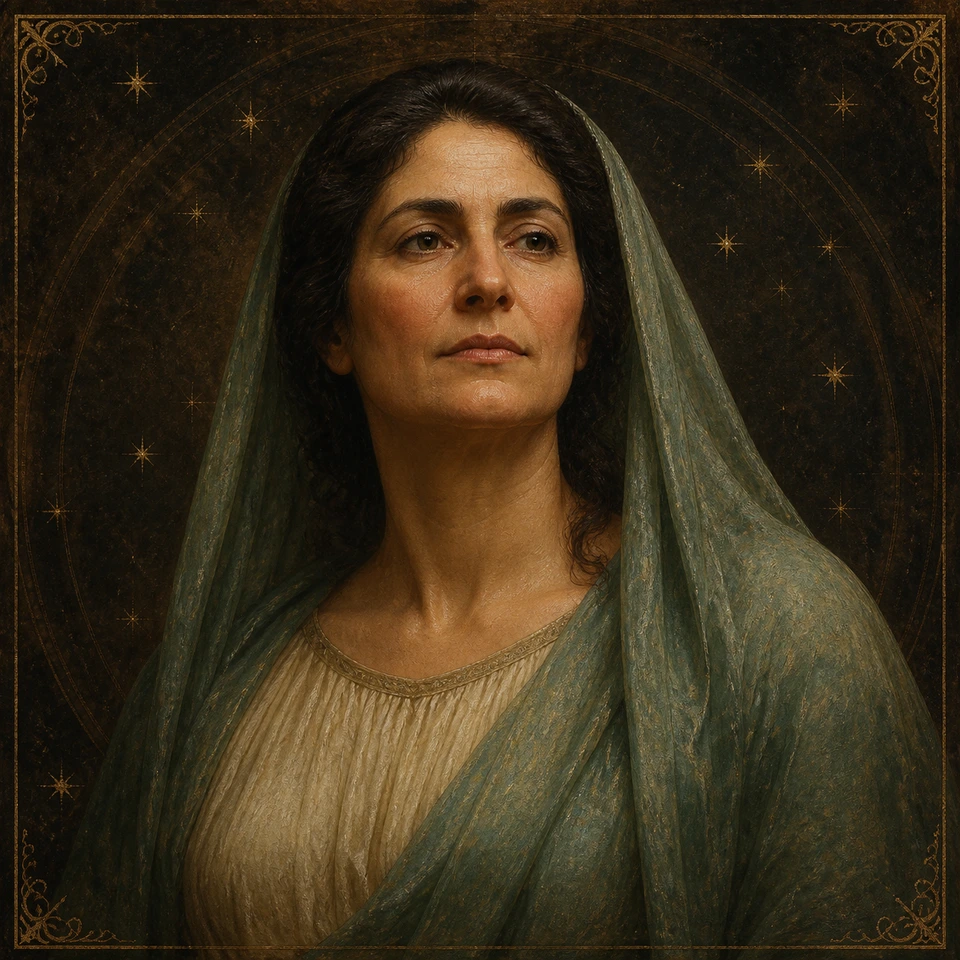
Partnering with Oceanus, the first-generation Titaness Tethys birthed the vast networks of global rivers and countless Oceanids. Remembered strictly as Hera's foster mother in Homeric tradition, she occupies a specific historical space separate from generic sea-goddesses and the Nereid Thetis.
Overview
Tethys enters Greek poetry as one name in a vast birth. Gaia and Uranus bring forth six Titan sons and six Titan daughters. Hesiod places Tethys at the end of that female sequence, beside Theia, Rhea, Themis, Mnemosyne, and Phoebe. The poem does not give her a weapon, throne, or private speech. Her first power is the fact of generation itself.
When Tethys next appears, the family opens outward. Oceanus joins with her, and the poem pours out the names of river sons and Oceanid daughters. Nile, Alpheus, Eridanus, Strymon, Maeander, and other rivers become distinct divine children. Peitho, Admete, Ianthe, Electra, Doris, Metis, Styx, and many more daughters follow. Hesiod says the daughters are three thousand, as many as the rivers. The number conveys abundance rather than a modern biological catalogue. Tethys is their mother, but she does not erase their individual courses and stories.
The Iliad brings her into a chamber of deception. Hera asks Aphrodite for the force of desire, claiming that she must travel to the ends of the fruitful earth. There, she says, Oceanus and mother Tethys received her from Rhea and raised her lovingly while Zeus fought Cronus. The old couple have long been separated from love and the shared bed. Hera says she means to reconcile them. The audience knows she is actually preparing to distract Zeus from the Trojan fighting.
That speech gives Tethys tenderness and fracture at once. She is foster mother and estranged partner, yet she never enters the scene to confirm either claim. The poem preserves what Hera says because the story makes her appeal persuasive. A careful reading holds both facts together: the fosterage tradition is ancient, and its immediate narrator is lying about why she tells it.
Pseudo-Apollodorus later gathers the Titan family into prose. Tethys is again a child of Earth and Sky and partner of Oceanus. The Library also says that all the Titans except Oceanus attacked Uranus. Since Tethys stands in the preceding Titan list, the collective wording can include her, but it gives her no individual speech, weapon, or blow. Hesiod’s own assault scene differs sharply, naming Cronus as the only son who answers Gaia.
Plato sets a conflicting genealogy beside that inheritance. In the Timaeus, Gaia and Uranus produce Oceanus and Tethys, then Oceanus and Tethys produce Phorcys, Cronus, Rhea, and the rest. Tethys becomes mother rather than sister of Cronus and Rhea. Aristotle later cites Oceanus and Tethys as parents of generation while considering whether ancient theology anticipated the claim that water is a first principle. Neither witness can be silently folded into Hesiod.
Plutarch carries the name into a different land and argument. In an alternative story of Rome’s beginnings attributed to Promathion, Tarchetius receives a response from an oracle of Tethys in Tyrrhenia. The oracle orders union with a hearth apparition and predicts an illustrious child. Plutarch gives no city, priest, inscription, or surviving Etruscan witness for the oracle. This is evidence for a later Greek report about an Italian foundation tale, not proof of a universal Greek water cult.
The expanded witness set still gives no named Greek temple, festival, offering list, or individualized bodily description for Tethys. Shells, dolphins, tridents, vessels, and marine crowns remain absent from the Greek genealogies and Hera’s speech. Her oldest stories gather around immense maternity, foster care, estrangement, and contradictory family orders.
The name entered a second, sharply separate history in astronomy. NASA identifies Tethys as Saturn’s fifth-largest moon, discovered by Giovanni Cassini in 1684 and later named within the Saturnian family proposed by John Herschel. The icy satellite and its Odyssey-named terrain are modern scientific namesakes. They do not turn Saturn, ice, craters, or planetary cycles into ancient correspondences of the Titaness.
Canonical identity
Canonical Identity
Tethys holds a secure identity rooted deeply in ancient genealogy rather than in an occult element, planetary office, or fixed sea throne. Hesiod precisely locates her among the six daughters and six Titan sons birthed by Uranus and Gaia. Surviving genealogies firmly tether her to Oceanus, Gaia, Uranus, the Oceanids, and the rivers. Because these specific kinships belong exclusively to this Titaness, they cannot be transferred to any other divine figure. English spelling often blurs Tethys with the similarly named Thetis, requiring careful distinction.
Linguistic Identity
Tethys is the Greek Τηθύς, designating a first-generation Greek deity and Titaness. The authentic ancient pronunciation remains unresolved because current literary editions lack the necessary phonological analysis. The lexical form deliberately keeps the final sigma audible. The application of a long eta, rounded upsilon, aspirated theta, and final raised tone denotes a qualified historical reconstruction rather than a modern English pronunciation rule.
Sources and evidence
TEXTUAL · Supported
LSJ records Τηθύς, ύος, ἡ as the Titaness, wife of Oceanus, nurse of Hera, and mother of rivers and Oceanids.
- Source
- Henry George Liddell and Robert Scott; Scaife ATLAS, Τηθύς, LSJ entry
- Reviewed edition
- LSJ digital entry Τηθύς, Scaife ATLAS URN lsj-n103776 · Tufts University
- Exact locator
- Entry Τηθύς, ύος, ἡ · Section LSJ headword; Scaife ATLAS lsj-n103776 · RecordUrl https://atlas.perseus.tufts.edu/dictionaries/entry/urn%3Acite2%3Ascaife-viewer%3Adictionaries.v1%3Alsj-n103776/
- Scope
- Modern classical scholarship · Ancient Greece
- Authority
- LSJ, Τηθύς
- Certainty
- Certain
The lexicon headword fixes the written identity while keeping the Titaness distinct from Thetis and later namesakes.
Open exact reviewed sourceTEXTUAL · Supported
Smyth’s fifth-century Attic sound and pitch rules support the qualified reconstruction /tɛː.tʰýs/ when applied to LSJ Τηθύς.
- Source
- Herbert Weir Smyth, A Greek Grammar for Colleges (1920)
- Reviewed edition
- Herbert Weir Smyth, A Greek Grammar for Colleges, American Book Company, 1920; Perseus text 1999.04.0007 · Perseus Digital Library
- Exact locator
- Entry A Greek Grammar for Colleges · Section §§1, 4, 24, 26, 150 · RecordUrl https://www.perseus.tufts.edu/hopper/text?doc=Perseus:text:1999.04.0007
- Scope
- Modern classical scholarship · Ancient Greece
- Authority
- Smyth, A Greek Grammar for Colleges
- Certainty
- Certain
The historical sound reconstruction remains qualified because no ancient recording survives.
Open exact reviewed sourceTEXTUAL · Supported
Hesiod names Tethys among the six Titan daughters of Gaia and Uranus.
- Source
- Hesiod; edited and translated by Hugh G. Evelyn-White, Theogony (1914)
- Reviewed edition
- Hugh G. Evelyn-White English translation in Hesiod, the Homeric Hymns and Homerica, Loeb Classical Library, 1914, Perseus eng1 component · translated by Hugh G. Evelyn-White · edited by Hugh G. Evelyn-White · Perseus Digital Library
- Exact locator
- Entry Theogony · Line 132-138
- Scope
- Archaic Greece · Ancient Greece
- Authority
- Hesiod, Theogony
- Certainty
- Certain
The genealogy names divine kinship without creating a local cult, ritual, or four-element system.
Open exact reviewed source3 reviewed sources for this section
- Henry George Liddell and Robert Scott; Scaife ATLAS, Τηθύς, LSJ entryLSJ digital entry with exact headword and inflection · Tufts University
- Herbert Weir Smyth, A Greek Grammar for Colleges (1920)American Book Company, 1920; Perseus text 1999.04.0007 · Perseus Digital Library
- Hesiod; edited and translated by Hugh G. Evelyn-White, Theogony (1914)Hesiod, the Homeric Hymns and Homerica, London and New York, 1914 · Perseus Digital Library / Scaife ATLAS
Culture, tradition, period, and place
In the surviving Archaic Greek poetry, Tethys belongs first to divine genealogy. Hesiod names her in the Titan generation and later joins her with Oceanus as the rivers and Oceanids enter the world. The Iliad places her at the far ends of the fruitful earth inside Hera’s account of divine fosterage.
Pseudo-Apollodorus preserves the Titan genealogy and immense family in a later Greek mythographic form, then uses collective language for the assault on Uranus. These works come from different periods and literary settings. They name no local sanctuary, civic calendar, or universal Mediterranean water cult for Tethys.
The cosmic edge in Iliad 14 is a household within epic geography, not a named coast. Ancient Greece remains the literary scope, while each river child keeps its own locality and cult history.
Sources and evidence
TEXTUAL · Supported
Archaic Greek hexameter places Tethys with Oceanus as mother of rivers and Oceanid daughters.
- Source
- Hesiod; edited and translated by Hugh G. Evelyn-White, Theogony (1914)
- Reviewed edition
- Hugh G. Evelyn-White English translation in Hesiod, the Homeric Hymns and Homerica, Loeb Classical Library, 1914, Perseus eng1 component · translated by Hugh G. Evelyn-White · edited by Hugh G. Evelyn-White · Perseus Digital Library
- Exact locator
- Entry Theogony · Line 337-370
- Scope
- Archaic Greece · Ancient Greece
- Authority
- Hesiod, Theogony
- Certainty
- Certain
The genealogy names divine kinship without creating a local cult, ritual, or four-element system.
Open exact reviewed sourceTEXTUAL · Supported
The Iliad places Oceanus and Tethys at the far bounds of fruitful earth within Hera’s deceptive speech.
- Source
- Homer; Monro and Allen Greek edition with edition-specific translations, Iliad (1920)
- Reviewed edition
- A. T. Murray English translation, volumes I-II, 1924-1925 · translated by A. T. Murray · Perseus Digital Library / Scaife ATLAS
- Exact locator
- Entry Iliad · Book 14 · Line 200-210; 300-304
- Scope
- Archaic Greece · Ancient Greece
- Authority
- Homer, Iliad 14
- Certainty
- Certain
Hera speaks during a deception, so the fosterage, estrangement, and world-edge setting remain part of her stratagem.
Open exact reviewed source2 reviewed sources for this section
- Hesiod; edited and translated by Hugh G. Evelyn-White, Theogony (1914)Hesiod, the Homeric Hymns and Homerica, London and New York, 1914 · Perseus Digital Library / Scaife ATLAS
- Homer; Monro and Allen Greek edition with edition-specific translations, Iliad (1920)Perseus CTS edition corpus; Greek edition, Oxford, 1908-1920 · Perseus Digital Library / Scaife ATLAS
Historical development
Hesiod first gives Tethys a position within divine ancestry, then a generative partnership. The catalogue lingers on named rivers and daughters rather than assigning her a personal weapon or deed. The Iliad adds intimacy and tension: Hera calls her mother, says she was raised in the old couple’s house, and describes Tethys and Oceanus as estranged.
The Library condenses these traditions and changes the succession scene. Its claim that every Titan except Oceanus attacked Uranus can include Tethys collectively, yet no individual action follows. Descriptions of a universal sea queen, lunar force, or astrological ruler are not present in these witnesses.
The shifts are changes of genre as much as date. Genealogical poetry counts generations, epic uses an old divine household inside a battlefield deception, Plato reverses part of the generation order, Aristotle makes the pair evidence in an argument about water, and Plutarch carries her name into a Tyrrhenian oracle tale.
Sources and evidence
TEXTUAL · Supported
Hesiod establishes Tethys first through Titan genealogy before expanding her family at Theogony 337-370.
- Source
- Hesiod; edited and translated by Hugh G. Evelyn-White, Theogony (1914)
- Reviewed edition
- Hugh G. Evelyn-White English translation in Hesiod, the Homeric Hymns and Homerica, Loeb Classical Library, 1914, Perseus eng1 component · translated by Hugh G. Evelyn-White · edited by Hugh G. Evelyn-White · Perseus Digital Library
- Exact locator
- Entry Theogony · Line 132-138
- Scope
- Archaic Greece · Ancient Greece
- Authority
- Hesiod, Theogony
- Certainty
- Certain
The genealogy names divine kinship without creating a local cult, ritual, or four-element system.
Open exact reviewed sourceTEXTUAL · Supported
The Iliad adds reported fosterage of Hera and estrangement between Tethys and Oceanus.
- Source
- Homer; Monro and Allen Greek edition with edition-specific translations, Iliad (1920)
- Reviewed edition
- A. T. Murray English translation, volumes I-II, 1924-1925 · translated by A. T. Murray · Perseus Digital Library / Scaife ATLAS
- Exact locator
- Entry Iliad · Book 14 · Line 200-210; 300-304
- Scope
- Archaic Greece · Ancient Greece
- Authority
- Homer, Iliad 14
- Certainty
- Certain
Hera speaks during a deception, so the fosterage, estrangement, and world-edge setting remain part of her stratagem.
Open exact reviewed sourceTEXTUAL · Supported
Pseudo-Apollodorus later includes Tethys only through collective Titan wording in the assault on Uranus.
- Source
- Pseudo-Apollodorus; edited and translated by James G. Frazer, Library (1921)
- Reviewed edition
- James G. Frazer edition and English translation, Harvard University Press and William Heinemann, 1921 · translated by James G. Frazer · edited by James G. Frazer · Perseus Digital Library / Scaife ATLAS
- Exact locator
- Entry Library · Book 1 · Chapter 1 · Section 3-4
- Scope
- Greek religion under Roman imperial rule · Ancient Greece
- Authority
- Pseudo-Apollodorus, Library
- Certainty
- Certain
The later mythographer compresses the Titans into collective action and gives Tethys no individual blow or speech.
Open exact reviewed sourceTEXTUAL · Supported
Plato preserves a different genealogy in which Oceanus and Tethys are children of Gaia and Uranus but parents of Phorcys, Cronus, Rhea, and the remaining generation.
- Source
- Plato, Timaeus (1929)
- Reviewed edition
- R. G. Bury English translation, 1929 · Perseus Digital Library
- Exact locator
- Entry Timaeus · Section 40d-e · RecordUrl https://cts.perseids.org/read/greekLit/tlg0059/tlg031/perseus-eng2/37-56
- Scope
- Classical Greece · Ancient Greece
- Authority
- Plato, Timaeus 40d-e
- Certainty
- Certain
Plato’s genealogy remains a distinct source variant and does not overwrite Hesiod’s Titan sibling generation.
Open exact reviewed sourceTEXTUAL · Supported
Aristotle cites ancient theologians who made Oceanus and Tethys parents of generation while discussing water as a first principle.
- Source
- Aristotle, Metaphysics (1933)
- Reviewed edition
- Hugh Tredennick English translation, 1933 · Perseus Digital Library
- Exact locator
- Entry Metaphysics · Book 1 · Chapter 3 · Section 983b20-30 · RecordUrl https://www.perseus.tufts.edu/hopper/text?doc=Perseus%3Atext%3A1999.01.0052%3Abook%3D1%3Asection%3D983b
- Scope
- Classical Greece · Ancient Greece
- Authority
- Aristotle, Metaphysics 1.3
- Certainty
- Certain
Aristotle reports philosophical reception of older divine poetry rather than an independent cult institution.
Open exact reviewed source5 reviewed sources for this section
- Hesiod; edited and translated by Hugh G. Evelyn-White, Theogony (1914)Hesiod, the Homeric Hymns and Homerica, London and New York, 1914 · Perseus Digital Library / Scaife ATLAS
- Homer; Monro and Allen Greek edition with edition-specific translations, Iliad (1920)Perseus CTS edition corpus; Greek edition, Oxford, 1908-1920 · Perseus Digital Library / Scaife ATLAS
- Pseudo-Apollodorus; edited and translated by James G. Frazer, Library (1921)Harvard University Press and William Heinemann edition, 1921 · Perseus Digital Library / Scaife ATLAS
- Plato, Timaeus (1929)R. G. Bury English translation, 1929 · Perseus Digital Library
- Aristotle, Metaphysics (1933)Hugh Tredennick English translation, 1933 · Perseus Digital Library
Attested roles and historical themes
Roles, powers, and limits
Tethys’s clearest role is maternal and genealogical. With Oceanus she produces rivers and Oceanid daughters, a family whose members retain their own names and identities. In Hera’s speech she also becomes foster mother, addressed simply as mother by the goddess who says Tethys received and reared her.
These roles do not make Tethys the physical substance of every river or sea. Individual river gods and Oceanids are not extensions of their mother. The three works grant her no command of storms, tides, prophecy, healing, or human fertility.
Her maternity is immense but not anonymous. Hesiod names many children before stating that the unlisted daughters and rivers match one another in number, making abundance part of the family’s scale.
Sources and evidence
TEXTUAL · Supported
Tethys’s directly attested generative role is motherhood of named rivers and Oceanids with Oceanus.
- Source
- Hesiod; edited and translated by Hugh G. Evelyn-White, Theogony (1914)
- Reviewed edition
- Hugh G. Evelyn-White English translation in Hesiod, the Homeric Hymns and Homerica, Loeb Classical Library, 1914, Perseus eng1 component · translated by Hugh G. Evelyn-White · edited by Hugh G. Evelyn-White · Perseus Digital Library
- Exact locator
- Entry Theogony · Line 337-370
- Scope
- Archaic Greece · Ancient Greece
- Authority
- Hesiod, Theogony
- Certainty
- Certain
The genealogy names divine kinship without creating a local cult, ritual, or four-element system.
Open exact reviewed sourceTEXTUAL · Supported
Hera calls Tethys mother and says the old pair lovingly received and raised her.
- Source
- Homer; Monro and Allen Greek edition with edition-specific translations, Iliad (1920)
- Reviewed edition
- A. T. Murray English translation, volumes I-II, 1924-1925 · translated by A. T. Murray · Perseus Digital Library / Scaife ATLAS
- Exact locator
- Entry Iliad · Book 14 · Line 200-210; 300-304
- Scope
- Archaic Greece · Ancient Greece
- Authority
- Homer, Iliad 14
- Certainty
- Certain
Hera speaks during a deception, so the fosterage, estrangement, and world-edge setting remain part of her stratagem.
Open exact reviewed source2 reviewed sources for this section
- Hesiod; edited and translated by Hugh G. Evelyn-White, Theogony (1914)Hesiod, the Homeric Hymns and Homerica, London and New York, 1914 · Perseus Digital Library / Scaife ATLAS
- Homer; Monro and Allen Greek edition with edition-specific translations, Iliad (1920)Perseus CTS edition corpus; Greek edition, Oxford, 1908-1920 · Perseus Digital Library / Scaife ATLAS
Epithets and titles
No securely localized cult epithet is established; mother in Hera’s speech is a kinship address, not a proven cult title.
1 reviewed source for this section
- Homer; Monro and Allen Greek edition with edition-specific translations, Iliad (1920)Perseus CTS edition corpus; Greek edition, Oxford, 1908-1920 · Perseus Digital Library / Scaife ATLAS
Worship and cult
Hesiod, the Iliad, and the Library place Tethys in divine family history, but none describes worshippers approaching her at a temple, household shrine, civic rite, sacrifice, or dedication. Literary ancestry therefore cannot supply a sanctuary program.
No inscription, excavated dedication, local calendar, or ancient testimonium in these passages establishes a priesthood, cult center, ritual office, or named body of worshippers for her.
Tethys can be divine without a reconstructed Greek civic cult. Plutarch’s Tyrrhenian oracle is real literary evidence for a later Italian claim, but it names no priest, altar, city, or surviving local witness from which a ritual system can be rebuilt.
Sources and evidence
TEXTUAL · Supported
Theogony 132-138 names lineage but no sanctuary, priesthood, sacrifice, or worshipper of Tethys.
- Source
- Hesiod; edited and translated by Hugh G. Evelyn-White, Theogony (1914)
- Reviewed edition
- Hugh G. Evelyn-White English translation in Hesiod, the Homeric Hymns and Homerica, Loeb Classical Library, 1914, Perseus eng1 component · translated by Hugh G. Evelyn-White · edited by Hugh G. Evelyn-White · Perseus Digital Library
- Exact locator
- Entry Theogony · Line 132-138
- Scope
- Archaic Greece · Ancient Greece
- Authority
- Hesiod, Theogony
- Certainty
- Certain
The genealogy names divine kinship without creating a local cult, ritual, or four-element system.
Open exact reviewed sourceTEXTUAL · Supported
Iliad 14 gives a cosmic household and family report, not a cult institution for Tethys.
- Source
- Homer; Monro and Allen Greek edition with edition-specific translations, Iliad (1920)
- Reviewed edition
- A. T. Murray English translation, volumes I-II, 1924-1925 · translated by A. T. Murray · Perseus Digital Library / Scaife ATLAS
- Exact locator
- Entry Iliad · Book 14 · Line 200-210; 300-304
- Scope
- Archaic Greece · Ancient Greece
- Authority
- Homer, Iliad 14
- Certainty
- Certain
Hera speaks during a deception, so the fosterage, estrangement, and world-edge setting remain part of her stratagem.
Open exact reviewed sourceTEXTUAL · Supported
Plutarch reports an oracle of Tethys in Tyrrhenia inside Promathion’s alternative Roman-foundation tale, without naming a site, priesthood, inscription, or surviving local institution.
- Source
- Plutarch, Life of Romulus (1914)
- Reviewed edition
- Bernadotte Perrin English translation, Loeb Classical Library, 1914 · LacusCurtius, University of Chicago
- Exact locator
- Entry Life of Romulus · Chapter 2 · Section 4-6 · RecordUrl https://penelope.uchicago.edu/Thayer/E/Roman/Texts/Plutarch/Lives/Romulus%2A.html#2
- Scope
- Greek religion under Roman imperial rule · Italy
- Authority
- Plutarch, Romulus 2.4-6
- Certainty
- Certain
The oracle belongs to a source-attributed Tyrrhenian and Roman-origin tale, not to a documented Greek sanctuary program.
Open exact reviewed source3 reviewed sources for this section
- Hesiod; edited and translated by Hugh G. Evelyn-White, Theogony (1914)Hesiod, the Homeric Hymns and Homerica, London and New York, 1914 · Perseus Digital Library / Scaife ATLAS
- Homer; Monro and Allen Greek edition with edition-specific translations, Iliad (1920)Perseus CTS edition corpus; Greek edition, Oxford, 1908-1920 · Perseus Digital Library / Scaife ATLAS
- Plutarch, Life of Romulus (1914)Bernadotte Perrin English translation, Loeb Classical Library, 1914 · LacusCurtius, University of Chicago
Temples, sanctuaries, and sacred places
Hera says she is traveling to the far ends of the fruitful earth to visit Oceanus and mother Tethys. That setting belongs to the cosmic geography of the Iliad and to a deceptive speech. It is not the address of an excavated temple.
The surviving passages name no island, spring, river mouth, coastline, or city as Tethys’s sanctuary. Her river children have their own identities, but their local waters do not automatically become shrines of their mother. The world edge remains a powerful poetic location rather than a map coordinate.
The far boundary matters because Hera needs a destination remote enough to explain her departure from Olympus. Plutarch’s Tyrrhenia is a second and culturally different setting, yet his report still withholds an exact sanctuary site.
Sources and evidence
TEXTUAL · Supported
Hera’s far edge of fruitful earth is a poetic household setting for Oceanus and Tethys, not an excavated sanctuary.
- Source
- Homer; Monro and Allen Greek edition with edition-specific translations, Iliad (1920)
- Reviewed edition
- A. T. Murray English translation, volumes I-II, 1924-1925 · translated by A. T. Murray · Perseus Digital Library / Scaife ATLAS
- Exact locator
- Entry Iliad · Book 14 · Line 200-210; 300-304
- Scope
- Archaic Greece · Ancient Greece
- Authority
- Homer, Iliad 14
- Certainty
- Certain
Hera speaks during a deception, so the fosterage, estrangement, and world-edge setting remain part of her stratagem.
Open exact reviewed sourceTEXTUAL · Supported
The Tyrrhenian oracle is a broad Italian setting in a later Greek literary report, not an identified excavated sanctuary.
- Source
- Plutarch, Life of Romulus (1914)
- Reviewed edition
- Bernadotte Perrin English translation, Loeb Classical Library, 1914 · LacusCurtius, University of Chicago
- Exact locator
- Entry Life of Romulus · Chapter 2 · Section 4-6 · RecordUrl https://penelope.uchicago.edu/Thayer/E/Roman/Texts/Plutarch/Lives/Romulus%2A.html#2
- Scope
- Greek religion under Roman imperial rule · Italy
- Authority
- Plutarch, Romulus 2.4-6
- Certainty
- Certain
The oracle belongs to a source-attributed Tyrrhenian and Roman-origin tale, not to a documented Greek sanctuary program.
Open exact reviewed source2 reviewed sources for this section
- Homer; Monro and Allen Greek edition with edition-specific translations, Iliad (1920)Perseus CTS edition corpus; Greek edition, Oxford, 1908-1920 · Perseus Digital Library / Scaife ATLAS
- Plutarch, Life of Romulus (1914)Bernadotte Perrin English translation, Loeb Classical Library, 1914 · LacusCurtius, University of Chicago
Festivals and processions
The genealogies and Hera’s reported journey contain no annual festival, procession, month, or seasonal observance for Tethys. The long catalogue of rivers and Oceanids names descendants, while Hera’s intended journey is a false explanation meant to obtain Aphrodite’s aid.
A water festival belonging to another deity, city, or river community remains with that named power. Genealogical resemblance does not transfer its date or procession to Tethys.
Even the multitude of rivers yields no shared feast day. Their descent from Tethys is genealogy, while any local river observance belongs first to the community and divine power actually named there.
Sources and evidence
TEXTUAL · Supported
The river and Oceanid catalogue establishes descendants but no festival or procession for Tethys.
- Source
- Hesiod; edited and translated by Hugh G. Evelyn-White, Theogony (1914)
- Reviewed edition
- Hugh G. Evelyn-White English translation in Hesiod, the Homeric Hymns and Homerica, Loeb Classical Library, 1914, Perseus eng1 component · translated by Hugh G. Evelyn-White · edited by Hugh G. Evelyn-White · Perseus Digital Library
- Exact locator
- Entry Theogony · Line 337-370
- Scope
- Archaic Greece · Ancient Greece
- Authority
- Hesiod, Theogony
- Certainty
- Certain
The genealogy names divine kinship without creating a local cult, ritual, or four-element system.
Open exact reviewed sourceTEXTUAL · Supported
Hera’s claimed journey to reconcile the old pair is part of her deception, not a recurring sacred calendar.
- Source
- Homer; Monro and Allen Greek edition with edition-specific translations, Iliad (1920)
- Reviewed edition
- A. T. Murray English translation, volumes I-II, 1924-1925 · translated by A. T. Murray · Perseus Digital Library / Scaife ATLAS
- Exact locator
- Entry Iliad · Book 14 · Line 200-210; 300-304
- Scope
- Archaic Greece · Ancient Greece
- Authority
- Homer, Iliad 14
- Certainty
- Certain
Hera speaks during a deception, so the fosterage, estrangement, and world-edge setting remain part of her stratagem.
Open exact reviewed source2 reviewed sources for this section
- Hesiod; edited and translated by Hugh G. Evelyn-White, Theogony (1914)Hesiod, the Homeric Hymns and Homerica, London and New York, 1914 · Perseus Digital Library / Scaife ATLAS
- Homer; Monro and Allen Greek edition with edition-specific translations, Iliad (1920)Perseus CTS edition corpus; Greek edition, Oxford, 1908-1920 · Perseus Digital Library / Scaife ATLAS
Offerings, votives, and ritual evidence
The surviving works give Tethys no offering list, libation rule, votive formula, incense, sacrifice, or ritual tool. Water is central to the family she bears, but parentage does not prove that ancient worshippers offered seawater, shells, fish, blue cloth, or vessels to her.
The ancient genealogies describe no modern devotional gift and support no physical or medical claim.
Hera’s proposed reconciliation is also not a ritual model. She requests Aphrodite’s power under false pretences, then carries it into a plan against Zeus rather than toward Tethys and Oceanus.
Sources and evidence
TEXTUAL · Supported
Theogony 337-370 provides no offering, libation, incense, sacrifice, or ritual tool for Tethys.
- Source
- Hesiod; edited and translated by Hugh G. Evelyn-White, Theogony (1914)
- Reviewed edition
- Hugh G. Evelyn-White English translation in Hesiod, the Homeric Hymns and Homerica, Loeb Classical Library, 1914, Perseus eng1 component · translated by Hugh G. Evelyn-White · edited by Hugh G. Evelyn-White · Perseus Digital Library
- Exact locator
- Entry Theogony · Line 337-370
- Scope
- Archaic Greece · Ancient Greece
- Authority
- Hesiod, Theogony
- Certainty
- Certain
The genealogy names divine kinship without creating a local cult, ritual, or four-element system.
Open exact reviewed sourceTEXTUAL · Supported
The Library’s genealogy does not convert water, shells, fish, or vessels into offerings for Tethys.
- Source
- Pseudo-Apollodorus; edited and translated by James G. Frazer, Library (1921)
- Reviewed edition
- James G. Frazer edition and English translation, Harvard University Press and William Heinemann, 1921 · translated by James G. Frazer · edited by James G. Frazer · Perseus Digital Library / Scaife ATLAS
- Exact locator
- Entry Library · Book 1 · Chapter 2 · Section 2-3
- Scope
- Greek religion under Roman imperial rule · Ancient Greece
- Authority
- Pseudo-Apollodorus, Library
- Certainty
- Certain
The later mythographer compresses the Titans into collective action and gives Tethys no individual blow or speech.
Open exact reviewed source2 reviewed sources for this section
- Hesiod; edited and translated by Hugh G. Evelyn-White, Theogony (1914)Hesiod, the Homeric Hymns and Homerica, London and New York, 1914 · Perseus Digital Library / Scaife ATLAS
- Pseudo-Apollodorus; edited and translated by James G. Frazer, Library (1921)Harvard University Press and William Heinemann edition, 1921 · Perseus Digital Library / Scaife ATLAS
Iconography and material culture
The surviving literary passages give Tethys no bodily description, dress, posture, shell, trident, fish, dolphin, crown, vessel, chariot, or handheld object. Genealogy and reported fosterage define her more securely than any visual attribute.
No named object, excavation context, accession, or inscription currently gives Tethys an individualized ancient image. The literary silence leaves her appearance unknown without proving that no representation ever existed.
A later artist may visualize age, water, or kinship, but those choices would be interpretation. The oldest passages offer names, relationships, reported care, and conflict instead of a fixed ancient portrait.
Sources and evidence
TEXTUAL · Supported
Hesiod identifies Tethys by name and family without describing body, dress, posture, crown, vehicle, or handheld object.
- Source
- Hesiod; edited and translated by Hugh G. Evelyn-White, Theogony (1914)
- Reviewed edition
- Hugh G. Evelyn-White English translation in Hesiod, the Homeric Hymns and Homerica, Loeb Classical Library, 1914, Perseus eng1 component · translated by Hugh G. Evelyn-White · edited by Hugh G. Evelyn-White · Perseus Digital Library
- Exact locator
- Entry Theogony · Line 132-138
- Scope
- Archaic Greece · Ancient Greece
- Authority
- Hesiod, Theogony
- Certainty
- Certain
The genealogy names divine kinship without creating a local cult, ritual, or four-element system.
Open exact reviewed sourceTEXTUAL · Supported
The Iliad’s fosterage speech describes no individualized visual attribute for Tethys.
- Source
- Homer; Monro and Allen Greek edition with edition-specific translations, Iliad (1920)
- Reviewed edition
- A. T. Murray English translation, volumes I-II, 1924-1925 · translated by A. T. Murray · Perseus Digital Library / Scaife ATLAS
- Exact locator
- Entry Iliad · Book 14 · Line 200-210; 300-304
- Scope
- Archaic Greece · Ancient Greece
- Authority
- Homer, Iliad 14
- Certainty
- Certain
Hera speaks during a deception, so the fosterage, estrangement, and world-edge setting remain part of her stratagem.
Open exact reviewed source2 reviewed sources for this section
- Hesiod; edited and translated by Hugh G. Evelyn-White, Theogony (1914)Hesiod, the Homeric Hymns and Homerica, London and New York, 1914 · Perseus Digital Library / Scaife ATLAS
- Homer; Monro and Allen Greek edition with edition-specific translations, Iliad (1920)Perseus CTS edition corpus; Greek edition, Oxford, 1908-1920 · Perseus Digital Library / Scaife ATLAS
Animals, plants, and embodied forms
Hesiod, the Iliad, and the Library assign Tethys no animal, plant, or transformed body. Her children include rivers and Oceanids, but neither group becomes a personal beast, sacred tree, or botanical emblem for their mother.
Fish, dolphins, shells, seaweed, and coral are absent from these passages. Water resemblance alone cannot establish ancient ownership, and the genealogy does not turn Tethys into a mermaid or the physical ocean.
The distinction protects the children as well. A river may receive local animal or plant imagery in its own tradition without passing that imagery upward to Tethys as an inherited universal emblem.
Sources and evidence
TEXTUAL · Supported
Hesiod assigns Tethys no animal, plant, tree, or transformed body in the river and Oceanid genealogy.
- Source
- Hesiod; edited and translated by Hugh G. Evelyn-White, Theogony (1914)
- Reviewed edition
- Hugh G. Evelyn-White English translation in Hesiod, the Homeric Hymns and Homerica, Loeb Classical Library, 1914, Perseus eng1 component · translated by Hugh G. Evelyn-White · edited by Hugh G. Evelyn-White · Perseus Digital Library
- Exact locator
- Entry Theogony · Line 337-370
- Scope
- Archaic Greece · Ancient Greece
- Authority
- Hesiod, Theogony
- Certainty
- Certain
The genealogy names divine kinship without creating a local cult, ritual, or four-element system.
Open exact reviewed sourceTEXTUAL · Supported
Pseudo-Apollodorus preserves Tethys’s children without making marine life or vegetation her sacred species.
- Source
- Pseudo-Apollodorus; edited and translated by James G. Frazer, Library (1921)
- Reviewed edition
- James G. Frazer edition and English translation, Harvard University Press and William Heinemann, 1921 · translated by James G. Frazer · edited by James G. Frazer · Perseus Digital Library / Scaife ATLAS
- Exact locator
- Entry Library · Book 1 · Chapter 2 · Section 2-3
- Scope
- Greek religion under Roman imperial rule · Ancient Greece
- Authority
- Pseudo-Apollodorus, Library
- Certainty
- Certain
The later mythographer compresses the Titans into collective action and gives Tethys no individual blow or speech.
Open exact reviewed source2 reviewed sources for this section
- Hesiod; edited and translated by Hugh G. Evelyn-White, Theogony (1914)Hesiod, the Homeric Hymns and Homerica, London and New York, 1914 · Perseus Digital Library / Scaife ATLAS
- Pseudo-Apollodorus; edited and translated by James G. Frazer, Library (1921)Harvard University Press and William Heinemann edition, 1921 · Perseus Digital Library / Scaife ATLAS
Relationships and genealogy
Gaia and Uranus are Tethys’s parents in the first Titan genealogy. Oceanus is her partner. Hesiod names rivers and many Oceanid daughters born from their union, while Pseudo-Apollodorus preserves a later version of the same broad family structure.
The Iliad adds foster kinship. Hera says that Rhea gave her into the care of Oceanus and Tethys and that they lovingly raised her. She also says the pair have long been separated from love and the shared bed. Because Hera tells this while preparing to deceive Zeus, fosterage and estrangement remain reported family history, not scenes independently narrated by the poet.
Hesiod’s named catalogue demonstrates why “mother of the Oceanids” is not a single undifferentiated edge. Plato’s Timaeus then changes the generation order by making Cronus and Rhea her children, so the two genealogies must stand side by side.
Sources and evidence
TEXTUAL · Supported
Gaia and Uranus are Tethys’s parents in Hesiod’s Titan genealogy.
- Source
- Hesiod; edited and translated by Hugh G. Evelyn-White, Theogony (1914)
- Reviewed edition
- Hugh G. Evelyn-White English translation in Hesiod, the Homeric Hymns and Homerica, Loeb Classical Library, 1914, Perseus eng1 component · translated by Hugh G. Evelyn-White · edited by Hugh G. Evelyn-White · Perseus Digital Library
- Exact locator
- Entry Theogony · Line 132-138
- Scope
- Archaic Greece · Ancient Greece
- Authority
- Hesiod, Theogony
- Certainty
- Certain
The genealogy names divine kinship without creating a local cult, ritual, or four-element system.
Open exact reviewed sourceTEXTUAL · Supported
Oceanus is Tethys’s partner and co-parent of rivers and Oceanids in Hesiod.
- Source
- Hesiod; edited and translated by Hugh G. Evelyn-White, Theogony (1914)
- Reviewed edition
- Hugh G. Evelyn-White English translation in Hesiod, the Homeric Hymns and Homerica, Loeb Classical Library, 1914, Perseus eng1 component · translated by Hugh G. Evelyn-White · edited by Hugh G. Evelyn-White · Perseus Digital Library
- Exact locator
- Entry Theogony · Line 337-370
- Scope
- Archaic Greece · Ancient Greece
- Authority
- Hesiod, Theogony
- Certainty
- Certain
The genealogy names divine kinship without creating a local cult, ritual, or four-element system.
Open exact reviewed sourceTEXTUAL · Supported
Hera reports foster kinship with Tethys and a long separation between Tethys and Oceanus.
- Source
- Homer; Monro and Allen Greek edition with edition-specific translations, Iliad (1920)
- Reviewed edition
- A. T. Murray English translation, volumes I-II, 1924-1925 · translated by A. T. Murray · Perseus Digital Library / Scaife ATLAS
- Exact locator
- Entry Iliad · Book 14 · Line 200-210; 300-304
- Scope
- Archaic Greece · Ancient Greece
- Authority
- Homer, Iliad 14
- Certainty
- Certain
Hera speaks during a deception, so the fosterage, estrangement, and world-edge setting remain part of her stratagem.
Open exact reviewed sourceTEXTUAL · Supported
Plato’s Timaeus makes Tethys mother rather than sister of Cronus and Rhea, a genealogy that cannot be merged with Hesiod.
- Source
- Plato, Timaeus (1929)
- Reviewed edition
- R. G. Bury English translation, 1929 · Perseus Digital Library
- Exact locator
- Entry Timaeus · Section 40d-e · RecordUrl https://cts.perseids.org/read/greekLit/tlg0059/tlg031/perseus-eng2/37-56
- Scope
- Classical Greece · Ancient Greece
- Authority
- Plato, Timaeus 40d-e
- Certainty
- Certain
Plato’s genealogy remains a distinct source variant and does not overwrite Hesiod’s Titan sibling generation.
Open exact reviewed source3 reviewed sources for this section
- Hesiod; edited and translated by Hugh G. Evelyn-White, Theogony (1914)Hesiod, the Homeric Hymns and Homerica, London and New York, 1914 · Perseus Digital Library / Scaife ATLAS
- Homer; Monro and Allen Greek edition with edition-specific translations, Iliad (1920)Perseus CTS edition corpus; Greek edition, Oxford, 1908-1920 · Perseus Digital Library / Scaife ATLAS
- Plato, Timaeus (1929)R. G. Bury English translation, 1929 · Perseus Digital Library
Actual myths and source variants
Four linked narratives define Tethys. She is born among the first Titans. In Pseudo-Apollodorus’s later overthrow account, collective wording includes every Titan except Oceanus, but Tethys receives no private deed. With Oceanus she becomes mother of rivers and Oceanids. In the Iliad she appears through Hera’s speech as foster mother and estranged partner.
The tellings remain distinct. Hesiod makes Cronus the only son who answers Gaia and does not name Tethys at the ambush. The Library’s group attack cannot be folded backward into that scene. Hera’s fosterage tale carries the uncertainty of deception, while the genealogical parentage is stated directly by Hesiod and the mythographer.
The fosterage story has causation beyond family memory. Hera needs Aphrodite’s girdle to distract Zeus. The Timaeus genealogy and Plutarch’s Tyrrhenian oracle belong to different source worlds and remain separate first-class variants or narratives.
Sources and evidence
TEXTUAL · Supported
Tethys participates directly in the first-Titan genealogy and the river-and-Oceanid birth sequence.
- Source
- Hesiod; edited and translated by Hugh G. Evelyn-White, Theogony (1914)
- Reviewed edition
- Hugh G. Evelyn-White English translation in Hesiod, the Homeric Hymns and Homerica, Loeb Classical Library, 1914, Perseus eng1 component · translated by Hugh G. Evelyn-White · edited by Hugh G. Evelyn-White · Perseus Digital Library
- Exact locator
- Entry Theogony · Line 132-138
- Scope
- Archaic Greece · Ancient Greece
- Authority
- Hesiod, Theogony
- Certainty
- Certain
The genealogy names divine kinship without creating a local cult, ritual, or four-element system.
Open exact reviewed sourceTEXTUAL · Supported
The Library’s overthrow variant includes Tethys collectively but gives her no individual weapon, blow, or speech.
- Source
- Pseudo-Apollodorus; edited and translated by James G. Frazer, Library (1921)
- Reviewed edition
- James G. Frazer edition and English translation, Harvard University Press and William Heinemann, 1921 · translated by James G. Frazer · edited by James G. Frazer · Perseus Digital Library / Scaife ATLAS
- Exact locator
- Entry Library · Book 1 · Chapter 1 · Section 3-4
- Scope
- Greek religion under Roman imperial rule · Ancient Greece
- Authority
- Pseudo-Apollodorus, Library
- Certainty
- Certain
The later mythographer compresses the Titans into collective action and gives Tethys no individual blow or speech.
Open exact reviewed sourceTEXTUAL · Supported
Hera’s fosterage and estrangement account remains source-bound because it is told during her deception of Aphrodite.
- Source
- Homer; Monro and Allen Greek edition with edition-specific translations, Iliad (1920)
- Reviewed edition
- A. T. Murray English translation, volumes I-II, 1924-1925 · translated by A. T. Murray · Perseus Digital Library / Scaife ATLAS
- Exact locator
- Entry Iliad · Book 14 · Line 200-210; 300-304
- Scope
- Archaic Greece · Ancient Greece
- Authority
- Homer, Iliad 14
- Certainty
- Certain
Hera speaks during a deception, so the fosterage, estrangement, and world-edge setting remain part of her stratagem.
Open exact reviewed sourceTEXTUAL · Supported
The Timaeus preserves a source-scoped divine genealogy in which Oceanus and Tethys generate Cronus, Rhea, Phorcys, and the rest.
- Source
- Plato, Timaeus (1929)
- Reviewed edition
- R. G. Bury English translation, 1929 · Perseus Digital Library
- Exact locator
- Entry Timaeus · Section 40d-e · RecordUrl https://cts.perseids.org/read/greekLit/tlg0059/tlg031/perseus-eng2/37-56
- Scope
- Classical Greece · Ancient Greece
- Authority
- Plato, Timaeus 40d-e
- Certainty
- Certain
Plato’s genealogy remains a distinct source variant and does not overwrite Hesiod’s Titan sibling generation.
Open exact reviewed sourceTEXTUAL · Supported
Plutarch’s alternative Roman-origin tale makes a Tyrrhenian oracle of Tethys announce the conception of an illustrious child to Tarchetius.
- Source
- Plutarch, Life of Romulus (1914)
- Reviewed edition
- Bernadotte Perrin English translation, Loeb Classical Library, 1914 · LacusCurtius, University of Chicago
- Exact locator
- Entry Life of Romulus · Chapter 2 · Section 4-6 · RecordUrl https://penelope.uchicago.edu/Thayer/E/Roman/Texts/Plutarch/Lives/Romulus%2A.html#2
- Scope
- Greek religion under Roman imperial rule · Italy
- Authority
- Plutarch, Romulus 2.4-6
- Certainty
- Certain
The oracle belongs to a source-attributed Tyrrhenian and Roman-origin tale, not to a documented Greek sanctuary program.
Open exact reviewed source5 reviewed sources for this section
- Hesiod; edited and translated by Hugh G. Evelyn-White, Theogony (1914)Hesiod, the Homeric Hymns and Homerica, London and New York, 1914 · Perseus Digital Library / Scaife ATLAS
- Pseudo-Apollodorus; edited and translated by James G. Frazer, Library (1921)Harvard University Press and William Heinemann edition, 1921 · Perseus Digital Library / Scaife ATLAS
- Homer; Monro and Allen Greek edition with edition-specific translations, Iliad (1920)Perseus CTS edition corpus; Greek edition, Oxford, 1908-1920 · Perseus Digital Library / Scaife ATLAS
- Plato, Timaeus (1929)R. G. Bury English translation, 1929 · Perseus Digital Library
- Plutarch, Life of Romulus (1914)Bernadotte Perrin English translation, Loeb Classical Library, 1914 · LacusCurtius, University of Chicago
Myth Library
Each myth gathers its attested participants into one source-grounded account, while distinct source traditions remain readable in their own variants.
Divine Genealogy
The Birth of the First Titans
Gaia and Uranus bring forth twelve named Titans, whose shared birth establishes a generation without assigning every sibling the same deed or cosmic office.
- Role in this profile
- enters as a first-generation Titan daughter of Gaia and Uranus
- Place scope
- Ancient Greece
- Witnesses
- 4
- Variants
- 4
Theogonic Succession
The Titans Overthrow Uranus
Hesiod makes Cronus the sole child who answers Gaia, while Pseudo-Apollodorus makes every Titan except Oceanus join the violent attack and thereby gives Theia only a collective role.
- Role in this profile
- is included collectively among the Titans who attack Uranus in Pseudo-Apollodorus
- Place scope
- Ancient Greece
- Witnesses
- 2
- Variants
- 2
Divine Genealogy
Oceanus and Tethys Parent the Rivers and Oceanids
Oceanus and Tethys become parents of divine rivers and the many Oceanid daughters, with Hesiod naming Tyche among the daughters.
- Role in this profile
- bears the river sons and Oceanid daughters with Oceanus
- Place scope
- Ancient Greece
- Witnesses
- 2
- Variants
- 2
Reported Divine Fosterage And Estrangement
Oceanus and Tethys Foster Hera
Hera says Oceanus and Tethys raised her, then uses their estrangement as a false explanation for leaving Olympus.
- Role in this profile
- is named by Hera as foster mother and as a partner separated from Oceanus
- Place scope
- Ancient Greece
- Witnesses
- 1
- Variants
- 1
Foundation Variant
Tarchetius and the Oracle of Tethys
Plutarch preserves Promathion’s alternative Italian foundation story, in which a Tyrrhenian oracle of Tethys announces the conception of an illustrious child.
- Role in this profile
- is the named power of the Tyrrhenian oracle that announces the required union and the child’s future
- Place scope
- Italy
- Witnesses
- 1
- Variants
- 1
Epic
Hera Beguiles Zeus on Ida
Hera borrows Aphrodite’s embroidered zone, bargains with Sleep, and draws Zeus into love and sleep on Mount Ida so Poseidon can aid the Achaeans.
- Role in this profile
- Named by Hera as foster mother and estranged partner within her false reconciliation story
- Place scope
- Mount Ida in the Troad
- Witnesses
- 1
- Variants
- 1
Equivalences, syncretisms, and identity boundaries
The surviving genealogies identify Tethys through her Titan birth and her family with Oceanus. The Iliad adds Hera’s fosterage report. These kinships distinguish her from the similarly named Thetis and from other figures whose own traditions are not interchangeable with hers.
None of the three works equates Tethys with another marine figure, a celestial body, or an occult force. Any later identification requires a dated source that explains its own cultural setting rather than using shared water imagery as proof of identity.
Thetis belongs to a different genealogy and heroic cycle. The Tyrrhenian oracle belongs to an Italian foundation tale, not proof that every water power or Mediterranean oracle was Tethys under another name.
Sources and evidence
TEXTUAL · Supported
LSJ’s Tethys headword binds the Titaness to Oceanus and Hera rather than to the similarly named Nereid Thetis.
- Source
- Henry George Liddell and Robert Scott; Scaife ATLAS, Τηθύς, LSJ entry
- Reviewed edition
- LSJ digital entry Τηθύς, Scaife ATLAS URN lsj-n103776 · Tufts University
- Exact locator
- Entry Τηθύς, ύος, ἡ · Section LSJ headword; Scaife ATLAS lsj-n103776 · RecordUrl https://atlas.perseus.tufts.edu/dictionaries/entry/urn%3Acite2%3Ascaife-viewer%3Adictionaries.v1%3Alsj-n103776/
- Scope
- Modern classical scholarship · Ancient Greece
- Authority
- LSJ, Τηθύς
- Certainty
- Certain
The lexicon headword fixes the written identity while keeping the Titaness distinct from Thetis and later namesakes.
Open exact reviewed sourceTEXTUAL · Supported
Tethys’s maternity of rivers does not identify her with each river, the sea, or a four-element water principle.
- Source
- Hesiod; edited and translated by Hugh G. Evelyn-White, Theogony (1914)
- Reviewed edition
- Hugh G. Evelyn-White English translation in Hesiod, the Homeric Hymns and Homerica, Loeb Classical Library, 1914, Perseus eng1 component · translated by Hugh G. Evelyn-White · edited by Hugh G. Evelyn-White · Perseus Digital Library
- Exact locator
- Entry Theogony · Line 337-370
- Scope
- Archaic Greece · Ancient Greece
- Authority
- Hesiod, Theogony
- Certainty
- Certain
The genealogy names divine kinship without creating a local cult, ritual, or four-element system.
Open exact reviewed sourceTEXTUAL · Supported
The Tyrrhenian oracle report belongs to an Italian foundation tale preserved by a Greek author and does not prove that Greek Tethys had a universal Mediterranean cult.
- Source
- Plutarch, Life of Romulus (1914)
- Reviewed edition
- Bernadotte Perrin English translation, Loeb Classical Library, 1914 · LacusCurtius, University of Chicago
- Exact locator
- Entry Life of Romulus · Chapter 2 · Section 4-6 · RecordUrl https://penelope.uchicago.edu/Thayer/E/Roman/Texts/Plutarch/Lives/Romulus%2A.html#2
- Scope
- Greek religion under Roman imperial rule · Italy
- Authority
- Plutarch, Romulus 2.4-6
- Certainty
- Certain
The oracle belongs to a source-attributed Tyrrhenian and Roman-origin tale, not to a documented Greek sanctuary program.
Open exact reviewed source3 reviewed sources for this section
- Henry George Liddell and Robert Scott; Scaife ATLAS, Τηθύς, LSJ entryLSJ digital entry with exact headword and inflection · Tufts University
- Hesiod; edited and translated by Hugh G. Evelyn-White, Theogony (1914)Hesiod, the Homeric Hymns and Homerica, London and New York, 1914 · Perseus Digital Library / Scaife ATLAS
- Plutarch, Life of Romulus (1914)Bernadotte Perrin English translation, Loeb Classical Library, 1914 · LacusCurtius, University of Chicago
Correspondence index
The strongest associations are narrow and textual: Oceanus, rivers, Oceanids, foster care, estrangement, and the far edge named in Hera’s speech. Water enters through Tethys’s children and family, not through a four-element rulership table.
The surviving works assign no planet, zodiac sign, gemstone, metal, plant, animal, sacred color, weekday, moon phase, incense, festival, offering, or ritual tool. Kinship and difficult partnership are literary themes here, not promises of command over oceans, fertility, weather, reconciliation, or protection.
The direct record therefore favors kinship over substance: the waters are children, not ingredients. No ancient passage here turns their mother into a gemstone, color, incense, weekday, or spell.
Contextual evidence, not a general correspondence
| Category | Direct correspondence | How and why | Evidence boundary |
|---|---|---|---|
| classical-element | Water through her river childrenContextual evidence only | Hesiod makes Tethys mother of rivers and Oceanids with Oceanus. | Ancient Literary The waters are divine children within genealogy, not proof of rulership in a later four-element system. 1 reviewed source for this section
|
| direction-place | The far ends of the fruitful earthContextual evidence only | Hera places Oceanus and Tethys at the far ends of the fruitful earth in her reported journey. | Ancient Literary The poetic world edge serves Hera’s deception and does not become a ritual compass direction. 1 reviewed source for this section
|
| intention-magical-power | Generative waters, foster care, and difficult partnershipContextual evidence only | Genealogy and fosterage make kinship, abundance, care, and estrangement central literary themes. | Ancient Literary These narrative themes grant no ritual power over fertility, seas, weather, reconciliation, or protection. 2 reviewed sources for this section
|
13 expected categories currently not evidenced
celestial-body · Not evidenced
No celestial body
Hesiod, Homer, and Pseudo-Apollodorus describe divine kinship and fosterage, while NASA’s Saturnian moon remains a separate modern namesake.
- Layer
- Research Boundary
- Scope
- No ancient planet or star follows from Tethys’s Titan genealogy.
4 reviewed sources for this section
- Hesiod; edited and translated by Hugh G. Evelyn-White, Theogony (1914)Hesiod, the Homeric Hymns and Homerica, London and New York, 1914 · Perseus Digital Library / Scaife ATLAS
- Homer; Monro and Allen Greek edition with edition-specific translations, Iliad (1920)Perseus CTS edition corpus; Greek edition, Oxford, 1908-1920 · Perseus Digital Library / Scaife ATLAS
- Pseudo-Apollodorus; edited and translated by James G. Frazer, Library (1921)Harvard University Press and William Heinemann edition, 1921 · Perseus Digital Library / Scaife ATLAS
- NASA Science Editorial Team, TethysNASA Science Saturn moon profile · NASA
zodiac · Not evidenced
No zodiac sign
No zodiac sign appears in the Titan genealogies or in Hera’s report.
- Layer
- Research Boundary
- Scope
- Neither genealogy nor epic speech makes Tethys a ruler of a horoscope sign.
3 reviewed sources for this section
- Hesiod; edited and translated by Hugh G. Evelyn-White, Theogony (1914)Hesiod, the Homeric Hymns and Homerica, London and New York, 1914 · Perseus Digital Library / Scaife ATLAS
- Homer; Monro and Allen Greek edition with edition-specific translations, Iliad (1920)Perseus CTS edition corpus; Greek edition, Oxford, 1908-1920 · Perseus Digital Library / Scaife ATLAS
- Pseudo-Apollodorus; edited and translated by James G. Frazer, Library (1921)Harvard University Press and William Heinemann edition, 1921 · Perseus Digital Library / Scaife ATLAS
gemstone-crystal-mineral · Not evidenced
No gemstone or mineral
The Titan genealogies and Hera’s account name no gemstone, crystal, or mineral for Tethys.
- Layer
- Research Boundary
- Scope
- Water imagery does not turn a stone into her ancient attribute.
3 reviewed sources for this section
- Hesiod; edited and translated by Hugh G. Evelyn-White, Theogony (1914)Hesiod, the Homeric Hymns and Homerica, London and New York, 1914 · Perseus Digital Library / Scaife ATLAS
- Homer; Monro and Allen Greek edition with edition-specific translations, Iliad (1920)Perseus CTS edition corpus; Greek edition, Oxford, 1908-1920 · Perseus Digital Library / Scaife ATLAS
- Pseudo-Apollodorus; edited and translated by James G. Frazer, Library (1921)Harvard University Press and William Heinemann edition, 1921 · Perseus Digital Library / Scaife ATLAS
metal-material · Not evidenced
No canonical metal
No metal is attached to Tethys in the genealogies or in Hera’s account.
- Layer
- Research Boundary
- Scope
- The poems give her no metallic body, ornament, weapon, or cult material.
3 reviewed sources for this section
- Hesiod; edited and translated by Hugh G. Evelyn-White, Theogony (1914)Hesiod, the Homeric Hymns and Homerica, London and New York, 1914 · Perseus Digital Library / Scaife ATLAS
- Homer; Monro and Allen Greek edition with edition-specific translations, Iliad (1920)Perseus CTS edition corpus; Greek edition, Oxford, 1908-1920 · Perseus Digital Library / Scaife ATLAS
- Pseudo-Apollodorus; edited and translated by James G. Frazer, Library (1921)Harvard University Press and William Heinemann edition, 1921 · Perseus Digital Library / Scaife ATLAS
plant-tree · Not evidenced
No identified plant
The genealogies and fosterage account assign no plant or tree to Tethys.
- Layer
- Research Boundary
- Scope
- No botanical emblem emerges from her river children.
3 reviewed sources for this section
- Hesiod; edited and translated by Hugh G. Evelyn-White, Theogony (1914)Hesiod, the Homeric Hymns and Homerica, London and New York, 1914 · Perseus Digital Library / Scaife ATLAS
- Homer; Monro and Allen Greek edition with edition-specific translations, Iliad (1920)Perseus CTS edition corpus; Greek edition, Oxford, 1908-1920 · Perseus Digital Library / Scaife ATLAS
- Pseudo-Apollodorus; edited and translated by James G. Frazer, Library (1921)Harvard University Press and William Heinemann edition, 1921 · Perseus Digital Library / Scaife ATLAS
animal-embodied-form · Not evidenced
No canonical animal
Hesiod’s genealogy, Hera’s speech, and the Library family lists give Tethys no animal companion, sacred beast, or transformed body.
- Layer
- Research Boundary
- Scope
- Fish and other marine creatures cannot be inherited from water imagery.
3 reviewed sources for this section
- Hesiod; edited and translated by Hugh G. Evelyn-White, Theogony (1914)Hesiod, the Homeric Hymns and Homerica, London and New York, 1914 · Perseus Digital Library / Scaife ATLAS
- Homer; Monro and Allen Greek edition with edition-specific translations, Iliad (1920)Perseus CTS edition corpus; Greek edition, Oxford, 1908-1920 · Perseus Digital Library / Scaife ATLAS
- Pseudo-Apollodorus; edited and translated by James G. Frazer, Library (1921)Harvard University Press and William Heinemann edition, 1921 · Perseus Digital Library / Scaife ATLAS
color · Not evidenced
No canonical color
The ancient accounts give Tethys no sacred color.
- Layer
- Research Boundary
- Scope
- Later artists may choose a palette, but the poems attach none to her.
3 reviewed sources for this section
- Hesiod; edited and translated by Hugh G. Evelyn-White, Theogony (1914)Hesiod, the Homeric Hymns and Homerica, London and New York, 1914 · Perseus Digital Library / Scaife ATLAS
- Homer; Monro and Allen Greek edition with edition-specific translations, Iliad (1920)Perseus CTS edition corpus; Greek edition, Oxford, 1908-1920 · Perseus Digital Library / Scaife ATLAS
- Pseudo-Apollodorus; edited and translated by James G. Frazer, Library (1921)Harvard University Press and William Heinemann edition, 1921 · Perseus Digital Library / Scaife ATLAS
weekday · Not evidenced
No weekday
No weekday is connected with Tethys in these ancient accounts.
- Layer
- Research Boundary
- Scope
- The genealogies and Hera’s journey contain no weekly calendar.
3 reviewed sources for this section
- Hesiod; edited and translated by Hugh G. Evelyn-White, Theogony (1914)Hesiod, the Homeric Hymns and Homerica, London and New York, 1914 · Perseus Digital Library / Scaife ATLAS
- Homer; Monro and Allen Greek edition with edition-specific translations, Iliad (1920)Perseus CTS edition corpus; Greek edition, Oxford, 1908-1920 · Perseus Digital Library / Scaife ATLAS
- Pseudo-Apollodorus; edited and translated by James G. Frazer, Library (1921)Harvard University Press and William Heinemann edition, 1921 · Perseus Digital Library / Scaife ATLAS
moon-phase · Not evidenced
No moon phase
No lunar phase appears in Tethys’s ancient narratives, and NASA’s moon remains a separate physical namesake.
- Layer
- Research Boundary
- Scope
- The Saturnian body gives the Titaness no waxing, full, or waning phase.
4 reviewed sources for this section
- Hesiod; edited and translated by Hugh G. Evelyn-White, Theogony (1914)Hesiod, the Homeric Hymns and Homerica, London and New York, 1914 · Perseus Digital Library / Scaife ATLAS
- Homer; Monro and Allen Greek edition with edition-specific translations, Iliad (1920)Perseus CTS edition corpus; Greek edition, Oxford, 1908-1920 · Perseus Digital Library / Scaife ATLAS
- Pseudo-Apollodorus; edited and translated by James G. Frazer, Library (1921)Harvard University Press and William Heinemann edition, 1921 · Perseus Digital Library / Scaife ATLAS
- NASA Science Editorial Team, TethysNASA Science Saturn moon profile · NASA
festival-time · Not evidenced
No secure festival time
The genealogies and Hera’s speech contain no feast, month, procession, or season for Tethys.
- Layer
- Research Boundary
- Scope
- No recurring sacred calendar appears around her divine household.
3 reviewed sources for this section
- Hesiod; edited and translated by Hugh G. Evelyn-White, Theogony (1914)Hesiod, the Homeric Hymns and Homerica, London and New York, 1914 · Perseus Digital Library / Scaife ATLAS
- Homer; Monro and Allen Greek edition with edition-specific translations, Iliad (1920)Perseus CTS edition corpus; Greek edition, Oxford, 1908-1920 · Perseus Digital Library / Scaife ATLAS
- Pseudo-Apollodorus; edited and translated by James G. Frazer, Library (1921)Harvard University Press and William Heinemann edition, 1921 · Perseus Digital Library / Scaife ATLAS
incense-perfume · Not evidenced
No incense or perfume
No incense, fumigant, perfume, or aromatic substance appears in these passages.
- Layer
- Research Boundary
- Scope
- The ancient accounts leave Tethys without a named scent.
3 reviewed sources for this section
- Hesiod; edited and translated by Hugh G. Evelyn-White, Theogony (1914)Hesiod, the Homeric Hymns and Homerica, London and New York, 1914 · Perseus Digital Library / Scaife ATLAS
- Homer; Monro and Allen Greek edition with edition-specific translations, Iliad (1920)Perseus CTS edition corpus; Greek edition, Oxford, 1908-1920 · Perseus Digital Library / Scaife ATLAS
- Pseudo-Apollodorus; edited and translated by James G. Frazer, Library (1921)Harvard University Press and William Heinemann edition, 1921 · Perseus Digital Library / Scaife ATLAS
offering-ritual-material · Not evidenced
No attested offering
The genealogies and Hera’s speech name no offering or ritual material for Tethys.
- Layer
- Research Boundary
- Scope
- Water, shells, cloth, and vessels do not become offerings through marine resemblance.
3 reviewed sources for this section
- Hesiod; edited and translated by Hugh G. Evelyn-White, Theogony (1914)Hesiod, the Homeric Hymns and Homerica, London and New York, 1914 · Perseus Digital Library / Scaife ATLAS
- Homer; Monro and Allen Greek edition with edition-specific translations, Iliad (1920)Perseus CTS edition corpus; Greek edition, Oxford, 1908-1920 · Perseus Digital Library / Scaife ATLAS
- Pseudo-Apollodorus; edited and translated by James G. Frazer, Library (1921)Harvard University Press and William Heinemann edition, 1921 · Perseus Digital Library / Scaife ATLAS
ritual-object-symbol-tool · Not evidenced
No personal ritual object
No shell, trident, vessel, crown, or handheld tool is given to Tethys.
- Layer
- Research Boundary
- Scope
- Her oldest narratives describe family and speech rather than a personal object.
3 reviewed sources for this section
- Hesiod; edited and translated by Hugh G. Evelyn-White, Theogony (1914)Hesiod, the Homeric Hymns and Homerica, London and New York, 1914 · Perseus Digital Library / Scaife ATLAS
- Homer; Monro and Allen Greek edition with edition-specific translations, Iliad (1920)Perseus CTS edition corpus; Greek edition, Oxford, 1908-1920 · Perseus Digital Library / Scaife ATLAS
- Pseudo-Apollodorus; edited and translated by James G. Frazer, Library (1921)Harvard University Press and William Heinemann edition, 1921 · Perseus Digital Library / Scaife ATLAS
Sources and evidence
TEXTUAL · Supported
Oceanus, rivers, and Oceanids are direct family associations for Tethys in Hesiod.
- Source
- Hesiod; edited and translated by Hugh G. Evelyn-White, Theogony (1914)
- Reviewed edition
- Hugh G. Evelyn-White English translation in Hesiod, the Homeric Hymns and Homerica, Loeb Classical Library, 1914, Perseus eng1 component · translated by Hugh G. Evelyn-White · edited by Hugh G. Evelyn-White · Perseus Digital Library
- Exact locator
- Entry Theogony · Line 337-370
- Scope
- Archaic Greece · Ancient Greece
- Authority
- Hesiod, Theogony
- Certainty
- Certain
The genealogy names divine kinship without creating a local cult, ritual, or four-element system.
Open exact reviewed sourceTEXTUAL · Supported
Foster care, estrangement, and the far world edge belong to Hera’s Iliadic account of Tethys.
- Source
- Homer; Monro and Allen Greek edition with edition-specific translations, Iliad (1920)
- Reviewed edition
- A. T. Murray English translation, volumes I-II, 1924-1925 · translated by A. T. Murray · Perseus Digital Library / Scaife ATLAS
- Exact locator
- Entry Iliad · Book 14 · Line 200-210; 300-304
- Scope
- Archaic Greece · Ancient Greece
- Authority
- Homer, Iliad 14
- Certainty
- Certain
Hera speaks during a deception, so the fosterage, estrangement, and world-edge setting remain part of her stratagem.
Open exact reviewed source2 reviewed sources for this section
- Hesiod; edited and translated by Hugh G. Evelyn-White, Theogony (1914)Hesiod, the Homeric Hymns and Homerica, London and New York, 1914 · Perseus Digital Library / Scaife ATLAS
- Homer; Monro and Allen Greek edition with edition-specific translations, Iliad (1920)Perseus CTS edition corpus; Greek edition, Oxford, 1908-1920 · Perseus Digital Library / Scaife ATLAS
Later reception and living significance
Later readers inherited several irreducible images of Tethys: first-generation Titaness, mother of rivers and Oceanids, reported foster mother of Hera, estranged partner of Oceanus, parent of Cronus and Rhea in Plato’s alternate genealogy, and named power behind a Tyrrhenian oracle in Plutarch’s Italian foundation tale. These are not one seamless theology. No named contemporary community or published liturgy here establishes a shared modern rite around them.
NASA’s moon profile gives the name a separate astronomical history. Giovanni Cassini discovered the Saturnian body in 1684, John Herschel later proposed mythological names for Saturn’s moons, and modern planetary geology uses names from the Odyssey for its terrain. The icy moon remains a physical namesake, not an ancient attribute or contemporary rite of the Titaness.
Sources and evidence
TEXTUAL · Supported
NASA records the modern moon Tethys as a Saturnian satellite discovered by Giovanni Cassini in 1684 and later named from the Greek Titaness.
- Source
- NASA Science Editorial Team, Tethys
- Reviewed edition
- NASA Science Tethys profile, updated 3 November 2024 · NASA
- Exact locator
- Entry Tethys · Section Discovery; Overview; How Tethys Got Its Name · RecordUrl https://science.nasa.gov/saturn/moons/tethys/
- Scope
- Modern astronomical reception · Global astronomical observation
- Authority
- NASA Science, Tethys
- Certainty
- Certain
The Saturnian moon is a physical modern namesake, not an ancient aspect, cult object, or correspondence of the Titaness.
Open exact reviewed source1 reviewed source for this section
- NASA Science Editorial Team, TethysNASA Science Saturn moon profile · NASA
Evidence, conflicts, and research gaps
Across the surviving accounts, vast motherhood remains stable while the generation order does not. Hesiod and Pseudo-Apollodorus make Tethys sister of Cronus and Rhea; Plato makes her their mother. Fosterage and estrangement appear only inside Hera’s deception. The assault on Uranus appears only in later mythography and treats the Titans collectively, without an individual blow or speech from Tethys.
Plutarch reports an oracle of Tethys in Tyrrhenia inside Promathion’s alternative Roman-foundation story. No exact sanctuary, priesthood, inscription, excavation, or independent Etruscan witness currently secures that oracle as a recoverable local institution. No Linear B form, individualized ancient portrait, or named contemporary community has been established.
The LSJ headword spells Τηθύς and identifies her as wife of Oceanus, nurse of Hera, daughter of Uranus and Gaia, and mother of rivers and Oceanids. Smyth’s rules support the qualified Attic reconstruction. The object record, the Tyrrhenian oracle’s local identity, and any modern communal practice remain open.
Sources and evidence
TEXTUAL · Supported
Hesiod secures Tethys’s Titan birth and generative family without an individualized cult or image.
- Source
- Hesiod; edited and translated by Hugh G. Evelyn-White, Theogony (1914)
- Reviewed edition
- Hugh G. Evelyn-White English translation in Hesiod, the Homeric Hymns and Homerica, Loeb Classical Library, 1914, Perseus eng1 component · translated by Hugh G. Evelyn-White · edited by Hugh G. Evelyn-White · Perseus Digital Library
- Exact locator
- Entry Theogony · Line 337-370
- Scope
- Archaic Greece · Ancient Greece
- Authority
- Hesiod, Theogony
- Certainty
- Certain
The genealogy names divine kinship without creating a local cult, ritual, or four-element system.
Open exact reviewed sourceTEXTUAL · Supported
Iliad 14 preserves fosterage and estrangement only through Hera’s strategically deceptive speech.
- Source
- Homer; Monro and Allen Greek edition with edition-specific translations, Iliad (1920)
- Reviewed edition
- A. T. Murray English translation, volumes I-II, 1924-1925 · translated by A. T. Murray · Perseus Digital Library / Scaife ATLAS
- Exact locator
- Entry Iliad · Book 14 · Line 200-210; 300-304
- Scope
- Archaic Greece · Ancient Greece
- Authority
- Homer, Iliad 14
- Certainty
- Certain
Hera speaks during a deception, so the fosterage, estrangement, and world-edge setting remain part of her stratagem.
Open exact reviewed sourceTEXTUAL · Supported
Pseudo-Apollodorus preserves a collective overthrow variant that does not isolate Tethys’s action.
- Source
- Pseudo-Apollodorus; edited and translated by James G. Frazer, Library (1921)
- Reviewed edition
- James G. Frazer edition and English translation, Harvard University Press and William Heinemann, 1921 · translated by James G. Frazer · edited by James G. Frazer · Perseus Digital Library / Scaife ATLAS
- Exact locator
- Entry Library · Book 1 · Chapter 1 · Section 3-4
- Scope
- Greek religion under Roman imperial rule · Ancient Greece
- Authority
- Pseudo-Apollodorus, Library
- Certainty
- Certain
The later mythographer compresses the Titans into collective action and gives Tethys no individual blow or speech.
Open exact reviewed sourceTEXTUAL · Supported
Plato’s reversed generation order is preserved as a contradiction, not smoothed into Hesiod’s sibling genealogy.
- Source
- Plato, Timaeus (1929)
- Reviewed edition
- R. G. Bury English translation, 1929 · Perseus Digital Library
- Exact locator
- Entry Timaeus · Section 40d-e · RecordUrl https://cts.perseids.org/read/greekLit/tlg0059/tlg031/perseus-eng2/37-56
- Scope
- Classical Greece · Ancient Greece
- Authority
- Plato, Timaeus 40d-e
- Certainty
- Certain
Plato’s genealogy remains a distinct source variant and does not overwrite Hesiod’s Titan sibling generation.
Open exact reviewed sourceTEXTUAL · Supported
Plutarch attributes the Tyrrhenian oracle narrative to Promathion, but gives no exact sanctuary, material record, or independent Etruscan witness.
- Source
- Plutarch, Life of Romulus (1914)
- Reviewed edition
- Bernadotte Perrin English translation, Loeb Classical Library, 1914 · LacusCurtius, University of Chicago
- Exact locator
- Entry Life of Romulus · Chapter 2 · Section 4-6 · RecordUrl https://penelope.uchicago.edu/Thayer/E/Roman/Texts/Plutarch/Lives/Romulus%2A.html#2
- Scope
- Greek religion under Roman imperial rule · Italy
- Authority
- Plutarch, Romulus 2.4-6
- Certainty
- Certain
The oracle belongs to a source-attributed Tyrrhenian and Roman-origin tale, not to a documented Greek sanctuary program.
Open exact reviewed source5 reviewed sources for this section
- Hesiod; edited and translated by Hugh G. Evelyn-White, Theogony (1914)Hesiod, the Homeric Hymns and Homerica, London and New York, 1914 · Perseus Digital Library / Scaife ATLAS
- Homer; Monro and Allen Greek edition with edition-specific translations, Iliad (1920)Perseus CTS edition corpus; Greek edition, Oxford, 1908-1920 · Perseus Digital Library / Scaife ATLAS
- Pseudo-Apollodorus; edited and translated by James G. Frazer, Library (1921)Harvard University Press and William Heinemann edition, 1921 · Perseus Digital Library / Scaife ATLAS
- Plato, Timaeus (1929)R. G. Bury English translation, 1929 · Perseus Digital Library
- Plutarch, Life of Romulus (1914)Bernadotte Perrin English translation, Loeb Classical Library, 1914 · LacusCurtius, University of Chicago
Direct connections and evidence
Explicit Source
Hesiod names Iapetus and Tethys in the same generation born from Gaia and Ouranos
Sibling genealogy only; it transfers no office, deed, cult, or correspondence between the two figures.
1 attestation · high confidence
- Hesiod; edited and translated by Hugh G. Evelyn-White, TheogonyHugh G. Evelyn-White edition and English translation in Hesiod, the Homeric Hymns and Homerica, 1914 · translated by Hugh G. Evelyn-White · edited by Hugh G. Evelyn-White · Perseus Digital Library / Scaife ATLAS · Archaic Greece · Ancient Greece · Entry Theogony · Line 132-138
Explicit Source
Hesiod names Mnemosyne and Tethys in the same generation born from Gaia and Ouranos
Sibling genealogy only; it transfers no office, deed, cult, or correspondence between the two figures.
1 attestation · high confidence
- Hesiod; edited and translated by Hugh G. Evelyn-White, TheogonyHugh G. Evelyn-White edition and English translation in Hesiod, the Homeric Hymns and Homerica, 1914 · translated by Hugh G. Evelyn-White · edited by Hugh G. Evelyn-White · Perseus Digital Library / Scaife ATLAS · Archaic Greece · Ancient Greece · Entry Theogony · Line 132-138
Explicit Source
Oceanus and Tethys are partners and parents in Hesiod, and an estranged pair in Hera’s Iliadic report
Hesiod secures shared parentage; Hera’s speech preserves an estrangement tradition inside her deception.
2 attestations · high confidence
- Hesiod; edited and translated by Hugh G. Evelyn-White, TheogonyHugh G. Evelyn-White edition and English translation in Hesiod, the Homeric Hymns and Homerica, 1914 · translated by Hugh G. Evelyn-White · edited by Hugh G. Evelyn-White · Perseus Digital Library / Scaife ATLAS · Archaic Greece · Ancient Greece · Entry Theogony · Line 337-370
- Homer; Monro and Allen Greek edition with edition-specific translations, IliadMonro and Allen Greek edition represented by the Perseus CTS corpus, Oxford, 1908-1920 · edited by David Binning Monro and Thomas William Allen · Perseus Digital Library / Scaife ATLAS · Archaic Greece · Ancient Greece · Entry Iliad · Book 14 · Line 200-210; 300-304
Explicit Source
Hesiod names Rhea and Tethys in the same generation born from Gaia and Ouranos
Sibling genealogy only; it transfers no office, deed, cult, or correspondence between the two figures.
1 attestation · high confidence
- Hesiod; edited and translated by Hugh G. Evelyn-White, TheogonyHugh G. Evelyn-White edition and English translation in Hesiod, the Homeric Hymns and Homerica, 1914 · translated by Hugh G. Evelyn-White · edited by Hugh G. Evelyn-White · Perseus Digital Library / Scaife ATLAS · Archaic Greece · Ancient Greece · Entry Theogony · Line 132-138
Explicit Source
Hesiod names Tethys as a child of Gaia
Gaia’s motherhood places Tethys in the first Titan generation.
1 attestation · high confidence
- Hesiod; edited and translated by Hugh G. Evelyn-White, TheogonyHugh G. Evelyn-White edition and English translation in Hesiod, the Homeric Hymns and Homerica, 1914 · translated by Hugh G. Evelyn-White · edited by Hugh G. Evelyn-White · Perseus Digital Library / Scaife ATLAS · Archaic Greece · Ancient Greece · Entry Theogony · Line 132-138
Explicit Source
Hesiod names Tethys as a child of Uranus
Uranus’s fatherhood places Tethys in the first Titan generation.
1 attestation · high confidence
- Hesiod; edited and translated by Hugh G. Evelyn-White, TheogonyHugh G. Evelyn-White edition and English translation in Hesiod, the Homeric Hymns and Homerica, 1914 · translated by Hugh G. Evelyn-White · edited by Hugh G. Evelyn-White · Perseus Digital Library / Scaife ATLAS · Archaic Greece · Ancient Greece · Entry Theogony · Line 132-138
Explicit Source
Tethys is Tyche’s mother in Hesiod
Hesiod names Tethys as Tyche’s mother within the Oceanid family; Pindar preserves a different fatherhood tradition.
1 attestation · high confidence
- Hesiod; edited and translated by Hugh G. Evelyn-White, TheogonyHugh G. Evelyn-White English translation in Hesiod, the Homeric Hymns and Homerica, Loeb Classical Library, 1914, Perseus eng1 component · translated by Hugh G. Evelyn-White · edited by Hugh G. Evelyn-White · Perseus Digital Library · Archaic Greece · Ancient Greece · Entry Theogony · Line 337-370
Archive scope and classification
- Figure classification
- Titan or Titaness, God or goddess · certain
- Pantheon or tradition shelf
- Greek
- Cultures
- Greek
- Traditions
- Ancient Greek religion
- Periods
- Archaic Greece
- Places
- Ancient Greece
Terminal evidence review preserves Tethys as a first-generation Greek Titaness, partner of Oceanus, mother of rivers and Oceanids, and reported foster mother of Hera, while keeping Thetis, generic sea-goddess imagery, unattested cult, and modern astronomical namesake claims separate.
Reviewed sources
- Hesiod; edited and translated by Hugh G. Evelyn-White, Theogony (1914)Hesiod, the Homeric Hymns and Homerica, London and New York, 1914 · Perseus Digital Library / Scaife ATLAS
- Homer; Monro and Allen Greek edition with edition-specific translations, Iliad (1920)Perseus CTS edition corpus; Greek edition, Oxford, 1908-1920 · Perseus Digital Library / Scaife ATLAS
- Pseudo-Apollodorus; edited and translated by James G. Frazer, Library (1921)Harvard University Press and William Heinemann edition, 1921 · Perseus Digital Library / Scaife ATLAS
- Herbert Weir Smyth, A Greek Grammar for Colleges (1920)American Book Company, 1920; Perseus text 1999.04.0007 · Perseus Digital Library
- Aristotle, Metaphysics (1933)Hugh Tredennick English translation, 1933 · Perseus Digital Library
- Henry George Liddell and Robert Scott; Scaife ATLAS, Τηθύς, LSJ entryLSJ digital entry with exact headword and inflection · Tufts University
- NASA Science Editorial Team, TethysNASA Science Saturn moon profile · NASA
- Plato, Timaeus (1929)R. G. Bury English translation, 1929 · Perseus Digital Library
- Plutarch, Life of Romulus (1914)Bernadotte Perrin English translation, Loeb Classical Library, 1914 · LacusCurtius, University of Chicago