
Greek · God or goddess · Certain
Eileithyia
e-re-u-ti-ja · e-re-u-ti-ja
Pronunciation: Ancient vocalization unresolved
Research and editorial review by Cody Manes · Reviewed 2026-08-31
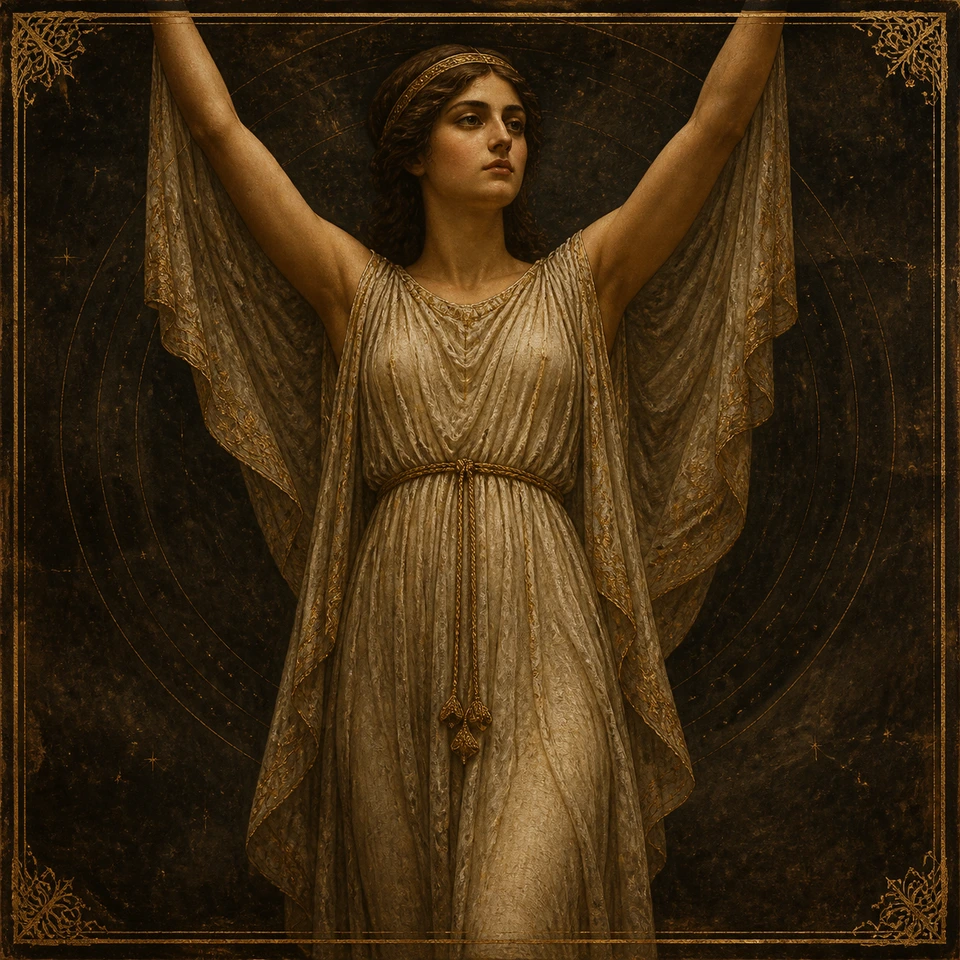
Controlling the agonizing and dangerous passage into birth, Eileithyia governs labor pain and precise divine timing. Her vital influence over human generation is firmly documented within ancient poetry, localized sanctuary traditions, and evocative Attic art.
Overview
Leto has labored for nine days and nine nights on Delos, surrounded by goddesses but unable to give birth. One power is missing. Hera has kept Eileithyia on Olympus beneath golden clouds, away from news of the suffering. Iris slips from the island, draws the childbirth goddess aside with the promise of a great necklace, and brings her across the sea. The instant Eileithyia sets foot on Delos, labor seizes Leto and Apollo comes into the light.
That arrival reveals both mercy and danger. Eileithyia is not simply a gentle guardian standing near a cradle. She governs the passage itself, the onset and release of labor, and Greek poetry knows what happens when that power is withheld. In the Iliad, Hera manipulates Zeus' oath by hastening Eurystheus' birth and restraining the Eileithyiae from Alcmene. Heracles is delayed, another child is born first, and kingship follows the timing of a goddess's intervention.
The name can be singular or plural. Zeus speaks of Eileithyia as a goddess of childbirth, Homer elsewhere compares pain to the shafts of the Eileithyiae, and an Attic black-figure amphora places two richly dressed birth assistants beside Zeus as Athena emerges. A later red-figure pelike names one Eileithyia turning back from the same divine birth. The variation belongs to Greek poetry and art; it should be preserved rather than forced into one rigid form.
The written trail reaches back into the palace archives at Knossos. Tablet Gg(3) 705 sends a measured jar of honey to Amnissos for e-re-u-ti-ja, and three wool tablets name her again. The excavated cave at Amnissos was used across widely separated periods, but the evidence does not prove that every century understood the goddess in exactly the same way.
Her cult geography is equally concrete. The Odyssey names her cave beside the difficult harbor of Amnisos in Crete. Pausanias describes an Athenian temple with three draped wooden images and recalls Delian sacrifice and Olen's hymn. At Olympia, an annual priestess served Eileithyia Olympia at a public altar before the inner chamber of Sosipolis. At Argos, local tradition credited Helen with founding her sanctuary after giving birth there.
Offerings require the same precision. Herodotus says a Hyperborean tribute came to Delos in thanksgiving for childbirth, wrapped in wheat straw and carried through a chain of peoples. Honeyed barley cakes, bath water, incense, and the wine restriction at Olympia belong to Sosipolis, not automatically to Eileithyia. The shared sanctuary joins neighboring cults without erasing their boundaries.
Hesiod calls her a daughter of Zeus and Hera and sister of Hebe and Ares. Roman Lucina and Juno Lucina remain Roman figures rather than alternate labels for every Greek appearance. Eileithyia's ancient power is already large enough without importing planets, crystals, lunar phases, or a generalized modern fertility system.
Canonical identity
Canonical Identity
Eileithyia is the ancient Greek goddess possessing the critical power to either advance labor toward birth or painfully prolong it through withholding her presence. Greek poetry approaches her identity fluidly, sometimes invoking a singular Eileithyia and at other times referring to plural Eileithyiae. The Iliad even shifts between these singular and plural forms within a single depiction of divine action. This plurality must not be erased, but it does not necessitate splitting every textual appearance into a completely separate goddess. Current Greek witnesses do not authorize merging her with childbirth figures from other religious traditions.
Linguistic Identity
The goddess's earliest recorded name appears on Knossian tablets as "e-re-u-ti-ja". Her subsequent alphabetic Greek name is Εἰλείθυια, usually transliterated as Eileithyia or Eileithuia, with Eilithyia and Ilithyia serving as alternate English translations. While these various spellings all identify the same Greek figure, scholars have not yet secured a reliable, period-specific pronunciation, meaning an invented IPA guide would only obscure this historical uncertainty.
4 reviewed sources for this section
- Georgia Flouda, The Goddess Eileithyia in the Knossian Linear B Tablets (2022)Chapter 6 in Honors to Eileithyia at Ancient Inatos, pages 33-36 · INSTAP Academic Press
- Hesiod; edited and translated by Hugh G. Evelyn-White, Theogony (1914)Hesiod, the Homeric Hymns and Homerica, London and New York, 1914 · Perseus Digital Library / Scaife ATLAS
- Homer; Monro and Allen Greek edition with edition-specific translations, Iliad (1920)Perseus CTS edition corpus; Greek edition, Oxford, 1908-1920 · Perseus Digital Library / Scaife ATLAS
- British Museum, British Museum CollectionLive official museum collection · British Museum
Culture, tradition, period, and place
Her surviving landscape begins with Final Palatial Knossian tablets, then stretches through archaic epic and hymn to Classical painted pottery, Hellenistic dedications, and Pausanias' descriptions under Roman rule. Delos holds the delayed birth of Apollo and the Hyperborean tribute. Amnisos in Crete has the cave named in the Odyssey. Athens preserves a temple tradition and draped wooden images. Argos tells of a sanctuary founded after Helen's delivery, while Olympia joins Eileithyia Olympia to a carefully divided precinct shared with Sosipolis.
The map widens further. A sacred regulation from Chios concerns sacrifice and festival for Eileithyia. Paros preserves a cave sanctuary with dedications made for named children, and Spartan evidence places her near Artemis, Apollo, and spaces where young people trained. Boeotian inscriptions call on Artemis Eileithyia and include dedications connected with children. These places do not describe one uniform national ceremony. Each community gives childbirth and the child's entry into family and civic life a different religious setting.
5 reviewed sources for this section
- Georgia Flouda, The Goddess Eileithyia in the Knossian Linear B Tablets (2022)Chapter 6 in Honors to Eileithyia at Ancient Inatos, pages 33-36 · INSTAP Academic Press
- Homeric Hymn to Apollo; translated by Rodney Merrill, The Homeric Hymn to ApolloCenter for Hellenic Studies online translation · Harvard University Center for Hellenic Studies
- Homer; translated by A. T. Murray, Odyssey (1919)A. T. Murray English translation, London: William Heinemann; New York: G. P. Putnam's Sons, 1919 · Perseus Digital Library / Scaife ATLAS
- Pausanias; Spiro Greek edition and Jones/Ormerod translation volumes, Description of Greece (1935)Perseus CTS edition corpus, 1903-1935 · Perseus Digital Library / Scaife ATLAS
- Gabriella Pironti and Vinciane Pirenne-Delforge, Ilithyie au travail: de la mère à l’enfant (2013)Mètis, N.S. 11, pages 71-91 · ORBi, University of Liège
Historical development
Knossian records give Eileithyia a Bronze Age documentary presence. Tablet Gg(3) 705 sends a measured jar of honey to Amnissos for e-re-u-ti-ja. Tablets Od(2) 714-716 record wool allocations to her. The excavated cave at Amnissos was used from Neolithic and Late Minoan phases through several later periods, but the specialist study keeps uninterrupted continuity of worship an open question.
Archaic hexameter gives the goddess genealogy, action, and danger. Hesiod places her among the children of Zeus and Hera. The Iliad imagines the Eileithyiae sending the piercing pains of labor and shows Hera restraining them to delay Heracles' birth. The Homeric Hymn to Apollo turns the goddess's arrival into the decisive movement at Delos. The Odyssey locates her cave beside the harbor at Amnisos.
Attic vases make the divine birth assistant visible. One image uses two Eileithyiai around Zeus at Athena's birth; another names a single Eileithyia moving from the scene. Centuries later, Pausanias encountered temples, images, local genealogies, priestly offices, and sharply bounded ritual spaces. The evidence reveals continuity, revival, and local difference without pretending that one unchanged theology survived across every period.
Sources and evidence
TEXTUAL · Supported
Knossian tablet Gg(3) 705 sends a measured jar of honey to Amnissos for e-re-u-ti-ja, while Od(2) 714-716 record wool allocations to her; the later continuity of worship in the excavated cave remains debated.
- Source
- Georgia Flouda, The Goddess Eileithyia in the Knossian Linear B Tablets (2022)
- Reviewed edition
- Honors to Eileithyia at Ancient Inatos, English edition, chapter 6, pages 33-36 · INSTAP Academic Press
- Exact locator
- Chapter 6 · Page 33-36 · Tablet KN Gg(3) 705; KN Od(2) 714-716
- Scope
- Mycenaean Greece · Amnisos
- Authority
- specialist Linear B and archaeological scholarship
- Certainty
- Certain for the tablets; continuity qualified
The tablet readings and allocations are secure within the cited edition; the chapter itself keeps uninterrupted continuity into later cult open.
Open exact reviewed source8 reviewed sources for this section
- Georgia Flouda, The Goddess Eileithyia in the Knossian Linear B Tablets (2022)Chapter 6 in Honors to Eileithyia at Ancient Inatos, pages 33-36 · INSTAP Academic Press
- Gabriella Pironti and Vinciane Pirenne-Delforge, Ilithyie au travail: de la mère à l’enfant (2013)Mètis, N.S. 11, pages 71-91 · ORBi, University of Liège
- Hesiod; edited and translated by Hugh G. Evelyn-White, Theogony (1914)Hesiod, the Homeric Hymns and Homerica, London and New York, 1914 · Perseus Digital Library / Scaife ATLAS
- Homer; Monro and Allen Greek edition with edition-specific translations, Iliad (1920)Perseus CTS edition corpus; Greek edition, Oxford, 1908-1920 · Perseus Digital Library / Scaife ATLAS
- Homeric Hymn to Apollo; translated by Rodney Merrill, The Homeric Hymn to ApolloCenter for Hellenic Studies online translation · Harvard University Center for Hellenic Studies
- Homer; translated by A. T. Murray, Odyssey (1919)A. T. Murray English translation, London: William Heinemann; New York: G. P. Putnam's Sons, 1919 · Perseus Digital Library / Scaife ATLAS
- British Museum, British Museum CollectionLive official museum collection · British Museum
- Pausanias; Spiro Greek edition and Jones/Ormerod translation volumes, Description of Greece (1935)Perseus CTS edition corpus, 1903-1935 · Perseus Digital Library / Scaife ATLAS
Attested roles and historical themes
Roles, powers, and limits
Eileithyia governs the perilous threshold at which pregnancy becomes birth. Greek poetry does not reduce her to comfort. Her arrival can release Leto from nine days and nights of labor, while her restraint can keep Alcmene from delivering. The Iliad's simile makes childbirth pain sharp, sudden, and divinely sent. Power lies in timing, opening, delay, and passage. Modern source-critical scholarship therefore follows her through labor and the decisive arrival of the child instead of reducing her to a personification of pain.
Some cult evidence carries that work beyond delivery. On Paros, parents dedicated children to her; at Sparta, she stood near Artemis and Apollo in settings tied to the lives of young people; and a Thespian dedication to Artemis Eileithyia probably placed three children under divine protection. These records connect birth with filiation, household legitimacy, and growth. They do not turn Eileithyia into a universal healer, crop-fertility goddess, or ruler of sexuality and marriage. Her wider reach remains tied to children entering and growing within families and communities.
Sources and evidence
TEXTUAL · Supported
The Iliad compares labor to the sharp pains sent by the Eileithyiae, daughters of Hera.
- Source
- Homer; Monro and Allen Greek edition with edition-specific translations, Iliad (1920)
- Reviewed edition
- Monro and Allen Greek edition represented by the Perseus CTS corpus, Oxford, 1908-1920 · edited by David Binning Monro and Thomas William Allen · Perseus Digital Library / Scaife ATLAS
- Exact locator
- Book 11 · Line 269-272
- Scope
- Archaic Greece · Ancient Greece
- Authority
- primary literary witness
- Certainty
- Certain
The plural form is preserved rather than silently converted into a single figure.
Open exact reviewed sourceTEXTUAL · Supported
Pironti and Pirenne-Delforge distinguish Eileithyia’s action across labor and the decisive moment of birth rather than reducing her to pain alone.
- Source
- Gabriella Pironti and Vinciane Pirenne-Delforge, Ilithyie au travail: de la mère à l’enfant (2013)
- Reviewed edition
- Mètis, N.S. 11, 2013, pages 71-91, publisher postprint · ORBi, University of Liège
- Exact locator
- Volume Mètis N.S. 11 · Page 71-77
- Scope
- Classical Greece · Ancient Greece
- Authority
- peer-reviewed Greek-religion scholarship
- Certainty
- Certain
The claim preserves the article’s contextual analysis and does not convert it into a universal medical or magical rule.
Open exact reviewed sourceINSCRIPTIONAL · Supported
A Hellenistic dedication from Thespies probably supported statues of three children offered to Artemis Eileithyia, extending the joint cult beyond relief in labor toward protection and development.
- Source
- Gabriella Pironti and Vinciane Pirenne-Delforge, Ilithyie au travail: de la mère à l’enfant (2013)
- Reviewed edition
- Mètis, N.S. 11, 2013, pages 71-91, publisher postprint · ORBi, University of Liège
- Exact locator
- Volume Mètis N.S. 11 · Page 88 · InscriptionId IThesp 236
- Scope
- Hellenistic Greek world · Boeotia
- Authority
- peer-reviewed source-critical cult analysis
- Certainty
- Probable
The statue interpretation is probable rather than certain because it rests on the inscription and three mounting holes.
Open exact reviewed source3 reviewed sources for this section
- Gabriella Pironti and Vinciane Pirenne-Delforge, Ilithyie au travail: de la mère à l’enfant (2013)Mètis, N.S. 11, pages 71-91 · ORBi, University of Liège
- Homer; Monro and Allen Greek edition with edition-specific translations, Iliad (1920)Perseus CTS edition corpus; Greek edition, Oxford, 1908-1920 · Perseus Digital Library / Scaife ATLAS
- Homeric Hymn to Apollo; translated by Rodney Merrill, The Homeric Hymn to ApolloCenter for Hellenic Studies online translation · Harvard University Center for Hellenic Studies
Epithets and titles
Cult Epithet
Olympia
Ὀλυμπία · Olympian
Olympia in Elis · Cult described by Pausanias in the second century ADA local title at the sanctuary shared with Sosipolis.
1 reviewed source for this section
- Pausanias; Spiro Greek edition and Jones/Ormerod translation volumes, Description of Greece (1935)Perseus CTS edition corpus, 1903-1935 · Perseus Digital Library / Scaife ATLAS
Worship and cult
At Athens, women told Pausanias about three fully draped wooden images in Eileithyia's temple. Two were said to be Cretan gifts of Phaedra and the oldest a Delian image brought by Erysichthon. The same passage says the Delians sacrificed to the goddess and sang a hymn by Olen. Memory moved between Crete, Delos, and Athens through images, stories, and ritual speech.
Olympia gives the clearest view of organized service. An annual priestess belonged to Eileithyia Olympia, and her altar stood in the public front chamber. Sosipolis occupied the inner chamber under different restrictions. The architecture itself kept neighboring cults together without making their recipients or offerings interchangeable.
The cave sanctuary on Paros reveals another side of worship. Most dedications come from women, many thanking the goddess or naming a child. One unusual first-century BC inscription records an adopted boy dedicated by his adoptive mother and father while also naming his biological father. The act makes the sanctuary a place where birth could be social as well as bodily, affirming the child's place within a family.
Sources and evidence
TEXTUAL · Supported
Pausanias describes an Athenian temple of Eileithyia, Delian sacrifice and hymn, Cretan traditions, and three draped wooden images.
- Source
- Pausanias; Spiro Greek edition and Jones/Ormerod translation volumes, Description of Greece (1935)
- Reviewed edition
- Spiro Greek edition and Jones/Ormerod English volumes represented by the Perseus CTS corpus, 1903-1935 · translated by W. H. S. Jones and H. A. Ormerod, volume-dependent · edited by Friedrich Spiro for the Greek edition · Perseus Digital Library / Scaife ATLAS
- Exact locator
- Book 1 · Chapter 18 · Section 5
- Scope
- Greek religion under Roman imperial rule · Athens
- Authority
- primary literary witness
- Certainty
- Certain
The statement remains limited to the named witness and locator.
Open exact reviewed sourceTEXTUAL · Supported
At Olympia, Eileithyia Olympia had an annual priestess, a public altar, and a two-part sanctuary shared with the Elean deity Sosipolis.
- Source
- Pausanias; Spiro Greek edition and Jones/Ormerod translation volumes, Description of Greece (1935)
- Reviewed edition
- Spiro Greek edition and Jones/Ormerod English volumes represented by the Perseus CTS corpus, 1903-1935 · translated by W. H. S. Jones and H. A. Ormerod, volume-dependent · edited by Friedrich Spiro for the Greek edition · Perseus Digital Library / Scaife ATLAS
- Exact locator
- Book 6 · Chapter 20 · Section 2-3
- Scope
- Greek religion under Roman imperial rule · Olympia
- Authority
- primary literary witness
- Certainty
- Certain
Honeyed barley cakes, water, incense, and the restricted inner chamber belong to Sosipolis and are not reassigned to Eileithyia.
Open exact reviewed sourceINSCRIPTIONAL · Supported
Dedications from Eileithyia's cave sanctuary on Paros name children, including an adopted boy dedicated by his adoptive parents while his biological father is also identified.
- Source
- Gabriella Pironti and Vinciane Pirenne-Delforge, Ilithyie au travail: de la mère à l’enfant (2013)
- Reviewed edition
- Mètis, N.S. 11, 2013, pages 71-91, publisher postprint · ORBi, University of Liège
- Exact locator
- Volume Mètis N.S. 11 · Page 85 · InscriptionId IG XII 5, 185-209; especially 199
- Scope
- Hellenistic Greek world · Paros
- Authority
- peer-reviewed source-critical cult analysis
- Certainty
- Certain for the dedications; social-birth interpretation qualified
The adopted child's dedication supports a social and familial dimension without making every Parian dedication an adoption rite.
Open exact reviewed source2 reviewed sources for this section
- Pausanias; Spiro Greek edition and Jones/Ormerod translation volumes, Description of Greece (1935)Perseus CTS edition corpus, 1903-1935 · Perseus Digital Library / Scaife ATLAS
- Gabriella Pironti and Vinciane Pirenne-Delforge, Ilithyie au travail: de la mère à l’enfant (2013)Mètis, N.S. 11, pages 71-91 · ORBi, University of Liège
Temples, sanctuaries, and sacred places
The cave at Amnisos enters Greek literature as a landmark beside a dangerous harbor. The Odyssey does not narrate its rites, but naming it assumes a recognized sacred place tied to Eileithyia. At Delos, the goddess belongs to Leto's labor and to a tradition of far-traveling childbirth tribute. Athens held a temple with old wooden images, Argos explained a sanctuary through Helen's delivery, Olympia placed her altar before the hidden chamber of Sosipolis, and Paros preserved a cave sanctuary rich in dedications.
Sparta held more than one sacred setting. Pausanias places one sanctuary near the training ground of young men, alongside cults of the Dioscuri, Charites, Apollo Karneios, and Artemis Hegemone, and another near Artemis Orthia. An archaic pin bearing Eileithyia's name shows that the connection with Orthia was older than Pausanias' visit. Cave, island, urban temple, training ground, and divided sanctuary therefore reveal different ways birth could open into the protected growth and civic placement of a child.
Sources and evidence
TEXTUAL · Supported
The Odyssey places a cave of Eileithyia at the difficult Cretan harbor of Amnisos.
- Source
- Homer; translated by A. T. Murray, Odyssey (1919)
- Reviewed edition
- A. T. Murray English translation, London: William Heinemann; New York: G. P. Putnam's Sons, 1919 · translated by A. T. Murray · Perseus Digital Library / Scaife ATLAS
- Exact locator
- Book 19 · Line 188-189
- Scope
- Archaic Greece · Amnisos
- Authority
- primary literary witness
- Certainty
- Certain
The statement remains limited to the named witness and locator.
Open exact reviewed sourceTEXTUAL · Supported
Pausanias says Helen founded a sanctuary of Eileithyia at Argos after giving birth there.
- Source
- Pausanias; Spiro Greek edition and Jones/Ormerod translation volumes, Description of Greece (1935)
- Reviewed edition
- Spiro Greek edition and Jones/Ormerod English volumes represented by the Perseus CTS corpus, 1903-1935 · translated by W. H. S. Jones and H. A. Ormerod, volume-dependent · edited by Friedrich Spiro for the Greek edition · Perseus Digital Library / Scaife ATLAS
- Exact locator
- Book 2 · Chapter 22 · Section 6-7
- Scope
- Greek religion under Roman imperial rule · Argos
- Authority
- primary literary witness
- Certainty
- Certain
This is an Argive foundation tradition reported by Pausanias.
Open exact reviewed sourceTEXTUAL · Supported
Spartan evidence places sanctuaries of Eileithyia near youth-training and Artemis Orthia contexts, while an archaic inscribed pin demonstrates an older connection with Orthia.
- Source
- Gabriella Pironti and Vinciane Pirenne-Delforge, Ilithyie au travail: de la mère à l’enfant (2013)
- Reviewed edition
- Mètis, N.S. 11, 2013, pages 71-91, publisher postprint · ORBi, University of Liège
- Exact locator
- Volume Mètis N.S. 11 · Page 85-86 · Entry Pausanias 3.14.6 and 3.17.1; archaic inscribed pin from the Orthia sanctuary
- Scope
- Greek religion under Roman imperial rule · Sparta
- Authority
- peer-reviewed source-critical cult analysis
- Certainty
- Certain for locations and pin; youth-protection interpretation probable
The evidence broadens the local cult setting without turning Eileithyia into the sole guardian of Spartan youth.
Open exact reviewed source4 reviewed sources for this section
- Homer; translated by A. T. Murray, Odyssey (1919)A. T. Murray English translation, London: William Heinemann; New York: G. P. Putnam's Sons, 1919 · Perseus Digital Library / Scaife ATLAS
- Homeric Hymn to Apollo; translated by Rodney Merrill, The Homeric Hymn to ApolloCenter for Hellenic Studies online translation · Harvard University Center for Hellenic Studies
- Pausanias; Spiro Greek edition and Jones/Ormerod translation volumes, Description of Greece (1935)Perseus CTS edition corpus, 1903-1935 · Perseus Digital Library / Scaife ATLAS
- Gabriella Pironti and Vinciane Pirenne-Delforge, Ilithyie au travail: de la mère à l’enfant (2013)Mètis, N.S. 11, pages 71-91 · ORBi, University of Liège
Festivals and processions
No securely reconstructed calendar date for a named festival of Eileithyia appears in the evidence used here. A late fifth-century BC regulation from Chios nevertheless governed aspects of sacrifice and festival in her honor and ordered the inscription displayed in the local Heraion. The record proves organized celebration without supplying a modern date or a complete program.
Olympia elected her priestess each year, but Pausanias does not name that selection as a festival. Delian sacrifice and Olen's hymn show recurring ritual memory without supplying a calendar, while the Hyperborean tribute crossed generations through relay and local dedication. Each practice belongs to its own community and cannot be assembled into one universal festival.
Sources and evidence
INSCRIPTIONAL · Supported
A late fifth-century BC sacred regulation from Chios concerned sacrifice and festival for Eileithyia and required display in the local Heraion.
- Source
- Gabriella Pironti and Vinciane Pirenne-Delforge, Ilithyie au travail: de la mère à l’enfant (2013)
- Reviewed edition
- Mètis, N.S. 11, 2013, pages 71-91, publisher postprint · ORBi, University of Liège
- Exact locator
- Volume Mètis N.S. 11 · Page 75 · InscriptionId NGSL no. 20, line 25
- Scope
- Classical Greece · Chios
- Authority
- peer-reviewed source-critical cult analysis
- Certainty
- Certain for the regulation; calendar date unresolved
The regulation establishes organized ritual but does not supply a modern date or complete festival program.
Open exact reviewed source3 reviewed sources for this section
- Pausanias; Spiro Greek edition and Jones/Ormerod translation volumes, Description of Greece (1935)Perseus CTS edition corpus, 1903-1935 · Perseus Digital Library / Scaife ATLAS
- Herodotus; translated by A. D. Godley, The Histories (1925)A. D. Godley English translation, Loeb Classical Library volumes I-IV, 1920-1925; Perseus eng2 component · Perseus Digital Library / Scaife ATLAS
- Gabriella Pironti and Vinciane Pirenne-Delforge, Ilithyie au travail: de la mère à l’enfant (2013)Mètis, N.S. 11, pages 71-91 · ORBi, University of Liège
Offerings, votives, and ritual evidence
The earliest written offerings are administrative rather than literary. Knossian tablet Gg(3) 705 allocates a measured jar of honey to e-re-u-ti-ja at Amnissos. Tablets Od(2) 714-716 assign one or possibly several units of wool to her. Their exact ritual handling is uncertain, so the commodities should be named without inventing a ceremony.
Herodotus says the first Hyperborean mission brought a tribute for Eileithyia in thanksgiving for childbirth. The sacred things were wrapped in wheat straw and passed through many peoples when direct journeys ceased. At Delos, the dead maidens were honored near Artemis's sanctuary and young Delians dedicated cut hair at their tomb. These actions belong to a layered Delian story whose recipients and locations must remain clear.
Pausanias says the Delians sacrificed to Eileithyia and sang Olen's hymn, but he does not specify the sacrificial victim in that passage. At Olympia, cakes kneaded with honey, water for bathing, incense, and a wine restriction concern Sosipolis in the shared sanctuary. They cannot be transferred to Eileithyia merely because her altar stood in the front chamber.
Sources and evidence
TEXTUAL · Supported
Herodotus attributes to the Delians a Hyperborean tribute for Eileithyia in thanksgiving for childbirth.
- Source
- Herodotus; translated by A. D. Godley, The Histories (1925)
- Reviewed edition
- A. D. Godley English translation, Loeb Classical Library volumes I-IV, 1920-1925 · translated by A. D. Godley · edited by A. D. Godley · Perseus Digital Library / Scaife ATLAS
- Exact locator
- Book 4 · Section 32-36
- Scope
- Classical Greece · Delos
- Authority
- primary literary witness
- Certainty
- Certain
Herodotus distinguishes the Delian report from northern marvels he doubts.
Open exact reviewed source3 reviewed sources for this section
- Georgia Flouda, The Goddess Eileithyia in the Knossian Linear B Tablets (2022)Chapter 6 in Honors to Eileithyia at Ancient Inatos, pages 33-36 · INSTAP Academic Press
- Herodotus; translated by A. D. Godley, The Histories (1925)A. D. Godley English translation, Loeb Classical Library volumes I-IV, 1920-1925; Perseus eng2 component · Perseus Digital Library / Scaife ATLAS
- Pausanias; Spiro Greek edition and Jones/Ormerod translation volumes, Description of Greece (1935)Perseus CTS edition corpus, 1903-1935 · Perseus Digital Library / Scaife ATLAS
Iconography and material culture
Attic pottery shows childbirth assistance through dress, posture, and gesture rather than through a universal handheld emblem. On the Antimenes Painter's black-figure amphora, two Eileithyiai flank Zeus as Athena is born, their raised hands marking active assistance. A red-figure pelike about two generations later names one Eileithyia in the scene, dressed in a Doric chiton with apoptygma, a trefoil-ended girdle, and a fillet as she turns away and looks back.
The difference is significant. Ancient artists could make the birth power plural or singular and could place her at different moments in the action. The raised gesture is securely tied to these birth scenes, but it is not evidence for a wand, torch, key, crystal, or fixed magical tool.
Sources and evidence
MATERIAL CULTURE · Supported
A black-figure amphora shows two Eileithyiai in long embroidered dress flanking the birth of Athena with raised assisting gestures.
- Source
- British Museum, British Museum Collection
- Reviewed edition
- Live record-level official museum collection · British Museum
- Exact locator
- MuseumObjectId 1836,0224.10
- Scope
- Archaic Greece · Attica
- Authority
- institutional collection catalog
- Certainty
- Certain
Attic black-figure amphora by the Antimenes Painter, about 520 BC.
Open exact reviewed sourceMATERIAL CULTURE · Supported
A red-figure pelike names Eileithyia in the birth of Athena, dressed in a Doric chiton, girdle, and fillet as she turns from the scene.
- Source
- British Museum, British Museum Collection
- Reviewed edition
- Live record-level official museum collection · British Museum
- Exact locator
- MuseumObjectId 1849,0620.14
- Scope
- Classical Greece · Attica
- Authority
- institutional collection catalog
- Certainty
- Certain
Attic pelike attributed to the Painter of the Birth of Athena, about 460-450 BC.
Open exact reviewed source1 reviewed source for this section
- British Museum, British Museum CollectionLive official museum collection · British Museum
Animals, plants, and embodied forms
No animal or plant serves as a secure universal attribute of Eileithyia in the witnesses used here. Wheat straw surrounds the Hyperborean sacred things during their journey, but Herodotus describes wrapping and transmission, not a sacred plant belonging to the goddess. The palm at Apollo's Delian birth is the tree Leto grasps; the hymn does not make it Eileithyia's botanical emblem.
Her absence of a fixed animal companion is equally important. Birth scenes focus on divine and mortal bodies, raised hands, clothing, and the event itself. Later symbolic systems may build new associations, but they cannot be projected backward without named evidence.
2 reviewed sources for this section
- Herodotus; translated by A. D. Godley, The Histories (1925)A. D. Godley English translation, Loeb Classical Library volumes I-IV, 1920-1925; Perseus eng2 component · Perseus Digital Library / Scaife ATLAS
- Homeric Hymn to Apollo; translated by Rodney Merrill, The Homeric Hymn to ApolloCenter for Hellenic Studies online translation · Harvard University Center for Hellenic Studies
Relationships and genealogy
Hesiod names Eileithyia as a daughter of Zeus and Hera, in the same compact genealogy as Hebe and Ares. Those sibling relationships belong to that poetic witness. Homer also calls the Eileithyiae daughters of Hera when describing labor pains. Genealogy and function therefore meet in Hera, who is both mother in Hesiod and the goddess able to restrain the childbirth powers in the Iliad.
These family links do not make Eileithyia a mere aspect of Hera. The Homeric Hymn to Apollo places her apart on Olympus, capable of being kept uninformed and then persuaded by Iris. Once she reaches Delos, Leto's labor changes at once. Related divinities remain distinct agents within the story.
Sources and evidence
TEXTUAL · Supported
Hesiod names Eileithyia among the children of Zeus and Hera, beside Hebe and Ares.
- Source
- Hesiod; edited and translated by Hugh G. Evelyn-White, Theogony (1914)
- Reviewed edition
- Hugh G. Evelyn-White edition and English translation in Hesiod, the Homeric Hymns and Homerica, 1914 · translated by Hugh G. Evelyn-White · edited by Hugh G. Evelyn-White · Perseus Digital Library / Scaife ATLAS
- Exact locator
- Entry Theogony · Line 921-923
- Scope
- Archaic Greece · Ancient Greece
- Authority
- primary literary witness
- Certainty
- Certain
The statement remains limited to the named witness and locator.
Open exact reviewed source3 reviewed sources for this section
- Hesiod; edited and translated by Hugh G. Evelyn-White, Theogony (1914)Hesiod, the Homeric Hymns and Homerica, London and New York, 1914 · Perseus Digital Library / Scaife ATLAS
- Homer; Monro and Allen Greek edition with edition-specific translations, Iliad (1920)Perseus CTS edition corpus; Greek edition, Oxford, 1908-1920 · Perseus Digital Library / Scaife ATLAS
- Homeric Hymn to Apollo; translated by Rodney Merrill, The Homeric Hymn to ApolloCenter for Hellenic Studies online translation · Harvard University Center for Hellenic Studies
Actual myths and source variants
At Delos, Leto labors for nine days and nights while Hera keeps Eileithyia away. Iris slips from the island, draws the childbirth goddess aside with the promise of a golden necklace, and escorts her back like a shy dove. The moment Eileithyia steps onto Delos, labor takes hold and Apollo comes into the light. Her role is brief in lines but decisive in action.
The Iliad tells a harsher story around Heracles. Zeus swears that a descendant born that day will rule. Hera makes Eurystheus arrive early and holds the Eileithyiae away from Alcmene, turning the oath against Zeus and the unborn hero. In the birth of Athena, vase painters place one or two Eileithyiai beside Zeus, while Hesiod's compressed telling names no helper. Each witness preserves its own version of divine birth rather than filling every silence from another.
Sources and evidence
TEXTUAL · Supported
In the Homeric Hymn to Apollo, Leto's labor ends only after Iris secretly brings Eileithyia from Olympus to Delos.
- Source
- Homeric Hymn to Apollo; translated by Rodney Merrill, The Homeric Hymn to Apollo
- Reviewed edition
- Rodney Merrill English translation, Center for Hellenic Studies online edition · translated by Rodney Merrill · Harvard University Center for Hellenic Studies
- Exact locator
- Hymn 3 · Line 90-119
- Scope
- Archaic Greece · Delos
- Authority
- primary literary witness
- Certainty
- Certain
The necklace, Hera's obstruction, Iris' journey, and Eileithyia's arrival belong to this hymnic telling.
Open exact reviewed sourceTEXTUAL · Supported
Hera hastens Eurystheus while holding back the Eileithyiae from Alcmene, changing the outcome of Zeus' oath about Heracles.
- Source
- Homer; Monro and Allen Greek edition with edition-specific translations, Iliad (1920)
- Reviewed edition
- Monro and Allen Greek edition represented by the Perseus CTS corpus, Oxford, 1908-1920 · edited by David Binning Monro and Thomas William Allen · Perseus Digital Library / Scaife ATLAS
- Exact locator
- Book 19 · Line 95-133
- Scope
- Archaic Greece · Ancient Greece
- Authority
- primary literary witness
- Certainty
- Certain
The passage moves from singular Eileithyia in Zeus' speech to plural Eileithyiae in Hera's action.
Open exact reviewed source4 reviewed sources for this section
- Homeric Hymn to Apollo; translated by Rodney Merrill, The Homeric Hymn to ApolloCenter for Hellenic Studies online translation · Harvard University Center for Hellenic Studies
- Homer; Monro and Allen Greek edition with edition-specific translations, Iliad (1920)Perseus CTS edition corpus; Greek edition, Oxford, 1908-1920 · Perseus Digital Library / Scaife ATLAS
- British Museum, British Museum CollectionLive official museum collection · British Museum
- Hesiod; edited and translated by Hugh G. Evelyn-White, Theogony (1914)Hesiod, the Homeric Hymns and Homerica, London and New York, 1914 · Perseus Digital Library / Scaife ATLAS
Myth Library
Each myth gathers its attested participants into one source-grounded account, while distinct source traditions remain readable in their own variants.
Divine Birth
The Birth of Apollo at Delos
Leto finds refuge on Delos and gives birth to Apollo after the island receives a sworn promise of honor; Callimachus later reshapes the birth through Delos's wanderings, Hera's resistance, and the island's fixing in place.
- Role in this profile
- childbirth goddess whose delayed arrival allows Leto's labor to end
- Place scope
- Delos
- Witnesses
- 2
- Variants
- 2
Ritual Aetiology
Hyperborean Offerings and the Delian Maidens
Herodotus reports a Delian tradition that a Hyperborean tribute for Eileithyia passed through a chain of peoples to Delos, where Hyperoche and Laodice were honored near Artemis's sanctuary and Delian youths dedicated their hair.
- Role in this profile
- childbirth goddess for whom the Delians said the first Hyperborean tribute was sent
- Place scope
- Delos
- Witnesses
- 1
- Variants
- 1
Theogony
The Birth of Athena
Athena erupts armed from Zeus; Hesiod preserves Metis as her mother, while Attic vessels place one or two Eileithyiai around the divine birth.
- Role in this profile
- birth assistant shown as two goddesses on the black-figure amphora and one named goddess on the red-figure pelike
- Place scope
- Ancient Greece · Attica
- Witnesses
- 4
- Variants
- 4
Birth And Divine Rivalry
Hera Delays the Birth of Heracles
Hera turns Zeus' oath against the unborn Heracles by advancing Eurystheus' birth and holding the Eileithyiae away from Alcmene.
- Role in this profile
- childbirth power named singularly in Zeus' promise and plurally when Hera restrains Alcmene's labor
- Place scope
- Ancient Greece
- Witnesses
- 1
- Variants
- 1
Equivalences, syncretisms, and identity boundaries
Eileithyia can stand beside another goddess without ceasing to be herself. Boeotian inscriptions attest Artemis Eileithyia, and modern analysis reads the title as a joint invocation of two childbirth powers rather than a major goddess swallowing a minor one. Knossian tablets likewise record Eileithyia and Artemis independently. Association, collaboration, title, and identity must not be treated as interchangeable.
Pausanias describes Cretan claims about Eileithyia's birthplace and Hera's motherhood alongside Delian and Athenian traditions. Local disagreement is not proof of a wholesale borrowing. Singular and plural forms need equal care: vase painters can show two Eileithyiai, the Iliad can name plural daughters of Hera, and other passages speak of one goddess. These variations belong inside Greek tradition and do not authorize merging every childbirth divinity across cultures.
Sources and evidence
INSCRIPTIONAL · Supported
Boeotian cult inscriptions attest Artemis Eileithyia, which Pironti and Pirenne-Delforge interpret as a joint invocation of two effective childbirth powers rather than Eileithyia vanishing into Artemis.
- Source
- Gabriella Pironti and Vinciane Pirenne-Delforge, Ilithyie au travail: de la mère à l’enfant (2013)
- Reviewed edition
- Mètis, N.S. 11, 2013, pages 71-91, publisher postprint · ORBi, University of Liège
- Exact locator
- Volume Mètis N.S. 11 · Page 74 · InscriptionId IG VII 546, 555, 1871, 3214, 3410-3411, 4174-4176
- Scope
- Classical Greece · Ancient Greece
- Authority
- peer-reviewed source-critical cult analysis
- Certainty
- Certain
Association and joint invocation are preserved without merging the two goddess records.
Open exact reviewed source5 reviewed sources for this section
- Gabriella Pironti and Vinciane Pirenne-Delforge, Ilithyie au travail: de la mère à l’enfant (2013)Mètis, N.S. 11, pages 71-91 · ORBi, University of Liège
- Georgia Flouda, The Goddess Eileithyia in the Knossian Linear B Tablets (2022)Chapter 6 in Honors to Eileithyia at Ancient Inatos, pages 33-36 · INSTAP Academic Press
- Pausanias; Spiro Greek edition and Jones/Ormerod translation volumes, Description of Greece (1935)Perseus CTS edition corpus, 1903-1935 · Perseus Digital Library / Scaife ATLAS
- Homer; Monro and Allen Greek edition with edition-specific translations, Iliad (1920)Perseus CTS edition corpus; Greek edition, Oxford, 1908-1920 · Perseus Digital Library / Scaife ATLAS
- British Museum, British Museum CollectionLive official museum collection · British Museum
Correspondence index
Her strongest ancient associations are not a modern table of planets, stones, colors, or weekdays. They are concrete: labor, delayed or released birth, Delos, Amnisos, temples at Athens and Argos, Eileithyia Olympia, the caves on Crete and Paros, Spartan youth settings, Boeotian child dedications, draped wooden images, hymnic arrival, sacrifice, tribute, and the raised assisting gesture on Attic pottery.
The evidence therefore separates cult place and ritual action from analogies that merely feel appropriate. Wheat straw carried an offering but is not automatically her sacred grain. The Delian palm belongs to Leto's posture during birth. Painted clothing has color, but no universal sacred color follows. Childbirth power does not itself establish a moon, zodiac, crystal, metal, direction, or generic magical intention.
Direct ancient correspondences
| Category | Direct correspondence | How and why | Evidence boundary |
|---|---|---|---|
| direction-place | Delos, Amnisos, Athens, Argos, Olympia, Chios, Paros, Sparta, and BoeotiaDirect historical association | Poetry, Pausanias, sacred regulations, inscriptions, and material evidence anchor her in island, cave, urban temple, youth, and sanctuary settings across Greek communities. | Ancient Cultic Cult places are historically specific and do not create a compass direction 4 reviewed sources for this section
|
| festival-time | Chian festival regulation and annual Olympian priestessDirect historical association | A Chian regulation governs sacrifice and festival, Olympia chose Eileithyia's priestess each year, and Delos preserved sacrifice and hymn. | Ancient Cultic The evidence does not supply a securely reconstructed calendar date or one universal program 2 reviewed sources for this section
|
| offering-ritual-material | Delian tribute, sacrifice, and hymnDirect historical association | Herodotus names the Hyperborean childbirth tribute, and Pausanias names Delian sacrifice and Olen's hymn. | Ancient Cultic The sacrificial victim and the contents of the tribute remain unspecified 2 reviewed sources for this section
|
| ritual-object-symbol-tool | Raised assisting gestureDirect historical association | Two accessioned Attic vessels show one or two Eileithyiai using raised hands around Athena's birth. | Ancient Material A scene-specific gesture, not a universal handheld tool 1 reviewed source for this section
|
Contextual evidence, not a general correspondence
| Category | Direct correspondence | How and why | Evidence boundary |
|---|---|---|---|
| plant-tree | Wheat straw and the Delian palm are contextualContextual evidence only | Wheat straw wraps the Hyperborean sacred things, while Leto grasps the palm when Apollo is born. | Ancient Literary Neither passage names a plant as Eileithyia's universal attribute 2 reviewed sources for this section
|
11 expected categories currently not evidenced
celestial-body · Not evidenced
No celestial body attested
Her power concerns the timing and passage of labor. No planet, Sun, or Moon is assigned to her.
- Layer
- Research Boundary
- Scope
- Birth timing does not establish celestial rulership
zodiac · Not evidenced
No zodiac sign attested
Greek poetry and sanctuary evidence place her at childbirth, not within a zodiacal scheme.
- Layer
- Research Boundary
- Scope
- Any later zodiac claim needs a named later authority
gemstone-crystal-mineral · Not evidenced
No gemstone or mineral attested
Her ancient images rely on dress and gesture. No stone or crystal accompanies the goddess.
- Layer
- Research Boundary
- Scope
- Protective symbolism cannot supply a mineral by analogy
metal-material · Not evidenced
No sacred metal attested
Wooden images and ceramic vessels preserve her presence, but neither material becomes her divine metal.
- Layer
- Research Boundary
- Scope
- Object manufacture and sacred correspondence remain different claims
animal-embodied-form · Not evidenced
No animal form attested
Her surviving appearances focus on divine action and human birth. No animal body or companion is named.
- Layer
- Research Boundary
- Scope
- Later animal symbolism requires independent evidence
color · Not evidenced
No universal color attested
Draped images and painted pottery show clothing, but no text or cult account assigns one sacred color.
- Layer
- Research Boundary
- Scope
- Pigment on an individual object remains local to that object
classical-element · Not evidenced
No classical element attested
The surviving Greek witnesses describe birth, pain, sanctuary, and arrival without four-element rulership.
- Layer
- Research Boundary
- Scope
- Bodily heat or water used in another cult cannot create an element assignment
weekday · Not evidenced
No weekday attested
Her cult places and stories do not attach worship to a planetary weekday.
- Layer
- Research Boundary
- Scope
- Annual priestly selection at Olympia is not a weekday rule
moon-phase · Not evidenced
No moon phase attested
Pregnancy and childbirth do not automatically make Eileithyia lunar. No phase structures these witnesses.
- Layer
- Research Boundary
- Scope
- Modern lunar analogies remain outside ancient attestation
incense-perfume · Not evidenced
No incense assigned directly
Incense appears inside the Olympia precinct in service of Sosipolis, not as a named offering to Eileithyia.
- Layer
- Research Boundary
- Scope
- A shared building does not transfer one recipient's offerings to another
intention-magical-power · Not evidenced
No universal magical intention attested
Her ancient role concerns the danger, timing, and completion of childbirth within Greek religion.
- Layer
- Research Boundary
- Scope
- Historical childbirth cult is not a generic spell category
7 reviewed sources for this section
- Homer; Monro and Allen Greek edition with edition-specific translations, Iliad (1920)Perseus CTS edition corpus; Greek edition, Oxford, 1908-1920 · Perseus Digital Library / Scaife ATLAS
- Homer; translated by A. T. Murray, Odyssey (1919)A. T. Murray English translation, London: William Heinemann; New York: G. P. Putnam's Sons, 1919 · Perseus Digital Library / Scaife ATLAS
- Homeric Hymn to Apollo; translated by Rodney Merrill, The Homeric Hymn to ApolloCenter for Hellenic Studies online translation · Harvard University Center for Hellenic Studies
- Herodotus; translated by A. D. Godley, The Histories (1925)A. D. Godley English translation, Loeb Classical Library volumes I-IV, 1920-1925; Perseus eng2 component · Perseus Digital Library / Scaife ATLAS
- Pausanias; Spiro Greek edition and Jones/Ormerod translation volumes, Description of Greece (1935)Perseus CTS edition corpus, 1903-1935 · Perseus Digital Library / Scaife ATLAS
- British Museum, British Museum CollectionLive official museum collection · British Museum
- Gabriella Pironti and Vinciane Pirenne-Delforge, Ilithyie au travail: de la mère à l’enfant (2013)Mètis, N.S. 11, pages 71-91 · ORBi, University of Liège
Later reception and living significance
Eileithyia remains present in translations, museum galleries, and classical scholarship. Her surviving stories speak directly to the fear, duration, bodily danger, and social consequence of birth, which is one reason she resists becoming a soft emblem of generalized fertility. The ancient texts can hold relief and coercion in the same divine power.
No named contemporary rite is supported by the reviewed evidence here, and ancient birth practice should not be improvised as medical instruction. Modern devotion, where practiced, belongs to living people and communities who can explain their own observance. Historical hymns and sanctuary descriptions provide context, not a universal prescription for pregnancy or childbirth.
4 reviewed sources for this section
- British Museum, British Museum CollectionLive official museum collection · British Museum
- Hesiod; edited and translated by Hugh G. Evelyn-White, Theogony (1914)Hesiod, the Homeric Hymns and Homerica, London and New York, 1914 · Perseus Digital Library / Scaife ATLAS
- Homer; Monro and Allen Greek edition with edition-specific translations, Iliad (1920)Perseus CTS edition corpus; Greek edition, Oxford, 1908-1920 · Perseus Digital Library / Scaife ATLAS
- Homer; translated by A. T. Murray, Odyssey (1919)A. T. Murray English translation, London: William Heinemann; New York: G. P. Putnam's Sons, 1919 · Perseus Digital Library / Scaife ATLAS
Evidence, conflicts, and research gaps
The evidence now joins Knossian administrative tablets, primary poetry, Pausanias' place-by-place descriptions, Herodotus' attributed Delian report, accession-level Attic pottery, excavation history, and peer-reviewed Greek-religion analysis. Exact locators keep each claim bounded: tablet numbers for Bronze Age offerings, lines for myth and genealogy, printed pages for scholarly interpretation, and museum numbers for gesture or dress.
Serious uncertainties remain. The tablets establish e-re-u-ti-ja at Knossos and Amnissos, but uninterrupted continuity into every later phase of cave worship is not proven. Ancient pronunciation remains unresolved. A full regional inscriptional survey may sharpen festival, priesthood, and offering history beyond the sites treated here. Modern living practice still lacks a reviewed community witness, and comparison with Roman Lucina requires Roman evidence rather than functional resemblance.
9 reviewed sources for this section
- Georgia Flouda, The Goddess Eileithyia in the Knossian Linear B Tablets (2022)Chapter 6 in Honors to Eileithyia at Ancient Inatos, pages 33-36 · INSTAP Academic Press
- Gabriella Pironti and Vinciane Pirenne-Delforge, Ilithyie au travail: de la mère à l’enfant (2013)Mètis, N.S. 11, pages 71-91 · ORBi, University of Liège
- Hesiod; edited and translated by Hugh G. Evelyn-White, Theogony (1914)Hesiod, the Homeric Hymns and Homerica, London and New York, 1914 · Perseus Digital Library / Scaife ATLAS
- Homer; Monro and Allen Greek edition with edition-specific translations, Iliad (1920)Perseus CTS edition corpus; Greek edition, Oxford, 1908-1920 · Perseus Digital Library / Scaife ATLAS
- Homer; translated by A. T. Murray, Odyssey (1919)A. T. Murray English translation, London: William Heinemann; New York: G. P. Putnam's Sons, 1919 · Perseus Digital Library / Scaife ATLAS
- Homeric Hymn to Apollo; translated by Rodney Merrill, The Homeric Hymn to ApolloCenter for Hellenic Studies online translation · Harvard University Center for Hellenic Studies
- Herodotus; translated by A. D. Godley, The Histories (1925)A. D. Godley English translation, Loeb Classical Library volumes I-IV, 1920-1925; Perseus eng2 component · Perseus Digital Library / Scaife ATLAS
- Pausanias; Spiro Greek edition and Jones/Ormerod translation volumes, Description of Greece (1935)Perseus CTS edition corpus, 1903-1935 · Perseus Digital Library / Scaife ATLAS
- British Museum, British Museum CollectionLive official museum collection · British Museum
Direct connections and evidence
Explicit Source
Hesiod names Zeus as Eileithyia's father
The compact genealogy gives Zeus the paternal place in Eileithyia's lineage.
1 attestation · high confidence
- Hesiod; edited and translated by Hugh G. Evelyn-White, TheogonyHugh G. Evelyn-White edition and English translation in Hesiod, the Homeric Hymns and Homerica, 1914 · translated by Hugh G. Evelyn-White · edited by Hugh G. Evelyn-White · Perseus Digital Library / Scaife ATLAS · Archaic Greece · Ancient Greece · Entry Theogony · Line 921-923
Explicit Source
Hesiod names Hera as Eileithyia's mother
Hera holds the maternal place and is also linked to childbirth powers elsewhere in Homer.
1 attestation · high confidence
- Hesiod; edited and translated by Hugh G. Evelyn-White, TheogonyHugh G. Evelyn-White edition and English translation in Hesiod, the Homeric Hymns and Homerica, 1914 · translated by Hugh G. Evelyn-White · edited by Hugh G. Evelyn-White · Perseus Digital Library / Scaife ATLAS · Archaic Greece · Ancient Greece · Entry Theogony · Line 921-923
Explicit Source
Hesiod names Ares beside Eileithyia in one sibling group
The shared parentage is explicit in Hesiod's compact genealogy.
1 attestation · high confidence
- Hesiod; edited and translated by Hugh G. Evelyn-White, TheogonyHugh G. Evelyn-White edition and English translation in Hesiod, the Homeric Hymns and Homerica, 1914 · translated by Hugh G. Evelyn-White · edited by Hugh G. Evelyn-White · Perseus Digital Library / Scaife ATLAS · Archaic Greece · Ancient Greece · Entry Theogony · Line 921-923
Explicit Source
Hesiod names Hebe beside Eileithyia in one sibling group
The shared parentage is explicit in Hesiod's compact genealogy.
1 attestation · high confidence
- Hesiod; edited and translated by Hugh G. Evelyn-White, TheogonyHugh G. Evelyn-White edition and English translation in Hesiod, the Homeric Hymns and Homerica, 1914 · translated by Hugh G. Evelyn-White · edited by Hugh G. Evelyn-White · Perseus Digital Library / Scaife ATLAS · Archaic Greece · Ancient Greece · Entry Theogony · Line 921-923
Archive scope and classification
- Figure classification
- God or goddess · certain
- Pantheon or tradition shelf
- Greek
- Cultures
- Greek
- Traditions
- Ancient Greek religion
- Periods
- Mycenaean Greece, Archaic Greece, Classical Greece, Greek religion under Roman imperial rule
- Places
- Ancient Greece, Delos, Amnisos, Athens, Argos, Olympia, Chios, Paros, Sparta, Boeotia
Knossian tablet evidence, Greek poetry, Delian and regional cult evidence, Attic birth scenes, genealogy, and identity boundaries have been reviewed; pronunciation, cult continuity, and living-practice evidence remain explicit limits.
Reviewed sources
- Hesiod; edited and translated by Hugh G. Evelyn-White, Theogony (1914)Hesiod, the Homeric Hymns and Homerica, London and New York, 1914 · Perseus Digital Library / Scaife ATLAS
- Homer; Monro and Allen Greek edition with edition-specific translations, Iliad (1920)Perseus CTS edition corpus; Greek edition, Oxford, 1908-1920 · Perseus Digital Library / Scaife ATLAS
- Homer; translated by A. T. Murray, Odyssey (1919)A. T. Murray English translation, London: William Heinemann; New York: G. P. Putnam's Sons, 1919 · Perseus Digital Library / Scaife ATLAS
- Pausanias; Spiro Greek edition and Jones/Ormerod translation volumes, Description of Greece (1935)Perseus CTS edition corpus, 1903-1935 · Perseus Digital Library / Scaife ATLAS
- British Museum, British Museum CollectionLive official museum collection · British Museum
- Herodotus; translated by A. D. Godley, The Histories (1925)A. D. Godley English translation, Loeb Classical Library volumes I-IV, 1920-1925; Perseus eng2 component · Perseus Digital Library / Scaife ATLAS
- Homeric Hymn to Apollo; translated by Rodney Merrill, The Homeric Hymn to ApolloCenter for Hellenic Studies online translation · Harvard University Center for Hellenic Studies
- Georgia Flouda, The Goddess Eileithyia in the Knossian Linear B Tablets (2022)Chapter 6 in Honors to Eileithyia at Ancient Inatos, pages 33-36 · INSTAP Academic Press
- Gabriella Pironti and Vinciane Pirenne-Delforge, Ilithyie au travail: de la mère à l’enfant (2013)Mètis, N.S. 11, pages 71-91 · ORBi, University of Liège