
Greek · God or goddess · Certain
Hestia
Ἑστία · Hestía
Pronunciation: /hes.tí.aː/ · hes-TEE-ah
Research and editorial review by Cody Manes · Reviewed 2026-08-30
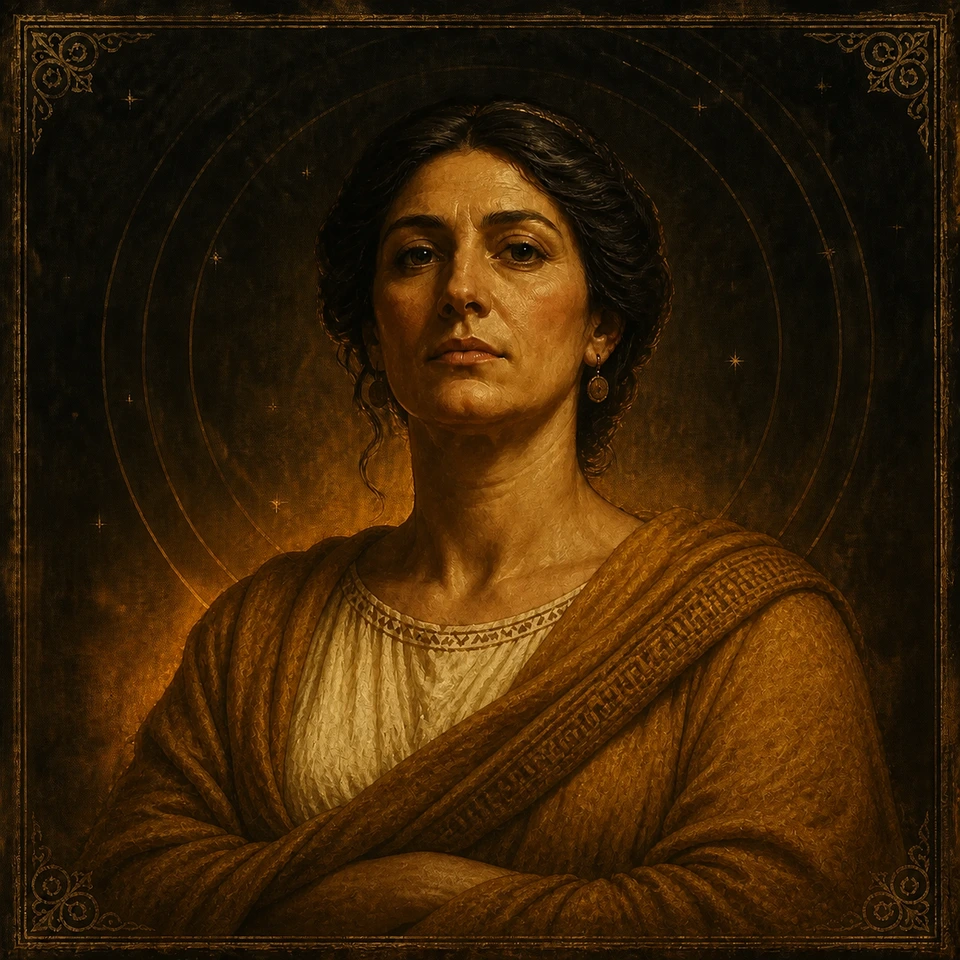
Grounding the ancient community in unwavering stability, Hestia commands the sacred flames of the household and the civic hearth. Maintaining chosen virginity and strict ritual precedence, she rightfully claims the first and last honors at banquets and sanctuary sequences.
Overview
A fire can roar, leap, devour, and die. Hestia's power is quieter and harder to see. It is the settled center around which a house becomes a place of belonging, a meal becomes a shared act, and a city gathers its officials beneath one roof. Yet the goddess is not merely a poetic way of saying fire. Hymns address her as a divine person who receives honor, chooses her own condition, enters houses, and stands beside other gods without surrendering her distinct place.
Her most complete story survives inside the Homeric Hymn to Aphrodite. Apollo and Poseidon both seek marriage with her. Hestia refuses them, touches Zeus's head, and swears a great oath to remain unmarried. Zeus does not treat that refusal as an absence. He gives her honor in the center of the house, a rich portion, a share in every temple, and precedence among mortals. The scene makes agency and ritual standing inseparable. Hestia's stillness is chosen, publicly sworn, and answered with a place no marriage could confer.
Other poems reveal how far that place extends. Hymn 24 calls her to the holy house of Apollo at Pytho, where oil shines in her hair, then invites her into the singer's own house in harmony with Zeus. Hymn 29 says her seat endures in the high dwellings of gods and mortals. No mortal banquet proceeds without sweet wine poured to her first and last. The same hymn asks Hestia and Hermes to dwell together in friendship, joining the fixed center of the house with the god who crosses its threshold.
Pindar brings the hearth into civic office. At Tenedos, Hestia holds the town hall under her protection. Aristagoras and his fellow officials approach her dwelling and scepter as they begin a twelve-month term. They honor her first with libations and burnt sacrifice while lyres and songs sound around them. Pausanias finds the same priority at Olympia in a different setting: the Eleans sacrifice first to Hestia, then to Olympian Zeus, and only afterward proceed to other altars. Household, sanctuary, banquet, and council hall are not interchangeable, but each gives Hestia a place at the beginning of ordered communal action.
Her genealogy belongs to the violent beginning of Zeus's generation. Hesiod names Hestia first among the children of Rhea and Cronus, then Demeter, Hera, Hades, Poseidon, and Zeus. Cronus swallows each child as it reaches Rhea's knees. Zeus escapes, grows, and forces the swallowed generation back into the world. The later Library makes Hestia explicitly the first swallowed and adds Metis as the giver of the drug that makes Cronus release the stone and children. This difference matters. It preserves two tellings instead of pretending that every ancient author narrated one seamless event.
Ancient images securely named as Hestia are scarce. A fragment of the Sophilos dinos in the British Museum preserves her among the procession for Peleus and Thetis. A later Attic black-figure hydria identifies her beside Hermes, wearing earrings, a long chiton, and an embroidered himation. These objects support a grave, fully clothed divine presence. They do not authorize a torch, crown, later priestess costume, or invented bestiary. The painted portrait keeps that restraint, including its low hearth glow as an interpretive sign rather than an archaeological attribute.
The evidence supports Hestia as an ancient Greek goddess of household and civic centrality, ritual precedence, and chosen virginity. It supports no planetary, zodiacal, mineral, color, weekday, lunar, directional, incense, or sacred-animal assignment. Fire, wine, the house, Pytho, Tenedos, and Olympia are all present, but each belongs to a named passage, place, or act. Hestia's force lies in the exactness of those placements: the center, the first cup, the last cup, the first sacrifice, and the office held under her protection.
Canonical identity
Canonical Identity
Hestia is unequivocally recognized as a goddess throughout Greek poetic and religious sources. The ancient hymns revere her as a daughter of Cronus who deliberately selects permanent virginity, receives distinct honors from Zeus, accepts sacred offerings, and dwells within houses. While the shared vocabulary for the goddess and the hearth establishes a profound link between the divine figure and the physical space, it does not mandate that every random fire or flame functions as an automatic manifestation of Hestia.
Linguistic Identity
The ancient Greek name is Ἑστία, transliterated precisely as Hestía. A qualified fifth-century BC Attic reconstruction provides the sound /hes.tí.aː/, approximated for English speakers as hes-TEE-ah. The lexical form roots directly in "ἑστία," the standard Greek noun for hearth. The alternative Epic and Ionic spelling, Ἑστίη, simply represents a dialectal variation of the exact same name rather than a secondary figure.
Sources and evidence
TEXTUAL · Supported
For Hestia’s name and divine standing, the name Ἑστία is transliterated Hestía, with a qualified fifth-century BC Attic reconstruction /hes.tí.aː/.
- Source
- Wiktionary contributors, Ἑστία
- Reviewed edition
- Permanent revision 89218799, last edited 2026-01-17 · Wiktionary
- Exact locator
- Entry Ἑστία · Section Ancient Greek pronunciation
- Scope
- Classical Greece · Attica
- Authority
- collaborative lexical reference
- Certainty
- Qualified
The readable guide hes-TEE-ah is approximate.
Open exact reviewed sourceTEXTUAL · Supported
For Hestia’s name and divine standing, homeric Hymn 5 says Hestia refused Apollo and Poseidon, touched Zeus’s head, and swore to remain a maiden all her days.
- Source
- Anonymous Homeric Hymns; edited and translated by Hugh G. Evelyn-White, Homeric Hymns (1914)
- Reviewed edition
- Hugh G. Evelyn-White English translation of Homeric Hymn 5, To Aphrodite, 1914 · translated by Hugh G. Evelyn-White · edited by Hugh G. Evelyn-White · Perseus Digital Library / Scaife ATLAS
- Exact locator
- Hymn Homeric Hymn 5 to Aphrodite · Line 21-32
- Scope
- Archaic Greece · Ancient Greece
- Authority
- primary hymn source
- Certainty
- Certain
The refusal establishes no spouse relationship to either suitor.
Open exact reviewed sourceTEXTUAL · Supported
For Hestia’s name and divine standing, homeric Hymn 5 says Zeus granted Hestia honor in the center of the house, a rich portion, a share in every temple, and precedence among mortals.
- Source
- Anonymous Homeric Hymns; edited and translated by Hugh G. Evelyn-White, Homeric Hymns (1914)
- Reviewed edition
- Hugh G. Evelyn-White English translation of Homeric Hymn 5, To Aphrodite, 1914 · translated by Hugh G. Evelyn-White · edited by Hugh G. Evelyn-White · Perseus Digital Library / Scaife ATLAS
- Exact locator
- Hymn Homeric Hymn 5 to Aphrodite · Line 21-32
- Scope
- Archaic Greece · Ancient Greece
- Authority
- primary hymn source
- Certainty
- Certain
The honors are the narrative consequence of Hestia's oath.
Open exact reviewed source2 reviewed sources for this section
- Wiktionary contributors, ἙστίαPermanent revision 89218799, Ancient Greek pronunciation section · Wiktionary
- Anonymous Homeric Hymns; edited and translated by Hugh G. Evelyn-White, Homeric Hymns (1914)Hesiod, the Homeric Hymns and Homerica, London and New York, 1914 · Perseus Digital Library / Scaife ATLAS
Culture, tradition, period, and place
Hestia belongs to ancient Greek religion and Greek-language poetry from the Archaic and Classical periods into the second-century AD travel account of Pausanias. Hesiod and the Homeric Hymns place her within the divine generation of Cronus and Rhea. Pindar addresses her in a specific civic setting at Tenedos, while Pausanias describes her priority in the Elean sacrificial order at Olympia.
The geography is not a single cult map. Pytho in Hymn 24 is Apollo's holy house and a place where Hestia is invoked. The town hall at Tenedos is tied to office, libation, sacrifice, music, and hospitality. Olympia supplies a sequence of altar sacrifice. Houses and divine dwellings in Hymn 29 widen the spatial language without erasing these local settings.
Sources and evidence
TEXTUAL · Supported
Across a named Greek setting, hesiod names Hestia first among the children of Rhea and Cronus and says Cronus swallowed the children as they were born before Zeus brought them forth again.
- Source
- Hesiod; edited and translated by Hugh G. Evelyn-White, Theogony (1914)
- Reviewed edition
- Hugh G. Evelyn-White edition and English translation in Hesiod, the Homeric Hymns and Homerica, 1914 · translated by Hugh G. Evelyn-White · edited by Hugh G. Evelyn-White · Perseus Digital Library / Scaife ATLAS
- Exact locator
- Entry Theogony · Line 453-506
- Scope
- Archaic Greece · Ancient Greece
- Authority
- primary literary source
- Certainty
- Certain
The passage does not assign Metis a role in the release.
Open exact reviewed sourceTEXTUAL · Supported
Across a named Greek setting, homeric Hymn 24 invokes Hestia at Apollo’s holy house in Pytho, describes oil shining from her hair, and calls her into the singer’s house.
- Source
- Anonymous Homeric Hymns; edited and translated by Hugh G. Evelyn-White, Homeric Hymns (1914)
- Reviewed edition
- Hugh G. Evelyn-White English translation of Homeric Hymn 24, To Hestia, 1914 · translated by Hugh G. Evelyn-White · edited by Hugh G. Evelyn-White · Perseus Digital Library / Scaife ATLAS
- Exact locator
- Hymn Homeric Hymn 24 to Hestia · Line 1-5
- Scope
- Archaic Greece · Delphi
- Authority
- primary hymn source
- Certainty
- Certain
Oil in the hair is poetic appearance, not a universal offering instruction.
Open exact reviewed sourceTEXTUAL · Supported
Across a named Greek setting, pindar’s Nemean 11 places Hestia in the Tenedian town hall, where officials honor her first with libations and burnt sacrifice at the start of a twelve-month office.
- Source
- Pindar; translated by Diane Arnson Svarlien, Odes of Pindar (1990)
- Reviewed edition
- Diane Arnson Svarlien English translation, 1990 · translated by Diane Arnson Svarlien · Tufts University
- Exact locator
- Entry Nemean 11 · Line 1-10
- Scope
- Classical Greece · Ancient Greece
- Authority
- primary lyric source
- Certainty
- Certain
Tenedos supplies a local civic setting; the ode does not name a festival.
Open exact reviewed sourceTEXTUAL · Supported
Across a named Greek setting, pausanias says the Eleans sacrifice first to Hestia at Olympia, then to Olympian Zeus, before proceeding to other altars.
- Source
- Pausanias; Spiro Greek edition and Jones/Ormerod translation volumes, Description of Greece (1935)
- Reviewed edition
- W. H. S. Jones and H. A. Ormerod English translation volumes, 1918-1935 · translated by W. H. S. Jones and H. A. Ormerod, volume-dependent · Perseus Digital Library / Scaife ATLAS
- Exact locator
- Book 5 · Chapter 14 · Section 4
- Scope
- Greek religion under Roman imperial rule · Ancient Greece
- Authority
- ancient travel and cult description
- Certainty
- Certain
The claim preserves Elean local ritual order.
Open exact reviewed source4 reviewed sources for this section
- Hesiod; edited and translated by Hugh G. Evelyn-White, Theogony (1914)Hesiod, the Homeric Hymns and Homerica, London and New York, 1914 · Perseus Digital Library / Scaife ATLAS
- Anonymous Homeric Hymns; edited and translated by Hugh G. Evelyn-White, Homeric Hymns (1914)Hesiod, the Homeric Hymns and Homerica, London and New York, 1914 · Perseus Digital Library / Scaife ATLAS
- Pindar; translated by Diane Arnson Svarlien, Odes of Pindar (1990)1990 translation hosted by the Perseus Digital Library · Tufts University
- Pausanias; Spiro Greek edition and Jones/Ormerod translation volumes, Description of Greece (1935)Perseus CTS edition corpus, 1903-1935 · Perseus Digital Library / Scaife ATLAS
Historical development
Hesiod places Hestia first in the birth sequence of Rhea's children and within Cronus's attempt to prevent his overthrow. The Hymn to Aphrodite develops a different question: why an unmarried goddess possesses such pervasive honor. Her oath before Zeus answers that question through choice and compensation rather than through marriage or offspring.
Classical lyric brings the goddess into civic government. Pindar's Hestia protects the Tenedian town hall and receives the first libations and burnt sacrifice from officials beginning a year of office. Centuries later, Pausanias still describes first sacrifice to Hestia in the ordered ritual circuit at Olympia. Two securely identified Attic vessels, one around 580 BC and another around 525 to 510 BC, place her visible form inside divine processions and assemblies. The evidence moves among genealogy, hymn, city, sanctuary, and image without becoming one continuous institutional history.
Sources and evidence
TEXTUAL · Supported
Within the surviving chronology, hesiod names Hestia first among the children of Rhea and Cronus and says Cronus swallowed the children as they were born before Zeus brought them forth again.
- Source
- Hesiod; edited and translated by Hugh G. Evelyn-White, Theogony (1914)
- Reviewed edition
- Hugh G. Evelyn-White edition and English translation in Hesiod, the Homeric Hymns and Homerica, 1914 · translated by Hugh G. Evelyn-White · edited by Hugh G. Evelyn-White · Perseus Digital Library / Scaife ATLAS
- Exact locator
- Entry Theogony · Line 453-506
- Scope
- Archaic Greece · Ancient Greece
- Authority
- primary literary source
- Certainty
- Certain
The passage does not assign Metis a role in the release.
Open exact reviewed sourceTEXTUAL · Supported
Within the surviving chronology, homeric Hymn 5 says Hestia refused Apollo and Poseidon, touched Zeus’s head, and swore to remain a maiden all her days.
- Source
- Anonymous Homeric Hymns; edited and translated by Hugh G. Evelyn-White, Homeric Hymns (1914)
- Reviewed edition
- Hugh G. Evelyn-White English translation of Homeric Hymn 5, To Aphrodite, 1914 · translated by Hugh G. Evelyn-White · edited by Hugh G. Evelyn-White · Perseus Digital Library / Scaife ATLAS
- Exact locator
- Hymn Homeric Hymn 5 to Aphrodite · Line 21-32
- Scope
- Archaic Greece · Ancient Greece
- Authority
- primary hymn source
- Certainty
- Certain
The refusal establishes no spouse relationship to either suitor.
Open exact reviewed sourceTEXTUAL · Supported
Within the surviving chronology, homeric Hymn 5 says Zeus granted Hestia honor in the center of the house, a rich portion, a share in every temple, and precedence among mortals.
- Source
- Anonymous Homeric Hymns; edited and translated by Hugh G. Evelyn-White, Homeric Hymns (1914)
- Reviewed edition
- Hugh G. Evelyn-White English translation of Homeric Hymn 5, To Aphrodite, 1914 · translated by Hugh G. Evelyn-White · edited by Hugh G. Evelyn-White · Perseus Digital Library / Scaife ATLAS
- Exact locator
- Hymn Homeric Hymn 5 to Aphrodite · Line 21-32
- Scope
- Archaic Greece · Ancient Greece
- Authority
- primary hymn source
- Certainty
- Certain
The honors are the narrative consequence of Hestia's oath.
Open exact reviewed sourceTEXTUAL · Supported
Within the surviving chronology, pindar’s Nemean 11 places Hestia in the Tenedian town hall, where officials honor her first with libations and burnt sacrifice at the start of a twelve-month office.
- Source
- Pindar; translated by Diane Arnson Svarlien, Odes of Pindar (1990)
- Reviewed edition
- Diane Arnson Svarlien English translation, 1990 · translated by Diane Arnson Svarlien · Tufts University
- Exact locator
- Entry Nemean 11 · Line 1-10
- Scope
- Classical Greece · Ancient Greece
- Authority
- primary lyric source
- Certainty
- Certain
Pindar attests a year-long office under Hestia's protection, not a cult calendar.
Open exact reviewed sourceTEXTUAL · Supported
Within the surviving chronology, pausanias says the Eleans sacrifice first to Hestia at Olympia, then to Olympian Zeus, before proceeding to other altars.
- Source
- Pausanias; Spiro Greek edition and Jones/Ormerod translation volumes, Description of Greece (1935)
- Reviewed edition
- W. H. S. Jones and H. A. Ormerod English translation volumes, 1918-1935 · translated by W. H. S. Jones and H. A. Ormerod, volume-dependent · Perseus Digital Library / Scaife ATLAS
- Exact locator
- Book 5 · Chapter 14 · Section 4
- Scope
- Greek religion under Roman imperial rule · Ancient Greece
- Authority
- ancient travel and cult description
- Certainty
- Certain
The claim preserves Elean local ritual order.
Open exact reviewed sourceMATERIAL CULTURE · Supported
British Museum dinos fragment 1978,0607.1, painted by Sophilos around 580 BC, preserves part of Hestia within the wedding procession of Peleus and Thetis.
- Source
- British Museum, British Museum Collection
- Reviewed edition
- British Museum object record 1978,0607.1, Sophilos dinos fragment, Attic black-figure · British Museum
- Exact locator
- MuseumObjectId 1978,0607.1 · Entry object description and production date
- Scope
- Archaic Greece · Attica
- Authority
- official museum collection description
- Certainty
- Qualified
The fragment anchors an Archaic Attic image within a mythic wedding procession.
Open exact reviewed sourceMATERIAL CULTURE · Supported
British Museum hydria 1836,0224.84, attributed to the Priam Painter and dated 525 to 510 BC, shows Hestia wearing earrings, a long chiton, and an embroidered himation beside Hermes.
- Source
- British Museum, British Museum Collection
- Reviewed edition
- British Museum object record 1836,0224.84 (B345), Attic black-figure hydria · British Museum
- Exact locator
- MuseumObjectId 1836,0224.84 (B345) · Entry object description and production date
- Scope
- Archaic Greece · Attica
- Authority
- official museum collection description
- Certainty
- Qualified
The hydria anchors a later Archaic Attic divine assembly and documented clothing.
Open exact reviewed source5 reviewed sources for this section
- Hesiod; edited and translated by Hugh G. Evelyn-White, Theogony (1914)Hesiod, the Homeric Hymns and Homerica, London and New York, 1914 · Perseus Digital Library / Scaife ATLAS
- Anonymous Homeric Hymns; edited and translated by Hugh G. Evelyn-White, Homeric Hymns (1914)Hesiod, the Homeric Hymns and Homerica, London and New York, 1914 · Perseus Digital Library / Scaife ATLAS
- Pindar; translated by Diane Arnson Svarlien, Odes of Pindar (1990)1990 translation hosted by the Perseus Digital Library · Tufts University
- Pausanias; Spiro Greek edition and Jones/Ormerod translation volumes, Description of Greece (1935)Perseus CTS edition corpus, 1903-1935 · Perseus Digital Library / Scaife ATLAS
- British Museum, British Museum CollectionLive official museum collection · British Museum
Attested roles and historical themes
Roles, powers, and limits
Hestia gives divine weight to the stable center of house and community. Hymn 29 grants her an enduring seat in the dwellings of gods and mortals and makes her necessary to banquet libations. Hymn 24 links her with Apollo's holy house at Pytho and calls her into another house in harmony with Zeus. Pindar extends the pattern to a town hall, where officials guard their island under her protection.
Her virginity is an active limit, not a lack of story. Apollo and Poseidon seek marriage, but Hestia refuses and seals the decision with an oath. Aphrodite's power does not bend her. Zeus's answer gives her honor at the center of the house and a share in temples. None of these passages supports unlimited control over all fire, every household, or a formal philosophical element.
Jean-Pierre Vernant later read Hestia and Hermes as a religious contrast between fixed center and movement. The interpretation clarifies the pairing in Hymn 29, yet it remains modern scholarship, not an ancient epithet or proof that the two gods form one being.
Sources and evidence
TEXTUAL · Supported
For an attested function or its interpretation, homeric Hymn 5 says Hestia refused Apollo and Poseidon, touched Zeus’s head, and swore to remain a maiden all her days.
- Source
- Anonymous Homeric Hymns; edited and translated by Hugh G. Evelyn-White, Homeric Hymns (1914)
- Reviewed edition
- Hugh G. Evelyn-White English translation of Homeric Hymn 5, To Aphrodite, 1914 · translated by Hugh G. Evelyn-White · edited by Hugh G. Evelyn-White · Perseus Digital Library / Scaife ATLAS
- Exact locator
- Hymn Homeric Hymn 5 to Aphrodite · Line 21-32
- Scope
- Archaic Greece · Ancient Greece
- Authority
- primary hymn source
- Certainty
- Certain
The refusal establishes no spouse relationship to either suitor.
Open exact reviewed sourceTEXTUAL · Supported
For an attested function or its interpretation, homeric Hymn 5 says Zeus granted Hestia honor in the center of the house, a rich portion, a share in every temple, and precedence among mortals.
- Source
- Anonymous Homeric Hymns; edited and translated by Hugh G. Evelyn-White, Homeric Hymns (1914)
- Reviewed edition
- Hugh G. Evelyn-White English translation of Homeric Hymn 5, To Aphrodite, 1914 · translated by Hugh G. Evelyn-White · edited by Hugh G. Evelyn-White · Perseus Digital Library / Scaife ATLAS
- Exact locator
- Hymn Homeric Hymn 5 to Aphrodite · Line 21-32
- Scope
- Archaic Greece · Ancient Greece
- Authority
- primary hymn source
- Certainty
- Certain
The honors are the narrative consequence of Hestia's oath.
Open exact reviewed sourceTEXTUAL · Supported
For an attested function or its interpretation, homeric Hymn 24 invokes Hestia at Apollo’s holy house in Pytho, describes oil shining from her hair, and calls her into the singer’s house.
- Source
- Anonymous Homeric Hymns; edited and translated by Hugh G. Evelyn-White, Homeric Hymns (1914)
- Reviewed edition
- Hugh G. Evelyn-White English translation of Homeric Hymn 24, To Hestia, 1914 · translated by Hugh G. Evelyn-White · edited by Hugh G. Evelyn-White · Perseus Digital Library / Scaife ATLAS
- Exact locator
- Hymn Homeric Hymn 24 to Hestia · Line 1-5
- Scope
- Archaic Greece · Delphi
- Authority
- primary hymn source
- Certainty
- Certain
Oil in the hair is poetic appearance, not a universal offering instruction.
Open exact reviewed sourceTEXTUAL · Supported
For an attested function or its interpretation, homeric Hymn 29 gives Hestia an enduring place in divine and mortal dwellings and requires sweet wine for her first and last at mortal banquets.
- Source
- Anonymous Homeric Hymns; edited and translated by Hugh G. Evelyn-White, Homeric Hymns (1914)
- Reviewed edition
- Hugh G. Evelyn-White English translation of Homeric Hymn 29, To Hestia, 1914 · translated by Hugh G. Evelyn-White · edited by Hugh G. Evelyn-White · Perseus Digital Library / Scaife ATLAS
- Exact locator
- Hymn Homeric Hymn 29 to Hestia · Line 1-11
- Scope
- Archaic Greece · Ancient Greece
- Authority
- primary hymn source
- Certainty
- Certain
The same hymn addresses Hestia and Hermes as friendly co-dwellers.
Open exact reviewed sourceTEXTUAL · Supported
For an attested function or its interpretation, pindar’s Nemean 11 places Hestia in the Tenedian town hall, where officials honor her first with libations and burnt sacrifice at the start of a twelve-month office.
- Source
- Pindar; translated by Diane Arnson Svarlien, Odes of Pindar (1990)
- Reviewed edition
- Diane Arnson Svarlien English translation, 1990 · translated by Diane Arnson Svarlien · Tufts University
- Exact locator
- Entry Nemean 11 · Line 1-10
- Scope
- Classical Greece · Ancient Greece
- Authority
- primary lyric source
- Certainty
- Certain
The ode makes civic protection and precedence explicit without universalizing the office.
Open exact reviewed sourceSCHOLARLY INTERPRETATION · Supported
For an attested function or its interpretation, jean-Pierre Vernant interprets Hestia and Hermes through a religious contrast between fixed center and movement, an analytic frame rather than an ancient cult title.
- Source
- Jean-Pierre Vernant, Hestia-Hermes: The Religious Expression of Space and Movement among the Greeks (1969)
- Reviewed edition
- Social Science Information, volume 8, issue 4, pages 131-168 · Social Science Information
- Exact locator
- Volume 8.4 · Page 131-139 · Entry Hestia and Hermes as fixed center and movement
- Scope
- Archaic Greece · Ancient Greece
- Authority
- peer-reviewed history of Greek religion
- Certainty
- Qualified scholarly interpretation
Vernant's fixed-center and movement reading is modern scholarship, not an ancient title.
Open exact reviewed source3 reviewed sources for this section
- Anonymous Homeric Hymns; edited and translated by Hugh G. Evelyn-White, Homeric Hymns (1914)Hesiod, the Homeric Hymns and Homerica, London and New York, 1914 · Perseus Digital Library / Scaife ATLAS
- Pindar; translated by Diane Arnson Svarlien, Odes of Pindar (1990)1990 translation hosted by the Perseus Digital Library · Tufts University
- Jean-Pierre Vernant, Hestia-Hermes: The Religious Expression of Space and Movement among the Greeks (1969)Social Science Information 8.4, pages 131-168 · Social Science Information
Epithets and titles
No securely controlled cult epithet or poetic epithet for Hestia was established by the exact passages and objects used here; descriptive phrases remain in their source contexts.
3 reviewed sources for this section
- Anonymous Homeric Hymns; edited and translated by Hugh G. Evelyn-White, Homeric Hymns (1914)Hesiod, the Homeric Hymns and Homerica, London and New York, 1914 · Perseus Digital Library / Scaife ATLAS
- Pindar; translated by Diane Arnson Svarlien, Odes of Pindar (1990)1990 translation hosted by the Perseus Digital Library · Tufts University
- Pausanias; Spiro Greek edition and Jones/Ormerod translation volumes, Description of Greece (1935)Perseus CTS edition corpus, 1903-1935 · Perseus Digital Library / Scaife ATLAS
Worship and cult
Hestia's worship is visible through ritual priority. Hymn 29 says mortals do not hold a banquet without pouring sweet wine to her first and last. Pindar's Tenedian officials honor her first with libations and the savor of burnt sacrifice. Pausanias says the Eleans begin their ordered sacrifices at Olympia with Hestia before approaching Olympian Zeus and the other altars.
The settings matter. A banquet, a town-hall installation, and the altar circuit at Olympia are different occasions. Together they show precedence, but they do not authorize one universal liturgy. Hymn 24 also places her in Apollo's holy house at Pytho and invites her into the singer's house, giving the short poem the movement of an invocation rather than a manual of rites.
Sources and evidence
TEXTUAL · Supported
As evidence for worship, homeric Hymn 5 says Zeus granted Hestia honor in the center of the house, a rich portion, a share in every temple, and precedence among mortals.
- Source
- Anonymous Homeric Hymns; edited and translated by Hugh G. Evelyn-White, Homeric Hymns (1914)
- Reviewed edition
- Hugh G. Evelyn-White English translation of Homeric Hymn 5, To Aphrodite, 1914 · translated by Hugh G. Evelyn-White · edited by Hugh G. Evelyn-White · Perseus Digital Library / Scaife ATLAS
- Exact locator
- Hymn Homeric Hymn 5 to Aphrodite · Line 21-32
- Scope
- Archaic Greece · Ancient Greece
- Authority
- primary hymn source
- Certainty
- Certain
The honors are the narrative consequence of Hestia's oath.
Open exact reviewed sourceTEXTUAL · Supported
As evidence for worship, homeric Hymn 24 invokes Hestia at Apollo’s holy house in Pytho, describes oil shining from her hair, and calls her into the singer’s house.
- Source
- Anonymous Homeric Hymns; edited and translated by Hugh G. Evelyn-White, Homeric Hymns (1914)
- Reviewed edition
- Hugh G. Evelyn-White English translation of Homeric Hymn 24, To Hestia, 1914 · translated by Hugh G. Evelyn-White · edited by Hugh G. Evelyn-White · Perseus Digital Library / Scaife ATLAS
- Exact locator
- Hymn Homeric Hymn 24 to Hestia · Line 1-5
- Scope
- Archaic Greece · Delphi
- Authority
- primary hymn source
- Certainty
- Certain
Oil in the hair is poetic appearance, not a universal offering instruction.
Open exact reviewed sourceTEXTUAL · Supported
As evidence for worship, homeric Hymn 29 gives Hestia an enduring place in divine and mortal dwellings and requires sweet wine for her first and last at mortal banquets.
- Source
- Anonymous Homeric Hymns; edited and translated by Hugh G. Evelyn-White, Homeric Hymns (1914)
- Reviewed edition
- Hugh G. Evelyn-White English translation of Homeric Hymn 29, To Hestia, 1914 · translated by Hugh G. Evelyn-White · edited by Hugh G. Evelyn-White · Perseus Digital Library / Scaife ATLAS
- Exact locator
- Hymn Homeric Hymn 29 to Hestia · Line 1-11
- Scope
- Archaic Greece · Ancient Greece
- Authority
- primary hymn source
- Certainty
- Certain
The same hymn addresses Hestia and Hermes as friendly co-dwellers.
Open exact reviewed sourceTEXTUAL · Supported
As evidence for worship, pindar’s Nemean 11 places Hestia in the Tenedian town hall, where officials honor her first with libations and burnt sacrifice at the start of a twelve-month office.
- Source
- Pindar; translated by Diane Arnson Svarlien, Odes of Pindar (1990)
- Reviewed edition
- Diane Arnson Svarlien English translation, 1990 · translated by Diane Arnson Svarlien · Tufts University
- Exact locator
- Entry Nemean 11 · Line 1-10
- Scope
- Classical Greece · Ancient Greece
- Authority
- primary lyric source
- Certainty
- Certain
The Tenedian rite begins the officials' service and remains locally bounded.
Open exact reviewed sourceTEXTUAL · Supported
As evidence for worship, pausanias says the Eleans sacrifice first to Hestia at Olympia, then to Olympian Zeus, before proceeding to other altars.
- Source
- Pausanias; Spiro Greek edition and Jones/Ormerod translation volumes, Description of Greece (1935)
- Reviewed edition
- W. H. S. Jones and H. A. Ormerod English translation volumes, 1918-1935 · translated by W. H. S. Jones and H. A. Ormerod, volume-dependent · Perseus Digital Library / Scaife ATLAS
- Exact locator
- Book 5 · Chapter 14 · Section 4
- Scope
- Greek religion under Roman imperial rule · Ancient Greece
- Authority
- ancient travel and cult description
- Certainty
- Certain
The claim preserves Elean local ritual order.
Open exact reviewed source3 reviewed sources for this section
- Anonymous Homeric Hymns; edited and translated by Hugh G. Evelyn-White, Homeric Hymns (1914)Hesiod, the Homeric Hymns and Homerica, London and New York, 1914 · Perseus Digital Library / Scaife ATLAS
- Pindar; translated by Diane Arnson Svarlien, Odes of Pindar (1990)1990 translation hosted by the Perseus Digital Library · Tufts University
- Pausanias; Spiro Greek edition and Jones/Ormerod translation volumes, Description of Greece (1935)Perseus CTS edition corpus, 1903-1935 · Perseus Digital Library / Scaife ATLAS
Temples, sanctuaries, and sacred places
Pytho, Tenedos, and Olympia supply three distinct sacred or civic locations. Hymn 24 names Apollo's holy house at Pytho and presents Hestia tending it. Pindar places her in the town hall of Tenedos, where civic officers enter her dwelling and approach her scepter. Pausanias places her first in the sequence of sacrifices at Olympia.
The household remains central in the hymns, but it is not a single excavated sanctuary. Hymn 5 locates her honor in the middle of the house and gives her a share in divine temples. Hymn 29 places her in the high dwellings of gods and mortals. These phrases support a broad religious presence while the named sites retain their local histories.
Sources and evidence
TEXTUAL · Supported
At a named sacred or civic place, homeric Hymn 5 says Zeus granted Hestia honor in the center of the house, a rich portion, a share in every temple, and precedence among mortals.
- Source
- Anonymous Homeric Hymns; edited and translated by Hugh G. Evelyn-White, Homeric Hymns (1914)
- Reviewed edition
- Hugh G. Evelyn-White English translation of Homeric Hymn 5, To Aphrodite, 1914 · translated by Hugh G. Evelyn-White · edited by Hugh G. Evelyn-White · Perseus Digital Library / Scaife ATLAS
- Exact locator
- Hymn Homeric Hymn 5 to Aphrodite · Line 21-32
- Scope
- Archaic Greece · Ancient Greece
- Authority
- primary hymn source
- Certainty
- Certain
The honors are the narrative consequence of Hestia's oath.
Open exact reviewed sourceTEXTUAL · Supported
At a named sacred or civic place, homeric Hymn 24 invokes Hestia at Apollo’s holy house in Pytho, describes oil shining from her hair, and calls her into the singer’s house.
- Source
- Anonymous Homeric Hymns; edited and translated by Hugh G. Evelyn-White, Homeric Hymns (1914)
- Reviewed edition
- Hugh G. Evelyn-White English translation of Homeric Hymn 24, To Hestia, 1914 · translated by Hugh G. Evelyn-White · edited by Hugh G. Evelyn-White · Perseus Digital Library / Scaife ATLAS
- Exact locator
- Hymn Homeric Hymn 24 to Hestia · Line 1-5
- Scope
- Archaic Greece · Delphi
- Authority
- primary hymn source
- Certainty
- Certain
Oil in the hair is poetic appearance, not a universal offering instruction.
Open exact reviewed sourceTEXTUAL · Supported
At a named sacred or civic place, pindar’s Nemean 11 places Hestia in the Tenedian town hall, where officials honor her first with libations and burnt sacrifice at the start of a twelve-month office.
- Source
- Pindar; translated by Diane Arnson Svarlien, Odes of Pindar (1990)
- Reviewed edition
- Diane Arnson Svarlien English translation, 1990 · translated by Diane Arnson Svarlien · Tufts University
- Exact locator
- Entry Nemean 11 · Line 1-10
- Scope
- Classical Greece · Ancient Greece
- Authority
- primary lyric source
- Certainty
- Certain
The town hall is Hestia's civic dwelling at Tenedos, not a universal temple type.
Open exact reviewed sourceTEXTUAL · Supported
At a named sacred or civic place, pausanias says the Eleans sacrifice first to Hestia at Olympia, then to Olympian Zeus, before proceeding to other altars.
- Source
- Pausanias; Spiro Greek edition and Jones/Ormerod translation volumes, Description of Greece (1935)
- Reviewed edition
- W. H. S. Jones and H. A. Ormerod English translation volumes, 1918-1935 · translated by W. H. S. Jones and H. A. Ormerod, volume-dependent · Perseus Digital Library / Scaife ATLAS
- Exact locator
- Book 5 · Chapter 14 · Section 4
- Scope
- Greek religion under Roman imperial rule · Ancient Greece
- Authority
- ancient travel and cult description
- Certainty
- Certain
The claim preserves Elean local ritual order.
Open exact reviewed source3 reviewed sources for this section
- Anonymous Homeric Hymns; edited and translated by Hugh G. Evelyn-White, Homeric Hymns (1914)Hesiod, the Homeric Hymns and Homerica, London and New York, 1914 · Perseus Digital Library / Scaife ATLAS
- Pindar; translated by Diane Arnson Svarlien, Odes of Pindar (1990)1990 translation hosted by the Perseus Digital Library · Tufts University
- Pausanias; Spiro Greek edition and Jones/Ormerod translation volumes, Description of Greece (1935)Perseus CTS edition corpus, 1903-1935 · Perseus Digital Library / Scaife ATLAS
Festivals and processions
No named festival devoted to Hestia is established by these passages and objects. The Sophilos dinos places her within the divine procession for the wedding of Peleus and Thetis, but a painted mythic procession is not evidence for a recurring festival in her honor. Pindar's twelve-month office at Tenedos marks civic time, not a festival calendar.
The absence of a named feast should remain visible. Banquet libations, civic installation, sacrifice at Olympia, and a mythic wedding procession are strong forms of evidence, but none may be relabeled as a Hestian festival without another dated and located witness.
Sources and evidence
TEXTUAL · Supported
For the boundary between procession, office, and festival, pindar’s Nemean 11 places Hestia in the Tenedian town hall, where officials honor her first with libations and burnt sacrifice at the start of a twelve-month office.
- Source
- Pindar; translated by Diane Arnson Svarlien, Odes of Pindar (1990)
- Reviewed edition
- Diane Arnson Svarlien English translation, 1990 · translated by Diane Arnson Svarlien · Tufts University
- Exact locator
- Entry Nemean 11 · Line 1-10
- Scope
- Classical Greece · Ancient Greece
- Authority
- primary lyric source
- Certainty
- Certain
A twelve-month term measures office, not a feast dedicated to Hestia.
Open exact reviewed sourceMATERIAL CULTURE · Supported
The wedding procession on British Museum dinos fragment 1978,0607.1 is a mythic scene, not evidence for a recurring festival devoted to Hestia.
- Source
- British Museum, British Museum Collection
- Reviewed edition
- British Museum object record 1978,0607.1, Sophilos dinos fragment, Attic black-figure · British Museum
- Exact locator
- MuseumObjectId 1978,0607.1 · Entry object description and production date
- Scope
- Archaic Greece · Attica
- Authority
- official museum collection description
- Certainty
- Qualified
The scene is mythic, so it cannot establish a recurring historical rite.
Open exact reviewed source2 reviewed sources for this section
- Pindar; translated by Diane Arnson Svarlien, Odes of Pindar (1990)1990 translation hosted by the Perseus Digital Library · Tufts University
- British Museum, British Museum CollectionLive official museum collection · British Museum
Offerings, votives, and ritual evidence
Sweet wine is the clearest named offering. Hymn 29 places its libation to Hestia at both opening and close of a mortal banquet. At Tenedos, Pindar names repeated libations and the savor of burnt sacrifice as officials honor her first. Pausanias confirms first place in another ritual order at Olympia, though his passage does not turn every altar offering into an offering exclusive to Hestia.
Hymn 24 describes soft oil dripping from Hestia's hair. That poetic detail belongs to her appearance in the invocation and is not enough to establish oil as a general offering. No universal list of bread, candles, incense, crystals, coins, or domestic objects follows from the available evidence.
Sources and evidence
TEXTUAL · Supported
For an offering or ritual sequence, homeric Hymn 24 invokes Hestia at Apollo’s holy house in Pytho, describes oil shining from her hair, and calls her into the singer’s house.
- Source
- Anonymous Homeric Hymns; edited and translated by Hugh G. Evelyn-White, Homeric Hymns (1914)
- Reviewed edition
- Hugh G. Evelyn-White English translation of Homeric Hymn 24, To Hestia, 1914 · translated by Hugh G. Evelyn-White · edited by Hugh G. Evelyn-White · Perseus Digital Library / Scaife ATLAS
- Exact locator
- Hymn Homeric Hymn 24 to Hestia · Line 1-5
- Scope
- Archaic Greece · Delphi
- Authority
- primary hymn source
- Certainty
- Certain
Oil in the hair is poetic appearance, not a universal offering instruction.
Open exact reviewed sourceTEXTUAL · Supported
For an offering or ritual sequence, homeric Hymn 29 gives Hestia an enduring place in divine and mortal dwellings and requires sweet wine for her first and last at mortal banquets.
- Source
- Anonymous Homeric Hymns; edited and translated by Hugh G. Evelyn-White, Homeric Hymns (1914)
- Reviewed edition
- Hugh G. Evelyn-White English translation of Homeric Hymn 29, To Hestia, 1914 · translated by Hugh G. Evelyn-White · edited by Hugh G. Evelyn-White · Perseus Digital Library / Scaife ATLAS
- Exact locator
- Hymn Homeric Hymn 29 to Hestia · Line 1-11
- Scope
- Archaic Greece · Ancient Greece
- Authority
- primary hymn source
- Certainty
- Certain
The same hymn addresses Hestia and Hermes as friendly co-dwellers.
Open exact reviewed sourceTEXTUAL · Supported
For an offering or ritual sequence, pindar’s Nemean 11 places Hestia in the Tenedian town hall, where officials honor her first with libations and burnt sacrifice at the start of a twelve-month office.
- Source
- Pindar; translated by Diane Arnson Svarlien, Odes of Pindar (1990)
- Reviewed edition
- Diane Arnson Svarlien English translation, 1990 · translated by Diane Arnson Svarlien · Tufts University
- Exact locator
- Entry Nemean 11 · Line 1-10
- Scope
- Classical Greece · Ancient Greece
- Authority
- primary lyric source
- Certainty
- Certain
The passage names libation and burnt sacrifice at this civic installation.
Open exact reviewed sourceTEXTUAL · Supported
For an offering or ritual sequence, pausanias says the Eleans sacrifice first to Hestia at Olympia, then to Olympian Zeus, before proceeding to other altars.
- Source
- Pausanias; Spiro Greek edition and Jones/Ormerod translation volumes, Description of Greece (1935)
- Reviewed edition
- W. H. S. Jones and H. A. Ormerod English translation volumes, 1918-1935 · translated by W. H. S. Jones and H. A. Ormerod, volume-dependent · Perseus Digital Library / Scaife ATLAS
- Exact locator
- Book 5 · Chapter 14 · Section 4
- Scope
- Greek religion under Roman imperial rule · Ancient Greece
- Authority
- ancient travel and cult description
- Certainty
- Certain
The claim preserves Elean local ritual order.
Open exact reviewed source3 reviewed sources for this section
- Anonymous Homeric Hymns; edited and translated by Hugh G. Evelyn-White, Homeric Hymns (1914)Hesiod, the Homeric Hymns and Homerica, London and New York, 1914 · Perseus Digital Library / Scaife ATLAS
- Pindar; translated by Diane Arnson Svarlien, Odes of Pindar (1990)1990 translation hosted by the Perseus Digital Library · Tufts University
- Pausanias; Spiro Greek edition and Jones/Ormerod translation volumes, Description of Greece (1935)Perseus CTS edition corpus, 1903-1935 · Perseus Digital Library / Scaife ATLAS
Iconography and material culture
The British Museum preserves two securely identified Attic images. A fragment from the Sophilos dinos, made around 580 BC, retains Hestia among the gods attending the wedding of Peleus and Thetis. A black-figure hydria dated around 525 to 510 BC shows Hestia as a fully clothed female figure with earrings, a long chiton, and an embroidered himation.
The evidence is sparse enough to demand restraint. Long dress, mantle, earrings, and a composed divine presence are supported. A torch, key, crown, scepter as a constant attribute, sacred animal, or later priestess costume is not. The painted portrait preserves this restrained visual language. Its low amber glow interprets the hearth theme but is not presented as a copied ancient attribute.
Sources and evidence
MATERIAL CULTURE · Supported
British Museum dinos fragment 1978,0607.1 preserves part of Hestia among the divine procession for the wedding of Peleus and Thetis.
- Source
- British Museum, British Museum Collection
- Reviewed edition
- British Museum object record 1978,0607.1, Sophilos dinos fragment, Attic black-figure · British Museum
- Exact locator
- MuseumObjectId 1978,0607.1 · Entry object description and production date
- Scope
- Archaic Greece · Attica
- Authority
- official museum collection description
- Certainty
- Qualified
The fragment supports procession imagery, not a fixed individual attribute.
Open exact reviewed sourceMATERIAL CULTURE · Supported
British Museum hydria 1836,0224.84 shows Hestia in earrings, a long chiton, and an embroidered himation beside Hermes.
- Source
- British Museum, British Museum Collection
- Reviewed edition
- British Museum object record 1836,0224.84 (B345), Attic black-figure hydria · British Museum
- Exact locator
- MuseumObjectId 1836,0224.84 (B345) · Entry object description and production date
- Scope
- Archaic Greece · Attica
- Authority
- official museum collection description
- Certainty
- Qualified
The clothing is documented, but no torch, crown, or key identifies her.
Open exact reviewed sourceTEXTUAL · Supported
In literary or material iconography, pindar’s Nemean 11 places Hestia in the Tenedian town hall, where officials honor her first with libations and burnt sacrifice at the start of a twelve-month office.
- Source
- Pindar; translated by Diane Arnson Svarlien, Odes of Pindar (1990)
- Reviewed edition
- Diane Arnson Svarlien English translation, 1990 · translated by Diane Arnson Svarlien · Tufts University
- Exact locator
- Entry Nemean 11 · Line 1-10
- Scope
- Classical Greece · Ancient Greece
- Authority
- primary lyric source
- Certainty
- Certain
The scepter belongs to the Tenedian address and is not a constant visual attribute.
Open exact reviewed source2 reviewed sources for this section
- British Museum, British Museum CollectionLive official museum collection · British Museum
- Pindar; translated by Diane Arnson Svarlien, Odes of Pindar (1990)1990 translation hosted by the Perseus Digital Library · Tufts University
Animals, plants, and embodied forms
No sacred animal, animal transformation, sacred plant, or sacred tree is established for Hestia in these sources. The divine procession on the Sophilos dinos includes many figures, but proximity within one painted scene does not turn another participant, creature, or wedding element into her emblem.
Embodied evidence is clearer. The hydria presents Hestia wearing earrings, a long chiton, and an embroidered himation. Hymn 24 imagines oil shining through her hair. These details support a dignified clothed body without fixing one skin tone, hair color, age, or costume for every period and place.
Sources and evidence
TEXTUAL · Supported
For embodied form and its limits, homeric Hymn 24 invokes Hestia at Apollo’s holy house in Pytho, describes oil shining from her hair, and calls her into the singer’s house.
- Source
- Anonymous Homeric Hymns; edited and translated by Hugh G. Evelyn-White, Homeric Hymns (1914)
- Reviewed edition
- Hugh G. Evelyn-White English translation of Homeric Hymn 24, To Hestia, 1914 · translated by Hugh G. Evelyn-White · edited by Hugh G. Evelyn-White · Perseus Digital Library / Scaife ATLAS
- Exact locator
- Hymn Homeric Hymn 24 to Hestia · Line 1-5
- Scope
- Archaic Greece · Delphi
- Authority
- primary hymn source
- Certainty
- Certain
Oil in the hair is poetic appearance, not a universal offering instruction.
Open exact reviewed sourceMATERIAL CULTURE · Supported
British Museum dinos fragment 1978,0607.1 identifies Hestia within a multi-figure procession but supplies no sacred animal or plant attribute.
- Source
- British Museum, British Museum Collection
- Reviewed edition
- British Museum object record 1978,0607.1, Sophilos dinos fragment, Attic black-figure · British Museum
- Exact locator
- MuseumObjectId 1978,0607.1 · Entry object description and production date
- Scope
- Archaic Greece · Attica
- Authority
- official museum collection description
- Certainty
- Qualified
No animal or plant is attached to Hestia by this object description.
Open exact reviewed sourceMATERIAL CULTURE · Supported
British Museum hydria 1836,0224.84 shows Hestia as a fully clothed female figure with earrings, a long chiton, and an embroidered himation.
- Source
- British Museum, British Museum Collection
- Reviewed edition
- British Museum object record 1836,0224.84 (B345), Attic black-figure hydria · British Museum
- Exact locator
- MuseumObjectId 1836,0224.84 (B345) · Entry object description and production date
- Scope
- Archaic Greece · Attica
- Authority
- official museum collection description
- Certainty
- Qualified
The divine group supplies embodied dress, not a sacred animal or plant.
Open exact reviewed source2 reviewed sources for this section
- Anonymous Homeric Hymns; edited and translated by Hugh G. Evelyn-White, Homeric Hymns (1914)Hesiod, the Homeric Hymns and Homerica, London and New York, 1914 · Perseus Digital Library / Scaife ATLAS
- British Museum, British Museum CollectionLive official museum collection · British Museum
Relationships and genealogy
Hesiod names Hestia as the first child born to Rhea and Cronus, followed by Demeter, Hera, Hades, Poseidon, and Zeus. The same family sequence becomes an act of violence when Cronus swallows each newborn. The later Library agrees that Hestia is the first swallowed and makes the release depend on a drug supplied by Metis to the grown Zeus.
Hymn 5 places Apollo and Poseidon as rejected suitors, not partners. Hestia's oath before Zeus closes the proposed marriages. Hymn 29 calls her daughter of Cronus and joins her with Hermes in friendship within a glorious house. Pindar calls her daughter of Rhea and sister of Zeus and Hera. These kinship and companionship statements remain tied to their passages and do not create marriages, offspring, or automatic cult alliances.
Sources and evidence
TEXTUAL · Supported
Within the attested genealogy, hesiod names Hestia first among the children of Rhea and Cronus and says Cronus swallowed the children as they were born before Zeus brought them forth again.
- Source
- Hesiod; edited and translated by Hugh G. Evelyn-White, Theogony (1914)
- Reviewed edition
- Hugh G. Evelyn-White edition and English translation in Hesiod, the Homeric Hymns and Homerica, 1914 · translated by Hugh G. Evelyn-White · edited by Hugh G. Evelyn-White · Perseus Digital Library / Scaife ATLAS
- Exact locator
- Entry Theogony · Line 453-506
- Scope
- Archaic Greece · Ancient Greece
- Authority
- primary literary source
- Certainty
- Certain
The passage does not assign Metis a role in the release.
Open exact reviewed sourceTEXTUAL · Supported
Within the attested genealogy, the Library calls Hestia Cronus’s first swallowed child and says Metis gave Zeus the drug that forced Cronus to disgorge the stone and the swallowed children.
- Source
- Pseudo-Apollodorus; edited and translated by James G. Frazer, Library (1921)
- Reviewed edition
- James G. Frazer edition and English translation, Harvard University Press and William Heinemann, 1921 · translated by James G. Frazer · edited by James G. Frazer · Perseus Digital Library / Scaife ATLAS
- Exact locator
- Book 1 · Chapter 1-2 · Section 1.1.5-1.2.1
- Scope
- Greek religion under Roman imperial rule · Ancient Greece
- Authority
- ancient mythographic source
- Certainty
- Certain
Metis belongs to this later witness and is not backfilled into Hesiod.
Open exact reviewed sourceTEXTUAL · Supported
Within the attested genealogy, homeric Hymn 5 says Hestia refused Apollo and Poseidon, touched Zeus’s head, and swore to remain a maiden all her days.
- Source
- Anonymous Homeric Hymns; edited and translated by Hugh G. Evelyn-White, Homeric Hymns (1914)
- Reviewed edition
- Hugh G. Evelyn-White English translation of Homeric Hymn 5, To Aphrodite, 1914 · translated by Hugh G. Evelyn-White · edited by Hugh G. Evelyn-White · Perseus Digital Library / Scaife ATLAS
- Exact locator
- Hymn Homeric Hymn 5 to Aphrodite · Line 21-32
- Scope
- Archaic Greece · Ancient Greece
- Authority
- primary hymn source
- Certainty
- Certain
The refusal establishes no spouse relationship to either suitor.
Open exact reviewed sourceTEXTUAL · Supported
Within the attested genealogy, homeric Hymn 29 gives Hestia an enduring place in divine and mortal dwellings and requires sweet wine for her first and last at mortal banquets.
- Source
- Anonymous Homeric Hymns; edited and translated by Hugh G. Evelyn-White, Homeric Hymns (1914)
- Reviewed edition
- Hugh G. Evelyn-White English translation of Homeric Hymn 29, To Hestia, 1914 · translated by Hugh G. Evelyn-White · edited by Hugh G. Evelyn-White · Perseus Digital Library / Scaife ATLAS
- Exact locator
- Hymn Homeric Hymn 29 to Hestia · Line 1-11
- Scope
- Archaic Greece · Ancient Greece
- Authority
- primary hymn source
- Certainty
- Certain
The same hymn addresses Hestia and Hermes as friendly co-dwellers.
Open exact reviewed sourceTEXTUAL · Supported
Within the attested genealogy, pindar’s Nemean 11 places Hestia in the Tenedian town hall, where officials honor her first with libations and burnt sacrifice at the start of a twelve-month office.
- Source
- Pindar; translated by Diane Arnson Svarlien, Odes of Pindar (1990)
- Reviewed edition
- Diane Arnson Svarlien English translation, 1990 · translated by Diane Arnson Svarlien · Tufts University
- Exact locator
- Entry Nemean 11 · Line 1-10
- Scope
- Classical Greece · Ancient Greece
- Authority
- primary lyric source
- Certainty
- Certain
The ode names Hestia as Rhea's daughter and Zeus and Hera's sister.
Open exact reviewed source4 reviewed sources for this section
- Hesiod; edited and translated by Hugh G. Evelyn-White, Theogony (1914)Hesiod, the Homeric Hymns and Homerica, London and New York, 1914 · Perseus Digital Library / Scaife ATLAS
- Pseudo-Apollodorus; edited and translated by James G. Frazer, Library (1921)Harvard University Press and William Heinemann edition, 1921 · Perseus Digital Library / Scaife ATLAS
- Anonymous Homeric Hymns; edited and translated by Hugh G. Evelyn-White, Homeric Hymns (1914)Hesiod, the Homeric Hymns and Homerica, London and New York, 1914 · Perseus Digital Library / Scaife ATLAS
- Pindar; translated by Diane Arnson Svarlien, Odes of Pindar (1990)1990 translation hosted by the Perseus Digital Library · Tufts University
Actual myths and source variants
Two major narrative arcs define Hestia in the surviving material. In the first, Cronus swallows the children of Rhea as soon as they are born. Hestia enters the darkness first. Zeus escapes, grows, and brings the swallowed generation back. Hesiod and the Library agree on the family crisis but disagree over the agency of Metis in the release.
The second story turns away from cosmic war toward a sworn decision. Apollo and Poseidon seek to marry Hestia. She refuses, touches Zeus's head, and promises lifelong virginity. Zeus grants her household and temple honors in place of marriage. Her public myths are few, but they are not empty. One places her at the beginning of a generation trapped within its father; the other places her at the center of house and temple through an oath no suitor can undo.
Sources and evidence
TEXTUAL · Supported
Within a shared narrative, hesiod names Hestia first among the children of Rhea and Cronus and says Cronus swallowed the children as they were born before Zeus brought them forth again.
- Source
- Hesiod; edited and translated by Hugh G. Evelyn-White, Theogony (1914)
- Reviewed edition
- Hugh G. Evelyn-White edition and English translation in Hesiod, the Homeric Hymns and Homerica, 1914 · translated by Hugh G. Evelyn-White · edited by Hugh G. Evelyn-White · Perseus Digital Library / Scaife ATLAS
- Exact locator
- Entry Theogony · Line 453-506
- Scope
- Archaic Greece · Ancient Greece
- Authority
- primary literary source
- Certainty
- Certain
The passage does not assign Metis a role in the release.
Open exact reviewed sourceTEXTUAL · Supported
Within a shared narrative, the Library calls Hestia Cronus’s first swallowed child and says Metis gave Zeus the drug that forced Cronus to disgorge the stone and the swallowed children.
- Source
- Pseudo-Apollodorus; edited and translated by James G. Frazer, Library (1921)
- Reviewed edition
- James G. Frazer edition and English translation, Harvard University Press and William Heinemann, 1921 · translated by James G. Frazer · edited by James G. Frazer · Perseus Digital Library / Scaife ATLAS
- Exact locator
- Book 1 · Chapter 1-2 · Section 1.1.5-1.2.1
- Scope
- Greek religion under Roman imperial rule · Ancient Greece
- Authority
- ancient mythographic source
- Certainty
- Certain
Metis belongs to this later witness and is not backfilled into Hesiod.
Open exact reviewed sourceTEXTUAL · Supported
Within a shared narrative, homeric Hymn 5 says Hestia refused Apollo and Poseidon, touched Zeus’s head, and swore to remain a maiden all her days.
- Source
- Anonymous Homeric Hymns; edited and translated by Hugh G. Evelyn-White, Homeric Hymns (1914)
- Reviewed edition
- Hugh G. Evelyn-White English translation of Homeric Hymn 5, To Aphrodite, 1914 · translated by Hugh G. Evelyn-White · edited by Hugh G. Evelyn-White · Perseus Digital Library / Scaife ATLAS
- Exact locator
- Hymn Homeric Hymn 5 to Aphrodite · Line 21-32
- Scope
- Archaic Greece · Ancient Greece
- Authority
- primary hymn source
- Certainty
- Certain
The refusal establishes no spouse relationship to either suitor.
Open exact reviewed sourceTEXTUAL · Supported
Within a shared narrative, homeric Hymn 5 says Zeus granted Hestia honor in the center of the house, a rich portion, a share in every temple, and precedence among mortals.
- Source
- Anonymous Homeric Hymns; edited and translated by Hugh G. Evelyn-White, Homeric Hymns (1914)
- Reviewed edition
- Hugh G. Evelyn-White English translation of Homeric Hymn 5, To Aphrodite, 1914 · translated by Hugh G. Evelyn-White · edited by Hugh G. Evelyn-White · Perseus Digital Library / Scaife ATLAS
- Exact locator
- Hymn Homeric Hymn 5 to Aphrodite · Line 21-32
- Scope
- Archaic Greece · Ancient Greece
- Authority
- primary hymn source
- Certainty
- Certain
The honors are the narrative consequence of Hestia's oath.
Open exact reviewed source3 reviewed sources for this section
- Hesiod; edited and translated by Hugh G. Evelyn-White, Theogony (1914)Hesiod, the Homeric Hymns and Homerica, London and New York, 1914 · Perseus Digital Library / Scaife ATLAS
- Pseudo-Apollodorus; edited and translated by James G. Frazer, Library (1921)Harvard University Press and William Heinemann edition, 1921 · Perseus Digital Library / Scaife ATLAS
- Anonymous Homeric Hymns; edited and translated by Hugh G. Evelyn-White, Homeric Hymns (1914)Hesiod, the Homeric Hymns and Homerica, London and New York, 1914 · Perseus Digital Library / Scaife ATLAS
Myth Library
Each myth gathers its attested participants into one source-grounded account, while distinct source traditions remain readable in their own variants.
Divine Oath And Honor
Hestia's Oath and Honors
Hestia refuses Apollo and Poseidon, swears before Zeus to remain unmarried, and receives central household and temple honors.
- Role in this profile
- refuses marriage, swears lifelong virginity, and receives central honors
- Place scope
- Ancient Greece
- Witnesses
- 1
- Variants
- 1
Theogony
Cronus and the Swallowed Children
Cronus swallows five children born by Rhea, but she hides Zeus and gives Cronus a wrapped stone; Zeus survives, the children return, and the feared succession begins.
- Role in this profile
- first named child swallowed by Cronus and one of the five siblings later restored
- Place scope
- Ancient Greece · Crete · Olympia · Arcadia
- Witnesses
- 4
- Variants
- 4
Foundation Variant
Tarchetius and the Oracle of Tethys
Plutarch preserves Promathion’s alternative Italian foundation story, in which a Tyrrhenian oracle of Tethys announces the conception of an illustrious child.
- Role in this profile
- appears in a dream and forbids Tarchetius from killing the women
- Place scope
- Italy
- Witnesses
- 1
- Variants
- 1
Equivalences, syncretisms, and identity boundaries
The reviewed poems, hymns, mythography, and Attic objects concern the Greek Hestia. None of these witnesses establishes an equivalence with a separately named figure, so no cross-cultural identity is asserted.
The lexical relationship between Ἑστία and the Greek common noun for hearth is internal to Greek. It binds the goddess closely to the central place of the fire without proving that a similarly functioning figure in another language is the same being.
Sources and evidence
TEXTUAL · Supported
For the Greek name boundary, the name Ἑστία is transliterated Hestía, with a qualified fifth-century BC Attic reconstruction /hes.tí.aː/.
- Source
- Wiktionary contributors, Ἑστία
- Reviewed edition
- Permanent revision 89218799, last edited 2026-01-17 · Wiktionary
- Exact locator
- Entry Ἑστία · Section Ancient Greek pronunciation
- Scope
- Classical Greece · Attica
- Authority
- collaborative lexical reference
- Certainty
- Qualified
The readable guide hes-TEE-ah is approximate.
Open exact reviewed sourceTEXTUAL · Supported
For the Greek name boundary, hesiod names Hestia first among the children of Rhea and Cronus and says Cronus swallowed the children as they were born before Zeus brought them forth again.
- Source
- Hesiod; edited and translated by Hugh G. Evelyn-White, Theogony (1914)
- Reviewed edition
- Hugh G. Evelyn-White edition and English translation in Hesiod, the Homeric Hymns and Homerica, 1914 · translated by Hugh G. Evelyn-White · edited by Hugh G. Evelyn-White · Perseus Digital Library / Scaife ATLAS
- Exact locator
- Entry Theogony · Line 453-506
- Scope
- Archaic Greece · Ancient Greece
- Authority
- primary literary source
- Certainty
- Certain
The passage does not assign Metis a role in the release.
Open exact reviewed sourceTEXTUAL · Supported
For the Greek name boundary, the Library calls Hestia Cronus’s first swallowed child and says Metis gave Zeus the drug that forced Cronus to disgorge the stone and the swallowed children.
- Source
- Pseudo-Apollodorus; edited and translated by James G. Frazer, Library (1921)
- Reviewed edition
- James G. Frazer edition and English translation, Harvard University Press and William Heinemann, 1921 · translated by James G. Frazer · edited by James G. Frazer · Perseus Digital Library / Scaife ATLAS
- Exact locator
- Book 1 · Chapter 1-2 · Section 1.1.5-1.2.1
- Scope
- Greek religion under Roman imperial rule · Ancient Greece
- Authority
- ancient mythographic source
- Certainty
- Certain
Metis belongs to this later witness and is not backfilled into Hesiod.
Open exact reviewed sourceTEXTUAL · Supported
For the Greek name boundary, homeric Hymn 5 says Hestia refused Apollo and Poseidon, touched Zeus’s head, and swore to remain a maiden all her days.
- Source
- Anonymous Homeric Hymns; edited and translated by Hugh G. Evelyn-White, Homeric Hymns (1914)
- Reviewed edition
- Hugh G. Evelyn-White English translation of Homeric Hymn 5, To Aphrodite, 1914 · translated by Hugh G. Evelyn-White · edited by Hugh G. Evelyn-White · Perseus Digital Library / Scaife ATLAS
- Exact locator
- Hymn Homeric Hymn 5 to Aphrodite · Line 21-32
- Scope
- Archaic Greece · Ancient Greece
- Authority
- primary hymn source
- Certainty
- Certain
The refusal establishes no spouse relationship to either suitor.
Open exact reviewed sourceTEXTUAL · Supported
For the Greek name boundary, homeric Hymn 5 says Zeus granted Hestia honor in the center of the house, a rich portion, a share in every temple, and precedence among mortals.
- Source
- Anonymous Homeric Hymns; edited and translated by Hugh G. Evelyn-White, Homeric Hymns (1914)
- Reviewed edition
- Hugh G. Evelyn-White English translation of Homeric Hymn 5, To Aphrodite, 1914 · translated by Hugh G. Evelyn-White · edited by Hugh G. Evelyn-White · Perseus Digital Library / Scaife ATLAS
- Exact locator
- Hymn Homeric Hymn 5 to Aphrodite · Line 21-32
- Scope
- Archaic Greece · Ancient Greece
- Authority
- primary hymn source
- Certainty
- Certain
The honors are the narrative consequence of Hestia's oath.
Open exact reviewed sourceTEXTUAL · Supported
For the Greek name boundary, homeric Hymn 24 invokes Hestia at Apollo’s holy house in Pytho, describes oil shining from her hair, and calls her into the singer’s house.
- Source
- Anonymous Homeric Hymns; edited and translated by Hugh G. Evelyn-White, Homeric Hymns (1914)
- Reviewed edition
- Hugh G. Evelyn-White English translation of Homeric Hymn 24, To Hestia, 1914 · translated by Hugh G. Evelyn-White · edited by Hugh G. Evelyn-White · Perseus Digital Library / Scaife ATLAS
- Exact locator
- Hymn Homeric Hymn 24 to Hestia · Line 1-5
- Scope
- Archaic Greece · Delphi
- Authority
- primary hymn source
- Certainty
- Certain
Oil in the hair is poetic appearance, not a universal offering instruction.
Open exact reviewed sourceTEXTUAL · Supported
For the Greek name boundary, homeric Hymn 29 gives Hestia an enduring place in divine and mortal dwellings and requires sweet wine for her first and last at mortal banquets.
- Source
- Anonymous Homeric Hymns; edited and translated by Hugh G. Evelyn-White, Homeric Hymns (1914)
- Reviewed edition
- Hugh G. Evelyn-White English translation of Homeric Hymn 29, To Hestia, 1914 · translated by Hugh G. Evelyn-White · edited by Hugh G. Evelyn-White · Perseus Digital Library / Scaife ATLAS
- Exact locator
- Hymn Homeric Hymn 29 to Hestia · Line 1-11
- Scope
- Archaic Greece · Ancient Greece
- Authority
- primary hymn source
- Certainty
- Certain
The same hymn addresses Hestia and Hermes as friendly co-dwellers.
Open exact reviewed sourceTEXTUAL · Supported
For the Greek name boundary, pindar’s Nemean 11 places Hestia in the Tenedian town hall, where officials honor her first with libations and burnt sacrifice at the start of a twelve-month office.
- Source
- Pindar; translated by Diane Arnson Svarlien, Odes of Pindar (1990)
- Reviewed edition
- Diane Arnson Svarlien English translation, 1990 · translated by Diane Arnson Svarlien · Tufts University
- Exact locator
- Entry Nemean 11 · Line 1-10
- Scope
- Classical Greece · Ancient Greece
- Authority
- primary lyric source
- Certainty
- Certain
The twelve-month office is civic time, not evidence for a named Hestian festival.
Open exact reviewed sourceTEXTUAL · Supported
For the Greek name boundary, pausanias says the Eleans sacrifice first to Hestia at Olympia, then to Olympian Zeus, before proceeding to other altars.
- Source
- Pausanias; Spiro Greek edition and Jones/Ormerod translation volumes, Description of Greece (1935)
- Reviewed edition
- W. H. S. Jones and H. A. Ormerod English translation volumes, 1918-1935 · translated by W. H. S. Jones and H. A. Ormerod, volume-dependent · Perseus Digital Library / Scaife ATLAS
- Exact locator
- Book 5 · Chapter 14 · Section 4
- Scope
- Greek religion under Roman imperial rule · Ancient Greece
- Authority
- ancient travel and cult description
- Certainty
- Certain
The claim preserves Elean local ritual order.
Open exact reviewed sourceMATERIAL CULTURE · Supported
British Museum dinos fragment 1978,0607.1 places Hestia within Attic material culture and does not establish a cross-cultural equivalence.
- Source
- British Museum, British Museum Collection
- Reviewed edition
- British Museum object record 1978,0607.1, Sophilos dinos fragment, Attic black-figure · British Museum
- Exact locator
- MuseumObjectId 1978,0607.1 · Entry object description and production date
- Scope
- Archaic Greece · Attica
- Authority
- official museum collection description
- Certainty
- Qualified
The Attic procession does not establish equivalence with a separate divine figure.
Open exact reviewed sourceMATERIAL CULTURE · Supported
British Museum hydria 1836,0224.84 identifies Hestia within an Attic divine group and does not establish a cross-cultural equivalence.
- Source
- British Museum, British Museum Collection
- Reviewed edition
- British Museum object record 1836,0224.84 (B345), Attic black-figure hydria · British Museum
- Exact locator
- MuseumObjectId 1836,0224.84 (B345) · Entry object description and production date
- Scope
- Archaic Greece · Attica
- Authority
- official museum collection description
- Certainty
- Qualified
The Attic assembly preserves Greek identity without proving cross-cultural identity.
Open exact reviewed source7 reviewed sources for this section
- Wiktionary contributors, ἙστίαPermanent revision 89218799, Ancient Greek pronunciation section · Wiktionary
- Hesiod; edited and translated by Hugh G. Evelyn-White, Theogony (1914)Hesiod, the Homeric Hymns and Homerica, London and New York, 1914 · Perseus Digital Library / Scaife ATLAS
- Pseudo-Apollodorus; edited and translated by James G. Frazer, Library (1921)Harvard University Press and William Heinemann edition, 1921 · Perseus Digital Library / Scaife ATLAS
- Anonymous Homeric Hymns; edited and translated by Hugh G. Evelyn-White, Homeric Hymns (1914)Hesiod, the Homeric Hymns and Homerica, London and New York, 1914 · Perseus Digital Library / Scaife ATLAS
- Pindar; translated by Diane Arnson Svarlien, Odes of Pindar (1990)1990 translation hosted by the Perseus Digital Library · Tufts University
- Pausanias; Spiro Greek edition and Jones/Ormerod translation volumes, Description of Greece (1935)Perseus CTS edition corpus, 1903-1935 · Perseus Digital Library / Scaife ATLAS
- British Museum, British Museum CollectionLive official museum collection · British Museum
Correspondence index
The strongest historical associations are the hearth and house, the town hall at Tenedos, first and last wine libations, burnt sacrifice, and first place in the Elean altar sequence at Olympia. Fire belongs contextually through the hearth, but the sources do not describe Hestia as ruler of a formal philosophical element.
No planet, zodiac sign, gemstone, metal, sacred plant, sacred animal, ritual color, weekday, moon phase, compass direction, incense, or fixed festival is supported here. Household continuity, hospitality, civic steadiness, and ordered beginnings and endings are faithful descriptions of her attested functions. They are not promises of an automatic magical result or permission to manufacture an offering table.
Direct ancient correspondences
| Category | Direct correspondence | How and why | Evidence boundary |
|---|---|---|---|
| offering-ritual-material | Sweet wine libations and burnt sacrificeDirect historical association | Hymn 29 names sweet wine first and last; Pindar names libations and burnt sacrifice; Pausanias preserves first place in the Elean sacrificial order. | Ancient Cultic Each offering remains tied to its named occasion and place 3 reviewed sources for this section
|
| ritual-object-symbol-tool | Hearth and household or civic centerDirect historical association | The Greek name is rooted in hearth, while hymns and Pindar place Hestia at house and town-hall centers. | Ancient Cultic The hearth is not expanded into an invented tool list 3 reviewed sources for this section
|
Contextual evidence, not a general correspondence
| Category | Direct correspondence | How and why | Evidence boundary |
|---|---|---|---|
| animal-embodied-form | Fully clothed female figure in Attic vase paintingContextual evidence only | Two Attic objects identify Hestia in fully clothed female form; no sacred animal is supported. | Ancient Material Embodied iconography is not an animal assignment 1 reviewed source for this section
|
| classical-element | Hearth fireContextual evidence only | The name and household center bind Hestia to the hearth, but formal philosophical elemental rulership is not established. | Ancient Cultic Hearth identity does not prove universal elemental rule 2 reviewed sources for this section
|
| direction-place | House, Pytho, Tenedos town hall, and OlympiaContextual evidence only | Named houses and places are attested, but none establishes a compass direction. | Ancient Cultic Cult and poetic geography is not a compass assignment 3 reviewed sources for this section
|
| intention-magical-power | Household continuity, civic steadiness, hospitality, and ordered beginnings and endingsContextual evidence only | These themes describe attested household, banquet, and civic functions; they are not promises of a spell result. | Ancient Cultic Historical functions do not become automatic magical instructions 3 reviewed sources for this section
|
10 expected categories currently not evidenced
celestial-body · Not evidenced
No celestial body attested
No reviewed ancient or dated later witness supports a planet or star assignment.
- Layer
- Research Boundary
- Scope
- No celestial assignment follows from hearth light
zodiac · Not evidenced
No zodiac sign attested
No reviewed witness supports a zodiac sign assignment.
- Layer
- Research Boundary
- Scope
- A sign cannot be inferred from virginity, fire, or household order
gemstone-crystal-mineral · Not evidenced
No gemstone or mineral attested
No reviewed witness supports a gemstone, crystal, or mineral correspondence.
- Layer
- Research Boundary
- Scope
- A gemstone correspondence would require a dated and accountable source
metal-material · Not evidenced
No metal correspondence attested
Bronze jewelry and vessel media do not establish a sacred metal.
- Layer
- Research Boundary
- Scope
- Object material is not a universal rulership
plant-tree · Not evidenced
No sacred plant or tree attested
No reviewed witness establishes a sacred plant or tree.
- Layer
- Research Boundary
- Scope
- No plant is inferred from domestic or sacrificial settings
color · Not evidenced
No ritual color attested
Garment and painted colors do not establish a ritual color correspondence.
- Layer
- Research Boundary
- Scope
- The portrait palette is not ancient ritual evidence
weekday · Not evidenced
No weekday attested
No reviewed witness supports a weekday assignment.
- Layer
- Research Boundary
- Scope
- No weekday can be borrowed from a planetary scheme
moon-phase · Not evidenced
No moon phase attested
No reviewed witness supports a moon-phase assignment.
- Layer
- Research Boundary
- Scope
- No lunar phase is assigned
festival-time · Not evidenced
No named festival attested
A year of civic office and ritual sequence do not establish a named Hestian festival.
- Layer
- Research Boundary
- Scope
- No calendar date or festival is assigned
incense-perfume · Not evidenced
No incense or perfume attested
The savor of burnt sacrifice at Tenedos is not a named incense blend.
- Layer
- Research Boundary
- Scope
- No resin or fragrance correspondence is established
Sources and evidence
TEXTUAL · Supported
For a historically bounded association, the name Ἑστία is transliterated Hestía, with a qualified fifth-century BC Attic reconstruction /hes.tí.aː/.
- Source
- Wiktionary contributors, Ἑστία
- Reviewed edition
- Permanent revision 89218799, last edited 2026-01-17 · Wiktionary
- Exact locator
- Entry Ἑστία · Section Ancient Greek pronunciation
- Scope
- Classical Greece · Attica
- Authority
- collaborative lexical reference
- Certainty
- Qualified
The readable guide hes-TEE-ah is approximate.
Open exact reviewed sourceTEXTUAL · Supported
For a historically bounded association, homeric Hymn 5 says Zeus granted Hestia honor in the center of the house, a rich portion, a share in every temple, and precedence among mortals.
- Source
- Anonymous Homeric Hymns; edited and translated by Hugh G. Evelyn-White, Homeric Hymns (1914)
- Reviewed edition
- Hugh G. Evelyn-White English translation of Homeric Hymn 5, To Aphrodite, 1914 · translated by Hugh G. Evelyn-White · edited by Hugh G. Evelyn-White · Perseus Digital Library / Scaife ATLAS
- Exact locator
- Hymn Homeric Hymn 5 to Aphrodite · Line 21-32
- Scope
- Archaic Greece · Ancient Greece
- Authority
- primary hymn source
- Certainty
- Certain
The honors are the narrative consequence of Hestia's oath.
Open exact reviewed sourceTEXTUAL · Supported
For a historically bounded association, homeric Hymn 29 gives Hestia an enduring place in divine and mortal dwellings and requires sweet wine for her first and last at mortal banquets.
- Source
- Anonymous Homeric Hymns; edited and translated by Hugh G. Evelyn-White, Homeric Hymns (1914)
- Reviewed edition
- Hugh G. Evelyn-White English translation of Homeric Hymn 29, To Hestia, 1914 · translated by Hugh G. Evelyn-White · edited by Hugh G. Evelyn-White · Perseus Digital Library / Scaife ATLAS
- Exact locator
- Hymn Homeric Hymn 29 to Hestia · Line 1-11
- Scope
- Archaic Greece · Ancient Greece
- Authority
- primary hymn source
- Certainty
- Certain
The same hymn addresses Hestia and Hermes as friendly co-dwellers.
Open exact reviewed sourceTEXTUAL · Supported
For a historically bounded association, pindar’s Nemean 11 places Hestia in the Tenedian town hall, where officials honor her first with libations and burnt sacrifice at the start of a twelve-month office.
- Source
- Pindar; translated by Diane Arnson Svarlien, Odes of Pindar (1990)
- Reviewed edition
- Diane Arnson Svarlien English translation, 1990 · translated by Diane Arnson Svarlien · Tufts University
- Exact locator
- Entry Nemean 11 · Line 1-10
- Scope
- Classical Greece · Ancient Greece
- Authority
- primary lyric source
- Certainty
- Certain
Tenedian civic order supports a local association with office and steadiness.
Open exact reviewed sourceTEXTUAL · Supported
For a historically bounded association, pausanias says the Eleans sacrifice first to Hestia at Olympia, then to Olympian Zeus, before proceeding to other altars.
- Source
- Pausanias; Spiro Greek edition and Jones/Ormerod translation volumes, Description of Greece (1935)
- Reviewed edition
- W. H. S. Jones and H. A. Ormerod English translation volumes, 1918-1935 · translated by W. H. S. Jones and H. A. Ormerod, volume-dependent · Perseus Digital Library / Scaife ATLAS
- Exact locator
- Book 5 · Chapter 14 · Section 4
- Scope
- Greek religion under Roman imperial rule · Ancient Greece
- Authority
- ancient travel and cult description
- Certainty
- Certain
The claim preserves Elean local ritual order.
Open exact reviewed source4 reviewed sources for this section
- Wiktionary contributors, ἙστίαPermanent revision 89218799, Ancient Greek pronunciation section · Wiktionary
- Anonymous Homeric Hymns; edited and translated by Hugh G. Evelyn-White, Homeric Hymns (1914)Hesiod, the Homeric Hymns and Homerica, London and New York, 1914 · Perseus Digital Library / Scaife ATLAS
- Pindar; translated by Diane Arnson Svarlien, Odes of Pindar (1990)1990 translation hosted by the Perseus Digital Library · Tufts University
- Pausanias; Spiro Greek edition and Jones/Ormerod translation volumes, Description of Greece (1935)Perseus CTS edition corpus, 1903-1935 · Perseus Digital Library / Scaife ATLAS
Later reception and living significance
Homeric Hymn 5, Hymn 29, and Pindar preserve distinct forms of Hestia’s authority: a freely sworn oath, precedence in the house and banquet, and protection of civic office. The reviewed editions preserve those ancient forms, but they do not establish a later ritual system.
No specific later cult, devotional movement, rite, calendar, offering, or religious identity is described here because no accountable public modern source was reviewed. Ancient evidence remains ancient evidence, and no present-day community is asked to stand for every worshipper.
Sources and evidence
TEXTUAL · Supported
For the ancient evidence that survives into reception, homeric Hymn 5 says Hestia refused Apollo and Poseidon, touched Zeus’s head, and swore to remain a maiden all her days.
- Source
- Anonymous Homeric Hymns; edited and translated by Hugh G. Evelyn-White, Homeric Hymns (1914)
- Reviewed edition
- Hugh G. Evelyn-White English translation of Homeric Hymn 5, To Aphrodite, 1914 · translated by Hugh G. Evelyn-White · edited by Hugh G. Evelyn-White · Perseus Digital Library / Scaife ATLAS
- Exact locator
- Hymn Homeric Hymn 5 to Aphrodite · Line 21-32
- Scope
- Archaic Greece · Ancient Greece
- Authority
- primary hymn source
- Certainty
- Certain
The refusal establishes no spouse relationship to either suitor.
Open exact reviewed sourceTEXTUAL · Supported
For the ancient evidence that survives into reception, homeric Hymn 29 gives Hestia an enduring place in divine and mortal dwellings and requires sweet wine for her first and last at mortal banquets.
- Source
- Anonymous Homeric Hymns; edited and translated by Hugh G. Evelyn-White, Homeric Hymns (1914)
- Reviewed edition
- Hugh G. Evelyn-White English translation of Homeric Hymn 29, To Hestia, 1914 · translated by Hugh G. Evelyn-White · edited by Hugh G. Evelyn-White · Perseus Digital Library / Scaife ATLAS
- Exact locator
- Hymn Homeric Hymn 29 to Hestia · Line 1-11
- Scope
- Archaic Greece · Ancient Greece
- Authority
- primary hymn source
- Certainty
- Certain
The same hymn addresses Hestia and Hermes as friendly co-dwellers.
Open exact reviewed sourceTEXTUAL · Supported
For the ancient evidence that survives into reception, pindar’s Nemean 11 places Hestia in the Tenedian town hall, where officials honor her first with libations and burnt sacrifice at the start of a twelve-month office.
- Source
- Pindar; translated by Diane Arnson Svarlien, Odes of Pindar (1990)
- Reviewed edition
- Diane Arnson Svarlien English translation, 1990 · translated by Diane Arnson Svarlien · Tufts University
- Exact locator
- Entry Nemean 11 · Line 1-10
- Scope
- Classical Greece · Ancient Greece
- Authority
- primary lyric source
- Certainty
- Certain
The ancient ode supplies no evidence for a modern ritual system.
Open exact reviewed source2 reviewed sources for this section
- Anonymous Homeric Hymns; edited and translated by Hugh G. Evelyn-White, Homeric Hymns (1914)Hesiod, the Homeric Hymns and Homerica, London and New York, 1914 · Perseus Digital Library / Scaife ATLAS
- Pindar; translated by Diane Arnson Svarlien, Odes of Pindar (1990)1990 translation hosted by the Perseus Digital Library · Tufts University
Evidence, conflicts, and research gaps
The principal literary evidence is concentrated in Hesiod’s Theogony, Homeric Hymns 5, 24, and 29, Pindar’s Nemean 11, the later mythographic Library, and Pausanias 5.14.4. Two British Museum objects provide accession-level material evidence. Jean-Pierre Vernant supplies a clearly labeled modern interpretation of Hestia and Hermes, while pronunciation remains a qualified collaborative reconstruction tied to a permanent lexical revision.
Important gaps remain. No named Hestian festival, universal priesthood, comprehensive Greek sanctuary inventory, sacred animal, sacred plant, or ancient occult correspondence table is established. The chronology and local performance settings of the short hymns require further specialist study. Cross-cultural identification and specific present-day practice remain outside the reviewed evidence. Museum catalog rights remain item-specific, so object descriptions support research while the images themselves are not reproduced.
Sources and evidence
TEXTUAL · Supported
As a direct evidentiary control, the name Ἑστία is transliterated Hestía, with a qualified fifth-century BC Attic reconstruction /hes.tí.aː/.
- Source
- Wiktionary contributors, Ἑστία
- Reviewed edition
- Permanent revision 89218799, last edited 2026-01-17 · Wiktionary
- Exact locator
- Entry Ἑστία · Section Ancient Greek pronunciation
- Scope
- Classical Greece · Attica
- Authority
- collaborative lexical reference
- Certainty
- Qualified
The readable guide hes-TEE-ah is approximate.
Open exact reviewed sourceTEXTUAL · Supported
As a direct evidentiary control, hesiod names Hestia first among the children of Rhea and Cronus and says Cronus swallowed the children as they were born before Zeus brought them forth again.
- Source
- Hesiod; edited and translated by Hugh G. Evelyn-White, Theogony (1914)
- Reviewed edition
- Hugh G. Evelyn-White edition and English translation in Hesiod, the Homeric Hymns and Homerica, 1914 · translated by Hugh G. Evelyn-White · edited by Hugh G. Evelyn-White · Perseus Digital Library / Scaife ATLAS
- Exact locator
- Entry Theogony · Line 453-506
- Scope
- Archaic Greece · Ancient Greece
- Authority
- primary literary source
- Certainty
- Certain
The passage does not assign Metis a role in the release.
Open exact reviewed sourceTEXTUAL · Supported
As a direct evidentiary control, the Library calls Hestia Cronus’s first swallowed child and says Metis gave Zeus the drug that forced Cronus to disgorge the stone and the swallowed children.
- Source
- Pseudo-Apollodorus; edited and translated by James G. Frazer, Library (1921)
- Reviewed edition
- James G. Frazer edition and English translation, Harvard University Press and William Heinemann, 1921 · translated by James G. Frazer · edited by James G. Frazer · Perseus Digital Library / Scaife ATLAS
- Exact locator
- Book 1 · Chapter 1-2 · Section 1.1.5-1.2.1
- Scope
- Greek religion under Roman imperial rule · Ancient Greece
- Authority
- ancient mythographic source
- Certainty
- Certain
Metis belongs to this later witness and is not backfilled into Hesiod.
Open exact reviewed sourceTEXTUAL · Supported
As a direct evidentiary control, homeric Hymn 5 says Hestia refused Apollo and Poseidon, touched Zeus’s head, and swore to remain a maiden all her days.
- Source
- Anonymous Homeric Hymns; edited and translated by Hugh G. Evelyn-White, Homeric Hymns (1914)
- Reviewed edition
- Hugh G. Evelyn-White English translation of Homeric Hymn 5, To Aphrodite, 1914 · translated by Hugh G. Evelyn-White · edited by Hugh G. Evelyn-White · Perseus Digital Library / Scaife ATLAS
- Exact locator
- Hymn Homeric Hymn 5 to Aphrodite · Line 21-32
- Scope
- Archaic Greece · Ancient Greece
- Authority
- primary hymn source
- Certainty
- Certain
The refusal establishes no spouse relationship to either suitor.
Open exact reviewed sourceTEXTUAL · Supported
As a direct evidentiary control, homeric Hymn 5 says Zeus granted Hestia honor in the center of the house, a rich portion, a share in every temple, and precedence among mortals.
- Source
- Anonymous Homeric Hymns; edited and translated by Hugh G. Evelyn-White, Homeric Hymns (1914)
- Reviewed edition
- Hugh G. Evelyn-White English translation of Homeric Hymn 5, To Aphrodite, 1914 · translated by Hugh G. Evelyn-White · edited by Hugh G. Evelyn-White · Perseus Digital Library / Scaife ATLAS
- Exact locator
- Hymn Homeric Hymn 5 to Aphrodite · Line 21-32
- Scope
- Archaic Greece · Ancient Greece
- Authority
- primary hymn source
- Certainty
- Certain
The honors are the narrative consequence of Hestia's oath.
Open exact reviewed sourceTEXTUAL · Supported
As a direct evidentiary control, homeric Hymn 24 invokes Hestia at Apollo’s holy house in Pytho, describes oil shining from her hair, and calls her into the singer’s house.
- Source
- Anonymous Homeric Hymns; edited and translated by Hugh G. Evelyn-White, Homeric Hymns (1914)
- Reviewed edition
- Hugh G. Evelyn-White English translation of Homeric Hymn 24, To Hestia, 1914 · translated by Hugh G. Evelyn-White · edited by Hugh G. Evelyn-White · Perseus Digital Library / Scaife ATLAS
- Exact locator
- Hymn Homeric Hymn 24 to Hestia · Line 1-5
- Scope
- Archaic Greece · Delphi
- Authority
- primary hymn source
- Certainty
- Certain
Oil in the hair is poetic appearance, not a universal offering instruction.
Open exact reviewed sourceTEXTUAL · Supported
As a direct evidentiary control, homeric Hymn 29 gives Hestia an enduring place in divine and mortal dwellings and requires sweet wine for her first and last at mortal banquets.
- Source
- Anonymous Homeric Hymns; edited and translated by Hugh G. Evelyn-White, Homeric Hymns (1914)
- Reviewed edition
- Hugh G. Evelyn-White English translation of Homeric Hymn 29, To Hestia, 1914 · translated by Hugh G. Evelyn-White · edited by Hugh G. Evelyn-White · Perseus Digital Library / Scaife ATLAS
- Exact locator
- Hymn Homeric Hymn 29 to Hestia · Line 1-11
- Scope
- Archaic Greece · Ancient Greece
- Authority
- primary hymn source
- Certainty
- Certain
The same hymn addresses Hestia and Hermes as friendly co-dwellers.
Open exact reviewed sourceTEXTUAL · Supported
As a direct evidentiary control, pindar’s Nemean 11 places Hestia in the Tenedian town hall, where officials honor her first with libations and burnt sacrifice at the start of a twelve-month office.
- Source
- Pindar; translated by Diane Arnson Svarlien, Odes of Pindar (1990)
- Reviewed edition
- Diane Arnson Svarlien English translation, 1990 · translated by Diane Arnson Svarlien · Tufts University
- Exact locator
- Entry Nemean 11 · Line 1-10
- Scope
- Classical Greece · Ancient Greece
- Authority
- primary lyric source
- Certainty
- Certain
The ode supplies local cult detail, not a pan-Greek festival or complete priesthood.
Open exact reviewed sourceTEXTUAL · Supported
As a direct evidentiary control, pausanias says the Eleans sacrifice first to Hestia at Olympia, then to Olympian Zeus, before proceeding to other altars.
- Source
- Pausanias; Spiro Greek edition and Jones/Ormerod translation volumes, Description of Greece (1935)
- Reviewed edition
- W. H. S. Jones and H. A. Ormerod English translation volumes, 1918-1935 · translated by W. H. S. Jones and H. A. Ormerod, volume-dependent · Perseus Digital Library / Scaife ATLAS
- Exact locator
- Book 5 · Chapter 14 · Section 4
- Scope
- Greek religion under Roman imperial rule · Ancient Greece
- Authority
- ancient travel and cult description
- Certainty
- Certain
The claim preserves Elean local ritual order.
Open exact reviewed sourceMATERIAL CULTURE · Supported
British Museum dinos fragment 1978,0607.1 is accession-level evidence for Hestia in an Attic mythic procession around 580 BC.
- Source
- British Museum, British Museum Collection
- Reviewed edition
- British Museum object record 1978,0607.1, Sophilos dinos fragment, Attic black-figure · British Museum
- Exact locator
- MuseumObjectId 1978,0607.1 · Entry object description and production date
- Scope
- Archaic Greece · Attica
- Authority
- official museum collection description
- Certainty
- Qualified
Accession, title, painter, date, and description were checked against the live museum page.
Open exact reviewed sourceMATERIAL CULTURE · Supported
British Museum hydria 1836,0224.84 is accession-level evidence for Hestia in Attic black-figure painting dated 525 to 510 BC.
- Source
- British Museum, British Museum Collection
- Reviewed edition
- British Museum object record 1836,0224.84 (B345), Attic black-figure hydria · British Museum
- Exact locator
- MuseumObjectId 1836,0224.84 (B345) · Entry object description and production date
- Scope
- Archaic Greece · Attica
- Authority
- official museum collection description
- Certainty
- Qualified
Accession, title, attribution, date, and description were checked against the live museum page.
Open exact reviewed sourceSCHOLARLY INTERPRETATION · Supported
As a direct evidentiary control, jean-Pierre Vernant interprets Hestia and Hermes through a religious contrast between fixed center and movement, an analytic frame rather than an ancient cult title.
- Source
- Jean-Pierre Vernant, Hestia-Hermes: The Religious Expression of Space and Movement among the Greeks (1969)
- Reviewed edition
- Social Science Information, volume 8, issue 4, pages 131-168 · Social Science Information
- Exact locator
- Volume 8.4 · Page 131-139 · Entry Hestia and Hermes as fixed center and movement
- Scope
- Archaic Greece · Ancient Greece
- Authority
- peer-reviewed history of Greek religion
- Certainty
- Qualified scholarly interpretation
The modern structural interpretation is clearly attributed and not backdated.
Open exact reviewed source8 reviewed sources for this section
- Wiktionary contributors, ἙστίαPermanent revision 89218799, Ancient Greek pronunciation section · Wiktionary
- Hesiod; edited and translated by Hugh G. Evelyn-White, Theogony (1914)Hesiod, the Homeric Hymns and Homerica, London and New York, 1914 · Perseus Digital Library / Scaife ATLAS
- Pseudo-Apollodorus; edited and translated by James G. Frazer, Library (1921)Harvard University Press and William Heinemann edition, 1921 · Perseus Digital Library / Scaife ATLAS
- Anonymous Homeric Hymns; edited and translated by Hugh G. Evelyn-White, Homeric Hymns (1914)Hesiod, the Homeric Hymns and Homerica, London and New York, 1914 · Perseus Digital Library / Scaife ATLAS
- Pindar; translated by Diane Arnson Svarlien, Odes of Pindar (1990)1990 translation hosted by the Perseus Digital Library · Tufts University
- Pausanias; Spiro Greek edition and Jones/Ormerod translation volumes, Description of Greece (1935)Perseus CTS edition corpus, 1903-1935 · Perseus Digital Library / Scaife ATLAS
- British Museum, British Museum CollectionLive official museum collection · British Museum
- Jean-Pierre Vernant, Hestia-Hermes: The Religious Expression of Space and Movement among the Greeks (1969)Social Science Information 8.4, pages 131-168 · Social Science Information
Direct connections and evidence
Explicit Source
Cronus and Rhea are parents of Hestia
Hestia is named first among the six children in Hesiod's sequence.
1 attestation · high confidence
- Hesiod; edited and translated by Hugh G. Evelyn-White, TheogonyHugh G. Evelyn-White edition and English translation in Hesiod, the Homeric Hymns and Homerica, 1914 · translated by Hugh G. Evelyn-White · edited by Hugh G. Evelyn-White · Perseus Digital Library / Scaife ATLAS · Archaic Greece · Ancient Greece · Entry Theogony · Line 453-458
Explicit Source
Hesiod names Hera and Hestia in the same sibling generation of Cronus and Rhea
Theogony 453-458 gives Hera and Hestia the same parents; the relationship does not imply shared cult or correspondence.
1 attestation · high confidence
- Hesiod; edited and translated by Hugh G. Evelyn-White, TheogonyHugh G. Evelyn-White edition and English translation in Hesiod, the Homeric Hymns and Homerica, 1914 · translated by Hugh G. Evelyn-White · edited by Hugh G. Evelyn-White · Perseus Digital Library / Scaife ATLAS · Archaic Greece · Ancient Greece · Entry Theogony · Line 453-458
Cross Source
Hestia is a daughter of Rhea
Hesiod gives the parental pair and Pindar directly addresses Hestia as daughter of Rhea.
2 attestations · high confidence
- Hesiod; edited and translated by Hugh G. Evelyn-White, TheogonyHugh G. Evelyn-White edition and English translation in Hesiod, the Homeric Hymns and Homerica, 1914 · translated by Hugh G. Evelyn-White · edited by Hugh G. Evelyn-White · Perseus Digital Library / Scaife ATLAS · Archaic Greece · Ancient Greece · Entry Theogony · Line 453-506
- Pindar; translated by Diane Arnson Svarlien, Odes of PindarDiane Arnson Svarlien English translation, 1990 · translated by Diane Arnson Svarlien · Tufts University · Classical Greece · Ancient Greece · Entry Nemean 11 · Line 1-10
Explicit Source
Hesiod names Poseidon and Hestia in the same sibling generation of Cronus and Rhea
Theogony 453-458 gives the same parents; siblinghood creates no automatic cult or correspondence.
1 attestation · high confidence
- Hesiod; edited and translated by Hugh G. Evelyn-White, TheogonyHugh G. Evelyn-White edition and English translation in Hesiod, the Homeric Hymns and Homerica, 1914 · translated by Hugh G. Evelyn-White · edited by Hugh G. Evelyn-White · Perseus Digital Library / Scaife ATLAS · Archaic Greece · Ancient Greece · Entry Theogony · Line 453-458
Archive scope and classification
- Figure classification
- God or goddess · certain
- Pantheon or tradition shelf
- Greek
- Cultures
- Greek
- Traditions
- Ancient Greek religion
- Periods
- Archaic Greece, Classical Greece, Greek religion under Roman imperial rule
- Places
- Ancient Greece, Attica, Delphi
Greek divine identity, succession, oath, household and civic cult, material evidence, relationships, pronunciation, and correspondence limits reviewed on 2026-08-30. Later reception and comparative identity remain explicit gaps.
Reviewed sources
- Hesiod; edited and translated by Hugh G. Evelyn-White, Theogony (1914)Hesiod, the Homeric Hymns and Homerica, London and New York, 1914 · Perseus Digital Library / Scaife ATLAS
- Anonymous Homeric Hymns; edited and translated by Hugh G. Evelyn-White, Homeric Hymns (1914)Hesiod, the Homeric Hymns and Homerica, London and New York, 1914 · Perseus Digital Library / Scaife ATLAS
- Pseudo-Apollodorus; edited and translated by James G. Frazer, Library (1921)Harvard University Press and William Heinemann edition, 1921 · Perseus Digital Library / Scaife ATLAS
- Pausanias; Spiro Greek edition and Jones/Ormerod translation volumes, Description of Greece (1935)Perseus CTS edition corpus, 1903-1935 · Perseus Digital Library / Scaife ATLAS
- British Museum, British Museum CollectionLive official museum collection · British Museum
- Pindar; translated by Diane Arnson Svarlien, Odes of Pindar (1990)1990 translation hosted by the Perseus Digital Library · Tufts University
- Wiktionary contributors, ἙστίαPermanent revision 89218799, Ancient Greek pronunciation section · Wiktionary
- Jean-Pierre Vernant, Hestia-Hermes: The Religious Expression of Space and Movement among the Greeks (1969)Social Science Information 8.4, pages 131-168 · Social Science Information