
Greek · Titan or Titaness · Certain
Rhea
Ῥέα · Rhéa
Pronunciation: /ˈɹiə/ · REE-uh
Research and editorial review by Cody Manes · Reviewed 2026-08-30
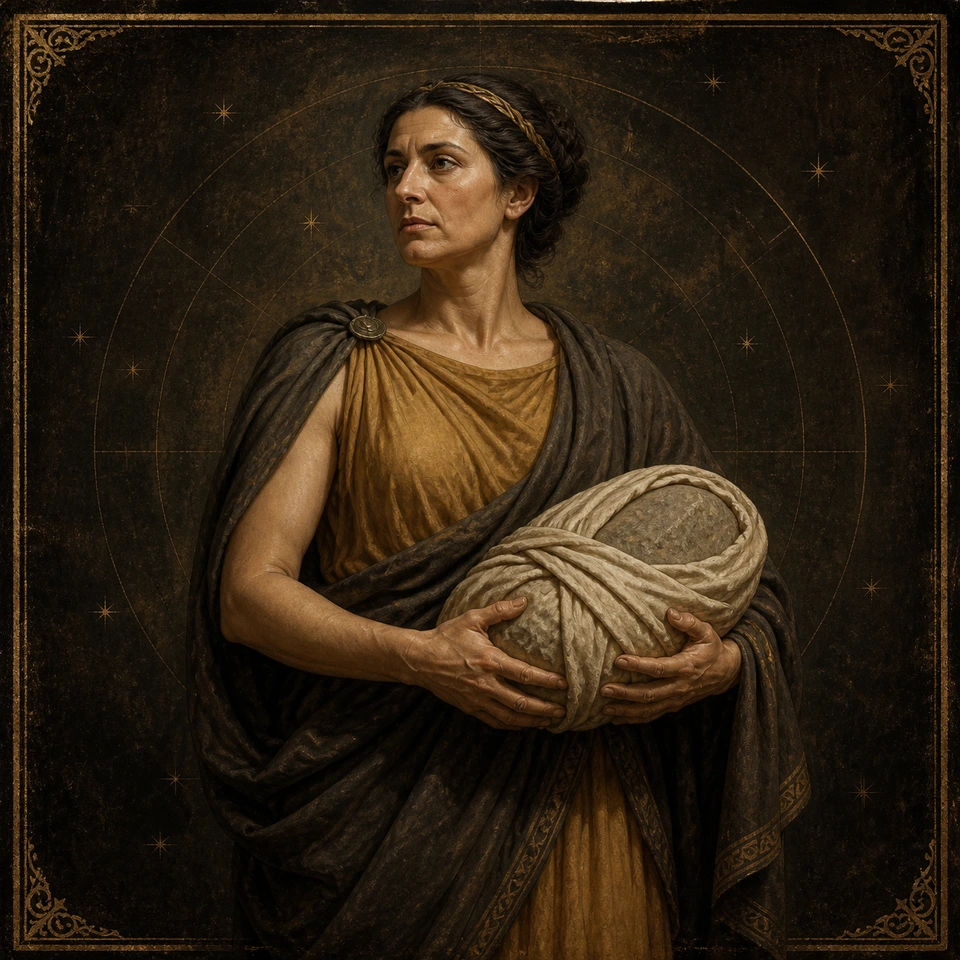
Engineering the famous stone deception to save her offspring, the Titaness Rhea mothered six central gods alongside her husband Cronus. The daughter of Gaia and Ouranos, she acts as a powerful mediator in early hymns and famously purifies Dionysus in later Phrygian mythological accounts.
Overview
On an Attic red-figure krater made in Athens about 460 BC, Rhea stands beside Cronus holding the stone. The Louvre catalogue names her bun, headband, chiton, and himation. It does not call the painted covering swaddling cloth. That detail comes from the succession story, where a hard substitute must pass for a newborn long enough to enter the hands of a father who has already swallowed five children.
Hesiod gives the act its family and danger. Rhea is a daughter of Gaia and Ouranos, sister and wife of Cronus, and mother of Hestia, Demeter, Hera, Hades, Poseidon, and Zeus. Cronus consumes the first five because he has heard that one of his own children will overthrow him. Rhea grieves, turns to her parents, travels to Crete, hides Zeus, and gives Cronus the swaddled stone. Fear swallows the wrong body.
The deception changes the divine order, but it does not make Rhea a passive bridge between male rulers. She listens, moves, conceals, binds cloth, and approaches the danger herself. Zeus survives because his mother refuses repetition and converts grief into a plan. When the swallowed siblings return, the household Cronus tried to seal inside himself becomes the generation that ends his reign.
Later witnesses alter the machinery. Pseudo-Apollodorus names Cretan guardians and makes Metis give Cronus the drug that brings up stone and children. Pausanias preserves an Elean tradition in which Rhea entrusts Zeus to the Idaean Dactyls, and an Arcadian one in which Hopladamus and a few giants stand ready to defend her on Mount Thaumasios. These versions belong beside Hesiod, not inside his mouth.
Arcadia also saves Poseidon separately. Rhea lays the newborn among lambs and gives Cronus a foal to swallow. That local story contradicts the swallowed-Poseidon sequence and roots the rescue at a spring near Mantineia. The animals carry one act of concealment. They are not universal sacred companions.
Rhea enters two other crises. In Homeric Hymn 2, she carries Zeus’s settlement after Demeter’s famine has forced negotiation over Persephone. In Pseudo-Apollodorus 3.5.1, she purifies Dionysus in Phrygia, teaches him rites, and gives him ritual dress. The first role is mediation after a mother’s refusal. The second is purification and instruction in a later mythographic setting. Neither should disappear behind the stone.
Cult remains survive in fragments. Pausanias saw a temple of Cronus and Rhea inside the Olympian precinct at Athens. On Mount Thaumasios, only women sacred to Rhea could enter her cave. At Plataea, a marble image by Praxiteles carried the swaddled stone. At Delphi, the stone itself received oil and raw wool, a practice attached to that object rather than a general offering list for the goddess.
Pausanias therefore binds the substitution to different kinds of place. Plataea held an image of Rhea carrying the bundle toward Cronus. Delphi tended the stone after the story had become local sacred matter. A temple image and an anointed object are not interchangeable, yet both show that the deception survived beyond the poem as more than a private family memory.
Modern reception often merges Rhea with Gaia, Phrygian Matar, Cybele, Roman Ops, or a universal mother archetype. The Greek record resists that flattening. Gaia is her mother, while Demeter and Hera are daughters. A Greek mythographer can place her in Phrygia without erasing distinct Anatolian and Roman histories. Hellenion’s Hymnodia shows living devotion in one contemporary Hellenic polytheist community. Rhea endures as the Titaness who makes violence misrecognize its own future.
Canonical identity
Canonical Identity
Rhea actively shapes ancient myth beyond a simple title of motherhood. As the sister and wife to Cronus, she becomes the mother of six central gods, executes the crucial stone deception, acts as an elder messenger to Demeter, and, in one specific later mythographic episode, serves as the instructor and purifier of Dionysus. Hesiod firmly groups her among the Titan daughters born to Ouranos and Gaia. She must not be treated as a generic mother goddess, and she strictly remains separate from Gaia, Roman Ops, Phrygian Matar, and Cybele.
Linguistic Identity
Rhea operates as the standard English form of the Greek Ῥέα, which transliterates interchangeably as Rhéa or Rhea. The pinned English dictionary verifies /ˈɹiə/ (REE-uh) for standard General American English usage, and no secure Ancient Greek reconstruction is asserted here.
Sources and evidence
TEXTUAL · Supported
The pinned CMUdict entry gives current General American English Rhea as /ˈɹiə/, REE-uh.
- Source
- Carnegie Mellon University Speech Group, CMU Pronouncing Dictionary
- Reviewed edition
- cmudict data file at commit 74790861f652b15e4ac49015a90074ad62a27690 · Carnegie Mellon University
- Exact locator
- Entry rhea · Section ARPABET R IY1 AH0, commit 74790861f652b15e4ac49015a90074ad62a27690 · RecordUrl https://raw.githubusercontent.com/cmusphinx/cmudict/74790861f652b15e4ac49015a90074ad62a27690/cmudict.dict
- Scope
- Contemporary living religion · International online religious community
- Authority
- Carnegie Mellon Pronouncing Dictionary
- Certainty
- High
The entry concerns current English only; the Ancient Greek vocalization remains unresolved.
Open exact reviewed sourceTEXTUAL · Supported
Hesiod names Rhea among the Titan daughters of Gaia and Ouranos.
- Source
- Hesiod; edited and translated by Hugh G. Evelyn-White, Theogony (1914)
- Reviewed edition
- Hugh G. Evelyn-White edition and English translation in Hesiod, the Homeric Hymns and Homerica, 1914 · translated by Hugh G. Evelyn-White · edited by Hugh G. Evelyn-White · Perseus Digital Library / Scaife ATLAS
- Exact locator
- Entry Theogony · Line 132-138
- Scope
- Archaic Greece · Ancient Greece
- Authority
- Hesiod, Theogony, Evelyn-White 1914 English translation
- Certainty
- High
Rhea is a distinct daughter in the Titan genealogy, not an alias of Gaia.
Open exact reviewed sourceTEXTUAL · Supported
Homeric Hymn 2 identifies Rhea as the elder messenger sent to Demeter after the Persephone settlement.
- Source
- Anonymous Homeric Hymns; edited and translated by Hugh G. Evelyn-White, Homeric Hymns (1914)
- Reviewed edition
- Hugh G. Evelyn-White English translation of Homeric Hymn 2, To Demeter, 1914 · translated by Hugh G. Evelyn-White · edited by Hugh G. Evelyn-White · Perseus Digital Library / Scaife ATLAS
- Exact locator
- Hymn Homeric Hymn 2 to Demeter · Line 441-470
- Scope
- Archaic Greece · Eleusis
- Authority
- Homeric Hymn 2 to Demeter, Evelyn-White 1914 English translation
- Certainty
- High
The hymn gives Rhea a distinct role rather than a general mother title.
Open exact reviewed sourceTEXTUAL · Supported
Pseudo-Apollodorus identifies Rhea as Dionysus’s purifier and instructor in a Phrygian episode.
- Source
- Pseudo-Apollodorus; edited and translated by James G. Frazer, Library (1921)
- Reviewed edition
- James G. Frazer edition and English translation, Harvard University Press and William Heinemann, 1921 · translated by James G. Frazer · edited by James G. Frazer · Perseus Digital Library / Scaife ATLAS
- Exact locator
- Entry Library · Book 3 · Chapter 5 · Section 1
- Scope
- Greek religion under Roman imperial rule · Phrygia
- Authority
- Pseudo-Apollodorus, Library, Frazer 1921 English translation
- Certainty
- High
The later action remains attached to Greek Rhea in the named witness.
Open exact reviewed source4 reviewed sources for this section
- Carnegie Mellon University Speech Group, CMU Pronouncing DictionaryPinned repository commit 74790861f652b15e4ac49015a90074ad62a27690 · Carnegie Mellon University
- Hesiod; edited and translated by Hugh G. Evelyn-White, Theogony (1914)Hesiod, the Homeric Hymns and Homerica, London and New York, 1914 · Perseus Digital Library / Scaife ATLAS
- Anonymous Homeric Hymns; edited and translated by Hugh G. Evelyn-White, Homeric Hymns (1914)Hesiod, the Homeric Hymns and Homerica, London and New York, 1914 · Perseus Digital Library / Scaife ATLAS
- Pseudo-Apollodorus; edited and translated by James G. Frazer, Library (1921)Harvard University Press and William Heinemann edition, 1921 · Perseus Digital Library / Scaife ATLAS
Culture, tradition, period, and place
Rhea belongs first to Greek poetic, cultic, and visual histories. Archaic hexameter names her Titan lineage and preserves the succession crisis. Homeric Hymn 2 places her at the close of Demeter’s struggle. An Attic vase made about 460 BC gives the stone episode a Classical image, while later Greek mythography and Pausanias preserve new actions and regional memories.
Her map is plural. Crete shelters Zeus in Hesiod and Pseudo-Apollodorus. Arcadia keeps the spring where Poseidon is hidden and Mount Thaumasios where local people placed the deception of Cronus. Athens holds a shared temple, Plataea a stone-bearing image, Olympia an Elean guardian tradition, and Phrygia the later story of Dionysus’s purification. None of these places cancels the others.
Sources and evidence
TEXTUAL · Supported
Archaic Greek poetry places Rhea in the Titan succession and in the settlement that ends Demeter’s famine.
- Source
- Hesiod; edited and translated by Hugh G. Evelyn-White, Theogony (1914)
- Reviewed edition
- Hugh G. Evelyn-White edition and English translation in Hesiod, the Homeric Hymns and Homerica, 1914 · translated by Hugh G. Evelyn-White · edited by Hugh G. Evelyn-White · Perseus Digital Library / Scaife ATLAS
- Exact locator
- Entry Theogony · Line 132-138; 453-506
- Scope
- Archaic Greece · Ancient Greece
- Authority
- Hesiod, Theogony, Evelyn-White 1914 English translation
- Certainty
- High
The genealogy and succession acts belong to archaic Greek hexameter.
Open exact reviewed sourceTEXTUAL · Supported
Homeric Hymn 2 places Rhea at the end of Demeter’s Eleusinian crisis.
- Source
- Anonymous Homeric Hymns; edited and translated by Hugh G. Evelyn-White, Homeric Hymns (1914)
- Reviewed edition
- Hugh G. Evelyn-White English translation of Homeric Hymn 2, To Demeter, 1914 · translated by Hugh G. Evelyn-White · edited by Hugh G. Evelyn-White · Perseus Digital Library / Scaife ATLAS
- Exact locator
- Hymn Homeric Hymn 2 to Demeter · Line 441-470
- Scope
- Archaic Greece · Eleusis
- Authority
- Homeric Hymn 2 to Demeter, Evelyn-White 1914 English translation
- Certainty
- High
The hymn’s setting and action remain distinct from the succession narrative.
Open exact reviewed sourceMATERIAL CULTURE · Supported
The Louvre object record places Rhea’s stone image on an Attic vessel made in Athens about 460 BC.
- Source
- Musée du Louvre, Department of Greek, Etruscan, and Roman Antiquities, cratère
- Reviewed edition
- Musée du Louvre French collections record cl010270223, inventory MNB 1289; G 366 · Musée du Louvre
- Exact locator
- MuseumObjectId MNB 1289; G 366 · Entry place and date; Face A
- Scope
- Classical Greece · Athens
- Authority
- Musée du Louvre official French catalogue
- Certainty
- High
The object anchors Rhea in Classical Athenian visual production.
Open exact reviewed sourceTEXTUAL · Supported
Pausanias preserves Rhea at Athens, Olympia, Plataea, and Arcadian Mount Thaumasios and Arne.
- Source
- Pausanias; Spiro Greek edition and Jones/Ormerod translation volumes, Description of Greece (1935)
- Reviewed edition
- W. H. S. Jones and H. A. Ormerod English translation volumes, 1918-1935 · translated by W. H. S. Jones and H. A. Ormerod, volume-dependent · Perseus Digital Library / Scaife ATLAS
- Exact locator
- Entry Description of Greece · Section 1.18.7; 5.7.6; 8.8.2; 8.36.2-3; 9.2.7
- Scope
- Greek religion under Roman imperial rule · Ancient Greece
- Authority
- Pausanias, Description of Greece, Jones and Ormerod translation
- Certainty
- High
The local notices preserve different kinds of place, including temple, travel tradition, spring, cave, and cult image.
Open exact reviewed sourceTEXTUAL · Supported
Pseudo-Apollodorus locates Rhea’s purification of Dionysus at Cybela in Phrygia.
- Source
- Pseudo-Apollodorus; edited and translated by James G. Frazer, Library (1921)
- Reviewed edition
- James G. Frazer edition and English translation, Harvard University Press and William Heinemann, 1921 · translated by James G. Frazer · edited by James G. Frazer · Perseus Digital Library / Scaife ATLAS
- Exact locator
- Entry Library · Book 3 · Chapter 5 · Section 1
- Scope
- Greek religion under Roman imperial rule · Phrygia
- Authority
- Pseudo-Apollodorus, Library, Frazer 1921 English translation
- Certainty
- High
This is a Greek mythographic location, not a merged cultural identity.
Open exact reviewed source5 reviewed sources for this section
- Hesiod; edited and translated by Hugh G. Evelyn-White, Theogony (1914)Hesiod, the Homeric Hymns and Homerica, London and New York, 1914 · Perseus Digital Library / Scaife ATLAS
- Anonymous Homeric Hymns; edited and translated by Hugh G. Evelyn-White, Homeric Hymns (1914)Hesiod, the Homeric Hymns and Homerica, London and New York, 1914 · Perseus Digital Library / Scaife ATLAS
- Musée du Louvre, Department of Greek, Etruscan, and Roman Antiquities, cratèreMusée du Louvre collections record cl010270223, inventory MNB 1289; G 366 · Musée du Louvre
- Pausanias; Spiro Greek edition and Jones/Ormerod translation volumes, Description of Greece (1935)Perseus CTS edition corpus, 1903-1935 · Perseus Digital Library / Scaife ATLAS
- Pseudo-Apollodorus; edited and translated by James G. Frazer, Library (1921)Harvard University Press and William Heinemann edition, 1921 · Perseus Digital Library / Scaife ATLAS
Historical development
Hesiod’s Rhea is already more than a genealogical name. Cronus swallows five children, and grief drives her to Gaia and Ouranos. She travels, conceals Zeus, wraps a stone, and delivers it to the ruler who fears his own offspring. The poem makes her bodily labor, sorrow, counsel, movement, and deception necessary to the change of divine generations.
Later witnesses do not merely repeat that sequence. Pseudo-Apollodorus names Cretan guardians and Metis’s drug, then gives Rhea a separate Phrygian encounter with Dionysus. Pausanias records an Elean Dactyl tradition, Arcadian allies led by Hopladamus, a foal substituted for Poseidon, sacred architecture, and sculpted memory. The Classical Louvre krater stands between poem and travel account as material proof that Greek viewers recognized Rhea beside the stone.
Sources and evidence
TEXTUAL · Supported
Hesiod gives Rhea grief, counsel, travel, concealment, and the stone substitution rather than passive maternity.
- Source
- Hesiod; edited and translated by Hugh G. Evelyn-White, Theogony (1914)
- Reviewed edition
- Hugh G. Evelyn-White edition and English translation in Hesiod, the Homeric Hymns and Homerica, 1914 · translated by Hugh G. Evelyn-White · edited by Hugh G. Evelyn-White · Perseus Digital Library / Scaife ATLAS
- Exact locator
- Entry Theogony · Line 453-500
- Scope
- Archaic Greece · Crete
- Authority
- Hesiod, Theogony, Evelyn-White 1914 English translation
- Certainty
- High
Her response to Cronus unfolds as deliberate action across the succession crisis.
Open exact reviewed sourceTEXTUAL · Supported
Later Greek witnesses add named Cretan guardians, Arcadian defensive giants, a separate rescue of Poseidon, and Rhea’s instruction of Dionysus in Phrygia.
- Source
- Pseudo-Apollodorus; edited and translated by James G. Frazer, Library (1921)
- Reviewed edition
- James G. Frazer edition and English translation, Harvard University Press and William Heinemann, 1921 · translated by James G. Frazer · edited by James G. Frazer · Perseus Digital Library / Scaife ATLAS
- Exact locator
- Entry Library · Section 1.1.5-1.2.1; 3.5.1
- Scope
- Greek religion under Roman imperial rule · Ancient Greece
- Authority
- Pseudo-Apollodorus, Library, Frazer 1921 English translation
- Certainty
- High
The later mythographer preserves both the expanded Zeus rescue and the Phrygian Dionysus episode.
Open exact reviewed sourceTEXTUAL · Supported
Pausanias adds Elean Dactyls, Arcadian giants, Poseidon’s foal substitution, temples, caves, and sculpture to Rhea’s surviving history.
- Source
- Pausanias; Spiro Greek edition and Jones/Ormerod translation volumes, Description of Greece (1935)
- Reviewed edition
- W. H. S. Jones and H. A. Ormerod English translation volumes, 1918-1935 · translated by W. H. S. Jones and H. A. Ormerod, volume-dependent · Perseus Digital Library / Scaife ATLAS
- Exact locator
- Entry Description of Greece · Section 1.18.7; 5.7.6; 8.8.2; 8.36.2-3; 9.2.7
- Scope
- Greek religion under Roman imperial rule · Ancient Greece
- Authority
- Pausanias, Description of Greece, Jones and Ormerod translation
- Certainty
- High
The local notices preserve regional changes without forming one continuous biography.
Open exact reviewed sourceMATERIAL CULTURE · Supported
Louvre G 366 shows that the Rhea-and-stone scene was legible in Classical Attic visual culture.
- Source
- Musée du Louvre, Department of Greek, Etruscan, and Roman Antiquities, cratère
- Reviewed edition
- Musée du Louvre French collections record cl010270223, inventory MNB 1289; G 366 · Musée du Louvre
- Exact locator
- MuseumObjectId MNB 1289; G 366 · Entry Face A; place and date
- Scope
- Classical Greece · Athens
- Authority
- Musée du Louvre official French catalogue
- Certainty
- High
The object stands as a material witness between archaic poetry and later travel writing.
Open exact reviewed source4 reviewed sources for this section
- Hesiod; edited and translated by Hugh G. Evelyn-White, Theogony (1914)Hesiod, the Homeric Hymns and Homerica, London and New York, 1914 · Perseus Digital Library / Scaife ATLAS
- Pseudo-Apollodorus; edited and translated by James G. Frazer, Library (1921)Harvard University Press and William Heinemann edition, 1921 · Perseus Digital Library / Scaife ATLAS
- Pausanias; Spiro Greek edition and Jones/Ormerod translation volumes, Description of Greece (1935)Perseus CTS edition corpus, 1903-1935 · Perseus Digital Library / Scaife ATLAS
- Musée du Louvre, Department of Greek, Etruscan, and Roman Antiquities, cratèreMusée du Louvre collections record cl010270223, inventory MNB 1289; G 366 · Musée du Louvre
Attested roles and historical themes
Roles, powers, and limits
Rhea’s strongest power appears in a household under terror. She cannot stop Cronus from swallowing five children, yet she refuses to let repetition decide the sixth birth. Counsel becomes a plan, and the stone makes deception material. Her protection is neither soft nor abstract. It asks her to carry weight toward the husband who has already consumed their family and to keep her purpose hidden at close range.
Other stories give her bounded authority. She carries Zeus’s settlement to Demeter only after famine has forced negotiation. In Phrygia, Pseudo-Apollodorus makes her purify Dionysus and teach him rites before his campaign. These are particular acts of mediation, purification, and instruction. They do not grant Rhea universal command over every birth, harvest, earth power, mystery, or maternal life.
Sources and evidence
TEXTUAL · Supported
Rhea preserves Zeus by seeking counsel, removing him from Cronus, and presenting the wrapped stone.
- Source
- Hesiod; edited and translated by Hugh G. Evelyn-White, Theogony (1914)
- Reviewed edition
- Hugh G. Evelyn-White edition and English translation in Hesiod, the Homeric Hymns and Homerica, 1914 · translated by Hugh G. Evelyn-White · edited by Hugh G. Evelyn-White · Perseus Digital Library / Scaife ATLAS
- Exact locator
- Entry Theogony · Line 459-500
- Scope
- Archaic Greece · Crete
- Authority
- Hesiod, Theogony, Evelyn-White 1914 English translation
- Certainty
- High
The act joins maternal protection to political resistance inside the divine household.
Open exact reviewed sourceTEXTUAL · Supported
In Homeric Hymn 2, Rhea carries Zeus’s terms to Demeter after famine forces a settlement.
- Source
- Anonymous Homeric Hymns; edited and translated by Hugh G. Evelyn-White, Homeric Hymns (1914)
- Reviewed edition
- Hugh G. Evelyn-White English translation of Homeric Hymn 2, To Demeter, 1914 · translated by Hugh G. Evelyn-White · edited by Hugh G. Evelyn-White · Perseus Digital Library / Scaife ATLAS
- Exact locator
- Hymn Homeric Hymn 2 to Demeter · Line 441-470
- Scope
- Archaic Greece · Eleusis
- Authority
- Homeric Hymn 2 to Demeter, Evelyn-White 1914 English translation
- Certainty
- High
Rhea enters after Demeter’s resistance has compelled negotiation and does not erase the coercion that began the crisis.
Open exact reviewed sourceTEXTUAL · Supported
Pseudo-Apollodorus gives Rhea a bounded role as purifier and ritual instructor of Dionysus in Phrygia.
- Source
- Pseudo-Apollodorus; edited and translated by James G. Frazer, Library (1921)
- Reviewed edition
- James G. Frazer edition and English translation, Harvard University Press and William Heinemann, 1921 · translated by James G. Frazer · edited by James G. Frazer · Perseus Digital Library / Scaife ATLAS
- Exact locator
- Entry Library · Book 3 · Chapter 5 · Section 1
- Scope
- Greek religion under Roman imperial rule · Phrygia
- Authority
- Pseudo-Apollodorus, Library, Frazer 1921 English translation
- Certainty
- High
The episode does not grant authority over every mystery or rite.
Open exact reviewed source3 reviewed sources for this section
- Hesiod; edited and translated by Hugh G. Evelyn-White, Theogony (1914)Hesiod, the Homeric Hymns and Homerica, London and New York, 1914 · Perseus Digital Library / Scaife ATLAS
- Anonymous Homeric Hymns; edited and translated by Hugh G. Evelyn-White, Homeric Hymns (1914)Hesiod, the Homeric Hymns and Homerica, London and New York, 1914 · Perseus Digital Library / Scaife ATLAS
- Pseudo-Apollodorus; edited and translated by James G. Frazer, Library (1921)Harvard University Press and William Heinemann edition, 1921 · Perseus Digital Library / Scaife ATLAS
Epithets and titles
Poetic Epithet
Rich-haired Rhea
Rich-haired
Greek hymn tradition · Archaic Greek hymn witnessHomeric Hymn 2 uses the epithet when Zeus sends Rhea to Demeter.
1 reviewed source for this section
- Anonymous Homeric Hymns; edited and translated by Hugh G. Evelyn-White, Homeric Hymns (1914)Hesiod, the Homeric Hymns and Homerica, London and New York, 1914 · Perseus Digital Library / Scaife ATLAS
Worship and cult
At Athens, Pausanias entered the Olympian precinct and noted a temple shared by Cronus and Rhea. The shared dedication matters because it places the Titaness within named civic sacred space, yet it also limits what can be said. A temple proves neither that every rite of Cronus belonged to Rhea nor that her worship followed one pattern across the Greek world.
Mount Thaumasios preserves a different sacred boundary. Pausanias says no one could enter Rhea’s cave except women sacred to the goddess. Their status shows local service, and the restriction deserves to remain intact. The account gives no initiation, priestly office list, sacrifice, or domestic rite. Silence around those acts is part of the historical shape of the cult, not an invitation to supply them from another goddess.
Sources and evidence
TEXTUAL · Supported
Pausanias reports a temple of Cronus and Rhea inside the precinct of Olympian Zeus at Athens.
- Source
- Pausanias; Spiro Greek edition and Jones/Ormerod translation volumes, Description of Greece (1935)
- Reviewed edition
- W. H. S. Jones and H. A. Ormerod English translation volumes, 1918-1935 · translated by W. H. S. Jones and H. A. Ormerod, volume-dependent · Perseus Digital Library / Scaife ATLAS
- Exact locator
- Entry Description of Greece · Book 1 · Chapter 18 · Section 7
- Scope
- Greek religion under Roman imperial rule · Athens
- Authority
- Pausanias, Description of Greece, Jones and Ormerod translation
- Certainty
- High
The shared temple gives Rhea a named Athenian cult place without defining a pan-Greek ritual system.
Open exact reviewed sourceTEXTUAL · Supported
On Mount Thaumasios, Pausanias says only women sacred to Rhea could enter her cave.
- Source
- Pausanias; Spiro Greek edition and Jones/Ormerod translation volumes, Description of Greece (1935)
- Reviewed edition
- W. H. S. Jones and H. A. Ormerod English translation volumes, 1918-1935 · translated by W. H. S. Jones and H. A. Ormerod, volume-dependent · Perseus Digital Library / Scaife ATLAS
- Exact locator
- Entry Description of Greece · Book 8 · Chapter 36 · Section 2-3
- Scope
- Greek religion under Roman imperial rule · Arcadia
- Authority
- Pausanias, Description of Greece, Jones and Ormerod translation
- Certainty
- High
The restriction marks a local sacred boundary and reveals no initiatory procedure.
Open exact reviewed source1 reviewed source for this section
- Pausanias; Spiro Greek edition and Jones/Ormerod translation volumes, Description of Greece (1935)Perseus CTS edition corpus, 1903-1935 · Perseus Digital Library / Scaife ATLAS
Temples, sanctuaries, and sacred places
Crete enters Rhea’s story as refuge. Hesiod sends her there before Zeus’s birth, away from Cronus’s grasp, and Pseudo-Apollodorus later fills the Cretan protection with Curetes and named nymphs. The place carries concealment and survival in those literary witnesses. It does not automatically identify a particular excavated cave or transfer every Cretan Zeus rite to Rhea.
Arcadia answers with its own ground. At Arne, the newborn Poseidon lies among lambs while a foal takes his place. On Mount Thaumasios, Hopladamus and a few giants stand ready against Cronus, and Rhea’s cave remains closed to all but sacred women. Athens, Olympia, and Plataea preserve other local forms. These landscapes hold different memories rather than stations in one uniform pilgrimage sequence.
Sources and evidence
TEXTUAL · Supported
Hesiod sends the pregnant Rhea to Crete, where Zeus is hidden before she gives Cronus the stone.
- Source
- Hesiod; edited and translated by Hugh G. Evelyn-White, Theogony (1914)
- Reviewed edition
- Hugh G. Evelyn-White edition and English translation in Hesiod, the Homeric Hymns and Homerica, 1914 · translated by Hugh G. Evelyn-White · edited by Hugh G. Evelyn-White · Perseus Digital Library / Scaife ATLAS
- Exact locator
- Entry Theogony · Line 468-500
- Scope
- Archaic Greece · Crete
- Authority
- Hesiod, Theogony, Evelyn-White 1914 English translation
- Certainty
- High
Crete is a narrative refuge in the poem, not interchangeable with Arcadian local claims.
Open exact reviewed sourceTEXTUAL · Supported
Arcadian traditions place Rhea at Arne’s flock and on Mount Thaumasios with Hopladamus and his giants.
- Source
- Pausanias; Spiro Greek edition and Jones/Ormerod translation volumes, Description of Greece (1935)
- Reviewed edition
- W. H. S. Jones and H. A. Ormerod English translation volumes, 1918-1935 · translated by W. H. S. Jones and H. A. Ormerod, volume-dependent · Perseus Digital Library / Scaife ATLAS
- Exact locator
- Entry Description of Greece · Section 8.8.2; 8.36.2-3
- Scope
- Greek religion under Roman imperial rule · Arcadia
- Authority
- Pausanias, Description of Greece, Jones and Ormerod translation
- Certainty
- High
The spring and mountain preserve separate Arcadian claims about Poseidon and Zeus.
Open exact reviewed sourceTEXTUAL · Supported
Pausanias also places Rhea in an Athenian temple, an Elean guardian tradition at Olympia, and a stone-bearing image at Plataea.
- Source
- Pausanias; Spiro Greek edition and Jones/Ormerod translation volumes, Description of Greece (1935)
- Reviewed edition
- W. H. S. Jones and H. A. Ormerod English translation volumes, 1918-1935 · translated by W. H. S. Jones and H. A. Ormerod, volume-dependent · Perseus Digital Library / Scaife ATLAS
- Exact locator
- Entry Description of Greece · Section 1.18.7; 5.7.6; 9.2.7
- Scope
- Greek religion under Roman imperial rule · Ancient Greece
- Authority
- Pausanias, Description of Greece, Jones and Ormerod translation
- Certainty
- High
Built cult place, regional story, and temple image remain different forms of locality.
Open exact reviewed source2 reviewed sources for this section
- Hesiod; edited and translated by Hugh G. Evelyn-White, Theogony (1914)Hesiod, the Homeric Hymns and Homerica, London and New York, 1914 · Perseus Digital Library / Scaife ATLAS
- Pausanias; Spiro Greek edition and Jones/Ormerod translation volumes, Description of Greece (1935)Perseus CTS edition corpus, 1903-1935 · Perseus Digital Library / Scaife ATLAS
Festivals and processions
No ancient festival dedicated to Rhea alone is named in the Athenian temple or Mount Thaumasios passages. The building at Athens is shared with Cronus, but that fact does not place the whole Kronia under Rhea’s name. The Arcadian cave has a guarded threshold, not a calendar. Its sacred women cannot be turned into a procession, feast, or annual ceremony absent from the account.
Hellenion includes Rhea among the Titans in its contemporary Hymnodia program. That is a real modern devotional setting, but it is not an ancient festival recovered intact and does not establish a date for every present-day Hellenic polytheist. The distinction leaves room for living devotion without rewriting a fragmentary ancient calendar.
Sources and evidence
TEXTUAL · Supported
Pausanias names Rhea’s Athenian temple and Arcadian cave without naming a festival dedicated to her at either place.
- Source
- Pausanias; Spiro Greek edition and Jones/Ormerod translation volumes, Description of Greece (1935)
- Reviewed edition
- W. H. S. Jones and H. A. Ormerod English translation volumes, 1918-1935 · translated by W. H. S. Jones and H. A. Ormerod, volume-dependent · Perseus Digital Library / Scaife ATLAS
- Exact locator
- Entry Description of Greece · Section 1.18.7; 8.36.2-3
- Scope
- Greek religion under Roman imperial rule · Ancient Greece
- Authority
- Pausanias, Description of Greece, Jones and Ormerod translation
- Certainty
- High
A building and a restricted cave do not by themselves assign the Kronia or another calendar feast to Rhea.
Open exact reviewed sourceTEXTUAL · Supported
Hellenion lists Rhea under the Titans in its contemporary Hymnodia program.
- Source
- Hellenion, Hymnodia
- Reviewed edition
- Live first-party community program page reviewed 2026-08-30 · Hellenion
- Exact locator
- Entry Hymnodia · Section The Titans, Rhea
- Scope
- Contemporary living religion · International online religious community
- Authority
- Hellenion first-party community page
- Certainty
- High
The listing is a modern devotional example and establishes no ancient festival date.
Open exact reviewed source2 reviewed sources for this section
- Pausanias; Spiro Greek edition and Jones/Ormerod translation volumes, Description of Greece (1935)Perseus CTS edition corpus, 1903-1935 · Perseus Digital Library / Scaife ATLAS
- Hellenion, HymnodiaLive official community program page · Hellenion
Offerings, votives, and ritual evidence
The stone’s later life at Delphi gives one precise ritual scene. Pausanias says it received oil each day and raw wool on festival days. Those acts concern the Delphic stone associated with Cronus’s swallowing. They do not prove that Greek worshippers everywhere offered stones, oil, or wool to Rhea, and they do not make wool a personal substance of the goddess.
At Mount Thaumasios, the sacred women and closed cave show ritual protection without revealing its performance. Pausanias names no incense, sacrificial animal, votive form, libation, or priestly speech there. The lambs, foal, clay vessel, and swaddling cloth belong to stories and images. Keeping each in its place prevents a modern offering list from being assembled out of narrative props.
Sources and evidence
TEXTUAL · Supported
At Delphi, Pausanias says the stone associated with Cronus received daily oil and raw wool on festival days.
- Source
- Pausanias; Spiro Greek edition and Jones/Ormerod translation volumes, Description of Greece (1935)
- Reviewed edition
- W. H. S. Jones and H. A. Ormerod English translation volumes, 1918-1935 · translated by W. H. S. Jones and H. A. Ormerod, volume-dependent · Perseus Digital Library / Scaife ATLAS
- Exact locator
- Entry Description of Greece · Book 10 · Chapter 24 · Section 6
- Scope
- Greek religion under Roman imperial rule · Delphi
- Authority
- Pausanias, Description of Greece, Jones and Ormerod translation
- Certainty
- High
The treatment belongs to the Delphic stone and cannot become a universal offering list for Rhea.
Open exact reviewed sourceTEXTUAL · Supported
The Mount Thaumasios notice records sacred women and restricted entry but names no gift, sacrifice, incense, or votive material.
- Source
- Pausanias; Spiro Greek edition and Jones/Ormerod translation volumes, Description of Greece (1935)
- Reviewed edition
- W. H. S. Jones and H. A. Ormerod English translation volumes, 1918-1935 · translated by W. H. S. Jones and H. A. Ormerod, volume-dependent · Perseus Digital Library / Scaife ATLAS
- Exact locator
- Entry Description of Greece · Book 8 · Chapter 36 · Section 2-3
- Scope
- Greek religion under Roman imperial rule · Arcadia
- Authority
- Pausanias, Description of Greece, Jones and Ormerod translation
- Certainty
- High
The protected cave remains a local cult fact rather than a ritual recipe.
Open exact reviewed sourceTEXTUAL · Supported
Pausanias’s lambs and foal belong to Poseidon’s concealment and substitution, not to a sacrificial list for Rhea.
- Source
- Pausanias; Spiro Greek edition and Jones/Ormerod translation volumes, Description of Greece (1935)
- Reviewed edition
- W. H. S. Jones and H. A. Ormerod English translation volumes, 1918-1935 · translated by W. H. S. Jones and H. A. Ormerod, volume-dependent · Perseus Digital Library / Scaife ATLAS
- Exact locator
- Entry Description of Greece · Book 8 · Chapter 8 · Section 2
- Scope
- Greek religion under Roman imperial rule · Arcadia
- Authority
- Pausanias, Description of Greece, Jones and Ormerod translation
- Certainty
- High
Narrative function does not become ritual prescription.
Open exact reviewed sourceMATERIAL CULTURE · Supported
The Louvre catalogue’s clay and red-figure materials describe the krater rather than gifts or sacred substances for Rhea.
- Source
- Musée du Louvre, Department of Greek, Etruscan, and Roman Antiquities, cratère
- Reviewed edition
- Musée du Louvre French collections record cl010270223, inventory MNB 1289; G 366 · Musée du Louvre
- Exact locator
- MuseumObjectId MNB 1289; G 366 · Entry materials and techniques
- Scope
- Classical Greece · Athens
- Authority
- Musée du Louvre official French catalogue
- Certainty
- High
Object manufacture stays distinct from cult offering.
Open exact reviewed source2 reviewed sources for this section
- Pausanias; Spiro Greek edition and Jones/Ormerod translation volumes, Description of Greece (1935)Perseus CTS edition corpus, 1903-1935 · Perseus Digital Library / Scaife ATLAS
- Musée du Louvre, Department of Greek, Etruscan, and Roman Antiquities, cratèreMusée du Louvre collections record cl010270223, inventory MNB 1289; G 366 · Musée du Louvre
Iconography and material culture
The Louvre’s French catalogue for krater MNB 1289, G 366, identifies Rhea holding the stone. Her hair is gathered in a bun beneath a headband, and she wears chiton and himation beside Cronus. The Attic red-figure vessel was made in Athens about 460 BC. The catalogue does not call the painted covering swaddling; that detail belongs to the literary form of the deception.
Pausanias saw another rendering in Hera’s temple at Plataea: a Pentelic-marble Rhea by Praxiteles carrying a swaddled stone to Cronus. Together, object catalogue and travel account show a durable visual scene rather than a universal portrait type. Lions, tympana, mural crowns, infant Zeus in her arms, and Roman abundance symbols cannot be imported from Cybele, Matar, or Ops without their own dated history.
Sources and evidence
MATERIAL CULTURE · Supported
The Louvre catalogue identifies Rhea holding the stone, with a bun, headband, chiton, and himation on Attic krater G 366.
- Source
- Musée du Louvre, Department of Greek, Etruscan, and Roman Antiquities, cratère
- Reviewed edition
- Musée du Louvre French collections record cl010270223, inventory MNB 1289; G 366 · Musée du Louvre
- Exact locator
- MuseumObjectId MNB 1289; G 366 · Entry Face A; personnages représentés
- Scope
- Classical Greece · Athens
- Authority
- Musée du Louvre official French catalogue
- Certainty
- High
The catalogue identifies the stone but does not call its painted covering swaddling cloth.
Open exact reviewed sourceTEXTUAL · Supported
At Plataea, Pausanias saw a marble Rhea carrying a swaddled stone to Cronus, made by Praxiteles.
- Source
- Pausanias; Spiro Greek edition and Jones/Ormerod translation volumes, Description of Greece (1935)
- Reviewed edition
- W. H. S. Jones and H. A. Ormerod English translation volumes, 1918-1935 · translated by W. H. S. Jones and H. A. Ormerod, volume-dependent · Perseus Digital Library / Scaife ATLAS
- Exact locator
- Entry Description of Greece · Book 9 · Chapter 2 · Section 7
- Scope
- Greek religion under Roman imperial rule · Plataea
- Authority
- Pausanias, Description of Greece, Jones and Ormerod translation
- Certainty
- High
The sculpture fixes the substitution scene in a Boeotian temple without turning the stone into a general mineral power.
Open exact reviewed source2 reviewed sources for this section
- Musée du Louvre, Department of Greek, Etruscan, and Roman Antiquities, cratèreMusée du Louvre collections record cl010270223, inventory MNB 1289; G 366 · Musée du Louvre
- Pausanias; Spiro Greek edition and Jones/Ormerod translation volumes, Description of Greece (1935)Perseus CTS edition corpus, 1903-1935 · Perseus Digital Library / Scaife ATLAS
Animals, plants, and embodied forms
Lambs and a foal belong to the Arcadian rescue of Poseidon. Rhea places the newborn within a flock and gives Cronus the foal to swallow. The animals make concealment and substitution possible in that one regional story. Pausanias does not call them Rhea’s companions, sacred species, sacrificial animals, or permanent attributes.
The Elean story of the Idaean Dactyls moves from Rhea’s guardianship of Zeus to a running race crowned with wild olive. The branch belongs to the Dactyl contest and the local ancestry of the Olympic games, not to a plant correspondence for Rhea. No ancient passage here names a sacred tree or botanical offering for her, and the wool around the stone does not make sheep a cult-wide emblem.
Sources and evidence
TEXTUAL · Supported
The Arcadian Poseidon story uses lambs as concealment and a foal as the substitute swallowed by Cronus.
- Source
- Pausanias; Spiro Greek edition and Jones/Ormerod translation volumes, Description of Greece (1935)
- Reviewed edition
- W. H. S. Jones and H. A. Ormerod English translation volumes, 1918-1935 · translated by W. H. S. Jones and H. A. Ormerod, volume-dependent · Perseus Digital Library / Scaife ATLAS
- Exact locator
- Entry Description of Greece · Book 8 · Chapter 8 · Section 2
- Scope
- Greek religion under Roman imperial rule · Arcadia
- Authority
- Pausanias, Description of Greece, Jones and Ormerod translation
- Certainty
- High
The animals perform one local narrative action; the passage names no sacred species or plant for Rhea.
Open exact reviewed sourceTEXTUAL · Supported
The Elean account joins the Idaean Dactyls to Zeus’s guardianship and later wild-olive games, not to a sacred plant of Rhea.
- Source
- Pausanias; Spiro Greek edition and Jones/Ormerod translation volumes, Description of Greece (1935)
- Reviewed edition
- W. H. S. Jones and H. A. Ormerod English translation volumes, 1918-1935 · translated by W. H. S. Jones and H. A. Ormerod, volume-dependent · Perseus Digital Library / Scaife ATLAS
- Exact locator
- Entry Description of Greece · Book 5 · Chapter 7 · Section 6-7
- Scope
- Greek religion under Roman imperial rule · Olympia
- Authority
- Pausanias, Description of Greece, Jones and Ormerod translation
- Certainty
- High
The wild olive belongs to the Dactyls’ running contest in the Elean genealogy of the games.
Open exact reviewed source1 reviewed source for this section
- Pausanias; Spiro Greek edition and Jones/Ormerod translation volumes, Description of Greece (1935)Perseus CTS edition corpus, 1903-1935 · Perseus Digital Library / Scaife ATLAS
Relationships and genealogy
Rhea is a daughter of Gaia and Ouranos and one of twelve Titans in Hesiod. Her siblings are Oceanus, Coeus, Crius, Hyperion, Iapetus, Theia, Themis, Mnemosyne, Phoebe, Tethys, and Cronus. The sibling marriage to Cronus places violence within the same divine generation. It does not merge their identities or make Rhea responsible for her husband’s kingship and sickle.
Their children are Hestia, Demeter, Hera, Hades, Poseidon, and Zeus. Each child later carries offices and stories that remain their own. Rhea’s relationships matter where they become acts: she resists Cronus, preserves Zeus, separately protects Poseidon in Arcadia, and mediates between Zeus and Demeter. Genealogy explains proximity and stakes, not an automatic transfer of hearth, grain, marriage, underworld, sea, or sky.
Sources and evidence
TEXTUAL · Supported
Hesiod makes Rhea one of twelve Titan children born from Gaia and Ouranos.
- Source
- Hesiod; edited and translated by Hugh G. Evelyn-White, Theogony (1914)
- Reviewed edition
- Hugh G. Evelyn-White edition and English translation in Hesiod, the Homeric Hymns and Homerica, 1914 · translated by Hugh G. Evelyn-White · edited by Hugh G. Evelyn-White · Perseus Digital Library / Scaife ATLAS
- Exact locator
- Entry Theogony · Line 132-138
- Scope
- Archaic Greece · Ancient Greece
- Authority
- Hesiod, Theogony, Evelyn-White 1914 English translation
- Certainty
- High
The same list gives her eleven siblings, including Cronus, whom she later marries.
Open exact reviewed sourceTEXTUAL · Supported
Hesiod names Hestia, Demeter, Hera, Hades, Poseidon, and Zeus as the children of Rhea and Cronus.
- Source
- Hesiod; edited and translated by Hugh G. Evelyn-White, Theogony (1914)
- Reviewed edition
- Hugh G. Evelyn-White edition and English translation in Hesiod, the Homeric Hymns and Homerica, 1914 · translated by Hugh G. Evelyn-White · edited by Hugh G. Evelyn-White · Perseus Digital Library / Scaife ATLAS
- Exact locator
- Entry Theogony · Line 453-458
- Scope
- Archaic Greece · Ancient Greece
- Authority
- Hesiod, Theogony, Evelyn-White 1914 English translation
- Certainty
- High
Their later domains do not transfer to their mother through genealogy.
Open exact reviewed sourceTEXTUAL · Supported
The Arcadian account turns Rhea’s motherhood of Poseidon into active concealment and substitution.
- Source
- Pausanias; Spiro Greek edition and Jones/Ormerod translation volumes, Description of Greece (1935)
- Reviewed edition
- W. H. S. Jones and H. A. Ormerod English translation volumes, 1918-1935 · translated by W. H. S. Jones and H. A. Ormerod, volume-dependent · Perseus Digital Library / Scaife ATLAS
- Exact locator
- Entry Description of Greece · Book 8 · Chapter 8 · Section 2
- Scope
- Greek religion under Roman imperial rule · Arcadia
- Authority
- Pausanias, Description of Greece, Jones and Ormerod translation
- Certainty
- High
The local act differs from the swallowed-son genealogy in Hesiod.
Open exact reviewed sourceTEXTUAL · Supported
Homeric Hymn 2 makes Rhea an elder mediator between her children Zeus and Demeter.
- Source
- Anonymous Homeric Hymns; edited and translated by Hugh G. Evelyn-White, Homeric Hymns (1914)
- Reviewed edition
- Hugh G. Evelyn-White English translation of Homeric Hymn 2, To Demeter, 1914 · translated by Hugh G. Evelyn-White · edited by Hugh G. Evelyn-White · Perseus Digital Library / Scaife ATLAS
- Exact locator
- Hymn Homeric Hymn 2 to Demeter · Line 441-470
- Scope
- Archaic Greece · Eleusis
- Authority
- Homeric Hymn 2 to Demeter, Evelyn-White 1914 English translation
- Certainty
- High
Family position becomes a bounded narrative action after famine.
Open exact reviewed source3 reviewed sources for this section
- Hesiod; edited and translated by Hugh G. Evelyn-White, Theogony (1914)Hesiod, the Homeric Hymns and Homerica, London and New York, 1914 · Perseus Digital Library / Scaife ATLAS
- Pausanias; Spiro Greek edition and Jones/Ormerod translation volumes, Description of Greece (1935)Perseus CTS edition corpus, 1903-1935 · Perseus Digital Library / Scaife ATLAS
- Anonymous Homeric Hymns; edited and translated by Hugh G. Evelyn-White, Homeric Hymns (1914)Hesiod, the Homeric Hymns and Homerica, London and New York, 1914 · Perseus Digital Library / Scaife ATLAS
Actual myths and source variants
The succession myth belongs to Rhea as decisively as to Cronus or Zeus. Hesiod makes five births end in swallowing. Rhea seeks counsel, reaches Crete, hides the sixth child, and gives Cronus a swaddled stone. Pseudo-Apollodorus later names guardians and a drug, while Pausanias preserves Elean and Arcadian local forms. Each witness changes the machinery without removing Rhea’s deliberate resistance.
Three further narratives prevent the stone from swallowing her whole identity. In Arcadia she saves Poseidon with lambs and a foal, contradicting Hesiod’s swallowed sibling sequence. In Homeric Hymn 2 she carries the settlement that brings Demeter back after famine and Persephone’s partial return. In Pseudo-Apollodorus 3.5.1 she purifies Dionysus in Phrygia, teaches him rites, and gives him ritual dress. Protection, mediation, and instruction recur, but never as one seamless universal myth.
Sources and evidence
TEXTUAL · Supported
Hesiod’s succession story makes Rhea save Zeus with a swaddled stone after Cronus swallows five children.
- Source
- Hesiod; edited and translated by Hugh G. Evelyn-White, Theogony (1914)
- Reviewed edition
- Hugh G. Evelyn-White edition and English translation in Hesiod, the Homeric Hymns and Homerica, 1914 · translated by Hugh G. Evelyn-White · edited by Hugh G. Evelyn-White · Perseus Digital Library / Scaife ATLAS
- Exact locator
- Entry Theogony · Line 453-506
- Scope
- Archaic Greece · Crete
- Authority
- Hesiod, Theogony, Evelyn-White 1914 English translation
- Certainty
- High
Rhea’s deception breaks the repeated violence inside Cronus’s household.
Open exact reviewed sourceTEXTUAL · Supported
Pausanias preserves an Arcadian story in which Rhea hides Poseidon among lambs and gives Cronus a foal.
- Source
- Pausanias; Spiro Greek edition and Jones/Ormerod translation volumes, Description of Greece (1935)
- Reviewed edition
- W. H. S. Jones and H. A. Ormerod English translation volumes, 1918-1935 · translated by W. H. S. Jones and H. A. Ormerod, volume-dependent · Perseus Digital Library / Scaife ATLAS
- Exact locator
- Entry Description of Greece · Book 8 · Chapter 8 · Section 2
- Scope
- Greek religion under Roman imperial rule · Arcadia
- Authority
- Pausanias, Description of Greece, Jones and Ormerod translation
- Certainty
- High
This local rescue contradicts the swallowed-Poseidon sequence in Hesiod.
Open exact reviewed sourceTEXTUAL · Supported
Homeric Hymn 2 brings Rhea into the Eleusinian crisis as the messenger who summons Demeter back after the settlement.
- Source
- Anonymous Homeric Hymns; edited and translated by Hugh G. Evelyn-White, Homeric Hymns (1914)
- Reviewed edition
- Hugh G. Evelyn-White English translation of Homeric Hymn 2, To Demeter, 1914 · translated by Hugh G. Evelyn-White · edited by Hugh G. Evelyn-White · Perseus Digital Library / Scaife ATLAS
- Exact locator
- Hymn Homeric Hymn 2 to Demeter · Line 441-470
- Scope
- Archaic Greece · Eleusis
- Authority
- Homeric Hymn 2 to Demeter, Evelyn-White 1914 English translation
- Certainty
- High
Her bounded mediation follows the famine and negotiated partial return of Persephone.
Open exact reviewed sourceTEXTUAL · Supported
Pseudo-Apollodorus says Rhea purified Dionysus in Phrygia, taught him initiation rites, and gave him ritual dress.
- Source
- Pseudo-Apollodorus; edited and translated by James G. Frazer, Library (1921)
- Reviewed edition
- James G. Frazer edition and English translation, Harvard University Press and William Heinemann, 1921 · translated by James G. Frazer · edited by James G. Frazer · Perseus Digital Library / Scaife ATLAS
- Exact locator
- Entry Library · Book 3 · Chapter 5 · Section 1
- Scope
- Greek religion under Roman imperial rule · Phrygia
- Authority
- Pseudo-Apollodorus, Library, Frazer 1921 English translation
- Certainty
- High
The Greek mythographic episode places Rhea in Phrygia without proving identity with Matar or Cybele.
Open exact reviewed source4 reviewed sources for this section
- Hesiod; edited and translated by Hugh G. Evelyn-White, Theogony (1914)Hesiod, the Homeric Hymns and Homerica, London and New York, 1914 · Perseus Digital Library / Scaife ATLAS
- Pausanias; Spiro Greek edition and Jones/Ormerod translation volumes, Description of Greece (1935)Perseus CTS edition corpus, 1903-1935 · Perseus Digital Library / Scaife ATLAS
- Anonymous Homeric Hymns; edited and translated by Hugh G. Evelyn-White, Homeric Hymns (1914)Hesiod, the Homeric Hymns and Homerica, London and New York, 1914 · Perseus Digital Library / Scaife ATLAS
- Pseudo-Apollodorus; edited and translated by James G. Frazer, Library (1921)Harvard University Press and William Heinemann edition, 1921 · Perseus Digital Library / Scaife ATLAS
Myth Library
Each myth gathers its attested participants into one source-grounded account, while distinct source traditions remain readable in their own variants.
Theogony
Cronus and the Swallowed Children
Cronus swallows five children born by Rhea, but she hides Zeus and gives Cronus a wrapped stone; Zeus survives, the children return, and the feared succession begins.
- Role in this profile
- mother who seeks counsel, hides Zeus, and gives Cronus the wrapped stone
- Place scope
- Ancient Greece · Crete · Olympia · Arcadia
- Witnesses
- 4
- Variants
- 4
Hymnic Cycle
Demeter, Persephone, and the Eleusinian Settlement
Persephone gathers flowers with Tyche and other divine companions before she is seized by Hades with Zeus's consent, and Demeter's search brings her to Eleusis. After an interrupted attempt to make Demophon deathless, Demeter reveals herself, demands a temple, and withholds the seed until famine forces divine negotiation. Hades obeys the release order but secretly puts pomegranate seed in Persephone’s mouth; Zeus then assigns her a divided residence, and Hecate becomes her companion before Demeter teaches the Eleusinian rites.
- Role in this profile
- messenger who carries Zeus's final terms to Demeter and summons her back among the gods
- Place scope
- Eleusis · Attica
- Witnesses
- 2
- Variants
- 2
Local Birth And Concealment
Rhea Hides Poseidon in Arcadia
An Arcadian tradition gives Poseidon a separate rescue: Rhea hides the newborn among lambs and makes Cronus swallow a foal instead.
- Role in this profile
- hides her newborn son among lambs and gives Cronus a foal instead
- Place scope
- Arcadia
- Witnesses
- 1
- Variants
- 1
Purification And Initiation
Rhea Purifies and Instructs Dionysus in Phrygia
After Hera drives Dionysus mad, Pseudo-Apollodorus says Rhea purifies him in Phrygia, teaches him initiation rites, and gives him ritual dress before he proceeds toward Thrace and India.
- Role in this profile
- purifier and instructor who gives Dionysus initiation rites and ritual dress
- Place scope
- Phrygia
- Witnesses
- 1
- Variants
- 1
Reported Divine Fosterage And Estrangement
Oceanus and Tethys Foster Hera
Hera says Oceanus and Tethys raised her, then uses their estrangement as a false explanation for leaving Olympus.
- Role in this profile
- is said to have placed Hera into the care of Oceanus and Tethys
- Place scope
- Ancient Greece
- Witnesses
- 1
- Variants
- 1
Equivalences, syncretisms, and identity boundaries
Pseudo-Apollodorus places Rhea at Cybela in Phrygia during Dionysus’s purification. That Greek mythographic setting is important, but it is not a historical statement that Greek Rhea, Phrygian Matar, and every later form called Cybele were always one deity. Names, languages, ritual institutions, iconography, and political histories changed across Anatolia, Greece, and Rome.
The Greek genealogy draws another hard boundary: Gaia is Rhea’s mother. Demeter and Hera are her daughters. Each has a separate place in the family and separate cult histories. Roman Ops likewise remains a Roman figure, not a spelling variant. Historical identifications can be described when a dated witness makes them, but a broad mother title cannot erase generation, culture, or local worship.
Sources and evidence
TEXTUAL · Supported
Pseudo-Apollodorus places Rhea at Cybela in Phrygia but does not give a historical cult equation with Phrygian Matar or Greek and Roman Cybele.
- Source
- Pseudo-Apollodorus; edited and translated by James G. Frazer, Library (1921)
- Reviewed edition
- James G. Frazer edition and English translation, Harvard University Press and William Heinemann, 1921 · translated by James G. Frazer · edited by James G. Frazer · Perseus Digital Library / Scaife ATLAS
- Exact locator
- Entry Library · Book 3 · Chapter 5 · Section 1
- Scope
- Greek religion under Roman imperial rule · Phrygia
- Authority
- Pseudo-Apollodorus, Library, Frazer 1921 English translation
- Certainty
- High
A Greek mythographic location and ritual episode do not erase distinct names, languages, and cult histories.
Open exact reviewed sourceTEXTUAL · Supported
Hesiod names Gaia as Rhea’s mother, keeping the two goddesses distinct within the same genealogy.
- Source
- Hesiod; edited and translated by Hugh G. Evelyn-White, Theogony (1914)
- Reviewed edition
- Hugh G. Evelyn-White edition and English translation in Hesiod, the Homeric Hymns and Homerica, 1914 · translated by Hugh G. Evelyn-White · edited by Hugh G. Evelyn-White · Perseus Digital Library / Scaife ATLAS
- Exact locator
- Entry Theogony · Line 116-138
- Scope
- Archaic Greece · Ancient Greece
- Authority
- Hesiod, Theogony, Evelyn-White 1914 English translation
- Certainty
- High
Mother and daughter occupy separate generations and cannot be collapsed into one universal earth-mother identity.
Open exact reviewed source2 reviewed sources for this section
- Pseudo-Apollodorus; edited and translated by James G. Frazer, Library (1921)Harvard University Press and William Heinemann edition, 1921 · Perseus Digital Library / Scaife ATLAS
- Hesiod; edited and translated by Hugh G. Evelyn-White, Theogony (1914)Hesiod, the Homeric Hymns and Homerica, London and New York, 1914 · Perseus Digital Library / Scaife ATLAS
Correspondence index
Rhea’s strongest associations are concrete and narrow. The swaddled stone belongs to the succession story and its ancient images. Mount Thaumasios and its cave form a local sacred place. Protective concealment, mediation, purification, and instruction are actions in named narratives. Lambs, a foal, wild olive, wool, clay, and red-figure paint remain bound to their own story, game, ritual object, or vessel.
The ancient poems, mythography, travel account, and Louvre object do not give her a planet, zodiac sign, gemstone, sacred metal, color, classical element, weekday, moon phase, incense, or sacred plant. Hellenion’s modern listing adds living devotion without a universal offering system. These absences leave Rhea historically sharper: a Titaness who acts in crises, not a vacant mother-goddess chart waiting to borrow another tradition’s emblems.
Direct ancient correspondences
| Category | Direct correspondence | How and why | Evidence boundary |
|---|---|---|---|
| direction-place | Mount Thaumasios and Rhea’s restricted caveDirect historical association | Pausanias places Rhea’s cave on the Arcadian mountain and limits entry to women sacred to her. | Ancient Cultic A named local sacred place, not a compass direction or open ritual destination. 1 reviewed source for this section
|
Contextual evidence, not a general correspondence
| Category | Direct correspondence | How and why | Evidence boundary |
|---|---|---|---|
| animal-embodied-form | Lambs and a foal in the Arcadian Poseidon rescueContextual evidence only | Rhea hides Poseidon among lambs and gives Cronus a foal to swallow in one Arcadian account. | Ancient Literary Narrative animals in Pausanias 8.8.2, not universal sacred species, companions, or embodied forms. 1 reviewed source for this section
|
| offering-ritual-material | Oil and raw wool at the Delphic stoneContextual evidence only | Pausanias says the stone linked to Cronus received daily oil and raw wool on festival days at Delphi. | Ancient Cultic Treatment of one storied object, not a universal offering list addressed to Rhea. 1 reviewed source for this section
|
| ritual-object-symbol-tool | The swaddled stone of the succession crisisContextual evidence only | Hesiod’s substitute becomes a recognizable ancient image with Rhea at Plataea and on Louvre G 366. | Ancient Material A source-bound narrative and visual object, not a gemstone, talisman, or general ritual implement. 3 reviewed sources for this section
|
| intention-magical-power | Protective concealment, mediation, purification, and instructionContextual evidence only | Rhea saves children through concealment, carries a divine settlement, and in one later account purifies and instructs Dionysus. | Ancient Literary Actions in named Greek narratives, not guaranteed outcomes or unrestricted modern powers. 4 reviewed sources for this section
|
11 expected categories currently not evidenced
celestial-body · Not evidenced
No celestial body in the Greek witnesses
Rhea’s succession, cult, and visual records never attach her to a planet, star, or other celestial body.
- Layer
- Research Boundary
- Scope
- Astronomical names or later esoteric systems would need their own dated history.
4 reviewed sources for this section
- Hesiod; edited and translated by Hugh G. Evelyn-White, Theogony (1914)Hesiod, the Homeric Hymns and Homerica, London and New York, 1914 · Perseus Digital Library / Scaife ATLAS
- Pseudo-Apollodorus; edited and translated by James G. Frazer, Library (1921)Harvard University Press and William Heinemann edition, 1921 · Perseus Digital Library / Scaife ATLAS
- Pausanias; Spiro Greek edition and Jones/Ormerod translation volumes, Description of Greece (1935)Perseus CTS edition corpus, 1903-1935 · Perseus Digital Library / Scaife ATLAS
- Musée du Louvre, Department of Greek, Etruscan, and Roman Antiquities, cratèreMusée du Louvre collections record cl010270223, inventory MNB 1289; G 366 · Musée du Louvre
zodiac · Not evidenced
No zodiac sign in the Greek witnesses
No zodiac sign enters the poems, local cult notices, mythography, or Attic object connected with Rhea.
- Layer
- Research Boundary
- Scope
- A modern birth-chart convention cannot be presented as an ancient Greek association.
4 reviewed sources for this section
- Hesiod; edited and translated by Hugh G. Evelyn-White, Theogony (1914)Hesiod, the Homeric Hymns and Homerica, London and New York, 1914 · Perseus Digital Library / Scaife ATLAS
- Pseudo-Apollodorus; edited and translated by James G. Frazer, Library (1921)Harvard University Press and William Heinemann edition, 1921 · Perseus Digital Library / Scaife ATLAS
- Pausanias; Spiro Greek edition and Jones/Ormerod translation volumes, Description of Greece (1935)Perseus CTS edition corpus, 1903-1935 · Perseus Digital Library / Scaife ATLAS
- Musée du Louvre, Department of Greek, Etruscan, and Roman Antiquities, cratèreMusée du Louvre collections record cl010270223, inventory MNB 1289; G 366 · Musée du Louvre
gemstone-crystal-mineral · Not evidenced
No gemstone or mineral power assigned
The substitute is an unnamed stone whose importance lies in deception, not mineral species or energetic property.
- Layer
- Research Boundary
- Scope
- Narrative stone and gemstone correspondence remain separate categories.
4 reviewed sources for this section
- Hesiod; edited and translated by Hugh G. Evelyn-White, Theogony (1914)Hesiod, the Homeric Hymns and Homerica, London and New York, 1914 · Perseus Digital Library / Scaife ATLAS
- Pseudo-Apollodorus; edited and translated by James G. Frazer, Library (1921)Harvard University Press and William Heinemann edition, 1921 · Perseus Digital Library / Scaife ATLAS
- Pausanias; Spiro Greek edition and Jones/Ormerod translation volumes, Description of Greece (1935)Perseus CTS edition corpus, 1903-1935 · Perseus Digital Library / Scaife ATLAS
- Musée du Louvre, Department of Greek, Etruscan, and Roman Antiquities, cratèreMusée du Louvre collections record cl010270223, inventory MNB 1289; G 366 · Musée du Louvre
metal-material · Not evidenced
No sacred metal assigned
Clay, marble, cloth, oil, and wool appear as object or ritual materials, but no metal is named as sacred to Rhea.
- Layer
- Research Boundary
- Scope
- The material of an artwork or later implement does not become a divine metal by proximity.
4 reviewed sources for this section
- Hesiod; edited and translated by Hugh G. Evelyn-White, Theogony (1914)Hesiod, the Homeric Hymns and Homerica, London and New York, 1914 · Perseus Digital Library / Scaife ATLAS
- Pseudo-Apollodorus; edited and translated by James G. Frazer, Library (1921)Harvard University Press and William Heinemann edition, 1921 · Perseus Digital Library / Scaife ATLAS
- Pausanias; Spiro Greek edition and Jones/Ormerod translation volumes, Description of Greece (1935)Perseus CTS edition corpus, 1903-1935 · Perseus Digital Library / Scaife ATLAS
- Musée du Louvre, Department of Greek, Etruscan, and Roman Antiquities, cratèreMusée du Louvre collections record cl010270223, inventory MNB 1289; G 366 · Musée du Louvre
plant-tree · Not evidenced
No sacred plant assigned
Wild olive belongs to the Dactyls’ Elean race tradition, while Rhea’s own passages name no sacred plant or tree.
- Layer
- Research Boundary
- Scope
- A plant in a connected episode is not a cult-wide botanical bond.
4 reviewed sources for this section
- Hesiod; edited and translated by Hugh G. Evelyn-White, Theogony (1914)Hesiod, the Homeric Hymns and Homerica, London and New York, 1914 · Perseus Digital Library / Scaife ATLAS
- Pseudo-Apollodorus; edited and translated by James G. Frazer, Library (1921)Harvard University Press and William Heinemann edition, 1921 · Perseus Digital Library / Scaife ATLAS
- Pausanias; Spiro Greek edition and Jones/Ormerod translation volumes, Description of Greece (1935)Perseus CTS edition corpus, 1903-1935 · Perseus Digital Library / Scaife ATLAS
- Musée du Louvre, Department of Greek, Etruscan, and Roman Antiquities, cratèreMusée du Louvre collections record cl010270223, inventory MNB 1289; G 366 · Musée du Louvre
color · Not evidenced
No sacred color assigned
The ochres and blacks of painted pottery describe an object and technique, not a named ritual color for Rhea.
- Layer
- Research Boundary
- Scope
- Artwork palette cannot silently become a devotional color code.
4 reviewed sources for this section
- Hesiod; edited and translated by Hugh G. Evelyn-White, Theogony (1914)Hesiod, the Homeric Hymns and Homerica, London and New York, 1914 · Perseus Digital Library / Scaife ATLAS
- Pseudo-Apollodorus; edited and translated by James G. Frazer, Library (1921)Harvard University Press and William Heinemann edition, 1921 · Perseus Digital Library / Scaife ATLAS
- Pausanias; Spiro Greek edition and Jones/Ormerod translation volumes, Description of Greece (1935)Perseus CTS edition corpus, 1903-1935 · Perseus Digital Library / Scaife ATLAS
- Musée du Louvre, Department of Greek, Etruscan, and Roman Antiquities, cratèreMusée du Louvre collections record cl010270223, inventory MNB 1289; G 366 · Musée du Louvre
classical-element · Not evidenced
No classical element assigned
The sources describe stone, earthbound places, childbirth, famine, and ritual objects without assigning Rhea one of the Greek four elements.
- Layer
- Research Boundary
- Scope
- Concrete material and landscape language is not an elemental doctrine.
4 reviewed sources for this section
- Hesiod; edited and translated by Hugh G. Evelyn-White, Theogony (1914)Hesiod, the Homeric Hymns and Homerica, London and New York, 1914 · Perseus Digital Library / Scaife ATLAS
- Pseudo-Apollodorus; edited and translated by James G. Frazer, Library (1921)Harvard University Press and William Heinemann edition, 1921 · Perseus Digital Library / Scaife ATLAS
- Pausanias; Spiro Greek edition and Jones/Ormerod translation volumes, Description of Greece (1935)Perseus CTS edition corpus, 1903-1935 · Perseus Digital Library / Scaife ATLAS
- Musée du Louvre, Department of Greek, Etruscan, and Roman Antiquities, cratèreMusée du Louvre collections record cl010270223, inventory MNB 1289; G 366 · Musée du Louvre
weekday · Not evidenced
No weekday assigned
No weekly day appears in the ancient or living-community material attached to Rhea here.
- Layer
- Research Boundary
- Scope
- Planetary weekday systems require direct historical linkage rather than a borrowed analogy.
4 reviewed sources for this section
- Hesiod; edited and translated by Hugh G. Evelyn-White, Theogony (1914)Hesiod, the Homeric Hymns and Homerica, London and New York, 1914 · Perseus Digital Library / Scaife ATLAS
- Pseudo-Apollodorus; edited and translated by James G. Frazer, Library (1921)Harvard University Press and William Heinemann edition, 1921 · Perseus Digital Library / Scaife ATLAS
- Pausanias; Spiro Greek edition and Jones/Ormerod translation volumes, Description of Greece (1935)Perseus CTS edition corpus, 1903-1935 · Perseus Digital Library / Scaife ATLAS
- Musée du Louvre, Department of Greek, Etruscan, and Roman Antiquities, cratèreMusée du Louvre collections record cl010270223, inventory MNB 1289; G 366 · Musée du Louvre
moon-phase · Not evidenced
No moon phase assigned
Rhea’s Greek witnesses do not connect her actions or worship to a lunar phase.
- Layer
- Research Boundary
- Scope
- Maternal imagery alone does not create a waxing, full, or waning moon correspondence.
4 reviewed sources for this section
- Hesiod; edited and translated by Hugh G. Evelyn-White, Theogony (1914)Hesiod, the Homeric Hymns and Homerica, London and New York, 1914 · Perseus Digital Library / Scaife ATLAS
- Pseudo-Apollodorus; edited and translated by James G. Frazer, Library (1921)Harvard University Press and William Heinemann edition, 1921 · Perseus Digital Library / Scaife ATLAS
- Pausanias; Spiro Greek edition and Jones/Ormerod translation volumes, Description of Greece (1935)Perseus CTS edition corpus, 1903-1935 · Perseus Digital Library / Scaife ATLAS
- Musée du Louvre, Department of Greek, Etruscan, and Roman Antiquities, cratèreMusée du Louvre collections record cl010270223, inventory MNB 1289; G 366 · Musée du Louvre
festival-time · Not evidenced
No independent ancient festival date preserved
The Athenian temple and Arcadian cave have no festival date, while Hymnodia is a modern program rather than an ancient calendar.
- Layer
- Research Boundary
- Scope
- The Kronia cannot be assigned wholesale to Rhea from a shared temple alone.
2 reviewed sources for this section
- Pausanias; Spiro Greek edition and Jones/Ormerod translation volumes, Description of Greece (1935)Perseus CTS edition corpus, 1903-1935 · Perseus Digital Library / Scaife ATLAS
- Hellenion, HymnodiaLive official community program page · Hellenion
incense-perfume · Not evidenced
No incense or perfume assigned
None of the Greek narratives, cult notices, or objects names an aromatic substance for Rhea.
- Layer
- Research Boundary
- Scope
- General Greek fumigation practice cannot replace a direct local record.
4 reviewed sources for this section
- Hesiod; edited and translated by Hugh G. Evelyn-White, Theogony (1914)Hesiod, the Homeric Hymns and Homerica, London and New York, 1914 · Perseus Digital Library / Scaife ATLAS
- Pseudo-Apollodorus; edited and translated by James G. Frazer, Library (1921)Harvard University Press and William Heinemann edition, 1921 · Perseus Digital Library / Scaife ATLAS
- Pausanias; Spiro Greek edition and Jones/Ormerod translation volumes, Description of Greece (1935)Perseus CTS edition corpus, 1903-1935 · Perseus Digital Library / Scaife ATLAS
- Musée du Louvre, Department of Greek, Etruscan, and Roman Antiquities, cratèreMusée du Louvre collections record cl010270223, inventory MNB 1289; G 366 · Musée du Louvre
Sources and evidence
TEXTUAL · Supported
Hesiod gives Rhea the swaddled stone, protective concealment, and succession action but no planet, zodiac sign, gemstone, metal, color, element, weekday, moon phase, plant, or incense.
- Source
- Hesiod; edited and translated by Hugh G. Evelyn-White, Theogony (1914)
- Reviewed edition
- Hugh G. Evelyn-White edition and English translation in Hesiod, the Homeric Hymns and Homerica, 1914 · translated by Hugh G. Evelyn-White · edited by Hugh G. Evelyn-White · Perseus Digital Library / Scaife ATLAS
- Exact locator
- Entry Theogony · Line 132-138; 453-506
- Scope
- Archaic Greece · Ancient Greece
- Authority
- Hesiod, Theogony, Evelyn-White 1914 English translation
- Certainty
- High
The poem’s concrete objects and actions remain inside the succession narrative.
Open exact reviewed sourceTEXTUAL · Supported
Pseudo-Apollodorus adds guardians, purification, rites, and ritual dress but assigns none of the common planetary, mineral, elemental, weekday, lunar, botanical, or aromatic correspondences to Rhea.
- Source
- Pseudo-Apollodorus; edited and translated by James G. Frazer, Library (1921)
- Reviewed edition
- James G. Frazer edition and English translation, Harvard University Press and William Heinemann, 1921 · translated by James G. Frazer · edited by James G. Frazer · Perseus Digital Library / Scaife ATLAS
- Exact locator
- Entry Library · Section 1.1.5-1.2.1; 3.5.1
- Scope
- Greek religion under Roman imperial rule · Ancient Greece
- Authority
- Pseudo-Apollodorus, Library, Frazer 1921 English translation
- Certainty
- High
The named actions are source-bound roles rather than a general magical table.
Open exact reviewed sourceTEXTUAL · Supported
Pausanias gives Rhea named places, animals in one birth tale, cult images, and the Delphic stone’s treatment without assigning a universal sacred animal, plant, color, metal, element, day, moon phase, or incense.
- Source
- Pausanias; Spiro Greek edition and Jones/Ormerod translation volumes, Description of Greece (1935)
- Reviewed edition
- W. H. S. Jones and H. A. Ormerod English translation volumes, 1918-1935 · translated by W. H. S. Jones and H. A. Ormerod, volume-dependent · Perseus Digital Library / Scaife ATLAS
- Exact locator
- Entry Description of Greece · Section 1.18.7; 5.7.6-7; 8.8.2; 8.36.2-3; 9.2.7; 10.24.6
- Scope
- Greek religion under Roman imperial rule · Ancient Greece
- Authority
- Pausanias, Description of Greece, Jones and Ormerod translation
- Certainty
- High
Local narrative and cult details stay attached to their recorded places.
Open exact reviewed sourceMATERIAL CULTURE · Supported
Louvre G 366 identifies Rhea, the stone, her Greek dress, the clay vessel, and red-figure technique without making those materials sacred correspondences.
- Source
- Musée du Louvre, Department of Greek, Etruscan, and Roman Antiquities, cratère
- Reviewed edition
- Musée du Louvre French collections record cl010270223, inventory MNB 1289; G 366 · Musée du Louvre
- Exact locator
- MuseumObjectId MNB 1289; G 366 · Entry Face A; materials and techniques; place and date
- Scope
- Classical Greece · Athens
- Authority
- Musée du Louvre official French catalogue
- Certainty
- High
Object material and painted color describe the krater rather than Rhea’s cultic substances or colors.
Open exact reviewed sourceTEXTUAL · Supported
Hellenion names Rhea in Hymnodia without publishing a universal offering list, festival date, incense, plant, mineral, planet, or ritual prescription for all devotees.
- Source
- Hellenion, Hymnodia
- Reviewed edition
- Live first-party community program page reviewed 2026-08-30 · Hellenion
- Exact locator
- Entry Hymnodia · Section The Titans, Rhea
- Scope
- Contemporary living religion · International online religious community
- Authority
- Hellenion first-party community page
- Certainty
- High
The modern listing speaks for one named community and remains narrower than a general devotional system.
Open exact reviewed source5 reviewed sources for this section
- Hesiod; edited and translated by Hugh G. Evelyn-White, Theogony (1914)Hesiod, the Homeric Hymns and Homerica, London and New York, 1914 · Perseus Digital Library / Scaife ATLAS
- Pseudo-Apollodorus; edited and translated by James G. Frazer, Library (1921)Harvard University Press and William Heinemann edition, 1921 · Perseus Digital Library / Scaife ATLAS
- Pausanias; Spiro Greek edition and Jones/Ormerod translation volumes, Description of Greece (1935)Perseus CTS edition corpus, 1903-1935 · Perseus Digital Library / Scaife ATLAS
- Musée du Louvre, Department of Greek, Etruscan, and Roman Antiquities, cratèreMusée du Louvre collections record cl010270223, inventory MNB 1289; G 366 · Musée du Louvre
- Hellenion, HymnodiaLive official community program page · Hellenion
Later reception and living significance
Hellenion places Rhea among the Titans in its Hymnodia program, a dated example of contemporary Hellenic polytheist devotion. The page shows that she remains addressable in living religion rather than surviving only as a character in old books. It speaks for one organization and cannot describe the private rites, local customs, or theological differences of every devotee.
Modern readers often meet Rhea as a universal mother archetype or as a second name for Gaia or Cybele. The ancient material is rougher and more particular. She grieves five swallowed children, deceives a violent husband, crosses regional landscapes, negotiates after famine, and purifies Dionysus in one later story. Living interpretation can grow from those acts without claiming that ancient Greeks already held a single timeless psychological system.
Sources and evidence
TEXTUAL · Supported
Hellenion’s Hymnodia program includes devotional material for Rhea among the Titans.
- Source
- Hellenion, Hymnodia
- Reviewed edition
- Live first-party community program page reviewed 2026-08-30 · Hellenion
- Exact locator
- Entry Hymnodia · Section The Titans, Rhea
- Scope
- Contemporary living religion · International online religious community
- Authority
- Hellenion first-party community page
- Certainty
- High
The page documents one contemporary Hellenic polytheist organization rather than every living practice.
Open exact reviewed sourceTEXTUAL · Supported
The ancient witnesses preserve Rhea’s genealogy, myths, local cult places, and material images without presenting a universal psychological mother archetype.
- Source
- Hesiod; edited and translated by Hugh G. Evelyn-White, Theogony (1914)
- Reviewed edition
- Hugh G. Evelyn-White edition and English translation in Hesiod, the Homeric Hymns and Homerica, 1914 · translated by Hugh G. Evelyn-White · edited by Hugh G. Evelyn-White · Perseus Digital Library / Scaife ATLAS
- Exact locator
- Entry Theogony · Line 132-138; 453-506
- Scope
- Archaic Greece · Ancient Greece
- Authority
- Hesiod, Theogony, Evelyn-White 1914 English translation
- Certainty
- High
Modern archetypal language remains later interpretation rather than a claim made by the poem.
Open exact reviewed sourceTEXTUAL · Supported
Homeric Hymn 2 portrays Rhea negotiating within a family crisis after Demeter’s famine.
- Source
- Anonymous Homeric Hymns; edited and translated by Hugh G. Evelyn-White, Homeric Hymns (1914)
- Reviewed edition
- Hugh G. Evelyn-White English translation of Homeric Hymn 2, To Demeter, 1914 · translated by Hugh G. Evelyn-White · edited by Hugh G. Evelyn-White · Perseus Digital Library / Scaife ATLAS
- Exact locator
- Hymn Homeric Hymn 2 to Demeter · Line 441-470
- Scope
- Archaic Greece · Eleusis
- Authority
- Homeric Hymn 2 to Demeter, Evelyn-White 1914 English translation
- Certainty
- High
The scene is historically particular rather than a timeless psychological role.
Open exact reviewed sourceTEXTUAL · Supported
Pseudo-Apollodorus’s Rhea purifies and instructs Dionysus in one named Phrygian episode.
- Source
- Pseudo-Apollodorus; edited and translated by James G. Frazer, Library (1921)
- Reviewed edition
- James G. Frazer edition and English translation, Harvard University Press and William Heinemann, 1921 · translated by James G. Frazer · edited by James G. Frazer · Perseus Digital Library / Scaife ATLAS
- Exact locator
- Entry Library · Book 3 · Chapter 5 · Section 1
- Scope
- Greek religion under Roman imperial rule · Phrygia
- Authority
- Pseudo-Apollodorus, Library, Frazer 1921 English translation
- Certainty
- High
The later episode gives concrete action without a universal archetype.
Open exact reviewed source4 reviewed sources for this section
- Hellenion, HymnodiaLive official community program page · Hellenion
- Hesiod; edited and translated by Hugh G. Evelyn-White, Theogony (1914)Hesiod, the Homeric Hymns and Homerica, London and New York, 1914 · Perseus Digital Library / Scaife ATLAS
- Anonymous Homeric Hymns; edited and translated by Hugh G. Evelyn-White, Homeric Hymns (1914)Hesiod, the Homeric Hymns and Homerica, London and New York, 1914 · Perseus Digital Library / Scaife ATLAS
- Pseudo-Apollodorus; edited and translated by James G. Frazer, Library (1921)Harvard University Press and William Heinemann edition, 1921 · Perseus Digital Library / Scaife ATLAS
Evidence, conflicts, and research gaps
Rhea survives unevenly. Poetry gives her the deepest narrative action, mythography adds later machinery and a Phrygian episode, the Louvre catalogue secures one Classical object, and Pausanias preserves scattered temples, images, springs, and caves. Those fragments prove local presence without restoring a complete priesthood, sacrificial calendar, household liturgy, or regional chronology of worship.
The modern record is equally bounded. Hellenion shows one community’s devotional attention but not the full range of practice. Ancient Greek pronunciation remains unresolved here. So do the exact histories by which Rhea was compared with Anatolian and Roman Mother figures. Those questions should stay open until dated linguistic, inscriptional, archaeological, and cult-historical work can distinguish contact, translation, adoption, and later identification.
Sources and evidence
TEXTUAL · Supported
Hesiod preserves Rhea’s deepest continuous succession action, including grief, counsel, concealment, and substitution.
- Source
- Hesiod; edited and translated by Hugh G. Evelyn-White, Theogony (1914)
- Reviewed edition
- Hugh G. Evelyn-White edition and English translation in Hesiod, the Homeric Hymns and Homerica, 1914 · translated by Hugh G. Evelyn-White · edited by Hugh G. Evelyn-White · Perseus Digital Library / Scaife ATLAS
- Exact locator
- Entry Theogony · Line 453-506
- Scope
- Archaic Greece · Crete
- Authority
- Hesiod, Theogony, Evelyn-White 1914 English translation
- Certainty
- High
The poem is narratively rich but does not restore a complete cult history.
Open exact reviewed sourceTEXTUAL · Supported
Pseudo-Apollodorus adds Cretan guardians, Metis’s drug, and Rhea’s Phrygian work with Dionysus.
- Source
- Pseudo-Apollodorus; edited and translated by James G. Frazer, Library (1921)
- Reviewed edition
- James G. Frazer edition and English translation, Harvard University Press and William Heinemann, 1921 · translated by James G. Frazer · edited by James G. Frazer · Perseus Digital Library / Scaife ATLAS
- Exact locator
- Entry Library · Section 1.1.5-1.2.1; 3.5.1
- Scope
- Greek religion under Roman imperial rule · Ancient Greece
- Authority
- Pseudo-Apollodorus, Library, Frazer 1921 English translation
- Certainty
- High
The later compilation expands narrative machinery without supplying a full chronology of worship.
Open exact reviewed sourceMATERIAL CULTURE · Supported
Louvre G 366 secures one Classical Attic material image of Rhea holding the stone.
- Source
- Musée du Louvre, Department of Greek, Etruscan, and Roman Antiquities, cratère
- Reviewed edition
- Musée du Louvre French collections record cl010270223, inventory MNB 1289; G 366 · Musée du Louvre
- Exact locator
- MuseumObjectId MNB 1289; G 366 · Entry Face A; place and date
- Scope
- Classical Greece · Athens
- Authority
- Musée du Louvre official French catalogue
- Certainty
- High
One catalogue object cannot define every regional image or ritual use.
Open exact reviewed sourceTEXTUAL · Supported
Rhea’s surviving cult record here consists of a shared Athenian temple, a restricted Arcadian cave, local travel traditions, and a few named images.
- Source
- Pausanias; Spiro Greek edition and Jones/Ormerod translation volumes, Description of Greece (1935)
- Reviewed edition
- W. H. S. Jones and H. A. Ormerod English translation volumes, 1918-1935 · translated by W. H. S. Jones and H. A. Ormerod, volume-dependent · Perseus Digital Library / Scaife ATLAS
- Exact locator
- Entry Description of Greece · Section 1.18.7; 8.8.2; 8.36.2-3; 9.2.7
- Scope
- Greek religion under Roman imperial rule · Ancient Greece
- Authority
- Pausanias, Description of Greece, Jones and Ormerod translation
- Certainty
- High
These notices preserve real local presence but not a complete priesthood, calendar, or sacrificial system.
Open exact reviewed sourceTEXTUAL · Supported
The modern Hymnodia listing shows continuing devotion to Rhea while leaving the variety of contemporary practice undescribed.
- Source
- Hellenion, Hymnodia
- Reviewed edition
- Live first-party community program page reviewed 2026-08-30 · Hellenion
- Exact locator
- Entry Hymnodia · Section The Titans, Rhea
- Scope
- Contemporary living religion · International online religious community
- Authority
- Hellenion first-party community page
- Certainty
- High
One organization’s public program cannot stand for private, local, or independent devotional lives.
Open exact reviewed sourceTEXTUAL · Supported
The pinned dictionary entry gives only current General American English and leaves Rhea’s Ancient Greek pronunciation unresolved.
- Source
- Carnegie Mellon University Speech Group, CMU Pronouncing Dictionary
- Reviewed edition
- cmudict data file at commit 74790861f652b15e4ac49015a90074ad62a27690 · Carnegie Mellon University
- Exact locator
- Entry rhea · Section ARPABET R IY1 AH0, commit 74790861f652b15e4ac49015a90074ad62a27690 · RecordUrl https://raw.githubusercontent.com/cmusphinx/cmudict/74790861f652b15e4ac49015a90074ad62a27690/cmudict.dict
- Scope
- Contemporary living religion · International online religious community
- Authority
- Carnegie Mellon Pronouncing Dictionary
- Certainty
- High
English phonology cannot be used as a reconstruction of Ῥέα.
Open exact reviewed sourceTEXTUAL · Supported
Pseudo-Apollodorus places Rhea in Phrygia without explaining the historical development of identifications among Rhea, Matar, Cybele, and Roman Mother figures.
- Source
- Pseudo-Apollodorus; edited and translated by James G. Frazer, Library (1921)
- Reviewed edition
- James G. Frazer edition and English translation, Harvard University Press and William Heinemann, 1921 · translated by James G. Frazer · edited by James G. Frazer · Perseus Digital Library / Scaife ATLAS
- Exact locator
- Entry Library · Book 3 · Chapter 5 · Section 1
- Scope
- Greek religion under Roman imperial rule · Phrygia
- Authority
- Pseudo-Apollodorus, Library, Frazer 1921 English translation
- Certainty
- High
The mythographic episode leaves linguistic, inscriptional, archaeological, and cult-historical questions open.
Open exact reviewed source6 reviewed sources for this section
- Hesiod; edited and translated by Hugh G. Evelyn-White, Theogony (1914)Hesiod, the Homeric Hymns and Homerica, London and New York, 1914 · Perseus Digital Library / Scaife ATLAS
- Pseudo-Apollodorus; edited and translated by James G. Frazer, Library (1921)Harvard University Press and William Heinemann edition, 1921 · Perseus Digital Library / Scaife ATLAS
- Musée du Louvre, Department of Greek, Etruscan, and Roman Antiquities, cratèreMusée du Louvre collections record cl010270223, inventory MNB 1289; G 366 · Musée du Louvre
- Pausanias; Spiro Greek edition and Jones/Ormerod translation volumes, Description of Greece (1935)Perseus CTS edition corpus, 1903-1935 · Perseus Digital Library / Scaife ATLAS
- Hellenion, HymnodiaLive official community program page · Hellenion
- Carnegie Mellon University Speech Group, CMU Pronouncing DictionaryPinned repository commit 74790861f652b15e4ac49015a90074ad62a27690 · Carnegie Mellon University
Direct connections and evidence
Explicit Source
Rhea is Cronus' Titan sister and spouse
The relationship carries the birth, swallowing, stone-substitution, and succession narratives.
1 attestation · high confidence
- Hesiod; edited and translated by Hugh G. Evelyn-White, TheogonyHugh G. Evelyn-White edition and English translation in Hesiod, the Homeric Hymns and Homerica, 1914 · translated by Hugh G. Evelyn-White · edited by Hugh G. Evelyn-White · Perseus Digital Library / Scaife ATLAS · Archaic Greece · Ancient Greece · Entry Theogony · Line 453-458
Explicit Source
Hesiod names Rhea as Demeter's mother
Hesiod names Demeter among the children of Cronus and Rhea.
1 attestation · high confidence
- Hesiod; edited and translated by Hugh G. Evelyn-White, TheogonyHugh G. Evelyn-White edition and English translation in Hesiod, the Homeric Hymns and Homerica, 1914 · translated by Hugh G. Evelyn-White · edited by Hugh G. Evelyn-White · Perseus Digital Library / Scaife ATLAS · Archaic Greece · Ancient Greece · Entry Theogony · Line 453-467
Explicit Source
Hades is a son of Rhea
Hesiod names Rhea as Hades’ mother, and her resistance to Cronus enables the siblings’ eventual recovery.
1 attestation · high confidence
- Hesiod; edited and translated by Hugh G. Evelyn-White, TheogonyHugh G. Evelyn-White edition and English translation in Hesiod, the Homeric Hymns and Homerica, 1914 · translated by Hugh G. Evelyn-White · edited by Hugh G. Evelyn-White · Perseus Digital Library / Scaife ATLAS · Archaic Greece · Ancient Greece · Entry Theogony · Line 453-458
Explicit Source
Daughter of Rhea
Hesiodic descent from Rhea only; local upbringing traditions remain separately narrated.
1 attestation · high confidence
- Hesiod; edited and translated by Hugh G. Evelyn-White, TheogonyHugh G. Evelyn-White edition and English translation in Hesiod, the Homeric Hymns and Homerica, 1914 · translated by Hugh G. Evelyn-White · edited by Hugh G. Evelyn-White · Perseus Digital Library / Scaife ATLAS · Archaic Greece · Ancient Greece · Entry Theogony · Line 453-458
Cross Source
Hestia is a daughter of Rhea
Hesiod gives the parental pair and Pindar directly addresses Hestia as daughter of Rhea.
2 attestations · high confidence
- Hesiod; edited and translated by Hugh G. Evelyn-White, TheogonyHugh G. Evelyn-White edition and English translation in Hesiod, the Homeric Hymns and Homerica, 1914 · translated by Hugh G. Evelyn-White · edited by Hugh G. Evelyn-White · Perseus Digital Library / Scaife ATLAS · Archaic Greece · Ancient Greece · Entry Theogony · Line 453-506
- Pindar; translated by Diane Arnson Svarlien, Odes of PindarDiane Arnson Svarlien English translation, 1990 · translated by Diane Arnson Svarlien · Tufts University · Classical Greece · Ancient Greece · Entry Nemean 11 · Line 1-10
Explicit Source
Hesiod names Iapetus and Rhea in the same generation born from Gaia and Ouranos
Sibling genealogy only; it transfers no office, deed, cult, or correspondence between the two figures.
1 attestation · high confidence
- Hesiod; edited and translated by Hugh G. Evelyn-White, TheogonyHugh G. Evelyn-White edition and English translation in Hesiod, the Homeric Hymns and Homerica, 1914 · translated by Hugh G. Evelyn-White · edited by Hugh G. Evelyn-White · Perseus Digital Library / Scaife ATLAS · Archaic Greece · Ancient Greece · Entry Theogony · Line 132-138
Explicit Source
Hesiod names Mnemosyne and Rhea in the same generation born from Gaia and Ouranos
Sibling genealogy only; it transfers no office, deed, cult, or correspondence between the two figures.
1 attestation · high confidence
- Hesiod; edited and translated by Hugh G. Evelyn-White, TheogonyHugh G. Evelyn-White edition and English translation in Hesiod, the Homeric Hymns and Homerica, 1914 · translated by Hugh G. Evelyn-White · edited by Hugh G. Evelyn-White · Perseus Digital Library / Scaife ATLAS · Archaic Greece · Ancient Greece · Entry Theogony · Line 132-138
Explicit Source
Hesiod names Rhea as Poseidon’s mother
This direct genealogy accompanies the separately preserved link to Cronus.
1 attestation · high confidence
- Hesiod; edited and translated by Hugh G. Evelyn-White, TheogonyHugh G. Evelyn-White edition and English translation in Hesiod, the Homeric Hymns and Homerica, 1914 · translated by Hugh G. Evelyn-White · edited by Hugh G. Evelyn-White · Perseus Digital Library / Scaife ATLAS · Archaic Greece · Ancient Greece · Entry Theogony · Line 453-458
Explicit Source
Hesiod names Gaia as Rhea’s mother
Rhea remains a first-generation Titaness with her own later actions.
1 attestation · high confidence
- Hesiod; edited and translated by Hugh G. Evelyn-White, TheogonyHugh G. Evelyn-White edition and English translation in Hesiod, the Homeric Hymns and Homerica, 1914 · translated by Hugh G. Evelyn-White · edited by Hugh G. Evelyn-White · Perseus Digital Library / Scaife ATLAS · Archaic Greece · Ancient Greece · Entry Theogony · Line 132-138
Explicit Source
Hesiod names Ouranos as Rhea’s father
The Greek Ouranos relationship does not create an astrological association.
1 attestation · high confidence
- Hesiod; edited and translated by Hugh G. Evelyn-White, TheogonyHugh G. Evelyn-White edition and English translation in Hesiod, the Homeric Hymns and Homerica, 1914 · translated by Hugh G. Evelyn-White · edited by Hugh G. Evelyn-White · Perseus Digital Library / Scaife ATLAS · Archaic Greece · Ancient Greece · Entry Theogony · Line 132-138
Explicit Source
Hesiod names Rhea as Poseidon’s mother
The bond with Poseidon belongs to the succession genealogy and does not transfer that child’s powers to Rhea.
1 attestation · high confidence
- Hesiod; edited and translated by Hugh G. Evelyn-White, TheogonyHugh G. Evelyn-White edition and English translation in Hesiod, the Homeric Hymns and Homerica, 1914 · translated by Hugh G. Evelyn-White · edited by Hugh G. Evelyn-White · Perseus Digital Library / Scaife ATLAS · Archaic Greece · Ancient Greece · Entry Theogony · Line 453-458
Explicit Source
Hesiod names Rhea as Zeus’s mother
The bond with Zeus belongs to the succession genealogy and does not transfer that child’s powers to Rhea.
1 attestation · high confidence
- Hesiod; edited and translated by Hugh G. Evelyn-White, TheogonyHugh G. Evelyn-White edition and English translation in Hesiod, the Homeric Hymns and Homerica, 1914 · translated by Hugh G. Evelyn-White · edited by Hugh G. Evelyn-White · Perseus Digital Library / Scaife ATLAS · Archaic Greece · Ancient Greece · Entry Theogony · Line 453-458
Explicit Source
Hesiod names Rhea and Coeus in the same generation born from Gaia and Ouranos
Sibling genealogy only; it transfers no office, deed, cult, or correspondence between the two figures.
1 attestation · high confidence
- Hesiod; edited and translated by Hugh G. Evelyn-White, TheogonyHugh G. Evelyn-White edition and English translation in Hesiod, the Homeric Hymns and Homerica, 1914 · translated by Hugh G. Evelyn-White · edited by Hugh G. Evelyn-White · Perseus Digital Library / Scaife ATLAS · Archaic Greece · Ancient Greece · Entry Theogony · Line 132-138
Explicit Source
Hesiod names Rhea and Crius in the same generation born from Gaia and Ouranos
Sibling genealogy only; it transfers no office, deed, cult, or correspondence between the two figures.
1 attestation · high confidence
- Hesiod; edited and translated by Hugh G. Evelyn-White, TheogonyHugh G. Evelyn-White edition and English translation in Hesiod, the Homeric Hymns and Homerica, 1914 · translated by Hugh G. Evelyn-White · edited by Hugh G. Evelyn-White · Perseus Digital Library / Scaife ATLAS · Archaic Greece · Ancient Greece · Entry Theogony · Line 132-138
Explicit Source
Hesiod names Rhea and Cronus in the same generation born from Gaia and Ouranos
Sibling genealogy only; it transfers no office, deed, cult, or correspondence between the two figures.
1 attestation · high confidence
- Hesiod; edited and translated by Hugh G. Evelyn-White, TheogonyHugh G. Evelyn-White edition and English translation in Hesiod, the Homeric Hymns and Homerica, 1914 · translated by Hugh G. Evelyn-White · edited by Hugh G. Evelyn-White · Perseus Digital Library / Scaife ATLAS · Archaic Greece · Ancient Greece · Entry Theogony · Line 132-138
Explicit Source
Hesiod names Rhea and Hyperion in the same generation born from Gaia and Ouranos
Sibling genealogy only; it transfers no office, deed, cult, or correspondence between the two figures.
1 attestation · high confidence
- Hesiod; edited and translated by Hugh G. Evelyn-White, TheogonyHugh G. Evelyn-White edition and English translation in Hesiod, the Homeric Hymns and Homerica, 1914 · translated by Hugh G. Evelyn-White · edited by Hugh G. Evelyn-White · Perseus Digital Library / Scaife ATLAS · Archaic Greece · Ancient Greece · Entry Theogony · Line 132-138
Explicit Source
Hesiod names Rhea and Oceanus in the same generation born from Gaia and Ouranos
Sibling genealogy only; it transfers no office, deed, cult, or correspondence between the two figures.
1 attestation · high confidence
- Hesiod; edited and translated by Hugh G. Evelyn-White, TheogonyHugh G. Evelyn-White edition and English translation in Hesiod, the Homeric Hymns and Homerica, 1914 · translated by Hugh G. Evelyn-White · edited by Hugh G. Evelyn-White · Perseus Digital Library / Scaife ATLAS · Archaic Greece · Ancient Greece · Entry Theogony · Line 132-138
Explicit Source
Hesiod names Rhea and Phoebe in the same generation born from Gaia and Ouranos
Sibling genealogy only; it transfers no office, deed, cult, or correspondence between the two figures.
1 attestation · high confidence
- Hesiod; edited and translated by Hugh G. Evelyn-White, TheogonyHugh G. Evelyn-White edition and English translation in Hesiod, the Homeric Hymns and Homerica, 1914 · translated by Hugh G. Evelyn-White · edited by Hugh G. Evelyn-White · Perseus Digital Library / Scaife ATLAS · Archaic Greece · Ancient Greece · Entry Theogony · Line 132-138
Explicit Source
Hesiod names Rhea and Tethys in the same generation born from Gaia and Ouranos
Sibling genealogy only; it transfers no office, deed, cult, or correspondence between the two figures.
1 attestation · high confidence
- Hesiod; edited and translated by Hugh G. Evelyn-White, TheogonyHugh G. Evelyn-White edition and English translation in Hesiod, the Homeric Hymns and Homerica, 1914 · translated by Hugh G. Evelyn-White · edited by Hugh G. Evelyn-White · Perseus Digital Library / Scaife ATLAS · Archaic Greece · Ancient Greece · Entry Theogony · Line 132-138
Explicit Source
Hesiod names Rhea and Theia in the same generation born from Gaia and Ouranos
Sibling genealogy only; it transfers no office, deed, cult, or correspondence between the two figures.
1 attestation · high confidence
- Hesiod; edited and translated by Hugh G. Evelyn-White, TheogonyHugh G. Evelyn-White edition and English translation in Hesiod, the Homeric Hymns and Homerica, 1914 · translated by Hugh G. Evelyn-White · edited by Hugh G. Evelyn-White · Perseus Digital Library / Scaife ATLAS · Archaic Greece · Ancient Greece · Entry Theogony · Line 132-138
Explicit Source
Hesiod names Rhea and Themis in the same generation born from Gaia and Ouranos
Sibling genealogy only; it transfers no office, deed, cult, or correspondence between the two figures.
1 attestation · high confidence
- Hesiod; edited and translated by Hugh G. Evelyn-White, TheogonyHugh G. Evelyn-White edition and English translation in Hesiod, the Homeric Hymns and Homerica, 1914 · translated by Hugh G. Evelyn-White · edited by Hugh G. Evelyn-White · Perseus Digital Library / Scaife ATLAS · Archaic Greece · Ancient Greece · Entry Theogony · Line 132-138
Archive scope and classification
- Figure classification
- Titan or Titaness, God or goddess · certain
- Pantheon or tradition shelf
- Greek
- Cultures
- Greek
- Traditions
- Ancient Greek religion
- Periods
- Archaic Greece, Classical Greece, Greek religion under Roman imperial rule, Contemporary living religion
- Places
- Ancient Greece, Crete, Arcadia, Athens, Olympia, Plataea, Phrygia, International online religious community
Greek identity, narrative roles, local cult places, relationships, source variants, material images, correspondence limits, and one named living devotional reception are complete for the cited record.
Reviewed sources
- Hesiod; edited and translated by Hugh G. Evelyn-White, Theogony (1914)Hesiod, the Homeric Hymns and Homerica, London and New York, 1914 · Perseus Digital Library / Scaife ATLAS
- Anonymous Homeric Hymns; edited and translated by Hugh G. Evelyn-White, Homeric Hymns (1914)Hesiod, the Homeric Hymns and Homerica, London and New York, 1914 · Perseus Digital Library / Scaife ATLAS
- Pseudo-Apollodorus; edited and translated by James G. Frazer, Library (1921)Harvard University Press and William Heinemann edition, 1921 · Perseus Digital Library / Scaife ATLAS
- Pausanias; Spiro Greek edition and Jones/Ormerod translation volumes, Description of Greece (1935)Perseus CTS edition corpus, 1903-1935 · Perseus Digital Library / Scaife ATLAS
- Pindar; translated by Diane Arnson Svarlien, Odes of Pindar (1990)1990 translation hosted by the Perseus Digital Library · Tufts University
- Musée du Louvre, Department of Greek, Etruscan, and Roman Antiquities, cratèreMusée du Louvre collections record cl010270223, inventory MNB 1289; G 366 · Musée du Louvre
- Hellenion, HymnodiaLive official community program page · Hellenion
- Carnegie Mellon University Speech Group, CMU Pronouncing DictionaryPinned repository commit 74790861f652b15e4ac49015a90074ad62a27690 · Carnegie Mellon University