
Greek · Titan or Titaness · Certain
Cronus
Κρόνος · Krónos
Pronunciation: /kró.nos/ · KRO-nos
Research and editorial review by Cody Manes · Reviewed 2026-08-30
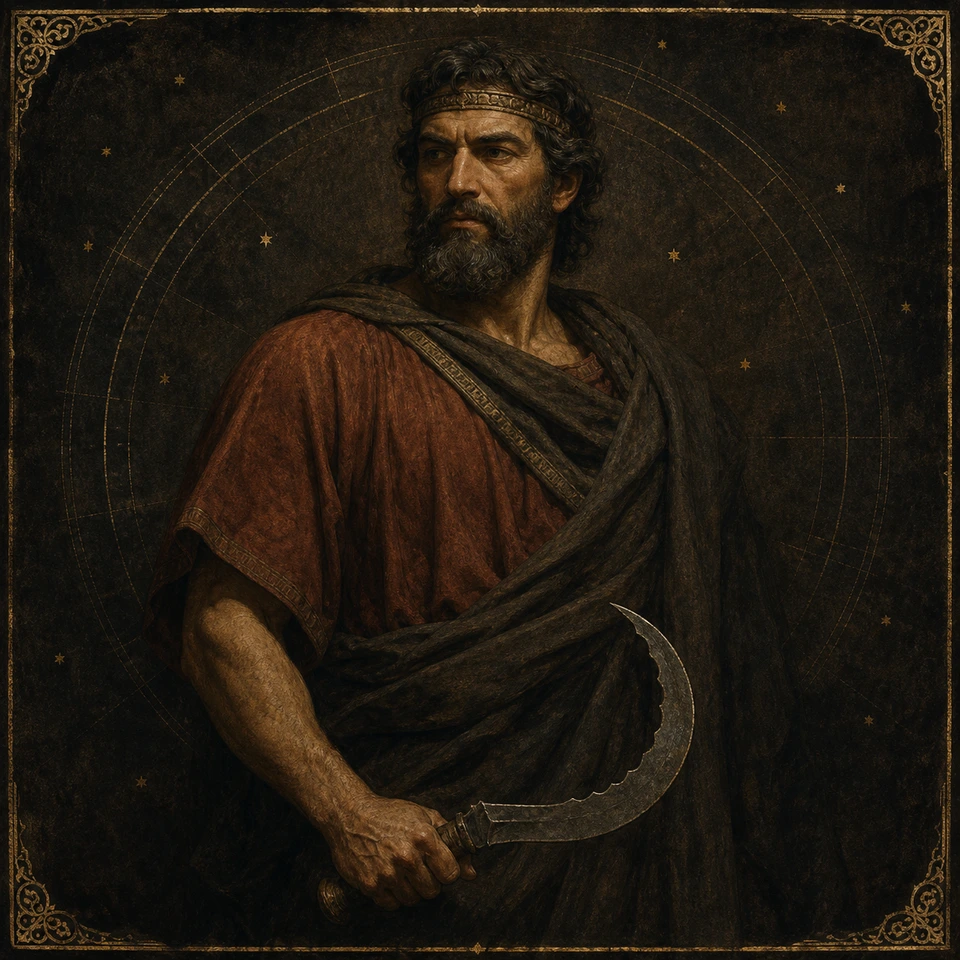
Reigning as the formidable Titan king, Cronus sired the first Olympian siblings with his spouse Rhea. He commands a central role in the violent divine succession, anchoring the myths of the Golden Race and the traditions of the blessed islands.
Overview
Cronus stands at the violent hinge of Greek divine succession. Hesiod names him the youngest Titan born from Gaia and Ouranos, marks him with crooked counsel, and makes him the one child willing to answer his mother's plan against the sky. From ambush comes a jagged sickle, a severed sovereignty, and a new ruler who immediately becomes what he feared. The story is not a simple tale of an evil old god replaced by a good young one. It is a cycle of concealed children, swallowed heirs, prophecy, rebellion, and authority held by force.
Rhea bears Hestia, Demeter, Hera, Hades, Poseidon, and Zeus. Cronus swallows the first five because Gaia and Ouranos have warned that one of his children will overthrow him. Rhea hides Zeus and offers a wrapped stone in the infant's place. Hesiod says Cronus later brings up his children and the stone, but does not name the means. Pseudo-Apollodorus supplies a different mechanism: Metis gives him a drug. The distinction matters because the familiar seamless version is already a blend.
War follows recovery. In the Theogony, the children of Cronus fight the Titans for ten years until the Hundred-Handers join Zeus' side and the conflict ends in crushing force. Cronus is the fallen ruler at the center of the succession, yet Hesiod does not stage a private duel between Cronus and Zeus. Later mythography adds details, but no source used here turns the battle into a single combat.
Other poems preserve another face of his reign. Works and Days places the Golden Race in the time when Cronus was king over the sky, living without harsh labor or bitter age while the earth yielded abundance. A longer papyrus form of the poem also places a released Cronus over heroes on the Isles of the Blessed. Pindar gives a related but distinct vision: Cronus' tower lies on the blessed shore, with Rhadamanthys beside him. These are not erasures of the succession story. They are separate poetic traditions in which the defeated ruler remains attached to an imagined age or distant afterlife of ease.
Cult was local and historically uneven. Demosthenes fixes the Athenian Kronia on the twelfth of Hekatombaion and treats the day as a council holiday. Pausanias later reports a temple of Cronus and Rhea in Athens and an annual sacrifice on Mount Cronion at Olympia during the Elean spring month Elaphius. Robert Parker's study shows both the importance and the limits of the Athenian festival evidence. Household feasting and a temporary loosening of rank are plausible parts of the tradition, but the strongest reversal details come through Latin witnesses, and the festival does not prove that Cronus possessed a universal agricultural portfolio.
A red-figure krater made in Athens about 460 BC gives the god a material presence. On Face A, the Louvre identifies a bearded Kronos in headband and himation, holding a sceptre beside Rhea with the stone. The image belongs to the swallowing cycle and royal posture. It does not turn every sickle, harvest implement, or image of an old man into Cronus.
Greek Κρόνος, Krónos, remains distinct from Greek Chronos, time, and from the planet Saturn. Cicero identifies Roman Saturn with the Greek figure and offers a time-based interpretation in a first-century BC philosophical argument. That reception is historically real, but it cannot be pushed backward into Hesiod as the original nature of Cronus. The Roman deity Saturn is a separate identity, and the celestial body is separate again. Cronus is best approached through the sharp edges the sources actually preserve: Titan kingship, generational terror, the remembered Golden Race, local rites, and the stubborn survival of a dethroned power beyond defeat.
Canonical identity
Canonical Identity
Cronus operates as the youngest of the first-generation Titans birthed by Gaia and Ouranos. Within the violent succession myths, Hesiod describes him using the poetic epithet ἀγκυλομήτης, generally translated as crooked-counselled or wily. This specific epithet underscores his strategic mind and dangerous intent during the overthrow of his father. It does not, however, designate a formal cult title, a planetary body, a harvest office, or a universal embodiment of time.
Linguistic Identity
The name is Greek Κρόνος, which transliterates directly as Krónos. A qualified fifth-century BC Attic reconstruction provides the pronunciation /kró.nos/ (approximately KRO-nos), utilizing a pitch accent that English phonetic guides cannot accurately capture. Cronus serves as the firmly established normalized English form.
Sources and evidence
TEXTUAL · Supported
The Ancient Greek name is Κρόνος, transliterated Krónos, with a qualified fifth-century BC Attic reconstruction /kró.nos/.
- Source
- Wiktionary contributors, Κρόνος
- Reviewed edition
- Wiktionary live revision reviewed 2026-08-30 · Wiktionary
- Exact locator
- Entry Κρόνος · Section Ancient Greek pronunciation
- Scope
- Classical Greece · Attica
- Authority
- collaborative historical lexicon
- Certainty
- Qualified
The readable guide KRO-nos cannot reproduce Attic pitch accent exactly.
Open exact reviewed sourceTEXTUAL · Supported
Hesiod names Cronus as the youngest of the twelve Titans born from Gaia and Ouranos.
- Source
- Hesiod; edited and translated by Hugh G. Evelyn-White, Theogony (1914)
- Reviewed edition
- Hugh G. Evelyn-White edition and English translation in Hesiod, the Homeric Hymns and Homerica, 1914 · translated by Hugh G. Evelyn-White · edited by Hugh G. Evelyn-White · Perseus Digital Library / Scaife ATLAS
- Exact locator
- Entry Theogony · Line 132-138
- Scope
- Archaic Greece · Ancient Greece
- Authority
- primary poetic witness
- Certainty
- Certain
The passage secures genealogy and class without assigning a planet, crop, or temporal embodiment.
Open exact reviewed sourceTEXTUAL · Supported
Theogony characterizes Cronus with the poetic epithet ἀγκυλομήτης, commonly rendered crooked-counselled or wily.
- Source
- Hesiod; edited and translated by Hugh G. Evelyn-White, Theogony (1914)
- Reviewed edition
- Hugh G. Evelyn-White edition and English translation in Hesiod, the Homeric Hymns and Homerica, 1914 · translated by Hugh G. Evelyn-White · edited by Hugh G. Evelyn-White · Perseus Digital Library / Scaife ATLAS
- Exact locator
- Entry Theogony · Line 137-138
- Scope
- Archaic Greece · Ancient Greece
- Authority
- primary poetic witness
- Certainty
- Certain
Poetic characterization is retained separately from any cult epithet.
Open exact reviewed source2 reviewed sources for this section
- Wiktionary contributors, ΚρόνοςLive collaborative lexical entry reviewed 2026-08-30 · Wiktionary
- Hesiod; edited and translated by Hugh G. Evelyn-White, Theogony (1914)Hesiod, the Homeric Hymns and Homerica, London and New York, 1914 · Perseus Digital Library / Scaife ATLAS
Culture, tradition, period, and place
Cronus belongs first to Greek theogonic poetry, where Archaic witnesses place him between primordial parents and the Olympian generation. Classical Athens leaves a dated festival and a painted vessel. Later Greek mythography organizes the succession narratives in another form, while Pausanias preserves Roman-imperial reports of cult in Athens and Olympia.
The places are specific rather than interchangeable. Attica supplies the Kronia and an Athenian temple report. Elis supplies Mount Cronion and an Elean sacrifice. The Isles of the Blessed belong to poetic geography. Rome supplies the later Saturn identification, not the original setting of the Greek Titan.
Sources and evidence
TEXTUAL · Supported
Hesiod names Cronus as the youngest of the twelve Titans born from Gaia and Ouranos.
- Source
- Hesiod; edited and translated by Hugh G. Evelyn-White, Theogony (1914)
- Reviewed edition
- Hugh G. Evelyn-White edition and English translation in Hesiod, the Homeric Hymns and Homerica, 1914 · translated by Hugh G. Evelyn-White · edited by Hugh G. Evelyn-White · Perseus Digital Library / Scaife ATLAS
- Exact locator
- Entry Theogony · Line 132-138
- Scope
- Archaic Greece · Ancient Greece
- Authority
- primary poetic witness
- Certainty
- Certain
The passage secures genealogy and class without assigning a planet, crop, or temporal embodiment.
Open exact reviewed sourceTEXTUAL · Supported
Demosthenes identifies Hekatombaion 12 as the day of the Athenian Kronia and indicates that the council normally had a holiday.
- Source
- Demosthenes; translated by J. H. Vince, Against Timocrates (1935)
- Reviewed edition
- J. H. Vince English translation, Loeb Classical Library 299, 1935 · translated by J. H. Vince · Perseus Digital Library / Scaife ATLAS
- Exact locator
- Book Oration 24, Against Timocrates · Section 26
- Scope
- Classical Greece · Athens
- Authority
- primary Athenian oratorical witness
- Certainty
- Certain
The passage dates the festival but supplies no procession, offering, or social-reversal rite.
Open exact reviewed sourceTEXTUAL · Supported
Pausanias reports a temple of Cronus and Rhea inside the precinct of Olympian Zeus at Athens.
- Source
- Pausanias; Spiro Greek edition and Jones/Ormerod translation volumes, Description of Greece (1935)
- Reviewed edition
- Spiro Greek edition and Jones/Ormerod English volumes represented by the Perseus CTS corpus, 1903-1935 · translated by W. H. S. Jones and H. A. Ormerod, volume-dependent · edited by Friedrich Spiro for the Greek edition · Perseus Digital Library / Scaife ATLAS
- Exact locator
- Book 1 · Chapter 18 · Section 7
- Scope
- Greek religion under Roman imperial rule · Athens
- Authority
- second-century AD travel and cult witness
- Certainty
- Certain
The claim is local and preserves the shared dedication to Cronus and Rhea.
Open exact reviewed sourceTEXTUAL · Supported
Pausanias states that Elean officials called Basilae sacrificed to Cronus on the summit of Mount Cronion during Elaphius at the spring equinox.
- Source
- Pausanias; Spiro Greek edition and Jones/Ormerod translation volumes, Description of Greece (1935)
- Reviewed edition
- Spiro Greek edition and Jones/Ormerod English volumes represented by the Perseus CTS corpus, 1903-1935 · translated by W. H. S. Jones and H. A. Ormerod, volume-dependent · edited by Friedrich Spiro for the Greek edition · Perseus Digital Library / Scaife ATLAS
- Exact locator
- Book 6 · Chapter 20 · Section 1
- Scope
- Greek religion under Roman imperial rule · Olympia
- Authority
- second-century AD local cult report
- Certainty
- Certain
The victim or sacrificial substance is not named.
Open exact reviewed source3 reviewed sources for this section
- Hesiod; edited and translated by Hugh G. Evelyn-White, Theogony (1914)Hesiod, the Homeric Hymns and Homerica, London and New York, 1914 · Perseus Digital Library / Scaife ATLAS
- Demosthenes; translated by J. H. Vince, Against Timocrates (1935)Demosthenes, Orations XXI-XXVI, Loeb Classical Library 299, 1935 · Perseus Digital Library / Scaife ATLAS
- Pausanias; Spiro Greek edition and Jones/Ormerod translation volumes, Description of Greece (1935)Perseus CTS edition corpus, 1903-1935 · Perseus Digital Library / Scaife ATLAS
Historical development
The earliest surviving profile is already divided. Theogony makes Cronus the calculating son who takes power from Ouranos, swallows his heirs, and loses the following war. Works and Days remembers his kingship as the time of the Golden Race, and one longer papyrus reading gives him a later rule among blessed heroes.
Classical evidence shows more than literary survival. The Kronia was a named Athenian festival, and an Attic krater gave the swallowing cycle a visible form. Pausanias later encountered local sacred places and ritual memory. Cicero's Saturn equation then belongs to Roman reception. The sequence is not a single theology moving smoothly from cruelty to abundance; it is a set of poetic, civic, material, and philosophical contexts that preserve different uses of the same divine name.
Sources and evidence
TEXTUAL · Supported
Gaia fashions a jagged sickle, Cronus accepts her ambush plan, attacks Ouranos, and inaugurates the next divine succession.
- Source
- Hesiod; edited and translated by Hugh G. Evelyn-White, Theogony (1914)
- Reviewed edition
- Hugh G. Evelyn-White edition and English translation in Hesiod, the Homeric Hymns and Homerica, 1914 · translated by Hugh G. Evelyn-White · edited by Hugh G. Evelyn-White · Perseus Digital Library / Scaife ATLAS
- Exact locator
- Entry Theogony · Line 154-210
- Scope
- Archaic Greece · Ancient Greece
- Authority
- primary poetic witness
- Certainty
- Certain
The sequence is Hesiod's form and is not blended with later mythographic details.
Open exact reviewed sourceTEXTUAL · Supported
Works and Days places the Golden Race in the time when Cronus was king over the sky and describes life without harsh labor or bitter old age amid spontaneous abundance.
- Source
- Hesiod; translated by Gregory Nagy, Hesiodic Works and Days
- Reviewed edition
- Gregory Nagy online English translation with textual notes · translated by Gregory Nagy · Harvard University Center for Hellenic Studies / Kosmos Society
- Exact locator
- Entry Works and Days · Line 109-126
- Scope
- Archaic Greece · Ancient Greece
- Authority
- primary poetic witness
- Certainty
- Certain
Human abundance under his reign does not by itself define a cult office over agriculture.
Open exact reviewed sourceTEXTUAL · Supported
A longer papyrus form of Works and Days adds the release of Cronus by Zeus and his kingship over heroes on the Isles of the Blessed.
- Source
- Hesiod; translated by Gregory Nagy, Hesiodic Works and Days
- Reviewed edition
- Gregory Nagy online English translation with textual notes · translated by Gregory Nagy · Harvard University Center for Hellenic Studies / Kosmos Society
- Exact locator
- Entry Works and Days, textual note 5, longer papyrus form after line 173 · Line 167-173
- Scope
- Archaic Greece · Ancient Greece
- Authority
- primary poetic witness with textual-variant note
- Certainty
- Qualified
The lines are not silently treated as part of every manuscript form.
Open exact reviewed sourceTEXTUAL · Supported
Demosthenes identifies Hekatombaion 12 as the day of the Athenian Kronia and indicates that the council normally had a holiday.
- Source
- Demosthenes; translated by J. H. Vince, Against Timocrates (1935)
- Reviewed edition
- J. H. Vince English translation, Loeb Classical Library 299, 1935 · translated by J. H. Vince · Perseus Digital Library / Scaife ATLAS
- Exact locator
- Book Oration 24, Against Timocrates · Section 26
- Scope
- Classical Greece · Athens
- Authority
- primary Athenian oratorical witness
- Certainty
- Certain
The passage dates the festival but supplies no procession, offering, or social-reversal rite.
Open exact reviewed sourceMATERIAL CULTURE · Supported
Louvre G 366 identifies Face A as a bearded Kronos wearing a headband and himation and holding a sceptre beside Rhea with the stone.
- Source
- Musée du Louvre, Department of Greek, Etruscan, and Roman Antiquities, cratère
- Reviewed edition
- Musée du Louvre French collections record cl010270223, inventory MNB 1289; G 366 · Musée du Louvre
- Exact locator
- MuseumObjectId MNB 1289; G 366 · Entry Description/Features, Face A · RecordUrl https://collections.louvre.fr/en/ark:/53355/cl010270223
- Scope
- Classical Greece · Athens
- Authority
- official museum object record
- Certainty
- Certain
Face B remains qualified because the museum marks the figures with question marks.
Open exact reviewed sourceTEXTUAL · Supported
Cicero identifies Roman Saturn as the figure called Cronus by the Greeks in a first-century BC philosophical discussion.
- Source
- Marcus Tullius Cicero; translated by H. Rackham, De Natura Deorum (1933)
- Reviewed edition
- Cicero, De Natura Deorum, translated by H. Rackham, Loeb Classical Library 268, 1933 · LacusCurtius, University of Chicago web domain
- Exact locator
- Book 2 · Section 64
- Scope
- Roman Republican period · Rome
- Authority
- Roman philosophical witness
- Certainty
- Certain
Historical equation does not merge the Greek and Roman cult identities.
Open exact reviewed source5 reviewed sources for this section
- Hesiod; edited and translated by Hugh G. Evelyn-White, Theogony (1914)Hesiod, the Homeric Hymns and Homerica, London and New York, 1914 · Perseus Digital Library / Scaife ATLAS
- Hesiod; translated by Gregory Nagy, Hesiodic Works and DaysOnline translation with textual notes, Kosmos Society and Center for Hellenic Studies · Harvard University Center for Hellenic Studies / Kosmos Society
- Demosthenes; translated by J. H. Vince, Against Timocrates (1935)Demosthenes, Orations XXI-XXVI, Loeb Classical Library 299, 1935 · Perseus Digital Library / Scaife ATLAS
- Musée du Louvre, Department of Greek, Etruscan, and Roman Antiquities, cratèreMusée du Louvre collections record cl010270223, inventory MNB 1289; G 366 · Musée du Louvre
- Marcus Tullius Cicero; translated by H. Rackham, De Natura Deorum (1933)Loeb Classical Library 268, 1933; LacusCurtius transcription · LacusCurtius, University of Chicago web domain
Attested roles and historical themes
Roles, powers, and limits
Cronus is an attested Titan ruler, agent of divine succession, father who consumes threatened heirs, defeated leader of the older generation, and king linked with the Golden Race. Each role belongs to a particular narrative. Works and Days calls him king over the sky in the Golden Race passage, while the Theogony builds his power through seizure and prophecy.
His limits are equally clear. No reviewed Greek witness makes him the literal substance of time, the planet Saturn, a universal harvest god, or ruler of every sickle and crop. Parker explicitly warns that the Kronia need not prove an intrinsic agricultural nature. The Roman Saturn identification and time interpretation are later contexts, not an all-purpose explanation for the Greek figure.
Sources and evidence
TEXTUAL · Supported
Gaia fashions a jagged sickle, Cronus accepts her ambush plan, attacks Ouranos, and inaugurates the next divine succession.
- Source
- Hesiod; edited and translated by Hugh G. Evelyn-White, Theogony (1914)
- Reviewed edition
- Hugh G. Evelyn-White edition and English translation in Hesiod, the Homeric Hymns and Homerica, 1914 · translated by Hugh G. Evelyn-White · edited by Hugh G. Evelyn-White · Perseus Digital Library / Scaife ATLAS
- Exact locator
- Entry Theogony · Line 154-210
- Scope
- Archaic Greece · Ancient Greece
- Authority
- primary poetic witness
- Certainty
- Certain
The sequence is Hesiod's form and is not blended with later mythographic details.
Open exact reviewed sourceTEXTUAL · Supported
Works and Days places the Golden Race in the time when Cronus was king over the sky and describes life without harsh labor or bitter old age amid spontaneous abundance.
- Source
- Hesiod; translated by Gregory Nagy, Hesiodic Works and Days
- Reviewed edition
- Gregory Nagy online English translation with textual notes · translated by Gregory Nagy · Harvard University Center for Hellenic Studies / Kosmos Society
- Exact locator
- Entry Works and Days · Line 109-126
- Scope
- Archaic Greece · Ancient Greece
- Authority
- primary poetic witness
- Certainty
- Certain
Human abundance under his reign does not by itself define a cult office over agriculture.
Open exact reviewed sourceTEXTUAL · Supported
Kronia harvest timing does not prove that Cronus possessed an intrinsic universal agricultural domain.
- Source
- Robert Parker, Polytheism and Society at Athens (2005)
- Reviewed edition
- Robert Parker, Polytheism and Society at Athens, Oxford University Press, 2005 · National and Kapodistrian University of Athens course repository
- Exact locator
- Page 202-203
- Scope
- Modern classical scholarship · Attica
- Authority
- specialist academic monograph
- Certainty
- Certain
The boundary prevents a festival context from becoming an unrestricted divine portfolio.
Open exact reviewed sourceTEXTUAL · Supported
Cicero's time-based explanation of Saturn and Cronus is later Roman philosophical reception and does not establish that Greek Κρόνος was originally identical with Chronos or the planet Saturn.
- Source
- Marcus Tullius Cicero; translated by H. Rackham, De Natura Deorum (1933)
- Reviewed edition
- Cicero, De Natura Deorum, translated by H. Rackham, Loeb Classical Library 268, 1933 · LacusCurtius, University of Chicago web domain
- Exact locator
- Book 2 · Section 64-65 · Entry De Natura Deorum, compared with lexical entry Κρόνος
- Scope
- Roman Republican period · Rome
- Authority
- historical reception and lexical boundary
- Certainty
- Certain
The spelling and identity boundary prevents later etymology from becoming original theology.
Open exact reviewed source4 reviewed sources for this section
- Hesiod; edited and translated by Hugh G. Evelyn-White, Theogony (1914)Hesiod, the Homeric Hymns and Homerica, London and New York, 1914 · Perseus Digital Library / Scaife ATLAS
- Hesiod; translated by Gregory Nagy, Hesiodic Works and DaysOnline translation with textual notes, Kosmos Society and Center for Hellenic Studies · Harvard University Center for Hellenic Studies / Kosmos Society
- Robert Parker, Polytheism and Society at Athens (2005)Oxford University Press, 2005 · National and Kapodistrian University of Athens course repository
- Marcus Tullius Cicero; translated by H. Rackham, De Natura Deorum (1933)Loeb Classical Library 268, 1933; LacusCurtius transcription · LacusCurtius, University of Chicago web domain
Epithets and titles
Poetic Epithet
Crooked-counselled
ἀγκυλομήτης · Of crooked counsel; wily
Archaic Greek poetic tradition · Archaic GreekA Hesiodic poetic characterization, not a localized cult title.
1 reviewed source for this section
- Hesiod; edited and translated by Hugh G. Evelyn-White, Theogony (1914)Hesiod, the Homeric Hymns and Homerica, London and New York, 1914 · Perseus Digital Library / Scaife ATLAS
Worship and cult
Cronus received documented local observance in Attica and Elis. Demosthenes names the Kronia as an Athenian calendar day, Pausanias reports a temple shared by Cronus and Rhea in Athens, and the same traveler records a sacrifice to Cronus on Mount Cronion at Olympia. These witnesses establish worship without pretending that one uniform cult covered the Greek world.
Parker treats the Kronia as widely observed in Athenian households and notes a modest public component. He also keeps the evidence unstable where it is unstable. The fullest claims about masters serving slaves arrive through Latin testimony and may carry Saturnalian coloring. Local cult is secure; a single universal ritual script is not.
Sources and evidence
TEXTUAL · Supported
Demosthenes identifies Hekatombaion 12 as the day of the Athenian Kronia and indicates that the council normally had a holiday.
- Source
- Demosthenes; translated by J. H. Vince, Against Timocrates (1935)
- Reviewed edition
- J. H. Vince English translation, Loeb Classical Library 299, 1935 · translated by J. H. Vince · Perseus Digital Library / Scaife ATLAS
- Exact locator
- Book Oration 24, Against Timocrates · Section 26
- Scope
- Classical Greece · Athens
- Authority
- primary Athenian oratorical witness
- Certainty
- Certain
The passage dates the festival but supplies no procession, offering, or social-reversal rite.
Open exact reviewed sourceTEXTUAL · Supported
Pausanias reports a temple of Cronus and Rhea inside the precinct of Olympian Zeus at Athens.
- Source
- Pausanias; Spiro Greek edition and Jones/Ormerod translation volumes, Description of Greece (1935)
- Reviewed edition
- Spiro Greek edition and Jones/Ormerod English volumes represented by the Perseus CTS corpus, 1903-1935 · translated by W. H. S. Jones and H. A. Ormerod, volume-dependent · edited by Friedrich Spiro for the Greek edition · Perseus Digital Library / Scaife ATLAS
- Exact locator
- Book 1 · Chapter 18 · Section 7
- Scope
- Greek religion under Roman imperial rule · Athens
- Authority
- second-century AD travel and cult witness
- Certainty
- Certain
The claim is local and preserves the shared dedication to Cronus and Rhea.
Open exact reviewed sourceTEXTUAL · Supported
Pausanias states that Elean officials called Basilae sacrificed to Cronus on the summit of Mount Cronion during Elaphius at the spring equinox.
- Source
- Pausanias; Spiro Greek edition and Jones/Ormerod translation volumes, Description of Greece (1935)
- Reviewed edition
- Spiro Greek edition and Jones/Ormerod English volumes represented by the Perseus CTS corpus, 1903-1935 · translated by W. H. S. Jones and H. A. Ormerod, volume-dependent · edited by Friedrich Spiro for the Greek edition · Perseus Digital Library / Scaife ATLAS
- Exact locator
- Book 6 · Chapter 20 · Section 1
- Scope
- Greek religion under Roman imperial rule · Olympia
- Authority
- second-century AD local cult report
- Certainty
- Certain
The victim or sacrificial substance is not named.
Open exact reviewed sourceTEXTUAL · Supported
Parker locates much Athenian Kronia observance in households and treats status reversal cautiously because the sharpest master-slave detail is mediated through Latin testimony.
- Source
- Robert Parker, Polytheism and Society at Athens (2005)
- Reviewed edition
- Robert Parker, Polytheism and Society at Athens, Oxford University Press, 2005 · National and Kapodistrian University of Athens course repository
- Exact locator
- Page 161-162; 201-203
- Scope
- Modern classical scholarship · Attica
- Authority
- specialist academic monograph
- Certainty
- Qualified
The social inversion is neither rejected nor presented as an uncontested Classical ritual script.
Open exact reviewed source3 reviewed sources for this section
- Demosthenes; translated by J. H. Vince, Against Timocrates (1935)Demosthenes, Orations XXI-XXVI, Loeb Classical Library 299, 1935 · Perseus Digital Library / Scaife ATLAS
- Pausanias; Spiro Greek edition and Jones/Ormerod translation volumes, Description of Greece (1935)Perseus CTS edition corpus, 1903-1935 · Perseus Digital Library / Scaife ATLAS
- Robert Parker, Polytheism and Society at Athens (2005)Oxford University Press, 2005 · National and Kapodistrian University of Athens course repository
Temples, sanctuaries, and sacred places
Athens and Olympia provide the clearest sacred geography. Pausanias places a temple of Cronus and Rhea inside the precinct of Olympian Zeus in Athens. At Olympia, Mount Cronion rises above the sanctuary, and Pausanias records an Elean sacrifice on its summit.
His account also preserves local claims that Cronus once ruled heaven and that people of the Golden Race built a temple to him at Olympia. Those are Elean antiquarian traditions reported in the second century AD, not securely dated Archaic construction records. The Isles of the Blessed remain a poetic afterlife landscape rather than an earthly pilgrimage destination.
Sources and evidence
TEXTUAL · Supported
Pausanias reports a temple of Cronus and Rhea inside the precinct of Olympian Zeus at Athens.
- Source
- Pausanias; Spiro Greek edition and Jones/Ormerod translation volumes, Description of Greece (1935)
- Reviewed edition
- Spiro Greek edition and Jones/Ormerod English volumes represented by the Perseus CTS corpus, 1903-1935 · translated by W. H. S. Jones and H. A. Ormerod, volume-dependent · edited by Friedrich Spiro for the Greek edition · Perseus Digital Library / Scaife ATLAS
- Exact locator
- Book 1 · Chapter 18 · Section 7
- Scope
- Greek religion under Roman imperial rule · Athens
- Authority
- second-century AD travel and cult witness
- Certainty
- Certain
The claim is local and preserves the shared dedication to Cronus and Rhea.
Open exact reviewed sourceTEXTUAL · Supported
Pausanias states that Elean officials called Basilae sacrificed to Cronus on the summit of Mount Cronion during Elaphius at the spring equinox.
- Source
- Pausanias; Spiro Greek edition and Jones/Ormerod translation volumes, Description of Greece (1935)
- Reviewed edition
- Spiro Greek edition and Jones/Ormerod English volumes represented by the Perseus CTS corpus, 1903-1935 · translated by W. H. S. Jones and H. A. Ormerod, volume-dependent · edited by Friedrich Spiro for the Greek edition · Perseus Digital Library / Scaife ATLAS
- Exact locator
- Book 6 · Chapter 20 · Section 1
- Scope
- Greek religion under Roman imperial rule · Olympia
- Authority
- second-century AD local cult report
- Certainty
- Certain
The victim or sacrificial substance is not named.
Open exact reviewed sourceTEXTUAL · Supported
Pausanias preserves Elean traditions that Cronus first ruled heaven and that people of the Golden Race built a temple to him at Olympia.
- Source
- Pausanias; Spiro Greek edition and Jones/Ormerod translation volumes, Description of Greece (1935)
- Reviewed edition
- Spiro Greek edition and Jones/Ormerod English volumes represented by the Perseus CTS corpus, 1903-1935 · translated by W. H. S. Jones and H. A. Ormerod, volume-dependent · edited by Friedrich Spiro for the Greek edition · Perseus Digital Library / Scaife ATLAS
- Exact locator
- Book 5 · Chapter 7 · Section 6
- Scope
- Greek religion under Roman imperial rule · Olympia
- Authority
- reported local antiquarian tradition
- Certainty
- Qualified
The passage cannot establish a securely dated Golden Race temple.
Open exact reviewed source1 reviewed source for this section
- Pausanias; Spiro Greek edition and Jones/Ormerod translation volumes, Description of Greece (1935)Perseus CTS edition corpus, 1903-1935 · Perseus Digital Library / Scaife ATLAS
Festivals and processions
The Athenian Kronia fell on the twelfth of Hekatombaion. Demosthenes uses the festival day inside a legal chronology and says the council normally had a holiday. This is direct Classical evidence for the date and civic interruption, but it names no procession, costume, prayer, or offering.
Parker's synthesis places much of the celebration in households and discusses shared feasting across status lines. The sharper image of masters waiting upon slaves comes through Latin material and remains qualified. At Olympia, Pausanias gives a different calendar point, the spring month Elaphius, for sacrifice on Mount Cronion. The two rites should remain local rather than collapsed into a single annual feast.
Sources and evidence
TEXTUAL · Supported
Demosthenes identifies Hekatombaion 12 as the day of the Athenian Kronia and indicates that the council normally had a holiday.
- Source
- Demosthenes; translated by J. H. Vince, Against Timocrates (1935)
- Reviewed edition
- J. H. Vince English translation, Loeb Classical Library 299, 1935 · translated by J. H. Vince · Perseus Digital Library / Scaife ATLAS
- Exact locator
- Book Oration 24, Against Timocrates · Section 26
- Scope
- Classical Greece · Athens
- Authority
- primary Athenian oratorical witness
- Certainty
- Certain
The passage dates the festival but supplies no procession, offering, or social-reversal rite.
Open exact reviewed sourceTEXTUAL · Supported
Parker locates much Athenian Kronia observance in households and treats status reversal cautiously because the sharpest master-slave detail is mediated through Latin testimony.
- Source
- Robert Parker, Polytheism and Society at Athens (2005)
- Reviewed edition
- Robert Parker, Polytheism and Society at Athens, Oxford University Press, 2005 · National and Kapodistrian University of Athens course repository
- Exact locator
- Page 161-162; 201-203
- Scope
- Modern classical scholarship · Attica
- Authority
- specialist academic monograph
- Certainty
- Qualified
The social inversion is neither rejected nor presented as an uncontested Classical ritual script.
Open exact reviewed sourceTEXTUAL · Supported
Pausanias states that Elean officials called Basilae sacrificed to Cronus on the summit of Mount Cronion during Elaphius at the spring equinox.
- Source
- Pausanias; Spiro Greek edition and Jones/Ormerod translation volumes, Description of Greece (1935)
- Reviewed edition
- Spiro Greek edition and Jones/Ormerod English volumes represented by the Perseus CTS corpus, 1903-1935 · translated by W. H. S. Jones and H. A. Ormerod, volume-dependent · edited by Friedrich Spiro for the Greek edition · Perseus Digital Library / Scaife ATLAS
- Exact locator
- Book 6 · Chapter 20 · Section 1
- Scope
- Greek religion under Roman imperial rule · Olympia
- Authority
- second-century AD local cult report
- Certainty
- Certain
The victim or sacrificial substance is not named.
Open exact reviewed source3 reviewed sources for this section
- Demosthenes; translated by J. H. Vince, Against Timocrates (1935)Demosthenes, Orations XXI-XXVI, Loeb Classical Library 299, 1935 · Perseus Digital Library / Scaife ATLAS
- Robert Parker, Polytheism and Society at Athens (2005)Oxford University Press, 2005 · National and Kapodistrian University of Athens course repository
- Pausanias; Spiro Greek edition and Jones/Ormerod translation volumes, Description of Greece (1935)Perseus CTS edition corpus, 1903-1935 · Perseus Digital Library / Scaife ATLAS
Offerings, votives, and ritual evidence
Pausanias states that the Elean officials called Basilae sacrificed to Cronus on Mount Cronion at the spring equinox. He does not specify the victim or substance. That silence rules out a confident list of grain, wine, incense, animals, or ritual tools for the rite.
The Athenian evidence supports festival observance and household feasting, not a fixed offering formula. Parker's harvest discussion explains the social timing while warning that the festival does not by itself make Cronus agricultural in essence. Any modern offering remains a contemporary choice unless an accountable community identifies it as such.
Sources and evidence
TEXTUAL · Supported
Pausanias states that Elean officials called Basilae sacrificed to Cronus on the summit of Mount Cronion during Elaphius at the spring equinox.
- Source
- Pausanias; Spiro Greek edition and Jones/Ormerod translation volumes, Description of Greece (1935)
- Reviewed edition
- Spiro Greek edition and Jones/Ormerod English volumes represented by the Perseus CTS corpus, 1903-1935 · translated by W. H. S. Jones and H. A. Ormerod, volume-dependent · edited by Friedrich Spiro for the Greek edition · Perseus Digital Library / Scaife ATLAS
- Exact locator
- Book 6 · Chapter 20 · Section 1
- Scope
- Greek religion under Roman imperial rule · Olympia
- Authority
- second-century AD local cult report
- Certainty
- Certain
The victim or sacrificial substance is not named.
Open exact reviewed sourceTEXTUAL · Supported
The reviewed Athenian and Elean witnesses do not supply a fixed offering inventory for Cronus.
- Source
- Pausanias; Spiro Greek edition and Jones/Ormerod translation volumes, Description of Greece (1935)
- Reviewed edition
- Spiro Greek edition and Jones/Ormerod English volumes represented by the Perseus CTS corpus, 1903-1935 · translated by W. H. S. Jones and H. A. Ormerod, volume-dependent · edited by Friedrich Spiro for the Greek edition · Perseus Digital Library / Scaife ATLAS
- Exact locator
- Book 6 · Chapter 20 · Section 1; compared with Demosthenes 24.26
- Scope
- Greek religion under Roman imperial rule · Olympia
- Authority
- bounded cross-witness absence review
- Certainty
- Certain
Sacrifice is attested, but its victim and materials remain unspecified.
Open exact reviewed sourceTEXTUAL · Supported
Kronia harvest timing does not prove that Cronus possessed an intrinsic universal agricultural domain.
- Source
- Robert Parker, Polytheism and Society at Athens (2005)
- Reviewed edition
- Robert Parker, Polytheism and Society at Athens, Oxford University Press, 2005 · National and Kapodistrian University of Athens course repository
- Exact locator
- Page 202-203
- Scope
- Modern classical scholarship · Attica
- Authority
- specialist academic monograph
- Certainty
- Certain
The boundary prevents a festival context from becoming an unrestricted divine portfolio.
Open exact reviewed source2 reviewed sources for this section
- Pausanias; Spiro Greek edition and Jones/Ormerod translation volumes, Description of Greece (1935)Perseus CTS edition corpus, 1903-1935 · Perseus Digital Library / Scaife ATLAS
- Robert Parker, Polytheism and Society at Athens (2005)Oxford University Press, 2005 · National and Kapodistrian University of Athens course repository
Iconography and material culture
A Classical Attic krater gives Cronus a bearded face, headband, himation, and sceptre beside Rhea carrying the stone. The vessel was made in Athens about 460 BC and survives as Louvre MNB 1289, G 366. Face A is the secure basis; the museum itself qualifies the figures on Face B.
The jagged sickle belongs to the Theogony's overthrow narrative and is a strong literary attribute. It is not enough to identify any solitary sickle as cult equipment or any bearded ruler as Cronus. The stone, sceptre, dress, and weapon must stay tied to their particular scene or object.
Sources and evidence
MATERIAL CULTURE · Supported
Louvre G 366 identifies Face A as a bearded Kronos wearing a headband and himation and holding a sceptre beside Rhea with the stone.
- Source
- Musée du Louvre, Department of Greek, Etruscan, and Roman Antiquities, cratère
- Reviewed edition
- Musée du Louvre French collections record cl010270223, inventory MNB 1289; G 366 · Musée du Louvre
- Exact locator
- MuseumObjectId MNB 1289; G 366 · Entry Description/Features, Face A · RecordUrl https://collections.louvre.fr/en/ark:/53355/cl010270223
- Scope
- Classical Greece · Athens
- Authority
- official museum object record
- Certainty
- Certain
Face B remains qualified because the museum marks the figures with question marks.
Open exact reviewed sourceMATERIAL CULTURE · Supported
The Cronus and Rhea vessel is an Attic red-figure clay column-krater made in Athens in the second quarter of the fifth century BC, about 460 BC.
- Source
- Musée du Louvre, Department of Greek, Etruscan, and Roman Antiquities, cratère
- Reviewed edition
- Musée du Louvre French collections record cl010270223, inventory MNB 1289; G 366 · Musée du Louvre
- Exact locator
- MuseumObjectId MNB 1289; G 366 · Entry Materials and techniques; Places and dates
- Scope
- Classical Greece · Athens
- Authority
- official museum object record
- Certainty
- Certain
The red-figure palette describes technique, not a ritual color correspondence.
Open exact reviewed sourceTEXTUAL · Supported
The jagged sickle is Cronus' explicit instrument in Hesiod's attack on Ouranos.
- Source
- Hesiod; edited and translated by Hugh G. Evelyn-White, Theogony (1914)
- Reviewed edition
- Hugh G. Evelyn-White edition and English translation in Hesiod, the Homeric Hymns and Homerica, 1914 · translated by Hugh G. Evelyn-White · edited by Hugh G. Evelyn-White · Perseus Digital Library / Scaife ATLAS
- Exact locator
- Entry Theogony · Line 161-182
- Scope
- Archaic Greece · Ancient Greece
- Authority
- primary poetic witness
- Certainty
- Certain
Narrative attribute only; the passage does not identify a cult implement or sacred metal.
Open exact reviewed source2 reviewed sources for this section
- Musée du Louvre, Department of Greek, Etruscan, and Roman Antiquities, cratèreMusée du Louvre collections record cl010270223, inventory MNB 1289; G 366 · Musée du Louvre
- Hesiod; edited and translated by Hugh G. Evelyn-White, Theogony (1914)Hesiod, the Homeric Hymns and Homerica, London and New York, 1914 · Perseus Digital Library / Scaife ATLAS
Animals, plants, and embodied forms
No reviewed primary or material witness assigns Cronus a sacred animal, plant, tree, or metamorphic body. The Golden Race passage speaks of flocks and earth's abundance as features of human life under his reign, not as species consecrated to the god.
Likewise, the household and harvest setting of the Kronia cannot turn grain, vines, or every harvest plant into his personal emblem. Ancient iconography reviewed here shows human royal form. No animal, plant, or metamorphic form can therefore be assigned to him with confidence.
Sources and evidence
MATERIAL CULTURE · Supported
No sacred animal, sacred plant, tree, or embodied animal form is established for Cronus in the reviewed literary, cultic, and material evidence.
- Source
- Musée du Louvre, Department of Greek, Etruscan, and Roman Antiquities, cratère
- Reviewed edition
- Musée du Louvre French collections record cl010270223, inventory MNB 1289; G 366 · Musée du Louvre
- Exact locator
- Entry Louvre Face A iconography; Hesiod Theogony 132-210; Works and Days 109-126
- Scope
- Classical Greece · Athens
- Authority
- bounded corpus review
- Certainty
- Certain
Flocks and abundant crops in the Golden Race describe human prosperity, not consecrated species.
Open exact reviewed sourceTEXTUAL · Supported
Works and Days places the Golden Race in the time when Cronus was king over the sky and describes life without harsh labor or bitter old age amid spontaneous abundance.
- Source
- Hesiod; translated by Gregory Nagy, Hesiodic Works and Days
- Reviewed edition
- Gregory Nagy online English translation with textual notes · translated by Gregory Nagy · Harvard University Center for Hellenic Studies / Kosmos Society
- Exact locator
- Entry Works and Days · Line 109-126
- Scope
- Archaic Greece · Ancient Greece
- Authority
- primary poetic witness
- Certainty
- Certain
Human abundance under his reign does not by itself define a cult office over agriculture.
Open exact reviewed sourceMATERIAL CULTURE · Supported
Louvre G 366 identifies Face A as a bearded Kronos wearing a headband and himation and holding a sceptre beside Rhea with the stone.
- Source
- Musée du Louvre, Department of Greek, Etruscan, and Roman Antiquities, cratère
- Reviewed edition
- Musée du Louvre French collections record cl010270223, inventory MNB 1289; G 366 · Musée du Louvre
- Exact locator
- MuseumObjectId MNB 1289; G 366 · Entry Description/Features, Face A · RecordUrl https://collections.louvre.fr/en/ark:/53355/cl010270223
- Scope
- Classical Greece · Athens
- Authority
- official museum object record
- Certainty
- Certain
Face B remains qualified because the museum marks the figures with question marks.
Open exact reviewed source3 reviewed sources for this section
- Hesiod; translated by Gregory Nagy, Hesiodic Works and DaysOnline translation with textual notes, Kosmos Society and Center for Hellenic Studies · Harvard University Center for Hellenic Studies / Kosmos Society
- Musée du Louvre, Department of Greek, Etruscan, and Roman Antiquities, cratèreMusée du Louvre collections record cl010270223, inventory MNB 1289; G 366 · Musée du Louvre
- Robert Parker, Polytheism and Society at Athens (2005)Oxford University Press, 2005 · National and Kapodistrian University of Athens course repository
Relationships and genealogy
Gaia and Ouranos are Cronus' parents, and Rhea is both his Titan sister and spouse in the succession cycle. Their children are Hestia, Demeter, Hera, Hades, Poseidon, and Zeus. Hesiod's birth order begins with Hestia and ends with Zeus, while later familiar orderings may differ.
The relationships drive events rather than decorate a family list. Gaia arms Cronus against Ouranos. Rhea protects Zeus against Cronus. Zeus then leads his siblings against the older generation. Roman Saturn is connected through historical equation, not blood descent, and remains a distinct god in Roman religion.
Sources and evidence
TEXTUAL · Supported
Gaia and Ouranos are Cronus' parents in Hesiod's Titan genealogy.
- Source
- Hesiod; edited and translated by Hugh G. Evelyn-White, Theogony (1914)
- Reviewed edition
- Hugh G. Evelyn-White edition and English translation in Hesiod, the Homeric Hymns and Homerica, 1914 · translated by Hugh G. Evelyn-White · edited by Hugh G. Evelyn-White · Perseus Digital Library / Scaife ATLAS
- Exact locator
- Entry Theogony · Line 132-138
- Scope
- Archaic Greece · Ancient Greece
- Authority
- primary poetic witness
- Certainty
- Certain
Parentage is direct and does not imply inherited element or sky correspondence.
Open exact reviewed sourceTEXTUAL · Supported
Rhea is Cronus' Titan sister and spouse in Hesiod's genealogy and the mother of his six named children.
- Source
- Hesiod; edited and translated by Hugh G. Evelyn-White, Theogony (1914)
- Reviewed edition
- Hugh G. Evelyn-White edition and English translation in Hesiod, the Homeric Hymns and Homerica, 1914 · translated by Hugh G. Evelyn-White · edited by Hugh G. Evelyn-White · Perseus Digital Library / Scaife ATLAS
- Exact locator
- Entry Theogony · Line 132-138; 453-458
- Scope
- Archaic Greece · Ancient Greece
- Authority
- primary poetic witness
- Certainty
- Certain
Sibling and spousal roles are held together without flattening Rhea into a narrative prop.
Open exact reviewed sourceTEXTUAL · Supported
Hestia, Demeter, Hera, Hades, Poseidon, and Zeus are the children of Cronus and Rhea in the Theogony.
- Source
- Hesiod; edited and translated by Hugh G. Evelyn-White, Theogony (1914)
- Reviewed edition
- Hugh G. Evelyn-White edition and English translation in Hesiod, the Homeric Hymns and Homerica, 1914 · translated by Hugh G. Evelyn-White · edited by Hugh G. Evelyn-White · Perseus Digital Library / Scaife ATLAS
- Exact locator
- Entry Theogony · Line 453-458
- Scope
- Archaic Greece · Ancient Greece
- Authority
- primary poetic witness
- Certainty
- Certain
The six direct parent-child relationships are modeled individually.
Open exact reviewed sourceTEXTUAL · Supported
Cicero identifies Roman Saturn as the figure called Cronus by the Greeks in a first-century BC philosophical discussion.
- Source
- Marcus Tullius Cicero; translated by H. Rackham, De Natura Deorum (1933)
- Reviewed edition
- Cicero, De Natura Deorum, translated by H. Rackham, Loeb Classical Library 268, 1933 · LacusCurtius, University of Chicago web domain
- Exact locator
- Book 2 · Section 64
- Scope
- Roman Republican period · Rome
- Authority
- Roman philosophical witness
- Certainty
- Certain
Historical equation does not merge the Greek and Roman cult identities.
Open exact reviewed source2 reviewed sources for this section
- Hesiod; edited and translated by Hugh G. Evelyn-White, Theogony (1914)Hesiod, the Homeric Hymns and Homerica, London and New York, 1914 · Perseus Digital Library / Scaife ATLAS
- Marcus Tullius Cicero; translated by H. Rackham, De Natura Deorum (1933)Loeb Classical Library 268, 1933; LacusCurtius transcription · LacusCurtius, University of Chicago web domain
Actual myths and source variants
Five major narratives define Cronus: the attack on Ouranos and seizure of rule, the swallowing of Rhea's children and substitution of the stone, the ten-year Titanomachy, the Golden Race under his kingship, and his later place on the Isles of the Blessed. The sea-birth of Aphrodite is a shared continuation of the first succession act and remains linked as its own narrative.
Hesiod and Pseudo-Apollodorus do not tell identical versions. Hesiod leaves the children's release mechanism unstated; the later mythographer introduces Metis and a drug. Hesiod's battle remains collective and gives Cronus no private duel with Zeus. The longer papyrus Works and Days passage and Pindar's blessed-island vision also remain separate witnesses rather than one seamless ending.
Sources and evidence
TEXTUAL · Supported
Gaia fashions a jagged sickle, Cronus accepts her ambush plan, attacks Ouranos, and inaugurates the next divine succession.
- Source
- Hesiod; edited and translated by Hugh G. Evelyn-White, Theogony (1914)
- Reviewed edition
- Hugh G. Evelyn-White edition and English translation in Hesiod, the Homeric Hymns and Homerica, 1914 · translated by Hugh G. Evelyn-White · edited by Hugh G. Evelyn-White · Perseus Digital Library / Scaife ATLAS
- Exact locator
- Entry Theogony · Line 154-210
- Scope
- Archaic Greece · Ancient Greece
- Authority
- primary poetic witness
- Certainty
- Certain
The sequence is Hesiod's form and is not blended with later mythographic details.
Open exact reviewed sourceTEXTUAL · Supported
Cronus swallows the first five children born by Rhea because he has learned that one of his children is destined to overthrow him.
- Source
- Hesiod; edited and translated by Hugh G. Evelyn-White, Theogony (1914)
- Reviewed edition
- Hugh G. Evelyn-White edition and English translation in Hesiod, the Homeric Hymns and Homerica, 1914 · translated by Hugh G. Evelyn-White · edited by Hugh G. Evelyn-White · Perseus Digital Library / Scaife ATLAS
- Exact locator
- Entry Theogony · Line 453-467
- Scope
- Archaic Greece · Ancient Greece
- Authority
- primary poetic witness
- Certainty
- Certain
The swallowed heirs are divine children, and the act is not reframed as a medical event.
Open exact reviewed sourceTEXTUAL · Supported
Hesiod states that Cronus brings up the children and stone without naming the mechanism, while Pseudo-Apollodorus introduces Metis and a drug.
- Source
- Pseudo-Apollodorus; edited and translated by James G. Frazer, Library (1921)
- Reviewed edition
- James G. Frazer edition and English translation, Harvard University Press and William Heinemann, 1921 · translated by James G. Frazer · edited by James G. Frazer · Perseus Digital Library / Scaife ATLAS
- Exact locator
- Entry Library · Book 1 · Chapter 2 · Section 1
- Scope
- Greek religion under Roman imperial rule · Ancient Greece
- Authority
- cross-witness variant comparison
- Certainty
- Certain
Comparison also uses Hesiod, Theogony 485-500; the mechanism remains witness-specific.
Open exact reviewed sourceTEXTUAL · Supported
Theogony presents a ten-year collective war between the Titans and the children of Cronus, ended after the Hundred-Handers join Zeus' side, without narrating a private Cronus-Zeus duel.
- Source
- Hesiod; edited and translated by Hugh G. Evelyn-White, Theogony (1914)
- Reviewed edition
- Hugh G. Evelyn-White edition and English translation in Hesiod, the Homeric Hymns and Homerica, 1914 · translated by Hugh G. Evelyn-White · edited by Hugh G. Evelyn-White · Perseus Digital Library / Scaife ATLAS
- Exact locator
- Entry Theogony · Line 617-735
- Scope
- Archaic Greece · Ancient Greece
- Authority
- primary poetic witness
- Certainty
- Certain
Collective battle language prevents invention of an individualized duel.
Open exact reviewed sourceTEXTUAL · Supported
Works and Days places the Golden Race in the time when Cronus was king over the sky and describes life without harsh labor or bitter old age amid spontaneous abundance.
- Source
- Hesiod; translated by Gregory Nagy, Hesiodic Works and Days
- Reviewed edition
- Gregory Nagy online English translation with textual notes · translated by Gregory Nagy · Harvard University Center for Hellenic Studies / Kosmos Society
- Exact locator
- Entry Works and Days · Line 109-126
- Scope
- Archaic Greece · Ancient Greece
- Authority
- primary poetic witness
- Certainty
- Certain
Human abundance under his reign does not by itself define a cult office over agriculture.
Open exact reviewed sourceTEXTUAL · Supported
A longer papyrus form of Works and Days adds the release of Cronus by Zeus and his kingship over heroes on the Isles of the Blessed.
- Source
- Hesiod; translated by Gregory Nagy, Hesiodic Works and Days
- Reviewed edition
- Gregory Nagy online English translation with textual notes · translated by Gregory Nagy · Harvard University Center for Hellenic Studies / Kosmos Society
- Exact locator
- Entry Works and Days, textual note 5, longer papyrus form after line 173 · Line 167-173
- Scope
- Archaic Greece · Ancient Greece
- Authority
- primary poetic witness with textual-variant note
- Certainty
- Qualified
The lines are not silently treated as part of every manuscript form.
Open exact reviewed sourceTEXTUAL · Supported
Pindar places Cronus' tower on the blessed island shore and names Rhadamanthys beside him in a distinct afterlife tradition.
- Source
- Pindar; translated by Diane Arnson Svarlien, Odes of Pindar (1990)
- Reviewed edition
- Diane Arnson Svarlien English translation, 1990 · translated by Diane Arnson Svarlien · Tufts University
- Exact locator
- Entry Olympian 2 · Line 68-80
- Scope
- Classical Greece · Ancient Greece
- Authority
- primary lyric witness
- Certainty
- Certain
Pindar's vision remains distinct from the longer Works and Days papyrus reading.
Open exact reviewed sourceTEXTUAL · Supported
Hesiod continues the castration aftermath into the sea-birth tradition of Aphrodite.
- Source
- Hesiod; edited and translated by Hugh G. Evelyn-White, Theogony (1914)
- Reviewed edition
- Hugh G. Evelyn-White edition and English translation in Hesiod, the Homeric Hymns and Homerica, 1914 · translated by Hugh G. Evelyn-White · edited by Hugh G. Evelyn-White · Perseus Digital Library / Scaife ATLAS
- Exact locator
- Entry Theogony · Line 188-206
- Scope
- Archaic Greece · Ancient Greece
- Authority
- primary poetic witness
- Certainty
- Certain
The consequence remains a shared myth rather than duplicated Cronus-owned prose.
Open exact reviewed source4 reviewed sources for this section
- Hesiod; edited and translated by Hugh G. Evelyn-White, Theogony (1914)Hesiod, the Homeric Hymns and Homerica, London and New York, 1914 · Perseus Digital Library / Scaife ATLAS
- Pseudo-Apollodorus; edited and translated by James G. Frazer, Library (1921)Harvard University Press and William Heinemann edition, 1921 · Perseus Digital Library / Scaife ATLAS
- Hesiod; translated by Gregory Nagy, Hesiodic Works and DaysOnline translation with textual notes, Kosmos Society and Center for Hellenic Studies · Harvard University Center for Hellenic Studies / Kosmos Society
- Pindar; translated by Diane Arnson Svarlien, Odes of Pindar (1990)1990 translation hosted by the Perseus Digital Library · Tufts University
Myth Library
Each myth gathers its attested participants into one source-grounded account, while distinct source traditions remain readable in their own variants.
Theogony
Cronus Overthrows Ouranos
Gaia arms Cronus with a jagged sickle, and he ambushes Ouranos, severs the old sky ruler's power, and opens the Greek succession cycle whose violent consequences include Aphrodite's sea-birth.
- Role in this profile
- youngest Titan who accepts the ambush and attacks Ouranos
- Place scope
- Ancient Greece
- Witnesses
- 2
- Variants
- 2
Theogony
Cronus and the Swallowed Children
Cronus swallows five children born by Rhea, but she hides Zeus and gives Cronus a wrapped stone; Zeus survives, the children return, and the feared succession begins.
- Role in this profile
- father who swallows the first five children and later releases them and the stone
- Place scope
- Ancient Greece · Crete · Olympia · Arcadia
- Witnesses
- 4
- Variants
- 4
Cosmic
The Titanomachy and Fall of the Titans
The children of Cronus fight the Titans for ten years; Gaia's counsel brings the Hundred-Handers into Zeus' alliance, and their force breaks the older generation and ends Cronus' reign.
- Role in this profile
- older-generation ruler defeated with the Titans
- Place scope
- Ancient Greece
- Witnesses
- 2
- Variants
- 2
Philosophical Literary
The Golden Race Under Cronus
Works and Days remembers the Golden Race in the reign of Cronus, living close to the gods without harsh labor or bitter age while the earth gives abundance.
- Role in this profile
- king over the sky during the life of the Golden Race
- Place scope
- Ancient Greece
- Witnesses
- 2
- Variants
- 2
Philosophical Literary
Cronus on the Isles of the Blessed
A longer papyrus form of Works and Days and Pindar's Olympian 2 preserve distinct visions of Cronus associated with blessed heroes at the far edge of the world.
- Role in this profile
- released king over heroes in the papyrus form and distant ruler beside Rhadamanthys in Pindar
- Place scope
- Ancient Greece
- Witnesses
- 2
- Variants
- 2
Theogonic
Births and Parentages of Aphrodite
Hesiod brings Aphrodite from sea foam around the severed genitals of Uranus, while the Iliad calls her the daughter of Zeus and Dione. Hymn and painted pottery carry the sea arrival into new settings without resolving the two incompatible genealogies.
- Role in this profile
- son of Uranus who cuts off his father's genitals and throws them behind him into the sea
- Place scope
- Cythera · Cyprus · Ancient Greece
- Witnesses
- 4
- Variants
- 4
Divine Genealogy
The Birth of the First Titans
Gaia and Uranus bring forth twelve named Titans, whose shared birth establishes a generation without assigning every sibling the same deed or cosmic office.
- Role in this profile
- youngest or later-listed Titan sibling whose separate succession story follows elsewhere
- Place scope
- Ancient Greece
- Witnesses
- 4
- Variants
- 4
Theogonic Succession
The Titans Overthrow Uranus
Hesiod makes Cronus the sole child who answers Gaia, while Pseudo-Apollodorus makes every Titan except Oceanus join the violent attack and thereby gives Theia only a collective role.
- Role in this profile
- son who takes the sickle and performs the decisive mutilation
- Place scope
- Ancient Greece
- Witnesses
- 2
- Variants
- 2
Local Birth And Concealment
Rhea Hides Poseidon in Arcadia
An Arcadian tradition gives Poseidon a separate rescue: Rhea hides the newborn among lambs and makes Cronus swallow a foal instead.
- Role in this profile
- demands the child and swallows the substituted foal
- Place scope
- Arcadia
- Witnesses
- 1
- Variants
- 1
Equivalences, syncretisms, and identity boundaries
Cicero identifies the Roman Saturn with the Greek Cronus in a first-century BC philosophical discussion. That historical equation is real, but it does not merge every Greek and Roman cult detail. Saturn keeps his own Roman rites, meanings, and canonical identity.
Cronus is also not Chronos, the Greek word and divine figure associated with time. Cicero's time-based explanation belongs to ancient reception, not to Hesiod's original name or role. The planet Saturn is a celestial body with its own identity. Shared later associations never make the Greek Titan, Roman deity, time figure, and planet a single identity.
Sources and evidence
TEXTUAL · Supported
Cicero identifies Roman Saturn as the figure called Cronus by the Greeks in a first-century BC philosophical discussion.
- Source
- Marcus Tullius Cicero; translated by H. Rackham, De Natura Deorum (1933)
- Reviewed edition
- Cicero, De Natura Deorum, translated by H. Rackham, Loeb Classical Library 268, 1933 · LacusCurtius, University of Chicago web domain
- Exact locator
- Book 2 · Section 64
- Scope
- Roman Republican period · Rome
- Authority
- Roman philosophical witness
- Certainty
- Certain
Historical equation does not merge the Greek and Roman cult identities.
Open exact reviewed sourceTEXTUAL · Supported
Cicero's time-based explanation of Saturn and Cronus is later Roman philosophical reception and does not establish that Greek Κρόνος was originally identical with Chronos or the planet Saturn.
- Source
- Marcus Tullius Cicero; translated by H. Rackham, De Natura Deorum (1933)
- Reviewed edition
- Cicero, De Natura Deorum, translated by H. Rackham, Loeb Classical Library 268, 1933 · LacusCurtius, University of Chicago web domain
- Exact locator
- Book 2 · Section 64-65 · Entry De Natura Deorum, compared with lexical entry Κρόνος
- Scope
- Roman Republican period · Rome
- Authority
- historical reception and lexical boundary
- Certainty
- Certain
The spelling and identity boundary prevents later etymology from becoming original theology.
Open exact reviewed source2 reviewed sources for this section
- Marcus Tullius Cicero; translated by H. Rackham, De Natura Deorum (1933)Loeb Classical Library 268, 1933; LacusCurtius transcription · LacusCurtius, University of Chicago web domain
- Wiktionary contributors, ΚρόνοςLive collaborative lexical entry reviewed 2026-08-30 · Wiktionary
Correspondence index
Four associations survive close review. Mount Cronion at Olympia is a direct sacred place. The Athenian Kronia and the Elean spring sacrifice are local sacred times. Sacrifice is attested at Olympia without a named victim. The jagged sickle is an ancient literary instrument in the overthrow of Ouranos.
No reviewed witness assigns Cronus a planet, zodiac sign, gemstone, sacred metal, plant, animal, ritual color, Classical element, weekday, moon phase, incense, or modern magical intention. Saturday and the planet Saturn belong to Roman and planetary histories, not automatically to Greek Cronus. The stone and sceptre remain narrative or iconographic attributes unless a ritual source says more.
Direct ancient correspondences
| Category | Direct correspondence | How and why | Evidence boundary |
|---|---|---|---|
| direction-place | Mount Cronion at OlympiaDirect historical association | Pausanias records sacrifice to Cronus on the summit of Mount Cronion at Olympia. | Ancient Cultic Local Elean sacred place reported in the second century AD, not a universal ritual direction. 1 reviewed source for this section
|
| festival-time | Kronia on Hekatombaion 12; Elean spring sacrificeDirect historical association | Demosthenes fixes the Athenian Kronia on Hekatombaion 12, while Pausanias gives the Elean spring month Elaphius for Mount Cronion. | Ancient Cultic Two local calendar traditions remain distinct and are not converted to a modern fixed solar date. 2 reviewed sources for this section
|
| offering-ritual-material | Sacrifice on Mount Cronion, victim unspecifiedDirect historical association | Pausanias reports that the Elean Basilae sacrificed to Cronus, but he does not name the victim or offering material. | Ancient Cultic The attested act is retained without inventing grain, wine, blood, incense, or another substance. 1 reviewed source for this section
|
Contextual evidence, not a general correspondence
| Category | Direct correspondence | How and why | Evidence boundary |
|---|---|---|---|
| ritual-object-symbol-tool | Jagged sickle in the overthrow of OuranosContextual evidence only | Gaia fashions the sickle that Cronus uses in the Theogony succession narrative. | Ancient Literary Ancient literary instrument and iconographic caution, not automatically a cult tool used in worship. 1 reviewed source for this section
|
12 expected categories currently not evidenced
celestial-body · Not evidenced
No celestial body evidenced for Greek Cronus
The planet Saturn is separately typed, and Cicero's equation concerns the Roman deity rather than automatic planetary identity.
- Layer
- Research Boundary
- Scope
- Do not merge Cronus with the planet Saturn or derive celestial rulership from Roman naming.
1 reviewed source for this section
- Marcus Tullius Cicero; translated by H. Rackham, De Natura Deorum (1933)Loeb Classical Library 268, 1933; LacusCurtius transcription · LacusCurtius, University of Chicago web domain
zodiac · Not evidenced
No zodiac sign evidenced
No reviewed Greek literary, cultic, or material witness assigns Cronus a zodiac sign.
- Layer
- Research Boundary
- Scope
- Planetary and modern astrological systems require their own evidence and cannot be imported through Saturn.
gemstone-crystal-mineral · Not evidenced
No gemstone, crystal, or mineral evidenced
No cited witness dedicates a gemstone, crystal, or mineral to Cronus.
- Layer
- Research Boundary
- Scope
- The wrapped stone in the swallowing story is a narrative substitute, not a named mineral correspondence.
2 reviewed sources for this section
- Hesiod; edited and translated by Hugh G. Evelyn-White, Theogony (1914)Hesiod, the Homeric Hymns and Homerica, London and New York, 1914 · Perseus Digital Library / Scaife ATLAS
- Pseudo-Apollodorus; edited and translated by James G. Frazer, Library (1921)Harvard University Press and William Heinemann edition, 1921 · Perseus Digital Library / Scaife ATLAS
metal-material · Not evidenced
No sacred metal or universal material evidenced
Theogony gives a jagged sickle but does not establish a sacred metal assigned to Cronus.
- Layer
- Research Boundary
- Scope
- A weapon's material cannot become a general devotional correspondence without an explicit witness.
1 reviewed source for this section
- Hesiod; edited and translated by Hugh G. Evelyn-White, Theogony (1914)Hesiod, the Homeric Hymns and Homerica, London and New York, 1914 · Perseus Digital Library / Scaife ATLAS
plant-tree · Not evidenced
No sacred plant or tree evidenced
The Golden Race and harvest setting of the Kronia do not name a plant sacred to Cronus.
- Layer
- Research Boundary
- Scope
- Grain, vines, and other crops remain contextual unless a cult source assigns them directly.
2 reviewed sources for this section
- Hesiod; translated by Gregory Nagy, Hesiodic Works and DaysOnline translation with textual notes, Kosmos Society and Center for Hellenic Studies · Harvard University Center for Hellenic Studies / Kosmos Society
- Robert Parker, Polytheism and Society at Athens (2005)Oxford University Press, 2005 · National and Kapodistrian University of Athens course repository
animal-embodied-form · Not evidenced
No sacred animal or embodied form evidenced
Neither the reviewed narratives nor the Louvre vessel gives Cronus a sacred animal or transformation.
- Layer
- Research Boundary
- Scope
- Royal human form is materially attested; no species may be inferred from Titan status.
2 reviewed sources for this section
- Hesiod; edited and translated by Hugh G. Evelyn-White, Theogony (1914)Hesiod, the Homeric Hymns and Homerica, London and New York, 1914 · Perseus Digital Library / Scaife ATLAS
- Musée du Louvre, Department of Greek, Etruscan, and Roman Antiquities, cratèreMusée du Louvre collections record cl010270223, inventory MNB 1289; G 366 · Musée du Louvre
color · Not evidenced
No ritual color evidenced
Red-figure technique describes the vessel, not a ritual color consecrated to the god.
- Layer
- Research Boundary
- Scope
- Pigment, garment color, and modern planetary color systems remain outside direct Cronus evidence.
1 reviewed source for this section
- Musée du Louvre, Department of Greek, Etruscan, and Roman Antiquities, cratèreMusée du Louvre collections record cl010270223, inventory MNB 1289; G 366 · Musée du Louvre
classical-element · Not evidenced
No Classical element evidenced
No reviewed source assigns earth, air, fire, or water to Cronus as a ritual correspondence.
- Layer
- Research Boundary
- Scope
- Gaia's motherhood does not make her element an inherited domain.
1 reviewed source for this section
- Hesiod; edited and translated by Hugh G. Evelyn-White, Theogony (1914)Hesiod, the Homeric Hymns and Homerica, London and New York, 1914 · Perseus Digital Library / Scaife ATLAS
weekday · Not evidenced
No weekday evidenced for Greek Cronus
Saturday belongs to later Roman and planetary naming histories, not automatically to Greek Cronus.
- Layer
- Research Boundary
- Scope
- The historical Saturn equation is preserved without transferring every Roman or planetary association.
1 reviewed source for this section
- Marcus Tullius Cicero; translated by H. Rackham, De Natura Deorum (1933)Loeb Classical Library 268, 1933; LacusCurtius transcription · LacusCurtius, University of Chicago web domain
moon-phase · Not evidenced
No moon phase evidenced
No lunar episode or cult instruction connects Cronus with a phase of the moon.
- Layer
- Research Boundary
- Scope
- The Attic calendar date does not equal a moon-phase correspondence.
1 reviewed source for this section
- Demosthenes; translated by J. H. Vince, Against Timocrates (1935)Demosthenes, Orations XXI-XXVI, Loeb Classical Library 299, 1935 · Perseus Digital Library / Scaife ATLAS
incense-perfume · Not evidenced
No incense or perfume evidenced
The cult witnesses name festival and sacrifice but no aromatic substance.
- Layer
- Research Boundary
- Scope
- Modern incense choices cannot be backdated into Athens or Olympia.
2 reviewed sources for this section
- Demosthenes; translated by J. H. Vince, Against Timocrates (1935)Demosthenes, Orations XXI-XXVI, Loeb Classical Library 299, 1935 · Perseus Digital Library / Scaife ATLAS
- Pausanias; Spiro Greek edition and Jones/Ormerod translation volumes, Description of Greece (1935)Perseus CTS edition corpus, 1903-1935 · Perseus Digital Library / Scaife ATLAS
intention-magical-power · Not evidenced
No shared magical intention evidenced
No accountable modern community source establishes a fixed Cronus intention such as time work, harvest, authority, shadow work, or generational healing.
- Layer
- Research Boundary
- Scope
- Personal devotional readings may be named as personal, not presented as ancient or universally Pagan.
Sources and evidence
TEXTUAL · Supported
Pausanias states that Elean officials called Basilae sacrificed to Cronus on the summit of Mount Cronion during Elaphius at the spring equinox.
- Source
- Pausanias; Spiro Greek edition and Jones/Ormerod translation volumes, Description of Greece (1935)
- Reviewed edition
- Spiro Greek edition and Jones/Ormerod English volumes represented by the Perseus CTS corpus, 1903-1935 · translated by W. H. S. Jones and H. A. Ormerod, volume-dependent · edited by Friedrich Spiro for the Greek edition · Perseus Digital Library / Scaife ATLAS
- Exact locator
- Book 6 · Chapter 20 · Section 1
- Scope
- Greek religion under Roman imperial rule · Olympia
- Authority
- second-century AD local cult report
- Certainty
- Certain
The victim or sacrificial substance is not named.
Open exact reviewed sourceTEXTUAL · Supported
Demosthenes identifies Hekatombaion 12 as the day of the Athenian Kronia and indicates that the council normally had a holiday.
- Source
- Demosthenes; translated by J. H. Vince, Against Timocrates (1935)
- Reviewed edition
- J. H. Vince English translation, Loeb Classical Library 299, 1935 · translated by J. H. Vince · Perseus Digital Library / Scaife ATLAS
- Exact locator
- Book Oration 24, Against Timocrates · Section 26
- Scope
- Classical Greece · Athens
- Authority
- primary Athenian oratorical witness
- Certainty
- Certain
The passage dates the festival but supplies no procession, offering, or social-reversal rite.
Open exact reviewed sourceTEXTUAL · Supported
The jagged sickle is Cronus' explicit instrument in Hesiod's attack on Ouranos.
- Source
- Hesiod; edited and translated by Hugh G. Evelyn-White, Theogony (1914)
- Reviewed edition
- Hugh G. Evelyn-White edition and English translation in Hesiod, the Homeric Hymns and Homerica, 1914 · translated by Hugh G. Evelyn-White · edited by Hugh G. Evelyn-White · Perseus Digital Library / Scaife ATLAS
- Exact locator
- Entry Theogony · Line 161-182
- Scope
- Archaic Greece · Ancient Greece
- Authority
- primary poetic witness
- Certainty
- Certain
Narrative attribute only; the passage does not identify a cult implement or sacred metal.
Open exact reviewed sourceTEXTUAL · Supported
No accountable public modern community source was established for a shared Cronus weekday, planet, zodiac sign, stone, color, incense, or magical intention.
- Source
- Robert Parker, Polytheism and Society at Athens (2005)
- Reviewed edition
- Robert Parker, Polytheism and Society at Athens, Oxford University Press, 2005 · National and Kapodistrian University of Athens course repository
- Exact locator
- Page 201-203 · Entry Ancient Kronia evidence compared against unsupported modern extensions
- Scope
- Modern classical scholarship · Ancient Greece
- Authority
- explicit modern-evidence gap
- Certainty
- Certain
The ancient festival does not authorize a universal modern correspondence list.
Open exact reviewed source3 reviewed sources for this section
- Pausanias; Spiro Greek edition and Jones/Ormerod translation volumes, Description of Greece (1935)Perseus CTS edition corpus, 1903-1935 · Perseus Digital Library / Scaife ATLAS
- Demosthenes; translated by J. H. Vince, Against Timocrates (1935)Demosthenes, Orations XXI-XXVI, Loeb Classical Library 299, 1935 · Perseus Digital Library / Scaife ATLAS
- Hesiod; edited and translated by Hugh G. Evelyn-White, Theogony (1914)Hesiod, the Homeric Hymns and Homerica, London and New York, 1914 · Perseus Digital Library / Scaife ATLAS
Later reception and living significance
Cronus remains powerful in contemporary Pagan reading because the ancient traditions do not reduce him to one moral. He can appear as a dethroned king, the father who devours futurity, the ruler remembered through a Golden Race, and the distant lord of blessed heroes. Those possibilities arise from named ancient witnesses rather than a generic shadow-work slogan.
No accountable public modern community source was reviewed for a shared rite or fixed correspondence set. Private devotion may develop from the myths, but it should be named as personal or community-specific practice. Roman Saturnalia, modern Father Time, and planetary Saturday symbolism need their own historical pathways before they are brought near Cronus.
Sources and evidence
TEXTUAL · Supported
Works and Days places the Golden Race in the time when Cronus was king over the sky and describes life without harsh labor or bitter old age amid spontaneous abundance.
- Source
- Hesiod; translated by Gregory Nagy, Hesiodic Works and Days
- Reviewed edition
- Gregory Nagy online English translation with textual notes · translated by Gregory Nagy · Harvard University Center for Hellenic Studies / Kosmos Society
- Exact locator
- Entry Works and Days · Line 109-126
- Scope
- Archaic Greece · Ancient Greece
- Authority
- primary poetic witness
- Certainty
- Certain
Human abundance under his reign does not by itself define a cult office over agriculture.
Open exact reviewed sourceTEXTUAL · Supported
A longer papyrus form of Works and Days adds the release of Cronus by Zeus and his kingship over heroes on the Isles of the Blessed.
- Source
- Hesiod; translated by Gregory Nagy, Hesiodic Works and Days
- Reviewed edition
- Gregory Nagy online English translation with textual notes · translated by Gregory Nagy · Harvard University Center for Hellenic Studies / Kosmos Society
- Exact locator
- Entry Works and Days, textual note 5, longer papyrus form after line 173 · Line 167-173
- Scope
- Archaic Greece · Ancient Greece
- Authority
- primary poetic witness with textual-variant note
- Certainty
- Qualified
The lines are not silently treated as part of every manuscript form.
Open exact reviewed sourceTEXTUAL · Supported
No accountable public modern community source was established for a shared Cronus weekday, planet, zodiac sign, stone, color, incense, or magical intention.
- Source
- Robert Parker, Polytheism and Society at Athens (2005)
- Reviewed edition
- Robert Parker, Polytheism and Society at Athens, Oxford University Press, 2005 · National and Kapodistrian University of Athens course repository
- Exact locator
- Page 201-203 · Entry Ancient Kronia evidence compared against unsupported modern extensions
- Scope
- Modern classical scholarship · Ancient Greece
- Authority
- explicit modern-evidence gap
- Certainty
- Certain
The ancient festival does not authorize a universal modern correspondence list.
Open exact reviewed source2 reviewed sources for this section
- Hesiod; translated by Gregory Nagy, Hesiodic Works and DaysOnline translation with textual notes, Kosmos Society and Center for Hellenic Studies · Harvard University Center for Hellenic Studies / Kosmos Society
- Pindar; translated by Diane Arnson Svarlien, Odes of Pindar (1990)1990 translation hosted by the Perseus Digital Library · Tufts University
Evidence, conflicts, and research gaps
Hesiod controls the earliest succession, swallowing, Titanomachy, and Golden Race claims used here. Pseudo-Apollodorus preserves later, materially different mechanisms. Demosthenes supplies the Athenian Kronia date, Pausanias supplies later local cult reports, the Louvre supplies Classical material evidence, and Parker explains where modern confidence should stop.
Important gaps remain. No sacrificial victim is named for Mount Cronion. No procession is secure for the Kronia. The strongest master-slave reversal detail is mediated through Latin sources. The longer Works and Days ending survives as a papyrus variant rather than every manuscript. No reviewed source supports universal agricultural rule, sacred species, mineral or color correspondences, a fixed modern rite, or an original identity with Chronos. These limits leave Cronus complex, not incomplete.
Sources and evidence
TEXTUAL · Supported
Hesiod states that Cronus brings up the children and stone without naming the mechanism, while Pseudo-Apollodorus introduces Metis and a drug.
- Source
- Pseudo-Apollodorus; edited and translated by James G. Frazer, Library (1921)
- Reviewed edition
- James G. Frazer edition and English translation, Harvard University Press and William Heinemann, 1921 · translated by James G. Frazer · edited by James G. Frazer · Perseus Digital Library / Scaife ATLAS
- Exact locator
- Entry Library · Book 1 · Chapter 2 · Section 1
- Scope
- Greek religion under Roman imperial rule · Ancient Greece
- Authority
- cross-witness variant comparison
- Certainty
- Certain
Comparison also uses Hesiod, Theogony 485-500; the mechanism remains witness-specific.
Open exact reviewed sourceTEXTUAL · Supported
Parker locates much Athenian Kronia observance in households and treats status reversal cautiously because the sharpest master-slave detail is mediated through Latin testimony.
- Source
- Robert Parker, Polytheism and Society at Athens (2005)
- Reviewed edition
- Robert Parker, Polytheism and Society at Athens, Oxford University Press, 2005 · National and Kapodistrian University of Athens course repository
- Exact locator
- Page 161-162; 201-203
- Scope
- Modern classical scholarship · Attica
- Authority
- specialist academic monograph
- Certainty
- Qualified
The social inversion is neither rejected nor presented as an uncontested Classical ritual script.
Open exact reviewed sourceTEXTUAL · Supported
The reviewed Athenian and Elean witnesses do not supply a fixed offering inventory for Cronus.
- Source
- Pausanias; Spiro Greek edition and Jones/Ormerod translation volumes, Description of Greece (1935)
- Reviewed edition
- Spiro Greek edition and Jones/Ormerod English volumes represented by the Perseus CTS corpus, 1903-1935 · translated by W. H. S. Jones and H. A. Ormerod, volume-dependent · edited by Friedrich Spiro for the Greek edition · Perseus Digital Library / Scaife ATLAS
- Exact locator
- Book 6 · Chapter 20 · Section 1; compared with Demosthenes 24.26
- Scope
- Greek religion under Roman imperial rule · Olympia
- Authority
- bounded cross-witness absence review
- Certainty
- Certain
Sacrifice is attested, but its victim and materials remain unspecified.
Open exact reviewed sourceTEXTUAL · Supported
Kronia harvest timing does not prove that Cronus possessed an intrinsic universal agricultural domain.
- Source
- Robert Parker, Polytheism and Society at Athens (2005)
- Reviewed edition
- Robert Parker, Polytheism and Society at Athens, Oxford University Press, 2005 · National and Kapodistrian University of Athens course repository
- Exact locator
- Page 202-203
- Scope
- Modern classical scholarship · Attica
- Authority
- specialist academic monograph
- Certainty
- Certain
The boundary prevents a festival context from becoming an unrestricted divine portfolio.
Open exact reviewed sourceMATERIAL CULTURE · Supported
No sacred animal, sacred plant, tree, or embodied animal form is established for Cronus in the reviewed literary, cultic, and material evidence.
- Source
- Musée du Louvre, Department of Greek, Etruscan, and Roman Antiquities, cratère
- Reviewed edition
- Musée du Louvre French collections record cl010270223, inventory MNB 1289; G 366 · Musée du Louvre
- Exact locator
- Entry Louvre Face A iconography; Hesiod Theogony 132-210; Works and Days 109-126
- Scope
- Classical Greece · Athens
- Authority
- bounded corpus review
- Certainty
- Certain
Flocks and abundant crops in the Golden Race describe human prosperity, not consecrated species.
Open exact reviewed sourceTEXTUAL · Supported
No accountable public modern community source was established for a shared Cronus weekday, planet, zodiac sign, stone, color, incense, or magical intention.
- Source
- Robert Parker, Polytheism and Society at Athens (2005)
- Reviewed edition
- Robert Parker, Polytheism and Society at Athens, Oxford University Press, 2005 · National and Kapodistrian University of Athens course repository
- Exact locator
- Page 201-203 · Entry Ancient Kronia evidence compared against unsupported modern extensions
- Scope
- Modern classical scholarship · Ancient Greece
- Authority
- explicit modern-evidence gap
- Certainty
- Certain
The ancient festival does not authorize a universal modern correspondence list.
Open exact reviewed sourceTEXTUAL · Supported
Cicero's time-based explanation of Saturn and Cronus is later Roman philosophical reception and does not establish that Greek Κρόνος was originally identical with Chronos or the planet Saturn.
- Source
- Marcus Tullius Cicero; translated by H. Rackham, De Natura Deorum (1933)
- Reviewed edition
- Cicero, De Natura Deorum, translated by H. Rackham, Loeb Classical Library 268, 1933 · LacusCurtius, University of Chicago web domain
- Exact locator
- Book 2 · Section 64-65 · Entry De Natura Deorum, compared with lexical entry Κρόνος
- Scope
- Roman Republican period · Rome
- Authority
- historical reception and lexical boundary
- Certainty
- Certain
The spelling and identity boundary prevents later etymology from becoming original theology.
Open exact reviewed source8 reviewed sources for this section
- Hesiod; edited and translated by Hugh G. Evelyn-White, Theogony (1914)Hesiod, the Homeric Hymns and Homerica, London and New York, 1914 · Perseus Digital Library / Scaife ATLAS
- Pseudo-Apollodorus; edited and translated by James G. Frazer, Library (1921)Harvard University Press and William Heinemann edition, 1921 · Perseus Digital Library / Scaife ATLAS
- Demosthenes; translated by J. H. Vince, Against Timocrates (1935)Demosthenes, Orations XXI-XXVI, Loeb Classical Library 299, 1935 · Perseus Digital Library / Scaife ATLAS
- Pausanias; Spiro Greek edition and Jones/Ormerod translation volumes, Description of Greece (1935)Perseus CTS edition corpus, 1903-1935 · Perseus Digital Library / Scaife ATLAS
- Musée du Louvre, Department of Greek, Etruscan, and Roman Antiquities, cratèreMusée du Louvre collections record cl010270223, inventory MNB 1289; G 366 · Musée du Louvre
- Robert Parker, Polytheism and Society at Athens (2005)Oxford University Press, 2005 · National and Kapodistrian University of Athens course repository
- Hesiod; translated by Gregory Nagy, Hesiodic Works and DaysOnline translation with textual notes, Kosmos Society and Center for Hellenic Studies · Harvard University Center for Hellenic Studies / Kosmos Society
- Marcus Tullius Cicero; translated by H. Rackham, De Natura Deorum (1933)Loeb Classical Library 268, 1933; LacusCurtius transcription · LacusCurtius, University of Chicago web domain
Direct connections and evidence
Explicit Source
Coeus and Cronus share Gaia and Uranus as parents in Hesiod and Pseudo-Apollodorus
Their sibling relationship does not transfer Cronus's sickle, kingship, or deeds to Coeus.
2 attestations · high confidence
- Hesiod; edited and translated by Hugh G. Evelyn-White, TheogonyHugh G. Evelyn-White edition and English translation in Hesiod, the Homeric Hymns and Homerica, 1914 · translated by Hugh G. Evelyn-White · edited by Hugh G. Evelyn-White · Perseus Digital Library / Scaife ATLAS · Archaic Greece · Ancient Greece · Entry Theogony · Line 132-138
- Pseudo-Apollodorus; edited and translated by James G. Frazer, LibraryJames G. Frazer edition and English translation, Harvard University Press and William Heinemann, 1921 · translated by James G. Frazer · edited by James G. Frazer · Perseus Digital Library / Scaife ATLAS · Greek religion under Roman imperial rule · Ancient Greece · Book 1 · Chapter 1 · Section 3
Explicit Source
Hesiod names Crius and Cronus among the children of Gaia and Ouranos
This family bond does not assign Crius a role in Cronus’ separate succession story.
1 attestation · high confidence
- Hesiod; edited and translated by Hugh G. Evelyn-White, TheogonyHugh G. Evelyn-White edition and English translation in Hesiod, the Homeric Hymns and Homerica, 1914 · translated by Hugh G. Evelyn-White · edited by Hugh G. Evelyn-White · Perseus Digital Library / Scaife ATLAS · Archaic Greece · Ancient Greece · Entry Theogony · Line 132-138
Explicit Source
Hesiod names Gaia as Cronus' mother
Direct genealogy; it does not imply an earth-element correspondence.
1 attestation · high confidence
- Hesiod; edited and translated by Hugh G. Evelyn-White, TheogonyHugh G. Evelyn-White edition and English translation in Hesiod, the Homeric Hymns and Homerica, 1914 · translated by Hugh G. Evelyn-White · edited by Hugh G. Evelyn-White · Perseus Digital Library / Scaife ATLAS · Archaic Greece · Ancient Greece · Entry Theogony · Line 132-138
Explicit Source
Hesiod names Ouranos as Cronus' father
Ouranos is the Greek sky father attacked by Cronus and remains distinct from Roman Caelus.
1 attestation · high confidence
- Hesiod; edited and translated by Hugh G. Evelyn-White, TheogonyHugh G. Evelyn-White edition and English translation in Hesiod, the Homeric Hymns and Homerica, 1914 · translated by Hugh G. Evelyn-White · edited by Hugh G. Evelyn-White · Perseus Digital Library / Scaife ATLAS · Archaic Greece · Ancient Greece · Entry Theogony · Line 132-138
Explicit Source
Rhea is Cronus' Titan sister and spouse
The relationship carries the birth, swallowing, stone-substitution, and succession narratives.
1 attestation · high confidence
- Hesiod; edited and translated by Hugh G. Evelyn-White, TheogonyHugh G. Evelyn-White edition and English translation in Hesiod, the Homeric Hymns and Homerica, 1914 · translated by Hugh G. Evelyn-White · edited by Hugh G. Evelyn-White · Perseus Digital Library / Scaife ATLAS · Archaic Greece · Ancient Greece · Entry Theogony · Line 453-458
Explicit Source
Cronus and Rhea are parents of Hestia
Hestia is named first among the six children in Hesiod's sequence.
1 attestation · high confidence
- Hesiod; edited and translated by Hugh G. Evelyn-White, TheogonyHugh G. Evelyn-White edition and English translation in Hesiod, the Homeric Hymns and Homerica, 1914 · translated by Hugh G. Evelyn-White · edited by Hugh G. Evelyn-White · Perseus Digital Library / Scaife ATLAS · Archaic Greece · Ancient Greece · Entry Theogony · Line 453-458
Explicit Source
Cronus and Rhea are parents of Demeter
Genealogy does not transfer Demeter's agricultural roles to Cronus.
1 attestation · high confidence
- Hesiod; edited and translated by Hugh G. Evelyn-White, TheogonyHugh G. Evelyn-White edition and English translation in Hesiod, the Homeric Hymns and Homerica, 1914 · translated by Hugh G. Evelyn-White · edited by Hugh G. Evelyn-White · Perseus Digital Library / Scaife ATLAS · Archaic Greece · Ancient Greece · Entry Theogony · Line 453-458
Explicit Source
Cronus and Rhea are parents of Hera
Direct parent-child relationship only.
1 attestation · high confidence
- Hesiod; edited and translated by Hugh G. Evelyn-White, TheogonyHugh G. Evelyn-White edition and English translation in Hesiod, the Homeric Hymns and Homerica, 1914 · translated by Hugh G. Evelyn-White · edited by Hugh G. Evelyn-White · Perseus Digital Library / Scaife ATLAS · Archaic Greece · Ancient Greece · Entry Theogony · Line 453-458
Explicit Source
Cronus is Hades’ father
Direct parent-child relationship only; no underworld role transfers to Cronus.
1 attestation · high confidence
- Hesiod; edited and translated by Hugh G. Evelyn-White, TheogonyHugh G. Evelyn-White edition and English translation in Hesiod, the Homeric Hymns and Homerica, 1914 · translated by Hugh G. Evelyn-White · edited by Hugh G. Evelyn-White · Perseus Digital Library / Scaife ATLAS · Archaic Greece · Ancient Greece · Entry Theogony · Line 453-458
Explicit Source
Cronus and Rhea are parents of Poseidon
Direct parent-child relationship only; sea rule belongs to Poseidon's own evidence.
1 attestation · high confidence
- Hesiod; edited and translated by Hugh G. Evelyn-White, TheogonyHugh G. Evelyn-White edition and English translation in Hesiod, the Homeric Hymns and Homerica, 1914 · translated by Hugh G. Evelyn-White · edited by Hugh G. Evelyn-White · Perseus Digital Library / Scaife ATLAS · Archaic Greece · Ancient Greece · Entry Theogony · Line 453-458
Explicit Source
Cronus and Rhea are parents of Zeus
The parent-child relation anchors prophecy, concealment, overthrow, and the Titanomachy.
1 attestation · high confidence
- Hesiod; edited and translated by Hugh G. Evelyn-White, TheogonyHugh G. Evelyn-White edition and English translation in Hesiod, the Homeric Hymns and Homerica, 1914 · translated by Hugh G. Evelyn-White · edited by Hugh G. Evelyn-White · Perseus Digital Library / Scaife ATLAS · Archaic Greece · Ancient Greece · Entry Theogony · Line 457-467
Explicit Source
Cicero identifies Roman Saturn with Greek Cronus
Historical interpretatio and philosophical reception; the two canonical divine identities remain separate.
1 attestation · high confidence
- Marcus Tullius Cicero; translated by H. Rackham, De Natura DeorumCicero, De Natura Deorum, translated by H. Rackham, Loeb Classical Library 268, 1933 · LacusCurtius, University of Chicago web domain · Roman Republican period · Rome · Book 2 · Section 64
Explicit Source
Hesiod names Cronus as Demeter's father
Hesiod names Demeter among the children of Cronus and Rhea.
1 attestation · high confidence
- Hesiod; edited and translated by Hugh G. Evelyn-White, TheogonyHugh G. Evelyn-White edition and English translation in Hesiod, the Homeric Hymns and Homerica, 1914 · translated by Hugh G. Evelyn-White · edited by Hugh G. Evelyn-White · Perseus Digital Library / Scaife ATLAS · Archaic Greece · Ancient Greece · Entry Theogony · Line 453-467
Explicit Source
Cronus is the last-born Titan child of Gaia and Uranus
He later answers Gaia’s call against Uranus.
1 attestation · high confidence
- Hesiod; edited and translated by Hugh G. Evelyn-White, TheogonyHugh G. Evelyn-White edition and English translation in Hesiod, the Homeric Hymns and Homerica, 1914 · translated by Hugh G. Evelyn-White · edited by Hugh G. Evelyn-White · Perseus Digital Library / Scaife ATLAS · Archaic Greece · Ancient Greece · Entry Theogony · Line 132-138
Explicit Source
Hesiod names Iapetus and Cronus in the same generation born from Gaia and Ouranos
Sibling genealogy only; it transfers no office, deed, cult, or correspondence between the two figures.
1 attestation · high confidence
- Hesiod; edited and translated by Hugh G. Evelyn-White, TheogonyHugh G. Evelyn-White edition and English translation in Hesiod, the Homeric Hymns and Homerica, 1914 · translated by Hugh G. Evelyn-White · edited by Hugh G. Evelyn-White · Perseus Digital Library / Scaife ATLAS · Archaic Greece · Ancient Greece · Entry Theogony · Line 132-138
Explicit Source
Hesiod names Mnemosyne and Cronus in the same generation born from Gaia and Ouranos
Sibling genealogy only; it transfers no office, deed, cult, or correspondence between the two figures.
1 attestation · high confidence
- Hesiod; edited and translated by Hugh G. Evelyn-White, TheogonyHugh G. Evelyn-White edition and English translation in Hesiod, the Homeric Hymns and Homerica, 1914 · translated by Hugh G. Evelyn-White · edited by Hugh G. Evelyn-White · Perseus Digital Library / Scaife ATLAS · Archaic Greece · Ancient Greece · Entry Theogony · Line 132-138
Explicit Source
Hesiod names Rhea and Cronus in the same generation born from Gaia and Ouranos
Sibling genealogy only; it transfers no office, deed, cult, or correspondence between the two figures.
1 attestation · high confidence
- Hesiod; edited and translated by Hugh G. Evelyn-White, TheogonyHugh G. Evelyn-White edition and English translation in Hesiod, the Homeric Hymns and Homerica, 1914 · translated by Hugh G. Evelyn-White · edited by Hugh G. Evelyn-White · Perseus Digital Library / Scaife ATLAS · Archaic Greece · Ancient Greece · Entry Theogony · Line 132-138
Archive scope and classification
- Figure classification
- Titan or Titaness, God or goddess · certain
- Pantheon or tradition shelf
- Greek
- Cultures
- Greek
- Traditions
- Ancient Greek religion
- Periods
- Archaic Greece, Classical Greece, Greek religion under Roman imperial rule, Roman Republican period
- Places
- Ancient Greece, Athens, Olympia
Identity, myths, family, local cult, material iconography, Roman reception, correspondence boundaries, and source conflicts are complete for the reviewed public evidence.
Reviewed sources
- Hesiod; edited and translated by Hugh G. Evelyn-White, Theogony (1914)Hesiod, the Homeric Hymns and Homerica, London and New York, 1914 · Perseus Digital Library / Scaife ATLAS
- Pseudo-Apollodorus; edited and translated by James G. Frazer, Library (1921)Harvard University Press and William Heinemann edition, 1921 · Perseus Digital Library / Scaife ATLAS
- Pausanias; Spiro Greek edition and Jones/Ormerod translation volumes, Description of Greece (1935)Perseus CTS edition corpus, 1903-1935 · Perseus Digital Library / Scaife ATLAS
- Marcus Tullius Cicero; translated by H. Rackham, De Natura Deorum (1933)Loeb Classical Library 268, 1933; LacusCurtius transcription · LacusCurtius, University of Chicago web domain
- Hesiod; edited and translated by Hugh G. Evelyn-White, Works and Days (1914)Hesiod, the Homeric Hymns and Homerica, London and New York, 1914 · Perseus Digital Library / Scaife ATLAS
- Pindar; translated by Diane Arnson Svarlien, Odes of Pindar (1990)1990 translation hosted by the Perseus Digital Library · Tufts University
- Wiktionary contributors, ΚρόνοςLive collaborative lexical entry reviewed 2026-08-30 · Wiktionary
- Musée du Louvre, Department of Greek, Etruscan, and Roman Antiquities, cratèreMusée du Louvre collections record cl010270223, inventory MNB 1289; G 366 · Musée du Louvre
- Demosthenes; translated by J. H. Vince, Against Timocrates (1935)Demosthenes, Orations XXI-XXVI, Loeb Classical Library 299, 1935 · Perseus Digital Library / Scaife ATLAS
- Hesiod; translated by Gregory Nagy, Hesiodic Works and DaysOnline translation with textual notes, Kosmos Society and Center for Hellenic Studies · Harvard University Center for Hellenic Studies / Kosmos Society
- Robert Parker, Polytheism and Society at Athens (2005)Oxford University Press, 2005 · National and Kapodistrian University of Athens course repository