Greek · Divine group · Certain
Moirai
Μοῖραι · Moirai
Pronunciation: Ancient vocalization unresolved
Research and editorial review by Cody Manes · Reviewed 2026-08-30
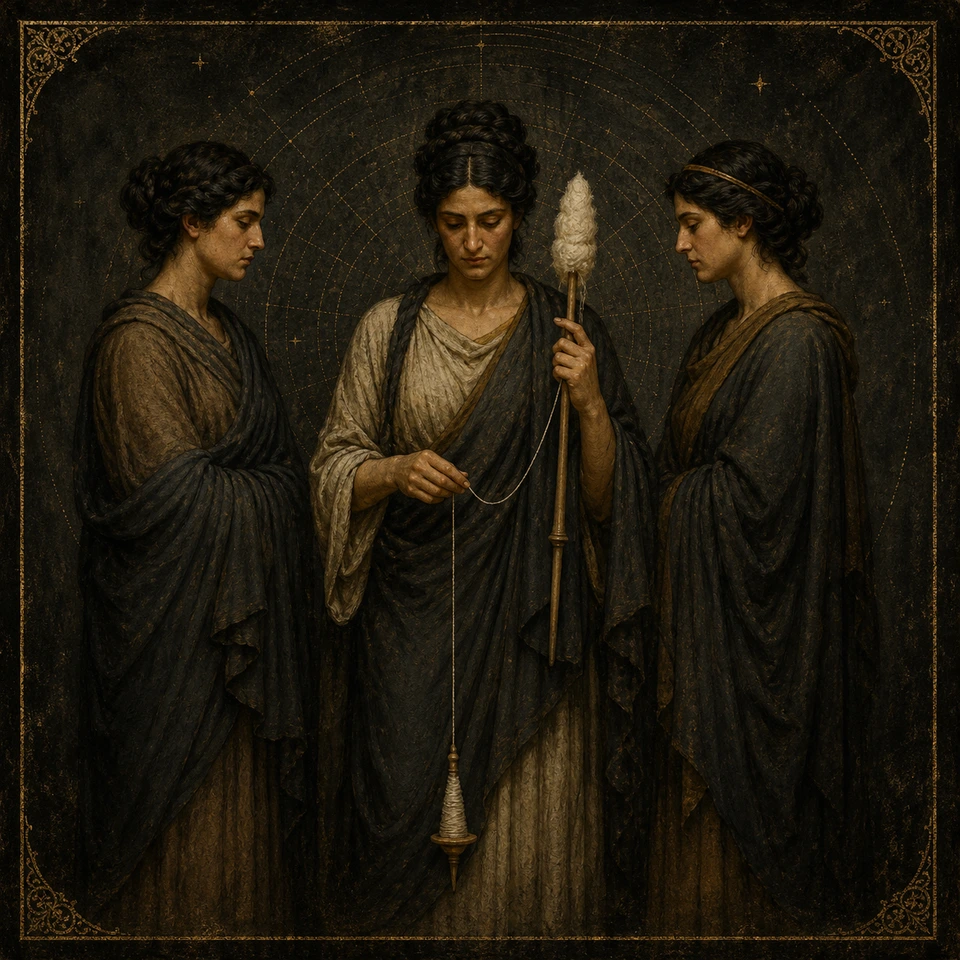
Dictating the inflexible parameters of mortal existence, the Moirai manifest as the three formidable Fates known as Clotho, Lachesis, and Atropos. Their terrifying authority over birth allotment is heavily documented across ancient genealogy, sacred cult sites, and deep philosophical cosmology.
Overview
A woman reaches into the hearth and lifts out a burning brand. Her son is seven days old. The Moirai have just declared that his life will end when the wood is consumed, so Althaea smothers the flame and hides the brand in a chest. Years later she will bring it out again. The Fates do not need to stand beside her when she burns it. Their spoken condition has already made a household object carry the limit of Meleager’s life.
This is one face of the Moirai: a Greek divine group whose limits enter birth, choice, divine conflict, and death. Hesiod names Clotho, Lachesis, and Atropos and says that they allot good and evil to mortals at birth, then pursue wrongdoing by gods and humans until punishment is paid. Yet even their family will not hold still. In one passage Night bears them without a partner. Later in the same poem Zeus and Themis become their parents, placing the sisters beside Order, Justice, and Peace. The contradiction is not a mistake to erase. Each genealogy explains something different about fate.
They can also be approached. Apollo obtains from them a condition that lets Admetus escape death if another person volunteers to die instead. Alcestis accepts the cost. Aeschylus preserves a harsher memory of the bargain: the Erinyes accuse Apollo of using wine to beguile the ancient goddesses and overturn an older allotment. One witness calls the change a favor; another calls it corruption. Together they show that even a successful negotiation with fate leaves loss and divine conflict behind.
Plato gives the named sisters their most elaborate ancient scene. Around the spindle of Necessity, Lachesis sings the past, Clotho the present, and Atropos the future. Souls draw lots and choose their next lives. The order comes by lot, but responsibility remains with the chooser. Lachesis assigns the chosen guardian, Clotho ratifies the course, and Atropos makes it irreversible. No shears appear. The familiar later picture of one sister spinning, one measuring, and one cutting should not replace the stranger ancient machinery of choice, song, turning circles, and necessity.
Cult and art bring them out of abstraction. Pausanias saw an oblong altar of the Moirai at Olympia near Zeus Moiragetes, the Guide of Fate. Inside Apollo’s temple at Delphi he saw images of two Moirai with Zeus and Apollo as Guides of Fate standing in place of the third. On the Sophilos Dinos, made around 580 to 570 BC, groups of Fates walk among the gods attending the wedding of Peleus and Thetis. These local arrangements differ, and their differences matter.
The Moirai are the collective; Clotho, Lachesis, and Atropos are its named members. The Greek collective is not interchangeable with its individual members. They are not crones, faceless automata, or proof that human choice is meaningless. The accompanying image presents the complete three-member Hesiodic group, while leaving every visual position unnamed rather than assigning one woman to Clotho, Lachesis, or Atropos. The surviving evidence is strongest when it keeps boundaries visible: life is allotted, choices still occur, consequences follow, and not every limit can be made gentle.
Canonical identity
Canonical Identity
The Moirai constitute a highly specific Greek divine group composed of three sisters identified by Hesiod as Clotho, Lachesis, and Atropos. The collective group and its individual members retain distinct boundaries; Clotho does not serve as an interchangeable name for all the Moirai, and narratives focusing solely on Lachesis do not automatically apply to her sisters. Within accompanying visual artifacts, they frequently appear as three fully draped Greek women representing the complete Hesiodic group, though their distinct roles remain unnamed, and tools like the spindle, thread, distaff, and wool do not reliably assign one figure to a specific sister.
Linguistic Identity
The Moirai are entirely Greek. Because no adequately reviewed ancient pronunciation model is currently available, a fabricated ancient phonetic guide is omitted.
Sources and evidence
TEXTUAL · Supported
Hesiod names the collective Moirai and its three members, Clotho, Lachesis, and Atropos.
- Source
- Hesiod; edited and translated by Hugh G. Evelyn-White, Theogony (1914)
- Reviewed edition
- Hugh G. Evelyn-White English translation in Hesiod, the Homeric Hymns and Homerica, Loeb Classical Library, 1914, Perseus eng1 component · translated by Hugh G. Evelyn-White · edited by Hugh G. Evelyn-White · Perseus Digital Library
- Exact locator
- Entry Theogony · Line 217-220; 901-906
- Scope
- Archaic Greece · Ancient Greece
- Authority
- Hesiod, Theogony
- Certainty
- High
The collective name and the three member names are related but not interchangeable.
Open exact reviewed sourceTEXTUAL · Supported
Plato gives Clotho, Lachesis, and Atropos distinct actions while presenting them together as the daughters of Necessity.
- Source
- Plato; translated by Paul Shorey, Republic, Book 10 (1935)
- Reviewed edition
- Paul Shorey English translation of Plato, Republic, volumes 5-6, Loeb Classical Library, 1935 · translated by Paul Shorey · edited by Paul Shorey · Perseus Digital Library
- Exact locator
- Book 10 · Section 616c-617d
- Scope
- Classical Greece · Ancient Greece
- Authority
- Plato, Republic
- Certainty
- High
Individual action does not turn a member name into an alias for the whole group.
Open exact reviewed source2 reviewed sources for this section
- Hesiod; edited and translated by Hugh G. Evelyn-White, Theogony (1914)Hesiod, the Homeric Hymns and Homerica, London and New York, 1914 · Perseus Digital Library / Scaife ATLAS
- Plato; translated by Paul Shorey, Republic, Book 10 (1935)Paul Shorey English translation, Republic volumes 5-6, Loeb Classical Library, 1935 · Perseus Digital Library
Culture, tradition, period, and place
The Moirai move through Archaic genealogy, Classical tragedy and philosophy, Attic painted pottery, later mythography, and Pausanias’s second-century AD account of Greek sanctuaries. These witnesses do not form one frozen creed. Each place and genre shows what fate means there.
The Sophilos Dinos brings groups of Fates into a divine wedding procession around 580 to 570 BC. Aeschylus turns an older allotment into a courtroom accusation against Apollo. Plato builds a cosmic spindle around the named sisters. Olympia has an altar, and Delphi places two images beside Zeus and Apollo as Guides of Fate. Calydon and Pherae belong to narrative geography rather than secure centers of their worship.
Sources and evidence
MATERIAL CULTURE · Supported
The Sophilos Dinos places groups of Fates in an Attic black-figure divine wedding procession around 580 to 570 BC.
- Source
- British Museum, British Museum Collection
- Reviewed edition
- British Museum object record 1971,1101.1, The Sophilos Dinos, Attic black-figure dinos and stand · British Museum
- Exact locator
- MuseumObjectId 1971,1101.1 · Entry Object description; circa 580-570 BC
- Scope
- Archaic Greece · Attica
- Authority
- British Museum, Sophilos Dinos catalogue
- Certainty
- High
The museum catalogue establishes the object's accession, date, and depicted procession; Hesiodic genealogy is attested separately.
Open exact reviewed sourceTEXTUAL · Supported
Aeschylus gives the Moirai a contested dramatic role when the Erinyes accuse Apollo of corrupting an older allotment.
- Source
- Aeschylus; translated by Herbert Weir Smyth, Eumenides (1926)
- Reviewed edition
- Herbert Weir Smyth English translation of Aeschylus, Eumenides, Volume 2, William Heinemann and G. P. Putnam's Sons, 1926, Perseus eng2 component modernized by Perseus · translated by Herbert Weir Smyth · edited by Herbert Weir Smyth · Perseus Digital Library
- Exact locator
- Entry Eumenides · Line 723-728
- Scope
- Classical Greece · Attica
- Authority
- Aeschylus, Eumenides
- Certainty
- High
The philosophical cosmic role is separately attested by Plato.
Open exact reviewed sourceTEXTUAL · Supported
Pausanias preserves Roman-imperial descriptions of Moirai cult and images at Olympia and Delphi.
- Source
- Pausanias; Spiro Greek edition and Jones/Ormerod translation volumes, Description of Greece (1935)
- Reviewed edition
- W. H. S. Jones and H. A. Ormerod English translation volumes, 1918-1935 · translated by W. H. S. Jones and H. A. Ormerod, volume-dependent · Perseus Digital Library / Scaife ATLAS
- Exact locator
- Book 5; 10 · Chapter 15; 24 · Section 5; 4
- Scope
- Greek religion under Roman imperial rule · Ancient Greece
- Authority
- Pausanias, Description of Greece
- Certainty
- High
These are local sacred settings, not a universal Greek arrangement.
Open exact reviewed sourceTEXTUAL · Supported
Archaic Greek poetry names the collective Moirai and the three sisters within divine genealogy.
- Source
- Hesiod; edited and translated by Hugh G. Evelyn-White, Theogony (1914)
- Reviewed edition
- Hugh G. Evelyn-White English translation in Hesiod, the Homeric Hymns and Homerica, Loeb Classical Library, 1914, Perseus eng1 component · translated by Hugh G. Evelyn-White · edited by Hugh G. Evelyn-White · Perseus Digital Library
- Exact locator
- Entry Theogony · Line 211-225; 901-906
- Scope
- Archaic Greece · Ancient Greece
- Authority
- Hesiod, Theogony
- Certainty
- High
The textual genealogy is distinct from the Sophilos material witness.
Open exact reviewed sourceTEXTUAL · Supported
Plato places the named Moirai around the spindle of Necessity in a Classical philosophical afterlife vision.
- Source
- Plato; translated by Paul Shorey, Republic, Book 10 (1935)
- Reviewed edition
- Paul Shorey English translation of Plato, Republic, volumes 5-6, Loeb Classical Library, 1935 · translated by Paul Shorey · edited by Paul Shorey · Perseus Digital Library
- Exact locator
- Book 10 · Section 616b-621d
- Scope
- Classical Greece · Ancient Greece
- Authority
- Plato, Republic
- Certainty
- High
This is source-scoped philosophical cosmology, not the scene in Aeschylus.
Open exact reviewed source7 reviewed sources for this section
- British Museum, British Museum CollectionLive official museum collection · British Museum
- Aeschylus; translated by Herbert Weir Smyth, Eumenides (1926)1926 Loeb edition hosted by the Perseus Digital Library · Perseus Digital Library
- Pausanias; Spiro Greek edition and Jones/Ormerod translation volumes, Description of Greece (1935)Perseus CTS edition corpus, 1903-1935 · Perseus Digital Library / Scaife ATLAS
- Hesiod; edited and translated by Hugh G. Evelyn-White, Theogony (1914)Hesiod, the Homeric Hymns and Homerica, London and New York, 1914 · Perseus Digital Library / Scaife ATLAS
- Plato; translated by Paul Shorey, Republic, Book 10 (1935)Paul Shorey English translation, Republic volumes 5-6, Loeb Classical Library, 1935 · Perseus Digital Library
- Pseudo-Apollodorus; edited and translated by James G. Frazer, Library (1921)Harvard University Press and William Heinemann edition, 1921 · Perseus Digital Library / Scaife ATLAS
- Euripides; translated by David Kovacs, Alcestis (1994)1994 translation hosted by the Perseus Digital Library · Perseus Digital Library
Historical development
The earliest selected witnesses already resist a single definition. Hesiod gives the group two genealogies and joins birth allotment to punishment. Sophilos places Fates among divine wedding guests around 580 to 570 BC, making collective presence visible in a named procession.
Classical Athens turns them toward argument. Aeschylus lets the Erinyes condemn Apollo for altering an older allotment, while Plato assigns each sister a precise part in a vision of choice and cosmic necessity. Later mythography gathers compact life stories such as Meleager’s brand, Admetus’s substitute, and the bronze clubs used against two Giants. Pausanias then preserves the cult topography of an altar at Olympia and a distinctive image group at Delphi.
Sources and evidence
TEXTUAL · Supported
Hesiod preserves two incompatible genealogies for the named Moirai within the same poem.
- Source
- Hesiod; edited and translated by Hugh G. Evelyn-White, Theogony (1914)
- Reviewed edition
- Hugh G. Evelyn-White English translation in Hesiod, the Homeric Hymns and Homerica, Loeb Classical Library, 1914, Perseus eng1 component · translated by Hugh G. Evelyn-White · edited by Hugh G. Evelyn-White · Perseus Digital Library
- Exact locator
- Entry Theogony · Line 211-225; 901-906
- Scope
- Archaic Greece · Ancient Greece
- Authority
- Hesiod, Theogony
- Certainty
- High
The parentages from Nyx and from Zeus with Themis remain separate.
Open exact reviewed sourceMATERIAL CULTURE · Supported
The Sophilos Dinos places groups of Fates among the gods at the wedding of Peleus and Thetis around 580 to 570 BC.
- Source
- British Museum, British Museum Collection
- Reviewed edition
- British Museum object record 1971,1101.1, The Sophilos Dinos, Attic black-figure dinos and stand · British Museum
- Exact locator
- MuseumObjectId 1971,1101.1 · Entry Object description; circa 580-570 BC
- Scope
- Archaic Greece · Attica
- Authority
- British Museum, Sophilos Dinos catalogue
- Certainty
- High
The accession entry supplies a dated material witness.
Open exact reviewed sourceTEXTUAL · Supported
Plato develops a philosophical afterlife scene in which the named sisters sing time and ratify chosen lives.
- Source
- Plato; translated by Paul Shorey, Republic, Book 10 (1935)
- Reviewed edition
- Paul Shorey English translation of Plato, Republic, volumes 5-6, Loeb Classical Library, 1935 · translated by Paul Shorey · edited by Paul Shorey · Perseus Digital Library
- Exact locator
- Book 10 · Section 616b-621d
- Scope
- Classical Greece · Ancient Greece
- Authority
- Plato, Republic
- Certainty
- High
This source-specific cosmology is later than the Archaic genealogies.
Open exact reviewed source6 reviewed sources for this section
- Hesiod; edited and translated by Hugh G. Evelyn-White, Theogony (1914)Hesiod, the Homeric Hymns and Homerica, London and New York, 1914 · Perseus Digital Library / Scaife ATLAS
- British Museum, British Museum CollectionLive official museum collection · British Museum
- Plato; translated by Paul Shorey, Republic, Book 10 (1935)Paul Shorey English translation, Republic volumes 5-6, Loeb Classical Library, 1935 · Perseus Digital Library
- Pseudo-Apollodorus; edited and translated by James G. Frazer, Library (1921)Harvard University Press and William Heinemann edition, 1921 · Perseus Digital Library / Scaife ATLAS
- Pausanias; Spiro Greek edition and Jones/Ormerod translation volumes, Description of Greece (1935)Perseus CTS edition corpus, 1903-1935 · Perseus Digital Library / Scaife ATLAS
- Aeschylus; translated by Herbert Weir Smyth, Eumenides (1926)1926 Loeb edition hosted by the Perseus Digital Library · Perseus Digital Library
Attested roles and historical themes
Roles, powers, and limits
Hesiod’s Moirai allot good and evil at birth and pursue offenses until punishment is paid. In Meleager’s story, their spoken condition fixes the boundary of a life. In Admetus’s story, Apollo obtains a costly exception. Plato gives the sisters different motions: Lachesis orders and assigns, Clotho confirms, and Atropos makes the chosen course irreversible. Pseudo-Apollodorus also puts bronze clubs in their hands when they kill Agrius and Thoas during the war with the Gigantes.
These actions are not interchangeable powers. The group does not control every event called moira in Greek poetry, and not every reference to fate describes three present goddesses. They do not erase choice in the Myth of Er, where souls remain responsible for the lives they select. Nor does one violent mythographic episode turn the clubs into universal cult attributes.
Sources and evidence
TEXTUAL · Supported
Hesiod says the Moirai allot good and evil at mortal birth and pursue transgression until punishment is paid.
- Source
- Hesiod; edited and translated by Hugh G. Evelyn-White, Theogony (1914)
- Reviewed edition
- Hugh G. Evelyn-White English translation in Hesiod, the Homeric Hymns and Homerica, Loeb Classical Library, 1914, Perseus eng1 component · translated by Hugh G. Evelyn-White · edited by Hugh G. Evelyn-White · Perseus Digital Library
- Exact locator
- Entry Theogony · Line 217-222
- Scope
- Archaic Greece · Ancient Greece
- Authority
- Hesiod, Theogony
- Certainty
- High
Allotment and consequence occur together in this passage.
Open exact reviewed sourceTEXTUAL · Supported
In the Myth of Er, Lachesis orders and assigns, Clotho ratifies, and Atropos makes each chosen course irreversible.
- Source
- Plato; translated by Paul Shorey, Republic, Book 10 (1935)
- Reviewed edition
- Paul Shorey English translation of Plato, Republic, volumes 5-6, Loeb Classical Library, 1935 · translated by Paul Shorey · edited by Paul Shorey · Perseus Digital Library
- Exact locator
- Book 10 · Section 617d-620e
- Scope
- Classical Greece · Ancient Greece
- Authority
- Plato, Republic
- Certainty
- High
The lot establishes order of choice while responsibility remains with the chooser.
Open exact reviewed sourceTEXTUAL · Supported
Pseudo-Apollodorus makes the Moirai armed combatants who kill the Giants Agrius and Thoas with bronze clubs.
- Source
- Pseudo-Apollodorus; edited and translated by James G. Frazer, Library (1921)
- Reviewed edition
- James G. Frazer edition and English translation, Harvard University Press and William Heinemann, 1921 · translated by James G. Frazer · edited by James G. Frazer · Perseus Digital Library / Scaife ATLAS
- Exact locator
- Book 1 · Chapter 6 · Section 2
- Scope
- Greek religion under Roman imperial rule · Ancient Greece
- Authority
- Pseudo-Apollodorus, Library
- Certainty
- High
This later mythographic role does not define their cult iconography.
Open exact reviewed source3 reviewed sources for this section
- Hesiod; edited and translated by Hugh G. Evelyn-White, Theogony (1914)Hesiod, the Homeric Hymns and Homerica, London and New York, 1914 · Perseus Digital Library / Scaife ATLAS
- Plato; translated by Paul Shorey, Republic, Book 10 (1935)Paul Shorey English translation, Republic volumes 5-6, Loeb Classical Library, 1935 · Perseus Digital Library
- Pseudo-Apollodorus; edited and translated by James G. Frazer, Library (1921)Harvard University Press and William Heinemann edition, 1921 · Perseus Digital Library / Scaife ATLAS
Epithets and titles
No secure epithet belonging to the collective was established. Moiragetes is a title of Zeus and Apollo in Pausanias, not a title transferred to the Moirai.
1 reviewed source for this section
- Pausanias; Spiro Greek edition and Jones/Ormerod translation volumes, Description of Greece (1935)Perseus CTS edition corpus, 1903-1935 · Perseus Digital Library / Scaife ATLAS
Worship and cult
At Olympia, Pausanias walks toward the chariot starting place and finds an altar inscribed for Zeus Moiragetes, the Guide of Fate. Nearby stands an oblong altar of the Moirai. The physical sequence gives the group a place in the sacred landscape and links their allotments to Zeus’s knowledge of human affairs.
The passage establishes cult presence without supplying a priesthood, daily service, sacrifice, prayer, or annual calendar. That silence does not weaken the altar itself. It limits what can be reconstructed about the people who approached it.
Sources and evidence
TEXTUAL · Supported
Pausanias saw an oblong altar of the Moirai beside an altar of Zeus Moiragetes at Olympia.
- Source
- Pausanias; Spiro Greek edition and Jones/Ormerod translation volumes, Description of Greece (1935)
- Reviewed edition
- W. H. S. Jones and H. A. Ormerod English translation volumes, 1918-1935 · translated by W. H. S. Jones and H. A. Ormerod, volume-dependent · Perseus Digital Library / Scaife ATLAS
- Exact locator
- Book 5 · Chapter 15 · Section 5
- Scope
- Greek religion under Roman imperial rule · Olympia
- Authority
- Pausanias, Description of Greece
- Certainty
- High
The passage establishes cult space but does not name officiants or offerings.
Open exact reviewed source1 reviewed source for this section
- Pausanias; Spiro Greek edition and Jones/Ormerod translation volumes, Description of Greece (1935)Perseus CTS edition corpus, 1903-1935 · Perseus Digital Library / Scaife ATLAS
Temples, sanctuaries, and sacred places
Olympia and Delphi are the strongest secure sacred places in this evidence. The Olympic altar stands among the altars near the hippodrome, close to Zeus Moiragetes and other divine powers. Its context is crowded public sacred ground rather than an isolated temple of the Fates.
At Delphi, their images stand inside Apollo’s temple beside images of Zeus and Apollo as Guides of Fate. This placement ties them to a particular sanctuary’s theology and visual program. The stories of Calydon, Pherae, the Gigantes, and the cosmic spindle remain narrative settings unless separate cult evidence is found.
Sources and evidence
TEXTUAL · Supported
The altar of the Moirai stood in the sacred landscape near Olympia’s chariot starting place.
- Source
- Pausanias; Spiro Greek edition and Jones/Ormerod translation volumes, Description of Greece (1935)
- Reviewed edition
- W. H. S. Jones and H. A. Ormerod English translation volumes, 1918-1935 · translated by W. H. S. Jones and H. A. Ormerod, volume-dependent · Perseus Digital Library / Scaife ATLAS
- Exact locator
- Book 5 · Chapter 15 · Section 5
- Scope
- Greek religion under Roman imperial rule · Olympia
- Authority
- Pausanias, Description of Greece
- Certainty
- High
Its setting is public sacred ground rather than an independently described temple.
Open exact reviewed sourceTEXTUAL · Supported
Inside Apollo’s temple at Delphi, Pausanias saw two Moirai with Zeus Moiragetes and Apollo Moiragetes in place of the third.
- Source
- Pausanias; Spiro Greek edition and Jones/Ormerod translation volumes, Description of Greece (1935)
- Reviewed edition
- W. H. S. Jones and H. A. Ormerod English translation volumes, 1918-1935 · translated by W. H. S. Jones and H. A. Ormerod, volume-dependent · Perseus Digital Library / Scaife ATLAS
- Exact locator
- Book 10 · Chapter 24 · Section 4
- Scope
- Greek religion under Roman imperial rule · Delphi
- Authority
- Pausanias, Description of Greece
- Certainty
- High
The arrangement is specifically Delphic.
Open exact reviewed source1 reviewed source for this section
- Pausanias; Spiro Greek edition and Jones/Ormerod translation volumes, Description of Greece (1935)Perseus CTS edition corpus, 1903-1935 · Perseus Digital Library / Scaife ATLAS
Festivals and processions
No securely named annual festival devoted only to the Moirai is established by these sources. The Sophilos Dinos does show groups of Fates walking in the procession of gods who attend the wedding of Peleus and Thetis. Painted movement places them inside a divine celebration, but a mythic wedding procession on pottery is not a civic festival calendar.
The distinction matters because an ancient image can preserve participation in a story without revealing what worshippers did on a recurring date. No seasonal observance or modern calendar is derived from the vessel.
Sources and evidence
MATERIAL CULTURE · Supported
The Sophilos Dinos shows the Fates in a mythic wedding procession, not a documented annual civic festival.
- Source
- British Museum, British Museum Collection
- Reviewed edition
- British Museum object record 1971,1101.1, The Sophilos Dinos, Attic black-figure dinos and stand · British Museum
- Exact locator
- MuseumObjectId 1971,1101.1 · Entry Object description; wedding procession
- Scope
- Archaic Greece · Attica
- Authority
- British Museum, Sophilos Dinos catalogue
- Certainty
- High
Painted divine movement cannot establish a ritual calendar by itself.
Open exact reviewed source1 reviewed source for this section
- British Museum, British Museum CollectionLive official museum collection · British Museum
Offerings, votives, and ritual evidence
An altar at Olympia secures a place where cult action could occur, but Pausanias does not name the offering, prayer, officiant, or calendar attached to it. The firm boundary is narrow: an oblong altar of the Moirai existed in that sacred setting, while its ritual sequence remains unknown.
The Sophilos Dinos is a painted wine bowl and stand, not proof that wine was offered to the Moirai. Aeschylus’s charge that Apollo used wine against the old goddesses belongs to hostile tragic speech, not devotional instruction. Thread, lots, firebrands, bronze clubs, and wine act inside particular narratives; none becomes a general offering merely through contact with the group.
Sources and evidence
TEXTUAL · Supported
Pausanias names the Olympia altar but gives no offering, prayer, officiant, or calendar for it.
- Source
- Pausanias; Spiro Greek edition and Jones/Ormerod translation volumes, Description of Greece (1935)
- Reviewed edition
- W. H. S. Jones and H. A. Ormerod English translation volumes, 1918-1935 · translated by W. H. S. Jones and H. A. Ormerod, volume-dependent · Perseus Digital Library / Scaife ATLAS
- Exact locator
- Book 5 · Chapter 15 · Section 5
- Scope
- Greek religion under Roman imperial rule · Olympia
- Authority
- Pausanias, Description of Greece
- Certainty
- High
The altar is secure while its rite sequence remains unknown.
Open exact reviewed sourceTEXTUAL · Supported
Aeschylus makes wine part of the Erinyes’ accusation that Apollo corrupted the ancient goddesses, not a devotional prescription.
- Source
- Aeschylus; translated by Herbert Weir Smyth, Eumenides (1926)
- Reviewed edition
- Herbert Weir Smyth English translation of Aeschylus, Eumenides, Volume 2, William Heinemann and G. P. Putnam's Sons, 1926, Perseus eng2 component modernized by Perseus · translated by Herbert Weir Smyth · edited by Herbert Weir Smyth · Perseus Digital Library
- Exact locator
- Entry Eumenides · Line 723-728
- Scope
- Classical Greece · Attica
- Authority
- Aeschylus, Eumenides
- Certainty
- High
Hostile tragic speech cannot be converted into a general offering.
Open exact reviewed source5 reviewed sources for this section
- Pausanias; Spiro Greek edition and Jones/Ormerod translation volumes, Description of Greece (1935)Perseus CTS edition corpus, 1903-1935 · Perseus Digital Library / Scaife ATLAS
- Aeschylus; translated by Herbert Weir Smyth, Eumenides (1926)1926 Loeb edition hosted by the Perseus Digital Library · Perseus Digital Library
- British Museum, British Museum CollectionLive official museum collection · British Museum
- Plato; translated by Paul Shorey, Republic, Book 10 (1935)Paul Shorey English translation, Republic volumes 5-6, Loeb Classical Library, 1935 · Perseus Digital Library
- Pseudo-Apollodorus; edited and translated by James G. Frazer, Library (1921)Harvard University Press and William Heinemann edition, 1921 · Perseus Digital Library / Scaife ATLAS
Iconography and material culture
The Sophilos Dinos gives the clearest Archaic collective image in this evidence: groups of Fates walk between chariots in the divine wedding procession. At Delphi, Pausanias describes another local solution, two images of Moirai accompanied by Zeus Moiragetes and Apollo Moiragetes in place of the third. Neither witness justifies a universal costume or fixed pose.
Plato’s spindle supplies ancient textile imagery for the three named sisters, but his details are precise. Clotho turns the outer circumference, Atropos the inner circles, and Lachesis assists both. Atropos carries no shears in this passage. The accompanying portrait shows exactly three living women, with one central figure operating a distaff and spindle, but it leaves all three positions unnamed.
Sources and evidence
MATERIAL CULTURE · Supported
The Sophilos Dinos depicts groups of Fates walking between chariots in a divine wedding procession.
- Source
- British Museum, British Museum Collection
- Reviewed edition
- British Museum object record 1971,1101.1, The Sophilos Dinos, Attic black-figure dinos and stand · British Museum
- Exact locator
- MuseumObjectId 1971,1101.1 · Entry Object description; circa 580-570 BC
- Scope
- Archaic Greece · Attica
- Authority
- British Museum, Sophilos Dinos catalogue
- Certainty
- High
This is the strongest dated collective image in the selected evidence.
Open exact reviewed sourceTEXTUAL · Supported
Pausanias describes a local Delphic image group with two Moirai and two male Guides of Fate.
- Source
- Pausanias; Spiro Greek edition and Jones/Ormerod translation volumes, Description of Greece (1935)
- Reviewed edition
- W. H. S. Jones and H. A. Ormerod English translation volumes, 1918-1935 · translated by W. H. S. Jones and H. A. Ormerod, volume-dependent · Perseus Digital Library / Scaife ATLAS
- Exact locator
- Book 10 · Chapter 24 · Section 4
- Scope
- Greek religion under Roman imperial rule · Delphi
- Authority
- Pausanias, Description of Greece
- Certainty
- High
The local composition differs from the Hesiodic triad.
Open exact reviewed sourceTEXTUAL · Supported
Plato places the three sisters around Necessity’s spindle and assigns each a different motion.
- Source
- Plato; translated by Paul Shorey, Republic, Book 10 (1935)
- Reviewed edition
- Paul Shorey English translation of Plato, Republic, volumes 5-6, Loeb Classical Library, 1935 · translated by Paul Shorey · edited by Paul Shorey · Perseus Digital Library
- Exact locator
- Book 10 · Section 616b-617d
- Scope
- Classical Greece · Ancient Greece
- Authority
- Plato, Republic
- Certainty
- High
The passage gives no shears or measuring rod.
Open exact reviewed source3 reviewed sources for this section
- British Museum, British Museum CollectionLive official museum collection · British Museum
- Pausanias; Spiro Greek edition and Jones/Ormerod translation volumes, Description of Greece (1935)Perseus CTS edition corpus, 1903-1935 · Perseus Digital Library / Scaife ATLAS
- Plato; translated by Paul Shorey, Republic, Book 10 (1935)Paul Shorey English translation, Republic volumes 5-6, Loeb Classical Library, 1935 · Perseus Digital Library
Animals, plants, and embodied forms
No animal or plant is securely established as an exclusive attribute of the Moirai here. The Calydonian boar belongs to Artemis’s anger and Meleager’s hunt, not to the Fates. Their role in that story is the condition pronounced over the infant and the brand.
Their bodies vary by witness. Sophilos shows groups moving in procession. Pausanias sees two images joined by two male Guides of Fate. Plato seats three white-robed, filleted sisters around Necessity’s spindle. These distinct scenes support embodied divine figures without authorizing a single timeless portrait.
Sources and evidence
TEXTUAL · Supported
The Calydonian boar is sent by Artemis and is not described as an animal of the Moirai.
- Source
- Pseudo-Apollodorus; edited and translated by James G. Frazer, Library (1921)
- Reviewed edition
- James G. Frazer edition and English translation, Harvard University Press and William Heinemann, 1921 · translated by James G. Frazer · edited by James G. Frazer · Perseus Digital Library / Scaife ATLAS
- Exact locator
- Book 1 · Chapter 8 · Section 2
- Scope
- Greek religion under Roman imperial rule · Calydon
- Authority
- Pseudo-Apollodorus, Library
- Certainty
- High
The Moirai enter the same life-story through the firebrand condition.
Open exact reviewed sourceTEXTUAL · Supported
Plato describes three white-robed, filleted sisters seated around the spindle of Necessity.
- Source
- Plato; translated by Paul Shorey, Republic, Book 10 (1935)
- Reviewed edition
- Paul Shorey English translation of Plato, Republic, volumes 5-6, Loeb Classical Library, 1935 · translated by Paul Shorey · edited by Paul Shorey · Perseus Digital Library
- Exact locator
- Book 10 · Section 617b-c
- Scope
- Classical Greece · Ancient Greece
- Authority
- Plato, Republic
- Certainty
- High
This philosophical image is not a universal cult costume.
Open exact reviewed source4 reviewed sources for this section
- Pseudo-Apollodorus; edited and translated by James G. Frazer, Library (1921)Harvard University Press and William Heinemann edition, 1921 · Perseus Digital Library / Scaife ATLAS
- Plato; translated by Paul Shorey, Republic, Book 10 (1935)Paul Shorey English translation, Republic volumes 5-6, Loeb Classical Library, 1935 · Perseus Digital Library
- British Museum, British Museum CollectionLive official museum collection · British Museum
- Pausanias; Spiro Greek edition and Jones/Ormerod translation volumes, Description of Greece (1935)Perseus CTS edition corpus, 1903-1935 · Perseus Digital Library / Scaife ATLAS
Relationships and genealogy
Hesiod preserves a real contradiction. In one passage Nyx bears Clotho, Lachesis, and Atropos without a partner. In another, Zeus and Themis are their parents. The second birth follows Order, Justice, and Peace, while the first stands among dark powers of mortal limitation and consequence.
The two genealogies remain separate attestations. Zeus and Themis are one parental pair, not two competing alternatives to each other; together they compete with the parentage from Night. Plato offers another philosophical kinship when he calls the Fates daughters of Necessity. That statement belongs to the Myth of Er and does not solve Hesiod’s contradiction.
Sources and evidence
TEXTUAL · Supported
Hesiod first makes the Moirai daughters of Nyx and names Clotho, Lachesis, and Atropos.
- Source
- Hesiod; edited and translated by Hugh G. Evelyn-White, Theogony (1914)
- Reviewed edition
- Hugh G. Evelyn-White English translation in Hesiod, the Homeric Hymns and Homerica, Loeb Classical Library, 1914, Perseus eng1 component · translated by Hugh G. Evelyn-White · edited by Hugh G. Evelyn-White · Perseus Digital Library
- Exact locator
- Entry Theogony · Line 211-225
- Scope
- Archaic Greece · Ancient Greece
- Authority
- Hesiod, Theogony
- Certainty
- High
Night is one complete parentage, not a hidden ancestor in the other version.
Open exact reviewed sourceTEXTUAL · Supported
Later in the same poem, Hesiod makes Zeus and Themis parents of the same three sisters.
- Source
- Hesiod; edited and translated by Hugh G. Evelyn-White, Theogony (1914)
- Reviewed edition
- Hugh G. Evelyn-White English translation in Hesiod, the Homeric Hymns and Homerica, Loeb Classical Library, 1914, Perseus eng1 component · translated by Hugh G. Evelyn-White · edited by Hugh G. Evelyn-White · Perseus Digital Library
- Exact locator
- Entry Theogony · Line 901-906
- Scope
- Archaic Greece · Ancient Greece
- Authority
- Hesiod, Theogony
- Certainty
- High
Zeus and Themis form one parental pair that conflicts with the Nyx genealogy.
Open exact reviewed sourceTEXTUAL · Supported
Plato calls the three Fates daughters of Necessity within the Myth of Er.
- Source
- Plato; translated by Paul Shorey, Republic, Book 10 (1935)
- Reviewed edition
- Paul Shorey English translation of Plato, Republic, volumes 5-6, Loeb Classical Library, 1935 · translated by Paul Shorey · edited by Paul Shorey · Perseus Digital Library
- Exact locator
- Book 10 · Section 617b-c
- Scope
- Classical Greece · Ancient Greece
- Authority
- Plato, Republic
- Certainty
- High
This philosophical kinship remains scoped to Plato’s vision.
Open exact reviewed source2 reviewed sources for this section
- Hesiod; edited and translated by Hugh G. Evelyn-White, Theogony (1914)Hesiod, the Homeric Hymns and Homerica, London and New York, 1914 · Perseus Digital Library / Scaife ATLAS
- Plato; translated by Paul Shorey, Republic, Book 10 (1935)Paul Shorey English translation, Republic volumes 5-6, Loeb Classical Library, 1935 · Perseus Digital Library
Actual myths and source variants
The Moirai enter stories where a life or divine conflict receives a boundary. They pronounce that Meleager will die when a hearth brand burns, then disappear while Althaea saves and later destroys the wood. They grant Apollo a substitution for Admetus, but Alcestis bears the cost. Aeschylus turns that bargain into an accusation that Apollo beguiled older goddesses with wine and overturned their allotment.
Hesiod’s contradictory genealogies explain fate through two cosmic families. Plato’s Myth of Er changes the scale again: souls draw lots, choose lives, and pass through Lachesis, Clotho, and Atropos for assignment, confirmation, and irreversibility. In Pseudo-Apollodorus’s Gigantes war, the group kills Agrius and Thoas with bronze clubs. No single smooth story contains every one of these roles.
Sources and evidence
TEXTUAL · Supported
Pseudo-Apollodorus says the Moirai came when Meleager was seven days old and tied his death to a burning hearth brand.
- Source
- Pseudo-Apollodorus; edited and translated by James G. Frazer, Library (1921)
- Reviewed edition
- James G. Frazer edition and English translation, Harvard University Press and William Heinemann, 1921 · translated by James G. Frazer · edited by James G. Frazer · Perseus Digital Library / Scaife ATLAS
- Exact locator
- Book 1 · Chapter 8 · Section 2
- Scope
- Greek religion under Roman imperial rule · Calydon
- Authority
- Pseudo-Apollodorus, Library
- Certainty
- High
The life-brand is one of two endings preserved for Meleager.
Open exact reviewed sourceTEXTUAL · Supported
Pseudo-Apollodorus says Apollo gained a death-substitution condition for Admetus from the Fates.
- Source
- Pseudo-Apollodorus; edited and translated by James G. Frazer, Library (1921)
- Reviewed edition
- James G. Frazer edition and English translation, Harvard University Press and William Heinemann, 1921 · translated by James G. Frazer · edited by James G. Frazer · Perseus Digital Library / Scaife ATLAS
- Exact locator
- Book 1 · Chapter 9 · Section 15
- Scope
- Greek religion under Roman imperial rule · Pherae
- Authority
- Pseudo-Apollodorus, Library
- Certainty
- High
Alcestis bears the mortal cost of the reprieve.
Open exact reviewed sourceTEXTUAL · Supported
In Aeschylus, the Erinyes accuse Apollo of using wine to overturn the ancient allotment in Admetus’s house.
- Source
- Aeschylus; translated by Herbert Weir Smyth, Eumenides (1926)
- Reviewed edition
- Herbert Weir Smyth English translation of Aeschylus, Eumenides, Volume 2, William Heinemann and G. P. Putnam's Sons, 1926, Perseus eng2 component modernized by Perseus · translated by Herbert Weir Smyth · edited by Herbert Weir Smyth · Perseus Digital Library
- Exact locator
- Entry Eumenides · Line 723-728
- Scope
- Classical Greece · Attica
- Authority
- Aeschylus, Eumenides
- Certainty
- High
This hostile version differs from the mythographic bargain.
Open exact reviewed sourceTEXTUAL · Supported
Plato’s Myth of Er makes the named Moirai sing time, cast lots, ratify chosen lives, and make them irreversible.
- Source
- Plato; translated by Paul Shorey, Republic, Book 10 (1935)
- Reviewed edition
- Paul Shorey English translation of Plato, Republic, volumes 5-6, Loeb Classical Library, 1935 · translated by Paul Shorey · edited by Paul Shorey · Perseus Digital Library
- Exact locator
- Book 10 · Section 616b-621d
- Scope
- Classical Greece · Ancient Greece
- Authority
- Plato, Republic
- Certainty
- High
The scene preserves responsibility alongside allotment.
Open exact reviewed sourceTEXTUAL · Supported
Pseudo-Apollodorus includes the Moirai in the war with the Gigantes, where they kill Agrius and Thoas.
- Source
- Pseudo-Apollodorus; edited and translated by James G. Frazer, Library (1921)
- Reviewed edition
- James G. Frazer edition and English translation, Harvard University Press and William Heinemann, 1921 · translated by James G. Frazer · edited by James G. Frazer · Perseus Digital Library / Scaife ATLAS
- Exact locator
- Book 1 · Chapter 6 · Section 2
- Scope
- Greek religion under Roman imperial rule · Ancient Greece
- Authority
- Pseudo-Apollodorus, Library
- Certainty
- High
Their bronze clubs belong to this battle witness.
Open exact reviewed source4 reviewed sources for this section
- Pseudo-Apollodorus; edited and translated by James G. Frazer, Library (1921)Harvard University Press and William Heinemann edition, 1921 · Perseus Digital Library / Scaife ATLAS
- Aeschylus; translated by Herbert Weir Smyth, Eumenides (1926)1926 Loeb edition hosted by the Perseus Digital Library · Perseus Digital Library
- Plato; translated by Paul Shorey, Republic, Book 10 (1935)Paul Shorey English translation, Republic volumes 5-6, Loeb Classical Library, 1935 · Perseus Digital Library
- Hesiod; edited and translated by Hugh G. Evelyn-White, Theogony (1914)Hesiod, the Homeric Hymns and Homerica, London and New York, 1914 · Perseus Digital Library / Scaife ATLAS
Myth Library
Each myth gathers its attested participants into one source-grounded account, while distinct source traditions remain readable in their own variants.
Theogony
The Two Genealogies of the Moirai
Hesiod gives the Moirai two different parentages, first as daughters of Night and later as daughters of Zeus and Themis.
- Role in this profile
- enter two different genealogies and allot good and evil at mortal birth
- Place scope
- Ancient Greece
- Witnesses
- 2
- Variants
- 2
Heroic
The Calydonian Boar Hunt
When Oeneus omits Artemis from the first-fruit offerings, she sends a devastating boar; the hunt ends with Atalanta winning the first wound, Meleager killing the beast, and a quarrel over the hide turning victory into family bloodshed.
- Role in this profile
- pronounce the infant Meleager’s death condition over the burning hearth brand
- Place scope
- Calydon
- Witnesses
- 1
- Variants
- 1
Mythographic Synthesis
The Cyclopes, Apollo's Service to Admetus, and the Fates
After Zeus kills Asclepius, Apollo kills the Cyclopes and serves Admetus; he gains a death-substitution condition from the Fates, while Aeschylus preserves the Erinyes’ accusation that he corrupted an older allotment.
- Role in this profile
- powers whom Apollo deceives or persuades into allowing a substitute death
- Place scope
- Pherae
- Witnesses
- 4
- Variants
- 3
Philosophical Literary
The Moirai at the Spindle of Necessity
In Plato’s Myth of Er, the three Fates sing time around Necessity’s spindle while souls draw lots and choose their next lives.
- Role in this profile
- sit around Necessity’s spindle and preside over the allotment and ratification of lives
- Place scope
- Ancient Greece
- Witnesses
- 1
- Variants
- 1
Mythographic Synthesis
Gaia and the Gigantes
Pseudo-Apollodorus makes Gaia bear the Gigantes in anger over the Titans and seek a protective drug before their war with the gods; the Pergamon Altar adds Phoibe’s long-torch combat beside Asteria.
- Role in this profile
- kill Agrius and Thoas with bronze clubs
- Place scope
- Ancient Greece · Pergamon
- Witnesses
- 2
- Variants
- 2
Equivalences, syncretisms, and identity boundaries
The collective and its members remain distinct. Clotho, Lachesis, and Atropos can act separately, as in Plato, without each becoming a title for all the Moirai. Translation as Fates is useful English, but it can blur the source-specific actions of the named sisters.
Zeus Moiragetes and Apollo Moiragetes are Guides of Fate in Pausanias; they do not become members of the Moirai. Abstract moira in a poem likewise does not always mean the three goddesses have entered the scene. Shared function or a similar number of figures cannot establish identity across cultures.
Sources and evidence
TEXTUAL · Supported
Hesiod’s collective Moirai and the three named sisters are related identities, but a member name is not an alias for the group.
- Source
- Hesiod; edited and translated by Hugh G. Evelyn-White, Theogony (1914)
- Reviewed edition
- Hugh G. Evelyn-White English translation in Hesiod, the Homeric Hymns and Homerica, Loeb Classical Library, 1914, Perseus eng1 component · translated by Hugh G. Evelyn-White · edited by Hugh G. Evelyn-White · Perseus Digital Library
- Exact locator
- Entry Theogony · Line 217-220; 901-906
- Scope
- Archaic Greece · Ancient Greece
- Authority
- Hesiod, Theogony
- Certainty
- High
The profile preserves collective and member identity.
Open exact reviewed sourceTEXTUAL · Supported
Pausanias calls Zeus and Apollo Moiragetes while continuing to distinguish them from the Moirai.
- Source
- Pausanias; Spiro Greek edition and Jones/Ormerod translation volumes, Description of Greece (1935)
- Reviewed edition
- W. H. S. Jones and H. A. Ormerod English translation volumes, 1918-1935 · translated by W. H. S. Jones and H. A. Ormerod, volume-dependent · Perseus Digital Library / Scaife ATLAS
- Exact locator
- Book 5; 10 · Chapter 15; 24 · Section 5; 4
- Scope
- Greek religion under Roman imperial rule · Ancient Greece
- Authority
- Pausanias, Description of Greece
- Certainty
- High
Guide of Fate is not membership in the Moirai.
Open exact reviewed source3 reviewed sources for this section
- Hesiod; edited and translated by Hugh G. Evelyn-White, Theogony (1914)Hesiod, the Homeric Hymns and Homerica, London and New York, 1914 · Perseus Digital Library / Scaife ATLAS
- Pausanias; Spiro Greek edition and Jones/Ormerod translation volumes, Description of Greece (1935)Perseus CTS edition corpus, 1903-1935 · Perseus Digital Library / Scaife ATLAS
- Plato; translated by Paul Shorey, Republic, Book 10 (1935)Paul Shorey English translation, Republic volumes 5-6, Loeb Classical Library, 1935 · Perseus Digital Library
Correspondence index
The strongest associations come from ancient action and objects: birth allotment, consequence after wrongdoing, lots, spindle work, the Meleager firebrand, the Olympic altar, and the Delphic images. Each belongs to a named passage, object, or sacred place.
No planet, zodiac sign, gemstone, color, classical element, weekday, moon phase, incense, plant, animal, or season is securely attached to the Moirai by this evidence. Fate alone does not justify assigning a familiar occult cluster. The supported themes are allotment, responsibility, consequence, and human limits, not a promise that destiny can be controlled.
Direct ancient correspondences
| Category | Direct correspondence | How and why | Evidence boundary |
|---|---|---|---|
| direction-place | Olympia and DelphiDirect historical association | Pausanias places an altar of the Moirai at Olympia and images of two Moirai inside Apollo’s temple at Delphi. | Ancient Cultic These are named sacred places, not a compass direction or a claim of uniform Greek worship. 1 reviewed source for this section
|
Contextual evidence, not a general correspondence
| Category | Direct correspondence | How and why | Evidence boundary |
|---|---|---|---|
| metal-material | Thread, spindle, pottery, and the hearth brandContextual evidence only | Textile tools, a painted vessel, and a burning piece of wood carry meaning in specific witnesses. | Ancient Material These materials remain bound to the particular scene and do not become universal sacred substances. 3 reviewed sources for this section
|
| modern-offerings | Altar attested, offering unspecifiedContextual evidence only | The oblong altar at Olympia proves cult space but Pausanias does not name what worshippers placed upon it. | Ancient Cultic No historical offering recipe is reconstructed from the altar alone. 1 reviewed source for this section
|
| ritual-object-symbol-tool | Lots and spindleContextual evidence only | Plato makes lots and the spindle central to the Myth of Er, where souls choose lives and the sisters ratify them. | Ancient Literary These philosophical objects are not presented as ordinary household tools for changing fate. 1 reviewed source for this section
|
| intention-magical-power | Allotment, consequence, responsibility, and life limitsContextual evidence only | Hesiod joins birth allotment to consequence, while Plato joins lots to accountable choice and irreversible result. | Ancient Literary These ancient themes do not promise magical control over destiny. 2 reviewed sources for this section
|
11 expected categories currently not evidenced
celestial-body · Not evidenced
No celestial body
The spindle in Plato carries the heavens, but the Moirai are not identified as a planet, star, or constellation.
- Layer
- Research Boundary
- Scope
- No celestial body remains unassigned until a dated source demonstrates the link.
zodiac · Not evidenced
No zodiac sign
Cosmic motion in the Myth of Er does not establish a zodiac rulership.
- Layer
- Research Boundary
- Scope
- No zodiac sign remains unassigned until a dated source demonstrates the link.
gemstone-crystal-mineral · Not evidenced
No gemstone or mineral
No stone or mineral is securely attached to their cult, myths, or ancient images here.
- Layer
- Research Boundary
- Scope
- No gemstone or mineral remains unassigned until a dated source demonstrates the link.
plant-tree · Not evidenced
No plant or tree
The reviewed passages do not give the group an exclusive sacred plant.
- Layer
- Research Boundary
- Scope
- No plant or tree remains unassigned until a dated source demonstrates the link.
animal · Not evidenced
No animal
The Calydonian boar belongs to Artemis and the hunt, not to the Moirai.
- Layer
- Research Boundary
- Scope
- No animal remains unassigned until a dated source demonstrates the link.
color · Not evidenced
No canonical color
Plato dresses the sisters in white within one philosophical vision; that scene does not prove a general cult color.
- Layer
- Research Boundary
- Scope
- No canonical color remains unassigned until a dated source demonstrates the link.
classical-element · Not evidenced
No classical element
Fire consumes Meleager’s brand, but the element belongs to that death condition rather than a broad rulership.
- Layer
- Research Boundary
- Scope
- No classical element remains unassigned until a dated source demonstrates the link.
weekday · Not evidenced
No weekday
No day of the week is securely attached to the Moirai in this evidence.
- Layer
- Research Boundary
- Scope
- No weekday remains unassigned until a dated source demonstrates the link.
moon-phase · Not evidenced
No moon phase
No lunar phase is securely attached to the group.
- Layer
- Research Boundary
- Scope
- No moon phase remains unassigned until a dated source demonstrates the link.
festival-time · Not evidenced
No secure festival time
A divine wedding procession and an altar near the Olympic hippodrome do not establish an annual Moirai festival.
- Layer
- Research Boundary
- Scope
- No secure festival time remains unassigned until a dated source demonstrates the link.
incense-perfume · Not evidenced
No incense or resin
No fumigant or perfume is securely specified for them.
- Layer
- Research Boundary
- Scope
- No incense or resin remains unassigned until a dated source demonstrates the link.
Sources and evidence
TEXTUAL · Supported
Plato supplies an ancient correspondence to spindle work through the cosmic spindle of Necessity.
- Source
- Plato; translated by Paul Shorey, Republic, Book 10 (1935)
- Reviewed edition
- Paul Shorey English translation of Plato, Republic, volumes 5-6, Loeb Classical Library, 1935 · translated by Paul Shorey · edited by Paul Shorey · Perseus Digital Library
- Exact locator
- Book 10 · Section 616b-617d
- Scope
- Classical Greece · Ancient Greece
- Authority
- Plato, Republic
- Certainty
- High
They do not establish a universal sacred material.
Open exact reviewed sourceMATERIAL CULTURE · Supported
The Sophilos Dinos is a material witness to the Fates in procession, not a prescribed ritual vessel for them.
- Source
- British Museum, British Museum Collection
- Reviewed edition
- British Museum object record 1971,1101.1, The Sophilos Dinos, Attic black-figure dinos and stand · British Museum
- Exact locator
- MuseumObjectId 1971,1101.1 · Entry Object description
- Scope
- Archaic Greece · Attica
- Authority
- British Museum, Sophilos Dinos catalogue
- Certainty
- High
Object context remains distinct from offering practice.
Open exact reviewed sourceTEXTUAL · Supported
The Meleager firebrand carries a life condition inside one myth and is not a general sacred material.
- Source
- Pseudo-Apollodorus; edited and translated by James G. Frazer, Library (1921)
- Reviewed edition
- James G. Frazer edition and English translation, Harvard University Press and William Heinemann, 1921 · translated by James G. Frazer · edited by James G. Frazer · Perseus Digital Library / Scaife ATLAS
- Exact locator
- Book 1 · Chapter 8 · Section 2
- Scope
- Greek religion under Roman imperial rule · Calydon
- Authority
- Pseudo-Apollodorus, Library
- Certainty
- High
Narrative contact alone does not create a universal correspondence.
Open exact reviewed sourceTEXTUAL · Supported
Olympia is directly connected to the Moirai by their named altar.
- Source
- Pausanias; Spiro Greek edition and Jones/Ormerod translation volumes, Description of Greece (1935)
- Reviewed edition
- W. H. S. Jones and H. A. Ormerod English translation volumes, 1918-1935 · translated by W. H. S. Jones and H. A. Ormerod, volume-dependent · Perseus Digital Library / Scaife ATLAS
- Exact locator
- Book 5 · Chapter 15 · Section 5
- Scope
- Greek religion under Roman imperial rule · Olympia
- Authority
- Pausanias, Description of Greece
- Certainty
- High
This is a historical place connection, not a compass direction.
Open exact reviewed sourceTEXTUAL · Supported
Delphi is directly connected to the Moirai by their images inside Apollo’s temple.
- Source
- Pausanias; Spiro Greek edition and Jones/Ormerod translation volumes, Description of Greece (1935)
- Reviewed edition
- W. H. S. Jones and H. A. Ormerod English translation volumes, 1918-1935 · translated by W. H. S. Jones and H. A. Ormerod, volume-dependent · Perseus Digital Library / Scaife ATLAS
- Exact locator
- Book 10 · Chapter 24 · Section 4
- Scope
- Greek religion under Roman imperial rule · Delphi
- Authority
- Pausanias, Description of Greece
- Certainty
- High
The Delphic arrangement is local.
Open exact reviewed sourceTEXTUAL · Supported
The Olympia altar is attested while the offering placed upon it is unspecified.
- Source
- Pausanias; Spiro Greek edition and Jones/Ormerod translation volumes, Description of Greece (1935)
- Reviewed edition
- W. H. S. Jones and H. A. Ormerod English translation volumes, 1918-1935 · translated by W. H. S. Jones and H. A. Ormerod, volume-dependent · Perseus Digital Library / Scaife ATLAS
- Exact locator
- Book 5 · Chapter 15 · Section 5
- Scope
- Greek religion under Roman imperial rule · Olympia
- Authority
- Pausanias, Description of Greece
- Certainty
- High
No historical offering recipe is reconstructed.
Open exact reviewed sourceTEXTUAL · Supported
Hesiod connects the Moirai with allotment at birth and punishment after wrongdoing.
- Source
- Hesiod; edited and translated by Hugh G. Evelyn-White, Theogony (1914)
- Reviewed edition
- Hugh G. Evelyn-White English translation in Hesiod, the Homeric Hymns and Homerica, Loeb Classical Library, 1914, Perseus eng1 component · translated by Hugh G. Evelyn-White · edited by Hugh G. Evelyn-White · Perseus Digital Library
- Exact locator
- Entry Theogony · Line 217-222
- Scope
- Archaic Greece · Ancient Greece
- Authority
- Hesiod, Theogony
- Certainty
- High
These are ancient literary themes, not promises of magical control.
Open exact reviewed sourceTEXTUAL · Supported
Plato connects lots and chosen lives with responsibility and irreversible consequence.
- Source
- Plato; translated by Paul Shorey, Republic, Book 10 (1935)
- Reviewed edition
- Paul Shorey English translation of Plato, Republic, volumes 5-6, Loeb Classical Library, 1935 · translated by Paul Shorey · edited by Paul Shorey · Perseus Digital Library
- Exact locator
- Book 10 · Section 617d-620e
- Scope
- Classical Greece · Ancient Greece
- Authority
- Plato, Republic
- Certainty
- High
The vision joins choice to necessity.
Open exact reviewed source5 reviewed sources for this section
- Plato; translated by Paul Shorey, Republic, Book 10 (1935)Paul Shorey English translation, Republic volumes 5-6, Loeb Classical Library, 1935 · Perseus Digital Library
- British Museum, British Museum CollectionLive official museum collection · British Museum
- Pseudo-Apollodorus; edited and translated by James G. Frazer, Library (1921)Harvard University Press and William Heinemann edition, 1921 · Perseus Digital Library / Scaife ATLAS
- Pausanias; Spiro Greek edition and Jones/Ormerod translation volumes, Description of Greece (1935)Perseus CTS edition corpus, 1903-1935 · Perseus Digital Library / Scaife ATLAS
- Hesiod; edited and translated by Hugh G. Evelyn-White, Theogony (1914)Hesiod, the Homeric Hymns and Homerica, London and New York, 1914 · Perseus Digital Library / Scaife ATLAS
Later reception and living significance
The familiar later formula in which Clotho spins, Lachesis measures, and Atropos cuts is not narrated as a complete division of labor by these ancient witnesses. Hesiod names the three and joins them in birth allotment. Plato gives temporal songs and spindle motions, and specifically makes Atropos turn inner circles rather than display shears.
The history of the spin, measure, and cut formula requires its own diachronic evidence. A shared contemporary rite, offering, or correspondence remains undocumented. Individual or community practice may exist, but treating it as collective custom requires accountable testimony.
Sources and evidence
TEXTUAL · Supported
Hesiod names the sisters and their shared birth-allotment role without narrating a complete spin, measure, and cut division of labor.
- Source
- Hesiod; edited and translated by Hugh G. Evelyn-White, Theogony (1914)
- Reviewed edition
- Hugh G. Evelyn-White English translation in Hesiod, the Homeric Hymns and Homerica, Loeb Classical Library, 1914, Perseus eng1 component · translated by Hugh G. Evelyn-White · edited by Hugh G. Evelyn-White · Perseus Digital Library
- Exact locator
- Entry Theogony · Line 217-222; 901-906
- Scope
- Archaic Greece · Ancient Greece
- Authority
- Hesiod, Theogony
- Certainty
- High
A later reception study is required for the familiar formula.
Open exact reviewed sourceTEXTUAL · Supported
Plato gives the sisters temporal songs and spindle motions, and assigns Atropos no shears in this scene.
- Source
- Plato; translated by Paul Shorey, Republic, Book 10 (1935)
- Reviewed edition
- Paul Shorey English translation of Plato, Republic, volumes 5-6, Loeb Classical Library, 1935 · translated by Paul Shorey · edited by Paul Shorey · Perseus Digital Library
- Exact locator
- Book 10 · Section 616b-617d
- Scope
- Classical Greece · Ancient Greece
- Authority
- Plato, Republic
- Certainty
- High
The ancient philosophical scene should not be rewritten through later iconography.
Open exact reviewed source2 reviewed sources for this section
- Hesiod; edited and translated by Hugh G. Evelyn-White, Theogony (1914)Hesiod, the Homeric Hymns and Homerica, London and New York, 1914 · Perseus Digital Library / Scaife ATLAS
- Plato; translated by Paul Shorey, Republic, Book 10 (1935)Paul Shorey English translation, Republic volumes 5-6, Loeb Classical Library, 1935 · Perseus Digital Library
Evidence, conflicts, and research gaps
Hesiod secures names, roles, and conflicting parentage. Aeschylus preserves the hostile Admetus accusation. Plato controls the spindle of Necessity. Pseudo-Apollodorus supplies Meleager, Admetus, and the Gigantes battle. Pausanias preserves Olympia and Delphi, and the Sophilos Dinos carries groups of Fates through a painted wedding procession. These witnesses keep different divine families, scenes, places, and objects visible instead of forcing one timeless account.
Important gaps remain. Ancient pronunciation is unresolved. The surviving evidence does not provide a complete ritual schedule, named priesthood, annual festival, standard offering, or universal dress. The Sophilos procession and the Delphic arrangement reveal different visual choices rather than one timeless portrait. Local inscriptions, excavation reports, member-specific cult evidence, and accountable contemporary testimony could deepen the picture.
Sources and evidence
TEXTUAL · Supported
Pausanias secures an altar and a Delphic image group but supplies no complete Moirai priesthood, ritual calendar, or offering list.
- Source
- Pausanias; Spiro Greek edition and Jones/Ormerod translation volumes, Description of Greece (1935)
- Reviewed edition
- W. H. S. Jones and H. A. Ormerod English translation volumes, 1918-1935 · translated by W. H. S. Jones and H. A. Ormerod, volume-dependent · Perseus Digital Library / Scaife ATLAS
- Exact locator
- Book 5; 10 · Chapter 15; 24 · Section 5; 4
- Scope
- Greek religion under Roman imperial rule · Ancient Greece
- Authority
- Pausanias, Description of Greece
- Certainty
- High
Cult presence is secure while institutional detail remains partial.
Open exact reviewed sourceMATERIAL CULTURE · Supported
The Sophilos Dinos preserves groups of Fates walking in an Attic divine wedding procession.
- Source
- British Museum, British Museum Collection
- Reviewed edition
- British Museum object record 1971,1101.1, The Sophilos Dinos, Attic black-figure dinos and stand · British Museum
- Exact locator
- MuseumObjectId 1971,1101.1 · Entry Object description; circa 580-570 BC
- Scope
- Archaic Greece · Attica
- Authority
- British Museum, Sophilos Dinos catalogue
- Certainty
- High
The different Delphic arrangement is separately attested by Pausanias.
Open exact reviewed sourceTEXTUAL · Supported
Pausanias describes a Delphic arrangement of two Moirai beside Zeus and Apollo as Guides of Fate.
- Source
- Pausanias; Spiro Greek edition and Jones/Ormerod translation volumes, Description of Greece (1935)
- Reviewed edition
- W. H. S. Jones and H. A. Ormerod English translation volumes, 1918-1935 · translated by W. H. S. Jones and H. A. Ormerod, volume-dependent · Perseus Digital Library / Scaife ATLAS
- Exact locator
- Book 10 · Chapter 24 · Section 4
- Scope
- Greek religion under Roman imperial rule · Delphi
- Authority
- Pausanias, Description of Greece
- Certainty
- High
The local Delphic composition does not establish a universal portrait type.
Open exact reviewed source6 reviewed sources for this section
- Pausanias; Spiro Greek edition and Jones/Ormerod translation volumes, Description of Greece (1935)Perseus CTS edition corpus, 1903-1935 · Perseus Digital Library / Scaife ATLAS
- British Museum, British Museum CollectionLive official museum collection · British Museum
- Hesiod; edited and translated by Hugh G. Evelyn-White, Theogony (1914)Hesiod, the Homeric Hymns and Homerica, London and New York, 1914 · Perseus Digital Library / Scaife ATLAS
- Aeschylus; translated by Herbert Weir Smyth, Eumenides (1926)1926 Loeb edition hosted by the Perseus Digital Library · Perseus Digital Library
- Plato; translated by Paul Shorey, Republic, Book 10 (1935)Paul Shorey English translation, Republic volumes 5-6, Loeb Classical Library, 1935 · Perseus Digital Library
- Pseudo-Apollodorus; edited and translated by James G. Frazer, Library (1921)Harvard University Press and William Heinemann edition, 1921 · Perseus Digital Library / Scaife ATLAS
Direct connections and evidence
Explicit Source
Hesiod first makes the Moirai daughters of Nyx
This parentage is not merged with the later Zeus and Themis genealogy.
1 attestation · high confidence
- Hesiod; edited and translated by Hugh G. Evelyn-White, TheogonyHugh G. Evelyn-White English translation in Hesiod, the Homeric Hymns and Homerica, Loeb Classical Library, 1914, Perseus eng1 component · translated by Hugh G. Evelyn-White · edited by Hugh G. Evelyn-White · Perseus Digital Library · Archaic Greece · Ancient Greece · Entry Theogony · Line 211-225
Explicit Source
Hesiod later makes the Moirai daughters of Zeus
1 attestation · high confidence
- Hesiod; edited and translated by Hugh G. Evelyn-White, TheogonyHugh G. Evelyn-White English translation in Hesiod, the Homeric Hymns and Homerica, Loeb Classical Library, 1914, Perseus eng1 component · translated by Hugh G. Evelyn-White · edited by Hugh G. Evelyn-White · Perseus Digital Library · Archaic Greece · Ancient Greece · Entry Theogony · Line 901-906
Explicit Source
Hesiod later makes the Moirai daughters of Themis
1 attestation · high confidence
- Hesiod; edited and translated by Hugh G. Evelyn-White, TheogonyHugh G. Evelyn-White English translation in Hesiod, the Homeric Hymns and Homerica, Loeb Classical Library, 1914, Perseus eng1 component · translated by Hugh G. Evelyn-White · edited by Hugh G. Evelyn-White · Perseus Digital Library · Archaic Greece · Ancient Greece · Entry Theogony · Line 901-906
Explicit Source
Apollo appears as Moiragetes beside the Moirai at Delphi
Pausanias distinguishes Apollo as Guide of Fate from the Moirai beside him.
1 attestation · high confidence
- Pausanias; Spiro Greek edition and Jones/Ormerod translation volumes, Description of GreeceW. H. S. Jones and H. A. Ormerod English translation volumes, 1918-1935 · translated by W. H. S. Jones and H. A. Ormerod, volume-dependent · Perseus Digital Library / Scaife ATLAS · Greek religion under Roman imperial rule · Delphi · Book 10 · Chapter 24 · Section 4
Explicit Source
Zeus Moiragetes is placed beside the Moirai at Olympia and Delphi
The local cult and image settings support association without making Zeus a member of the group.
2 attestations · high confidence
- Pausanias; Spiro Greek edition and Jones/Ormerod translation volumes, Description of GreeceW. H. S. Jones and H. A. Ormerod English translation volumes, 1918-1935 · translated by W. H. S. Jones and H. A. Ormerod, volume-dependent · Perseus Digital Library / Scaife ATLAS · Greek religion under Roman imperial rule · Olympia · Book 5 · Chapter 15 · Section 5
- Pausanias; Spiro Greek edition and Jones/Ormerod translation volumes, Description of GreeceW. H. S. Jones and H. A. Ormerod English translation volumes, 1918-1935 · translated by W. H. S. Jones and H. A. Ormerod, volume-dependent · Perseus Digital Library / Scaife ATLAS · Greek religion under Roman imperial rule · Delphi · Book 10 · Chapter 24 · Section 4
Archive scope and classification
- Figure classification
- Divine group, Divine personification · certain
- Pantheon or tradition shelf
- Greek
- Cultures
- Greek
- Traditions
- Ancient Greek religion
- Periods
- Archaic Greece, Classical Greece, Greek religion under Roman imperial rule
- Places
- Ancient Greece, Attica, Olympia, Delphi, Calydon
Collective identity, named members, contradictory parentage, major myths, local cult places, material imagery, and correspondence limits are reviewed.
Reviewed sources
- Hesiod; edited and translated by Hugh G. Evelyn-White, Theogony (1914)Hesiod, the Homeric Hymns and Homerica, London and New York, 1914 · Perseus Digital Library / Scaife ATLAS
- Pseudo-Apollodorus; edited and translated by James G. Frazer, Library (1921)Harvard University Press and William Heinemann edition, 1921 · Perseus Digital Library / Scaife ATLAS
- Pausanias; Spiro Greek edition and Jones/Ormerod translation volumes, Description of Greece (1935)Perseus CTS edition corpus, 1903-1935 · Perseus Digital Library / Scaife ATLAS
- British Museum, British Museum CollectionLive official museum collection · British Museum
- Aeschylus; translated by Herbert Weir Smyth, Eumenides (1926)1926 Loeb edition hosted by the Perseus Digital Library · Perseus Digital Library
- Euripides; translated by David Kovacs, Alcestis (1994)1994 translation hosted by the Perseus Digital Library · Perseus Digital Library
- Plato; translated by Paul Shorey, Republic, Book 10 (1935)Paul Shorey English translation, Republic volumes 5-6, Loeb Classical Library, 1935 · Perseus Digital Library