
Greek · God or goddess · Certain
Themis
· Thémis
Pronunciation: /tʰé.mis/ · TEH-miss, with an aspirated t and raised pitch on TEH
Research and editorial review by Cody Manes · Reviewed 2026-08-30
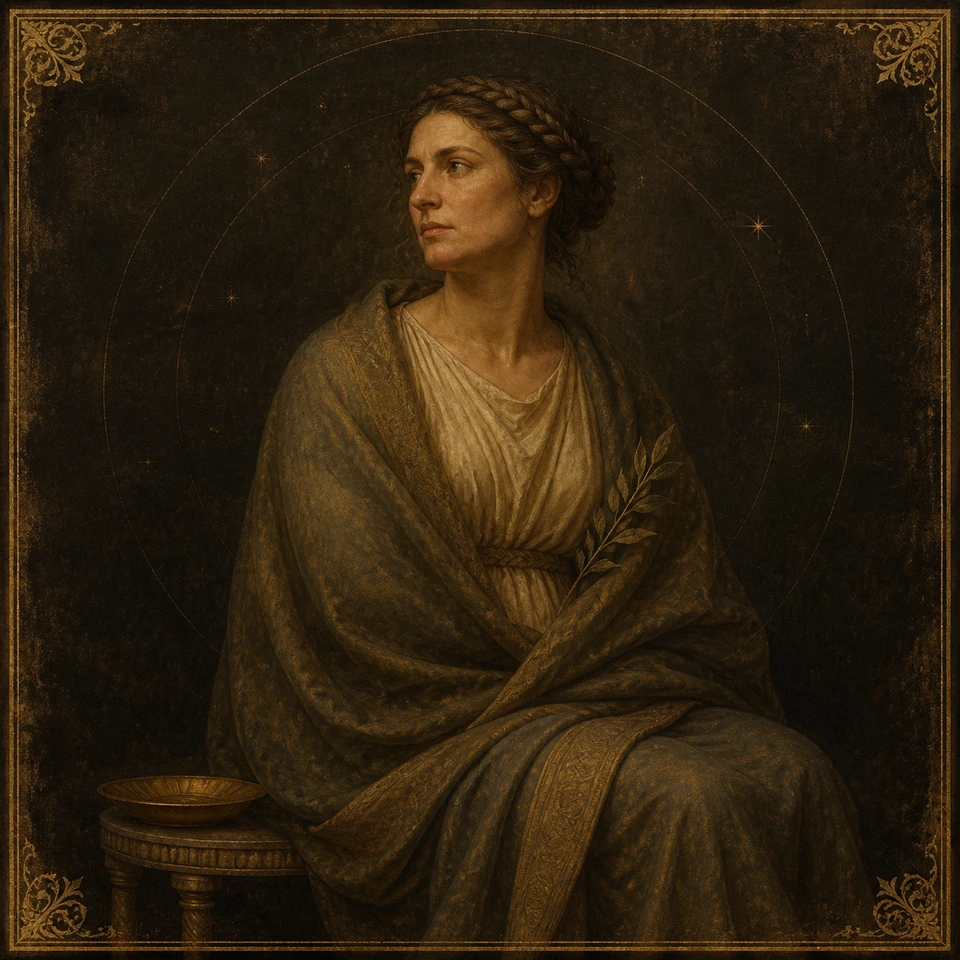
Enforcing the strict boundaries of divine custom and ordered right, Themis wields massive prophetic authority in ancient tradition. Visually preserved as a grave matron holding ritual objects, her deep historical record anchors highly contested ancient councils, sacred prophecies, and enduring cult places.
Overview
Themis enters Greek poetry before courts, codes, and marble halls. In Hesiod she is one of the daughters of Gaia and Ouranos, a first-generation Titaness who remains beside the Olympian order rather than vanishing with the defeated Titans. Zeus takes her as a partner after Metis, and she bears the Horae, Eunomia, Dike, and Eirene, along with the Moirai, Clotho, Lachesis, and Atropos. Established custom, lawful order, peace, and allotted fate become a family without becoming interchangeable.
Homer shows what that position looks like in motion. Themis is first to greet a troubled Hera in the house of Zeus, cup in hand, then leads the gods toward their shared table. When Zeus needs every divine power assembled before battle, he sends Themis. She crosses Olympus with the summons, and even Poseidon rises from the sea to answer. The scene makes her more than a word for law. She is the living condition of council, the one who brings different powers into a place where speech and decision can occur.
Prophecy gives her voice a sharper edge. In Pindar’s Isthmian 8, Zeus and Poseidon desire the sea goddess Thetis. Themis warns that Thetis will bear a son stronger than his father, capable of wielding a weapon beyond thunderbolt or trident. Her answer is political as well as prophetic: let Thetis marry the mortal Peleus. Achilles will be born, divine supremacy will remain intact, and the future will still take its terrible course.
Delphi preserves more than one memory of her authority. Aeschylus has the Pythia name Gaia, Themis, Phoebe, and Apollo in a peaceful chain of possession. Pseudo-Apollodorus instead says Apollo arrives while Themis gives oracles and kills Python before taking the sanctuary. A Classical Attic kylix names Themis in a consultation scene with Aigeus. She sits on a great tripod, looks into a phiale, and holds a small laurel branch. Pausanias adds another peaceful transfer in which Earth gives Delphi to Themis, Themis gives it to Apollo, and Apollo compensates Poseidon with Calaureia. The witnesses agree that she belongs to Delphic imagination, but they do not agree on one history of transfer.
Her cult is not confined to prophecy. Rhamnous preserves the strongest local material body: a marble statue from about 300 BC, dedicated by Megacles and made by Chairestratos. She wears a high-girt chiton, deeply folded himation, and sandals. Pausanias later reports a temple near the Athenian Acropolis, an altar within Olympia’s sacrificial circuit, a temple at Tanagra, and a Theban sanctuary beside the Moirai and Zeus Agoraios.
These ancient forms set a firm boundary around later imagery. The surviving Rhamnous statue and the Berlin kylix do not preserve a blindfold, scales, sword, or gavel; the statue’s missing right forearm and damaged left fingers prevent stronger claims about its original attribute. Marble, tripod, phiale, laurel, sanctuary, assembly, and counsel survive in exact places. Hymn LXXVIII names frankincense fumigation within its own ritual-poetic setting. In Ovid’s Roman Metamorphoses, Themis gives the post-flood riddle; Pseudo-Apollodorus instead gives the stone-throwing command to Zeus and contains no Themis. Hesiod’s two genealogies of the Moirai and Prometheus Bound’s Themis-Gaia identification keep ancient conflict visible. Themis remains ancient, local, spoken, and embodied rather than a universal justice spell.
Canonical identity
Canonical Identity
Themis possesses an unusually rich, yet harmonious, classification. Hesiod groups her among the first Titans, and both her actions and her name directly embody ordered right within human and divine assemblies. Greek poetry attributes to her movement, speech, counsel, a distinct lineage, and a prominent place right at the side of Zeus. A named Classical image portrays her draped at Delphi holding a laurel, phiale, and tripod, directly contradicting modern legal visual equipment. She must never be reduced to the later blindfolded woman clutching scales, nor to a faceless synonym for universal law.
Linguistic Identity
Themis is the Greek Θέμις (Thémis), a name that shares its exact form with a word defining what is permitted, right, or established custom. A fifth-century BC Attic reconstruction yields /tʰé.mis/ (approximately TEH-miss with an aspirated t), though the English guide fails to mirror the ancient pitch accent exactly.
Sources and evidence
SCHOLARLY INTERPRETATION · Supported
The Greek name is Θέμις, transliterated Thémis.
- Source
- Henry George Liddell and Robert Scott; Scaife ATLAS, θέμις and Θέμις, LSJ entry
- Reviewed edition
- LSJ digital entry θέμις, Scaife ATLAS URN lsj-n48121 · Tufts University
- Exact locator
- Entry LSJ θέμις and proper Θέμις · RecordUrl https://atlas.perseus.tufts.edu/dictionaries/entry/urn%3Acite2%3Ascaife-viewer%3Adictionaries.v1%3Alsj-n48121/
- Scope
- Classical Greece · Ancient Greece
- Authority
- LSJ historical lexicon
- Certainty
- Qualified lexical evidence
The written accent and proper form belong to the exact LSJ headword.
Open exact reviewed sourceSCHOLARLY INTERPRETATION · Supported
A fifth-century BC Attic reconstruction gives the pronunciation /tʰé.mis/.
- Source
- Herbert Weir Smyth, A Greek Grammar for Colleges (1920)
- Reviewed edition
- Herbert Weir Smyth, A Greek Grammar for Colleges, American Book Company, 1920; Perseus text 1999.04.0007 · Perseus Digital Library
- Exact locator
- Entry A Greek Grammar for Colleges · Section §§1, 24, 150 · RecordUrl https://www.perseus.tufts.edu/hopper/text?doc=Perseus:text:1999.04.0007
- Scope
- Classical Greece · Athens
- Authority
- Smyth historical Greek grammar
- Certainty
- Qualified reconstruction
The reconstruction remains qualified because English stress can only approximate ancient Greek pitch.
Open exact reviewed sourceTEXTUAL · Supported
Hesiod names Themis as a daughter of Gaia and Ouranos within the first Titan generation.
- Source
- Hesiod; edited and translated by Hugh G. Evelyn-White, Theogony (1914)
- Reviewed edition
- Hugh G. Evelyn-White edition and English translation in Hesiod, the Homeric Hymns and Homerica, 1914 · translated by Hugh G. Evelyn-White · edited by Hugh G. Evelyn-White · Perseus Digital Library / Scaife ATLAS
- Exact locator
- Entry Theogony · Line 132-138
- Scope
- Archaic Greece · Ancient Greece
- Authority
- Hesiod, Theogony
- Certainty
- Secure within the cited witness
Hesiodic Titan genealogy and later Olympian action belong to one named goddess without making her a faceless abstraction.
Open exact reviewed sourceMATERIAL CULTURE · Supported
The named Classical kylix shows Themis with tripod, mantle, phiale, and laurel rather than modern legal equipment.
- Source
- Staatliche Museen zu Berlin, Antikensammlung, Attic red-figure drinking cup (kylix), F 2538 (2026)
- Reviewed edition
- Online collection entry, updated 29 July 2026 · edited by Staatliche Museen zu Berlin, Antikensammlung · Antikensammlung
- Exact locator
- MuseumObjectId F 2538 · Entry Interior iconography and identifying inscriptions
- Scope
- Classical Greece · Delphi
- Authority
- Staatliche Museen zu Berlin, kylix F 2538
- Certainty
- Secure within the cited witness
The Classical vessel shows neither blindfold nor scales, sword, or gavel.
Open exact reviewed source4 reviewed sources for this section
- Henry George Liddell and Robert Scott; Scaife ATLAS, θέμις and Θέμις, LSJ entryLSJ digital entry with exact headword, inflection, meanings, and personified uses · Tufts University
- Herbert Weir Smyth, A Greek Grammar for Colleges (1920)American Book Company, 1920; Perseus text 1999.04.0007 · Perseus Digital Library
- Hesiod; edited and translated by Hugh G. Evelyn-White, Theogony (1914)Hesiod, the Homeric Hymns and Homerica, London and New York, 1914 · Perseus Digital Library / Scaife ATLAS
- Staatliche Museen zu Berlin, Antikensammlung, Attic red-figure drinking cup (kylix), F 2538 (2026)Online collection entry, updated 29 July 2026 · Antikensammlung
Culture, tradition, period, and place
Archaic poetry locates Themis within the first divine generation after Earth and Sky. Hesiod names her among the daughters of Gaia and Ouranos, then brings her into Zeus’s household as mother of the Horae and Moirai. Her movement across generations is not a tale of defeat. She remains active in the Olympian order as counselor, convener, mother, and prophetic speaker.
Cult evidence is local rather than uniform. Rhamnous in Attica gives her a dense material presence beside Nemesis. Pausanias later sees a temple near the Athenian Acropolis, an altar at Olympia, a temple at Tanagra, and a Theban sanctuary beside the Moirai and Zeus Agoraios. Delphi belongs chiefly to literary and visual sacred history. These places share a goddess, but not one identical ritual program.
Sources and evidence
TEXTUAL · Supported
Hesiod names Themis among the daughters of Gaia and Ouranos and among the first Titans.
- Source
- Hesiod; edited and translated by Hugh G. Evelyn-White, Theogony (1914)
- Reviewed edition
- Hugh G. Evelyn-White edition and English translation in Hesiod, the Homeric Hymns and Homerica, 1914 · translated by Hugh G. Evelyn-White · edited by Hugh G. Evelyn-White · Perseus Digital Library / Scaife ATLAS
- Exact locator
- Entry Theogony · Line 132-138
- Scope
- Archaic Greece · Ancient Greece
- Authority
- Hesiod, Theogony
- Certainty
- Secure within the cited witness
The first divine generation fixes Themis among the Titan daughters before Zeus’s household is formed.
Open exact reviewed sourceTEXTUAL · Supported
Pausanias locates cult places of Themis at Athens, Olympia, Tanagra, Thebes, and other regional settings.
- Source
- Pausanias; Spiro Greek edition and Jones/Ormerod translation volumes, Description of Greece (1935)
- Reviewed edition
- W. H. S. Jones and H. A. Ormerod English translation volumes, 1918-1935 · translated by W. H. S. Jones and H. A. Ormerod, volume-dependent · Perseus Digital Library / Scaife ATLAS
- Exact locator
- Book 1; 5; 9 · Chapter 22; 14; 22; 25 · Section 1; 10; 1; 4
- Scope
- Greek religion under Roman imperial rule · Ancient Greece
- Authority
- Pausanias, Description of Greece
- Certainty
- Secure within the cited witness
Athens, Olympia, Tanagra, and Thebes preserve different local sacred settings rather than one uniform ritual program.
Open exact reviewed sourceTEXTUAL · Supported
The Iliad presents Themis active in Zeus’s Olympian household and divine assemblies.
- Source
- Homer; Monro and Allen Greek edition with edition-specific translations, Iliad (1920)
- Reviewed edition
- A. T. Murray English translation, volumes I-II, 1924-1925 · translated by A. T. Murray · Perseus Digital Library / Scaife ATLAS
- Exact locator
- Entry Iliad · Book 15; 20 · Line 85-100; 4-15
- Scope
- Archaic Greece · Mount Olympus
- Authority
- Homer, Iliad, Murray 1924-1925 English eng3
- Certainty
- Secure within the cited witness
The epic scene belongs to Zeus’s divine household and assembly, not to a local cult calendar.
Open exact reviewed sourceTEXTUAL · Supported
Pindar’s Classical Isthmian 8 gives Themis prophetic speech before Zeus and Poseidon.
- Source
- Pindar; translated by Diane Arnson Svarlien, Odes of Pindar (1990)
- Reviewed edition
- Diane Arnson Svarlien English translation, 1990 · translated by Diane Arnson Svarlien · Tufts University
- Exact locator
- Entry Isthmian 8 · Line 27-49
- Scope
- Classical Greece · Ancient Greece
- Authority
- Pindar, Isthmian 8, Svarlien 1990 English
- Certainty
- Secure within the cited witness
Pindar alone places this counsel inside the contest between Zeus and Poseidon for Thetis.
Open exact reviewed sourceMATERIAL CULTURE · Supported
The Rhamnous marble gives Themis a Hellenistic Attic dedication and named sculptor.
- Source
- National Archaeological Museum; Ministry of Culture; SearchCulture.gr, Statue of Themis of Chairestratos
- Reviewed edition
- National Archive of Monuments object entry · edited by National Archaeological Museum; Ministry of Culture; SearchCulture.gr · National Archaeological Museum, Athens
- Exact locator
- MuseumObjectId National Archaeological Museum 231 · RecordUrl https://www.searchculture.gr/aggregator/edm/mnam/000150-457658?language=en
- Scope
- Hellenistic Greek world · Rhamnous
- Authority
- National Archaeological Museum object record via SearchCulture
- Certainty
- Secure within the cited witness
The official catalogue names the object, date, place, sculptor, and dedication.
Open exact reviewed sourceARCHAEOLOGICAL · Supported
Miles places Themis’s dedications within the Rhamnous sanctuary landscape beside Nemesis.
- Source
- Margaret M. Miles, A Reconstruction of the Temple of Nemesis at Rhamnous (1989)
- Reviewed edition
- Hesperia 58.2, 1989, pages 131-249 · American School of Classical Studies at Athens
- Exact locator
- Page 139-141
- Scope
- Hellenistic Greek world · Rhamnous
- Authority
- Miles, A Reconstruction of the Temple of Nemesis at Rhamnous
- Certainty
- Secure within the cited witness
The local archaeological context is not expanded into a pan-Greek ritual program.
Open exact reviewed source6 reviewed sources for this section
- Hesiod; edited and translated by Hugh G. Evelyn-White, Theogony (1914)Hesiod, the Homeric Hymns and Homerica, London and New York, 1914 · Perseus Digital Library / Scaife ATLAS
- Pausanias; Spiro Greek edition and Jones/Ormerod translation volumes, Description of Greece (1935)Perseus CTS edition corpus, 1903-1935 · Perseus Digital Library / Scaife ATLAS
- Homer; Monro and Allen Greek edition with edition-specific translations, Iliad (1920)Perseus CTS edition corpus; Greek edition, Oxford, 1908-1920 · Perseus Digital Library / Scaife ATLAS
- Pindar; translated by Diane Arnson Svarlien, Odes of Pindar (1990)1990 translation hosted by the Perseus Digital Library · Tufts University
- National Archaeological Museum; Ministry of Culture; SearchCulture.gr, Statue of Themis of ChairestratosNational Archive of Monuments object entry · National Archaeological Museum, Athens
- Margaret M. Miles, A Reconstruction of the Temple of Nemesis at Rhamnous (1989)Hesperia 58.2, pages 131-249 · American School of Classical Studies at Athens
Historical development
Homeric poetry does not pause to explain Themis as an abstraction. She already moves through the house of Zeus. She greets Hera with a cup, asks why the queen is troubled, and later crosses Olympus to summon every god and river except Oceanus into council. The role is social and cosmic at once: assembly happens because Themis calls it into being.
Classical lyric and tragedy sharpen her prophetic authority. Pindar lets her avert a disastrous divine marriage, while Aeschylus makes her one bearer in Delphi’s sacred succession. By about 300 BC, a monumental marble dedication at Rhamnous gives her a high-girt chiton, heavy folds, sandals, name, maker, and worshipper. The literary counselor has become archaeologically visible without losing her older genealogy.
Sources and evidence
TEXTUAL · Supported
In the Iliad, Zeus orders Themis to summon the gods to assembly.
- Source
- Homer; Monro and Allen Greek edition with edition-specific translations, Iliad (1920)
- Reviewed edition
- A. T. Murray English translation, volumes I-II, 1924-1925 · translated by A. T. Murray · Perseus Digital Library / Scaife ATLAS
- Exact locator
- Book 20 · Line 4-15
- Scope
- Archaic Greece · Ancient Greece
- Authority
- Homer, Iliad
- Certainty
- Secure within the cited witness
the Iliad shows Themis acting within epic society rather than defining a later legal system.
Open exact reviewed sourceMATERIAL CULTURE · Supported
The marble Themis from Rhamnous dates to about 300 BC and preserves a dedicatory base naming Chairestratos and Megacles.
- Source
- National Archaeological Museum; Ministry of Culture; SearchCulture.gr, Statue of Themis of Chairestratos
- Reviewed edition
- National Archive of Monuments object entry · edited by National Archaeological Museum; Ministry of Culture; SearchCulture.gr · National Archaeological Museum, Athens
- Exact locator
- MuseumObjectId National Archaeological Museum 231 · RecordUrl https://www.searchculture.gr/aggregator/edm/mnam/000150-457658?language=en
- Scope
- Hellenistic Greek world · Rhamnous
- Authority
- SearchCulture.gr, Themis of Chairestratos object 457658
- Certainty
- Secure within the cited witness
The institutional record dates the Rhamnous marble to about 300 BC and names its maker and dedicator.
Open exact reviewed sourceTEXTUAL · Supported
Isthmian 8 gives Themis a speaking prophetic role that averts a marriage threatening divine supremacy.
- Source
- Pindar; translated by Diane Arnson Svarlien, Odes of Pindar (1990)
- Reviewed edition
- Diane Arnson Svarlien English translation, 1990 · translated by Diane Arnson Svarlien · Tufts University
- Exact locator
- Entry Isthmian 8 · Line 27-49
- Scope
- Classical Greece · Ancient Greece
- Authority
- Pindar, Isthmian 8, Svarlien 1990 English
- Certainty
- Secure within the cited witness
The counsel belongs to Pindar’s Peleus and Achilles argument.
Open exact reviewed sourceTEXTUAL · Supported
The Eumenides prologue places Themis in a peaceful Delphic succession after Gaia and before Phoebe.
- Source
- Aeschylus; translated by Herbert Weir Smyth, Eumenides (1926)
- Reviewed edition
- Herbert Weir Smyth English translation of Aeschylus, Eumenides, Volume 2, William Heinemann and G. P. Putnam's Sons, 1926, Perseus eng2 component modernized by Perseus · translated by Herbert Weir Smyth · edited by Herbert Weir Smyth · Perseus Digital Library
- Exact locator
- Entry Eumenides · Line 1-8
- Scope
- Classical Greece · Delphi
- Authority
- Aeschylus, Eumenides, Smyth 1926 English
- Certainty
- Secure within the cited witness
This succession conflicts with the violent Python account in the Library.
Open exact reviewed source4 reviewed sources for this section
- Homer; Monro and Allen Greek edition with edition-specific translations, Iliad (1920)Perseus CTS edition corpus; Greek edition, Oxford, 1908-1920 · Perseus Digital Library / Scaife ATLAS
- National Archaeological Museum; Ministry of Culture; SearchCulture.gr, Statue of Themis of ChairestratosNational Archive of Monuments object entry · National Archaeological Museum, Athens
- Pindar; translated by Diane Arnson Svarlien, Odes of Pindar (1990)1990 translation hosted by the Perseus Digital Library · Tufts University
- Aeschylus; translated by Herbert Weir Smyth, Eumenides (1926)1926 Loeb edition hosted by the Perseus Digital Library · Perseus Digital Library
Attested roles and historical themes
Roles, powers, and limits
Themis makes ordered gathering possible. When Zeus wishes the gods assembled, he sends her, and Poseidon obeys her summons from the sea. In another Iliadic scene she is the first to receive Hera and leads the troubled gods toward the table where Zeus’s designs will be heard. Her power works through arrival, speech, place, and the rules that allow a council to exist.
Prophecy is equally concrete. Pindar’s Themis knows the danger in Thetis’s future son and speaks before Zeus and Poseidon can act on desire. She does not merely predict. She recommends a mortal marriage to Peleus and gives the assembly a course that protects divine sovereignty. Nothing in these passages makes her ruler of every court, oath, fate, or modern justice system.
The assembly she summons in Iliad 20 is not a harmless emblem of tidy procedure. Zeus calls the gods together because Achilles is returning to the Trojan War, then releases divine powers to take sides while the earth and sea convulse around the fighting. Themis makes council possible at the edge of renewed battlefield violence. Ordered speech here governs intervention where bodies, armies, and a city are at stake.
Sources and evidence
TEXTUAL · Supported
Themis gathers the gods for Zeus and receives Hera at the Olympian hall in two Iliadic scenes.
- Source
- Homer; Monro and Allen Greek edition with edition-specific translations, Iliad (1920)
- Reviewed edition
- A. T. Murray English translation, volumes I-II, 1924-1925 · translated by A. T. Murray · Perseus Digital Library / Scaife ATLAS
- Exact locator
- Book 15; 20 · Line 85-100; 4-15
- Scope
- Archaic Greece · Ancient Greece
- Authority
- Homer, Iliad
- Certainty
- Secure within the cited witness
the Iliad shows Themis acting within epic society rather than defining a later legal system.
Open exact reviewed sourceTEXTUAL · Supported
Pindar makes Themis foretell that Thetis will bear a son stronger than his father and advise marriage to Peleus.
- Source
- Pindar; translated by Diane Arnson Svarlien, Odes of Pindar (1990)
- Reviewed edition
- Diane Arnson Svarlien English translation, 1990 · translated by Diane Arnson Svarlien · Tufts University
- Exact locator
- Entry Isthmian 8 · Line 27-49
- Scope
- Classical Greece · Ancient Greece
- Authority
- Pindar, Isthmian 8
- Certainty
- Secure within the cited witness
Pindar’s lyric makes prophecy serve the poem’s argument about Peleus, Achilles, and divine order.
Open exact reviewed source2 reviewed sources for this section
- Homer; Monro and Allen Greek edition with edition-specific translations, Iliad (1920)Perseus CTS edition corpus; Greek edition, Oxford, 1908-1920 · Perseus Digital Library / Scaife ATLAS
- Pindar; translated by Diane Arnson Svarlien, Odes of Pindar (1990)1990 translation hosted by the Perseus Digital Library · Tufts University
Epithets and titles
No securely attested epithet can be assigned from these witnesses. In Homeric Hymn 3, Ichnaea and Themis are named separately, so Ichnaea is not treated as a title of Themis.
1 reviewed source for this section
- Anonymous Homeric Hymns; edited and translated by Hugh G. Evelyn-White, Homeric Hymns (1914)Hesiod, the Homeric Hymns and Homerica, London and New York, 1914 · Perseus Digital Library / Scaife ATLAS
Worship and cult
Rhamnous provides the firmest local cult landscape. The sanctuary is famous for Nemesis, yet archaeology and dedications show Themis beside her rather than hidden inside a literary genealogy. The marble statue dedicated by Megacles and carved by Chairestratos is one surviving act of honor, not an imagined cult portrait assembled from modern symbols.
At Olympia, Pausanias places an altar of Themis on the Stomion as he follows the order in which the Eleans sacrifice through the sanctuary. The notice is brief, but it matters because it places her inside repeated ritual movement. Neither witness establishes a universal priesthood, daily office, or standard offering menu. Local evidence remains local, and silence remains visible.
Hymn LXXVIII in Taylor’s 1792 English translation invokes Themis at Pytho alongside initiation and rites. Its ritual-poetic voice belongs to a late ancient hymn collection and does not describe the daily offices of the Rhamnous sanctuary.
Sources and evidence
ARCHAEOLOGICAL · Supported
Rhamnous preserves unusually dense dedications to Themis beside the better-known cult of Nemesis.
- Source
- Margaret M. Miles, A Reconstruction of the Temple of Nemesis at Rhamnous (1989)
- Reviewed edition
- Hesperia 58.2, 1989, pages 131-249 · American School of Classical Studies at Athens
- Exact locator
- Page 139 and note 9
- Scope
- Classical Greece · Rhamnous
- Authority
- Miles, A Reconstruction of the Temple of Nemesis at Rhamnous (1989)
- Certainty
- Secure within the cited witness
Miles reconstructs distinct settings for Themis and Nemesis from Rhamnousian buildings and dedications.
Open exact reviewed sourceRITUAL ATTESTED · Supported
Pausanias places an altar of Themis on the Stomion within Olympia’s ordered circuit of sacrifices.
- Source
- Pausanias; Spiro Greek edition and Jones/Ormerod translation volumes, Description of Greece (1935)
- Reviewed edition
- W. H. S. Jones and H. A. Ormerod English translation volumes, 1918-1935 · translated by W. H. S. Jones and H. A. Ormerod, volume-dependent · Perseus Digital Library / Scaife ATLAS
- Exact locator
- Book 5 · Chapter 14 · Section 10
- Scope
- Greek religion under Roman imperial rule · Olympia
- Authority
- Pausanias, Description of Greece
- Certainty
- Secure within the cited witness
The Olympian altar belongs to the Eleans’ ordered sacrificial circuit on the Stomion.
Open exact reviewed sourceINSCRIPTIONAL · Supported
The named Megacles dedication makes the Rhamnous statue a surviving act of honor to Themis.
- Source
- National Archaeological Museum; Ministry of Culture; SearchCulture.gr, Statue of Themis of Chairestratos
- Reviewed edition
- National Archive of Monuments object entry · edited by National Archaeological Museum; Ministry of Culture; SearchCulture.gr · National Archaeological Museum, Athens
- Exact locator
- MuseumObjectId National Archaeological Museum 231 · Entry Dedicatory inscription on the base
- Scope
- Hellenistic Greek world · Rhamnous
- Authority
- National Archaeological Museum object record via SearchCulture
- Certainty
- Secure within the cited witness
The dedication secures worshipper, goddess, sculptor, and place, while the ceremony remains unknown.
Open exact reviewed sourceRITUAL ATTESTED · Supported
Taylor’s 1792 Hymn LXXVIII invokes Themis at Pytho in connection with initiation and rites.
- Source
- Anonymous Orphic hymn poet; translated by Thomas Taylor, The Hymns of Orpheus (1792)
- Reviewed edition
- The Hymns of Orpheus, Thomas Taylor English translation, 1792 · translated by Thomas Taylor · Internet Archive
- Exact locator
- Entry Hymn LXXVIII, To Themis · Page 217
- Scope
- Greek religion under Roman imperial rule · Delphi
- Authority
- Orphic Hymn LXXVIII, Taylor 1792 English translation
- Certainty
- Secure within the cited witness
The hymn’s Pytho, initiation, and rites belong to this late ancient ritual-poetic witness.
Open exact reviewed source4 reviewed sources for this section
- Margaret M. Miles, A Reconstruction of the Temple of Nemesis at Rhamnous (1989)Hesperia 58.2, pages 131-249 · American School of Classical Studies at Athens
- Pausanias; Spiro Greek edition and Jones/Ormerod translation volumes, Description of Greece (1935)Perseus CTS edition corpus, 1903-1935 · Perseus Digital Library / Scaife ATLAS
- National Archaeological Museum; Ministry of Culture; SearchCulture.gr, Statue of Themis of ChairestratosNational Archive of Monuments object entry · National Archaeological Museum, Athens
- Anonymous Orphic hymn poet; translated by Thomas Taylor, The Hymns of Orpheus (1792)Thomas Taylor English translation, 1792 · Internet Archive
Temples, sanctuaries, and sacred places
At Delphi, Aeschylus opens the Eumenides with the Pythia naming Gaia, Themis, Phoebe, and Apollo in sequence. The transfer is peaceful, a chain of prophetic possession rather than a dragon conquest. This sacred history resists the assumption that every change at Delphi had to be narrated as violent conquest.
Pausanias expands the geography. Near the Athenian Acropolis he passes a temple of Themis. At Thebes he finds her sanctuary and white-marble image beside the Moirai and Zeus of the marketplace. These adjacencies fit her family and civic roles, but they do not prove that all three cults shared rites or administration.
Pausanias also reports the Eumolpia tradition in which Earth gives Delphi to Themis and Themis gives it to Apollo. Apollo then compensates Poseidon with Calaureia. This peaceful transfer differs both from Aeschylus’s four-holder succession and from the Library’s Python killing.
Sources and evidence
TEXTUAL · Supported
Aeschylus places Themis after Gaia and before Phoebe in a peaceful succession at Delphi.
- Source
- Aeschylus; translated by Herbert Weir Smyth, Eumenides (1926)
- Reviewed edition
- Herbert Weir Smyth English translation of Aeschylus, Eumenides, Volume 2, William Heinemann and G. P. Putnam's Sons, 1926, Perseus eng2 component modernized by Perseus · translated by Herbert Weir Smyth · edited by Herbert Weir Smyth · Perseus Digital Library
- Exact locator
- Entry Eumenides · Line 1-8
- Scope
- Classical Greece · Delphi
- Authority
- Aeschylus, Eumenides
- Certainty
- Secure within the cited witness
the tragic prologue creates a peaceful Delphic sacred history for its own dramatic setting.
Open exact reviewed sourceTEXTUAL · Supported
Pausanias reports a temple near the Athenian Acropolis and a Theban sanctuary with a white-marble image beside the Moirai and Zeus Agoraios.
- Source
- Pausanias; Spiro Greek edition and Jones/Ormerod translation volumes, Description of Greece (1935)
- Reviewed edition
- W. H. S. Jones and H. A. Ormerod English translation volumes, 1918-1935 · translated by W. H. S. Jones and H. A. Ormerod, volume-dependent · Perseus Digital Library / Scaife ATLAS
- Exact locator
- Book 1; 9 · Chapter 22; 25 · Section 1; 4
- Scope
- Greek religion under Roman imperial rule · Ancient Greece
- Authority
- Pausanias, Description of Greece
- Certainty
- Secure within the cited witness
The Athenian temple and Theban sanctuary are discrete second-century AD notices in Pausanias.
Open exact reviewed sourceTEXTUAL · Supported
In the Eumolpia tradition reported by Pausanias, Earth gives Delphi to Themis and Themis gives it to Apollo.
- Source
- Pausanias; Spiro Greek edition and Jones/Ormerod translation volumes, Description of Greece (1935)
- Reviewed edition
- W. H. S. Jones and H. A. Ormerod English translation volumes, 1918-1935 · translated by W. H. S. Jones and H. A. Ormerod, volume-dependent · Perseus Digital Library / Scaife ATLAS
- Exact locator
- Entry Description of Greece · Book 10 · Chapter 5 · Section 6
- Scope
- Greek religion under Roman imperial rule · Delphi
- Authority
- Pausanias, Description of Greece, Jones and Ormerod English eng2
- Certainty
- Secure within the cited witness
The transfer is peaceful and includes Apollo’s compensation of Poseidon with Calaureia.
Open exact reviewed source2 reviewed sources for this section
- Aeschylus; translated by Herbert Weir Smyth, Eumenides (1926)1926 Loeb edition hosted by the Perseus Digital Library · Perseus Digital Library
- Pausanias; Spiro Greek edition and Jones/Ormerod translation volumes, Description of Greece (1935)Perseus CTS edition corpus, 1903-1935 · Perseus Digital Library / Scaife ATLAS
Festivals and processions
The Olympian evidence places Themis inside a sacrificial circuit rather than at the head of a named festival. Pausanias moves from altar to altar in the order followed by the Eleans and eventually reaches her altar on the Stomion. The sequence shows ritual inclusion, but the passage establishes no Themis procession, calendar date, contest, or festival title.
Rhamnous likewise yields cult buildings and dedications without a securely identified feast belonging to Themis alone. The distinction matters because the neighboring Nemesis sanctuary had its own civic weight. A festival of one goddess cannot be assigned to the other by proximity. Together the Olympian notice and Rhamnous archaeology support sacred place and honor while leaving the festive calendar open.
Sources and evidence
RITUAL ATTESTED · Supported
Themis receives an altar in the Olympian sacrificial sequence, but Pausanias names no festival dedicated to her there.
- Source
- Pausanias; Spiro Greek edition and Jones/Ormerod translation volumes, Description of Greece (1935)
- Reviewed edition
- W. H. S. Jones and H. A. Ormerod English translation volumes, 1918-1935 · translated by W. H. S. Jones and H. A. Ormerod, volume-dependent · Perseus Digital Library / Scaife ATLAS
- Exact locator
- Book 5 · Chapter 14 · Section 4-10
- Scope
- Greek religion under Roman imperial rule · Olympia
- Authority
- Pausanias, Description of Greece
- Certainty
- Secure for the sequence; no wider festival inferred
The ordered altars establish ritual inclusion at Olympia but name no festival devoted to Themis.
Open exact reviewed sourceSCHOLARLY INTERPRETATION · Blocked
The Rhamnous study establishes cult and dedications but does not identify a festival unique to Themis.
- Source
- Margaret M. Miles, A Reconstruction of the Temple of Nemesis at Rhamnous (1989)
- Reviewed edition
- Hesperia 58.2, 1989, pages 131-249 · American School of Classical Studies at Athens
- Exact locator
- Page 139-141
- Scope
- Hellenistic Greek world · Rhamnous
- Authority
- Miles, A Reconstruction of the Temple of Nemesis at Rhamnous (1989)
- Certainty
- Not established in the reviewed evidence
Rhamnous preserves cult and dedication without a securely named feast belonging to Themis alone.
Open exact reviewed source2 reviewed sources for this section
- Pausanias; Spiro Greek edition and Jones/Ormerod translation volumes, Description of Greece (1935)Perseus CTS edition corpus, 1903-1935 · Perseus Digital Library / Scaife ATLAS
- Margaret M. Miles, A Reconstruction of the Temple of Nemesis at Rhamnous (1989)Hesperia 58.2, pages 131-249 · American School of Classical Studies at Athens
Offerings, votives, and ritual evidence
Megacles’s marble dedication at Rhamnous is the clearest surviving monumental gift. The base names Themis and Chairestratos, binding worshipper, sculptor, goddess, and place in stone. Its inscription makes the act of dedication legible even though the occasion and complete ceremony are not preserved.
Hymn LXXVIII to Themis gives a different kind of ritual evidence: fumigation from frankincense. Taylor’s 1792 English translation invokes Themis at Pytho in connection with initiation and rites. The named fumigation belongs directly to this hymn, not automatically to every sanctuary or period.
The Berlin kylix places a phiale in Themis’s hand, but the vessel belongs to a painted oracle scene and cannot become a universal offering prescription. The Rhamnous evidence names no portable menu of food, flowers, or colors. Ancient devotion survives here through incense in one hymn, altar and dedication in local cult, and ritual objects inside a painted consultation.
Sources and evidence
INSCRIPTIONAL · Supported
The Rhamnous statue was a dedication by Megacles to Themis and names Chairestratos as sculptor.
- Source
- National Archaeological Museum; Ministry of Culture; SearchCulture.gr, Statue of Themis of Chairestratos
- Reviewed edition
- National Archive of Monuments object entry · edited by National Archaeological Museum; Ministry of Culture; SearchCulture.gr · National Archaeological Museum, Athens
- Exact locator
- MuseumObjectId National Archaeological Museum 231 · Entry Dedicatory inscription on the base
- Scope
- Hellenistic Greek world · Rhamnous
- Authority
- SearchCulture.gr, Themis of Chairestratos object 457658
- Certainty
- Secure within the cited witness
The base joins Megacles, Chairestratos, Themis, and Rhamnous in one surviving dedication.
Open exact reviewed sourceSCHOLARLY INTERPRETATION · Blocked
Miles’s Rhamnous study names no portable offering menu of food, flowers, or prescribed colors for Themis.
- Source
- Margaret M. Miles, A Reconstruction of the Temple of Nemesis at Rhamnous (1989)
- Reviewed edition
- Hesperia 58.2, 1989, pages 131-249 · American School of Classical Studies at Athens
- Exact locator
- Page 139-141
- Scope
- Hellenistic Greek world · Rhamnous
- Authority
- Miles, A Reconstruction of the Temple of Nemesis at Rhamnous (1989)
- Certainty
- Not established
The published Rhamnous material names no portable menu of food, flowers, or prescribed colors.
Open exact reviewed sourceMATERIAL CULTURE · Supported
The phiale on kylix F 2538 belongs to a painted Delphic consultation and does not establish a universal offering prescription.
- Source
- Staatliche Museen zu Berlin, Antikensammlung, Attic red-figure drinking cup (kylix), F 2538 (2026)
- Reviewed edition
- Online collection entry, updated 29 July 2026 · edited by Staatliche Museen zu Berlin, Antikensammlung · Antikensammlung
- Exact locator
- MuseumObjectId F 2538 · Entry Interior: Themis consults a phiale
- Scope
- Classical Greece · Delphi
- Authority
- Staatliche Museen zu Berlin, kylix F 2538
- Certainty
- Secure within the cited witness
The phiale is held inside a painted oracle scene, not prescribed as an offering for every worshipper.
Open exact reviewed sourceRITUAL ATTESTED · Supported
Hymn LXXVIII to Themis prescribes fumigation from frankincense.
- Source
- Anonymous Orphic hymn poet; translated by Thomas Taylor, The Hymns of Orpheus (1792)
- Reviewed edition
- The Hymns of Orpheus, Thomas Taylor English translation, 1792 · translated by Thomas Taylor · Internet Archive
- Exact locator
- Entry Hymn LXXVIII, To Themis · Page 217 · Section Fumigation from Frankincense
- Scope
- Greek religion under Roman imperial rule · Delphi
- Authority
- Orphic Hymn LXXVIII, Taylor 1792 English translation
- Certainty
- Secure within the cited witness
Frankincense is explicit in this hymn and does not become a timeless rule for every Themis cult.
Open exact reviewed source4 reviewed sources for this section
- National Archaeological Museum; Ministry of Culture; SearchCulture.gr, Statue of Themis of ChairestratosNational Archive of Monuments object entry · National Archaeological Museum, Athens
- Margaret M. Miles, A Reconstruction of the Temple of Nemesis at Rhamnous (1989)Hesperia 58.2, pages 131-249 · American School of Classical Studies at Athens
- Staatliche Museen zu Berlin, Antikensammlung, Attic red-figure drinking cup (kylix), F 2538 (2026)Online collection entry, updated 29 July 2026 · Antikensammlung
- Anonymous Orphic hymn poet; translated by Thomas Taylor, The Hymns of Orpheus (1792)Thomas Taylor English translation, 1792 · Internet Archive
Iconography and material culture
The Rhamnous statue stands in marble with a high-girt chiton, richly folded himation, and sandals. The right hand and parts of the left are missing, which limits claims about any original attribute. Her surviving body is mature, fully clothed, and monumental. It does not depend on a blindfold or scales for recognition because the dedicatory base names the goddess.
Kylix F 2538 gives a different scene. Themis sits on a large tripod, wrapped in a mantle, looking into a phiale and holding a small laurel branch as the bearded Aigeus waits. Name inscriptions identify both figures. Tripod, phiale, laurel, drapery, and consultation are secure for this Delphic image, not mandatory attributes in every representation.
Sources and evidence
MATERIAL CULTURE · Supported
The Rhamnous statue wears a high-girt chiton, richly folded himation, and sandals.
- Source
- National Archaeological Museum; Ministry of Culture; SearchCulture.gr, Statue of Themis of Chairestratos
- Reviewed edition
- National Archive of Monuments object entry · edited by National Archaeological Museum; Ministry of Culture; SearchCulture.gr · National Archaeological Museum, Athens
- Exact locator
- MuseumObjectId National Archaeological Museum 231 · Entry Object description and clothing
- Scope
- Hellenistic Greek world · Rhamnous
- Authority
- SearchCulture.gr, Themis of Chairestratos object 457658
- Certainty
- Secure within the cited witness
High-girt chiton, folded himation, and sandals survive on the named marble body.
Open exact reviewed sourceMATERIAL CULTURE · Supported
The Berlin kylix names Themis and shows her seated on a tripod with a phiale and small laurel branch before Aigeus.
- Source
- Staatliche Museen zu Berlin, Antikensammlung, Attic red-figure drinking cup (kylix), F 2538 (2026)
- Reviewed edition
- Online collection entry, updated 29 July 2026 · edited by Staatliche Museen zu Berlin, Antikensammlung · Antikensammlung
- Exact locator
- MuseumObjectId F 2538 · Entry Interior: Oracle at Delphi, Aigeus before Themis
- Scope
- Classical Greece · Delphi
- Authority
- Staatliche Museen zu Berlin, kylix F 2538
- Certainty
- Secure within the cited witness
Name inscriptions identify Themis and Aigeus within the Delphic consultation scene on F 2538.
Open exact reviewed source2 reviewed sources for this section
- National Archaeological Museum; Ministry of Culture; SearchCulture.gr, Statue of Themis of ChairestratosNational Archive of Monuments object entry · National Archaeological Museum, Athens
- Staatliche Museen zu Berlin, Antikensammlung, Attic red-figure drinking cup (kylix), F 2538 (2026)Online collection entry, updated 29 July 2026 · Antikensammlung
Animals, plants, and embodied forms
The small laurel branch on the Berlin kylix belongs to a named Delphic consultation. It points into Apollo’s sanctuary landscape and helps the painter define the scene. The branch is therefore an ancient visual association, but one scene cannot establish laurel as a universal sacred plant of Themis or authorize a devotional preparation.
Neither the Berlin object entry nor the Rhamnous study identifies a sacred animal, animal transformation, or habitual animal companion for Themis. Her ancient body is human and draped, while the securely named surroundings are architectural and ritual: tripod, altar, sanctuary, marble, phiale, and laurel.
Sources and evidence
MATERIAL CULTURE · Supported
A small laurel branch appears in Themis’s hand in the Delphic consultation on F 2538.
- Source
- Staatliche Museen zu Berlin, Antikensammlung, Attic red-figure drinking cup (kylix), F 2538 (2026)
- Reviewed edition
- Online collection entry, updated 29 July 2026 · edited by Staatliche Museen zu Berlin, Antikensammlung · Antikensammlung
- Exact locator
- MuseumObjectId F 2538 · Entry Object description, small laurel branch
- Scope
- Classical Greece · Delphi
- Authority
- Staatliche Museen zu Berlin, kylix F 2538
- Certainty
- Secure within the cited witness
The small laurel branch belongs to this Delphic scene and does not become a universal sacred plant.
Open exact reviewed sourceSCHOLARLY INTERPRETATION · Blocked
Miles’s Rhamnous study identifies no sacred animal, animal transformation, or permanent creature companion for Themis.
- Source
- Margaret M. Miles, A Reconstruction of the Temple of Nemesis at Rhamnous (1989)
- Reviewed edition
- Hesperia 58.2, 1989, pages 131-249 · American School of Classical Studies at Athens
- Exact locator
- Page 139-141
- Scope
- Hellenistic Greek world · Rhamnous
- Authority
- Miles, A Reconstruction of the Temple of Nemesis at Rhamnous (1989)
- Certainty
- Not established
Miles names no sacred animal, animal transformation, or permanent creature companion in the published Rhamnous material.
Open exact reviewed sourceMATERIAL CULTURE · Supported
The Berlin catalogue identifies a human Themis, the tripod, phiale, mantle, and laurel, without naming an animal companion or transformation.
- Source
- Staatliche Museen zu Berlin, Antikensammlung, Attic red-figure drinking cup (kylix), F 2538 (2026)
- Reviewed edition
- Online collection entry, updated 29 July 2026 · edited by Staatliche Museen zu Berlin, Antikensammlung · Antikensammlung
- Exact locator
- MuseumObjectId F 2538 · RecordUrl https://id.smb.museum/object/686834
- Scope
- Classical Greece · Delphi
- Authority
- Staatliche Museen zu Berlin object catalogue
- Certainty
- Secure within the cited witness
The catalogue describes this named Delphic scene without giving Themis an animal form or companion.
Open exact reviewed source2 reviewed sources for this section
- Staatliche Museen zu Berlin, Antikensammlung, Attic red-figure drinking cup (kylix), F 2538 (2026)Online collection entry, updated 29 July 2026 · Antikensammlung
- Margaret M. Miles, A Reconstruction of the Temple of Nemesis at Rhamnous (1989)Hesperia 58.2, pages 131-249 · American School of Classical Studies at Athens
Relationships and genealogy
Gaia and Ouranos are Themis’s parents in both Hesiod and the later Library. The genealogy makes her sister to the other first Titans, including Cronus, Rhea, Mnemosyne, Phoebe, Oceanus, and Tethys. Siblinghood does not transfer the sea, moon, memory, or royal functions attached elsewhere to those figures.
With Zeus, Themis becomes mother of two ordered divine groups. Hesiod names the Horae as Eunomia, Dike, and Eirene, then names the Moirai as Clotho, Lachesis, and Atropos. Pseudo-Apollodorus preserves the same children in compressed mythography. The parentage joins custom, civic order, peace, and allotted fate, but each daughter or group retains its own identity.
Sources and evidence
TEXTUAL · Supported
Gaia and Ouranos are Themis’s parents in Hesiodic genealogy.
- Source
- Hesiod; edited and translated by Hugh G. Evelyn-White, Theogony (1914)
- Reviewed edition
- Hugh G. Evelyn-White edition and English translation in Hesiod, the Homeric Hymns and Homerica, 1914 · translated by Hugh G. Evelyn-White · edited by Hugh G. Evelyn-White · Perseus Digital Library / Scaife ATLAS
- Exact locator
- Entry Theogony · Line 132-138
- Scope
- Archaic Greece · Ancient Greece
- Authority
- Hesiod, Theogony
- Certainty
- Secure within the cited witness
Gaia and Ouranos are named parents; their identities do not transfer to their daughter.
Open exact reviewed sourceTEXTUAL · Supported
Hesiod makes Themis the partner of Zeus and mother of the Horae and the Moirai.
- Source
- Hesiod; edited and translated by Hugh G. Evelyn-White, Theogony (1914)
- Reviewed edition
- Hugh G. Evelyn-White edition and English translation in Hesiod, the Homeric Hymns and Homerica, 1914 · translated by Hugh G. Evelyn-White · edited by Hugh G. Evelyn-White · Perseus Digital Library / Scaife ATLAS
- Exact locator
- Entry Theogony · Line 901-906
- Scope
- Archaic Greece · Ancient Greece
- Authority
- Hesiod, Theogony
- Certainty
- Secure within the cited witness
Eunomia, Dike, Eirene, Clotho, Lachesis, and Atropos remain distinct daughters within the later genealogy.
Open exact reviewed sourceTEXTUAL · Supported
Pseudo-Apollodorus independently preserves Themis as daughter of Sky and mother by Zeus of the Horae and Moirai.
- Source
- Pseudo-Apollodorus; edited and translated by James G. Frazer, Library (1921)
- Reviewed edition
- James G. Frazer edition and English translation, Harvard University Press and William Heinemann, 1921 · translated by James G. Frazer · edited by James G. Frazer · Perseus Digital Library / Scaife ATLAS
- Exact locator
- Entry Library · Book 1 · Chapter 1; 3 · Section 3; 1
- Scope
- Greek religion under Roman imperial rule · Ancient Greece
- Authority
- Pseudo-Apollodorus, Library
- Certainty
- Secure within the cited witness
the later mythographer preserves a compressed genealogy or narrative that remains distinct from earlier poetry.
Open exact reviewed source2 reviewed sources for this section
- Hesiod; edited and translated by Hugh G. Evelyn-White, Theogony (1914)Hesiod, the Homeric Hymns and Homerica, London and New York, 1914 · Perseus Digital Library / Scaife ATLAS
- Pseudo-Apollodorus; edited and translated by James G. Frazer, Library (1921)Harvard University Press and William Heinemann edition, 1921 · Perseus Digital Library / Scaife ATLAS
Actual myths and source variants
Themis’s most forceful speech comes in Pindar’s Isthmian 8. Zeus and Poseidon both desire Thetis. Themis warns that the sea goddess will bear a son stronger than his father, one whose weapon would surpass thunderbolt or trident if either divine brother married her. Her counsel sends Thetis toward the mortal Peleus and makes the future Achilles possible. The poem turns knowledge into political action among the gods.
Other appearances are quieter but no less specific. At Apollo’s birth, Themis pours nectar and ambrosia for the newborn. At Delphi, Aeschylus, Pseudo-Apollodorus, and Pausanias give her incompatible positions before Apollo. The Eumolpia tradition moves the oracle from Earth through Themis to Apollo, who compensates Poseidon with Calaureia. In Hesiod’s Titan genealogy, Themis enters through birth among Gaia and Ouranos’s children.
Ovid’s Roman Metamorphoses gives Themis the post-flood oracle. Deucalion and Pyrrha survive, grieve, and pray at her temple; she answers with the riddle of their mother’s bones. They understand Earth as mother and stones as bones, then cast stones that become women and men. Pseudo-Apollodorus 1.7.2 contains no Themis and no such riddle. Zeus gives the stone-throwing order in that Greek mythographic passage.
Hesiod leaves another family conflict inside the Moirai’s birth. Night bears Clotho, Lachesis, and Atropos without a partner, then the same poem later makes Zeus and Themis their parents beside Eunomia, Dike, and Eirene. Prometheus Bound opens a different fracture by identifying Themis with Gaia as Prometheus’s mother and prophetic source. These witnesses cannot be pressed into one seamless genealogy.
Sources and evidence
TEXTUAL · Supported
In Pindar’s Isthmian 8, Themis warns Zeus and Poseidon against marrying Thetis and recommends Peleus.
- Source
- Pindar; translated by Diane Arnson Svarlien, Odes of Pindar (1990)
- Reviewed edition
- Diane Arnson Svarlien English translation, 1990 · translated by Diane Arnson Svarlien · Tufts University
- Exact locator
- Entry Isthmian 8 · Line 27-49
- Scope
- Classical Greece · Ancient Greece
- Authority
- Pindar, Isthmian 8
- Certainty
- Secure within the cited witness
Pindar’s lyric makes prophecy serve the poem’s argument about Peleus, Achilles, and divine order.
Open exact reviewed sourceTEXTUAL · Supported
Themis feeds newborn Apollo in the Homeric Hymn and holds an earlier Delphic place in distinct later witnesses.
- Source
- Anonymous Homeric Hymns; edited and translated by Hugh G. Evelyn-White, Homeric Hymns (1914)
- Reviewed edition
- Hugh G. Evelyn-White English translation of Homeric Hymn 3 to Apollo, 1914 · translated by Hugh G. Evelyn-White · edited by Hugh G. Evelyn-White · Perseus Digital Library / Scaife ATLAS
- Exact locator
- Hymn Homeric Hymn 3 to Apollo · Line 93-125
- Scope
- Archaic Greece · Delos
- Authority
- Homeric Hymn to Apollo
- Certainty
- Secure within the cited witness
the hymn supports only the deed, title, and setting named in its lines.
Open exact reviewed sourceTEXTUAL · Supported
Aeschylus places Themis between Gaia and Phoebe in a peaceful Delphic succession.
- Source
- Aeschylus; translated by Herbert Weir Smyth, Eumenides (1926)
- Reviewed edition
- Herbert Weir Smyth English translation of Aeschylus, Eumenides, Volume 2, William Heinemann and G. P. Putnam's Sons, 1926, Perseus eng2 component modernized by Perseus · translated by Herbert Weir Smyth · edited by Herbert Weir Smyth · Perseus Digital Library
- Exact locator
- Entry Eumenides · Line 1-8
- Scope
- Classical Greece · Delphi
- Authority
- Aeschylus, Eumenides
- Certainty
- Secure within the cited witness
the tragic prologue creates a peaceful Delphic sacred history for its own dramatic setting.
Open exact reviewed sourceTEXTUAL · Supported
Pseudo-Apollodorus makes Themis the current oracle holder when Apollo arrives and kills Python.
- Source
- Pseudo-Apollodorus; edited and translated by James G. Frazer, Library (1921)
- Reviewed edition
- James G. Frazer edition and English translation, Harvard University Press and William Heinemann, 1921 · translated by James G. Frazer · edited by James G. Frazer · Perseus Digital Library / Scaife ATLAS
- Exact locator
- Entry Library · Book 1 · Chapter 4 · Section 1
- Scope
- Greek religion under Roman imperial rule · Delphi
- Authority
- Pseudo-Apollodorus, Library
- Certainty
- Secure within the cited witness
the later mythographer preserves a compressed genealogy or narrative that remains distinct from earlier poetry.
Open exact reviewed sourceTEXTUAL · Supported
Hesiod names Themis directly within the birth genealogy of the first Titans.
- Source
- Hesiod; edited and translated by Hugh G. Evelyn-White, Theogony (1914)
- Reviewed edition
- Hugh G. Evelyn-White edition and English translation in Hesiod, the Homeric Hymns and Homerica, 1914 · translated by Hugh G. Evelyn-White · edited by Hugh G. Evelyn-White · Perseus Digital Library / Scaife ATLAS
- Exact locator
- Entry Theogony · Line 132-138
- Scope
- Archaic Greece · Ancient Greece
- Authority
- Hesiod, Theogony
- Certainty
- Secure within the cited witness
The first-Titan birth secures parents and generation before Themis receives later prophetic and civic roles.
Open exact reviewed sourceTEXTUAL · Supported
Ovid’s Metamorphoses gives Themis the post-flood riddle that leads Deucalion and Pyrrha to renew humankind from stones.
- Source
- Ovid; Hugo Magnus Latin edition and Brookes More translation, Metamorphoses (1922)
- Reviewed edition
- Brookes More English blank-verse translation of Ovid, Metamorphoses, 1922 · translated by Brookes More · Perseus Digital Library / Scaife ATLAS
- Exact locator
- Entry Metamorphoses · Book 1 · Line 348-415
- Scope
- Augustan Roman literature · Delphi
- Authority
- Ovid, Metamorphoses, Brookes More 1922 English eng3
- Certainty
- Secure within the cited witness
Themis and the bones-of-the-mother riddle belong to Roman literary reception in Ovid, not to Pseudo-Apollodorus 1.7.2.
Open exact reviewed sourceTEXTUAL · Supported
Hesiod names Themis as mother of the Moirai at 901-906 after earlier naming the same sisters as children of Night at 211-225.
- Source
- Hesiod; edited and translated by Hugh G. Evelyn-White, Theogony (1914)
- Reviewed edition
- Hugh G. Evelyn-White English translation in Hesiod, the Homeric Hymns and Homerica, Loeb Classical Library, 1914, Perseus eng1 component · translated by Hugh G. Evelyn-White · edited by Hugh G. Evelyn-White · Perseus Digital Library
- Exact locator
- Entry Theogony · Line 211-225; 901-906
- Scope
- Archaic Greece · Ancient Greece
- Authority
- Hesiod, Theogony, Evelyn-White 1914 English eng1
- Certainty
- Secure within the cited witness
The poem preserves two incompatible maternal genealogies without reconciling them.
Open exact reviewed sourceTEXTUAL · Supported
Prometheus Bound identifies Themis with Gaia as Prometheus’s mother and prophetic source.
- Source
- Traditionally attributed to Aeschylus; translated by Herbert Weir Smyth, Prometheus Bound (1922)
- Reviewed edition
- Herbert Weir Smyth English translation in Aeschylus, volume I, 1922; Perseus modernization · translated by Herbert Weir Smyth · Perseus Digital Library / Scaife ATLAS
- Exact locator
- Entry Prometheus Bound · Line 209-210; 873-874
- Scope
- Classical Greece · Scythian wilderness in Prometheus Bound
- Authority
- Prometheus Bound, Smyth 1922 English eng2
- Certainty
- Secure within the cited witness
The dramatic Themis-Gaia identification conflicts with Hesiodic genealogy and remains source-specific.
Open exact reviewed sourceTEXTUAL · Supported
Pausanias 10.5.6 reports the Eumolpia tradition in which Earth gives Delphi to Themis, Themis gives it to Apollo, and Apollo compensates Poseidon with Calaureia.
- Source
- Pausanias; Spiro Greek edition and Jones/Ormerod translation volumes, Description of Greece (1935)
- Reviewed edition
- W. H. S. Jones and H. A. Ormerod English translation volumes, 1918-1935 · translated by W. H. S. Jones and H. A. Ormerod, volume-dependent · Perseus Digital Library / Scaife ATLAS
- Exact locator
- Entry Description of Greece · Book 10 · Chapter 5 · Section 6
- Scope
- Greek religion under Roman imperial rule · Delphi
- Authority
- Pausanias, Description of Greece, Jones and Ormerod English eng2
- Certainty
- Secure within the cited witness
This peaceful transfer with compensation remains distinct from Aeschylus and Pseudo-Apollodorus.
Open exact reviewed source8 reviewed sources for this section
- Pindar; translated by Diane Arnson Svarlien, Odes of Pindar (1990)1990 translation hosted by the Perseus Digital Library · Tufts University
- Anonymous Homeric Hymns; edited and translated by Hugh G. Evelyn-White, Homeric Hymns (1914)Hesiod, the Homeric Hymns and Homerica, London and New York, 1914 · Perseus Digital Library / Scaife ATLAS
- Aeschylus; translated by Herbert Weir Smyth, Eumenides (1926)1926 Loeb edition hosted by the Perseus Digital Library · Perseus Digital Library
- Pseudo-Apollodorus; edited and translated by James G. Frazer, Library (1921)Harvard University Press and William Heinemann edition, 1921 · Perseus Digital Library / Scaife ATLAS
- Hesiod; edited and translated by Hugh G. Evelyn-White, Theogony (1914)Hesiod, the Homeric Hymns and Homerica, London and New York, 1914 · Perseus Digital Library / Scaife ATLAS
- Ovid; Hugo Magnus Latin edition and Brookes More translation, Metamorphoses (1922)Perseus / Scaife edition corpus, 1892-1922 components · Perseus Digital Library / Scaife ATLAS
- Traditionally attributed to Aeschylus; translated by Herbert Weir Smyth, Prometheus Bound (1922)Herbert Weir Smyth English translation, 1922, modernized by Perseus · Perseus Digital Library / Scaife ATLAS
- Pausanias; Spiro Greek edition and Jones/Ormerod translation volumes, Description of Greece (1935)Perseus CTS edition corpus, 1903-1935 · Perseus Digital Library / Scaife ATLAS
Myth Library
Each myth gathers its attested participants into one source-grounded account, while distinct source traditions remain readable in their own variants.
Divine Genealogy
The Birth of the First Titans
Gaia and Uranus bring forth twelve named Titans, whose shared birth establishes a generation without assigning every sibling the same deed or cosmic office.
- Role in this profile
- daughter of Gaia and Ouranos named among the first Titan generation
- Place scope
- Ancient Greece
- Witnesses
- 4
- Variants
- 4
Divine Birth
The Birth of Apollo at Delos
Leto finds refuge on Delos and gives birth to Apollo after the island receives a sworn promise of honor; Callimachus later reshapes the birth through Delos's wanderings, Hera's resistance, and the island's fixing in place.
- Role in this profile
- goddess who feeds the newborn Apollo nectar and ambrosia
- Place scope
- Delos
- Witnesses
- 2
- Variants
- 2
Sanctuary Foundation
Apollo Founds His Oracle at Delphi
Greek witnesses give competing accounts of Apollo’s Delphic establishment: the Homeric Hymn’s search and coerced Cretan service, Python’s killing in mythography, Aeschylus’s peaceful succession, and Pausanias’s Eumolpia transfer through Themis with compensation to Poseidon.
- Role in this profile
- holder and peaceful giver of the Delphic oracle in distinct mythographic, tragic, and periegetic successions
- Place scope
- Delphi
- Witnesses
- 5
- Variants
- 5
Prophecy And Divine Counsel
Themis Foretells the Fate of Thetis
Themis warns Zeus and Poseidon that Thetis will bear a son stronger than his father, then counsels marriage to the mortal Peleus.
- Role in this profile
- prophetic counselor who reveals the succession danger and recommends Peleus
- Place scope
- Ancient Greece
- Witnesses
- 1
- Variants
- 1
Theogony
The Two Genealogies of the Moirai
Hesiod gives the Moirai two different parentages, first as daughters of Night and later as daughters of Zeus and Themis.
- Role in this profile
- bears the Moirai to Zeus alongside Order, Justice, and Peace
- Place scope
- Ancient Greece
- Witnesses
- 2
- Variants
- 2
Tragic Bondage And Prophecy
Prometheus Bound and the Secret of Zeus
Prometheus Bound stages the divine culture hero chained at a remote crag, defending his gifts to mortals, prophesying Io's road, and withholding the secret of a marriage that could threaten Zeus.
- Role in this profile
- mother and prophetic source identified under two names in the drama
- Place scope
- Ancient Greece
- Witnesses
- 1
- Variants
- 3
Oracle And Human Renewal
Themis Gives the Post-Flood Oracle
In Ovid’s Roman Metamorphoses, Deucalion and Pyrrha grieve after the flood, pray at the temple of Themis, and renew humankind by deciphering her command to cast the bones of their mother behind them.
- Role in this profile
- Roman literary oracle giver who veils the command to renew humankind in a riddle
- Place scope
- Delphi
- Witnesses
- 1
- Variants
- 1
Equivalences, syncretisms, and identity boundaries
Themis should not be illustrated backward from modern Lady Justice. The Berlin kylix shows drapery, tripod, phiale, and laurel, with no blindfold, scales, sword, or gavel. Later legal allegory requires its own dated history. Visual resemblance or a shared concern with justice does not make every personification the same deity.
The name also touches ordinary language. Greek themis can describe established custom or what is right and permitted, while Θέμις can name the goddess. Context decides whether a passage presents divine action, a social norm, or a formula about propriety. Treating every noun as a hidden goddess would flatten both language and religion.
Sources and evidence
MATERIAL CULTURE · Supported
The named Berlin kylix shows Themis without blindfold, scales, sword, gavel, or courtroom costume.
- Source
- Staatliche Museen zu Berlin, Antikensammlung, Attic red-figure drinking cup (kylix), F 2538 (2026)
- Reviewed edition
- Online collection entry, updated 29 July 2026 · edited by Staatliche Museen zu Berlin, Antikensammlung · Antikensammlung
- Exact locator
- MuseumObjectId F 2538 · Entry Object description and named figures
- Scope
- Classical Greece · Delphi
- Authority
- Staatliche Museen zu Berlin, kylix F 2538
- Certainty
- Secure for this accessioned object
The vessel’s named Greek goddess is not visually identical with later European Lady Justice.
Open exact reviewed sourceSCHOLARLY INTERPRETATION · Supported
The divine name Θέμις is related to the Greek noun for established law or custom, but grammar does not turn every use of the noun into a divine appearance.
- Source
- Henry George Liddell and Robert Scott; Scaife ATLAS, θέμις and Θέμις, LSJ entry
- Reviewed edition
- LSJ digital entry θέμις, Scaife ATLAS URN lsj-n48121 · Tufts University
- Exact locator
- Entry LSJ θέμις and proper Θέμις · RecordUrl https://atlas.perseus.tufts.edu/dictionaries/entry/urn%3Acite2%3Ascaife-viewer%3Adictionaries.v1%3Alsj-n48121/
- Scope
- Classical Greece · Ancient Greece
- Authority
- LSJ historical lexicon
- Certainty
- Qualified lexical boundary
LSJ preserves both ordinary θέμις and the proper divine name Θέμις; context distinguishes them.
Open exact reviewed source2 reviewed sources for this section
- Staatliche Museen zu Berlin, Antikensammlung, Attic red-figure drinking cup (kylix), F 2538 (2026)Online collection entry, updated 29 July 2026 · Antikensammlung
- Henry George Liddell and Robert Scott; Scaife ATLAS, θέμις and Θέμις, LSJ entryLSJ digital entry with exact headword, inflection, meanings, and personified uses · Tufts University
Correspondence index
The strongest ancient associations survive in named places, objects, and ritual poetry. Delphi holds conflicting sacred histories and the consultation on Berlin F 2538. Rhamnous preserves a cult setting and the dedicated marble made by Chairestratos for Megacles. The painted vessel gives Themis a tripod, phiale, mantle, and small laurel branch; the Rhamnous dedication gives marble as one historical medium.
Hymn LXXVIII directly assigns frankincense as its fumigation for Themis. This is a firm hymn-specific incense correspondence, not a timeless rule for every cult. Miles’s Rhamnous study assigns no celestial body, zodiac sign, gemstone, weekday, lunar phase, classical element, or sacred animal to the goddess. Its silence is local. Neither marble, the neighboring cult of Nemesis, nor descent from Gaia and Ouranos becomes an occult system by implication.
Direct ancient correspondences
| Category | Direct correspondence | How and why | Evidence boundary |
|---|---|---|---|
| direction-place | Delphi and RhamnousDirect historical association | Delphi preserves prophetic narratives and imagery; Rhamnous preserves cult and dedication. | Ancient Cultic Delphi and Rhamnous preserve different images, texts, dedications, and rites. 5 reviewed sources for this section
|
| incense-perfume | Frankincense fumigation in Hymn LXXVIIIDirect historical association | Hymn LXXVIII to Themis explicitly names fumigation from frankincense. | Ancient Cultic The attestation belongs to this hymn in Taylor’s 1792 English translation, not to every Themis sanctuary or period. 1 reviewed source for this section
|
| offering-ritual-material | Dedicated marble statueDirect historical association | Megacles dedicated the named marble Themis at Rhamnous. | Ancient Material A single monumental dedication does not establish a portable offering menu. 1 reviewed source for this section
|
| ritual-object-symbol-tool | Tripod and phialeDirect historical association | The Berlin scene shows Themis consulting a phiale while seated on a large tripod. | Ancient Material These objects belong to the depicted Delphic consultation. 1 reviewed source for this section
|
Contextual evidence, not a general correspondence
| Category | Direct correspondence | How and why | Evidence boundary |
|---|---|---|---|
| metal-material | Marble at RhamnousContextual evidence only | The dedicated statue from Rhamnous is marble. | Ancient Material This material belongs to one named dedication and is not a magical substance. 1 reviewed source for this section
|
| plant-tree | Laurel branch in one Delphic sceneContextual evidence only | Kylix F 2538 places a small laurel branch in Themis’s hand. | Ancient Material The branch defines the Delphic image and is not generalized to every cult. 1 reviewed source for this section
|
| intention-magical-power | Assembly and protective counselContextual evidence only | Homer makes Themis convene the gods, while Pindar makes her counsel avert a threat to divine rule. | Ancient Literary These literary roles are not a universal spell promise. 2 reviewed sources for this section
|
9 expected categories currently not evidenced
celestial-body · Not evidenced
No star or planet
Miles’s Rhamnous study describes sanctuary, dedications, and built setting without assigning a star or planet to Themis.
- Layer
- Research Boundary
- Scope
- Descent from Ouranos does not by itself make her a sky or planetary goddess.
1 reviewed source for this section
- Margaret M. Miles, A Reconstruction of the Temple of Nemesis at Rhamnous (1989)Hesperia 58.2, pages 131-249 · American School of Classical Studies at Athens
zodiac · Not evidenced
No zodiac attribution
Miles’s Rhamnous study describes sanctuary, dedications, and built setting without assigning a zodiac sign to Themis.
- Layer
- Research Boundary
- Scope
- A sign pairing needs a dated astrological authority that names her.
1 reviewed source for this section
- Margaret M. Miles, A Reconstruction of the Temple of Nemesis at Rhamnous (1989)Hesperia 58.2, pages 131-249 · American School of Classical Studies at Athens
gemstone-crystal-mineral · Not evidenced
No sacred gem
Miles’s Rhamnous study describes sanctuary, dedications, and built setting without assigning a sacred gemstone to Themis.
- Layer
- Research Boundary
- Scope
- The marble at Rhamnous is sculptural material, not proof of mineral devotion.
1 reviewed source for this section
- Margaret M. Miles, A Reconstruction of the Temple of Nemesis at Rhamnous (1989)Hesperia 58.2, pages 131-249 · American School of Classical Studies at Athens
animal-embodied-form · Not evidenced
No attested sacred animal
The Berlin object and Rhamnous archaeology identify no animal embodiment, companion, or transformation for Themis.
- Layer
- Research Boundary
- Scope
- No creature can be assigned from later symbolism alone.
2 reviewed sources for this section
- Staatliche Museen zu Berlin, Antikensammlung, Attic red-figure drinking cup (kylix), F 2538 (2026)Online collection entry, updated 29 July 2026 · Antikensammlung
- Margaret M. Miles, A Reconstruction of the Temple of Nemesis at Rhamnous (1989)Hesperia 58.2, pages 131-249 · American School of Classical Studies at Athens
color · Not evidenced
No fixed cult color
Berlin F 2538 preserves a painted consultation scene without prescribing a sacred color for Themis.
- Layer
- Research Boundary
- Scope
- Stone, fired clay, and modern paint choices do not form a universal palette.
1 reviewed source for this section
- Staatliche Museen zu Berlin, Antikensammlung, Attic red-figure drinking cup (kylix), F 2538 (2026)Online collection entry, updated 29 July 2026 · Antikensammlung
classical-element · Not evidenced
No elemental rulership
Miles’s Rhamnous study describes sanctuary, dedications, and built setting without assigning earth, air, fire, or water as an elemental rulership to Themis.
- Layer
- Research Boundary
- Scope
- Her genealogy from Gaia and Ouranos is kinship, not an elemental assignment.
1 reviewed source for this section
- Margaret M. Miles, A Reconstruction of the Temple of Nemesis at Rhamnous (1989)Hesperia 58.2, pages 131-249 · American School of Classical Studies at Athens
weekday · Not evidenced
No appointed weekday
Miles’s Rhamnous study describes sanctuary, dedications, and built setting without assigning a weekday to Themis.
- Layer
- Research Boundary
- Scope
- A weekday link requires a dated planetary calendar or occult table.
1 reviewed source for this section
- Margaret M. Miles, A Reconstruction of the Temple of Nemesis at Rhamnous (1989)Hesperia 58.2, pages 131-249 · American School of Classical Studies at Athens
moon-phase · Not evidenced
No lunar phase
Miles’s Rhamnous study describes sanctuary, dedications, and built setting without assigning a lunar phase to Themis.
- Layer
- Research Boundary
- Scope
- Motherhood of the Horae and Moirai does not create a lunar schedule.
1 reviewed source for this section
- Margaret M. Miles, A Reconstruction of the Temple of Nemesis at Rhamnous (1989)Hesperia 58.2, pages 131-249 · American School of Classical Studies at Athens
festival-time · Not evidenced
No exclusive festival date
Pausanias places Themis within Olympia’s sacrificial circuit, while Hellenion names her in a modern rite for Zeus and Hera.
- Layer
- Research Boundary
- Scope
- Neither the Olympian notice nor the Hellenion rite names a festival belonging uniquely to Themis.
3 reviewed sources for this section
- Pausanias; Spiro Greek edition and Jones/Ormerod translation volumes, Description of Greece (1935)Perseus CTS edition corpus, 1903-1935 · Perseus Digital Library / Scaife ATLAS
- Margaret M. Miles, A Reconstruction of the Temple of Nemesis at Rhamnous (1989)Hesperia 58.2, pages 131-249 · American School of Classical Studies at Athens
- Timotheos; Hellenion, Theogamia Ritual (2007)Public community ritual page, consulted 2026 · Hellenion
Sources and evidence
MATERIAL CULTURE · Supported
The Delphic consultation on F 2538 joins Themis with the tripod, phiale, and laurel branch.
- Source
- Staatliche Museen zu Berlin, Antikensammlung, Attic red-figure drinking cup (kylix), F 2538 (2026)
- Reviewed edition
- Online collection entry, updated 29 July 2026 · edited by Staatliche Museen zu Berlin, Antikensammlung · Antikensammlung
- Exact locator
- MuseumObjectId F 2538 · Entry Interior iconography and name inscriptions
- Scope
- Classical Greece · Delphi
- Authority
- Staatliche Museen zu Berlin, kylix F 2538
- Certainty
- Secure within the cited witness
Tripod, phiale, laurel, and drapery belong to the named consultation scene rather than every image of the goddess.
Open exact reviewed sourceSCHOLARLY INTERPRETATION · Blocked
Miles’s Rhamnous study documents sanctuary and sculpture, not celestial, zodiacal, gemstone, weekday, lunar, color, elemental, incense, or animal correspondences.
- Source
- Margaret M. Miles, A Reconstruction of the Temple of Nemesis at Rhamnous (1989)
- Reviewed edition
- Hesperia 58.2, 1989, pages 131-249 · American School of Classical Studies at Athens
- Exact locator
- Page 139-141
- Scope
- Hellenistic Greek world · Rhamnous
- Authority
- Miles, A Reconstruction of the Temple of Nemesis at Rhamnous (1989)
- Certainty
- Not established
The Rhamnous sanctuary evidence does not turn marble, proximity, or dedication into a universal occult system.
Open exact reviewed sourceMATERIAL CULTURE · Supported
Rhamnous establishes a direct place and material association through the named marble dedication.
- Source
- National Archaeological Museum; Ministry of Culture; SearchCulture.gr, Statue of Themis of Chairestratos
- Reviewed edition
- National Archive of Monuments object entry · edited by National Archaeological Museum; Ministry of Culture; SearchCulture.gr · National Archaeological Museum, Athens
- Exact locator
- MuseumObjectId National Archaeological Museum 231 · Entry Object identity, date, material, and dedication
- Scope
- Hellenistic Greek world · Rhamnous
- Authority
- SearchCulture.gr, Themis of Chairestratos object 457658
- Certainty
- Secure within the cited witness
The named Rhamnous marble secures place and sculptural material without assigning magical rulership over stone.
Open exact reviewed sourceRITUAL ATTESTED · Supported
Frankincense is directly assigned as the fumigation for Hymn LXXVIII to Themis.
- Source
- Anonymous Orphic hymn poet; translated by Thomas Taylor, The Hymns of Orpheus (1792)
- Reviewed edition
- The Hymns of Orpheus, Thomas Taylor English translation, 1792 · translated by Thomas Taylor · Internet Archive
- Exact locator
- Entry Hymn LXXVIII, To Themis · Page 217 · Section Fumigation from Frankincense
- Scope
- Greek religion under Roman imperial rule · Delphi
- Authority
- Orphic Hymn LXXVIII, Taylor 1792 English translation
- Certainty
- Secure within the cited witness
Frankincense belongs to Hymn LXXVIII in its late ancient ritual setting.
Open exact reviewed sourceMATERIAL CULTURE · Supported
The Berlin catalogue identifies the figures and ritual objects on F 2538 without prescribing a sacred color for Themis.
- Source
- Staatliche Museen zu Berlin, Antikensammlung, Attic red-figure drinking cup (kylix), F 2538 (2026)
- Reviewed edition
- Online collection entry, updated 29 July 2026 · edited by Staatliche Museen zu Berlin, Antikensammlung · Antikensammlung
- Exact locator
- MuseumObjectId F 2538 · RecordUrl https://id.smb.museum/object/686834
- Scope
- Classical Greece · Delphi
- Authority
- Staatliche Museen zu Berlin object catalogue
- Certainty
- Secure within the cited witness
The painted vessel is one historical object, not a rule assigning devotional colors.
Open exact reviewed source4 reviewed sources for this section
- Staatliche Museen zu Berlin, Antikensammlung, Attic red-figure drinking cup (kylix), F 2538 (2026)Online collection entry, updated 29 July 2026 · Antikensammlung
- Margaret M. Miles, A Reconstruction of the Temple of Nemesis at Rhamnous (1989)Hesperia 58.2, pages 131-249 · American School of Classical Studies at Athens
- National Archaeological Museum; Ministry of Culture; SearchCulture.gr, Statue of Themis of ChairestratosNational Archive of Monuments object entry · National Archaeological Museum, Athens
- Anonymous Orphic hymn poet; translated by Thomas Taylor, The Hymns of Orpheus (1792)Thomas Taylor English translation, 1792 · Internet Archive
Later reception and living significance
Themis enters one documented modern Hellenic rite through ancient hymn and story. A public Hellenion Theogamia ritual uses a hymn to Zeus that calls Themis his counselor. The line keeps her close to divine planning inside a contemporary act of worship without turning her into generic legal magic.
That rite honors Zeus and Hera, not Themis alone, and it cannot define every modern devotee’s practice. It establishes no shared Themis festival, offering list, crystal, color, or spell. Other contemporary devotions, media, and artistic receptions remain too varied to collapse into one shared practice.
The uppercase name THEMIS also belongs to a NASA space mission launched in 2007. NASA expands the acronym as Time History of Events and Macroscale Interactions during Substorms and describes its study of energy transfer, auroras, and near-Earth space. That modern mission belongs to scientific naming and later reception. It establishes no evidence for the goddess’s ancient identity, cult, pronunciation, prophecy, legal meaning, or correspondences.
Sources and evidence
LIVING TRADITION PUBLIC · Supported
A public Hellenion Theogamia rite uses a hymn to Zeus that names Themis as the god’s counselor.
- Source
- Timotheos; Hellenion, Theogamia Ritual (2007)
- Reviewed edition
- Public community ritual page, consulted 2026 · edited by Timotheos; Hellenion · Hellenion
- Exact locator
- Entry Hymnodia, lines 39-44 of the public page · RecordUrl https://www.hellenion.org/rituals-and-practices/theogamia-ritual/
- Scope
- Contemporary living religion · English-language modern Pagan practice
- Authority
- Hellenion, Theogamia Ritual
- Certainty
- Secure for this published rite
the community page documents one public rite and does not speak for every contemporary practitioner.
Open exact reviewed sourceLIVING TRADITION PUBLIC · Supported
The public Theogamia rite honors Zeus and Hera and does not establish a universal modern rite dedicated to Themis.
- Source
- Timotheos; Hellenion, Theogamia Ritual (2007)
- Reviewed edition
- Public community ritual page, consulted 2026 · edited by Timotheos; Hellenion · Hellenion
- Exact locator
- Entry Statement of purpose, hymnodia, prayers, and libations
- Scope
- Contemporary living religion · English-language modern Pagan practice
- Authority
- Hellenion, Theogamia Ritual
- Certainty
- Secure for this source only
the community page documents one public rite and does not speak for every contemporary practitioner.
Open exact reviewed sourceTEXTUAL · Supported
NASA identifies THEMIS as the Time History of Events and Macroscale Interactions during Substorms mission, launched in 2007 to study near-Earth space and auroras; the acronym establishes no evidence about the ancient Greek goddess.
- Source
- National Aeronautics and Space Administration, THEMIS
- Reviewed edition
- Official NASA Science English mission profile accessed 2026-08-30 · NASA
- Exact locator
- Entry THEMIS · Section Mission profile, acronym, launch, target, and objective · RecordUrl https://science.nasa.gov/mission/themis/
- Scope
- Modern institutional astronomy · International astronomical reception
- Authority
- official NASA mission profile
- Certainty
- Secure for modern mission identity only
The mission acronym is a later homonym, not a divine alias, ancient reception witness, or correspondence.
Open exact reviewed source2 reviewed sources for this section
- Timotheos; Hellenion, Theogamia Ritual (2007)Public community ritual page, consulted 2026 · Hellenion
- National Aeronautics and Space Administration, THEMISNASA Science mission profile · NASA
Evidence, conflicts, and research gaps
The ancient witnesses preserve conflict rather than one polished theology. Hesiod gives the Moirai to Night and later to Zeus and Themis. Aeschylus makes Themis part of a peaceful Delphic succession, the Library places her at the oracle when Apollo kills Python, and Pausanias’s Eumolpia moves the seat from Earth through Themis to Apollo before compensating Poseidon. None of these sequences can replace the others. Ovid’s Metamorphoses gives Themis the post-flood riddle; Library 1.7.2 gives the stone-throwing order to Zeus and contains no Themis.
Material and ritual evidence narrows the goddess to bodies, places, and named acts. The Rhamnous marble joins Themis, Chairestratos, and Megacles; Berlin F 2538 joins Themis and Aigeus in a Delphic consultation. Miles keeps the Rhamnous settings of Themis and Nemesis distinct. Hymn LXXVIII names frankincense fumigation, Pytho, initiation, and rites. Pausanias adds temples, a sanctuary, a white-marble image, and the altar at Olympia, but his notices do not preserve a complete priestly succession or local calendar.
Hellenion’s public Theogamia rite names Themis as counselor within a ceremony for Zeus and Hera. NASA’s THEMIS is a space-mission acronym, not an ancient title. The surviving gaps concern local priesthoods, dated calendars, sacrificial tariffs, and the separate history of European justice imagery.
Sources and evidence
SCHOLARLY INTERPRETATION · Supported
At Rhamnous, Miles combines architecture and dedications to reconstruct distinct settings for Themis and Nemesis.
- Source
- Margaret M. Miles, A Reconstruction of the Temple of Nemesis at Rhamnous (1989)
- Reviewed edition
- Hesperia 58.2, 1989, pages 131-249 · American School of Classical Studies at Athens
- Exact locator
- Page 139-141
- Scope
- Hellenistic Greek world · Rhamnous
- Authority
- Miles, A Reconstruction of the Temple of Nemesis at Rhamnous (1989)
- Certainty
- Secure within the cited witness
The archaeological record is strongest for local buildings, dedications, and named worshippers at Rhamnous.
Open exact reviewed sourceSCHOLARLY INTERPRETATION · Blocked
Miles’s architectural study does not supply a complete corpus of Themis priesthoods, sacrificial tariffs, or local calendars.
- Source
- Margaret M. Miles, A Reconstruction of the Temple of Nemesis at Rhamnous (1989)
- Reviewed edition
- Hesperia 58.2, 1989, pages 131-249 · American School of Classical Studies at Athens
- Exact locator
- Page 139-141
- Scope
- Hellenistic Greek world · Rhamnous
- Authority
- Miles, A Reconstruction of the Temple of Nemesis at Rhamnous (1989)
- Certainty
- Open research need
Priesthood succession, sacrificial tariffs, and local calendars remain incomplete in the published Rhamnous study.
Open exact reviewed sourceRITUAL ATTESTED · Supported
Taylor’s 1792 Hymn LXXVIII names frankincense fumigation and invokes Themis at Pytho with initiation and rites.
- Source
- Anonymous Orphic hymn poet; translated by Thomas Taylor, The Hymns of Orpheus (1792)
- Reviewed edition
- The Hymns of Orpheus, Thomas Taylor English translation, 1792 · translated by Thomas Taylor · Internet Archive
- Exact locator
- Entry Hymn LXXVIII, To Themis · Page 217
- Scope
- Greek religion under Roman imperial rule · Delphi
- Authority
- Orphic Hymn LXXVIII, Taylor 1792 English translation
- Certainty
- Secure within the cited witness
The printed page secures the hymn-specific incense and ritual language without generalizing it to every sanctuary.
Open exact reviewed sourceTEXTUAL · Supported
Metamorphoses 1.348-415 gives Themis the post-flood oracle and bones-of-the-mother riddle.
- Source
- Ovid; Hugo Magnus Latin edition and Brookes More translation, Metamorphoses (1922)
- Reviewed edition
- Brookes More English blank-verse translation of Ovid, Metamorphoses, 1922 · translated by Brookes More · Perseus Digital Library / Scaife ATLAS
- Exact locator
- Entry Metamorphoses · Book 1 · Line 348-415
- Scope
- Augustan Roman literature · Delphi
- Authority
- Ovid, Metamorphoses, Brookes More 1922 English eng3
- Certainty
- Secure within the cited witness
The riddle belongs to Ovid’s Latin poem and its Roman literary setting.
Open exact reviewed sourceTEXTUAL · Supported
Library 1.7.2 makes Zeus order the survivors to throw stones and does not place Themis or her riddle in the episode.
- Source
- Pseudo-Apollodorus; edited and translated by James G. Frazer, Library (1921)
- Reviewed edition
- James G. Frazer edition and English translation, Harvard University Press and William Heinemann, 1921 · translated by James G. Frazer · edited by James G. Frazer · Perseus Digital Library / Scaife ATLAS
- Exact locator
- Entry Library · Book 1 · Chapter 7 · Section 2
- Scope
- Greek religion under Roman imperial rule · Ancient Greece
- Authority
- Pseudo-Apollodorus, Library, Frazer 1921 English eng2
- Certainty
- Secure within the cited witness
The Greek mythographic passage preserves Zeus’s command but no Themis oracle.
Open exact reviewed sourceTEXTUAL · Supported
Pausanias 10.5.6 preserves the Eumolpia succession from Earth to Themis to Apollo, followed by compensation to Poseidon.
- Source
- Pausanias; Spiro Greek edition and Jones/Ormerod translation volumes, Description of Greece (1935)
- Reviewed edition
- W. H. S. Jones and H. A. Ormerod English translation volumes, 1918-1935 · translated by W. H. S. Jones and H. A. Ormerod, volume-dependent · Perseus Digital Library / Scaife ATLAS
- Exact locator
- Entry Description of Greece · Book 10 · Chapter 5 · Section 6
- Scope
- Greek religion under Roman imperial rule · Delphi
- Authority
- Pausanias, Description of Greece, Jones and Ormerod English eng2
- Certainty
- Secure within the cited witness
The Eumolpia account remains a third succession form beside tragedy and mythography.
Open exact reviewed sourceTEXTUAL · Supported
Theogony 211-225 and 901-906 preserves incompatible maternal genealogies for the Moirai.
- Source
- Hesiod; edited and translated by Hugh G. Evelyn-White, Theogony (1914)
- Reviewed edition
- Hugh G. Evelyn-White English translation in Hesiod, the Homeric Hymns and Homerica, Loeb Classical Library, 1914, Perseus eng1 component · translated by Hugh G. Evelyn-White · edited by Hugh G. Evelyn-White · Perseus Digital Library
- Exact locator
- Entry Theogony · Line 211-225; 901-906
- Scope
- Archaic Greece · Ancient Greece
- Authority
- Hesiod, Theogony, Evelyn-White 1914 English eng1
- Certainty
- Secure within the cited witness
Night and Themis each appear as mother of the same three sisters within the poem.
Open exact reviewed sourceTEXTUAL · Supported
Eumenides 1-8 gives Delphi a peaceful succession from Gaia through Themis and Phoebe to Apollo.
- Source
- Aeschylus; translated by Herbert Weir Smyth, Eumenides (1926)
- Reviewed edition
- Herbert Weir Smyth English translation of Aeschylus, Eumenides, Volume 2, William Heinemann and G. P. Putnam's Sons, 1926, Perseus eng2 component modernized by Perseus · translated by Herbert Weir Smyth · edited by Herbert Weir Smyth · Perseus Digital Library
- Exact locator
- Entry Eumenides · Line 1-8
- Scope
- Classical Greece · Delphi
- Authority
- Aeschylus, Eumenides, Smyth 1926 English
- Certainty
- Secure within the cited witness
The Pythia’s prologue presents gift and succession without Python.
Open exact reviewed sourceTEXTUAL · Supported
Library 1.4.1 instead makes Themis the oracle holder when Apollo kills Python and takes the sanctuary.
- Source
- Pseudo-Apollodorus; edited and translated by James G. Frazer, Library (1921)
- Reviewed edition
- James G. Frazer edition and English translation, Harvard University Press and William Heinemann, 1921 · translated by James G. Frazer · edited by James G. Frazer · Perseus Digital Library / Scaife ATLAS
- Exact locator
- Entry Library · Book 1 · Chapter 4 · Section 1
- Scope
- Greek religion under Roman imperial rule · Delphi
- Authority
- Pseudo-Apollodorus, Library, Frazer 1921 English eng2
- Certainty
- Secure within the cited witness
The mythographic conquest remains distinct from Aeschylus’s peaceful genealogy of possession.
Open exact reviewed sourceMATERIAL CULTURE · Supported
National Archaeological Museum 231 preserves the named marble Themis, its Rhamnous provenance, date, sculptor, and dedicator.
- Source
- National Archaeological Museum; Ministry of Culture; SearchCulture.gr, Statue of Themis of Chairestratos
- Reviewed edition
- National Archive of Monuments object entry · edited by National Archaeological Museum; Ministry of Culture; SearchCulture.gr · National Archaeological Museum, Athens
- Exact locator
- MuseumObjectId National Archaeological Museum 231 · RecordUrl https://www.searchculture.gr/aggregator/edm/mnam/000150-457658?language=en
- Scope
- Hellenistic Greek world · Rhamnous
- Authority
- National Archaeological Museum object record via SearchCulture
- Certainty
- Secure within the cited witness
The object secures a local dedication while leaving its ceremony unnamed.
Open exact reviewed sourceMATERIAL CULTURE · Supported
Berlin F 2538 identifies Themis and Aigeus in a Delphic consultation with tripod, phiale, mantle, and laurel.
- Source
- Staatliche Museen zu Berlin, Antikensammlung, Attic red-figure drinking cup (kylix), F 2538 (2026)
- Reviewed edition
- Online collection entry, updated 29 July 2026 · edited by Staatliche Museen zu Berlin, Antikensammlung · Antikensammlung
- Exact locator
- MuseumObjectId F 2538 · RecordUrl https://id.smb.museum/object/686834
- Scope
- Classical Greece · Delphi
- Authority
- Staatliche Museen zu Berlin object catalogue
- Certainty
- Secure within the cited witness
Name inscriptions and the catalogue identify the figures within this single scene.
Open exact reviewed sourceARCHAEOLOGICAL · Supported
Miles reconstructs distinct settings for Themis and Nemesis at Rhamnous from architecture and dedications.
- Source
- Margaret M. Miles, A Reconstruction of the Temple of Nemesis at Rhamnous (1989)
- Reviewed edition
- Hesperia 58.2, 1989, pages 131-249 · American School of Classical Studies at Athens
- Exact locator
- Page 139-141
- Scope
- Hellenistic Greek world · Rhamnous
- Authority
- Miles, A Reconstruction of the Temple of Nemesis at Rhamnous
- Certainty
- Secure within the cited witness
The sanctuary landscape does not merge the two goddesses or their cult buildings.
Open exact reviewed sourceTEXTUAL · Supported
Pausanias names Themis’s temples, sanctuary, image, and Olympian altar without preserving a complete priestly succession, local calendar, or portable offering list.
- Source
- Pausanias; Spiro Greek edition and Jones/Ormerod translation volumes, Description of Greece (1935)
- Reviewed edition
- W. H. S. Jones and H. A. Ormerod English translation volumes, 1918-1935 · translated by W. H. S. Jones and H. A. Ormerod, volume-dependent · Perseus Digital Library / Scaife ATLAS
- Exact locator
- Entry Description of Greece · Book 1; 5; 9 · Section 1.22.1; 5.14.4-10; 9.22.1; 9.25.4
- Scope
- Greek religion under Roman imperial rule · Ancient Greece
- Authority
- Pausanias, Description of Greece, Jones and Ormerod English eng2
- Certainty
- Secure within the cited witness
The local notices establish cult geography while leaving many ritual offices and schedules unnamed.
Open exact reviewed sourceLIVING TRADITION PUBLIC · Supported
The public Hellenion Theogamia rite names Themis as Zeus’s counselor within a ceremony honoring Zeus and Hera.
- Source
- Timotheos; Hellenion, Theogamia Ritual (2007)
- Reviewed edition
- Public community ritual page, consulted 2026 · edited by Timotheos; Hellenion · Hellenion
- Exact locator
- Entry Theogamia ritual · RecordUrl https://www.hellenion.org/rituals-and-practices/theogamia-ritual/
- Scope
- Contemporary living religion · English-language modern Pagan practice
- Authority
- Hellenion public ritual page
- Certainty
- Secure within the cited witness
The published rite speaks for one accountable community and one named observance.
Open exact reviewed sourceTEXTUAL · Supported
NASA’s THEMIS acronym belongs to a 2007 space mission and offers no ancient evidence for the Greek goddess.
- Source
- National Aeronautics and Space Administration, THEMIS
- Reviewed edition
- Official NASA Science English mission profile accessed 2026-08-30 · NASA
- Exact locator
- Entry THEMIS mission profile · RecordUrl https://science.nasa.gov/mission/themis/
- Scope
- Modern institutional astronomy · International astronomical reception
- Authority
- NASA mission profile
- Certainty
- Secure within the cited witness
The acronym is a bounded modern namesake rather than a cult title or correspondence.
Open exact reviewed source11 reviewed sources for this section
- Margaret M. Miles, A Reconstruction of the Temple of Nemesis at Rhamnous (1989)Hesperia 58.2, pages 131-249 · American School of Classical Studies at Athens
- Anonymous Orphic hymn poet; translated by Thomas Taylor, The Hymns of Orpheus (1792)Thomas Taylor English translation, 1792 · Internet Archive
- Ovid; Hugo Magnus Latin edition and Brookes More translation, Metamorphoses (1922)Perseus / Scaife edition corpus, 1892-1922 components · Perseus Digital Library / Scaife ATLAS
- Pseudo-Apollodorus; edited and translated by James G. Frazer, Library (1921)Harvard University Press and William Heinemann edition, 1921 · Perseus Digital Library / Scaife ATLAS
- Pausanias; Spiro Greek edition and Jones/Ormerod translation volumes, Description of Greece (1935)Perseus CTS edition corpus, 1903-1935 · Perseus Digital Library / Scaife ATLAS
- Hesiod; edited and translated by Hugh G. Evelyn-White, Theogony (1914)Hesiod, the Homeric Hymns and Homerica, London and New York, 1914 · Perseus Digital Library / Scaife ATLAS
- Aeschylus; translated by Herbert Weir Smyth, Eumenides (1926)1926 Loeb edition hosted by the Perseus Digital Library · Perseus Digital Library
- National Archaeological Museum; Ministry of Culture; SearchCulture.gr, Statue of Themis of ChairestratosNational Archive of Monuments object entry · National Archaeological Museum, Athens
- Staatliche Museen zu Berlin, Antikensammlung, Attic red-figure drinking cup (kylix), F 2538 (2026)Online collection entry, updated 29 July 2026 · Antikensammlung
- Timotheos; Hellenion, Theogamia Ritual (2007)Public community ritual page, consulted 2026 · Hellenion
- National Aeronautics and Space Administration, THEMISNASA Science mission profile · NASA
Direct connections and evidence
Explicit Source
Themis is a Titan daughter of Gaia and Uranus
Their later Delphic succession has its own Aeschylean witness.
1 attestation · high confidence
- Hesiod; edited and translated by Hugh G. Evelyn-White, TheogonyHugh G. Evelyn-White edition and English translation in Hesiod, the Homeric Hymns and Homerica, 1914 · translated by Hugh G. Evelyn-White · edited by Hugh G. Evelyn-White · Perseus Digital Library / Scaife ATLAS · Archaic Greece · Ancient Greece · Entry Theogony · Line 132-138
Explicit Source
Hesiod names Iapetus and Themis in the same generation born from Gaia and Ouranos
Sibling genealogy only; it transfers no office, deed, cult, or correspondence between the two figures.
1 attestation · high confidence
- Hesiod; edited and translated by Hugh G. Evelyn-White, TheogonyHugh G. Evelyn-White edition and English translation in Hesiod, the Homeric Hymns and Homerica, 1914 · translated by Hugh G. Evelyn-White · edited by Hugh G. Evelyn-White · Perseus Digital Library / Scaife ATLAS · Archaic Greece · Ancient Greece · Entry Theogony · Line 132-138
Explicit Source
Hesiod names Mnemosyne and Themis in the same generation born from Gaia and Ouranos
Sibling genealogy only; it transfers no office, deed, cult, or correspondence between the two figures.
1 attestation · high confidence
- Hesiod; edited and translated by Hugh G. Evelyn-White, TheogonyHugh G. Evelyn-White edition and English translation in Hesiod, the Homeric Hymns and Homerica, 1914 · translated by Hugh G. Evelyn-White · edited by Hugh G. Evelyn-White · Perseus Digital Library / Scaife ATLAS · Archaic Greece · Ancient Greece · Entry Theogony · Line 132-138
Explicit Source
Hesiod later makes the Moirai daughters of Themis
1 attestation · high confidence
- Hesiod; edited and translated by Hugh G. Evelyn-White, TheogonyHugh G. Evelyn-White English translation in Hesiod, the Homeric Hymns and Homerica, Loeb Classical Library, 1914, Perseus eng1 component · translated by Hugh G. Evelyn-White · edited by Hugh G. Evelyn-White · Perseus Digital Library · Archaic Greece · Ancient Greece · Entry Theogony · Line 901-906
Explicit Source
Nemesis and Themis shared priestly service at Rhamnous
The epigraphic evidence supports co-cult and successive priestesses serving both goddesses; it does not identify them or prove simultaneous separate offices.
1 attestation · high confidence
- Attic Inscriptions Online editorial committee, Attic Inscriptions OnlineContinuously updated record-level editions and English translations · British School at Athens · Classical Greece · Rhamnous · InscriptionId DNO 2372 = IG II3 4,513 = IG II2 3109 = I Rhamnous 120 · RecordUrl https://www.atticinscriptions.com/inscription/DNO/2372 · Section notes 2-3
Explicit Source
Hesiod names Rhea and Themis in the same generation born from Gaia and Ouranos
Sibling genealogy only; it transfers no office, deed, cult, or correspondence between the two figures.
1 attestation · high confidence
- Hesiod; edited and translated by Hugh G. Evelyn-White, TheogonyHugh G. Evelyn-White edition and English translation in Hesiod, the Homeric Hymns and Homerica, 1914 · translated by Hugh G. Evelyn-White · edited by Hugh G. Evelyn-White · Perseus Digital Library / Scaife ATLAS · Archaic Greece · Ancient Greece · Entry Theogony · Line 132-138
Explicit Source
Themis is a partner of Zeus in Greek genealogy
The relationship belongs to the genealogy of the Horae and Moirai and does not erase Hera.
2 attestations · high confidence
- Hesiod; edited and translated by Hugh G. Evelyn-White, TheogonyHugh G. Evelyn-White edition and English translation in Hesiod, the Homeric Hymns and Homerica, 1914 · translated by Hugh G. Evelyn-White · edited by Hugh G. Evelyn-White · Perseus Digital Library / Scaife ATLAS · Archaic Greece · Ancient Greece · Entry Theogony · Line 901-906
- Pseudo-Apollodorus; edited and translated by James G. Frazer, LibraryJames G. Frazer edition and English translation, Harvard University Press and William Heinemann, 1921 · translated by James G. Frazer · edited by James G. Frazer · Perseus Digital Library / Scaife ATLAS · Greek religion under Roman imperial rule · Ancient Greece · Entry Library · Book 1 · Chapter 3 · Section 1
Explicit Source
Themis is a daughter of Ouranos
Ouranos is the Greek sky father and remains distinct from Roman Caelus.
2 attestations · high confidence
- Hesiod; edited and translated by Hugh G. Evelyn-White, TheogonyHugh G. Evelyn-White edition and English translation in Hesiod, the Homeric Hymns and Homerica, 1914 · translated by Hugh G. Evelyn-White · edited by Hugh G. Evelyn-White · Perseus Digital Library / Scaife ATLAS · Archaic Greece · Ancient Greece · Entry Theogony · Line 132-138
- Pseudo-Apollodorus; edited and translated by James G. Frazer, LibraryJames G. Frazer edition and English translation, Harvard University Press and William Heinemann, 1921 · translated by James G. Frazer · edited by James G. Frazer · Perseus Digital Library / Scaife ATLAS · Greek religion under Roman imperial rule · Ancient Greece · Entry Library · Book 1 · Chapter 1 · Section 3
Archive scope and classification
- Figure classification
- God or goddess · certain
- Pantheon or tradition shelf
- Greek
- Cultures
- Greek
- Traditions
- Ancient Greek religion
- Periods
- Archaic Greece, Classical Greece, Hellenistic Greek world, Greek religion under Roman imperial rule, Contemporary living religion, Modern institutional astronomy
- Places
- Ancient Greece, Mount Olympus, Olympia, Delphi, Rhamnous, Athens, Thebes
Greek poetry, mythography, sanctuaries, inscriptions, and accessioned objects establish Themis as Titaness, counselor, prophet, cult recipient, and named goddess; modern Hellenic practice and scientific homonyms remain separate later contexts.
Reviewed sources
- Hesiod; edited and translated by Hugh G. Evelyn-White, Theogony (1914)Hesiod, the Homeric Hymns and Homerica, London and New York, 1914 · Perseus Digital Library / Scaife ATLAS
- Anonymous Homeric Hymns; edited and translated by Hugh G. Evelyn-White, Homeric Hymns (1914)Hesiod, the Homeric Hymns and Homerica, London and New York, 1914 · Perseus Digital Library / Scaife ATLAS
- Homer; Monro and Allen Greek edition with edition-specific translations, Iliad (1920)Perseus CTS edition corpus; Greek edition, Oxford, 1908-1920 · Perseus Digital Library / Scaife ATLAS
- Pseudo-Apollodorus; edited and translated by James G. Frazer, Library (1921)Harvard University Press and William Heinemann edition, 1921 · Perseus Digital Library / Scaife ATLAS
- Pausanias; Spiro Greek edition and Jones/Ormerod translation volumes, Description of Greece (1935)Perseus CTS edition corpus, 1903-1935 · Perseus Digital Library / Scaife ATLAS
- Attic Inscriptions Online editorial committee, Attic Inscriptions OnlineContinuously updated scholarly digital corpus · British School at Athens
- Ovid; Hugo Magnus Latin edition and Brookes More translation, Metamorphoses (1922)Perseus / Scaife edition corpus, 1892-1922 components · Perseus Digital Library / Scaife ATLAS
- Pindar; translated by Diane Arnson Svarlien, Odes of Pindar (1990)1990 translation hosted by the Perseus Digital Library · Tufts University
- Aeschylus; translated by Herbert Weir Smyth, Eumenides (1926)1926 Loeb edition hosted by the Perseus Digital Library · Perseus Digital Library
- Traditionally attributed to Aeschylus; translated by Herbert Weir Smyth, Prometheus Bound (1922)Herbert Weir Smyth English translation, 1922, modernized by Perseus · Perseus Digital Library / Scaife ATLAS
- Margaret M. Miles, A Reconstruction of the Temple of Nemesis at Rhamnous (1989)Hesperia 58.2, pages 131-249 · American School of Classical Studies at Athens
- Anonymous Orphic hymn poet; translated by Thomas Taylor, The Hymns of Orpheus (1792)Thomas Taylor English translation, 1792 · Internet Archive
- Herbert Weir Smyth, A Greek Grammar for Colleges (1920)American Book Company, 1920; Perseus text 1999.04.0007 · Perseus Digital Library
- Timotheos; Hellenion, Theogamia Ritual (2007)Public community ritual page, consulted 2026 · Hellenion
- Henry George Liddell and Robert Scott; Scaife ATLAS, θέμις and Θέμις, LSJ entryLSJ digital entry with exact headword, inflection, meanings, and personified uses · Tufts University
- National Aeronautics and Space Administration, THEMISNASA Science mission profile · NASA
- National Archaeological Museum; Ministry of Culture; SearchCulture.gr, Statue of Themis of ChairestratosNational Archive of Monuments object entry · National Archaeological Museum, Athens
- Staatliche Museen zu Berlin, Antikensammlung, Attic red-figure drinking cup (kylix), F 2538 (2026)Online collection entry, updated 29 July 2026 · Antikensammlung