
Greek · Titan or Titaness · Certain
Phoebe
· Phoíbē
Pronunciation: /pʰói̯.bɛː/ · PHOY-beh
Research and editorial review by Cody Manes · Reviewed 2026-08-30
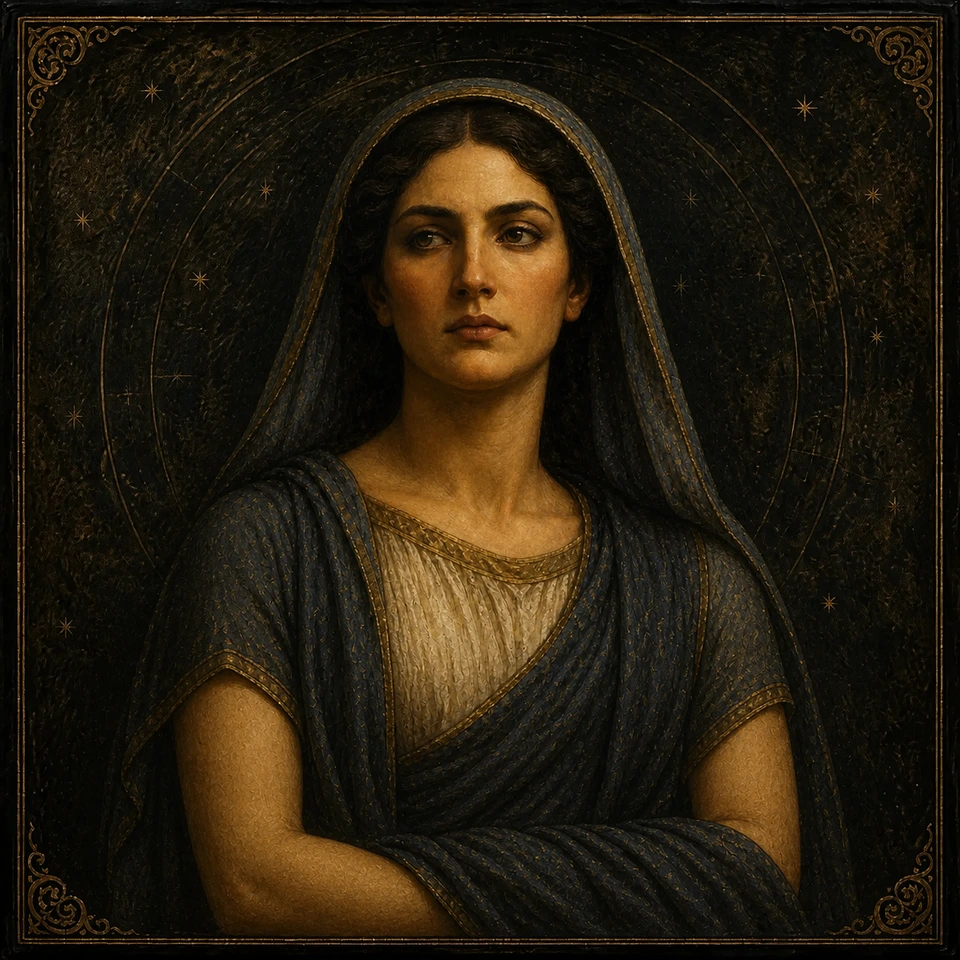
Celebrated as gold-crowned by Hesiod, the ancient Titaness Phoebe anchors early genealogies as the partner of Coeus. She stands entirely distinct from Artemis in the historical record, noted by Aeschylus as the willing giver of Delphi to Apollo and depicted violently wielding a torch on the Pergamon Altar.
Overview
Phoebe receives Delphi’s prophetic seat from Themis without force and gives it to Apollo as a birthday gift. Centuries later, sculptors at Pergamon set her back-to-back with Asteria, driving a long torch at a retreating Giant. The first act transfers sacred authority by consent. The second gives her a body in battle. Together they prevent the Titaness from disappearing into a bare family list or a borrowed lunar identity.
Hesiod places Φοίβη among the daughters of Gaia and Uranus, calls her gold-crowned, and joins her with Coeus as mother of Leto and Asteria. Leto becomes mother of Apollo and Artemis; Asteria becomes mother of Hecate. The crown belongs to one poetic line. It is vivid, but it does not prove a cult statue or authorize every later artist to make it her permanent emblem.
Her family changes with the teller. Pseudo-Apollodorus keeps Gaia, Uranus, Coeus, Leto, and Asteria. Diodorus preserves a Cretan account in which the Titans descend either from Uranus and Ge or from one Curete and Titaea, then names Coeus and Phoebe as parents of Leto in that statement. Hyginus writes in Latin and places Polus beside Phoebe as parents of Latone and Asterie. The names remain as each witness gives them. Polus is not silently made Coeus, and Titaea is not renamed Gaia.
Aeschylus also draws a strict boundary around Delphi. His Pythia names Earth, Themis, Phoebe, and Apollo in peaceful succession. Phoebe chooses the transfer, but the passage never shows her speaking an oracle, teaching divination, or sustaining a priesthood of her own. Apollo’s later office remains his. The Pergamon torch is just as precise: it belongs to one Hellenistic battle panel, not to every ancient account of Phoebe.
Other bearers of the name remain separate. Pausanias knows a mortal Phoebe among the Leucippides. Artemis is Phoebe’s granddaughter, not the Titaness under another mask. NASA’s account of Saturn’s moon associates that modern name with Artemis or Diana rather than this elder goddess. Phoebe’s own surviving line returns to the opening acts: gold-crowned in Hesiod, a willing keeper and giver at Delphi, and a torch-bearing fighter beside her daughter at Pergamon.
Canonical identity
Canonical Identity
Phoebe stands explicitly as an ancient Greek Titaness. Hesiod categorizes her among the daughters born to Gaia and Uranus, famously applying the poetic epithet χρυσοστέφανος (gold-crowned) at Theogony 136. This specific epithet belongs solely to the text of the poem rather than to a recovered statue. She must be kept absolutely distinct from the mortal woman named Phoebe in Pausanias, the Greek goddess Artemis, the Roman Diana, and Saturn’s moon (despite NASA linking the moon to Artemis/Diana).
Linguistic Identity
Phoebe is the Greek Φοίβη, transliterated as Phoíbē. Following Smyth’s historical rules and the LSJ preservation of the written accent, the qualified fifth-century BC Attic reconstruction is /pʰói̯.bɛː/ (approximately PHOY-beh), requiring a raised pitch on the opening syllable. The pinned CMUdict establishes the modern General American pronunciation as /ˈfiːbi/ (FEE-bee), which differs entirely from the ancient sound.
Sources and evidence
TEXTUAL · Supported
LSJ records the Ancient Greek headword Φοίβη and its written accent.
- Source
- Henry George Liddell and Robert Scott; Scaife ATLAS, Φοίβη, LSJ headword lookup
- Reviewed edition
- LSJ digital entry Φοίβη, Scaife ATLAS URN lsj-n111917 · Tufts University
- Exact locator
- Entry Φοίβη · Section LSJ headword · RecordUrl https://atlas.perseus.tufts.edu/dictionaries/headword/%CF%86%CE%BF%CE%AF%CE%B2%CE%B7/
- Scope
- Unspecified · Ancient Greece
- Authority
- Liddell and Scott, LSJ, Scaife ATLAS headword Φοίβη
- Certainty
- Certain
The lexicon anchors the word and written accent; historical sound values come separately from Smyth.
Open exact reviewed sourceTEXTUAL · Supported
Applying Smyth’s classical letter, vowel, diphthong, and pitch rules to LSJ Φοίβη supports qualified /pʰói̯.bɛː/.
- Source
- Herbert Weir Smyth, A Greek Grammar for Colleges (1920)
- Reviewed edition
- Herbert Weir Smyth, A Greek Grammar for Colleges, American Book Company, 1920; Perseus text 1999.04.0007 · Perseus Digital Library
- Exact locator
- Entry A Greek Grammar for Colleges · Section §§1, 4, 23-26, and 150 · RecordUrl https://www.perseus.tufts.edu/hopper/text?doc=Perseus:text:1999.04.0007
- Scope
- Classical Greece · Attica
- Authority
- Herbert Weir Smyth, A Greek Grammar for Colleges, 1920
- Certainty
- Qualified
LSJ separately anchors Φοίβη. PHOY-beh approximates the ancient segmental form and cannot reproduce pitch exactly.
Open exact reviewed sourceTEXTUAL · Supported
Pinned CMUdict records modern General American phoebe as F IY1 B IY0, /ˈfiːbi/.
- Source
- Carnegie Mellon University Speech Group, CMU Pronouncing Dictionary
- Reviewed edition
- cmudict data file at commit 74790861f652b15e4ac49015a90074ad62a27690 · Carnegie Mellon University
- Exact locator
- Entry phoebe · Section ARPABET F IY1 B IY0 · RecordUrl https://raw.githubusercontent.com/cmusphinx/cmudict/74790861f652b15e4ac49015a90074ad62a27690/cmudict.dict
- Scope
- Modern classical scholarship
- Authority
- CMU Pronouncing Dictionary, pinned commit 74790861f652b15e4ac49015a90074ad62a27690
- Certainty
- Qualified
This is current General American English pronunciation, not Ancient Greek sound.
Open exact reviewed sourceTEXTUAL · Supported
Hesiod names Phoebe among Gaia and Uranus’s daughters and calls her gold-crowned.
- Source
- Hesiod; edited and translated by Hugh G. Evelyn-White, Theogony (1914)
- Reviewed edition
- Hugh G. Evelyn-White edition and English translation in Hesiod, the Homeric Hymns and Homerica, 1914 · translated by Hugh G. Evelyn-White · edited by Hugh G. Evelyn-White · Perseus Digital Library / Scaife ATLAS
- Exact locator
- Entry Theogony · Line 132-138, especially 136
- Scope
- Archaic Greece · Ancient Greece
- Authority
- archaic Greek poetic witness
- Certainty
- Secure
Source-scoped poetic epithet; not automatic proof of a cult statue or universal crown attribute.
Open exact reviewed sourceTEXTUAL · Supported
Pausanias names a mortal Phoebe among the Leucippides, distinct from the Titaness.
- Source
- Pausanias; Spiro Greek edition and Jones/Ormerod translation volumes, Description of Greece (1935)
- Reviewed edition
- W. H. S. Jones and H. A. Ormerod English translation volumes, 1918-1935 · translated by W. H. S. Jones and H. A. Ormerod, volume-dependent · Perseus Digital Library / Scaife ATLAS
- Exact locator
- Book 2 · Chapter 22 · Section 5
- Scope
- Greek religion under Roman imperial rule · Ancient Greece
- Authority
- Pausanias, Description of Greece, Jones and Ormerod 1918-1935 English translation
- Certainty
- Secure within the named witness
Greek periegetic witness; book 2, chapter 22, section 5. Exact Jones and Ormerod English eng2 edition; the historical witness remains Ancient Greek.
Open exact reviewed sourceTEXTUAL · Supported
NASA describes Saturn’s moon Phoebe and associates its name with Artemis or Diana, not this Titaness.
- Source
- NASA Science Editorial Team, Phoebe
- Reviewed edition
- NASA Science page for Saturn’s moon Phoebe, reviewed 2026-08-30 · NASA Science
- Exact locator
- Entry Phoebe · Section Discovery; Overview
- Scope
- Modern institutional astronomy · Global astronomical observation
- Authority
- NASA Science, Phoebe overview and discovery history
- Certainty
- Secure within the named witness
Full NASA Discovery and Overview sections read; the former unsupported Saturn IX wording is removed.
Open exact reviewed source6 reviewed sources for this section
- Henry George Liddell and Robert Scott; Scaife ATLAS, Φοίβη, LSJ headword lookupScaife ATLAS headword lookup linking exact LSJ record lsj-n111917 · Tufts University
- Herbert Weir Smyth, A Greek Grammar for Colleges (1920)American Book Company, 1920; Perseus text 1999.04.0007 · Perseus Digital Library
- Carnegie Mellon University Speech Group, CMU Pronouncing DictionaryPinned repository commit 74790861f652b15e4ac49015a90074ad62a27690 · Carnegie Mellon University
- Hesiod; edited and translated by Hugh G. Evelyn-White, Theogony (1914)Hesiod, the Homeric Hymns and Homerica, London and New York, 1914 · Perseus Digital Library / Scaife ATLAS
- Pausanias; Spiro Greek edition and Jones/Ormerod translation volumes, Description of Greece (1935)Perseus CTS edition corpus, 1903-1935 · Perseus Digital Library / Scaife ATLAS
- NASA Science Editorial Team, PhoebeNASA Science Saturn moon page, reviewed 2026-08-30 · NASA Science
Culture, tradition, period, and place
Phoebe belongs first to ancient Greek poetry, drama, mythography, and material art. Hesiod supplies an Archaic genealogy. Aeschylus places her Delphic succession inside a fifth-century Athenian tragedy. The Pergamon Altar gives her an individualized Hellenistic form in western Anatolia during the second century BC. Pseudo-Apollodorus later compresses the Greek family line.
Diodorus, writing in Greek during the Roman Republican period, preserves a Cretan genealogy with competing parentages. Hyginus transmits a separate Latin arrangement in the Roman imperial period. These are not interchangeable cultural labels. Delphi belongs to Aeschylus’s tragic sacred history, Pergamon to a Hellenistic monument, Crete to Diodorus’s account, and the Latin names to Hyginus’s Roman reception.
Sources and evidence
TEXTUAL · Supported
Archaic Greek poetry names Phoebe in a divine genealogy.
- Source
- Hesiod; edited and translated by Hugh G. Evelyn-White, Theogony (1914)
- Reviewed edition
- Hugh G. Evelyn-White edition and English translation in Hesiod, the Homeric Hymns and Homerica, 1914 · translated by Hugh G. Evelyn-White · edited by Hugh G. Evelyn-White · Perseus Digital Library / Scaife ATLAS
- Exact locator
- Entry Theogony · Line 132-138, 404-410
- Scope
- Archaic Greece · Ancient Greece
- Authority
- archaic Greek poetic witness
- Certainty
- Secure
Source-scoped poetic epithet; not automatic proof of a cult statue or universal crown attribute.
Open exact reviewed sourceTEXTUAL · Supported
A fifth-century Athenian tragedy places Phoebe in Delphi’s sacred succession.
- Source
- Aeschylus; translated by Herbert Weir Smyth, Eumenides (1926)
- Reviewed edition
- Herbert Weir Smyth English translation of Aeschylus, Eumenides, Volume 2, William Heinemann and G. P. Putnam's Sons, 1926, Perseus eng2 component modernized by Perseus · translated by Herbert Weir Smyth · edited by Herbert Weir Smyth · Perseus Digital Library
- Exact locator
- Entry Eumenides · Line 1-8
- Scope
- Classical Greece · Delphi
- Authority
- Aeschylus, Eumenides, Smyth translation
- Certainty
- Secure within the named witness
fifth-century Greek tragic witness; entry Eumenides, line 1-8.
Open exact reviewed sourceMATERIAL CULTURE · Supported
The official Pergamon Altar record supplies a Hellenistic western Anatolian material setting.
- Source
- Staatliche Museen zu Berlin, Antikensammlung, Der Große Altar von Pergamon
- Reviewed edition
- Official German object record, Ident. Nr. Pe. 1, ObjID obj:829881 · Antikensammlung, Staatliche Museen zu Berlin
- Exact locator
- Entry Object description · MuseumObjectId obj:829881
- Scope
- Hellenistic Greek world · Pergamon
- Authority
- official museum object record
- Certainty
- Secure
Exact source-scoped claim; no identity or function is transferred beyond the cited witness.
Open exact reviewed sourceMATERIAL CULTURE · Supported
The south-frieze panel record identifies Phoibe and Asteria at Pergamon.
- Source
- Antikensammlung, Staatliche Museen zu Berlin, South frieze of the Altar: Phoibe and Asteria
- Reviewed edition
- Institutional English partner record, Inv. AvP III.2 GF 9, 1 - 9, 6, ISIL DE-MUS-814319 · Antikensammlung, Staatliche Museen zu Berlin
- Exact locator
- Entry Description and Details · MuseumObjectId AvP III.2 GF 9, 1 - 9, 6
- Scope
- Hellenistic Greek world · Pergamon
- Authority
- institutional English object record
- Certainty
- Secure
Exact source-scoped claim; no identity or function is transferred beyond the cited witness.
Open exact reviewed sourceTEXTUAL · Supported
Diodorus preserves a Cretan genealogy in Greek during the Roman Republican period.
- Source
- Diodorus Siculus; translated by Charles Henry Oldfather, Library, Books 1-7 (1933)
- Reviewed edition
- Charles Henry Oldfather English translation, Loeb 1933 transcription of Library Books 1-7 · translated by Charles Henry Oldfather · ToposText
- Exact locator
- Book 5 · Chapter 66-67 · Section 1-3
- Scope
- Roman Republican period · Crete
- Authority
- Greek historical and rationalizing witness
- Certainty
- Secure
Exact source-scoped claim; no identity or function is transferred beyond the cited witness.
Open exact reviewed sourceTEXTUAL · Supported
Pseudo-Apollodorus preserves a later Greek mythographic genealogy.
- Source
- Pseudo-Apollodorus; edited and translated by James G. Frazer, Library (1921)
- Reviewed edition
- James G. Frazer edition and English translation, Harvard University Press and William Heinemann, 1921 · translated by James G. Frazer · edited by James G. Frazer · Perseus Digital Library / Scaife ATLAS
- Exact locator
- Book 1 · Chapter 1-2 · Section 1.1.3; 1.2.2
- Scope
- Greek religion under Roman imperial rule · Ancient Greece
- Authority
- Pseudo-Apollodorus, Library, Frazer translation
- Certainty
- Secure within the named witness
later Greek mythographic witness; book 1, chapter 1-2, section 1.1.3; 1.2.2.
Open exact reviewed sourceTEXTUAL · Supported
Hyginus preserves a separate Latin genealogy in the Roman imperial period.
- Source
- Pseudo-Hyginus; translated and edited by Mary Grant, Fabulae (1960)
- Reviewed edition
- Mary Grant, The Myths of Hyginus, University of Kansas Publications in Humanistic Studies no. 34 · translated by Mary Grant · ToposText
- Exact locator
- Entry Fabulae Preface · Page 9
- Scope
- Greek religion under Roman imperial rule
- Authority
- Latin mythographic witness
- Certainty
- Secure
Polus remains unlinked and is not normalized to Coeus.
Open exact reviewed source7 reviewed sources for this section
- Hesiod; edited and translated by Hugh G. Evelyn-White, Theogony (1914)Hesiod, the Homeric Hymns and Homerica, London and New York, 1914 · Perseus Digital Library / Scaife ATLAS
- Aeschylus; translated by Herbert Weir Smyth, Eumenides (1926)1926 Loeb edition hosted by the Perseus Digital Library · Perseus Digital Library
- Staatliche Museen zu Berlin, Antikensammlung, Der Große Altar von PergamonOfficial object record, Ident. Nr. Pe. 1, ObjID obj:829881 · Antikensammlung, Staatliche Museen zu Berlin
- Antikensammlung, Staatliche Museen zu Berlin, South frieze of the Altar: Phoibe and AsteriaInstitutional English partner record, Inv. AvP III.2 GF 9, 1 - 9, 6, ISIL DE-MUS-814319 · Antikensammlung, Staatliche Museen zu Berlin
- Diodorus Siculus; translated by Charles Henry Oldfather, Library, Books 1-7 (1933)Charles Henry Oldfather English translation, Loeb Classical Library 1933 transcription · ToposText
- Pseudo-Apollodorus; edited and translated by James G. Frazer, Library (1921)Harvard University Press and William Heinemann edition, 1921 · Perseus Digital Library / Scaife ATLAS
- Pseudo-Hyginus; translated and edited by Mary Grant, Fabulae (1960)The Myths of Hyginus, University of Kansas Publications in Humanistic Studies no. 34 · ToposText
Historical development
Hesiod’s Phoebe begins as a named daughter of Gaia and Uranus, gold-crowned, then returns as Coeus’s partner and mother of Leto and Asteria. Aeschylus gives her a deliberate act: Themis yields Delphi without force, Phoebe holds the seat third, and she presents it to Apollo as a birthday gift.
Later genealogies fracture the family rather than merely repeat it. Pseudo-Apollodorus keeps the Hesiodic parents, partner, and daughters. Diodorus preserves two Cretan parentages for the Titans and names Leto alone as the child of Coeus and Phoebe in the relevant statement. Hyginus’s Latin preface names Polus, Phoebe, Latone, and Asterie. At Hellenistic Pergamon, marble adds a different afterlife, showing Phoebe in combat beside Asteria. Her development runs through genre, language, and monument, not through a single seamless biography.
Sources and evidence
TEXTUAL · Supported
Hesiod gives Phoebe a crown epithet and makes Coeus and Phoebe parents of Leto and Asteria.
- Source
- Hesiod; edited and translated by Hugh G. Evelyn-White, Theogony (1914)
- Reviewed edition
- Hugh G. Evelyn-White edition and English translation in Hesiod, the Homeric Hymns and Homerica, 1914 · translated by Hugh G. Evelyn-White · edited by Hugh G. Evelyn-White · Perseus Digital Library / Scaife ATLAS
- Exact locator
- Entry Theogony · Line 132-138, 404-410
- Scope
- Archaic Greece · Ancient Greece
- Authority
- archaic Greek poetic witness
- Certainty
- Secure
Exact source-scoped claim; no identity or function is transferred beyond the cited witness.
Open exact reviewed sourceTEXTUAL · Supported
Aeschylus gives Phoebe a peaceful transfer of Delphic authority.
- Source
- Aeschylus; translated by Herbert Weir Smyth, Eumenides (1926)
- Reviewed edition
- Herbert Weir Smyth English translation of Aeschylus, Eumenides, Volume 2, William Heinemann and G. P. Putnam's Sons, 1926, Perseus eng2 component modernized by Perseus · translated by Herbert Weir Smyth · edited by Herbert Weir Smyth · Perseus Digital Library
- Exact locator
- Entry Eumenides · Line 1-8
- Scope
- Classical Greece · Delphi
- Authority
- Aeschylus, Eumenides, Smyth translation
- Certainty
- Secure within the named witness
fifth-century Greek tragic witness; entry Eumenides, line 1-8.
Open exact reviewed sourceTEXTUAL · Supported
Pseudo-Apollodorus retains the Hesiodic parents, partner, and daughters.
- Source
- Pseudo-Apollodorus; edited and translated by James G. Frazer, Library (1921)
- Reviewed edition
- James G. Frazer edition and English translation, Harvard University Press and William Heinemann, 1921 · translated by James G. Frazer · edited by James G. Frazer · Perseus Digital Library / Scaife ATLAS
- Exact locator
- Book 1 · Chapter 1-2 · Section 1.1.3; 1.2.2
- Scope
- Greek religion under Roman imperial rule · Ancient Greece
- Authority
- Pseudo-Apollodorus, Library, Frazer translation
- Certainty
- Secure within the named witness
later Greek mythographic witness; book 1, chapter 1-2, section 1.1.3; 1.2.2.
Open exact reviewed sourceTEXTUAL · Supported
Diodorus preserves competing Cretan parentages and a Leto-only child statement.
- Source
- Diodorus Siculus; translated by Charles Henry Oldfather, Library, Books 1-7 (1933)
- Reviewed edition
- Charles Henry Oldfather English translation, Loeb 1933 transcription of Library Books 1-7 · translated by Charles Henry Oldfather · ToposText
- Exact locator
- Book 5 · Chapter 66-67 · Section 1-3
- Scope
- Roman Republican period · Crete
- Authority
- Greek historical and rationalizing witness
- Certainty
- Secure
Exact source-scoped claim; no identity or function is transferred beyond the cited witness.
Open exact reviewed sourceTEXTUAL · Supported
Hyginus names Polus, Phoebe, Latone, and Asterie in Latin.
- Source
- Pseudo-Hyginus; translated and edited by Mary Grant, Fabulae (1960)
- Reviewed edition
- Mary Grant, The Myths of Hyginus, University of Kansas Publications in Humanistic Studies no. 34 · translated by Mary Grant · ToposText
- Exact locator
- Entry Fabulae Preface · Page 9
- Scope
- Greek religion under Roman imperial rule
- Authority
- Latin mythographic witness
- Certainty
- Secure
Polus remains unlinked and is not normalized to Coeus.
Open exact reviewed sourceMATERIAL CULTURE · Supported
The Pergamon monument gives Phoebe an individualized Hellenistic battle setting.
- Source
- Staatliche Museen zu Berlin, Antikensammlung, Der Große Altar von Pergamon
- Reviewed edition
- Official German object record, Ident. Nr. Pe. 1, ObjID obj:829881 · Antikensammlung, Staatliche Museen zu Berlin
- Exact locator
- Entry Object description · MuseumObjectId obj:829881
- Scope
- Hellenistic Greek world · Pergamon
- Authority
- official museum object record
- Certainty
- Secure
Exact source-scoped claim; no identity or function is transferred beyond the cited witness.
Open exact reviewed sourceMATERIAL CULTURE · Supported
The panel record gives Phoibe a long-torch attack beside Asteria.
- Source
- Antikensammlung, Staatliche Museen zu Berlin, South frieze of the Altar: Phoibe and Asteria
- Reviewed edition
- Institutional English partner record, Inv. AvP III.2 GF 9, 1 - 9, 6, ISIL DE-MUS-814319 · Antikensammlung, Staatliche Museen zu Berlin
- Exact locator
- Entry Description and Details · MuseumObjectId AvP III.2 GF 9, 1 - 9, 6
- Scope
- Hellenistic Greek world · Pergamon
- Authority
- institutional English object record
- Certainty
- Secure
Exact source-scoped claim; no identity or function is transferred beyond the cited witness.
Open exact reviewed source7 reviewed sources for this section
- Hesiod; edited and translated by Hugh G. Evelyn-White, Theogony (1914)Hesiod, the Homeric Hymns and Homerica, London and New York, 1914 · Perseus Digital Library / Scaife ATLAS
- Aeschylus; translated by Herbert Weir Smyth, Eumenides (1926)1926 Loeb edition hosted by the Perseus Digital Library · Perseus Digital Library
- Pseudo-Apollodorus; edited and translated by James G. Frazer, Library (1921)Harvard University Press and William Heinemann edition, 1921 · Perseus Digital Library / Scaife ATLAS
- Diodorus Siculus; translated by Charles Henry Oldfather, Library, Books 1-7 (1933)Charles Henry Oldfather English translation, Loeb Classical Library 1933 transcription · ToposText
- Pseudo-Hyginus; translated and edited by Mary Grant, Fabulae (1960)The Myths of Hyginus, University of Kansas Publications in Humanistic Studies no. 34 · ToposText
- Staatliche Museen zu Berlin, Antikensammlung, Der Große Altar von PergamonOfficial object record, Ident. Nr. Pe. 1, ObjID obj:829881 · Antikensammlung, Staatliche Museen zu Berlin
- Antikensammlung, Staatliche Museen zu Berlin, South frieze of the Altar: Phoibe and AsteriaInstitutional English partner record, Inv. AvP III.2 GF 9, 1 - 9, 6, ISIL DE-MUS-814319 · Antikensammlung, Staatliche Museen zu Berlin
Attested roles and historical themes
Roles, powers, and limits
Phoebe’s secure roles are source-bound. Hesiod makes her a first-generation Titaness, partner of Coeus, and mother of Leto and Asteria. Pseudo-Apollodorus preserves that family. Diodorus gives a Cretan Leto-only statement, while Hyginus places Polus beside her in a Latin genealogy. Aeschylus makes her the willing third holder and giver of Delphi. The Pergamon panel makes her a combatant with a long torch.
No role absorbs the others. Aeschylus does not show her uttering an oracle or governing a lasting priesthood. The Pergamon torch belongs to one Gigantomachy scene. Apollo’s prophecy, Artemis’s hunt, and Hecate’s honors belong to those descendants. A bright name does not create lunar rulership or a universal power of intuition.
Sources and evidence
TEXTUAL · Supported
Hesiod makes Phoebe a Titaness, Coeus’s partner, and mother of Leto and Asteria.
- Source
- Hesiod; edited and translated by Hugh G. Evelyn-White, Theogony (1914)
- Reviewed edition
- Hugh G. Evelyn-White edition and English translation in Hesiod, the Homeric Hymns and Homerica, 1914 · translated by Hugh G. Evelyn-White · edited by Hugh G. Evelyn-White · Perseus Digital Library / Scaife ATLAS
- Exact locator
- Entry Theogony · Line 132-138, 404-410
- Scope
- Archaic Greece · Ancient Greece
- Authority
- archaic Greek poetic witness
- Certainty
- Secure
Exact source-scoped claim; no identity or function is transferred beyond the cited witness.
Open exact reviewed sourceTEXTUAL · Supported
Pseudo-Apollodorus preserves Phoebe’s Titan and maternal roles.
- Source
- Pseudo-Apollodorus; edited and translated by James G. Frazer, Library (1921)
- Reviewed edition
- James G. Frazer edition and English translation, Harvard University Press and William Heinemann, 1921 · translated by James G. Frazer · edited by James G. Frazer · Perseus Digital Library / Scaife ATLAS
- Exact locator
- Book 1 · Chapter 1-2 · Section 1.1.3; 1.2.2
- Scope
- Greek religion under Roman imperial rule · Ancient Greece
- Authority
- Pseudo-Apollodorus, Library, Frazer translation
- Certainty
- Secure within the named witness
later Greek mythographic witness; book 1, chapter 1-2, section 1.1.3; 1.2.2.
Open exact reviewed sourceTEXTUAL · Supported
Diodorus gives Coeus and Phoebe a source-specific Leto-only statement.
- Source
- Diodorus Siculus; translated by Charles Henry Oldfather, Library, Books 1-7 (1933)
- Reviewed edition
- Charles Henry Oldfather English translation, Loeb 1933 transcription of Library Books 1-7 · translated by Charles Henry Oldfather · ToposText
- Exact locator
- Book 5 · Chapter 67 · Section 1-3
- Scope
- Roman Republican period · Crete
- Authority
- Greek historical and rationalizing witness
- Certainty
- Secure
Exact source-scoped claim; no identity or function is transferred beyond the cited witness.
Open exact reviewed sourceTEXTUAL · Supported
Hyginus gives Phoebe a distinct Latin genealogy with Polus.
- Source
- Pseudo-Hyginus; translated and edited by Mary Grant, Fabulae (1960)
- Reviewed edition
- Mary Grant, The Myths of Hyginus, University of Kansas Publications in Humanistic Studies no. 34 · translated by Mary Grant · ToposText
- Exact locator
- Entry Fabulae Preface · Page 9
- Scope
- Greek religion under Roman imperial rule
- Authority
- Latin mythographic witness
- Certainty
- Secure
Polus remains unlinked and is not normalized to Coeus.
Open exact reviewed sourceTEXTUAL · Supported
Aeschylus makes Phoebe the willing third holder and giver of Delphi.
- Source
- Aeschylus; translated by Herbert Weir Smyth, Eumenides (1926)
- Reviewed edition
- Herbert Weir Smyth English translation of Aeschylus, Eumenides, Volume 2, William Heinemann and G. P. Putnam's Sons, 1926, Perseus eng2 component modernized by Perseus · translated by Herbert Weir Smyth · edited by Herbert Weir Smyth · Perseus Digital Library
- Exact locator
- Entry Eumenides · Line 1-8
- Scope
- Classical Greece · Delphi
- Authority
- Aeschylus, Eumenides, Smyth translation
- Certainty
- Secure within the named witness
fifth-century Greek tragic witness; entry Eumenides, line 1-8.
Open exact reviewed sourceMATERIAL CULTURE · Supported
The Pergamon panel makes Phoibe a long-torch combatant.
- Source
- Antikensammlung, Staatliche Museen zu Berlin, South frieze of the Altar: Phoibe and Asteria
- Reviewed edition
- Institutional English partner record, Inv. AvP III.2 GF 9, 1 - 9, 6, ISIL DE-MUS-814319 · Antikensammlung, Staatliche Museen zu Berlin
- Exact locator
- Entry Description and Details · MuseumObjectId AvP III.2 GF 9, 1 - 9, 6
- Scope
- Hellenistic Greek world · Pergamon
- Authority
- institutional English object record
- Certainty
- Secure
Exact source-scoped claim; no identity or function is transferred beyond the cited witness.
Open exact reviewed source6 reviewed sources for this section
- Hesiod; edited and translated by Hugh G. Evelyn-White, Theogony (1914)Hesiod, the Homeric Hymns and Homerica, London and New York, 1914 · Perseus Digital Library / Scaife ATLAS
- Pseudo-Apollodorus; edited and translated by James G. Frazer, Library (1921)Harvard University Press and William Heinemann edition, 1921 · Perseus Digital Library / Scaife ATLAS
- Diodorus Siculus; translated by Charles Henry Oldfather, Library, Books 1-7 (1933)Charles Henry Oldfather English translation, Loeb Classical Library 1933 transcription · ToposText
- Pseudo-Hyginus; translated and edited by Mary Grant, Fabulae (1960)The Myths of Hyginus, University of Kansas Publications in Humanistic Studies no. 34 · ToposText
- Aeschylus; translated by Herbert Weir Smyth, Eumenides (1926)1926 Loeb edition hosted by the Perseus Digital Library · Perseus Digital Library
- Antikensammlung, Staatliche Museen zu Berlin, South frieze of the Altar: Phoibe and AsteriaInstitutional English partner record, Inv. AvP III.2 GF 9, 1 - 9, 6, ISIL DE-MUS-814319 · Antikensammlung, Staatliche Museen zu Berlin
Epithets and titles
Poetic Epithet
Gold-crowned
χρυσοστέφανος · Gold-crowned
Greek hexameter tradition · Archaic Greek poetic witnessHesiod, Theogony 136. This source-scoped poetic epithet does not by itself prove a cult statue or a universal crown attribute.
1 reviewed source for this section
- Hesiod; edited and translated by Hugh G. Evelyn-White, Theogony (1914)Hesiod, the Homeric Hymns and Homerica, London and New York, 1914 · Perseus Digital Library / Scaife ATLAS
Worship and cult
Aeschylus’s Pythia remembers Phoebe within Delphi’s sacred succession, but the prologue names no independent Phoebe priesthood, congregation, sacrifice, or household rite. The Pergamon Altar places her in a public Hellenistic battle image, yet neither the official monument record nor the panel description supplies a separate cult.
These silences do not declare that devotion was impossible. They keep tragedy and monument in their proper forms. A remembered predecessor at Apollo’s oracle and a figure carved into a dynastic altar cannot be turned into a recovered Phoebe liturgy.
Sources and evidence
TEXTUAL · Supported
Aeschylus remembers Phoebe in sacred succession but names no independent Phoebe priesthood, sacrifice, congregation, or household rite.
- Source
- Aeschylus; translated by Herbert Weir Smyth, Eumenides (1926)
- Reviewed edition
- Herbert Weir Smyth English translation of Aeschylus, Eumenides, Volume 2, William Heinemann and G. P. Putnam's Sons, 1926, Perseus eng2 component modernized by Perseus · translated by Herbert Weir Smyth · edited by Herbert Weir Smyth · Perseus Digital Library
- Exact locator
- Entry Eumenides · Line 1-8
- Scope
- Classical Greece · Delphi
- Authority
- Aeschylus, Eumenides, Smyth translation
- Certainty
- Secure within the named witness
fifth-century Greek tragic witness; entry Eumenides, line 1-8.
Open exact reviewed sourceMATERIAL CULTURE · Supported
The Pergamon Altar identifies Phoebe in a public monument without documenting a separate cult.
- Source
- Staatliche Museen zu Berlin, Antikensammlung, Der Große Altar von Pergamon
- Reviewed edition
- Official German object record, Ident. Nr. Pe. 1, ObjID obj:829881 · Antikensammlung, Staatliche Museen zu Berlin
- Exact locator
- Entry Object description · MuseumObjectId obj:829881
- Scope
- Hellenistic Greek world · Pergamon
- Authority
- official museum object record
- Certainty
- Secure
Exact source-scoped claim; no identity or function is transferred beyond the cited witness.
Open exact reviewed sourceMATERIAL CULTURE · Supported
The panel catalog describes combat imagery, not ritual performed for Phoebe.
- Source
- Antikensammlung, Staatliche Museen zu Berlin, South frieze of the Altar: Phoibe and Asteria
- Reviewed edition
- Institutional English partner record, Inv. AvP III.2 GF 9, 1 - 9, 6, ISIL DE-MUS-814319 · Antikensammlung, Staatliche Museen zu Berlin
- Exact locator
- Entry Description and Details · MuseumObjectId AvP III.2 GF 9, 1 - 9, 6
- Scope
- Hellenistic Greek world · Pergamon
- Authority
- institutional English object record
- Certainty
- Secure
Exact source-scoped claim; no identity or function is transferred beyond the cited witness.
Open exact reviewed source3 reviewed sources for this section
- Aeschylus; translated by Herbert Weir Smyth, Eumenides (1926)1926 Loeb edition hosted by the Perseus Digital Library · Perseus Digital Library
- Staatliche Museen zu Berlin, Antikensammlung, Der Große Altar von PergamonOfficial object record, Ident. Nr. Pe. 1, ObjID obj:829881 · Antikensammlung, Staatliche Museen zu Berlin
- Antikensammlung, Staatliche Museen zu Berlin, South frieze of the Altar: Phoibe and AsteriaInstitutional English partner record, Inv. AvP III.2 GF 9, 1 - 9, 6, ISIL DE-MUS-814319 · Antikensammlung, Staatliche Museen zu Berlin
Temples, sanctuaries, and sacred places
Delphi belongs to Phoebe through Aeschylus’s peaceful succession. She receives the prophetic seat from Themis and gives it to Apollo, but the tragedy names no temple or altar dedicated to Phoebe herself. Pergamon belongs to her through the Altar’s southeast Gigantomachy, where the official catalog groups her with Leto, Hekate, and Asterie and the panel record gives her the long torch.
One place preserves sacred memory in drama; the other preserves battle in marble. Neither establishes a network of Phoebe sanctuaries.
Sources and evidence
TEXTUAL · Supported
Delphi is Phoebe’s tragic succession setting, but Aeschylus gives the seat onward to Apollo and names no separate Phoebe temple.
- Source
- Aeschylus; translated by Herbert Weir Smyth, Eumenides (1926)
- Reviewed edition
- Herbert Weir Smyth English translation of Aeschylus, Eumenides, Volume 2, William Heinemann and G. P. Putnam's Sons, 1926, Perseus eng2 component modernized by Perseus · translated by Herbert Weir Smyth · edited by Herbert Weir Smyth · Perseus Digital Library
- Exact locator
- Entry Eumenides · Line 1-8
- Scope
- Classical Greece · Delphi
- Authority
- Aeschylus, Eumenides, Smyth translation
- Certainty
- Secure within the named witness
fifth-century Greek tragic witness; entry Eumenides, line 1-8.
Open exact reviewed sourceMATERIAL CULTURE · Supported
Pergamon is the exact monument setting for Phoebe’s Hellenistic Gigantomachy image.
- Source
- Staatliche Museen zu Berlin, Antikensammlung, Der Große Altar von Pergamon
- Reviewed edition
- Official German object record, Ident. Nr. Pe. 1, ObjID obj:829881 · Antikensammlung, Staatliche Museen zu Berlin
- Exact locator
- Entry Object description · MuseumObjectId obj:829881
- Scope
- Hellenistic Greek world · Pergamon
- Authority
- official museum object record
- Certainty
- Secure
Exact source-scoped claim; no identity or function is transferred beyond the cited witness.
Open exact reviewed sourceMATERIAL CULTURE · Supported
The south-frieze panel fixes Phoibe’s battle action at Pergamon.
- Source
- Antikensammlung, Staatliche Museen zu Berlin, South frieze of the Altar: Phoibe and Asteria
- Reviewed edition
- Institutional English partner record, Inv. AvP III.2 GF 9, 1 - 9, 6, ISIL DE-MUS-814319 · Antikensammlung, Staatliche Museen zu Berlin
- Exact locator
- Entry Description and Details · MuseumObjectId AvP III.2 GF 9, 1 - 9, 6
- Scope
- Hellenistic Greek world · Pergamon
- Authority
- institutional English object record
- Certainty
- Secure
Exact source-scoped claim; no identity or function is transferred beyond the cited witness.
Open exact reviewed source3 reviewed sources for this section
- Aeschylus; translated by Herbert Weir Smyth, Eumenides (1926)1926 Loeb edition hosted by the Perseus Digital Library · Perseus Digital Library
- Staatliche Museen zu Berlin, Antikensammlung, Der Große Altar von PergamonOfficial object record, Ident. Nr. Pe. 1, ObjID obj:829881 · Antikensammlung, Staatliche Museen zu Berlin
- Antikensammlung, Staatliche Museen zu Berlin, South frieze of the Altar: Phoibe and AsteriaInstitutional English partner record, Inv. AvP III.2 GF 9, 1 - 9, 6, ISIL DE-MUS-814319 · Antikensammlung, Staatliche Museen zu Berlin
Festivals and processions
Hesiod’s genealogies, Aeschylus’s Delphic prologue, and Pseudo-Apollodorus’s family lists name no Phoebe festival, procession, sacred month, athletic contest, or calendar date. Apollo’s Delphic celebrations and the calendars of her descendants remain their own.
The silence is exact to those texts. It leaves no historical basis for assigning Phoebe a feast day from genealogy, a shared name, or the later astronomy of Saturn’s moon.
Sources and evidence
TEXTUAL · Supported
Hesiod names no Phoebe festival or calendar date.
- Source
- Hesiod; edited and translated by Hugh G. Evelyn-White, Theogony (1914)
- Reviewed edition
- Hugh G. Evelyn-White edition and English translation in Hesiod, the Homeric Hymns and Homerica, 1914 · translated by Hugh G. Evelyn-White · edited by Hugh G. Evelyn-White · Perseus Digital Library / Scaife ATLAS
- Exact locator
- Entry Theogony · Line 132-138, 404-410
- Scope
- Archaic Greece · Ancient Greece
- Authority
- archaic Greek poetic witness
- Certainty
- Secure
Source-scoped poetic epithet; not automatic proof of a cult statue or universal crown attribute.
Open exact reviewed sourceTEXTUAL · Supported
The Eumenides prologue names no Phoebe festival, procession, month, or contest.
- Source
- Aeschylus; translated by Herbert Weir Smyth, Eumenides (1926)
- Reviewed edition
- Herbert Weir Smyth English translation of Aeschylus, Eumenides, Volume 2, William Heinemann and G. P. Putnam's Sons, 1926, Perseus eng2 component modernized by Perseus · translated by Herbert Weir Smyth · edited by Herbert Weir Smyth · Perseus Digital Library
- Exact locator
- Entry Eumenides · Line 1-8
- Scope
- Classical Greece · Delphi
- Authority
- Aeschylus, Eumenides, Smyth translation
- Certainty
- Secure within the named witness
fifth-century Greek tragic witness; entry Eumenides, line 1-8.
Open exact reviewed sourceTEXTUAL · Supported
Pseudo-Apollodorus’s Phoebe passages contain genealogy rather than a festival calendar.
- Source
- Pseudo-Apollodorus; edited and translated by James G. Frazer, Library (1921)
- Reviewed edition
- James G. Frazer edition and English translation, Harvard University Press and William Heinemann, 1921 · translated by James G. Frazer · edited by James G. Frazer · Perseus Digital Library / Scaife ATLAS
- Exact locator
- Book 1 · Chapter 1-2 · Section 1.1.3; 1.2.2
- Scope
- Greek religion under Roman imperial rule · Ancient Greece
- Authority
- Pseudo-Apollodorus, Library, Frazer translation
- Certainty
- Secure within the named witness
later Greek mythographic witness; book 1, chapter 1-2, section 1.1.3; 1.2.2.
Open exact reviewed source3 reviewed sources for this section
- Hesiod; edited and translated by Hugh G. Evelyn-White, Theogony (1914)Hesiod, the Homeric Hymns and Homerica, London and New York, 1914 · Perseus Digital Library / Scaife ATLAS
- Aeschylus; translated by Herbert Weir Smyth, Eumenides (1926)1926 Loeb edition hosted by the Perseus Digital Library · Perseus Digital Library
- Pseudo-Apollodorus; edited and translated by James G. Frazer, Library (1921)Harvard University Press and William Heinemann edition, 1921 · Perseus Digital Library / Scaife ATLAS
Offerings, votives, and ritual evidence
Hesiod prescribes no food, drink, incense, textile, animal victim, or votive for Phoebe. Aeschylus describes a divine gift of office from Phoebe to Apollo, not a human offering made to her. Pseudo-Apollodorus preserves genealogy without a ritual formula.
Apollo’s tripod, laurel, and Delphic sacrifices belong to Apollo’s cult. They do not travel backward through the succession. The surviving Phoebe passages therefore authorize no ancient recipe or offering list.
Sources and evidence
TEXTUAL · Supported
Hesiod prescribes no offering, incense, victim, votive, or ritual recipe for Phoebe.
- Source
- Hesiod; edited and translated by Hugh G. Evelyn-White, Theogony (1914)
- Reviewed edition
- Hugh G. Evelyn-White edition and English translation in Hesiod, the Homeric Hymns and Homerica, 1914 · translated by Hugh G. Evelyn-White · edited by Hugh G. Evelyn-White · Perseus Digital Library / Scaife ATLAS
- Exact locator
- Entry Theogony · Line 132-138, 404-410
- Scope
- Archaic Greece · Ancient Greece
- Authority
- archaic Greek poetic witness
- Certainty
- Secure
Source-scoped poetic epithet; not automatic proof of a cult statue or universal crown attribute.
Open exact reviewed sourceTEXTUAL · Supported
Phoebe’s gift of office to Apollo is a divine transfer, not a human offering to her.
- Source
- Aeschylus; translated by Herbert Weir Smyth, Eumenides (1926)
- Reviewed edition
- Herbert Weir Smyth English translation of Aeschylus, Eumenides, Volume 2, William Heinemann and G. P. Putnam's Sons, 1926, Perseus eng2 component modernized by Perseus · translated by Herbert Weir Smyth · edited by Herbert Weir Smyth · Perseus Digital Library
- Exact locator
- Entry Eumenides · Line 1-8
- Scope
- Classical Greece · Delphi
- Authority
- Aeschylus, Eumenides, Smyth translation
- Certainty
- Secure within the named witness
fifth-century Greek tragic witness; entry Eumenides, line 1-8.
Open exact reviewed sourceTEXTUAL · Supported
Pseudo-Apollodorus’s family list supplies no Phoebe ritual formula or offering.
- Source
- Pseudo-Apollodorus; edited and translated by James G. Frazer, Library (1921)
- Reviewed edition
- James G. Frazer edition and English translation, Harvard University Press and William Heinemann, 1921 · translated by James G. Frazer · edited by James G. Frazer · Perseus Digital Library / Scaife ATLAS
- Exact locator
- Book 1 · Chapter 1-2 · Section 1.1.3; 1.2.2
- Scope
- Greek religion under Roman imperial rule · Ancient Greece
- Authority
- Pseudo-Apollodorus, Library, Frazer translation
- Certainty
- Secure within the named witness
later Greek mythographic witness; book 1, chapter 1-2, section 1.1.3; 1.2.2.
Open exact reviewed source3 reviewed sources for this section
- Hesiod; edited and translated by Hugh G. Evelyn-White, Theogony (1914)Hesiod, the Homeric Hymns and Homerica, London and New York, 1914 · Perseus Digital Library / Scaife ATLAS
- Aeschylus; translated by Herbert Weir Smyth, Eumenides (1926)1926 Loeb edition hosted by the Perseus Digital Library · Perseus Digital Library
- Pseudo-Apollodorus; edited and translated by James G. Frazer, Library (1921)Harvard University Press and William Heinemann edition, 1921 · Perseus Digital Library / Scaife ATLAS
Iconography and material culture
Two ancient attributes are secure, and each remains in its own witness. Hesiod calls Phoebe gold-crowned. At Pergamon, the official catalog identifies her in the southeast Gigantomachy grouping, while the institutional panel record shows her back-to-back with Asteria and driving a long torch at a retreating winged Giant.
The crown is poetic and the torch is carved action. Neither authorizes Artemis’s bow, quiver, crescent, or hunting animals. Aeschylus’s Delphic seat is an office Phoebe gives away, not a tripod she permanently carries. A modern portrait can omit the crown and torch without denying them, but it cannot replace the ancient evidence.
Sources and evidence
TEXTUAL · Supported
Hesiod calls Phoebe gold-crowned in one poetic line.
- Source
- Hesiod; edited and translated by Hugh G. Evelyn-White, Theogony (1914)
- Reviewed edition
- Hugh G. Evelyn-White edition and English translation in Hesiod, the Homeric Hymns and Homerica, 1914 · translated by Hugh G. Evelyn-White · edited by Hugh G. Evelyn-White · Perseus Digital Library / Scaife ATLAS
- Exact locator
- Entry Theogony · Line 136
- Scope
- Archaic Greece · Ancient Greece
- Authority
- archaic Greek poetic witness
- Certainty
- Secure
Source-scoped poetic epithet; not automatic proof of a cult statue or universal crown attribute.
Open exact reviewed sourceMATERIAL CULTURE · Supported
The official catalog places Phoibe in the Pergamon southeast Gigantomachy grouping.
- Source
- Staatliche Museen zu Berlin, Antikensammlung, Der Große Altar von Pergamon
- Reviewed edition
- Official German object record, Ident. Nr. Pe. 1, ObjID obj:829881 · Antikensammlung, Staatliche Museen zu Berlin
- Exact locator
- Entry Object description · MuseumObjectId obj:829881
- Scope
- Hellenistic Greek world · Pergamon
- Authority
- official museum object record
- Certainty
- Secure
Exact source-scoped claim; no identity or function is transferred beyond the cited witness.
Open exact reviewed sourceMATERIAL CULTURE · Supported
The panel record shows Phoibe back-to-back with Asteria and wielding a long torch.
- Source
- Antikensammlung, Staatliche Museen zu Berlin, South frieze of the Altar: Phoibe and Asteria
- Reviewed edition
- Institutional English partner record, Inv. AvP III.2 GF 9, 1 - 9, 6, ISIL DE-MUS-814319 · Antikensammlung, Staatliche Museen zu Berlin
- Exact locator
- Entry Description and Details · MuseumObjectId AvP III.2 GF 9, 1 - 9, 6
- Scope
- Hellenistic Greek world · Pergamon
- Authority
- institutional English object record
- Certainty
- Secure
Exact source-scoped claim; no identity or function is transferred beyond the cited witness.
Open exact reviewed source3 reviewed sources for this section
- Hesiod; edited and translated by Hugh G. Evelyn-White, Theogony (1914)Hesiod, the Homeric Hymns and Homerica, London and New York, 1914 · Perseus Digital Library / Scaife ATLAS
- Staatliche Museen zu Berlin, Antikensammlung, Der Große Altar von PergamonOfficial object record, Ident. Nr. Pe. 1, ObjID obj:829881 · Antikensammlung, Staatliche Museen zu Berlin
- Antikensammlung, Staatliche Museen zu Berlin, South frieze of the Altar: Phoibe and AsteriaInstitutional English partner record, Inv. AvP III.2 GF 9, 1 - 9, 6, ISIL DE-MUS-814319 · Antikensammlung, Staatliche Museen zu Berlin
Animals, plants, and embodied forms
Hesiod gives Phoebe genealogy and a crown epithet, not a sacred animal or plant. Aeschylus gives her the Delphic transfer without transformation or animal companion. Pseudo-Apollodorus gives her no hybrid body, metamorphosis, plant, or embodied natural form.
Asteria’s transformations, Artemis’s wild animals, and Apollo’s laurel belong to those figures and their own stories. Moonlight, silver, stars, and night may suit later art, but atmosphere alone creates no ancient Phoebe animal, plant, or landscape correspondence.
Sources and evidence
TEXTUAL · Supported
Hesiod gives Phoebe no sacred animal, plant, or transformation.
- Source
- Hesiod; edited and translated by Hugh G. Evelyn-White, Theogony (1914)
- Reviewed edition
- Hugh G. Evelyn-White edition and English translation in Hesiod, the Homeric Hymns and Homerica, 1914 · translated by Hugh G. Evelyn-White · edited by Hugh G. Evelyn-White · Perseus Digital Library / Scaife ATLAS
- Exact locator
- Entry Theogony · Line 132-138, 404-410
- Scope
- Archaic Greece · Ancient Greece
- Authority
- archaic Greek poetic witness
- Certainty
- Secure
Source-scoped poetic epithet; not automatic proof of a cult statue or universal crown attribute.
Open exact reviewed sourceTEXTUAL · Supported
Aeschylus’s Delphic transfer assigns Phoebe no animal, plant, or hybrid body.
- Source
- Aeschylus; translated by Herbert Weir Smyth, Eumenides (1926)
- Reviewed edition
- Herbert Weir Smyth English translation of Aeschylus, Eumenides, Volume 2, William Heinemann and G. P. Putnam's Sons, 1926, Perseus eng2 component modernized by Perseus · translated by Herbert Weir Smyth · edited by Herbert Weir Smyth · Perseus Digital Library
- Exact locator
- Entry Eumenides · Line 1-8
- Scope
- Classical Greece · Delphi
- Authority
- Aeschylus, Eumenides, Smyth translation
- Certainty
- Secure within the named witness
fifth-century Greek tragic witness; entry Eumenides, line 1-8.
Open exact reviewed sourceTEXTUAL · Supported
Pseudo-Apollodorus gives Phoebe no animal companion, plant, hybrid form, or metamorphosis.
- Source
- Pseudo-Apollodorus; edited and translated by James G. Frazer, Library (1921)
- Reviewed edition
- James G. Frazer edition and English translation, Harvard University Press and William Heinemann, 1921 · translated by James G. Frazer · edited by James G. Frazer · Perseus Digital Library / Scaife ATLAS
- Exact locator
- Book 1 · Chapter 1-2 · Section 1.1.3; 1.2.2
- Scope
- Greek religion under Roman imperial rule · Ancient Greece
- Authority
- Pseudo-Apollodorus, Library, Frazer translation
- Certainty
- Secure within the named witness
later Greek mythographic witness; book 1, chapter 1-2, section 1.1.3; 1.2.2.
Open exact reviewed source3 reviewed sources for this section
- Hesiod; edited and translated by Hugh G. Evelyn-White, Theogony (1914)Hesiod, the Homeric Hymns and Homerica, London and New York, 1914 · Perseus Digital Library / Scaife ATLAS
- Aeschylus; translated by Herbert Weir Smyth, Eumenides (1926)1926 Loeb edition hosted by the Perseus Digital Library · Perseus Digital Library
- Pseudo-Apollodorus; edited and translated by James G. Frazer, Library (1921)Harvard University Press and William Heinemann edition, 1921 · Perseus Digital Library / Scaife ATLAS
Relationships and genealogy
Phoebe’s family survives in incompatible forms. Hesiod makes Gaia and Uranus her parents and Coeus her partner, with Leto and Asteria as daughters. Pseudo-Apollodorus repeats that arrangement. Diodorus gives the Cretan Titans either Uranus and Ge or one Curete and Titaea as parents, then names Coeus and Phoebe as parents of Leto in the relevant statement. Hyginus’s Latin preface gives Polus and Phoebe as parents of Latone and Asterie.
The differences remain visible. Titaea is not renamed Gaia. One Curete is not converted into Uranus. Polus is not merged with Coeus. Through Leto, Phoebe is grandmother of Apollo and Artemis; through Asteria, she is grandmother of Hecate in Hesiod’s sequence. Their cults, animals, weapons, and powers do not pass backward to her.
Sources and evidence
TEXTUAL · Supported
Hesiod makes Gaia and Uranus Phoebe’s parents and Coeus and Phoebe parents of Leto and Asteria.
- Source
- Hesiod; edited and translated by Hugh G. Evelyn-White, Theogony (1914)
- Reviewed edition
- Hugh G. Evelyn-White edition and English translation in Hesiod, the Homeric Hymns and Homerica, 1914 · translated by Hugh G. Evelyn-White · edited by Hugh G. Evelyn-White · Perseus Digital Library / Scaife ATLAS
- Exact locator
- Entry Theogony · Line 132-138, 404-410
- Scope
- Archaic Greece · Ancient Greece
- Authority
- archaic Greek poetic witness
- Certainty
- Secure
Exact source-scoped claim; no identity or function is transferred beyond the cited witness.
Open exact reviewed sourceTEXTUAL · Supported
Pseudo-Apollodorus repeats Gaia, Uranus, Coeus, Leto, and Asteria in Phoebe’s genealogy.
- Source
- Pseudo-Apollodorus; edited and translated by James G. Frazer, Library (1921)
- Reviewed edition
- James G. Frazer edition and English translation, Harvard University Press and William Heinemann, 1921 · translated by James G. Frazer · edited by James G. Frazer · Perseus Digital Library / Scaife ATLAS
- Exact locator
- Book 1 · Chapter 1-2 · Section 1.1.3 and 1.2.2
- Scope
- Greek religion under Roman imperial rule · Ancient Greece
- Authority
- Pseudo-Apollodorus, Library, Frazer translation
- Certainty
- Secure within the named witness
later Greek mythographic witness; book 1, chapter 1-2, section 1.1.3; 1.2.2.
Open exact reviewed sourceTEXTUAL · Supported
Diodorus gives two Cretan Titan parentages and later names Coeus and Phoebe as parents of Leto.
- Source
- Diodorus Siculus; translated by Charles Henry Oldfather, Library, Books 1-7 (1933)
- Reviewed edition
- Charles Henry Oldfather English translation, Loeb 1933 transcription of Library Books 1-7 · translated by Charles Henry Oldfather · ToposText
- Exact locator
- Book 5 · Chapter 66-67 · Section 1-3
- Scope
- Roman Republican period · Crete
- Authority
- Greek historical and rationalizing witness
- Certainty
- Secure
Exact source-scoped claim; no identity or function is transferred beyond the cited witness.
Open exact reviewed sourceTEXTUAL · Supported
Hyginus names Polus and Phoebe as parents of Latone and Asterie.
- Source
- Pseudo-Hyginus; translated and edited by Mary Grant, Fabulae (1960)
- Reviewed edition
- Mary Grant, The Myths of Hyginus, University of Kansas Publications in Humanistic Studies no. 34 · translated by Mary Grant · ToposText
- Exact locator
- Entry Fabulae Preface · Page 9
- Scope
- Greek religion under Roman imperial rule
- Authority
- Latin mythographic witness
- Certainty
- Secure
Polus remains unlinked and is not normalized to Coeus.
Open exact reviewed source4 reviewed sources for this section
- Hesiod; edited and translated by Hugh G. Evelyn-White, Theogony (1914)Hesiod, the Homeric Hymns and Homerica, London and New York, 1914 · Perseus Digital Library / Scaife ATLAS
- Pseudo-Apollodorus; edited and translated by James G. Frazer, Library (1921)Harvard University Press and William Heinemann edition, 1921 · Perseus Digital Library / Scaife ATLAS
- Diodorus Siculus; translated by Charles Henry Oldfather, Library, Books 1-7 (1933)Charles Henry Oldfather English translation, Loeb Classical Library 1933 transcription · ToposText
- Pseudo-Hyginus; translated and edited by Mary Grant, Fabulae (1960)The Myths of Hyginus, University of Kansas Publications in Humanistic Studies no. 34 · ToposText
Actual myths and source variants
Four surviving narratives give Phoebe a direct role. Hesiod’s birth sequence names her among the twelve children of Gaia and Uranus; Pseudo-Apollodorus adds Dione to the later list; Diodorus preserves Cretan parentages through Uranus and Ge or one Curete and Titaea. The family narrative likewise keeps Hesiod and Pseudo-Apollodorus beside Diodorus’s Leto-only statement and Hyginus’s Polus, Latone, and Asterie.
Aeschylus makes Phoebe the third holder at Delphi and the willing giver of the seat to Apollo. The Pergamon Altar places her in another kind of story, back-to-back with Asteria and striking at a retreating Giant with a long torch. The relief presents another Gigantomachy episode and need not be mistaken for a second war.
The overthrow of Uranus remains separate. Hesiod gives Cronus the answering speech and attack. Pseudo-Apollodorus distinguishes the male Titans from the Titanides before the assault. The Titanomachy gives Phoebe no individual action. Those limits do not erase her separately attested combat in the later Pergamon image, which depicts a different war.
Sources and evidence
TEXTUAL · Supported
Hesiod supplies Phoebe’s first-generation birth and family, while Cronus alone answers Gaia and attacks Uranus and Phoebe receives no individual Titanomachy action.
- Source
- Hesiod; edited and translated by Hugh G. Evelyn-White, Theogony (1914)
- Reviewed edition
- Hugh G. Evelyn-White edition and English translation in Hesiod, the Homeric Hymns and Homerica, 1914 · translated by Hugh G. Evelyn-White · edited by Hugh G. Evelyn-White · Perseus Digital Library / Scaife ATLAS
- Exact locator
- Entry Theogony · Line 132-210, 404-410, 617-735
- Scope
- Archaic Greece · Ancient Greece
- Authority
- archaic Greek poetic witness
- Certainty
- Secure
Exact source-scoped claim; no identity or function is transferred beyond the cited witness.
Open exact reviewed sourceTEXTUAL · Supported
Pseudo-Apollodorus supplies a later Titan list and family, distinguishes Titanides from the attackers on Uranus, and gives Phoebe no individual assault.
- Source
- Pseudo-Apollodorus; edited and translated by James G. Frazer, Library (1921)
- Reviewed edition
- James G. Frazer edition and English translation, Harvard University Press and William Heinemann, 1921 · translated by James G. Frazer · edited by James G. Frazer · Perseus Digital Library / Scaife ATLAS
- Exact locator
- Book 1 · Chapter 1-2 · Section 1.1.3-4 and 1.2.2
- Scope
- Greek religion under Roman imperial rule · Ancient Greece
- Authority
- Greek mythographic witness
- Certainty
- Secure
Exact source-scoped claim; no identity or function is transferred beyond the cited witness.
Open exact reviewed sourceTEXTUAL · Supported
Diodorus supplies the Cretan Titan parentage variant and the Leto-only family statement.
- Source
- Diodorus Siculus; translated by Charles Henry Oldfather, Library, Books 1-7 (1933)
- Reviewed edition
- Charles Henry Oldfather English translation, Loeb 1933 transcription of Library Books 1-7 · translated by Charles Henry Oldfather · ToposText
- Exact locator
- Book 5 · Chapter 66-67 · Section 1-3
- Scope
- Roman Republican period · Crete
- Authority
- Greek historical and rationalizing witness
- Certainty
- Secure
Exact source-scoped claim; no identity or function is transferred beyond the cited witness.
Open exact reviewed sourceTEXTUAL · Supported
Hyginus supplies the Latin Polus, Latone, and Asterie family variant.
- Source
- Pseudo-Hyginus; translated and edited by Mary Grant, Fabulae (1960)
- Reviewed edition
- Mary Grant, The Myths of Hyginus, University of Kansas Publications in Humanistic Studies no. 34 · translated by Mary Grant · ToposText
- Exact locator
- Entry Fabulae Preface · Page 9
- Scope
- Greek religion under Roman imperial rule
- Authority
- Latin mythographic witness
- Certainty
- Secure
Polus remains unlinked and is not normalized to Coeus.
Open exact reviewed sourceTEXTUAL · Supported
Aeschylus makes Phoebe an active willing participant in Delphi’s peaceful succession.
- Source
- Aeschylus; translated by Herbert Weir Smyth, Eumenides (1926)
- Reviewed edition
- Herbert Weir Smyth English translation of Aeschylus, Eumenides, Volume 2, William Heinemann and G. P. Putnam's Sons, 1926, Perseus eng2 component modernized by Perseus · translated by Herbert Weir Smyth · edited by Herbert Weir Smyth · Perseus Digital Library
- Exact locator
- Entry Eumenides · Line 1-8
- Scope
- Classical Greece · Delphi
- Authority
- Aeschylus, Eumenides, Smyth translation
- Certainty
- Secure within the named witness
fifth-century Greek tragic witness; entry Eumenides, line 1-8.
Open exact reviewed sourceMATERIAL CULTURE · Supported
The official Pergamon record places Phoibe in the southeast Gigantomachy grouping.
- Source
- Staatliche Museen zu Berlin, Antikensammlung, Der Große Altar von Pergamon
- Reviewed edition
- Official German object record, Ident. Nr. Pe. 1, ObjID obj:829881 · Antikensammlung, Staatliche Museen zu Berlin
- Exact locator
- Entry Object description · MuseumObjectId obj:829881
- Scope
- Hellenistic Greek world · Pergamon
- Authority
- official museum object record
- Certainty
- Secure
Exact source-scoped claim; no identity or function is transferred beyond the cited witness.
Open exact reviewed sourceMATERIAL CULTURE · Supported
The panel record describes Phoibe’s long-torch attack beside Asteria.
- Source
- Antikensammlung, Staatliche Museen zu Berlin, South frieze of the Altar: Phoibe and Asteria
- Reviewed edition
- Institutional English partner record, Inv. AvP III.2 GF 9, 1 - 9, 6, ISIL DE-MUS-814319 · Antikensammlung, Staatliche Museen zu Berlin
- Exact locator
- Entry Description and Details · MuseumObjectId AvP III.2 GF 9, 1 - 9, 6
- Scope
- Hellenistic Greek world · Pergamon
- Authority
- institutional English object record
- Certainty
- Secure
Exact source-scoped claim; no identity or function is transferred beyond the cited witness.
Open exact reviewed source7 reviewed sources for this section
- Hesiod; edited and translated by Hugh G. Evelyn-White, Theogony (1914)Hesiod, the Homeric Hymns and Homerica, London and New York, 1914 · Perseus Digital Library / Scaife ATLAS
- Pseudo-Apollodorus; edited and translated by James G. Frazer, Library (1921)Harvard University Press and William Heinemann edition, 1921 · Perseus Digital Library / Scaife ATLAS
- Diodorus Siculus; translated by Charles Henry Oldfather, Library, Books 1-7 (1933)Charles Henry Oldfather English translation, Loeb Classical Library 1933 transcription · ToposText
- Pseudo-Hyginus; translated and edited by Mary Grant, Fabulae (1960)The Myths of Hyginus, University of Kansas Publications in Humanistic Studies no. 34 · ToposText
- Aeschylus; translated by Herbert Weir Smyth, Eumenides (1926)1926 Loeb edition hosted by the Perseus Digital Library · Perseus Digital Library
- Staatliche Museen zu Berlin, Antikensammlung, Der Große Altar von PergamonOfficial object record, Ident. Nr. Pe. 1, ObjID obj:829881 · Antikensammlung, Staatliche Museen zu Berlin
- Antikensammlung, Staatliche Museen zu Berlin, South frieze of the Altar: Phoibe and AsteriaInstitutional English partner record, Inv. AvP III.2 GF 9, 1 - 9, 6, ISIL DE-MUS-814319 · Antikensammlung, Staatliche Museen zu Berlin
Myth Library
Each myth gathers its attested participants into one source-grounded account, while distinct source traditions remain readable in their own variants.
Divine Genealogy
The Birth of the First Titans
Gaia and Uranus bring forth twelve named Titans, whose shared birth establishes a generation without assigning every sibling the same deed or cosmic office.
- Role in this profile
- first-generation Titaness born from Gaia and Uranus
- Place scope
- Ancient Greece
- Witnesses
- 4
- Variants
- 4
Divine Genealogy
Coeus and Phoebe Become Parents of Leto and Asteria
Hesiod and Pseudo-Apollodorus make Coeus and Phoebe parents of Leto and Asteria; Diodorus gives Leto alone in the relevant Cretan statement, while Hyginus names Polus, Latone, and Asterie in Latin.
- Role in this profile
- partner of Coeus and mother of Leto and Asteria
- Place scope
- Ancient Greece · Delos · Crete
- Witnesses
- 5
- Variants
- 5
Sanctuary Foundation
Apollo Founds His Oracle at Delphi
Greek witnesses give competing accounts of Apollo’s Delphic establishment: the Homeric Hymn’s search and coerced Cretan service, Python’s killing in mythography, Aeschylus’s peaceful succession, and Pausanias’s Eumolpia transfer through Themis with compensation to Poseidon.
- Role in this profile
- third holder who gives the Delphic seat and her name to Apollo
- Place scope
- Delphi
- Witnesses
- 5
- Variants
- 5
Mythographic Synthesis
Gaia and the Gigantes
Pseudo-Apollodorus makes Gaia bear the Gigantes in anger over the Titans and seek a protective drug before their war with the gods; the Pergamon Altar adds Phoibe’s long-torch combat beside Asteria.
- Role in this profile
- torch-bearing fighter beside Asteria on the Pergamon south frieze
- Place scope
- Ancient Greece · Pergamon
- Witnesses
- 2
- Variants
- 2
Equivalences, syncretisms, and identity boundaries
Phoebe is not Apollo, Artemis, the mortal Leucippid Phoebe, or Saturn’s moon. Aeschylus says Apollo receives the name Phoebus from her within one dramatic sacred history, but grandmother and grandson remain distinct. Hesiod’s genealogy makes Artemis her granddaughter through Leto. Pausanias’s Leucippid is a mortal woman.
NASA treats Phoebe as a physical Saturnian moon and associates its name with Artemis or Diana, so that page marks a modern namesake boundary rather than a cultic union. Hyginus’s Polus also remains the name written in a Latin genealogy, not an automatic synonym for Coeus.
Sources and evidence
TEXTUAL · Supported
Aeschylus derives Apollo’s name Phoebus from Phoebe without merging the two deities.
- Source
- Aeschylus; translated by Herbert Weir Smyth, Eumenides (1926)
- Reviewed edition
- Herbert Weir Smyth English translation of Aeschylus, Eumenides, Volume 2, William Heinemann and G. P. Putnam's Sons, 1926, Perseus eng2 component modernized by Perseus · translated by Herbert Weir Smyth · edited by Herbert Weir Smyth · Perseus Digital Library
- Exact locator
- Entry Eumenides · Line 1-8
- Scope
- Classical Greece · Delphi
- Authority
- Aeschylus, Eumenides, Smyth translation
- Certainty
- Secure within the named witness
fifth-century Greek tragic witness; entry Eumenides, line 1-8.
Open exact reviewed sourceTEXTUAL · Supported
Hesiod’s genealogy makes Artemis Phoebe’s granddaughter through Leto, not Phoebe under another identity.
- Source
- Hesiod; edited and translated by Hugh G. Evelyn-White, Theogony (1914)
- Reviewed edition
- Hugh G. Evelyn-White edition and English translation in Hesiod, the Homeric Hymns and Homerica, 1914 · translated by Hugh G. Evelyn-White · edited by Hugh G. Evelyn-White · Perseus Digital Library / Scaife ATLAS
- Exact locator
- Entry Theogony · Line 404-410
- Scope
- Archaic Greece · Ancient Greece
- Authority
- archaic Greek poetic witness
- Certainty
- Secure
Exact source-scoped claim; no identity or function is transferred beyond the cited witness.
Open exact reviewed sourceTEXTUAL · Supported
Pausanias’s Leucippid Phoebe is a mortal namesake.
- Source
- Pausanias; Spiro Greek edition and Jones/Ormerod translation volumes, Description of Greece (1935)
- Reviewed edition
- W. H. S. Jones and H. A. Ormerod English translation volumes, 1918-1935 · translated by W. H. S. Jones and H. A. Ormerod, volume-dependent · Perseus Digital Library / Scaife ATLAS
- Exact locator
- Book 2 · Chapter 22 · Section 5
- Scope
- Greek religion under Roman imperial rule · Ancient Greece
- Authority
- Pausanias, Description of Greece, Jones and Ormerod 1918-1935 English translation
- Certainty
- Secure within the named witness
Greek periegetic witness; book 2, chapter 22, section 5. Exact Jones and Ormerod English eng2 edition; the historical witness remains Ancient Greek.
Open exact reviewed sourceTEXTUAL · Supported
NASA’s Saturnian moon is a modern astronomical namesake associated with Artemis or Diana.
- Source
- NASA Science Editorial Team, Phoebe
- Reviewed edition
- NASA Science page for Saturn’s moon Phoebe, reviewed 2026-08-30 · NASA Science
- Exact locator
- Entry Phoebe · Section Discovery; Overview
- Scope
- Modern institutional astronomy · Global astronomical observation
- Authority
- NASA Science, Phoebe overview and discovery history
- Certainty
- Secure within the named witness
Full NASA Discovery and Overview sections read; the former unsupported Saturn IX wording is removed.
Open exact reviewed sourceTEXTUAL · Supported
Hyginus writes Polus in the Latin genealogy; that spelling alone cannot identify him with Coeus.
- Source
- Pseudo-Hyginus; translated and edited by Mary Grant, Fabulae (1960)
- Reviewed edition
- Mary Grant, The Myths of Hyginus, University of Kansas Publications in Humanistic Studies no. 34 · translated by Mary Grant · ToposText
- Exact locator
- Entry Fabulae Preface · Page 9
- Scope
- Greek religion under Roman imperial rule
- Authority
- Latin mythographic witness
- Certainty
- Secure
Polus remains unlinked and is not normalized to Coeus.
Open exact reviewed source5 reviewed sources for this section
- Aeschylus; translated by Herbert Weir Smyth, Eumenides (1926)1926 Loeb edition hosted by the Perseus Digital Library · Perseus Digital Library
- Hesiod; edited and translated by Hugh G. Evelyn-White, Theogony (1914)Hesiod, the Homeric Hymns and Homerica, London and New York, 1914 · Perseus Digital Library / Scaife ATLAS
- Pausanias; Spiro Greek edition and Jones/Ormerod translation volumes, Description of Greece (1935)Perseus CTS edition corpus, 1903-1935 · Perseus Digital Library / Scaife ATLAS
- NASA Science Editorial Team, PhoebeNASA Science Saturn moon page, reviewed 2026-08-30 · NASA Science
- Pseudo-Hyginus; translated and edited by Mary Grant, Fabulae (1960)The Myths of Hyginus, University of Kansas Publications in Humanistic Studies no. 34 · ToposText
Correspondence index
Delphi is a direct literary place association through Aeschylus. Pergamon is a direct material place association through the Altar and its south-frieze panel. The long torch is a scene-bound combat attribute, not a recovered ritual tool or a universal magical emblem.
Hesiod assigns Phoebe no planet, zodiac sign, mineral, metal, plant, animal, color, element, weekday, moon phase, incense, offering, or portable magical intention. NASA’s Saturnian moon strengthens the name boundary; it does not create lunar rulership for the Titaness.
Direct ancient correspondences
| Category | Direct correspondence | How and why | Evidence boundary |
|---|---|---|---|
| direction-place | Delphi and PergamonDirect historical association | Aeschylus places Phoebe in Delphi’s sacred succession; the Pergamon Altar places her in a Hellenistic Gigantomachy. | Ancient Literary Delphi is literary succession and Pergamon is material battle imagery, not universal cult geography. 3 reviewed sources for this section
|
| ritual-object-symbol-tool | Long torch on the Pergamon south friezeDirect historical association | The institutional panel record gives Phoibe a long torch in combat. | Ancient Material Scene-bound material attribute, not a recovered ritual tool or universal emblem. 1 reviewed source for this section
|
14 expected categories currently not evidenced
celestial-body · Not evidenced
No ancient celestial body evidenced
Hesiod and Aeschylus describe a goddess in genealogy and sacred succession. NASA describes a separate Saturnian moon.
- Layer
- Research Boundary
- Scope
- The ancient Titaness therefore receives no planet or moon from the modern namesake.
4 reviewed sources for this section
- Hesiod; edited and translated by Hugh G. Evelyn-White, Theogony (1914)Hesiod, the Homeric Hymns and Homerica, London and New York, 1914 · Perseus Digital Library / Scaife ATLAS
- Aeschylus; translated by Herbert Weir Smyth, Eumenides (1926)1926 Loeb edition hosted by the Perseus Digital Library · Perseus Digital Library
- Pseudo-Apollodorus; edited and translated by James G. Frazer, Library (1921)Harvard University Press and William Heinemann edition, 1921 · Perseus Digital Library / Scaife ATLAS
- NASA Science Editorial Team, PhoebeNASA Science Saturn moon page, reviewed 2026-08-30 · NASA Science
zodiac · Not evidenced
No zodiac sign evidenced
Theogony and Eumenides contain no zodiacal scheme for Phoebe.
- Layer
- Research Boundary
- Scope
- Her family line and Delphic office do not create a sign or house.
3 reviewed sources for this section
- Hesiod; edited and translated by Hugh G. Evelyn-White, Theogony (1914)Hesiod, the Homeric Hymns and Homerica, London and New York, 1914 · Perseus Digital Library / Scaife ATLAS
- Aeschylus; translated by Herbert Weir Smyth, Eumenides (1926)1926 Loeb edition hosted by the Perseus Digital Library · Perseus Digital Library
- Pseudo-Apollodorus; edited and translated by James G. Frazer, Library (1921)Harvard University Press and William Heinemann edition, 1921 · Perseus Digital Library / Scaife ATLAS
gemstone-crystal-mineral · Not evidenced
No stone or mineral evidenced
Neither the Hesiodic family passages nor the Delphic transfer names a stone or mineral.
- Layer
- Research Boundary
- Scope
- Brightness in her name cannot turn an unattested crystal into ancient custom.
3 reviewed sources for this section
- Hesiod; edited and translated by Hugh G. Evelyn-White, Theogony (1914)Hesiod, the Homeric Hymns and Homerica, London and New York, 1914 · Perseus Digital Library / Scaife ATLAS
- Aeschylus; translated by Herbert Weir Smyth, Eumenides (1926)1926 Loeb edition hosted by the Perseus Digital Library · Perseus Digital Library
- Pseudo-Apollodorus; edited and translated by James G. Frazer, Library (1921)Harvard University Press and William Heinemann edition, 1921 · Perseus Digital Library / Scaife ATLAS
metal-material · Not evidenced
No ritual metal or material evidenced
The ancient passages assign Phoebe no sacred metal or ritual substance.
- Layer
- Research Boundary
- Scope
- Silver belongs to later lunar imagination, not to the Titaness in these witnesses.
3 reviewed sources for this section
- Hesiod; edited and translated by Hugh G. Evelyn-White, Theogony (1914)Hesiod, the Homeric Hymns and Homerica, London and New York, 1914 · Perseus Digital Library / Scaife ATLAS
- Aeschylus; translated by Herbert Weir Smyth, Eumenides (1926)1926 Loeb edition hosted by the Perseus Digital Library · Perseus Digital Library
- Pseudo-Apollodorus; edited and translated by James G. Frazer, Library (1921)Harvard University Press and William Heinemann edition, 1921 · Perseus Digital Library / Scaife ATLAS
plant-tree · Not evidenced
No plant or tree evidenced
No plant stands beside Phoebe in Hesiod, Aeschylus, or Pseudo-Apollodorus.
- Layer
- Research Boundary
- Scope
- Apollo keeps his laurel; genealogy does not hand it to his grandmother.
3 reviewed sources for this section
- Hesiod; edited and translated by Hugh G. Evelyn-White, Theogony (1914)Hesiod, the Homeric Hymns and Homerica, London and New York, 1914 · Perseus Digital Library / Scaife ATLAS
- Aeschylus; translated by Herbert Weir Smyth, Eumenides (1926)1926 Loeb edition hosted by the Perseus Digital Library · Perseus Digital Library
- Pseudo-Apollodorus; edited and translated by James G. Frazer, Library (1921)Harvard University Press and William Heinemann edition, 1921 · Perseus Digital Library / Scaife ATLAS
animal-embodied-form · Not evidenced
No animal or embodied form evidenced
The family lists and Delphic succession give Phoebe no animal, hybrid body, or metamorphosis.
- Layer
- Research Boundary
- Scope
- Asteria’s transformations and Artemis’s animals stay with those figures.
3 reviewed sources for this section
- Hesiod; edited and translated by Hugh G. Evelyn-White, Theogony (1914)Hesiod, the Homeric Hymns and Homerica, London and New York, 1914 · Perseus Digital Library / Scaife ATLAS
- Aeschylus; translated by Herbert Weir Smyth, Eumenides (1926)1926 Loeb edition hosted by the Perseus Digital Library · Perseus Digital Library
- Pseudo-Apollodorus; edited and translated by James G. Frazer, Library (1921)Harvard University Press and William Heinemann edition, 1921 · Perseus Digital Library / Scaife ATLAS
color · Not evidenced
No historical color evidenced
Hesiod’s gold-crowned epithet names a crown, not a ritual color system.
- Layer
- Research Boundary
- Scope
- The palette of a modern portrait has no authority over ancient worship.
3 reviewed sources for this section
- Hesiod; edited and translated by Hugh G. Evelyn-White, Theogony (1914)Hesiod, the Homeric Hymns and Homerica, London and New York, 1914 · Perseus Digital Library / Scaife ATLAS
- Aeschylus; translated by Herbert Weir Smyth, Eumenides (1926)1926 Loeb edition hosted by the Perseus Digital Library · Perseus Digital Library
- Pseudo-Apollodorus; edited and translated by James G. Frazer, Library (1921)Harvard University Press and William Heinemann edition, 1921 · Perseus Digital Library / Scaife ATLAS
classical-element · Not evidenced
No classical element evidenced
Gaia and Uranus are Phoebe’s parents in Greek genealogy, not elemental offices bestowed on her.
- Layer
- Research Boundary
- Scope
- Ancestry alone creates no earth, air, fire, or water rulership.
3 reviewed sources for this section
- Hesiod; edited and translated by Hugh G. Evelyn-White, Theogony (1914)Hesiod, the Homeric Hymns and Homerica, London and New York, 1914 · Perseus Digital Library / Scaife ATLAS
- Aeschylus; translated by Herbert Weir Smyth, Eumenides (1926)1926 Loeb edition hosted by the Perseus Digital Library · Perseus Digital Library
- Pseudo-Apollodorus; edited and translated by James G. Frazer, Library (1921)Harvard University Press and William Heinemann edition, 1921 · Perseus Digital Library / Scaife ATLAS
weekday · Not evidenced
No weekday evidenced
No weekday is attached to Phoebe in the Greek texts or the modern astronomical naming record.
- Layer
- Research Boundary
- Scope
- Saturn’s moon does not transfer Saturn’s day to the Titaness.
4 reviewed sources for this section
- Hesiod; edited and translated by Hugh G. Evelyn-White, Theogony (1914)Hesiod, the Homeric Hymns and Homerica, London and New York, 1914 · Perseus Digital Library / Scaife ATLAS
- Aeschylus; translated by Herbert Weir Smyth, Eumenides (1926)1926 Loeb edition hosted by the Perseus Digital Library · Perseus Digital Library
- Pseudo-Apollodorus; edited and translated by James G. Frazer, Library (1921)Harvard University Press and William Heinemann edition, 1921 · Perseus Digital Library / Scaife ATLAS
- NASA Science Editorial Team, PhoebeNASA Science Saturn moon page, reviewed 2026-08-30 · NASA Science
moon-phase · Not evidenced
No moon phase evidenced
A physical moon bears the name Phoebe, but the ancient Titaness receives no lunar phase.
- Layer
- Research Boundary
- Scope
- The NASA namesake boundary blocks a borrowed waxing, full, or waning assignment.
4 reviewed sources for this section
- Hesiod; edited and translated by Hugh G. Evelyn-White, Theogony (1914)Hesiod, the Homeric Hymns and Homerica, London and New York, 1914 · Perseus Digital Library / Scaife ATLAS
- Aeschylus; translated by Herbert Weir Smyth, Eumenides (1926)1926 Loeb edition hosted by the Perseus Digital Library · Perseus Digital Library
- Pseudo-Apollodorus; edited and translated by James G. Frazer, Library (1921)Harvard University Press and William Heinemann edition, 1921 · Perseus Digital Library / Scaife ATLAS
- NASA Science Editorial Team, PhoebeNASA Science Saturn moon page, reviewed 2026-08-30 · NASA Science
festival-time · Not evidenced
No festival or sacred time evidenced
Hesiod, Aeschylus, and Pseudo-Apollodorus name no Phoebe festival, season, month, or procession.
- Layer
- Research Boundary
- Scope
- Apollo’s calendar remains Apollo’s.
3 reviewed sources for this section
- Hesiod; edited and translated by Hugh G. Evelyn-White, Theogony (1914)Hesiod, the Homeric Hymns and Homerica, London and New York, 1914 · Perseus Digital Library / Scaife ATLAS
- Aeschylus; translated by Herbert Weir Smyth, Eumenides (1926)1926 Loeb edition hosted by the Perseus Digital Library · Perseus Digital Library
- Pseudo-Apollodorus; edited and translated by James G. Frazer, Library (1921)Harvard University Press and William Heinemann edition, 1921 · Perseus Digital Library / Scaife ATLAS
incense-perfume · Not evidenced
No incense or perfume evidenced
The family and Delphic passages prescribe no aromatic offering for Phoebe.
- Layer
- Research Boundary
- Scope
- No ancient burning practice follows from the torch carved at Pergamon.
3 reviewed sources for this section
- Hesiod; edited and translated by Hugh G. Evelyn-White, Theogony (1914)Hesiod, the Homeric Hymns and Homerica, London and New York, 1914 · Perseus Digital Library / Scaife ATLAS
- Aeschylus; translated by Herbert Weir Smyth, Eumenides (1926)1926 Loeb edition hosted by the Perseus Digital Library · Perseus Digital Library
- Pseudo-Apollodorus; edited and translated by James G. Frazer, Library (1921)Harvard University Press and William Heinemann edition, 1921 · Perseus Digital Library / Scaife ATLAS
offering-ritual-material · Not evidenced
No human offering evidenced
Aeschylus narrates Phoebe’s gift of office to Apollo, not a human votive made to her.
- Layer
- Research Boundary
- Scope
- The texts supply no food, drink, cloth, or victim as Phoebe’s custom.
3 reviewed sources for this section
- Hesiod; edited and translated by Hugh G. Evelyn-White, Theogony (1914)Hesiod, the Homeric Hymns and Homerica, London and New York, 1914 · Perseus Digital Library / Scaife ATLAS
- Aeschylus; translated by Herbert Weir Smyth, Eumenides (1926)1926 Loeb edition hosted by the Perseus Digital Library · Perseus Digital Library
- Pseudo-Apollodorus; edited and translated by James G. Frazer, Library (1921)Harvard University Press and William Heinemann edition, 1921 · Perseus Digital Library / Scaife ATLAS
intention-magical-power · Not evidenced
No general magical intention evidenced
Aeschylus gives Phoebe one precise act at Delphi but no portable spell, intuition rite, or revelation practice.
- Layer
- Research Boundary
- Scope
- The prophetic seat passes to Apollo; it does not become a general modern intention.
3 reviewed sources for this section
- Hesiod; edited and translated by Hugh G. Evelyn-White, Theogony (1914)Hesiod, the Homeric Hymns and Homerica, London and New York, 1914 · Perseus Digital Library / Scaife ATLAS
- Aeschylus; translated by Herbert Weir Smyth, Eumenides (1926)1926 Loeb edition hosted by the Perseus Digital Library · Perseus Digital Library
- Pseudo-Apollodorus; edited and translated by James G. Frazer, Library (1921)Harvard University Press and William Heinemann edition, 1921 · Perseus Digital Library / Scaife ATLAS
Sources and evidence
TEXTUAL · Supported
Aeschylus establishes Delphi as a direct literary place association.
- Source
- Aeschylus; translated by Herbert Weir Smyth, Eumenides (1926)
- Reviewed edition
- Herbert Weir Smyth English translation of Aeschylus, Eumenides, Volume 2, William Heinemann and G. P. Putnam's Sons, 1926, Perseus eng2 component modernized by Perseus · translated by Herbert Weir Smyth · edited by Herbert Weir Smyth · Perseus Digital Library
- Exact locator
- Entry Eumenides · Line 1-8
- Scope
- Classical Greece · Delphi
- Authority
- Aeschylus, Eumenides, Smyth translation
- Certainty
- Secure within the named witness
fifth-century Greek tragic witness; entry Eumenides, line 1-8.
Open exact reviewed sourceMATERIAL CULTURE · Supported
The Pergamon Altar establishes Pergamon as a direct material place association.
- Source
- Staatliche Museen zu Berlin, Antikensammlung, Der Große Altar von Pergamon
- Reviewed edition
- Official German object record, Ident. Nr. Pe. 1, ObjID obj:829881 · Antikensammlung, Staatliche Museen zu Berlin
- Exact locator
- Entry Object description · MuseumObjectId obj:829881
- Scope
- Hellenistic Greek world · Pergamon
- Authority
- official museum object record
- Certainty
- Secure
Exact source-scoped claim; no identity or function is transferred beyond the cited witness.
Open exact reviewed sourceMATERIAL CULTURE · Supported
The long torch is a direct but scene-bound Pergamon combat attribute.
- Source
- Antikensammlung, Staatliche Museen zu Berlin, South frieze of the Altar: Phoibe and Asteria
- Reviewed edition
- Institutional English partner record, Inv. AvP III.2 GF 9, 1 - 9, 6, ISIL DE-MUS-814319 · Antikensammlung, Staatliche Museen zu Berlin
- Exact locator
- Entry Description and Details · MuseumObjectId AvP III.2 GF 9, 1 - 9, 6
- Scope
- Hellenistic Greek world · Pergamon
- Authority
- institutional English object record
- Certainty
- Secure
Exact source-scoped claim; no identity or function is transferred beyond the cited witness.
Open exact reviewed sourceTEXTUAL · Supported
Hesiod establishes no planet, zodiac sign, mineral, metal, plant, animal, color, element, weekday, moon phase, incense, offering, or portable magical intention for Phoebe.
- Source
- Hesiod; edited and translated by Hugh G. Evelyn-White, Theogony (1914)
- Reviewed edition
- Hugh G. Evelyn-White edition and English translation in Hesiod, the Homeric Hymns and Homerica, 1914 · translated by Hugh G. Evelyn-White · edited by Hugh G. Evelyn-White · Perseus Digital Library / Scaife ATLAS
- Exact locator
- Entry Theogony · Line 132-138, 404-410
- Scope
- Archaic Greece · Ancient Greece
- Authority
- archaic Greek poetic witness
- Certainty
- Secure
Source-scoped poetic epithet; not automatic proof of a cult statue or universal crown attribute.
Open exact reviewed sourceTEXTUAL · Supported
NASA’s moon page establishes a namesake boundary, not lunar rulership for the Titaness.
- Source
- NASA Science Editorial Team, Phoebe
- Reviewed edition
- NASA Science page for Saturn’s moon Phoebe, reviewed 2026-08-30 · NASA Science
- Exact locator
- Entry Phoebe · Section Discovery; Overview
- Scope
- Modern institutional astronomy · Global astronomical observation
- Authority
- NASA Science, Phoebe overview and discovery history
- Certainty
- Secure within the named witness
Full NASA Discovery and Overview sections read; the former unsupported Saturn IX wording is removed.
Open exact reviewed source5 reviewed sources for this section
- Aeschylus; translated by Herbert Weir Smyth, Eumenides (1926)1926 Loeb edition hosted by the Perseus Digital Library · Perseus Digital Library
- Staatliche Museen zu Berlin, Antikensammlung, Der Große Altar von PergamonOfficial object record, Ident. Nr. Pe. 1, ObjID obj:829881 · Antikensammlung, Staatliche Museen zu Berlin
- Antikensammlung, Staatliche Museen zu Berlin, South frieze of the Altar: Phoibe and AsteriaInstitutional English partner record, Inv. AvP III.2 GF 9, 1 - 9, 6, ISIL DE-MUS-814319 · Antikensammlung, Staatliche Museen zu Berlin
- Hesiod; edited and translated by Hugh G. Evelyn-White, Theogony (1914)Hesiod, the Homeric Hymns and Homerica, London and New York, 1914 · Perseus Digital Library / Scaife ATLAS
- NASA Science Editorial Team, PhoebeNASA Science Saturn moon page, reviewed 2026-08-30 · NASA Science
Later reception and living significance
NASA describes a dark, retrograde moon of Saturn, discovered by William Pickering in August 1898 and encountered by Cassini in 2004. Its naming account points to Artemis or Diana. The astronomical body therefore carries a classical name without becoming this Titaness.
Phoebe’s ancient material afterlife is sharper at Pergamon, where Hellenistic sculptors made her a torch-bearing combatant beside Asteria. No named public community or published liturgy currently establishes a shared modern Phoebe rite. Individual devotion may exist, but it cannot be presented as a documented collective tradition.
Sources and evidence
TEXTUAL · Supported
NASA records the discovery and Cassini encounter of Saturn’s moon and associates its name with Artemis or Diana.
- Source
- NASA Science Editorial Team, Phoebe
- Reviewed edition
- NASA Science page for Saturn’s moon Phoebe, reviewed 2026-08-30 · NASA Science
- Exact locator
- Entry Phoebe · Section Discovery; Overview
- Scope
- Modern institutional astronomy · Global astronomical observation
- Authority
- NASA Science, Phoebe overview and discovery history
- Certainty
- Secure within the named witness
Full NASA Discovery and Overview sections read; the former unsupported Saturn IX wording is removed.
Open exact reviewed sourceMATERIAL CULTURE · Supported
The Pergamon Altar preserves Phoebe’s ancient Hellenistic material afterlife.
- Source
- Staatliche Museen zu Berlin, Antikensammlung, Der Große Altar von Pergamon
- Reviewed edition
- Official German object record, Ident. Nr. Pe. 1, ObjID obj:829881 · Antikensammlung, Staatliche Museen zu Berlin
- Exact locator
- Entry Object description · MuseumObjectId obj:829881
- Scope
- Hellenistic Greek world · Pergamon
- Authority
- official museum object record
- Certainty
- Secure
Exact source-scoped claim; no identity or function is transferred beyond the cited witness.
Open exact reviewed sourceMATERIAL CULTURE · Supported
The south-frieze catalog preserves Phoibe as a torch-bearing combatant beside Asteria.
- Source
- Antikensammlung, Staatliche Museen zu Berlin, South frieze of the Altar: Phoibe and Asteria
- Reviewed edition
- Institutional English partner record, Inv. AvP III.2 GF 9, 1 - 9, 6, ISIL DE-MUS-814319 · Antikensammlung, Staatliche Museen zu Berlin
- Exact locator
- Entry Description and Details · MuseumObjectId AvP III.2 GF 9, 1 - 9, 6
- Scope
- Hellenistic Greek world · Pergamon
- Authority
- institutional English object record
- Certainty
- Secure
Exact source-scoped claim; no identity or function is transferred beyond the cited witness.
Open exact reviewed source3 reviewed sources for this section
- NASA Science Editorial Team, PhoebeNASA Science Saturn moon page, reviewed 2026-08-30 · NASA Science
- Staatliche Museen zu Berlin, Antikensammlung, Der Große Altar von PergamonOfficial object record, Ident. Nr. Pe. 1, ObjID obj:829881 · Antikensammlung, Staatliche Museen zu Berlin
- Antikensammlung, Staatliche Museen zu Berlin, South frieze of the Altar: Phoibe and AsteriaInstitutional English partner record, Inv. AvP III.2 GF 9, 1 - 9, 6, ISIL DE-MUS-814319 · Antikensammlung, Staatliche Museen zu Berlin
Evidence, conflicts, and research gaps
Hesiod controls the gold-crowned epithet, first-generation identity, and one family line. Aeschylus controls the peaceful Delphic transfer. Pausanias 10.5.5-7 preserves other Delphic foundation traditions but does not give Phoebe the succession action. Pseudo-Apollodorus supplies later Greek genealogy and exclusion from the male Titans’ assault. Diodorus and Hyginus preserve incompatible Greek and Latin family variants. The Pergamon relief and its official descriptions control her individualized Hellenistic battle image and long torch.
The conflicts are part of Phoebe’s history. One Curete and Titaea cannot be identified with Uranus and Gaia without separate evidence. Polus remains distinct from Coeus. Diodorus’s Leto-only statement does not cancel Asteria elsewhere. Smyth and LSJ support a qualified ancient pronunciation, while inscriptional cult evidence and a documented collective modern practice remain absent from the reviewed evidence.
Sources and evidence
TEXTUAL · Supported
Hesiod controls Phoebe’s crown epithet, first-generation identity, and one family line.
- Source
- Hesiod; edited and translated by Hugh G. Evelyn-White, Theogony (1914)
- Reviewed edition
- Hugh G. Evelyn-White edition and English translation in Hesiod, the Homeric Hymns and Homerica, 1914 · translated by Hugh G. Evelyn-White · edited by Hugh G. Evelyn-White · Perseus Digital Library / Scaife ATLAS
- Exact locator
- Entry Theogony · Line 132-138, 404-410
- Scope
- Archaic Greece · Ancient Greece
- Authority
- archaic Greek poetic witness
- Certainty
- Secure
Exact source-scoped claim; no identity or function is transferred beyond the cited witness.
Open exact reviewed sourceTEXTUAL · Supported
Aeschylus controls the peaceful Delphic transfer.
- Source
- Aeschylus; translated by Herbert Weir Smyth, Eumenides (1926)
- Reviewed edition
- Herbert Weir Smyth English translation of Aeschylus, Eumenides, Volume 2, William Heinemann and G. P. Putnam's Sons, 1926, Perseus eng2 component modernized by Perseus · translated by Herbert Weir Smyth · edited by Herbert Weir Smyth · Perseus Digital Library
- Exact locator
- Entry Eumenides · Line 1-8
- Scope
- Classical Greece · Delphi
- Authority
- Aeschylus, Eumenides, Smyth translation
- Certainty
- Secure within the named witness
fifth-century Greek tragic witness; entry Eumenides, line 1-8.
Open exact reviewed sourceTEXTUAL · Supported
Pausanias 10.5.5-7 preserves other Delphic foundation traditions without giving Phoebe Aeschylus’s succession action.
- Source
- Pausanias; Spiro Greek edition and Jones/Ormerod translation volumes, Description of Greece (1935)
- Reviewed edition
- W. H. S. Jones and H. A. Ormerod English translation volumes, 1918-1935 · translated by W. H. S. Jones and H. A. Ormerod, volume-dependent · Perseus Digital Library / Scaife ATLAS
- Exact locator
- Book 10 · Chapter 5 · Section 5-7
- Scope
- Greek religion under Roman imperial rule · Ancient Greece
- Authority
- Pausanias, Description of Greece, Jones and Ormerod 1918-1935 English translation
- Certainty
- Secure within the named witness
Greek periegetic witness; book 2, chapter 22, section 5. Exact Jones and Ormerod English eng2 edition; the historical witness remains Ancient Greek.
Open exact reviewed sourceTEXTUAL · Supported
Pseudo-Apollodorus controls later genealogy and the Titanide boundary in Uranus’s overthrow.
- Source
- Pseudo-Apollodorus; edited and translated by James G. Frazer, Library (1921)
- Reviewed edition
- James G. Frazer edition and English translation, Harvard University Press and William Heinemann, 1921 · translated by James G. Frazer · edited by James G. Frazer · Perseus Digital Library / Scaife ATLAS
- Exact locator
- Book 1 · Chapter 1-2 · Section 1.1.3-4 and 1.2.2
- Scope
- Greek religion under Roman imperial rule · Ancient Greece
- Authority
- Greek mythographic witness
- Certainty
- Secure
Exact source-scoped claim; no identity or function is transferred beyond the cited witness.
Open exact reviewed sourceTEXTUAL · Supported
Diodorus controls the two Cretan parentages and Leto-only family statement.
- Source
- Diodorus Siculus; translated by Charles Henry Oldfather, Library, Books 1-7 (1933)
- Reviewed edition
- Charles Henry Oldfather English translation, Loeb 1933 transcription of Library Books 1-7 · translated by Charles Henry Oldfather · ToposText
- Exact locator
- Book 5 · Chapter 66-67 · Section 1-3
- Scope
- Roman Republican period · Crete
- Authority
- Greek historical and rationalizing witness
- Certainty
- Secure
Exact source-scoped claim; no identity or function is transferred beyond the cited witness.
Open exact reviewed sourceTEXTUAL · Supported
Hyginus controls the Latin Polus, Latone, and Asterie genealogy.
- Source
- Pseudo-Hyginus; translated and edited by Mary Grant, Fabulae (1960)
- Reviewed edition
- Mary Grant, The Myths of Hyginus, University of Kansas Publications in Humanistic Studies no. 34 · translated by Mary Grant · ToposText
- Exact locator
- Entry Fabulae Preface · Page 9
- Scope
- Greek religion under Roman imperial rule
- Authority
- Latin mythographic witness
- Certainty
- Secure
Polus remains unlinked and is not normalized to Coeus.
Open exact reviewed sourceMATERIAL CULTURE · Supported
The official Pergamon catalog controls the monument identity and southeast grouping.
- Source
- Staatliche Museen zu Berlin, Antikensammlung, Der Große Altar von Pergamon
- Reviewed edition
- Official German object record, Ident. Nr. Pe. 1, ObjID obj:829881 · Antikensammlung, Staatliche Museen zu Berlin
- Exact locator
- Entry Object description · MuseumObjectId obj:829881
- Scope
- Hellenistic Greek world · Pergamon
- Authority
- official museum object record
- Certainty
- Secure
Exact source-scoped claim; no identity or function is transferred beyond the cited witness.
Open exact reviewed sourceMATERIAL CULTURE · Supported
The institutional panel record controls Phoibe’s long-torch combat action.
- Source
- Antikensammlung, Staatliche Museen zu Berlin, South frieze of the Altar: Phoibe and Asteria
- Reviewed edition
- Institutional English partner record, Inv. AvP III.2 GF 9, 1 - 9, 6, ISIL DE-MUS-814319 · Antikensammlung, Staatliche Museen zu Berlin
- Exact locator
- Entry Description and Details · MuseumObjectId AvP III.2 GF 9, 1 - 9, 6
- Scope
- Hellenistic Greek world · Pergamon
- Authority
- institutional English object record
- Certainty
- Secure
Exact source-scoped claim; no identity or function is transferred beyond the cited witness.
Open exact reviewed source8 reviewed sources for this section
- Hesiod; edited and translated by Hugh G. Evelyn-White, Theogony (1914)Hesiod, the Homeric Hymns and Homerica, London and New York, 1914 · Perseus Digital Library / Scaife ATLAS
- Aeschylus; translated by Herbert Weir Smyth, Eumenides (1926)1926 Loeb edition hosted by the Perseus Digital Library · Perseus Digital Library
- Pausanias; Spiro Greek edition and Jones/Ormerod translation volumes, Description of Greece (1935)Perseus CTS edition corpus, 1903-1935 · Perseus Digital Library / Scaife ATLAS
- Pseudo-Apollodorus; edited and translated by James G. Frazer, Library (1921)Harvard University Press and William Heinemann edition, 1921 · Perseus Digital Library / Scaife ATLAS
- Diodorus Siculus; translated by Charles Henry Oldfather, Library, Books 1-7 (1933)Charles Henry Oldfather English translation, Loeb Classical Library 1933 transcription · ToposText
- Pseudo-Hyginus; translated and edited by Mary Grant, Fabulae (1960)The Myths of Hyginus, University of Kansas Publications in Humanistic Studies no. 34 · ToposText
- Staatliche Museen zu Berlin, Antikensammlung, Der Große Altar von PergamonOfficial object record, Ident. Nr. Pe. 1, ObjID obj:829881 · Antikensammlung, Staatliche Museen zu Berlin
- Antikensammlung, Staatliche Museen zu Berlin, South frieze of the Altar: Phoibe and AsteriaInstitutional English partner record, Inv. AvP III.2 GF 9, 1 - 9, 6, ISIL DE-MUS-814319 · Antikensammlung, Staatliche Museen zu Berlin
Direct connections and evidence
Explicit Source
Hesiod and Pseudo-Apollodorus name Coeus and Phoebe as the parents of Leto and Asteria
Their parenthood of Leto and Asteria is explicit; Phoebe's name does not give Coeus lunar or prophetic functions.
2 attestations · high confidence
- Hesiod; edited and translated by Hugh G. Evelyn-White, TheogonyHugh G. Evelyn-White edition and English translation in Hesiod, the Homeric Hymns and Homerica, 1914 · translated by Hugh G. Evelyn-White · edited by Hugh G. Evelyn-White · Perseus Digital Library / Scaife ATLAS · Archaic Greece · Ancient Greece · Entry Theogony · Line 404-410
- Pseudo-Apollodorus; edited and translated by James G. Frazer, LibraryJames G. Frazer edition and English translation, Harvard University Press and William Heinemann, 1921 · translated by James G. Frazer · edited by James G. Frazer · Perseus Digital Library / Scaife ATLAS · Greek religion under Roman imperial rule · Ancient Greece · Book 1 · Chapter 2 · Section 2
Explicit Source
Hesiod names Iapetus and Phoebe in the same generation born from Gaia and Ouranos
Sibling genealogy only; it transfers no office, deed, cult, or correspondence between the two figures.
1 attestation · high confidence
- Hesiod; edited and translated by Hugh G. Evelyn-White, TheogonyHugh G. Evelyn-White edition and English translation in Hesiod, the Homeric Hymns and Homerica, 1914 · translated by Hugh G. Evelyn-White · edited by Hugh G. Evelyn-White · Perseus Digital Library / Scaife ATLAS · Archaic Greece · Ancient Greece · Entry Theogony · Line 132-138
Cross Source
Hesiod and Pseudo-Apollodorus name Phoebe as Leto's mother
Phoebe remains a distinct Titaness identity; the relationship is genealogical and does not create a lunar or oracular inheritance for Leto.
2 attestations · high confidence
- Hesiod; edited and translated by Hugh G. Evelyn-White, TheogonyHugh G. Evelyn-White edition and English translation in Hesiod, the Homeric Hymns and Homerica, 1914 · translated by Hugh G. Evelyn-White · edited by Hugh G. Evelyn-White · Perseus Digital Library / Scaife ATLAS · Archaic Greece · Ancient Greece · Entry Theogony · Line 404-410
- Pseudo-Apollodorus; edited and translated by James G. Frazer, LibraryJames G. Frazer edition and English translation, Harvard University Press and William Heinemann, 1921 · translated by James G. Frazer · edited by James G. Frazer · Perseus Digital Library / Scaife ATLAS · Greek religion under Roman imperial rule · Ancient Greece · Book 1 · Chapter 2 · Section 2
Explicit Source
Hesiod names Mnemosyne and Phoebe in the same generation born from Gaia and Ouranos
Sibling genealogy only; it transfers no office, deed, cult, or correspondence between the two figures.
1 attestation · high confidence
- Hesiod; edited and translated by Hugh G. Evelyn-White, TheogonyHugh G. Evelyn-White edition and English translation in Hesiod, the Homeric Hymns and Homerica, 1914 · translated by Hugh G. Evelyn-White · edited by Hugh G. Evelyn-White · Perseus Digital Library / Scaife ATLAS · Archaic Greece · Ancient Greece · Entry Theogony · Line 132-138
Explicit Source
Hesiod and Pseudo-Apollodorus name Gaia as Phoebe’s mother
Gaia bears the Titan generation by Uranus; no elemental correspondence is implied.
2 attestations · high confidence
- Hesiod; edited and translated by Hugh G. Evelyn-White, TheogonyHugh G. Evelyn-White edition and English translation in Hesiod, the Homeric Hymns and Homerica, 1914 · translated by Hugh G. Evelyn-White · edited by Hugh G. Evelyn-White · Perseus Digital Library / Scaife ATLAS · Archaic Greece · Ancient Greece · Entry Theogony · Line 132-138
- Pseudo-Apollodorus; edited and translated by James G. Frazer, LibraryJames G. Frazer edition and English translation, Harvard University Press and William Heinemann, 1921 · translated by James G. Frazer · edited by James G. Frazer · Perseus Digital Library / Scaife ATLAS · Greek religion under Roman imperial rule · Ancient Greece · Book 1 · Chapter 1 · Section 3
Explicit Source
Hesiod and Pseudo-Apollodorus name Uranus as Phoebe’s father
The divine father remains distinct from the planet Uranus.
2 attestations · high confidence
- Hesiod; edited and translated by Hugh G. Evelyn-White, TheogonyHugh G. Evelyn-White edition and English translation in Hesiod, the Homeric Hymns and Homerica, 1914 · translated by Hugh G. Evelyn-White · edited by Hugh G. Evelyn-White · Perseus Digital Library / Scaife ATLAS · Archaic Greece · Ancient Greece · Entry Theogony · Line 132-138
- Pseudo-Apollodorus; edited and translated by James G. Frazer, LibraryJames G. Frazer edition and English translation, Harvard University Press and William Heinemann, 1921 · translated by James G. Frazer · edited by James G. Frazer · Perseus Digital Library / Scaife ATLAS · Greek religion under Roman imperial rule · Ancient Greece · Book 1 · Chapter 1 · Section 3
Explicit Source
Hesiod names Rhea and Phoebe in the same generation born from Gaia and Ouranos
Sibling genealogy only; it transfers no office, deed, cult, or correspondence between the two figures.
1 attestation · high confidence
- Hesiod; edited and translated by Hugh G. Evelyn-White, TheogonyHugh G. Evelyn-White edition and English translation in Hesiod, the Homeric Hymns and Homerica, 1914 · translated by Hugh G. Evelyn-White · edited by Hugh G. Evelyn-White · Perseus Digital Library / Scaife ATLAS · Archaic Greece · Ancient Greece · Entry Theogony · Line 132-138
Archive scope and classification
- Figure classification
- Titan or Titaness, God or goddess · certain
- Pantheon or tradition shelf
- Greek
- Cultures
- Greek
- Traditions
- Ancient Greek religion
- Periods
- Archaic Greece, Classical Greece, Hellenistic Greek world, Roman Republican period, Greek religion under Roman imperial rule
- Places
- Ancient Greece, Delphi, Pergamon, Crete
Completed source-saturated profile preserves the Hesiodic epithet, Aeschylean Delphic transfer, Pergamon material witness, and incompatible genealogies without identity normalization.
Reviewed sources
- Hesiod; edited and translated by Hugh G. Evelyn-White, Theogony (1914)Hesiod, the Homeric Hymns and Homerica, London and New York, 1914 · Perseus Digital Library / Scaife ATLAS
- Pseudo-Apollodorus; edited and translated by James G. Frazer, Library (1921)Harvard University Press and William Heinemann edition, 1921 · Perseus Digital Library / Scaife ATLAS
- Pausanias; Spiro Greek edition and Jones/Ormerod translation volumes, Description of Greece (1935)Perseus CTS edition corpus, 1903-1935 · Perseus Digital Library / Scaife ATLAS
- Aeschylus; translated by Herbert Weir Smyth, Eumenides (1926)1926 Loeb edition hosted by the Perseus Digital Library · Perseus Digital Library
- Carnegie Mellon University Speech Group, CMU Pronouncing DictionaryPinned repository commit 74790861f652b15e4ac49015a90074ad62a27690 · Carnegie Mellon University
- Herbert Weir Smyth, A Greek Grammar for Colleges (1920)American Book Company, 1920; Perseus text 1999.04.0007 · Perseus Digital Library
- NASA Science Editorial Team, PhoebeNASA Science Saturn moon page, reviewed 2026-08-30 · NASA Science
- Diodorus Siculus; translated by Charles Henry Oldfather, Library, Books 1-7 (1933)Charles Henry Oldfather English translation, Loeb Classical Library 1933 transcription · ToposText
- Pseudo-Hyginus; translated and edited by Mary Grant, Fabulae (1960)The Myths of Hyginus, University of Kansas Publications in Humanistic Studies no. 34 · ToposText
- Staatliche Museen zu Berlin, Antikensammlung, Der Große Altar von PergamonOfficial object record, Ident. Nr. Pe. 1, ObjID obj:829881 · Antikensammlung, Staatliche Museen zu Berlin
- Antikensammlung, Staatliche Museen zu Berlin, South frieze of the Altar: Phoibe and AsteriaInstitutional English partner record, Inv. AvP III.2 GF 9, 1 - 9, 6, ISIL DE-MUS-814319 · Antikensammlung, Staatliche Museen zu Berlin
- Henry George Liddell and Robert Scott; Scaife ATLAS, Φοίβη, LSJ headword lookupScaife ATLAS headword lookup linking exact LSJ record lsj-n111917 · Tufts University