Greek · Titan or Titaness · Certain
Coeus
· Koîos
Pronunciation: /kôi̯.os/ · KOY-oss
Research and editorial review by Cody Manes · Reviewed 2026-08-30
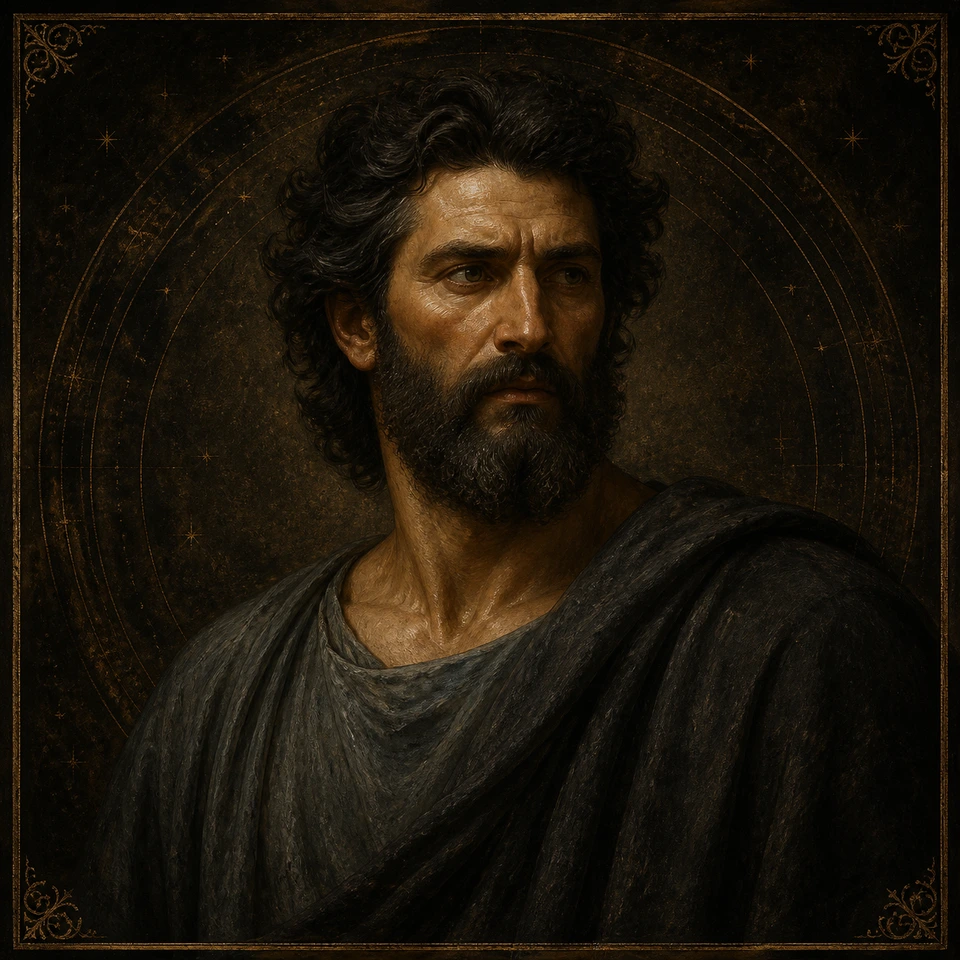
Born of Gaia and Uranus, the first-generation Titan Coeus stands in ancient genealogy as the partner of Phoebe and father to Leto and Asteria. Surviving records strictly confine him to these ancestral ties, offering no historical basis for modern attributions of intellect, inquiry, or celestial world-pillars.
Overview
Coeus, Greek Κοῖος and transliterated Koîos, is one of the first-generation Titans born from Gaia and Uranus. Hesiod places him inside two severe genealogical sequences. First he stands among the children of Earth and Sky, a generation born beneath Uranus's hatred and Gaia's pain. Later Phoebe joins him and bears Leto and Asteria. Pseudo-Apollodorus repeats both family structures and also draws Coeus into a collective revolt: all the Titans except Oceanus attack Uranus, while Cronus carries out the mutilation that ends his father's rule. Hesiod tells that overthrow differently. Gaia appeals to her children, but only Cronus answers and acts. Coeus is present in the family list, not named as an assailant.
That distinction defines the surviving evidence. Coeus is secure as a Titan, son, partner, father, and source-scoped participant in Pseudo-Apollodorus's Titan conspiracy. He is not securely attested as a god of intellect, inquiry, prophecy, the north, a polar pillar, or the celestial axis. Those familiar modern descriptions do not arise from the named archaic poem, hymn, or later mythography. They must not be smuggled backward through a speculative etymology or through Phoebe's later associations.
The Homeric Hymn to Apollo keeps his name alive within Leto's story when Delos addresses her as the glorious daughter of great Coeus. The hymn does not place him on Delos, give him an oracle, or make him act at Apollo's birth. In the nineteenth century, John Keats names Cœus among imprisoned powers in Hyperion, a Romantic recasting that freely mixes Titans, Giants, and other primeval beings. Ancient genealogy and modern poetry therefore preserve different kinds of significance.
No securely localized individual cult, sanctuary, festival, offering, epithet, priesthood, or recognizable ancient image is established by these witnesses. The sparse evidence is not a deficiency to disguise. It is the durable shape of Coeus's surviving outline: a divine figure whose weight falls through family, generational conflict, and the ancestry of Leto and Asteria rather than through a surviving body of rites or attributes.
Canonical identity
Canonical Identity
Coeus stands securely as a first-generation Titan, identified by both Hesiod and Pseudo-Apollodorus. His primary cultural classification is Titan, falling under the broader parent class of deity. While this classification is historically certain, it does not automatically confer a specific cosmic function or domain. The later Latin genealogical equivalent requires stringent critical-edition review before it can be treated as a direct match, and Polus is not accepted as a safe alias within this record. Furthermore, while his name is identical to a Messenian river, shared spelling does not transform the Titan into a river deity.
Linguistic Identity
Coeus serves as the conventional English translation of the Ancient Greek Κοῖος, which is transliterated as Koîos. A reviewed fifth-century BC Attic reconstruction establishes the pronunciation as /kôi̯.os/ (approximately KOY-oss), featuring a unique pitch contour impossible to replicate in English text. This phonetic reconstruction remains qualified, as collaborative lexical entries do not represent the absolute final authority on historical phonology. A closer, alternative transliteration frequently encountered by modern readers is Koios.
Sources and evidence
TEXTUAL · Supported
The Ancient Greek name is Κοῖος, transliterated Koîos and conventionally rendered Coeus in English.
- Source
- Wiktionary contributors, Κοῖος (2025)
- Reviewed edition
- Wiktionary permanent revision 88848693 · Wiktionary
- Exact locator
- Entry Ancient Greek Κοῖος, proper noun
- Scope
- Archaic Greece · Ancient Greece
- Authority
- open lexical reference
- Certainty
- Secure lexical form; conventional English rendering
Koios is a safe transliteration alias; no meaning is inferred from the name.
Open exact reviewed sourceSCHOLARLY INTERPRETATION · Supported
A fifth-century BC Attic reconstruction gives /kôi̯.os/; the readable guide KOY-oss remains qualified.
- Source
- Wiktionary contributors, Κοῖος (2025)
- Reviewed edition
- Wiktionary permanent revision 88848693 · Wiktionary
- Exact locator
- Entry Ancient Greek Κοῖος, Pronunciation, fifth-century BC Attic
- Scope
- Classical Greece · Attica
- Authority
- collaborative lexical reconstruction
- Certainty
- Qualified pending academic phonology cross-check
The guide does not reproduce pitch accent exactly.
Open exact reviewed sourceTEXTUAL · Supported
Hesiod names Coeus among the sons of Gaia and Uranus called Titans.
- Source
- Hesiod; edited and translated by Hugh G. Evelyn-White, Theogony (1914)
- Reviewed edition
- Hugh G. Evelyn-White edition and English translation in Hesiod, the Homeric Hymns and Homerica, 1914 · translated by Hugh G. Evelyn-White · edited by Hugh G. Evelyn-White · Perseus Digital Library / Scaife ATLAS
- Exact locator
- Entry Theogony · Line 132-138
- Scope
- Archaic Greece · Ancient Greece
- Authority
- archaic Greek poetic witness
- Certainty
- Secure
Titan is the culturally precise primary class; deity is its parent class.
Open exact reviewed sourceTEXTUAL · Supported
The proper noun Κοῖος can also designate a Messenian river, but shared spelling does not make the Titan a river deity.
- Source
- Wiktionary contributors, Κοῖος (2025)
- Reviewed edition
- Wiktionary permanent revision 88848693 · Wiktionary
- Exact locator
- Entry Ancient Greek Κοῖος, Proper noun, senses 1-2
- Scope
- Unspecified · Ancient Greece
- Authority
- lexical name-collision evidence
- Certainty
- Secure lexical collision; river identity not modeled
The Messenian river is not yet represented separately, so the warning remains textual.
Open exact reviewed source3 reviewed sources for this section
- Hesiod; edited and translated by Hugh G. Evelyn-White, Theogony (1914)Hesiod, the Homeric Hymns and Homerica, London and New York, 1914 · Perseus Digital Library / Scaife ATLAS
- Pseudo-Apollodorus; edited and translated by James G. Frazer, Library (1921)Harvard University Press and William Heinemann edition, 1921 · Perseus Digital Library / Scaife ATLAS
- Wiktionary contributors, Κοῖος (2025)Permanent revision 88848693, last edited 26 December 2025 · Wiktionary
Culture, tradition, period, and place
Coeus belongs to Greek-language theogonic and mythographic tradition. The earliest controlled witness used here is the Archaic Greek Theogony, a poem that orders divine generations and struggles for rule. The Homeric Hymn to Apollo supplies another archaic or early classical poetic context through Leto's ancestry. Pseudo-Apollodorus preserves a later Greek mythographic synthesis under Roman imperial rule.
These are literary scopes, not proof of one continuous practice throughout every Greek city. The sources do not locate an individual sanctuary of Coeus, identify a priesthood, or tie him to a civic landscape. Ancient Greece is therefore the broad place scope demanded by the surviving witnesses. Delos belongs to Leto and Apollo's hymn narrative, not to an inferred Coeus cult.
Sources and evidence
TEXTUAL · Supported
The earliest controlled evidence is Archaic Greek theogonic poetry rather than evidence for a localized cult.
- Source
- Hesiod; edited and translated by Hugh G. Evelyn-White, Theogony (1914)
- Reviewed edition
- Hugh G. Evelyn-White edition and English translation in Hesiod, the Homeric Hymns and Homerica, 1914 · translated by Hugh G. Evelyn-White · edited by Hugh G. Evelyn-White · Perseus Digital Library / Scaife ATLAS
- Exact locator
- Entry Theogony · Line 132-138; 404-410
- Scope
- Archaic Greece · Ancient Greece
- Authority
- archaic Greek poetic witness
- Certainty
- Secure for literary scope
Broad place scope reflects the witness; no city-specific cult is inferred.
Open exact reviewed sourceTEXTUAL · Supported
Pseudo-Apollodorus preserves Coeus within a later Greek mythographic synthesis under Roman imperial rule.
- Source
- Pseudo-Apollodorus; edited and translated by James G. Frazer, Library (1921)
- Reviewed edition
- James G. Frazer edition and English translation, Harvard University Press and William Heinemann, 1921 · translated by James G. Frazer · edited by James G. Frazer · Perseus Digital Library / Scaife ATLAS
- Exact locator
- Book 1 · Chapter 1-2 · Section 1.1.3-4; 1.2.2
- Scope
- Greek religion under Roman imperial rule · Ancient Greece
- Authority
- later Greek mythographic witness
- Certainty
- Secure source chronology layer
The later synthesis does not overwrite Hesiod's variant.
Open exact reviewed sourceTEXTUAL · Blocked
The named passages do not establish an individual sanctuary, temple, oracle, priesthood, or cult center for Coeus.
- Source
- Anonymous Homeric Hymns; edited and translated by Hugh G. Evelyn-White, Homeric Hymns (1914)
- Reviewed edition
- Hugh G. Evelyn-White edition and English translation in Hesiod, the Homeric Hymns and Homerica, 1914 · translated by Hugh G. Evelyn-White · edited by Hugh G. Evelyn-White · Perseus Digital Library / Scaife ATLAS
- Exact locator
- Entry Homeric Hymn to Apollo · Line 60-65; Coeus named only as Leto's father
- Scope
- Archaic Greece · Delos
- Authority
- bounded multi-source cult-place review
- Certainty
- Not evidenced in controlled witnesses
Delos belongs to Leto and Apollo's narrative, not an inferred Coeus cult.
Open exact reviewed source3 reviewed sources for this section
- Hesiod; edited and translated by Hugh G. Evelyn-White, Theogony (1914)Hesiod, the Homeric Hymns and Homerica, London and New York, 1914 · Perseus Digital Library / Scaife ATLAS
- Anonymous Homeric Hymns; edited and translated by Hugh G. Evelyn-White, Homeric Hymns (1914)Hesiod, the Homeric Hymns and Homerica, London and New York, 1914 · Perseus Digital Library / Scaife ATLAS
- Pseudo-Apollodorus; edited and translated by James G. Frazer, Library (1921)Harvard University Press and William Heinemann edition, 1921 · Perseus Digital Library / Scaife ATLAS
Historical development
Hesiod supplies the earliest secure profile: Coeus is born among the Titans and later joins Phoebe as parent of Leto and Asteria. The poem does not pause to give him an independent speech, weapon, office, or cult. His identity works through the architecture of generations. Leto will bear Apollo and Artemis; Asteria will bear Hecate. Coeus consequently stands behind major divine lines without becoming the active center of their later narratives.
The Homeric Hymn to Apollo retains that ancestry in direct address to Leto. Pseudo-Apollodorus later systematizes the family and gives the Titan generation a collective role in the overthrow of Uranus. This is development by narrative expansion, not evidence that every earlier audience already knew the later detail. Keats's Hyperion then moves Coeus into English Romantic poetry as an imprisoned primordial power. Each layer remains dated and separate.
Sources and evidence
TEXTUAL · Supported
Hesiod's Theogony securely names Coeus among the Titans and later as Phoebe's partner and father of Leto and Asteria.
- Source
- Hesiod; edited and translated by Hugh G. Evelyn-White, Theogony (1914)
- Reviewed edition
- Hugh G. Evelyn-White edition and English translation in Hesiod, the Homeric Hymns and Homerica, 1914 · translated by Hugh G. Evelyn-White · edited by Hugh G. Evelyn-White · Perseus Digital Library / Scaife ATLAS
- Exact locator
- Entry Theogony · Line 132-138; 404-410
- Scope
- Archaic Greece · Ancient Greece
- Authority
- archaic Greek poetic witness
- Certainty
- Secure
No earlier inscriptional or material witness is claimed.
Open exact reviewed sourceTEXTUAL · Supported
The Homeric Hymn to Apollo preserves Coeus through Leto's ancestry when Delos addresses her as his daughter.
- Source
- Anonymous Homeric Hymns; edited and translated by Hugh G. Evelyn-White, Homeric Hymns (1914)
- Reviewed edition
- Hugh G. Evelyn-White edition and English translation in Hesiod, the Homeric Hymns and Homerica, 1914 · translated by Hugh G. Evelyn-White · edited by Hugh G. Evelyn-White · Perseus Digital Library / Scaife ATLAS
- Exact locator
- Entry Homeric Hymn to Apollo · Line 60-65
- Scope
- Archaic Greece · Delos
- Authority
- archaic Greek hymn witness
- Certainty
- Secure for ancestry
The address does not make Coeus an active participant in Apollo's birth.
Open exact reviewed sourceTEXTUAL · Supported
Pseudo-Apollodorus expands Coeus's surviving story by making all Titans except Oceanus participants in the attack on Uranus.
- Source
- Pseudo-Apollodorus; edited and translated by James G. Frazer, Library (1921)
- Reviewed edition
- James G. Frazer edition and English translation, Harvard University Press and William Heinemann, 1921 · translated by James G. Frazer · edited by James G. Frazer · Perseus Digital Library / Scaife ATLAS
- Exact locator
- Book 1 · Chapter 1 · Section 3-4
- Scope
- Greek religion under Roman imperial rule · Ancient Greece
- Authority
- later Greek mythographic witness
- Certainty
- Secure within this source's collective wording
Coeus is implicated through the named list and all-except-Oceanus construction, not individualized by speech or weapon.
Open exact reviewed sourceTEXTUAL · Supported
Keats's Hyperion names Cœus among imprisoned primeval beings in Book II of the 1820 poem.
- Source
- John Keats; edited by M. Robertson, Hyperion (1909)
- Reviewed edition
- M. Robertson, editor, Keats: Poems Published in 1820, Oxford at the Clarendon Press, 1909; Project Gutenberg eBook 23684 · edited by M. Robertson · Project Gutenberg
- Exact locator
- Entry Hyperion, Book II · Line 1-30
- Scope
- British Romantic publication in 1820 · London publication context
- Authority
- English Romantic literary witness
- Certainty
- Secure for reception only
The poem mixes mythic generations and cannot establish ancient religion.
Open exact reviewed source4 reviewed sources for this section
- Hesiod; edited and translated by Hugh G. Evelyn-White, Theogony (1914)Hesiod, the Homeric Hymns and Homerica, London and New York, 1914 · Perseus Digital Library / Scaife ATLAS
- Anonymous Homeric Hymns; edited and translated by Hugh G. Evelyn-White, Homeric Hymns (1914)Hesiod, the Homeric Hymns and Homerica, London and New York, 1914 · Perseus Digital Library / Scaife ATLAS
- Pseudo-Apollodorus; edited and translated by James G. Frazer, Library (1921)Harvard University Press and William Heinemann edition, 1921 · Perseus Digital Library / Scaife ATLAS
- John Keats; edited by M. Robertson, Hyperion (1909)Poems Published in 1820, Clarendon Press reprint and notes, 1909; Project Gutenberg eBook 23684 · Project Gutenberg
Attested roles and historical themes
Roles, powers, and limits
Coeus's securely attested roles are relational and generational. He is a Titan, a son of Gaia and Uranus, Phoebe's partner, father of Leto and Asteria, and, in Pseudo-Apollodorus alone, one of the Titans who set upon Uranus. These roles matter because they join the first divine generation to Leto, Apollo, Artemis, Asteria, and Hecate.
No reviewed primary witness calls him intelligence, inquiry, reason, prophecy, the north, a world-pillar, a polar force, or the axis of heaven. The Theogony does not derive a domain from his name. Pseudo-Apollodorus gives the group action but no personal power. Even the Homeric hymn uses him as Leto's father, not as a source of her functions. The safe limit is firm: genealogy is evidence, inherited symbolism is not.
Sources and evidence
TEXTUAL · Supported
Coeus is securely attested as Titan, son of Gaia and Uranus, partner of Phoebe, and father of Leto and Asteria.
- Source
- Hesiod; edited and translated by Hugh G. Evelyn-White, Theogony (1914)
- Reviewed edition
- Hugh G. Evelyn-White edition and English translation in Hesiod, the Homeric Hymns and Homerica, 1914 · translated by Hugh G. Evelyn-White · edited by Hugh G. Evelyn-White · Perseus Digital Library / Scaife ATLAS
- Exact locator
- Entry Theogony · Line 132-138; 404-410
- Scope
- Archaic Greece · Ancient Greece
- Authority
- archaic Greek poetic witness
- Certainty
- Secure
Functions of descendants are not inherited.
Open exact reviewed sourceTEXTUAL · Blocked
The controlled ancient witnesses do not call Coeus a deity of intellect, inquiry, reason, prophecy, north, a world-pillar, or the celestial axis.
- Source
- Hesiod; edited and translated by Hugh G. Evelyn-White, Theogony (1914)
- Reviewed edition
- Hugh G. Evelyn-White edition and English translation in Hesiod, the Homeric Hymns and Homerica, 1914 · translated by Hugh G. Evelyn-White · edited by Hugh G. Evelyn-White · Perseus Digital Library / Scaife ATLAS
- Exact locator
- Entry Theogony · Line 132-138; 404-410; claimed domains absent
- Scope
- Archaic Greece · Ancient Greece
- Authority
- bounded cross-source domain review
- Certainty
- Not evidenced in controlled witnesses
Etymology and family association are not substituted for explicit function evidence.
Open exact reviewed source3 reviewed sources for this section
- Hesiod; edited and translated by Hugh G. Evelyn-White, Theogony (1914)Hesiod, the Homeric Hymns and Homerica, London and New York, 1914 · Perseus Digital Library / Scaife ATLAS
- Pseudo-Apollodorus; edited and translated by James G. Frazer, Library (1921)Harvard University Press and William Heinemann edition, 1921 · Perseus Digital Library / Scaife ATLAS
- Anonymous Homeric Hymns; edited and translated by Hugh G. Evelyn-White, Homeric Hymns (1914)Hesiod, the Homeric Hymns and Homerica, London and New York, 1914 · Perseus Digital Library / Scaife ATLAS
Epithets and titles
No securely localized epithet is established; Titan, father, and supposed modern domains are not converted into titles.
2 reviewed sources for this section
- Hesiod; edited and translated by Hugh G. Evelyn-White, Theogony (1914)Hesiod, the Homeric Hymns and Homerica, London and New York, 1914 · Perseus Digital Library / Scaife ATLAS
- Pseudo-Apollodorus; edited and translated by James G. Frazer, Library (1921)Harvard University Press and William Heinemann edition, 1921 · Perseus Digital Library / Scaife ATLAS
Worship and cult
The controlled literary witnesses establish divine identity but not an individual cult of Coeus. Hesiod names births, kin, and succession. The Homeric hymn names him through Leto. Pseudo-Apollodorus arranges genealogy and revolt. None of those passages identifies worshippers, priests, sacrifices, incubation, household rites, dedications, or a civic office conducted in his name.
This bounded absence does not prove that no ancient person ever honored him. It means no rite can be responsibly reconstructed from the evidence at hand. A Titan classification is not itself a ritual manual, and family connection to Leto does not transfer her sanctuaries or offerings to her father.
Sources and evidence
TEXTUAL · Blocked
No individual worshipper, rite, priesthood, sacrifice, dedication, or household practice for Coeus appears in the controlled passages.
- Source
- Pseudo-Apollodorus; edited and translated by James G. Frazer, Library (1921)
- Reviewed edition
- James G. Frazer edition and English translation, Harvard University Press and William Heinemann, 1921 · translated by James G. Frazer · edited by James G. Frazer · Perseus Digital Library / Scaife ATLAS
- Exact locator
- Book 1 · Chapter 1-2 · Section 1.1.3-4; 1.2.1-2; cult data absent
- Scope
- Greek religion under Roman imperial rule · Ancient Greece
- Authority
- bounded multi-source cult review
- Certainty
- Not evidenced in controlled witnesses
This is not a universal proof of non-worship.
Open exact reviewed source3 reviewed sources for this section
- Hesiod; edited and translated by Hugh G. Evelyn-White, Theogony (1914)Hesiod, the Homeric Hymns and Homerica, London and New York, 1914 · Perseus Digital Library / Scaife ATLAS
- Pseudo-Apollodorus; edited and translated by James G. Frazer, Library (1921)Harvard University Press and William Heinemann edition, 1921 · Perseus Digital Library / Scaife ATLAS
- Anonymous Homeric Hymns; edited and translated by Hugh G. Evelyn-White, Homeric Hymns (1914)Hesiod, the Homeric Hymns and Homerica, London and New York, 1914 · Perseus Digital Library / Scaife ATLAS
Temples, sanctuaries, and sacred places
No temple, sanctuary, sacred precinct, oracle, pilgrimage site, or geographic cult center for Coeus is securely localized in the named sources. Delos speaks within the birth story of Apollo and addresses Leto by her father; that kinship does not turn Delos into Coeus's sanctuary. Tartarus appears in wider Titan narratives, but a place of confinement is not automatically a sacred place or worship site. The broad label Ancient Greece marks the literary tradition only.
Sources and evidence
TEXTUAL · Blocked
The named passages do not establish an individual sanctuary, temple, oracle, priesthood, or cult center for Coeus.
- Source
- Anonymous Homeric Hymns; edited and translated by Hugh G. Evelyn-White, Homeric Hymns (1914)
- Reviewed edition
- Hugh G. Evelyn-White edition and English translation in Hesiod, the Homeric Hymns and Homerica, 1914 · translated by Hugh G. Evelyn-White · edited by Hugh G. Evelyn-White · Perseus Digital Library / Scaife ATLAS
- Exact locator
- Entry Homeric Hymn to Apollo · Line 60-65; Coeus named only as Leto's father
- Scope
- Archaic Greece · Delos
- Authority
- bounded multi-source cult-place review
- Certainty
- Not evidenced in controlled witnesses
Delos belongs to Leto and Apollo's narrative, not an inferred Coeus cult.
Open exact reviewed sourceTEXTUAL · Supported
Tartarus in collective Titan narratives is a place of confinement, not an attested sanctuary or sacred place of Coeus.
- Source
- Pseudo-Apollodorus; edited and translated by James G. Frazer, Library (1921)
- Reviewed edition
- James G. Frazer edition and English translation, Harvard University Press and William Heinemann, 1921 · translated by James G. Frazer · edited by James G. Frazer · Perseus Digital Library / Scaife ATLAS
- Exact locator
- Book 1 · Chapter 2 · Section 1
- Scope
- Greek religion under Roman imperial rule · Ancient Greece
- Authority
- source-scoped narrative boundary
- Certainty
- Secure distinction
Coeus is not individually named in the war-and-confinement sentence.
Open exact reviewed source2 reviewed sources for this section
- Anonymous Homeric Hymns; edited and translated by Hugh G. Evelyn-White, Homeric Hymns (1914)Hesiod, the Homeric Hymns and Homerica, London and New York, 1914 · Perseus Digital Library / Scaife ATLAS
- Pseudo-Apollodorus; edited and translated by James G. Frazer, Library (1921)Harvard University Press and William Heinemann edition, 1921 · Perseus Digital Library / Scaife ATLAS
Festivals and processions
No named festival, procession, calendar date, recurring season, sacred month, or public contest for Coeus is established. Apollo's Delian hymn and Leto's ancestry cannot be used to assign Apollo's festivals to his grandfather. Modern calendars that give Coeus a day or season require their own accountable witnesses and must remain outside the ancient layer until those witnesses are secured.
Sources and evidence
TEXTUAL · Blocked
No festival, procession, season, month, calendar date, or public contest for Coeus is established.
- Source
- Anonymous Homeric Hymns; edited and translated by Hugh G. Evelyn-White, Homeric Hymns (1914)
- Reviewed edition
- Hugh G. Evelyn-White edition and English translation in Hesiod, the Homeric Hymns and Homerica, 1914 · translated by Hugh G. Evelyn-White · edited by Hugh G. Evelyn-White · Perseus Digital Library / Scaife ATLAS
- Exact locator
- Entry Homeric Hymn to Apollo · Line 60-65; Coeus festival absent
- Scope
- Archaic Greece · Delos
- Authority
- bounded festival review
- Certainty
- Not evidenced in controlled witnesses
Apollo's Delian setting is not inherited.
Open exact reviewed source1 reviewed source for this section
- Anonymous Homeric Hymns; edited and translated by Hugh G. Evelyn-White, Homeric Hymns (1914)Hesiod, the Homeric Hymns and Homerica, London and New York, 1914 · Perseus Digital Library / Scaife ATLAS
Offerings, votives, and ritual evidence
No offering material, libation, incense, votive object, sacrifice, prayer formula, ritual posture, or temple rule is named for Coeus in the controlled corpus. The absence is especially important for practice: a gift associated with another Titan, with Leto, or with Apollo cannot be inherited through genealogy. No burning, ingestion, anointing, or material-use instruction follows from these literary passages.
Sources and evidence
TEXTUAL · Blocked
No offering, votive, libation, incense, sacrifice, prayer formula, or ritual procedure for Coeus is named.
- Source
- Hesiod; edited and translated by Hugh G. Evelyn-White, Theogony (1914)
- Reviewed edition
- Hugh G. Evelyn-White edition and English translation in Hesiod, the Homeric Hymns and Homerica, 1914 · translated by Hugh G. Evelyn-White · edited by Hugh G. Evelyn-White · Perseus Digital Library / Scaife ATLAS
- Exact locator
- Entry Theogony · Line 132-138; 404-410; ritual materials absent
- Scope
- Archaic Greece · Ancient Greece
- Authority
- bounded ritual review
- Certainty
- Not evidenced in controlled witnesses
No physical-use instruction follows from the surviving evidence.
Open exact reviewed source3 reviewed sources for this section
- Hesiod; edited and translated by Hugh G. Evelyn-White, Theogony (1914)Hesiod, the Homeric Hymns and Homerica, London and New York, 1914 · Perseus Digital Library / Scaife ATLAS
- Pseudo-Apollodorus; edited and translated by James G. Frazer, Library (1921)Harvard University Press and William Heinemann edition, 1921 · Perseus Digital Library / Scaife ATLAS
- Anonymous Homeric Hymns; edited and translated by Hugh G. Evelyn-White, Homeric Hymns (1914)Hesiod, the Homeric Hymns and Homerica, London and New York, 1914 · Perseus Digital Library / Scaife ATLAS
Iconography and material culture
Neither Hesiod nor Pseudo-Apollodorus describes Coeus's body, clothing, posture, weapon, crown, staff, vehicle, or personal emblem. The Homeric hymn adds ancestry but no appearance. No securely identified ancient statue, vase figure, relief, coin, inscription, or cult image has been attached to him here. Generic bearded Titans, starry skies, pillars, books, torches, or polar imagery cannot stand in for an identified object. Any future visual assignment must remain free of invented attributes and pass the governed image standard independently.
Sources and evidence
MATERIAL CULTURE · Blocked
No securely identified ancient object or personal visual attribute for Coeus is established by the controlled sources.
- Source
- Pseudo-Apollodorus; edited and translated by James G. Frazer, Library (1921)
- Reviewed edition
- James G. Frazer edition and English translation, Harvard University Press and William Heinemann, 1921 · translated by James G. Frazer · edited by James G. Frazer · Perseus Digital Library / Scaife ATLAS
- Exact locator
- Book 1 · Chapter 1-2 · Section 1.1.3-4; 1.2.2; appearance absent
- Scope
- Greek religion under Roman imperial rule · Ancient Greece
- Authority
- bounded iconography review
- Certainty
- Not evidenced
Generic Titan imagery and modern cosmic symbols remain excluded.
Open exact reviewed source3 reviewed sources for this section
- Hesiod; edited and translated by Hugh G. Evelyn-White, Theogony (1914)Hesiod, the Homeric Hymns and Homerica, London and New York, 1914 · Perseus Digital Library / Scaife ATLAS
- Pseudo-Apollodorus; edited and translated by James G. Frazer, Library (1921)Harvard University Press and William Heinemann edition, 1921 · Perseus Digital Library / Scaife ATLAS
- Anonymous Homeric Hymns; edited and translated by Hugh G. Evelyn-White, Homeric Hymns (1914)Hesiod, the Homeric Hymns and Homerica, London and New York, 1914 · Perseus Digital Library / Scaife ATLAS
Animals, plants, and embodied forms
No animal, plant, tree, transformed body, hybrid shape, or recurring embodied form is directly assigned to Coeus. The quail transformation sometimes associated with Asteria belongs to his daughter's narrative and does not become her father's sacred animal. Plants, animals, and celestial images linked to descendants likewise remain with the source-scoped figures and episodes that actually name them.
Sources and evidence
TEXTUAL · Blocked
No animal, plant, tree, transformation, or embodied form is directly assigned to Coeus.
- Source
- Hesiod; edited and translated by Hugh G. Evelyn-White, Theogony (1914)
- Reviewed edition
- Hugh G. Evelyn-White edition and English translation in Hesiod, the Homeric Hymns and Homerica, 1914 · translated by Hugh G. Evelyn-White · edited by Hugh G. Evelyn-White · Perseus Digital Library / Scaife ATLAS
- Exact locator
- Entry Theogony · Line 132-138; 404-410; animal and plant attributes absent
- Scope
- Archaic Greece · Ancient Greece
- Authority
- bounded attribute review
- Certainty
- Not evidenced
Asteria's later quail narrative remains her own.
Open exact reviewed source1 reviewed source for this section
- Hesiod; edited and translated by Hugh G. Evelyn-White, Theogony (1914)Hesiod, the Homeric Hymns and Homerica, London and New York, 1914 · Perseus Digital Library / Scaife ATLAS
Relationships and genealogy
Hesiod names Gaia and Uranus as parents of the Titan generation that includes Coeus. Pseudo-Apollodorus repeats the lineage. Coeus and Phoebe then become parents of Leto and Asteria in both authors. The Homeric Hymn to Apollo keeps one branch audible by calling Leto the daughter of great Coeus.
Gaia and Uranus can therefore be named as his parents, Phoebe as his partner, Leto as his daughter, and Cronus as his brother. These relationships rest on direct ancient testimony. Asteria remains fully named as his daughter even though her own page has not yet been prepared. The wider Titan family is left in the sources rather than reduced to a selective handful of siblings.
No child beyond Leto and Asteria is accepted. No role or correspondence passes automatically from descendants to ancestor. Apollo and Artemis are grandchildren in the family sequence, but their cults and myths do not become Coeus's possessions.
Sources and evidence
TEXTUAL · Supported
Gaia and Uranus are Coeus's parents in Hesiod's Titan genealogy.
- Source
- Hesiod; edited and translated by Hugh G. Evelyn-White, Theogony (1914)
- Reviewed edition
- Hugh G. Evelyn-White edition and English translation in Hesiod, the Homeric Hymns and Homerica, 1914 · translated by Hugh G. Evelyn-White · edited by Hugh G. Evelyn-White · Perseus Digital Library / Scaife ATLAS
- Exact locator
- Entry Theogony · Line 132-138
- Scope
- Archaic Greece · Ancient Greece
- Authority
- archaic Greek poetic witness
- Certainty
- Secure
Both live parent endpoints are linked.
Open exact reviewed sourceTEXTUAL · Supported
Hesiod joins Phoebe and Coeus as the parents of Leto and Asteria.
- Source
- Hesiod; edited and translated by Hugh G. Evelyn-White, Theogony (1914)
- Reviewed edition
- Hugh G. Evelyn-White edition and English translation in Hesiod, the Homeric Hymns and Homerica, 1914 · translated by Hugh G. Evelyn-White · edited by Hugh G. Evelyn-White · Perseus Digital Library / Scaife ATLAS
- Exact locator
- Entry Theogony · Line 404-410
- Scope
- Archaic Greece · Ancient Greece
- Authority
- archaic Greek poetic witness
- Certainty
- Secure
Phoebe now has her own distinct Titaness identity, allowing this partnership to be stated directly without confusing her with Artemis or mortal women of the same name.
Open exact reviewed sourceTEXTUAL · Supported
Leto and Asteria are the children of Coeus and Phoebe in Hesiod and Pseudo-Apollodorus.
- Source
- Pseudo-Apollodorus; edited and translated by James G. Frazer, Library (1921)
- Reviewed edition
- James G. Frazer edition and English translation, Harvard University Press and William Heinemann, 1921 · translated by James G. Frazer · edited by James G. Frazer · Perseus Digital Library / Scaife ATLAS
- Exact locator
- Book 1 · Chapter 2 · Section 2
- Scope
- Greek religion under Roman imperial rule · Ancient Greece
- Authority
- cross-source genealogy review
- Certainty
- Secure
Hesiod Theogony 404-410 independently supports the same children.
Open exact reviewed sourceTEXTUAL · Supported
Delos calls Leto the daughter of great Coeus in the Homeric Hymn to Apollo.
- Source
- Anonymous Homeric Hymns; edited and translated by Hugh G. Evelyn-White, Homeric Hymns (1914)
- Reviewed edition
- Hugh G. Evelyn-White edition and English translation in Hesiod, the Homeric Hymns and Homerica, 1914 · translated by Hugh G. Evelyn-White · edited by Hugh G. Evelyn-White · Perseus Digital Library / Scaife ATLAS
- Exact locator
- Entry Homeric Hymn to Apollo · Line 60-65
- Scope
- Archaic Greece · Delos
- Authority
- archaic Greek hymn witness
- Certainty
- Secure
The hymn supports Leto's offspring-of relationship, not a Coeus cult on Delos.
Open exact reviewed sourceTEXTUAL · Supported
Coeus and Cronus are siblings within the same list of children born to Gaia and Uranus.
- Source
- Hesiod; edited and translated by Hugh G. Evelyn-White, Theogony (1914)
- Reviewed edition
- Hugh G. Evelyn-White edition and English translation in Hesiod, the Homeric Hymns and Homerica, 1914 · translated by Hugh G. Evelyn-White · edited by Hugh G. Evelyn-White · Perseus Digital Library / Scaife ATLAS
- Exact locator
- Entry Theogony · Line 132-138
- Scope
- Archaic Greece · Ancient Greece
- Authority
- archaic Greek poetic witness
- Certainty
- Secure
The kinship does not transfer Cronus's sickle, kingship, or deeds to Coeus.
Open exact reviewed sourceTEXTUAL · Supported
Asteria remains a securely named daughter, but her identity must be reviewed independently before readers are sent to a separate page for her.
- Source
- Hesiod; edited and translated by Hugh G. Evelyn-White, Theogony (1914)
- Reviewed edition
- Hugh G. Evelyn-White edition and English translation in Hesiod, the Homeric Hymns and Homerica, 1914 · translated by Hugh G. Evelyn-White · edited by Hugh G. Evelyn-White · Perseus Digital Library / Scaife ATLAS
- Exact locator
- Entry Theogony · Line 404-410
- Scope
- Archaic Greece · Ancient Greece
- Authority
- source-backed identity boundary
- Certainty
- Secure daughter relation; dedicated identity review pending
Phoebe's separate Titaness identity is preserved; Asteria remains the only unresolved direct family identity.
Open exact reviewed source3 reviewed sources for this section
- Hesiod; edited and translated by Hugh G. Evelyn-White, Theogony (1914)Hesiod, the Homeric Hymns and Homerica, London and New York, 1914 · Perseus Digital Library / Scaife ATLAS
- Pseudo-Apollodorus; edited and translated by James G. Frazer, Library (1921)Harvard University Press and William Heinemann edition, 1921 · Perseus Digital Library / Scaife ATLAS
- Anonymous Homeric Hymns; edited and translated by Hugh G. Evelyn-White, Homeric Hymns (1914)Hesiod, the Homeric Hymns and Homerica, London and New York, 1914 · Perseus Digital Library / Scaife ATLAS
Actual myths and source variants
Two narratives meet the inclusion rule. In the overthrow of Uranus, Pseudo-Apollodorus first lists Coeus among the Titan sons and then says that every Titan except Oceanus attacked their father while Cronus performed the mutilation. Hesiod preserves a sharper, incompatible scene: Gaia calls on her children, fear holds them silent, and Cronus alone answers. Coeus is not named as an actor in that version.
The second shared narrative follows Coeus and Phoebe into the births of Leto and Asteria. Hesiod gives the union and births narrative motion; Pseudo-Apollodorus compresses them into a genealogical statement; the Homeric hymn invokes Leto through her father when Delos considers receiving Apollo's birth. Each witness keeps its own form.
The Titanomachy is context, not a personal episode. Neither Hesiod's battle nor Pseudo-Apollodorus's war passage singles Coeus out as a combatant. Calling him a combatant would turn membership in a divine generation into an unsupported deed. Apollo's birth also remains Leto's myth, since Coeus is named only as ancestor and does not intervene.
Sources and evidence
TEXTUAL · Supported
Pseudo-Apollodorus implicates Coeus in the collective attack on Uranus, while Hesiod names only Cronus as the son who answers Gaia and acts.
- Source
- Pseudo-Apollodorus; edited and translated by James G. Frazer, Library (1921)
- Reviewed edition
- James G. Frazer edition and English translation, Harvard University Press and William Heinemann, 1921 · translated by James G. Frazer · edited by James G. Frazer · Perseus Digital Library / Scaife ATLAS
- Exact locator
- Book 1 · Chapter 1 · Section 3-4
- Scope
- Greek religion under Roman imperial rule · Ancient Greece
- Authority
- cross-source variant review
- Certainty
- Secure source conflict
Hesiod Theogony 154-206 controls the contrasting variant.
Open exact reviewed sourceTEXTUAL · Supported
The births of Leto and Asteria form Coeus's principal individually named family narrative.
- Source
- Hesiod; edited and translated by Hugh G. Evelyn-White, Theogony (1914)
- Reviewed edition
- Hugh G. Evelyn-White edition and English translation in Hesiod, the Homeric Hymns and Homerica, 1914 · translated by Hugh G. Evelyn-White · edited by Hugh G. Evelyn-White · Perseus Digital Library / Scaife ATLAS
- Exact locator
- Entry Theogony · Line 404-410
- Scope
- Archaic Greece · Ancient Greece
- Authority
- archaic Greek poetic witness
- Certainty
- Secure
The shared myth remains usable by Phoebe, Leto, and Asteria.
Open exact reviewed sourceTEXTUAL · Blocked
The Titanomachy passages do not single Coeus out as an individual combatant, so no participant link is created.
- Source
- Hesiod; edited and translated by Hugh G. Evelyn-White, Theogony (1914)
- Reviewed edition
- Hugh G. Evelyn-White edition and English translation in Hesiod, the Homeric Hymns and Homerica, 1914 · translated by Hugh G. Evelyn-White · edited by Hugh G. Evelyn-White · Perseus Digital Library / Scaife ATLAS
- Exact locator
- Entry Theogony · Line 617-735
- Scope
- Archaic Greece · Ancient Greece
- Authority
- myth inclusion review
- Certainty
- Individual role not evidenced
Pseudo-Apollodorus Library 1.2.1 is likewise collective.
Open exact reviewed sourceTEXTUAL · Blocked
Coeus is an ancestor named in Leto's address but not an actor in Apollo's Delian birth, so the birth myth receives no Coeus participant.
- Source
- Anonymous Homeric Hymns; edited and translated by Hugh G. Evelyn-White, Homeric Hymns (1914)
- Reviewed edition
- Hugh G. Evelyn-White edition and English translation in Hesiod, the Homeric Hymns and Homerica, 1914 · translated by Hugh G. Evelyn-White · edited by Hugh G. Evelyn-White · Perseus Digital Library / Scaife ATLAS
- Exact locator
- Entry Homeric Hymn to Apollo · Line 60-130
- Scope
- Archaic Greece · Delos
- Authority
- myth inclusion review
- Certainty
- No active role evidenced
The genealogy remains visible in relationship evidence.
Open exact reviewed source3 reviewed sources for this section
- Hesiod; edited and translated by Hugh G. Evelyn-White, Theogony (1914)Hesiod, the Homeric Hymns and Homerica, London and New York, 1914 · Perseus Digital Library / Scaife ATLAS
- Pseudo-Apollodorus; edited and translated by James G. Frazer, Library (1921)Harvard University Press and William Heinemann edition, 1921 · Perseus Digital Library / Scaife ATLAS
- Anonymous Homeric Hymns; edited and translated by Hugh G. Evelyn-White, Homeric Hymns (1914)Hesiod, the Homeric Hymns and Homerica, London and New York, 1914 · Perseus Digital Library / Scaife ATLAS
Myth Library
Each myth gathers its attested participants into one source-grounded account, while distinct source traditions remain readable in their own variants.
Theogonic Succession
The Titans Overthrow Uranus
Hesiod makes Cronus the sole child who answers Gaia, while Pseudo-Apollodorus makes every Titan except Oceanus join the violent attack and thereby gives Theia only a collective role.
- Role in this profile
- one of the Titan sons collectively implicated in Pseudo-Apollodorus's attack on Uranus
- Place scope
- Ancient Greece
- Witnesses
- 2
- Variants
- 2
Divine Genealogy
Coeus and Phoebe Become Parents of Leto and Asteria
Hesiod and Pseudo-Apollodorus make Coeus and Phoebe parents of Leto and Asteria; Diodorus gives Leto alone in the relevant Cretan statement, while Hyginus names Polus, Latone, and Asterie in Latin.
- Role in this profile
- partner of Phoebe and father of Leto and Asteria
- Place scope
- Ancient Greece · Delos · Crete
- Witnesses
- 5
- Variants
- 5
Equivalences, syncretisms, and identity boundaries
Coeus is not merged with the Messenian river called Κοῖος, with the Roman sky god Caelus, with a planet, with a pole star, or with a generic cosmic axis. Similar sound, translated imagery, and genealogical proximity do not establish identity.
The Latin name Polus appears in later genealogical transmission associated with Phoebe and Leto, but a stable equivalence requires a controlled critical edition and source-lineage review. It therefore remains an unresolved research candidate, not a safe alias. The English form Coeus and transliterated Koios both point to the securely attested Greek Titan.
Phoebe's name, Leto's cult, Apollo's oracles, Asteria's later narratives, and Hecate's cosmic honors remain their own evidence. None of those features makes Coeus prophetic, lunar, solar, or oracular.
Sources and evidence
TEXTUAL · Supported
The proper noun Κοῖος can also designate a Messenian river, but shared spelling does not make the Titan a river deity.
- Source
- Wiktionary contributors, Κοῖος (2025)
- Reviewed edition
- Wiktionary permanent revision 88848693 · Wiktionary
- Exact locator
- Entry Ancient Greek Κοῖος, Proper noun, senses 1-2
- Scope
- Unspecified · Ancient Greece
- Authority
- lexical name-collision evidence
- Certainty
- Secure lexical collision; river identity not modeled
The Messenian river is not yet represented separately, so the warning remains textual.
Open exact reviewed sourceTEXTUAL · Blocked
Polus remains an unresolved later equivalence candidate and is not a safe alias without a controlled Latin critical edition and lineage review.
- Source
- Pseudo-Apollodorus; edited and translated by James G. Frazer, Library (1921)
- Reviewed edition
- James G. Frazer edition and English translation, Harvard University Press and William Heinemann, 1921 · translated by James G. Frazer · edited by James G. Frazer · Perseus Digital Library / Scaife ATLAS
- Exact locator
- Book 1 · Chapter 1-2 · Section 1.1.3; 1.2.2; secure Greek Coeus baseline
- Scope
- Greek religion under Roman imperial rule · Ancient Greece
- Authority
- bounded alias source-closure review
- Certainty
- Unresolved
A future Hyginus critical-edition extraction may resolve the relation.
Open exact reviewed sourceTEXTUAL · Blocked
Phoebe's name and the later cults or functions of Leto, Apollo, Artemis, Asteria, and Hecate do not establish Coeus as prophetic, lunar, solar, or oracular.
- Source
- Hesiod; edited and translated by Hugh G. Evelyn-White, Theogony (1914)
- Reviewed edition
- Hugh G. Evelyn-White edition and English translation in Hesiod, the Homeric Hymns and Homerica, 1914 · translated by Hugh G. Evelyn-White · edited by Hugh G. Evelyn-White · Perseus Digital Library / Scaife ATLAS
- Exact locator
- Entry Theogony · Line 404-452; functions differentiated by figure
- Scope
- Archaic Greece · Ancient Greece
- Authority
- genealogy non-inference review
- Certainty
- Unsupported as inherited functions
Each descendant retains separate evidence.
Open exact reviewed source3 reviewed sources for this section
- Wiktionary contributors, Κοῖος (2025)Permanent revision 88848693, last edited 26 December 2025 · Wiktionary
- Hesiod; edited and translated by Hugh G. Evelyn-White, Theogony (1914)Hesiod, the Homeric Hymns and Homerica, London and New York, 1914 · Perseus Digital Library / Scaife ATLAS
- Pseudo-Apollodorus; edited and translated by James G. Frazer, Library (1921)Harvard University Press and William Heinemann edition, 1921 · Perseus Digital Library / Scaife ATLAS
Correspondence index
No reviewed witness assigns Coeus a planet, zodiac sign, stone, metal, plant, animal, color, classical element, weekday, moon phase, direction, season, incense, offering, ritual tool, or magical intention. The result is not an empty invitation. It is sixteen explicit historical boundaries.
The popular north-pillar and celestial-axis claims are especially unsafe because they can make several unsupported categories appear at once: direction, celestial body, element, symbol, and intention. Hesiod's family structure does not say them. Pseudo-Apollodorus's revolt does not say them. Keats's imprisonment scene belongs to English Romantic reception and does not supply ancient ritual correspondences. Any later occult system must be documented as its own named, dated layer before one of these fields changes.
16 expected categories currently not evidenced
celestial-body · Not evidenced
No celestial body or planet evidenced
No reviewed witness assigns Coeus a planet, star, pole, or celestial axis.
- Layer
- Research Boundary
- Scope
- Do not infer astronomy from modern cosmic-axis descriptions.
zodiac · Not evidenced
No zodiac sign evidenced
No reviewed witness assigns Coeus a zodiac sign.
- Layer
- Research Boundary
- Scope
- A supposed north or polar role does not create zodiac rulership.
gemstone-crystal-mineral · Not evidenced
No stone or mineral evidenced
No reviewed witness directly links a stone or mineral to Coeus.
- Layer
- Research Boundary
- Scope
- Tartarus and cosmic conflict do not imply a crystal.
metal-material · Not evidenced
No metal or material evidenced
No reviewed witness assigns Coeus a ritual metal or material.
- Layer
- Research Boundary
- Scope
- Cronus's sickle belongs to Cronus's action, not Coeus.
plant-tree · Not evidenced
No plant or tree evidenced
No reviewed witness names a sacred plant or tree for Coeus.
- Layer
- Research Boundary
- Scope
- No descendant's plant association is inherited.
animal-embodied-form · Not evidenced
No animal or embodied form evidenced
No reviewed witness assigns Coeus an animal, hybrid body, or transformation.
- Layer
- Research Boundary
- Scope
- Asteria's later quail story is not her father's animal correspondence.
color · Not evidenced
No color evidenced
No reviewed witness assigns Coeus a ritual or magical color.
- Layer
- Research Boundary
- Scope
- Modern art palettes are not historical correspondences.
classical-element · Not evidenced
No classical element evidenced
No reviewed witness links Coeus to earth, air, fire, or water as a correspondence.
- Layer
- Research Boundary
- Scope
- Being born from Gaia and Uranus does not confer an elemental rulership.
weekday · Not evidenced
No weekday evidenced
No reviewed witness assigns Coeus a weekday.
- Layer
- Research Boundary
- Scope
- No day is inherited from descendants or a planet.
moon-phase · Not evidenced
No moon phase evidenced
No reviewed witness assigns Coeus a lunar phase.
- Layer
- Research Boundary
- Scope
- Phoebe's name does not create a lunar practice for Coeus.
direction-place · Not evidenced
No ritual direction evidenced
No reviewed witness assigns Coeus north or any other ritual direction.
- Layer
- Research Boundary
- Scope
- The north-pillar claim is not supported by the named ancient sources.
festival-time · Not evidenced
No season or festival time evidenced
No reviewed witness supplies a festival, season, month, or calendar date.
- Layer
- Research Boundary
- Scope
- Apollo's Delian traditions are not inherited by his grandfather.
incense-perfume · Not evidenced
No incense or resin evidenced
No reviewed witness names an incense, resin, or perfume for Coeus.
- Layer
- Research Boundary
- Scope
- No burning practice is implied.
offering-ritual-material · Not evidenced
No offering evidenced
No reviewed witness names an offering or votive material for Coeus.
- Layer
- Research Boundary
- Scope
- Family relationships do not transfer another deity's offerings.
ritual-object-symbol-tool · Not evidenced
No ritual object, symbol, or tool evidenced
No reviewed witness gives Coeus a personal emblem, weapon, staff, pillar, or ritual tool.
- Layer
- Research Boundary
- Scope
- Cronus's sickle and modern axis imagery remain excluded.
intention-magical-power · Not evidenced
No magical or devotional intention evidenced
No reviewed witness establishes an intention such as intelligence, inquiry, prophecy, revelation, or cosmic order.
- Layer
- Research Boundary
- Scope
- Later practice needs its own named, dated, accountable evidence.
Sources and evidence
TEXTUAL · Blocked
The controlled corpus supports no positive value in any of the sixteen correspondence families.
- Source
- Hesiod; edited and translated by Hugh G. Evelyn-White, Theogony (1914)
- Reviewed edition
- Hugh G. Evelyn-White edition and English translation in Hesiod, the Homeric Hymns and Homerica, 1914 · translated by Hugh G. Evelyn-White · edited by Hugh G. Evelyn-White · Perseus Digital Library / Scaife ATLAS
- Exact locator
- Entry Theogony · Line 132-138; 154-206; 404-410; correspondence assignments absent
- Scope
- Archaic Greece · Ancient Greece
- Authority
- bounded multi-source correspondence review
- Certainty
- Not evidenced in controlled corpus
Later named systems may be added only within their own dated evidence layers.
Open exact reviewed source4 reviewed sources for this section
- Hesiod; edited and translated by Hugh G. Evelyn-White, Theogony (1914)Hesiod, the Homeric Hymns and Homerica, London and New York, 1914 · Perseus Digital Library / Scaife ATLAS
- Pseudo-Apollodorus; edited and translated by James G. Frazer, Library (1921)Harvard University Press and William Heinemann edition, 1921 · Perseus Digital Library / Scaife ATLAS
- Anonymous Homeric Hymns; edited and translated by Hugh G. Evelyn-White, Homeric Hymns (1914)Hesiod, the Homeric Hymns and Homerica, London and New York, 1914 · Perseus Digital Library / Scaife ATLAS
- John Keats; edited by M. Robertson, Hyperion (1909)Poems Published in 1820, Clarendon Press reprint and notes, 1909; Project Gutenberg eBook 23684 · Project Gutenberg
Later reception and living significance
John Keats's Hyperion, published in 1820, names Cœus among imprisoned primeval powers while defeated Titans gather in a cavernous landscape. The passage is vivid but deliberately unfaithful to a single ancient genealogy: Titans, Hundred-Handers, Giants, and other figures occupy the same Romantic ruin. Its value is reception, not reconstruction.
Modern Pagan devotion to Coeus may exist in private or individual practice, but no accountable community-public source has been secured for a shared rite or doctrine. It would be wrong to deny private devotion, and equally wrong to publish solitary or unsourced claims as an established living tradition. Modern titles such as god of intelligence or the north remain unsupported until a named source and period can be reviewed.
Sources and evidence
TEXTUAL · Supported
Keats's Hyperion names Cœus among imprisoned primeval beings in Book II of the 1820 poem.
- Source
- John Keats; edited by M. Robertson, Hyperion (1909)
- Reviewed edition
- M. Robertson, editor, Keats: Poems Published in 1820, Oxford at the Clarendon Press, 1909; Project Gutenberg eBook 23684 · edited by M. Robertson · Project Gutenberg
- Exact locator
- Entry Hyperion, Book II · Line 1-30
- Scope
- British Romantic publication in 1820 · London publication context
- Authority
- English Romantic literary witness
- Certainty
- Secure for reception only
The poem mixes mythic generations and cannot establish ancient religion.
Open exact reviewed sourceTEXTUAL · Blocked
No accountable community-public source has yet established a shared modern devotional practice specific to Coeus.
- Source
- John Keats; edited by M. Robertson, Hyperion (1909)
- Reviewed edition
- M. Robertson, editor, Keats: Poems Published in 1820, Oxford at the Clarendon Press, 1909; Project Gutenberg eBook 23684 · edited by M. Robertson · Project Gutenberg
- Exact locator
- Entry Hyperion, Book II; literary reception rather than devotional authority
- Scope
- British Romantic publication in 1820 · London publication context
- Authority
- bounded living-practice source-closure review
- Certainty
- Living-practice evidence not closed
Private devotion is neither denied nor generalized.
Open exact reviewed source2 reviewed sources for this section
- John Keats; edited by M. Robertson, Hyperion (1909)Poems Published in 1820, Clarendon Press reprint and notes, 1909; Project Gutenberg eBook 23684 · Project Gutenberg
- Hesiod; edited and translated by Hugh G. Evelyn-White, Theogony (1914)Hesiod, the Homeric Hymns and Homerica, London and New York, 1914 · Perseus Digital Library / Scaife ATLAS
Evidence, conflicts, and research gaps
The strongest identity and genealogy evidence comes from Hesiod's Theogony, supported by the Homeric Hymn to Apollo and later Pseudo-Apollodoran mythography. Their most important conflict concerns the overthrow of Uranus. Hesiod makes Cronus the only son who answers Gaia; Pseudo-Apollodorus has every Titan except Oceanus attack. The source-scoped variants must remain separate.
Several limits remain visible. The pronunciation needs an academic phonology cross-check. A controlled critical edition must resolve whether Latin Polus should receive an equivalence relation. No secure individual cult, epithet, sanctuary, festival, offering, iconographic object, or ancient correspondence has been located. Phoebe now has her own distinct identity, while Asteria still needs dedicated identity review before her daughter relationship can lead to a separate page. The Titanomachy and released-Titan fragments need a dedicated edition review before Coeus can receive an individual participant role.
The source rights are exact: Perseus editions are reference-only because component rights vary; the Wiktionary lexical revision is CC BY-SA; the Project Gutenberg edition is public domain in the United States under its included license. Every narrative is an original paraphrase, not copied translation.
Sources and evidence
TEXTUAL · Supported
Hesiod and Pseudo-Apollodorus disagree about whether Coeus participates in the attack on Uranus.
- Source
- Hesiod; edited and translated by Hugh G. Evelyn-White, Theogony (1914)
- Reviewed edition
- Hugh G. Evelyn-White edition and English translation in Hesiod, the Homeric Hymns and Homerica, 1914 · translated by Hugh G. Evelyn-White · edited by Hugh G. Evelyn-White · Perseus Digital Library / Scaife ATLAS
- Exact locator
- Entry Theogony · Line 154-206; compared with Library 1.1.3-4
- Scope
- Archaic Greece · Ancient Greece
- Authority
- cross-source primary-text comparison
- Certainty
- Secure conflict
Hesiod names only Cronus as acting; the later mythographer includes the Titan group except Oceanus.
Open exact reviewed sourceSCHOLARLY INTERPRETATION · Blocked
Academic pronunciation, Polus equivalence, individual cult and iconography, Asteria identity review, and released-Titan fragments remain open.
- Source
- Wiktionary contributors, Κοῖος (2025)
- Reviewed edition
- Wiktionary permanent revision 88848693 · Wiktionary
- Exact locator
- Entry Ancient Greek Κοῖος and explicit qualification; unresolved-evidence review
- Scope
- Unspecified · Ancient Greece
- Authority
- bounded dossier gap review
- Certainty
- Explicit unresolved coverage
Secure identity and genealogy remain unaffected.
Open exact reviewed sourceTEXTUAL · Supported
Perseus text components remain reference-only, Wiktionary is CC BY-SA, and the Project Gutenberg edition is public domain in the United States under its license.
- Source
- John Keats; edited by M. Robertson, Hyperion (1909)
- Reviewed edition
- M. Robertson, editor, Keats: Poems Published in 1820, Oxford at the Clarendon Press, 1909; Project Gutenberg eBook 23684 · edited by M. Robertson · Project Gutenberg
- Exact locator
- Entry Project Gutenberg ebook header and license; compared with registered rights statements
- Scope
- British Romantic publication in 1820 · London publication context
- Authority
- cross-source rights review
- Certainty
- Secure rights dispositions
No source prose or protected image is reproduced.
Open exact reviewed source5 reviewed sources for this section
- Hesiod; edited and translated by Hugh G. Evelyn-White, Theogony (1914)Hesiod, the Homeric Hymns and Homerica, London and New York, 1914 · Perseus Digital Library / Scaife ATLAS
- Pseudo-Apollodorus; edited and translated by James G. Frazer, Library (1921)Harvard University Press and William Heinemann edition, 1921 · Perseus Digital Library / Scaife ATLAS
- Anonymous Homeric Hymns; edited and translated by Hugh G. Evelyn-White, Homeric Hymns (1914)Hesiod, the Homeric Hymns and Homerica, London and New York, 1914 · Perseus Digital Library / Scaife ATLAS
- Wiktionary contributors, Κοῖος (2025)Permanent revision 88848693, last edited 26 December 2025 · Wiktionary
- John Keats; edited by M. Robertson, Hyperion (1909)Poems Published in 1820, Clarendon Press reprint and notes, 1909; Project Gutenberg eBook 23684 · Project Gutenberg
Direct connections and evidence
Explicit Source
Hesiod and Pseudo-Apollodorus name Gaia as mother of Coeus
Direct genealogy; Gaia's domains do not become Coeus correspondences.
2 attestations · high confidence
- Hesiod; edited and translated by Hugh G. Evelyn-White, TheogonyHugh G. Evelyn-White edition and English translation in Hesiod, the Homeric Hymns and Homerica, 1914 · translated by Hugh G. Evelyn-White · edited by Hugh G. Evelyn-White · Perseus Digital Library / Scaife ATLAS · Archaic Greece · Ancient Greece · Entry Theogony · Line 132-138
- Pseudo-Apollodorus; edited and translated by James G. Frazer, LibraryJames G. Frazer edition and English translation, Harvard University Press and William Heinemann, 1921 · translated by James G. Frazer · edited by James G. Frazer · Perseus Digital Library / Scaife ATLAS · Greek religion under Roman imperial rule · Ancient Greece · Book 1 · Chapter 1 · Section 3
Explicit Source
Hesiod and Pseudo-Apollodorus name Uranus as father of Coeus
Direct genealogy; the divine father Uranus remains distinct from the planet of the same name.
2 attestations · high confidence
- Hesiod; edited and translated by Hugh G. Evelyn-White, TheogonyHugh G. Evelyn-White edition and English translation in Hesiod, the Homeric Hymns and Homerica, 1914 · translated by Hugh G. Evelyn-White · edited by Hugh G. Evelyn-White · Perseus Digital Library / Scaife ATLAS · Archaic Greece · Ancient Greece · Entry Theogony · Line 132-138
- Pseudo-Apollodorus; edited and translated by James G. Frazer, LibraryJames G. Frazer edition and English translation, Harvard University Press and William Heinemann, 1921 · translated by James G. Frazer · edited by James G. Frazer · Perseus Digital Library / Scaife ATLAS · Greek religion under Roman imperial rule · Ancient Greece · Book 1 · Chapter 1 · Section 3
Explicit Source
Hesiod, the Homeric Hymn to Apollo, and Pseudo-Apollodorus name Coeus as Leto's father
Direct genealogy; Leto's cult places and children create no automatic Coeus edges.
3 attestations · high confidence
- Hesiod; edited and translated by Hugh G. Evelyn-White, TheogonyHugh G. Evelyn-White edition and English translation in Hesiod, the Homeric Hymns and Homerica, 1914 · translated by Hugh G. Evelyn-White · edited by Hugh G. Evelyn-White · Perseus Digital Library / Scaife ATLAS · Archaic Greece · Ancient Greece · Entry Theogony · Line 404-410
- Anonymous Homeric Hymns; edited and translated by Hugh G. Evelyn-White, Homeric HymnsHugh G. Evelyn-White edition and English translation in Hesiod, the Homeric Hymns and Homerica, 1914 · translated by Hugh G. Evelyn-White · edited by Hugh G. Evelyn-White · Perseus Digital Library / Scaife ATLAS · Archaic Greece · Delos · Entry Homeric Hymn to Apollo · Line 60-65
- Pseudo-Apollodorus; edited and translated by James G. Frazer, LibraryJames G. Frazer edition and English translation, Harvard University Press and William Heinemann, 1921 · translated by James G. Frazer · edited by James G. Frazer · Perseus Digital Library / Scaife ATLAS · Greek religion under Roman imperial rule · Ancient Greece · Book 1 · Chapter 2 · Section 2
Explicit Source
Coeus and Cronus share Gaia and Uranus as parents in Hesiod and Pseudo-Apollodorus
Their sibling relationship does not transfer Cronus's sickle, kingship, or deeds to Coeus.
2 attestations · high confidence
- Hesiod; edited and translated by Hugh G. Evelyn-White, TheogonyHugh G. Evelyn-White edition and English translation in Hesiod, the Homeric Hymns and Homerica, 1914 · translated by Hugh G. Evelyn-White · edited by Hugh G. Evelyn-White · Perseus Digital Library / Scaife ATLAS · Archaic Greece · Ancient Greece · Entry Theogony · Line 132-138
- Pseudo-Apollodorus; edited and translated by James G. Frazer, LibraryJames G. Frazer edition and English translation, Harvard University Press and William Heinemann, 1921 · translated by James G. Frazer · edited by James G. Frazer · Perseus Digital Library / Scaife ATLAS · Greek religion under Roman imperial rule · Ancient Greece · Book 1 · Chapter 1 · Section 3
Explicit Source
Hesiod and Pseudo-Apollodorus name Coeus and Phoebe as the parents of Leto and Asteria
Their parenthood of Leto and Asteria is explicit; Phoebe's name does not give Coeus lunar or prophetic functions.
2 attestations · high confidence
- Hesiod; edited and translated by Hugh G. Evelyn-White, TheogonyHugh G. Evelyn-White edition and English translation in Hesiod, the Homeric Hymns and Homerica, 1914 · translated by Hugh G. Evelyn-White · edited by Hugh G. Evelyn-White · Perseus Digital Library / Scaife ATLAS · Archaic Greece · Ancient Greece · Entry Theogony · Line 404-410
- Pseudo-Apollodorus; edited and translated by James G. Frazer, LibraryJames G. Frazer edition and English translation, Harvard University Press and William Heinemann, 1921 · translated by James G. Frazer · edited by James G. Frazer · Perseus Digital Library / Scaife ATLAS · Greek religion under Roman imperial rule · Ancient Greece · Book 1 · Chapter 2 · Section 2
Explicit Source
Hesiod names Iapetus and Coeus in the same generation born from Gaia and Ouranos
Sibling genealogy only; it transfers no office, deed, cult, or correspondence between the two figures.
1 attestation · high confidence
- Hesiod; edited and translated by Hugh G. Evelyn-White, TheogonyHugh G. Evelyn-White edition and English translation in Hesiod, the Homeric Hymns and Homerica, 1914 · translated by Hugh G. Evelyn-White · edited by Hugh G. Evelyn-White · Perseus Digital Library / Scaife ATLAS · Archaic Greece · Ancient Greece · Entry Theogony · Line 132-138
Explicit Source
Hesiod names Mnemosyne and Coeus in the same generation born from Gaia and Ouranos
Sibling genealogy only; it transfers no office, deed, cult, or correspondence between the two figures.
1 attestation · high confidence
- Hesiod; edited and translated by Hugh G. Evelyn-White, TheogonyHugh G. Evelyn-White edition and English translation in Hesiod, the Homeric Hymns and Homerica, 1914 · translated by Hugh G. Evelyn-White · edited by Hugh G. Evelyn-White · Perseus Digital Library / Scaife ATLAS · Archaic Greece · Ancient Greece · Entry Theogony · Line 132-138
Explicit Source
Hesiod names Rhea and Coeus in the same generation born from Gaia and Ouranos
Sibling genealogy only; it transfers no office, deed, cult, or correspondence between the two figures.
1 attestation · high confidence
- Hesiod; edited and translated by Hugh G. Evelyn-White, TheogonyHugh G. Evelyn-White edition and English translation in Hesiod, the Homeric Hymns and Homerica, 1914 · translated by Hugh G. Evelyn-White · edited by Hugh G. Evelyn-White · Perseus Digital Library / Scaife ATLAS · Archaic Greece · Ancient Greece · Entry Theogony · Line 132-138
Archive scope and classification
- Figure classification
- Titan or Titaness, God or goddess · certain
- Pantheon or tradition shelf
- Greek
- Cultures
- Greek
- Traditions
- Ancient Greek religion
- Periods
- Archaic Greece, Greek religion under Roman imperial rule
- Places
- Ancient Greece
Identity, genealogy, source-scoped myths, cult and iconography limits, reception, correspondence boundaries, image, and remaining research gaps are reviewed.
Reviewed sources
- Hesiod; edited and translated by Hugh G. Evelyn-White, Theogony (1914)Hesiod, the Homeric Hymns and Homerica, London and New York, 1914 · Perseus Digital Library / Scaife ATLAS
- Anonymous Homeric Hymns; edited and translated by Hugh G. Evelyn-White, Homeric Hymns (1914)Hesiod, the Homeric Hymns and Homerica, London and New York, 1914 · Perseus Digital Library / Scaife ATLAS
- Pseudo-Apollodorus; edited and translated by James G. Frazer, Library (1921)Harvard University Press and William Heinemann edition, 1921 · Perseus Digital Library / Scaife ATLAS
- Wiktionary contributors, Κοῖος (2025)Permanent revision 88848693, last edited 26 December 2025 · Wiktionary
- John Keats; edited by M. Robertson, Hyperion (1909)Poems Published in 1820, Clarendon Press reprint and notes, 1909; Project Gutenberg eBook 23684 · Project Gutenberg