Greek · Titan or Titaness · Certain
Crius
Κρεῖος · Kreîos
Pronunciation: /krêː.os/ · KREH-oss
Research and editorial review by Cody Manes · Reviewed 2026-08-30
A primal descendant of Gaia and Ouranos, the first-generation Titan Crius partnered with Eurybia to father Astraeus, Pallas, and Perses. Despite his high genealogical standing, current historical evidence reveals no secure individual cult or dedicated iconography for him.
Overview
Crius enters Greek poetry in a roll call of enormous consequence. Gaia and Ouranos bring forth twelve Titans, six sons and six daughters, and Hesiod places Κρεῖος among them. Cronus receives the ominous description and the later succession story. Crius receives only his name. That silence has tempted later writers to supply a ram, a constellation, the sign Aries, the south, or a celestial pillar. None of those attributes appears in the ancient passages that preserve him.
His second appearance is quieter but more expansive. Eurybia, daughter of Pontus, bears Crius three sons: Astraeus, Pallas, and Perses. Hesiod calls Perses outstanding in wisdom and follows Astraeus into a union with Eos, the dawn. From that younger pair come winds and stars. The genealogy opens outward into air and night sky, but the poem never turns those descendants into Crius’ private domain. Family consequence is not the same thing as rulership.
Pseudo-Apollodorus preserves both structures in later mythography. Earth and Sky produce the Titans, including Crius. Crius and Eurybia produce the same three sons. The agreement makes the family lines secure; the brevity makes everything else uncertain. No individual combat, journey, transformation, punishment, sanctuary foundation, or heroic deed belongs to Crius in these locators. Even the Titanomachy cannot be expanded into a personal battle scene without a witness that names his action.
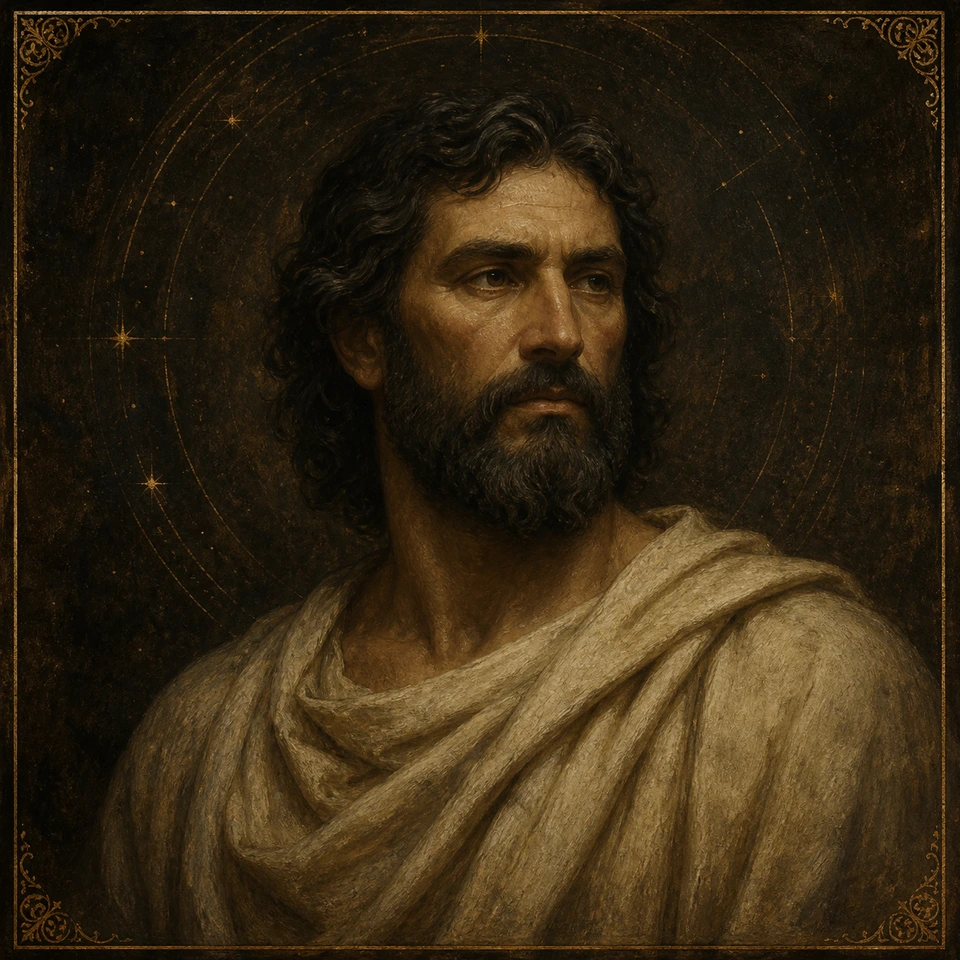
The surviving evidence establishes no sanctuary or organized worship centered on Crius. No securely identified ancient image gives him a face, garment, tool, animal, or posture. The collection portrait therefore follows a cautious living convention, free of ram horns, zodiac wheels, constellation marks, and fabricated weapons, rather than claiming an ancient model.
The Greek form is Κρεῖος, transliterated Kreîos. A qualified fifth-century BC Attic reconstruction gives /krêː.os/, approximately KREH-oss, although that guide cannot reproduce the falling pitch or long vowel. English Crius is the familiar normalized form. Neither pronunciation nor uncertain etymology supplies a religious function.
Crius shows why restraint can teach more than a crowded list of modern attributes. His first-generation Titan identity is certain. Gaia and Ouranos are his parents; Cronus is one securely connected sibling; Eurybia is his partner; Astraeus, Pallas, and Perses are his sons. Two genealogical myths carry his surviving presence. Beyond them, the honest profile remains spare. The restraint is part of the history. Crius did not need a modern portfolio to remain one of the divine children who connected the primordial generation to younger powers. His ancient presence is carried by placement, parentage, and continuity, which are quieter than conquest but no less exact.
Canonical identity
Canonical Identity
Crius is securely classified as a first-generation Titan and divine figure, born directly from Gaia and Ouranos according to both Hesiod and Pseudo-Apollodorus. His surviving ancient identity is strictly genealogical. The historical evidence does not grant him authority over a ram, the constellation Aries, a heavenly pillar, or any other private cosmic domain. Such claims stem from later speculative associations and visual resemblances, rather than from the foundational Greek texts.
Linguistic Identity
The Greek form is Κρεῖος, transliterated precisely as Kreîos. A qualified fifth-century BC Attic reconstruction yields /krêː.os/, roughly KREH-oss, though English guides cannot perfectly emulate the falling pitch or the long vowel. The commonly used English spelling "Crius" represents a later normalized adaptation rather than an authentic reflection of ancient pronunciation.
Sources and evidence
TEXTUAL · Supported
The Greek name is Κρεῖος, transliterated Kreîos, with a qualified fifth-century BC Attic reconstruction /krêː.os/.
- Source
- Wiktionary contributors, Κρεῖος
- Reviewed edition
- Wiktionary live revision reviewed 2026-08-30 · Wiktionary
- Exact locator
- Entry Κρεῖος · Section Ancient Greek pronunciation
- Scope
- Classical Greece · Attica
- Authority
- collaborative historical lexicon
- Certainty
- Qualified
The readable guide KREH-oss cannot reproduce the falling pitch or long vowel exactly.
Open exact reviewed sourceTEXTUAL · Supported
Hesiod names Crius among the twelve children of Gaia and Ouranos whom the poem calls Titans.
- Source
- Hesiod; edited and translated by Hugh G. Evelyn-White, Theogony (1914)
- Reviewed edition
- Hugh G. Evelyn-White edition and English translation in Hesiod, the Homeric Hymns and Homerica, 1914 · translated by Hugh G. Evelyn-White · edited by Hugh G. Evelyn-White · Perseus Digital Library / Scaife ATLAS
- Exact locator
- Entry Theogony · Line 132-138
- Scope
- Archaic Greece · Ancient Greece
- Authority
- primary textual witness
- Certainty
- High
This passage secures first-generation Titan identity without assigning a special domain.
Open exact reviewed source2 reviewed sources for this section
- Wiktionary contributors, ΚρεῖοςLive collaborative lexical entry reviewed 2026-08-30 · Wiktionary
- Hesiod; edited and translated by Hugh G. Evelyn-White, Theogony (1914)Hesiod, the Homeric Hymns and Homerica, London and New York, 1914 · Perseus Digital Library / Scaife ATLAS
Culture, tradition, period, and place
Crius survives first in archaic Greek theogony and later in Greek mythography. Hesiod places him inside a genealogy that moves from primordial Earth and Sky into the Titan generation and then toward younger divine families. Pseudo-Apollodorus preserves the same broad structure in a later handbook.
No city, island, mountain, sanctuary, or cult center is securely attached to Crius. The geography is cosmic and genealogical rather than civic. Ancient Greece describes the language and religious world of the witnesses, not a proven place of individual worship.
Sources and evidence
TEXTUAL · Supported
Hesiod names Crius among the twelve children of Gaia and Ouranos whom the poem calls Titans.
- Source
- Hesiod; edited and translated by Hugh G. Evelyn-White, Theogony (1914)
- Reviewed edition
- Hugh G. Evelyn-White edition and English translation in Hesiod, the Homeric Hymns and Homerica, 1914 · translated by Hugh G. Evelyn-White · edited by Hugh G. Evelyn-White · Perseus Digital Library / Scaife ATLAS
- Exact locator
- Entry Theogony · Line 132-138
- Scope
- Archaic Greece · Ancient Greece
- Authority
- primary textual witness
- Certainty
- High
This passage secures first-generation Titan identity without assigning a special domain.
Open exact reviewed sourceTEXTUAL · Supported
Pseudo-Apollodorus also names Crius among the Titans born from Earth and Sky.
- Source
- Pseudo-Apollodorus; edited and translated by James G. Frazer, Library (1921)
- Reviewed edition
- James G. Frazer edition and English translation, Harvard University Press and William Heinemann, 1921 · translated by James G. Frazer · edited by James G. Frazer · Perseus Digital Library / Scaife ATLAS
- Exact locator
- Entry Library · Book 1 · Chapter 1 · Section 3
- Scope
- Greek religion under Roman imperial rule · Ancient Greece
- Authority
- primary textual witness
- Certainty
- High
Later mythography confirms the genealogy but does not add cult evidence.
Open exact reviewed source2 reviewed sources for this section
- Hesiod; edited and translated by Hugh G. Evelyn-White, Theogony (1914)Hesiod, the Homeric Hymns and Homerica, London and New York, 1914 · Perseus Digital Library / Scaife ATLAS
- Pseudo-Apollodorus; edited and translated by James G. Frazer, Library (1921)Harvard University Press and William Heinemann edition, 1921 · Perseus Digital Library / Scaife ATLAS
Historical development
The archaic profile is already sparse. Hesiod names Crius among the twelve Titans, then later joins him with Eurybia as father of Astraeus, Pallas, and Perses. The poem continues through Astraeus to winds and stars without giving those powers to Crius.
Pseudo-Apollodorus repeats the parentage and three sons in compressed form. The later witness confirms continuity of the genealogy but adds no sanctuary, image, festival, or deed. Modern summaries often compensate by inventing celestial offices. The ancient development is more restrained: a secure divine name, a first-generation class, and a consequential descendant line.
Sources and evidence
TEXTUAL · Supported
Hesiod names Crius among the twelve children of Gaia and Ouranos whom the poem calls Titans.
- Source
- Hesiod; edited and translated by Hugh G. Evelyn-White, Theogony (1914)
- Reviewed edition
- Hugh G. Evelyn-White edition and English translation in Hesiod, the Homeric Hymns and Homerica, 1914 · translated by Hugh G. Evelyn-White · edited by Hugh G. Evelyn-White · Perseus Digital Library / Scaife ATLAS
- Exact locator
- Entry Theogony · Line 132-138
- Scope
- Archaic Greece · Ancient Greece
- Authority
- primary textual witness
- Certainty
- High
This passage secures first-generation Titan identity without assigning a special domain.
Open exact reviewed sourceTEXTUAL · Supported
Pseudo-Apollodorus also names Crius among the Titans born from Earth and Sky.
- Source
- Pseudo-Apollodorus; edited and translated by James G. Frazer, Library (1921)
- Reviewed edition
- James G. Frazer edition and English translation, Harvard University Press and William Heinemann, 1921 · translated by James G. Frazer · edited by James G. Frazer · Perseus Digital Library / Scaife ATLAS
- Exact locator
- Entry Library · Book 1 · Chapter 1 · Section 3
- Scope
- Greek religion under Roman imperial rule · Ancient Greece
- Authority
- primary textual witness
- Certainty
- High
Later mythography confirms the genealogy but does not add cult evidence.
Open exact reviewed sourceTEXTUAL · Supported
Hesiod says Eurybia bore Astraeus, Pallas, and Perses to Crius.
- Source
- Hesiod; edited and translated by Hugh G. Evelyn-White, Theogony (1914)
- Reviewed edition
- Hugh G. Evelyn-White edition and English translation in Hesiod, the Homeric Hymns and Homerica, 1914 · translated by Hugh G. Evelyn-White · edited by Hugh G. Evelyn-White · Perseus Digital Library / Scaife ATLAS
- Exact locator
- Entry Theogony · Line 375-377
- Scope
- Archaic Greece · Ancient Greece
- Authority
- primary textual witness
- Certainty
- High
The passage supports partnership and parentage within Hesiod’s genealogy.
Open exact reviewed sourceTEXTUAL · Supported
Pseudo-Apollodorus likewise gives Crius and Eurybia three sons: Astraeus, Pallas, and Perses.
- Source
- Pseudo-Apollodorus; edited and translated by James G. Frazer, Library (1921)
- Reviewed edition
- James G. Frazer edition and English translation, Harvard University Press and William Heinemann, 1921 · translated by James G. Frazer · edited by James G. Frazer · Perseus Digital Library / Scaife ATLAS
- Exact locator
- Entry Library · Book 1 · Chapter 2 · Section 2
- Scope
- Greek religion under Roman imperial rule · Ancient Greece
- Authority
- primary textual witness
- Certainty
- High
The later witness corroborates the three sons without supplying a narrative deed or cult.
Open exact reviewed source2 reviewed sources for this section
- Hesiod; edited and translated by Hugh G. Evelyn-White, Theogony (1914)Hesiod, the Homeric Hymns and Homerica, London and New York, 1914 · Perseus Digital Library / Scaife ATLAS
- Pseudo-Apollodorus; edited and translated by James G. Frazer, Library (1921)Harvard University Press and William Heinemann edition, 1921 · Perseus Digital Library / Scaife ATLAS
Attested roles and historical themes
Roles, powers, and limits
Crius’ attested role is genealogical. He belongs to the first Titan generation and becomes a parent with Eurybia. Through their son Astraeus, the family line later reaches winds and stars. Through Pallas and Perses, it branches into other divine genealogies.
No cited witness gives Crius rule over rams, Aries, constellations, stars, the south, seasons, pillars, war, mastery, or leadership. Descendant powers do not travel backward automatically, and an uncertain name meaning cannot create a divine office.
Sources and evidence
TEXTUAL · Supported
Hesiod names Crius among the twelve children of Gaia and Ouranos whom the poem calls Titans.
- Source
- Hesiod; edited and translated by Hugh G. Evelyn-White, Theogony (1914)
- Reviewed edition
- Hugh G. Evelyn-White edition and English translation in Hesiod, the Homeric Hymns and Homerica, 1914 · translated by Hugh G. Evelyn-White · edited by Hugh G. Evelyn-White · Perseus Digital Library / Scaife ATLAS
- Exact locator
- Entry Theogony · Line 132-138
- Scope
- Archaic Greece · Ancient Greece
- Authority
- primary textual witness
- Certainty
- High
This passage secures first-generation Titan identity without assigning a special domain.
Open exact reviewed sourceTEXTUAL · Supported
Hesiod says Eurybia bore Astraeus, Pallas, and Perses to Crius.
- Source
- Hesiod; edited and translated by Hugh G. Evelyn-White, Theogony (1914)
- Reviewed edition
- Hugh G. Evelyn-White edition and English translation in Hesiod, the Homeric Hymns and Homerica, 1914 · translated by Hugh G. Evelyn-White · edited by Hugh G. Evelyn-White · Perseus Digital Library / Scaife ATLAS
- Exact locator
- Entry Theogony · Line 375-377
- Scope
- Archaic Greece · Ancient Greece
- Authority
- primary textual witness
- Certainty
- High
The passage supports partnership and parentage within Hesiod’s genealogy.
Open exact reviewed sourceTEXTUAL · Supported
Hesiod continues the line through Astraeus and Eos to the winds and stars.
- Source
- Hesiod; edited and translated by Hugh G. Evelyn-White, Theogony (1914)
- Reviewed edition
- Hugh G. Evelyn-White edition and English translation in Hesiod, the Homeric Hymns and Homerica, 1914 · translated by Hugh G. Evelyn-White · edited by Hugh G. Evelyn-White · Perseus Digital Library / Scaife ATLAS
- Exact locator
- Entry Theogony · Line 378-382
- Scope
- Archaic Greece · Ancient Greece
- Authority
- primary textual witness
- Certainty
- High
This is a descendant line, not evidence that Crius rules stars, winds, zodiac, or sky pillars.
Open exact reviewed source1 reviewed source for this section
- Hesiod; edited and translated by Hugh G. Evelyn-White, Theogony (1914)Hesiod, the Homeric Hymns and Homerica, London and New York, 1914 · Perseus Digital Library / Scaife ATLAS
Epithets and titles
No securely localized poetic or cult epithet for Crius is established; Titan classification and family roles are not converted into titles.
2 reviewed sources for this section
- Hesiod; edited and translated by Hugh G. Evelyn-White, Theogony (1914)Hesiod, the Homeric Hymns and Homerica, London and New York, 1914 · Perseus Digital Library / Scaife ATLAS
- Pseudo-Apollodorus; edited and translated by James G. Frazer, Library (1921)Harvard University Press and William Heinemann edition, 1921 · Perseus Digital Library / Scaife ATLAS
Worship and cult
No sanctuary, priesthood, sacrifice, festival, dedication, prayer, or body of worshippers for Crius is established. His place in the Theogony demonstrates religious and mythic importance, but a divine genealogy is not proof of individual cult.
This silence should neither create a temple cult nor diminish the figure. Crius is a securely named Titan with sparse surviving evidence. A claim of ancient worship would require a precise inscription, object, sanctuary context, or accountable historical study.
Temples, sanctuaries, and sacred places
No temple, sanctuary, altar, sacred spring, grove, or pilgrimage site is securely connected with Crius. Gaia and Ouranos form the cosmic parental setting, while later genealogical lines move through Eurybia and their sons. None of those relationships supplies a local cult center.
A place associated with a descendant would not become Crius’ sacred place by inheritance. Silence about location cannot be filled with a zodiac quarter, cardinal point, or imagined Titan stronghold.
Festivals and processions
No festival, procession, sacred day, ritual season, or calendar observance for Crius is established. The listing of Titans and the birth of three sons are not festival descriptions.
Modern zodiac seasons, equinoxes, weekdays, and astronomical dates cannot be attached to him through the proposed ram or constellation theories. A living observance would require an accountable community source and would still remain separate from ancient evidence.
Offerings, votives, and ritual evidence
No offering, libation, sacrifice, incense, votive object, prayer formula, or ritual action directed to Crius survives in the cited evidence. The names of Eurybia and their sons belong to genealogy, not to an offering list.
Modern materials should not be reverse-engineered from imagined domains. Wool, horns, star-shaped objects, or southern symbols would all depend on claims the ancient witnesses do not make.
Iconography and material culture
No securely identified ancient image of Crius is established. The cited passages contain names and family structure, not dress, posture, weapon, tool, animal, color, or bodily description. The collection therefore shows a living mature Titan through a cautious modern convention, not as a reconstruction of an ancient type.
Ram horns, zodiac wheels, constellations, celestial pillars, and southern emblems remain specifically unsupported. The portrait deliberately excludes them.
Animals, plants, and embodied forms
No animal, plant, tree, or embodied form is securely assigned to Crius. The resemblance between Kreîos and words associated with rams has encouraged later ram symbolism, but spelling and proposed etymology do not establish ancient iconography or cult.
Nothing in Hesiod’s or Pseudo-Apollodorus’ cited passages transforms Crius into an animal or places a species beside him. No plant or animal can therefore be assigned to him with confidence.
Relationships and genealogy
Gaia and Ouranos are Crius’ parents in both witnesses. Hesiod names him among a first generation that includes Cronus, while the sibling connection to Cronus can be stated directly because both identities are established.
Eurybia is his partner, and Astraeus, Pallas, and Perses are their sons. Their individual histories deserve separate study, although their kinship with Crius is securely stated in the ancient texts. The descendant line through Astraeus reaches winds and stars, but it does not turn Crius into their ruler.
Sources and evidence
TEXTUAL · Supported
Hesiod names Crius among the twelve children of Gaia and Ouranos whom the poem calls Titans.
- Source
- Hesiod; edited and translated by Hugh G. Evelyn-White, Theogony (1914)
- Reviewed edition
- Hugh G. Evelyn-White edition and English translation in Hesiod, the Homeric Hymns and Homerica, 1914 · translated by Hugh G. Evelyn-White · edited by Hugh G. Evelyn-White · Perseus Digital Library / Scaife ATLAS
- Exact locator
- Entry Theogony · Line 132-138
- Scope
- Archaic Greece · Ancient Greece
- Authority
- primary textual witness
- Certainty
- High
This passage secures first-generation Titan identity without assigning a special domain.
Open exact reviewed sourceTEXTUAL · Supported
Pseudo-Apollodorus also names Crius among the Titans born from Earth and Sky.
- Source
- Pseudo-Apollodorus; edited and translated by James G. Frazer, Library (1921)
- Reviewed edition
- James G. Frazer edition and English translation, Harvard University Press and William Heinemann, 1921 · translated by James G. Frazer · edited by James G. Frazer · Perseus Digital Library / Scaife ATLAS
- Exact locator
- Entry Library · Book 1 · Chapter 1 · Section 3
- Scope
- Greek religion under Roman imperial rule · Ancient Greece
- Authority
- primary textual witness
- Certainty
- High
Later mythography confirms the genealogy but does not add cult evidence.
Open exact reviewed sourceTEXTUAL · Supported
Hesiod says Eurybia bore Astraeus, Pallas, and Perses to Crius.
- Source
- Hesiod; edited and translated by Hugh G. Evelyn-White, Theogony (1914)
- Reviewed edition
- Hugh G. Evelyn-White edition and English translation in Hesiod, the Homeric Hymns and Homerica, 1914 · translated by Hugh G. Evelyn-White · edited by Hugh G. Evelyn-White · Perseus Digital Library / Scaife ATLAS
- Exact locator
- Entry Theogony · Line 375-377
- Scope
- Archaic Greece · Ancient Greece
- Authority
- primary textual witness
- Certainty
- High
The passage supports partnership and parentage within Hesiod’s genealogy.
Open exact reviewed sourceTEXTUAL · Supported
Pseudo-Apollodorus likewise gives Crius and Eurybia three sons: Astraeus, Pallas, and Perses.
- Source
- Pseudo-Apollodorus; edited and translated by James G. Frazer, Library (1921)
- Reviewed edition
- James G. Frazer edition and English translation, Harvard University Press and William Heinemann, 1921 · translated by James G. Frazer · edited by James G. Frazer · Perseus Digital Library / Scaife ATLAS
- Exact locator
- Entry Library · Book 1 · Chapter 2 · Section 2
- Scope
- Greek religion under Roman imperial rule · Ancient Greece
- Authority
- primary textual witness
- Certainty
- High
The later witness corroborates the three sons without supplying a narrative deed or cult.
Open exact reviewed source2 reviewed sources for this section
- Hesiod; edited and translated by Hugh G. Evelyn-White, Theogony (1914)Hesiod, the Homeric Hymns and Homerica, London and New York, 1914 · Perseus Digital Library / Scaife ATLAS
- Pseudo-Apollodorus; edited and translated by James G. Frazer, Library (1921)Harvard University Press and William Heinemann edition, 1921 · Perseus Digital Library / Scaife ATLAS
Actual myths and source variants
Crius participates in two sparse but genuine theogonic narratives. First, Gaia and Ouranos produce the Titan generation, and his name takes its place among twelve siblings. Second, Eurybia bears him Astraeus, Pallas, and Perses, after which Hesiod follows Astraeus’ descendants toward winds and stars.
The later mythographer repeats both genealogies in compact form. Neither source narrates an individual combat, punishment, journey, transformation, or cult foundation for Crius. No personal Titanomachy action is assigned. Their meaning lies in generation and consequence, without borrowing deeds from his relatives.
Sources and evidence
TEXTUAL · Supported
Hesiod names Crius among the twelve children of Gaia and Ouranos whom the poem calls Titans.
- Source
- Hesiod; edited and translated by Hugh G. Evelyn-White, Theogony (1914)
- Reviewed edition
- Hugh G. Evelyn-White edition and English translation in Hesiod, the Homeric Hymns and Homerica, 1914 · translated by Hugh G. Evelyn-White · edited by Hugh G. Evelyn-White · Perseus Digital Library / Scaife ATLAS
- Exact locator
- Entry Theogony · Line 132-138
- Scope
- Archaic Greece · Ancient Greece
- Authority
- primary textual witness
- Certainty
- High
This passage secures first-generation Titan identity without assigning a special domain.
Open exact reviewed sourceTEXTUAL · Supported
Pseudo-Apollodorus also names Crius among the Titans born from Earth and Sky.
- Source
- Pseudo-Apollodorus; edited and translated by James G. Frazer, Library (1921)
- Reviewed edition
- James G. Frazer edition and English translation, Harvard University Press and William Heinemann, 1921 · translated by James G. Frazer · edited by James G. Frazer · Perseus Digital Library / Scaife ATLAS
- Exact locator
- Entry Library · Book 1 · Chapter 1 · Section 3
- Scope
- Greek religion under Roman imperial rule · Ancient Greece
- Authority
- primary textual witness
- Certainty
- High
Later mythography confirms the genealogy but does not add cult evidence.
Open exact reviewed sourceTEXTUAL · Supported
Hesiod says Eurybia bore Astraeus, Pallas, and Perses to Crius.
- Source
- Hesiod; edited and translated by Hugh G. Evelyn-White, Theogony (1914)
- Reviewed edition
- Hugh G. Evelyn-White edition and English translation in Hesiod, the Homeric Hymns and Homerica, 1914 · translated by Hugh G. Evelyn-White · edited by Hugh G. Evelyn-White · Perseus Digital Library / Scaife ATLAS
- Exact locator
- Entry Theogony · Line 375-377
- Scope
- Archaic Greece · Ancient Greece
- Authority
- primary textual witness
- Certainty
- High
The passage supports partnership and parentage within Hesiod’s genealogy.
Open exact reviewed sourceTEXTUAL · Supported
Hesiod continues the line through Astraeus and Eos to the winds and stars.
- Source
- Hesiod; edited and translated by Hugh G. Evelyn-White, Theogony (1914)
- Reviewed edition
- Hugh G. Evelyn-White edition and English translation in Hesiod, the Homeric Hymns and Homerica, 1914 · translated by Hugh G. Evelyn-White · edited by Hugh G. Evelyn-White · Perseus Digital Library / Scaife ATLAS
- Exact locator
- Entry Theogony · Line 378-382
- Scope
- Archaic Greece · Ancient Greece
- Authority
- primary textual witness
- Certainty
- High
This is a descendant line, not evidence that Crius rules stars, winds, zodiac, or sky pillars.
Open exact reviewed sourceTEXTUAL · Supported
Pseudo-Apollodorus likewise gives Crius and Eurybia three sons: Astraeus, Pallas, and Perses.
- Source
- Pseudo-Apollodorus; edited and translated by James G. Frazer, Library (1921)
- Reviewed edition
- James G. Frazer edition and English translation, Harvard University Press and William Heinemann, 1921 · translated by James G. Frazer · edited by James G. Frazer · Perseus Digital Library / Scaife ATLAS
- Exact locator
- Entry Library · Book 1 · Chapter 2 · Section 2
- Scope
- Greek religion under Roman imperial rule · Ancient Greece
- Authority
- primary textual witness
- Certainty
- High
The later witness corroborates the three sons without supplying a narrative deed or cult.
Open exact reviewed source2 reviewed sources for this section
- Hesiod; edited and translated by Hugh G. Evelyn-White, Theogony (1914)Hesiod, the Homeric Hymns and Homerica, London and New York, 1914 · Perseus Digital Library / Scaife ATLAS
- Pseudo-Apollodorus; edited and translated by James G. Frazer, Library (1921)Harvard University Press and William Heinemann edition, 1921 · Perseus Digital Library / Scaife ATLAS
Myth Library
Each myth gathers its attested participants into one source-grounded account, while distinct source traditions remain readable in their own variants.
Divine Genealogy
The Birth of the First Titans
Gaia and Uranus bring forth twelve named Titans, whose shared birth establishes a generation without assigning every sibling the same deed or cosmic office.
- Role in this profile
- first-generation Titan born from Gaia and Ouranos
- Place scope
- Ancient Greece
- Witnesses
- 4
- Variants
- 4
Divine Genealogy
Crius, Eurybia, and Their Sons
Crius and Eurybia become parents of Astraeus, Pallas, and Perses, after which Hesiod follows Astraeus’ line toward the winds and stars.
- Role in this profile
- divine father of Astraeus, Pallas, and Perses
- Place scope
- Ancient Greece
- Witnesses
- 2
- Variants
- 2
Equivalences, syncretisms, and identity boundaries
No historical equivalence, fused identity, foreign counterpart, or interpretatio is established for Crius. He is not Aries, a ram deity, a constellation, a cardinal direction, or a celestial pillar. He also remains distinct from Cronus and every other Titan sibling.
English Crius and Greek Kreîos belong to the same figure through normalization of the name. That linguistic relationship does not license meanings or powers based on English sound, modern astrology, or internet summaries.
Sources and evidence
TEXTUAL · Supported
The Greek name is Κρεῖος, transliterated Kreîos, with a qualified fifth-century BC Attic reconstruction /krêː.os/.
- Source
- Wiktionary contributors, Κρεῖος
- Reviewed edition
- Wiktionary live revision reviewed 2026-08-30 · Wiktionary
- Exact locator
- Entry Κρεῖος · Section Ancient Greek pronunciation
- Scope
- Classical Greece · Attica
- Authority
- collaborative historical lexicon
- Certainty
- Qualified
The readable guide KREH-oss cannot reproduce the falling pitch or long vowel exactly.
Open exact reviewed source1 reviewed source for this section
- Wiktionary contributors, ΚρεῖοςLive collaborative lexical entry reviewed 2026-08-30 · Wiktionary
Correspondence index
Later correspondence traditions offer no securely sourced link. No celestial body, zodiac sign, stone, metal, plant, animal, color, element, weekday, moon phase, direction, sacred time, incense, offering, ritual tool, or magical intention is historically supported for Crius.
Astraeus’ descendants include winds and stars, but a descendant’s sphere is not an ancestral correspondence. The ram and Aries claims likewise fail because no cited literary, cultic, or material witness supplies them.
16 expected categories currently not evidenced
celestial-body · Not evidenced
No celestial body or planet evidenced
No cited literary, cultic, material, or accountable modern witness assigns Crius a celestial body or planet.
- Layer
- Research Boundary
- Scope
- The winds and stars descended through Astraeus do not establish celestial rulership for Crius.
zodiac · Not evidenced
No zodiac sign evidenced
No cited literary, cultic, material, or accountable modern witness assigns Crius a zodiac sign.
- Layer
- Research Boundary
- Scope
- The proposed ram connection cannot establish Aries without an explicit historical witness.
gemstone-crystal-mineral · Not evidenced
No gemstone, crystal, or mineral evidenced
No cited literary, cultic, material, or accountable modern witness assigns Crius a gemstone, crystal, or mineral.
- Layer
- Research Boundary
- Scope
- No mineral can be inferred from Titan ancestry or an imagined celestial office.
metal-material · Not evidenced
No sacred metal or material evidenced
No cited literary, cultic, material, or accountable modern witness assigns Crius a sacred metal or material.
- Layer
- Research Boundary
- Scope
- No metal follows from divine generation, strength, or later artistic convention.
plant-tree · Not evidenced
No plant or tree evidenced
No cited literary, cultic, material, or accountable modern witness assigns Crius a plant or tree.
- Layer
- Research Boundary
- Scope
- No plant can be inherited from relatives or extracted from uncertain name meanings.
animal-embodied-form · Not evidenced
No animal or embodied form evidenced
No cited literary, cultic, material, or accountable modern witness assigns Crius a animal or embodied form.
- Layer
- Research Boundary
- Scope
- Ram symbolism and every other animal assignment lack an explicit ancient witness.
color · Not evidenced
No ritual color evidenced
No cited literary, cultic, material, or accountable modern witness assigns Crius a ritual color.
- Layer
- Research Boundary
- Scope
- No garment, image, or rite survives from which a ritual color could be established.
classical-element · Not evidenced
No Classical element evidenced
No cited literary, cultic, material, or accountable modern witness assigns Crius a Classical element.
- Layer
- Research Boundary
- Scope
- Primordial parentage and a descendant line do not assign fire, air, water, or earth.
weekday · Not evidenced
No weekday evidenced
No cited literary, cultic, material, or accountable modern witness assigns Crius a weekday.
- Layer
- Research Boundary
- Scope
- No planetary-day system names Crius, and no weekday follows from Titan ancestry.
moon-phase · Not evidenced
No moon phase evidenced
No cited literary, cultic, material, or accountable modern witness assigns Crius a moon phase.
- Layer
- Research Boundary
- Scope
- No lunar story or cult practice connects Crius with a phase of the moon.
direction-place · Not evidenced
No ritual direction or sacred place evidenced
No cited literary, cultic, material, or accountable modern witness assigns Crius a ritual direction or sacred place.
- Layer
- Research Boundary
- Scope
- No cult center or cardinal direction can be inherited from relatives or inferred from modern summaries.
festival-time · Not evidenced
No festival or sacred time evidenced
No cited literary, cultic, material, or accountable modern witness assigns Crius a festival or sacred time.
- Layer
- Research Boundary
- Scope
- The birth lists and descendant genealogy supply no season, anniversary, or procession.
incense-perfume · Not evidenced
No incense or perfume evidenced
No cited literary, cultic, material, or accountable modern witness assigns Crius a incense or perfume.
- Layer
- Research Boundary
- Scope
- No aromatic substance appears in worship because no individual rite is established.
offering-ritual-material · Not evidenced
No offering or ritual material evidenced
No cited literary, cultic, material, or accountable modern witness assigns Crius a offering or ritual material.
- Layer
- Research Boundary
- Scope
- No food, liquid, votive, or other material is directed to Crius in either witness.
ritual-object-symbol-tool · Not evidenced
No ritual object, symbol, or tool evidenced
No cited literary, cultic, material, or accountable modern witness assigns Crius a ritual object, symbol, or tool.
- Layer
- Research Boundary
- Scope
- No securely identified image or ritual scene supplies a tool, weapon, or emblem.
intention-magical-power · Not evidenced
No magical or devotional intention evidenced
No cited literary, cultic, material, or accountable modern witness assigns Crius a magical or devotional intention.
- Layer
- Research Boundary
- Scope
- Modern intentions involving mastery, endurance, stars, or rams remain unsupported.
Sources and evidence
TEXTUAL · Supported
Hesiod continues the line through Astraeus and Eos to the winds and stars.
- Source
- Hesiod; edited and translated by Hugh G. Evelyn-White, Theogony (1914)
- Reviewed edition
- Hugh G. Evelyn-White edition and English translation in Hesiod, the Homeric Hymns and Homerica, 1914 · translated by Hugh G. Evelyn-White · edited by Hugh G. Evelyn-White · Perseus Digital Library / Scaife ATLAS
- Exact locator
- Entry Theogony · Line 378-382
- Scope
- Archaic Greece · Ancient Greece
- Authority
- primary textual witness
- Certainty
- High
This is a descendant line, not evidence that Crius rules stars, winds, zodiac, or sky pillars.
Open exact reviewed source1 reviewed source for this section
- Hesiod; edited and translated by Hugh G. Evelyn-White, Theogony (1914)Hesiod, the Homeric Hymns and Homerica, London and New York, 1914 · Perseus Digital Library / Scaife ATLAS
Later reception and living significance
Modern myth summaries often give sparsely attested Titans tidy cosmic portfolios. Crius is frequently attached to rams, Aries, constellations, the south, or a heavenly pillar. None of those assignments is supported by the ancient passages used here.
No named public Pagan community has published an accountable tradition for Crius in the reviewed sources. Contemporary devotion may exist privately, but private possibility cannot be described as a shared historical or living tradition without accountable evidence.
Evidence, conflicts, and research gaps
Hesiod secures first-generation Titan identity, parentage from Gaia and Ouranos, partnership with Eurybia, three sons, and the continuation through Astraeus. Pseudo-Apollodorus corroborates the two genealogical structures. A qualified lexical source supplies the Greek form and one reconstructed Attic pronunciation.
The gaps are substantial and must remain visible. No cult, material image, epithet, sacred place, festival, offering, or modern community practice is established. Eurybia and the three sons need fuller identities. Academic phonology should confirm the pronunciation. Scholarly commentary may clarify the name and reception, but it cannot create a ram or celestial domain without ancient evidence.
Sources and evidence
TEXTUAL · Supported
The Greek name is Κρεῖος, transliterated Kreîos, with a qualified fifth-century BC Attic reconstruction /krêː.os/.
- Source
- Wiktionary contributors, Κρεῖος
- Reviewed edition
- Wiktionary live revision reviewed 2026-08-30 · Wiktionary
- Exact locator
- Entry Κρεῖος · Section Ancient Greek pronunciation
- Scope
- Classical Greece · Attica
- Authority
- collaborative historical lexicon
- Certainty
- Qualified
The readable guide KREH-oss cannot reproduce the falling pitch or long vowel exactly.
Open exact reviewed sourceTEXTUAL · Supported
Hesiod names Crius among the twelve children of Gaia and Ouranos whom the poem calls Titans.
- Source
- Hesiod; edited and translated by Hugh G. Evelyn-White, Theogony (1914)
- Reviewed edition
- Hugh G. Evelyn-White edition and English translation in Hesiod, the Homeric Hymns and Homerica, 1914 · translated by Hugh G. Evelyn-White · edited by Hugh G. Evelyn-White · Perseus Digital Library / Scaife ATLAS
- Exact locator
- Entry Theogony · Line 132-138
- Scope
- Archaic Greece · Ancient Greece
- Authority
- primary textual witness
- Certainty
- High
This passage secures first-generation Titan identity without assigning a special domain.
Open exact reviewed sourceTEXTUAL · Supported
Pseudo-Apollodorus also names Crius among the Titans born from Earth and Sky.
- Source
- Pseudo-Apollodorus; edited and translated by James G. Frazer, Library (1921)
- Reviewed edition
- James G. Frazer edition and English translation, Harvard University Press and William Heinemann, 1921 · translated by James G. Frazer · edited by James G. Frazer · Perseus Digital Library / Scaife ATLAS
- Exact locator
- Entry Library · Book 1 · Chapter 1 · Section 3
- Scope
- Greek religion under Roman imperial rule · Ancient Greece
- Authority
- primary textual witness
- Certainty
- High
Later mythography confirms the genealogy but does not add cult evidence.
Open exact reviewed sourceTEXTUAL · Supported
Hesiod says Eurybia bore Astraeus, Pallas, and Perses to Crius.
- Source
- Hesiod; edited and translated by Hugh G. Evelyn-White, Theogony (1914)
- Reviewed edition
- Hugh G. Evelyn-White edition and English translation in Hesiod, the Homeric Hymns and Homerica, 1914 · translated by Hugh G. Evelyn-White · edited by Hugh G. Evelyn-White · Perseus Digital Library / Scaife ATLAS
- Exact locator
- Entry Theogony · Line 375-377
- Scope
- Archaic Greece · Ancient Greece
- Authority
- primary textual witness
- Certainty
- High
The passage supports partnership and parentage within Hesiod’s genealogy.
Open exact reviewed sourceTEXTUAL · Supported
Hesiod continues the line through Astraeus and Eos to the winds and stars.
- Source
- Hesiod; edited and translated by Hugh G. Evelyn-White, Theogony (1914)
- Reviewed edition
- Hugh G. Evelyn-White edition and English translation in Hesiod, the Homeric Hymns and Homerica, 1914 · translated by Hugh G. Evelyn-White · edited by Hugh G. Evelyn-White · Perseus Digital Library / Scaife ATLAS
- Exact locator
- Entry Theogony · Line 378-382
- Scope
- Archaic Greece · Ancient Greece
- Authority
- primary textual witness
- Certainty
- High
This is a descendant line, not evidence that Crius rules stars, winds, zodiac, or sky pillars.
Open exact reviewed sourceTEXTUAL · Supported
Pseudo-Apollodorus likewise gives Crius and Eurybia three sons: Astraeus, Pallas, and Perses.
- Source
- Pseudo-Apollodorus; edited and translated by James G. Frazer, Library (1921)
- Reviewed edition
- James G. Frazer edition and English translation, Harvard University Press and William Heinemann, 1921 · translated by James G. Frazer · edited by James G. Frazer · Perseus Digital Library / Scaife ATLAS
- Exact locator
- Entry Library · Book 1 · Chapter 2 · Section 2
- Scope
- Greek religion under Roman imperial rule · Ancient Greece
- Authority
- primary textual witness
- Certainty
- High
The later witness corroborates the three sons without supplying a narrative deed or cult.
Open exact reviewed source3 reviewed sources for this section
- Wiktionary contributors, ΚρεῖοςLive collaborative lexical entry reviewed 2026-08-30 · Wiktionary
- Hesiod; edited and translated by Hugh G. Evelyn-White, Theogony (1914)Hesiod, the Homeric Hymns and Homerica, London and New York, 1914 · Perseus Digital Library / Scaife ATLAS
- Pseudo-Apollodorus; edited and translated by James G. Frazer, Library (1921)Harvard University Press and William Heinemann edition, 1921 · Perseus Digital Library / Scaife ATLAS
Direct connections and evidence
Cross Source
Hesiod and Pseudo-Apollodorus name Gaia or Earth as Crius’ mother
Both witnesses preserve the same maternal identity across poetic and mythographic forms.
2 attestations · high confidence
- Hesiod; edited and translated by Hugh G. Evelyn-White, TheogonyHugh G. Evelyn-White edition and English translation in Hesiod, the Homeric Hymns and Homerica, 1914 · translated by Hugh G. Evelyn-White · edited by Hugh G. Evelyn-White · Perseus Digital Library / Scaife ATLAS · Archaic Greece · Ancient Greece · Entry Theogony · Line 132-138
- Pseudo-Apollodorus; edited and translated by James G. Frazer, LibraryJames G. Frazer edition and English translation, Harvard University Press and William Heinemann, 1921 · translated by James G. Frazer · edited by James G. Frazer · Perseus Digital Library / Scaife ATLAS · Greek religion under Roman imperial rule · Ancient Greece · Entry Library · Book 1 · Chapter 1 · Section 3
Cross Source
Hesiod and Pseudo-Apollodorus name Ouranos or Sky as Crius’ father
The Greek father Ouranos is displayed through the existing Latinized Uranus identity.
2 attestations · high confidence
- Hesiod; edited and translated by Hugh G. Evelyn-White, TheogonyHugh G. Evelyn-White edition and English translation in Hesiod, the Homeric Hymns and Homerica, 1914 · translated by Hugh G. Evelyn-White · edited by Hugh G. Evelyn-White · Perseus Digital Library / Scaife ATLAS · Archaic Greece · Ancient Greece · Entry Theogony · Line 132-138
- Pseudo-Apollodorus; edited and translated by James G. Frazer, LibraryJames G. Frazer edition and English translation, Harvard University Press and William Heinemann, 1921 · translated by James G. Frazer · edited by James G. Frazer · Perseus Digital Library / Scaife ATLAS · Greek religion under Roman imperial rule · Ancient Greece · Entry Library · Book 1 · Chapter 1 · Section 3
Explicit Source
Hesiod names Crius and Cronus among the children of Gaia and Ouranos
This family bond does not assign Crius a role in Cronus’ separate succession story.
1 attestation · high confidence
- Hesiod; edited and translated by Hugh G. Evelyn-White, TheogonyHugh G. Evelyn-White edition and English translation in Hesiod, the Homeric Hymns and Homerica, 1914 · translated by Hugh G. Evelyn-White · edited by Hugh G. Evelyn-White · Perseus Digital Library / Scaife ATLAS · Archaic Greece · Ancient Greece · Entry Theogony · Line 132-138
Explicit Source
Hesiod names Iapetus and Crius in the same generation born from Gaia and Ouranos
Sibling genealogy only; it transfers no office, deed, cult, or correspondence between the two figures.
1 attestation · high confidence
- Hesiod; edited and translated by Hugh G. Evelyn-White, TheogonyHugh G. Evelyn-White edition and English translation in Hesiod, the Homeric Hymns and Homerica, 1914 · translated by Hugh G. Evelyn-White · edited by Hugh G. Evelyn-White · Perseus Digital Library / Scaife ATLAS · Archaic Greece · Ancient Greece · Entry Theogony · Line 132-138
Explicit Source
Hesiod names Mnemosyne and Crius in the same generation born from Gaia and Ouranos
Sibling genealogy only; it transfers no office, deed, cult, or correspondence between the two figures.
1 attestation · high confidence
- Hesiod; edited and translated by Hugh G. Evelyn-White, TheogonyHugh G. Evelyn-White edition and English translation in Hesiod, the Homeric Hymns and Homerica, 1914 · translated by Hugh G. Evelyn-White · edited by Hugh G. Evelyn-White · Perseus Digital Library / Scaife ATLAS · Archaic Greece · Ancient Greece · Entry Theogony · Line 132-138
Explicit Source
Hesiod names Rhea and Crius in the same generation born from Gaia and Ouranos
Sibling genealogy only; it transfers no office, deed, cult, or correspondence between the two figures.
1 attestation · high confidence
- Hesiod; edited and translated by Hugh G. Evelyn-White, TheogonyHugh G. Evelyn-White edition and English translation in Hesiod, the Homeric Hymns and Homerica, 1914 · translated by Hugh G. Evelyn-White · edited by Hugh G. Evelyn-White · Perseus Digital Library / Scaife ATLAS · Archaic Greece · Ancient Greece · Entry Theogony · Line 132-138
Archive scope and classification
- Figure classification
- Titan or Titaness, God or goddess · certain
- Pantheon or tradition shelf
- Greek
- Cultures
- Greek
- Traditions
- Ancient Greek religion
- Periods
- Archaic Greece, Greek religion under Roman imperial rule
- Places
- Ancient Greece
Identity, genealogy, source-scoped myths, cult and iconography limits, correspondence absences, image, reception, and remaining research gaps are reviewed.
Reviewed sources
- Hesiod; edited and translated by Hugh G. Evelyn-White, Theogony (1914)Hesiod, the Homeric Hymns and Homerica, London and New York, 1914 · Perseus Digital Library / Scaife ATLAS
- Pseudo-Apollodorus; edited and translated by James G. Frazer, Library (1921)Harvard University Press and William Heinemann edition, 1921 · Perseus Digital Library / Scaife ATLAS
- Wiktionary contributors, ΚρεῖοςLive collaborative lexical entry reviewed 2026-08-30 · Wiktionary