Greek · Primordial deity · Certain
Gaia
Γαῖα · Gaîa
Pronunciation: /ɡâi̯.a/ · GAI-ah
Research and editorial review by Cody Manes · Reviewed 2026-08-31
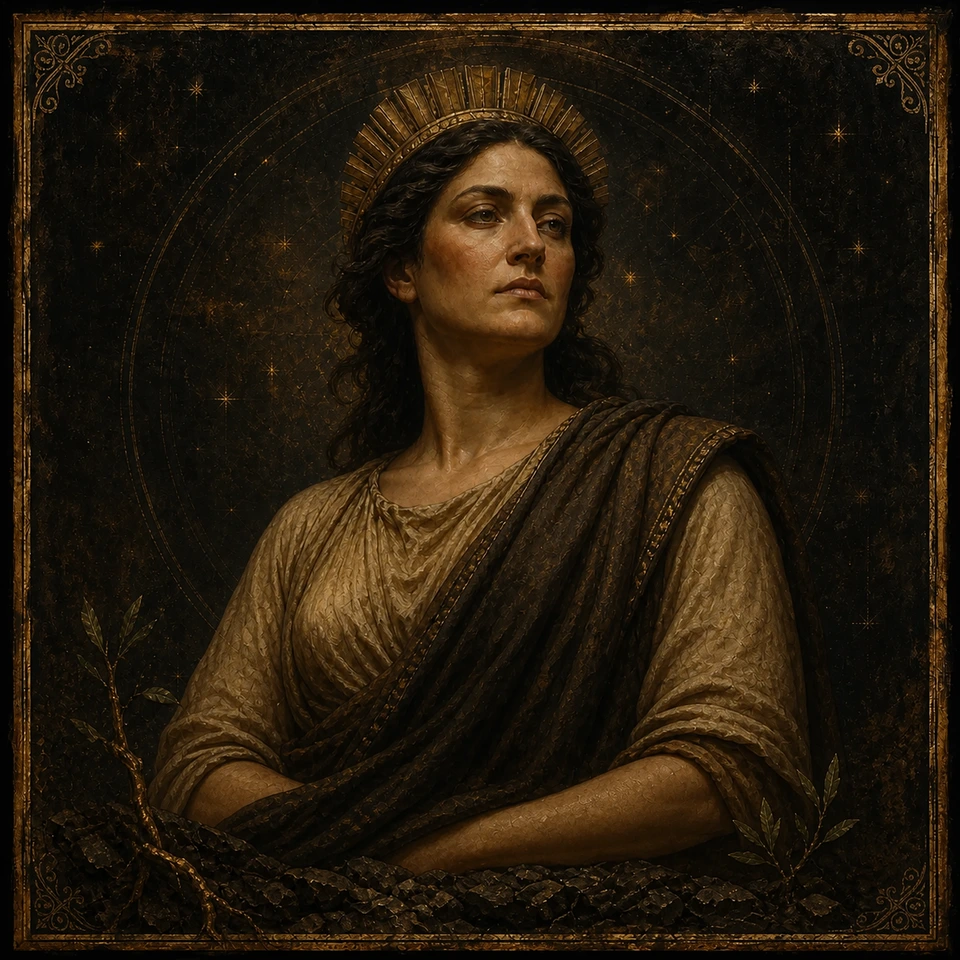
Rising as the foundational divine Earth, Gaia births entire cosmic generations and nourishes life across ancient hymns. She actively shaped violent succession myths as both counselor and challenger, while maintaining authority as a locally worshipped prophetic power.
Overview
Gaia does not enter Hesiod’s Theogony as scenery. After Chaos comes broad-breasted Earth, a secure seat for the immortals. She is ground, but she is also a divine woman who generates, desires, suffers, plans, remembers, advises, and rebels. The world is built through her body and repeatedly shaken by her decisions.
Alone, Gaia bears starry Uranus, the Mountains, and Pontus. With Uranus she bears the Titans, Cyclopes, and Hundred-Handers. When Uranus pushes hated children back into her depths, Gaia groans under the pressure and devises an answer. She creates a jagged sickle, tells her children what their father has done, and finds one willing son in Cronus. The overthrow begins as a mother’s response to confinement inside her own body.
The blood of Uranus falls back upon Earth, and later she bears Erinyes, Giants, and Meliae. Divine violence becomes another generation. Cronus rules, Zeus rises against him, and Gaia again supplies decisive knowledge: the younger gods will win if they free the Hundred-Handers and bring their strength into the Titan war. Her counsel helps establish Zeus, but loyalty to the new order is not permanent. After the Titans fall, Gaia and Tartarus produce Typhoeus, the enormous challenger whom Zeus must defeat with thunder.
Pseudo-Apollodorus gives another revolt. Gaia, angered over the Titans, bears the Gigantes and seeks a drug that could protect them from mortal aid. Zeus blocks the cosmic lights, takes the drug first, and brings Heracles into the divine battle. This is later mythography, not a missing chapter to blend invisibly into Hesiod.
Cult and praise bring Gaia closer to human life. Homeric Hymn 30 calls her well-founded, mother of all, and eldest of beings. She feeds creatures of land, sea, and air. Those she favors receive children, harvest, herds, household abundance, and cities governed with order; she can also withdraw them. Nourishment is an exercise of divine power.
At Olympia, Pausanias saw an ash altar of Earth in the Gaeum and heard of an older oracle there. At Delphi, Aeschylus’ Pythia names Gaia first in a peaceful succession that passes through Themis and Phoebe to Apollo. Neither sacred memory needs a conquest story added to it.
Attic painters make Earth visible at the boundary of ground and body. One hydria shows Gaia rising waist-up from the soil in chiton, mantle, long hair, and radiated stephane. A Cleveland lekythos seats Ge or Gaia as she presents earth-born Erichthonios to Athena. The ancient goddess needs no globe, green skin, or vegetation growing from her flesh.
Canonical identity
Canonical Identity
Gaia is far more than the physical soil beneath the gods; she is the primordial Earth herself, functioning as both a foundational goddess and an active cosmic power. In Hesiod's cosmology, she emerges early in existence to serve as the secure seat of the immortals before generating the sky, the sea, mountains, Titans, monsters, and the inevitable future divine conflicts. She must be kept historically distinct from Roman Tellus and Terra, Phrygian Cybele, Greek Rhea, and Demeter, all of whom retain their own unique timelines. Any modern planetary or ecological interpretations require evidence from their own eras rather than overwriting the ancient goddess.
Linguistic Identity
Her name is Γαῖα, officially transliterated as Gaîa, though Greek poetry frequently employs the variant Γῆ (Gê). A qualified fifth-century BC Attic reconstruction establishes the sound as /ɡâi̯.a/, approximating GAI-ah with a long first vowel and a falling pitch. The conventional English pronunciation, GYE-uh, stems from modern English evolution rather than ancient Attic speech.
Sources and evidence
SCHOLARLY INTERPRETATION · Supported
The proper name Γαῖα has a qualified fifth-century BC Attic reconstruction /ɡâi̯.a/.
- Source
- Wiktionary contributors, Γαῖα
- Reviewed edition
- Wiktionary live revision reviewed 2026-08-30 · Wiktionary
- Exact locator
- Entry Γαῖα · Section Ancient Greek pronunciation
- Scope
- Classical Greece · Attica
- Authority
- collaborative lexical reference
- Certainty
- Qualified
The readable guide simplifies vowel length and pitch accent.
Open exact reviewed sourceTEXTUAL · Supported
Hesiod makes broad-breasted Gaia emerge after Chaos as the secure seat of the immortals.
- Source
- Hesiod; edited and translated by Hugh G. Evelyn-White, Theogony (1914)
- Reviewed edition
- Hugh G. Evelyn-White edition and English translation in Hesiod, the Homeric Hymns and Homerica, 1914 · translated by Hugh G. Evelyn-White · edited by Hugh G. Evelyn-White · Perseus Digital Library / Scaife ATLAS
- Exact locator
- Entry Theogony · Line 116-122
- Scope
- Archaic Greece · Ancient Greece
- Authority
- ancient literary witness
- Certainty
- High
The passage establishes primordial identity and does not supply a cult rite.
Open exact reviewed sourceTEXTUAL · Supported
Aeschylus names Earth as the first prophetic power at Delphi, using the Greek identity carried by Gaia or Ge.
- Source
- Aeschylus; translated by Herbert Weir Smyth, Eumenides (1926)
- Reviewed edition
- Herbert Weir Smyth English translation of Aeschylus, Eumenides, Volume 2, William Heinemann and G. P. Putnam's Sons, 1926, Perseus eng2 component modernized by Perseus · translated by Herbert Weir Smyth · edited by Herbert Weir Smyth · Perseus Digital Library
- Exact locator
- Entry Eumenides · Line 1-8
- Scope
- Classical Greece · Delphi
- Authority
- ancient literary witness
- Certainty
- High
The tragic prologue supports the Greek Earth identity without merging Roman Earth goddesses.
Open exact reviewed source3 reviewed sources for this section
- Wiktionary contributors, ΓαῖαLive collaborative lexical entry reviewed 2026-08-30 · Wiktionary
- Hesiod; edited and translated by Hugh G. Evelyn-White, Theogony (1914)Hesiod, the Homeric Hymns and Homerica, London and New York, 1914 · Perseus Digital Library / Scaife ATLAS
- Aeschylus; translated by Herbert Weir Smyth, Eumenides (1926)1926 Loeb edition hosted by the Perseus Digital Library · Perseus Digital Library
Culture, tradition, period, and place
Greek hexameter poetry gives Gaia cosmic breadth; tragedy and travel writing give her local sacred histories. The Theogony builds succession from her body and counsel. Homeric Hymn 30 praises Earth as nourisher of everything that moves across land and sea or flies above it. Aeschylus places her first in Delphi’s prophetic succession.
Olympia supplies direct cultic ground. Pausanias saw an ash altar in the Gaeum and heard that an oracle of Earth had stood there in earlier days. Classical Attic pottery shows Gaia rising from the ground or presenting the earth-born Erichthonios. Cosmogony, sanctuary, oracle, and image each preserve a different scale of her Greek presence.
Sources and evidence
TEXTUAL · Supported
The Theogony places Gaia at the beginning of cosmic generation and succession.
- Source
- Hesiod; edited and translated by Hugh G. Evelyn-White, Theogony (1914)
- Reviewed edition
- Hugh G. Evelyn-White edition and English translation in Hesiod, the Homeric Hymns and Homerica, 1914 · translated by Hugh G. Evelyn-White · edited by Hugh G. Evelyn-White · Perseus Digital Library / Scaife ATLAS
- Exact locator
- Entry Theogony · Line 116-122
- Scope
- Archaic Greece · Ancient Greece
- Authority
- ancient literary witness
- Certainty
- High
This Archaic poetic witness governs the cosmogonic layer.
Open exact reviewed sourceTEXTUAL · Supported
Homeric Hymn 30 praises Earth as nourisher of creatures on land, in sea, and in air.
- Source
- Anonymous Homeric Hymns; edited and translated by Hugh G. Evelyn-White, Homeric Hymns (1914)
- Reviewed edition
- Hugh G. Evelyn-White edition and English translation in Hesiod, the Homeric Hymns and Homerica, 1914 · translated by Hugh G. Evelyn-White · edited by Hugh G. Evelyn-White · Perseus Digital Library / Scaife ATLAS
- Exact locator
- Hymn 30 · Line 1-19
- Scope
- Archaic Greece · Ancient Greece
- Authority
- ancient literary witness
- Certainty
- High
The hymn supplies praise and blessing rather than a local sanctuary description.
Open exact reviewed sourceTEXTUAL · Supported
Aeschylus places Gaia first in a peaceful Delphic prophetic succession.
- Source
- Aeschylus; translated by Herbert Weir Smyth, Eumenides (1926)
- Reviewed edition
- Herbert Weir Smyth English translation of Aeschylus, Eumenides, Volume 2, William Heinemann and G. P. Putnam's Sons, 1926, Perseus eng2 component modernized by Perseus · translated by Herbert Weir Smyth · edited by Herbert Weir Smyth · Perseus Digital Library
- Exact locator
- Entry Eumenides · Line 1-8
- Scope
- Classical Greece · Delphi
- Authority
- ancient literary witness
- Certainty
- High
The tragic sequence does not narrate conquest by Apollo.
Open exact reviewed sourceTEXTUAL · Supported
Pausanias reports an ash altar and remembered oracle of Earth in the Gaeum at Olympia.
- Source
- Pausanias; Spiro Greek edition and Jones/Ormerod translation volumes, Description of Greece (1935)
- Reviewed edition
- Spiro Greek edition and Jones/Ormerod English volumes represented by the Perseus CTS corpus, 1903-1935 · translated by W. H. S. Jones and H. A. Ormerod, volume-dependent · edited by Friedrich Spiro for the Greek edition · Perseus Digital Library / Scaife ATLAS
- Exact locator
- Book 5 · Chapter 14 · Section 10
- Scope
- Greek religion under Roman imperial rule · Ancient Greece
- Authority
- ancient literary witness
- Certainty
- High
The notice is local to Olympia and belongs to Pausanias’ described landscape.
Open exact reviewed sourceMATERIAL CULTURE · Supported
British Museum hydria 1837,0609.54 is an Attic red-figure material witness to Gaia rising from the ground.
- Source
- British Museum, British Museum Collection
- Reviewed edition
- Live record-level official museum collection · British Museum
- Exact locator
- MuseumObjectId 1837,0609.54 · Entry Object description and date
- Scope
- Classical Greece · Attica
- Authority
- museum accession record
- Certainty
- High
The accession anchors a Classical Attic visual form.
Open exact reviewed sourceMATERIAL CULTURE · Supported
Cleveland accession 1982.142 is an Attic red-figure lekythos showing Ge or Gaia with Erichthonios and Athena.
- Source
- Cleveland Museum of Art, Squat Lekythos with the Birth of Erichthonios
- Reviewed edition
- Cleveland Museum of Art online collection object 1982.142 · Cleveland Museum of Art
- Exact locator
- MuseumObjectId 1982.142 · Entry Object description and identification
- Scope
- Classical Greece · Attica
- Authority
- museum accession record
- Certainty
- High
The official museum entry dates and identifies the object.
Open exact reviewed source6 reviewed sources for this section
- Hesiod; edited and translated by Hugh G. Evelyn-White, Theogony (1914)Hesiod, the Homeric Hymns and Homerica, London and New York, 1914 · Perseus Digital Library / Scaife ATLAS
- Anonymous Homeric Hymns; edited and translated by Hugh G. Evelyn-White, Homeric Hymns (1914)Hesiod, the Homeric Hymns and Homerica, London and New York, 1914 · Perseus Digital Library / Scaife ATLAS
- Aeschylus; translated by Herbert Weir Smyth, Eumenides (1926)1926 Loeb edition hosted by the Perseus Digital Library · Perseus Digital Library
- Pausanias; Spiro Greek edition and Jones/Ormerod translation volumes, Description of Greece (1935)Perseus CTS edition corpus, 1903-1935 · Perseus Digital Library / Scaife ATLAS
- British Museum, British Museum CollectionLive official museum collection · British Museum
- Cleveland Museum of Art, Squat Lekythos with the Birth of ErichthoniosCollection object 1982.142 · Cleveland Museum of Art
Historical development
Hesiod’s Gaia is both stable foundation and insurgent intelligence. She produces Uranus, joins him, suffers when he hides their children, and devises the weapon that allows Cronus to overthrow him. Later she counsels Zeus in the war against the Titans, yet she also bears Typhoeus after their defeat. Divine order repeatedly grows from her and repeatedly faces her challenge.
The Homeric hymn emphasizes nourishment and sovereignty over mortal well-being rather than succession violence. Aeschylus remembers a peaceful line of prophetic women at Delphi, while Pausanias reports Earth’s old oracle at Olympia. Pseudo-Apollodorus later organizes the Gigantes into another revolt. These traditions overlap without becoming one biography.
Sources and evidence
TEXTUAL · Supported
Hesiod makes Gaia devise the sickle and recruit Cronus after Uranus confines their children.
- Source
- Hesiod; edited and translated by Hugh G. Evelyn-White, Theogony (1914)
- Reviewed edition
- Hugh G. Evelyn-White edition and English translation in Hesiod, the Homeric Hymns and Homerica, 1914 · translated by Hugh G. Evelyn-White · edited by Hugh G. Evelyn-White · Perseus Digital Library / Scaife ATLAS
- Exact locator
- Entry Theogony · Line 154-181
- Scope
- Archaic Greece · Ancient Greece
- Authority
- ancient literary witness
- Certainty
- High
The motive is bodily confinement within Gaia.
Open exact reviewed sourceTEXTUAL · Supported
Gaia’s counsel brings the Hundred-Handers into the Titanomachy and breaks the ten-year stalemate.
- Source
- Hesiod; edited and translated by Hugh G. Evelyn-White, Theogony (1914)
- Reviewed edition
- Hugh G. Evelyn-White edition and English translation in Hesiod, the Homeric Hymns and Homerica, 1914 · translated by Hugh G. Evelyn-White · edited by Hugh G. Evelyn-White · Perseus Digital Library / Scaife ATLAS
- Exact locator
- Entry Theogony · Line 617-735
- Scope
- Archaic Greece · Ancient Greece
- Authority
- ancient literary witness
- Certainty
- High
Her role is decisive counsel rather than battlefield combat.
Open exact reviewed sourceTEXTUAL · Supported
After the Titans fall, Gaia and Tartarus produce Typhoeus, whom Zeus defeats.
- Source
- Hesiod; edited and translated by Hugh G. Evelyn-White, Theogony (1914)
- Reviewed edition
- Hugh G. Evelyn-White edition and English translation in Hesiod, the Homeric Hymns and Homerica, 1914 · translated by Hugh G. Evelyn-White · edited by Hugh G. Evelyn-White · Perseus Digital Library / Scaife ATLAS
- Exact locator
- Entry Theogony · Line 820-880
- Scope
- Archaic Greece · Ancient Greece
- Authority
- ancient literary witness
- Certainty
- High
This episode follows the Titanomachy in the Theogony sequence.
Open exact reviewed sourceTEXTUAL · Supported
Homeric Hymn 30 emphasizes Gaia’s nourishment and authority over mortal flourishing.
- Source
- Anonymous Homeric Hymns; edited and translated by Hugh G. Evelyn-White, Homeric Hymns (1914)
- Reviewed edition
- Hugh G. Evelyn-White edition and English translation in Hesiod, the Homeric Hymns and Homerica, 1914 · translated by Hugh G. Evelyn-White · edited by Hugh G. Evelyn-White · Perseus Digital Library / Scaife ATLAS
- Exact locator
- Hymn 30 · Line 1-19
- Scope
- Archaic Greece · Ancient Greece
- Authority
- ancient literary witness
- Certainty
- High
The hymn presents a different historical genre and scale from succession poetry.
Open exact reviewed sourceTEXTUAL · Supported
Pseudo-Apollodorus later makes Gaia mother and attempted protector of the Gigantes.
- Source
- Pseudo-Apollodorus; edited and translated by James G. Frazer, Library (1921)
- Reviewed edition
- James G. Frazer edition and English translation, Harvard University Press and William Heinemann, 1921 · translated by James G. Frazer · edited by James G. Frazer · Perseus Digital Library / Scaife ATLAS
- Exact locator
- Book 1 · Chapter 6 · Section 1-2
- Scope
- Greek religion under Roman imperial rule · Ancient Greece
- Authority
- ancient literary witness
- Certainty
- High
The later mythographic war remains distinct from Hesiod’s blood-born Giants.
Open exact reviewed source3 reviewed sources for this section
- Hesiod; edited and translated by Hugh G. Evelyn-White, Theogony (1914)Hesiod, the Homeric Hymns and Homerica, London and New York, 1914 · Perseus Digital Library / Scaife ATLAS
- Anonymous Homeric Hymns; edited and translated by Hugh G. Evelyn-White, Homeric Hymns (1914)Hesiod, the Homeric Hymns and Homerica, London and New York, 1914 · Perseus Digital Library / Scaife ATLAS
- Pseudo-Apollodorus; edited and translated by James G. Frazer, Library (1921)Harvard University Press and William Heinemann edition, 1921 · Perseus Digital Library / Scaife ATLAS
Attested roles and historical themes
Roles, powers, and limits
Gaia supports, generates, nourishes, advises, and opposes. She is the physical Earth and an acting divine person. Mountains and sea emerge from her; generations of gods grow through her unions. She makes Cronus’ sickle and knows the condition for Zeus’ victory. Her wisdom does not bind her permanently to one ruler.
Homeric Hymn 30 gives her mortal scale. All creatures feed from Earth, and those she honors receive children, crops, herds, wealth, and orderly cities. The same hymn says she can withdraw these things. Nourishment is therefore power, not soft scenery. Earth sustains life and sets its limits.
Sources and evidence
TEXTUAL · Supported
Gaia alone bears Uranus, the Mountains, and Pontus before producing later generations through union.
- Source
- Hesiod; edited and translated by Hugh G. Evelyn-White, Theogony (1914)
- Reviewed edition
- Hugh G. Evelyn-White edition and English translation in Hesiod, the Homeric Hymns and Homerica, 1914 · translated by Hugh G. Evelyn-White · edited by Hugh G. Evelyn-White · Perseus Digital Library / Scaife ATLAS
- Exact locator
- Entry Theogony · Line 126-132
- Scope
- Archaic Greece · Ancient Greece
- Authority
- ancient literary witness
- Certainty
- High
The passage presents generation as a cosmic action.
Open exact reviewed sourceTEXTUAL · Supported
Gaia knows that freeing the Hundred-Handers will give Zeus’ side victory.
- Source
- Hesiod; edited and translated by Hugh G. Evelyn-White, Theogony (1914)
- Reviewed edition
- Hugh G. Evelyn-White edition and English translation in Hesiod, the Homeric Hymns and Homerica, 1914 · translated by Hugh G. Evelyn-White · edited by Hugh G. Evelyn-White · Perseus Digital Library / Scaife ATLAS
- Exact locator
- Entry Theogony · Line 617-735
- Scope
- Archaic Greece · Ancient Greece
- Authority
- ancient literary witness
- Certainty
- High
Her knowledge changes the balance of divine war.
Open exact reviewed sourceTEXTUAL · Supported
Homeric Hymn 30 links Gaia’s favor to children, harvest, herds, households, wealth, and orderly cities.
- Source
- Anonymous Homeric Hymns; edited and translated by Hugh G. Evelyn-White, Homeric Hymns (1914)
- Reviewed edition
- Hugh G. Evelyn-White edition and English translation in Hesiod, the Homeric Hymns and Homerica, 1914 · translated by Hugh G. Evelyn-White · edited by Hugh G. Evelyn-White · Perseus Digital Library / Scaife ATLAS
- Exact locator
- Hymn 30 · Line 1-19
- Scope
- Archaic Greece · Ancient Greece
- Authority
- ancient literary witness
- Certainty
- High
The hymn also allows these blessings to be withdrawn.
Open exact reviewed sourceTEXTUAL · Supported
Gaia’s maternity of Typhoeus places a new challenger after the defeat of her Titan children.
- Source
- Hesiod; edited and translated by Hugh G. Evelyn-White, Theogony (1914)
- Reviewed edition
- Hugh G. Evelyn-White edition and English translation in Hesiod, the Homeric Hymns and Homerica, 1914 · translated by Hugh G. Evelyn-White · edited by Hugh G. Evelyn-White · Perseus Digital Library / Scaife ATLAS
- Exact locator
- Entry Theogony · Line 820-880
- Scope
- Archaic Greece · Ancient Greece
- Authority
- ancient literary witness
- Certainty
- High
Motherhood does not place Gaia in Typhoeus’ battle.
Open exact reviewed source2 reviewed sources for this section
- Hesiod; edited and translated by Hugh G. Evelyn-White, Theogony (1914)Hesiod, the Homeric Hymns and Homerica, London and New York, 1914 · Perseus Digital Library / Scaife ATLAS
- Anonymous Homeric Hymns; edited and translated by Hugh G. Evelyn-White, Homeric Hymns (1914)Hesiod, the Homeric Hymns and Homerica, London and New York, 1914 · Perseus Digital Library / Scaife ATLAS
Epithets and titles
Functional Title
Mother of all
Mother of all
Greek hymnic poetry · Archaic Greek hymnic witnessHomeric Hymn 30 opens with this address.
1 reviewed source for this section
- Anonymous Homeric Hymns; edited and translated by Hugh G. Evelyn-White, Homeric Hymns (1914)Hesiod, the Homeric Hymns and Homerica, London and New York, 1914 · Perseus Digital Library / Scaife ATLAS
Poetic Epithet
Well-founded
Well-founded
Greek hymnic poetry · Archaic Greek hymnic witnessThe title presents Earth as the firm ground of mortal and divine life.
1 reviewed source for this section
- Anonymous Homeric Hymns; edited and translated by Hugh G. Evelyn-White, Homeric Hymns (1914)Hesiod, the Homeric Hymns and Homerica, London and New York, 1914 · Perseus Digital Library / Scaife ATLAS
Worship and cult
Homeric Hymn 30 is direct praise. It addresses well-founded Earth, mother of all, asks for a favorable heart, and closes with a promise to remember her in another song. The hymn’s abundance belongs to divine favor: flourishing children, harvest, livestock, goods, and civic order can grow or fail under her power.
At Olympia, Pausanias describes an ash altar of Earth inside the Gaeum and an old oracle remembered at the same place. These notices establish worship and prophetic memory without supplying a full priesthood, festival calendar, or sacrificial recipe. The surviving cult evidence is real and local.
Sources and evidence
TEXTUAL · Supported
Homeric Hymn 30 directly praises well-founded Earth, mother of all, and asks for her favor.
- Source
- Anonymous Homeric Hymns; edited and translated by Hugh G. Evelyn-White, Homeric Hymns (1914)
- Reviewed edition
- Hugh G. Evelyn-White edition and English translation in Hesiod, the Homeric Hymns and Homerica, 1914 · translated by Hugh G. Evelyn-White · edited by Hugh G. Evelyn-White · Perseus Digital Library / Scaife ATLAS
- Exact locator
- Hymn 30 · Line 1-19
- Scope
- Archaic Greece · Ancient Greece
- Authority
- ancient literary witness
- Certainty
- High
The closing promise to remember her in another song belongs to the hymnic act.
Open exact reviewed sourceTEXTUAL · Supported
Pausanias describes an ash altar of Earth in the Gaeum and reports an older oracle there.
- Source
- Pausanias; Spiro Greek edition and Jones/Ormerod translation volumes, Description of Greece (1935)
- Reviewed edition
- Spiro Greek edition and Jones/Ormerod English volumes represented by the Perseus CTS corpus, 1903-1935 · translated by W. H. S. Jones and H. A. Ormerod, volume-dependent · edited by Friedrich Spiro for the Greek edition · Perseus Digital Library / Scaife ATLAS
- Exact locator
- Book 5 · Chapter 14 · Section 10
- Scope
- Greek religion under Roman imperial rule · Ancient Greece
- Authority
- ancient literary witness
- Certainty
- High
The passage establishes local worship and prophetic memory without a full calendar.
Open exact reviewed source2 reviewed sources for this section
- Anonymous Homeric Hymns; edited and translated by Hugh G. Evelyn-White, Homeric Hymns (1914)Hesiod, the Homeric Hymns and Homerica, London and New York, 1914 · Perseus Digital Library / Scaife ATLAS
- Pausanias; Spiro Greek edition and Jones/Ormerod translation volumes, Description of Greece (1935)Perseus CTS edition corpus, 1903-1935 · Perseus Digital Library / Scaife ATLAS
Temples, sanctuaries, and sacred places
The Gaeum at Olympia held Earth’s ash altar, and local memory placed an older oracle there. Pausanias sets it near the Stomium and an altar of Themis, within the dense ritual geography of Olympia. This is the clearest named sanctuary setting in the present evidence.
Delphi carries a different memory. The Pythia of Aeschylus begins her prayer with Gaia, then names Themis, Phoebe, and Apollo in peaceful succession. The tragedy does not narrate Apollo conquering Gaia. Olympia’s remembered oracle and Delphi’s sacred genealogy must remain distinct local claims.
Sources and evidence
TEXTUAL · Supported
The Gaeum at Olympia held Earth’s ash altar near the Stomium and an altar of Themis.
- Source
- Pausanias; Spiro Greek edition and Jones/Ormerod translation volumes, Description of Greece (1935)
- Reviewed edition
- Spiro Greek edition and Jones/Ormerod English volumes represented by the Perseus CTS corpus, 1903-1935 · translated by W. H. S. Jones and H. A. Ormerod, volume-dependent · edited by Friedrich Spiro for the Greek edition · Perseus Digital Library / Scaife ATLAS
- Exact locator
- Book 5 · Chapter 14 · Section 10
- Scope
- Greek religion under Roman imperial rule · Ancient Greece
- Authority
- ancient literary witness
- Certainty
- High
The named sanctuary setting remains local to Olympia.
Open exact reviewed sourceTEXTUAL · Supported
The Pythia begins her prayer by honoring Gaia as Delphi’s first prophetic power.
- Source
- Aeschylus; translated by Herbert Weir Smyth, Eumenides (1926)
- Reviewed edition
- Herbert Weir Smyth English translation of Aeschylus, Eumenides, Volume 2, William Heinemann and G. P. Putnam's Sons, 1926, Perseus eng2 component modernized by Perseus · translated by Herbert Weir Smyth · edited by Herbert Weir Smyth · Perseus Digital Library
- Exact locator
- Entry Eumenides · Line 1-8
- Scope
- Classical Greece · Delphi
- Authority
- ancient literary witness
- Certainty
- High
Gaia passes peacefully to Themis in the tragic prologue.
Open exact reviewed source2 reviewed sources for this section
- Pausanias; Spiro Greek edition and Jones/Ormerod translation volumes, Description of Greece (1935)Perseus CTS edition corpus, 1903-1935 · Perseus Digital Library / Scaife ATLAS
- Aeschylus; translated by Herbert Weir Smyth, Eumenides (1926)1926 Loeb edition hosted by the Perseus Digital Library · Perseus Digital Library
Festivals and processions
No festival dedicated solely to Gaia is named in these witnesses. Homeric Hymn 30 can be sung in praise, and Pausanias places her altar within Olympia’s sacrificial landscape, but neither gives a dated annual procession or named competition belonging only to Earth.
Seasonal agriculture may make the hymn feel calendrical, yet crops and herds are domains of blessing, not proof of a specific feast day. A festival requires its own local name, civic calendar, and testimony.
Sources and evidence
TEXTUAL · Supported
Homeric Hymn 30 provides praise for Gaia but names no annual festival or procession.
- Source
- Anonymous Homeric Hymns; edited and translated by Hugh G. Evelyn-White, Homeric Hymns (1914)
- Reviewed edition
- Hugh G. Evelyn-White edition and English translation in Hesiod, the Homeric Hymns and Homerica, 1914 · translated by Hugh G. Evelyn-White · edited by Hugh G. Evelyn-White · Perseus Digital Library / Scaife ATLAS
- Exact locator
- Hymn 30 · Line 1-19
- Scope
- Archaic Greece · Ancient Greece
- Authority
- ancient literary witness
- Certainty
- High
Agricultural blessings in the hymn do not establish a feast day.
Open exact reviewed sourceTEXTUAL · Supported
Pausanias locates Gaia’s altar within Olympia without naming an exclusive festival for her.
- Source
- Pausanias; Spiro Greek edition and Jones/Ormerod translation volumes, Description of Greece (1935)
- Reviewed edition
- Spiro Greek edition and Jones/Ormerod English volumes represented by the Perseus CTS corpus, 1903-1935 · translated by W. H. S. Jones and H. A. Ormerod, volume-dependent · edited by Friedrich Spiro for the Greek edition · Perseus Digital Library / Scaife ATLAS
- Exact locator
- Book 5 · Chapter 14 · Section 10
- Scope
- Greek religion under Roman imperial rule · Ancient Greece
- Authority
- ancient literary witness
- Certainty
- High
A place of sacrifice is not automatically a dated festival.
Open exact reviewed source2 reviewed sources for this section
- Anonymous Homeric Hymns; edited and translated by Hugh G. Evelyn-White, Homeric Hymns (1914)Hesiod, the Homeric Hymns and Homerica, London and New York, 1914 · Perseus Digital Library / Scaife ATLAS
- Pausanias; Spiro Greek edition and Jones/Ormerod translation volumes, Description of Greece (1935)Perseus CTS edition corpus, 1903-1935 · Perseus Digital Library / Scaife ATLAS
Offerings, votives, and ritual evidence
The ash altar at Olympia proves a place of sacrifice, but Pausanias does not isolate a distinctive animal, grain, liquid, or incense as Gaia’s exclusive offering in this passage. Its bed of ash reflects repeated burning, but it does not license invention of a recipe.
Homeric Hymn 30 supplies a form of verbal praise and a prayer for favor. Harvest, herds, children, and household goods are blessings in the hymn, not a list of materials to present. Modern offerings require their own community testimony.
Sources and evidence
TEXTUAL · Supported
Pausanias identifies an ash altar of Earth but does not specify a distinctive exclusive offering in the cited passage.
- Source
- Pausanias; Spiro Greek edition and Jones/Ormerod translation volumes, Description of Greece (1935)
- Reviewed edition
- Spiro Greek edition and Jones/Ormerod English volumes represented by the Perseus CTS corpus, 1903-1935 · translated by W. H. S. Jones and H. A. Ormerod, volume-dependent · edited by Friedrich Spiro for the Greek edition · Perseus Digital Library / Scaife ATLAS
- Exact locator
- Book 5 · Chapter 14 · Section 10
- Scope
- Greek religion under Roman imperial rule · Ancient Greece
- Authority
- ancient literary witness
- Certainty
- High
The ash documents repeated burning without supplying a ritual recipe.
Open exact reviewed sourceTEXTUAL · Supported
Homeric Hymn 30 preserves verbal praise and a request for Gaia’s favor.
- Source
- Anonymous Homeric Hymns; edited and translated by Hugh G. Evelyn-White, Homeric Hymns (1914)
- Reviewed edition
- Hugh G. Evelyn-White edition and English translation in Hesiod, the Homeric Hymns and Homerica, 1914 · translated by Hugh G. Evelyn-White · edited by Hugh G. Evelyn-White · Perseus Digital Library / Scaife ATLAS
- Exact locator
- Hymn 30 · Line 1-19
- Scope
- Archaic Greece · Ancient Greece
- Authority
- ancient literary witness
- Certainty
- High
Children, crops, and herds are blessings named in the prayer, not materials presented to her.
Open exact reviewed source2 reviewed sources for this section
- Pausanias; Spiro Greek edition and Jones/Ormerod translation volumes, Description of Greece (1935)Perseus CTS edition corpus, 1903-1935 · Perseus Digital Library / Scaife ATLAS
- Anonymous Homeric Hymns; edited and translated by Hugh G. Evelyn-White, Homeric Hymns (1914)Hesiod, the Homeric Hymns and Homerica, London and New York, 1914 · Perseus Digital Library / Scaife ATLAS
Iconography and material culture
The earth line is Gaia’s strongest ancient visual sign. British Museum hydria 1837,0609.54 shows a monumental woman rising only from the waist upward, wearing chiton, mantle, long hair, and a radiated stephane. Her body and the ground meet directly without turning her skin into vegetation or stone.
Cleveland lekythos 1982.142 gives another composition: Ge or Gaia sits and presents Erichthonios to Athena. The child belongs to an Athenian earth-birth story, not a universal attribute. Neither vessel shows Gaia holding a globe, wearing a planet costume, or becoming generic green-skinned Mother Nature.
Sources and evidence
MATERIAL CULTURE · Supported
British Museum hydria 1837,0609.54 shows Gaia rising waist-up from the ground in chiton, mantle, long hair, and a radiated stephane.
- Source
- British Museum, British Museum Collection
- Reviewed edition
- Live record-level official museum collection · British Museum
- Exact locator
- MuseumObjectId 1837,0609.54 · Entry Object description and date
- Scope
- Classical Greece · Attica
- Authority
- museum accession record
- Certainty
- High
The object supports emergence, dress, hair, and crown details.
Open exact reviewed sourceMATERIAL CULTURE · Supported
Cleveland accession 1982.142 identifies Ge or Gaia seated and presenting Erichthonios to Athena.
- Source
- Cleveland Museum of Art, Squat Lekythos with the Birth of Erichthonios
- Reviewed edition
- Cleveland Museum of Art online collection object 1982.142 · Cleveland Museum of Art
- Exact locator
- MuseumObjectId 1982.142 · Entry Object description and identification
- Scope
- Classical Greece · Attica
- Authority
- museum accession record
- Certainty
- High
The earth-born child belongs to this Athenian narrative scene.
Open exact reviewed source2 reviewed sources for this section
- British Museum, British Museum CollectionLive official museum collection · British Museum
- Cleveland Museum of Art, Squat Lekythos with the Birth of ErichthoniosCollection object 1982.142 · Cleveland Museum of Art
Animals, plants, and embodied forms
Homeric Hymn 30 says Earth feeds creatures that move on land and in the sea and those that fly. It praises her power over herds, harvest, and mortal livelihood. The breadth is ecological and agricultural, but it does not name one sacred animal or plant species.
No single grain, flower, tree, serpent, cattle breed, or bird should displace that breadth without a local witness. A later animal or plant emblem needs its own dated source before it can be presented as Gaia’s historical sign.
Sources and evidence
TEXTUAL · Supported
Homeric Hymn 30 makes Earth nourisher of land creatures, sea creatures, birds, herds, and crops without naming one sacred species.
- Source
- Anonymous Homeric Hymns; edited and translated by Hugh G. Evelyn-White, Homeric Hymns (1914)
- Reviewed edition
- Hugh G. Evelyn-White edition and English translation in Hesiod, the Homeric Hymns and Homerica, 1914 · translated by Hugh G. Evelyn-White · edited by Hugh G. Evelyn-White · Perseus Digital Library / Scaife ATLAS
- Exact locator
- Hymn 30 · Line 1-19
- Scope
- Archaic Greece · Ancient Greece
- Authority
- ancient literary witness
- Certainty
- High
The breadth of sustenance should not be narrowed into an unsupported animal or plant emblem.
Open exact reviewed source1 reviewed source for this section
- Anonymous Homeric Hymns; edited and translated by Hugh G. Evelyn-White, Homeric Hymns (1914)Hesiod, the Homeric Hymns and Homerica, London and New York, 1914 · Perseus Digital Library / Scaife ATLAS
Relationships and genealogy
Gaia generates Uranus, Mountains, and Pontus without a partner. With Uranus she bears the Titans, Cyclopes, and Hundred-Handers. Uranus becomes both son and partner within Hesiodic cosmogony, a structure that belongs to primordial generation rather than human kinship custom.
Cronus and Themis stand among her Titan children. The blood of the castrated Uranus later produces Erinyes, Giants, and Meliae through Gaia. After the Titan war, Gaia and Tartarus produce Typhoeus. Genealogy makes her ancestor of opposing generations without reducing her to one faction.
Sources and evidence
TEXTUAL · Supported
Gaia alone bears Uranus, the Mountains, and Pontus.
- Source
- Hesiod; edited and translated by Hugh G. Evelyn-White, Theogony (1914)
- Reviewed edition
- Hugh G. Evelyn-White edition and English translation in Hesiod, the Homeric Hymns and Homerica, 1914 · translated by Hugh G. Evelyn-White · edited by Hugh G. Evelyn-White · Perseus Digital Library / Scaife ATLAS
- Exact locator
- Entry Theogony · Line 126-132
- Scope
- Archaic Greece · Ancient Greece
- Authority
- ancient literary witness
- Certainty
- High
Primordial generation precedes later unions.
Open exact reviewed sourceTEXTUAL · Supported
With Uranus, Gaia bears the Titans, Cyclopes, and Hundred-Handers.
- Source
- Hesiod; edited and translated by Hugh G. Evelyn-White, Theogony (1914)
- Reviewed edition
- Hugh G. Evelyn-White edition and English translation in Hesiod, the Homeric Hymns and Homerica, 1914 · translated by Hugh G. Evelyn-White · edited by Hugh G. Evelyn-White · Perseus Digital Library / Scaife ATLAS
- Exact locator
- Entry Theogony · Line 132-153
- Scope
- Archaic Greece · Ancient Greece
- Authority
- ancient literary witness
- Certainty
- High
Uranus is both son and partner within the primordial genealogy.
Open exact reviewed sourceTEXTUAL · Supported
Gaia receives Uranus’ blood and later bears the Erinyes, Giants, and Meliae.
- Source
- Hesiod; edited and translated by Hugh G. Evelyn-White, Theogony (1914)
- Reviewed edition
- Hugh G. Evelyn-White edition and English translation in Hesiod, the Homeric Hymns and Homerica, 1914 · translated by Hugh G. Evelyn-White · edited by Hugh G. Evelyn-White · Perseus Digital Library / Scaife ATLAS
- Exact locator
- Entry Theogony · Line 182-187
- Scope
- Archaic Greece · Ancient Greece
- Authority
- ancient literary witness
- Certainty
- High
The blood-born generation follows the ambush.
Open exact reviewed sourceTEXTUAL · Supported
Gaia and Tartarus produce Typhoeus through Aphrodite’s agency.
- Source
- Hesiod; edited and translated by Hugh G. Evelyn-White, Theogony (1914)
- Reviewed edition
- Hugh G. Evelyn-White edition and English translation in Hesiod, the Homeric Hymns and Homerica, 1914 · translated by Hugh G. Evelyn-White · edited by Hugh G. Evelyn-White · Perseus Digital Library / Scaife ATLAS
- Exact locator
- Entry Theogony · Line 820-880
- Scope
- Archaic Greece · Ancient Greece
- Authority
- ancient literary witness
- Certainty
- High
The conception phrase and the later battle remain distinct actions.
Open exact reviewed source1 reviewed source for this section
- Hesiod; edited and translated by Hugh G. Evelyn-White, Theogony (1914)Hesiod, the Homeric Hymns and Homerica, London and New York, 1914 · Perseus Digital Library / Scaife ATLAS
Actual myths and source variants
Gaia’s narratives cluster around succession. The Birth of the First Titans establishes her older children. Two surviving accounts of Uranus’ overthrow work at different scales, one concentrating on Gaia and Cronus, another preserving later collective Titan involvement. The swallowed-children story gives Gaia prophetic and protective counsel, while the Titanomachy turns her knowledge of the Hundred-Handers into the condition of victory.
Other stories move beyond that cycle. Aeschylus places Gaia first in Delphi’s peaceful prophetic succession. Hesiod makes her mother of Typhoeus after the Titan defeat. Pseudo-Apollodorus makes her mother and attempted protector of the Gigantes. These accounts show Earth as origin, strategist, ancestor, sanctuary predecessor, and source of new resistance without forcing every witness into one seamless biography.
Sources and evidence
TEXTUAL · Supported
Gaia and Uranus produce the first named Titan generation.
- Source
- Hesiod; edited and translated by Hugh G. Evelyn-White, Theogony (1914)
- Reviewed edition
- Hugh G. Evelyn-White edition and English translation in Hesiod, the Homeric Hymns and Homerica, 1914 · translated by Hugh G. Evelyn-White · edited by Hugh G. Evelyn-White · Perseus Digital Library / Scaife ATLAS
- Exact locator
- Entry Theogony · Line 132-153
- Scope
- Archaic Greece · Ancient Greece
- Authority
- ancient literary witness
- Certainty
- High
The shared birth account establishes the family before the succession conflict.
Open exact reviewed sourceTEXTUAL · Supported
Gaia fashions the sickle and Cronus ambushes Uranus after the children are confined.
- Source
- Hesiod; edited and translated by Hugh G. Evelyn-White, Theogony (1914)
- Reviewed edition
- Hugh G. Evelyn-White edition and English translation in Hesiod, the Homeric Hymns and Homerica, 1914 · translated by Hugh G. Evelyn-White · edited by Hugh G. Evelyn-White · Perseus Digital Library / Scaife ATLAS
- Exact locator
- Entry Theogony · Line 154-181
- Scope
- Archaic Greece · Ancient Greece
- Authority
- ancient literary witness
- Certainty
- High
The surviving shared succession tellings remain distinct rather than receiving another duplicate.
Open exact reviewed sourceTEXTUAL · Supported
Gaia and Uranus warn Cronus about succession, then counsel Rhea when she hides Zeus.
- Source
- Hesiod; edited and translated by Hugh G. Evelyn-White, Theogony (1914)
- Reviewed edition
- Hugh G. Evelyn-White edition and English translation in Hesiod, the Homeric Hymns and Homerica, 1914 · translated by Hugh G. Evelyn-White · edited by Hugh G. Evelyn-White · Perseus Digital Library / Scaife ATLAS
- Exact locator
- Entry Theogony · Line 453-506
- Scope
- Archaic Greece · Ancient Greece
- Authority
- ancient literary witness
- Certainty
- High
Gaia’s part belongs to prophecy and the concealment plan.
Open exact reviewed sourceTEXTUAL · Supported
Gaia reveals that the Hundred-Handers must be freed for the younger gods to win the Titanomachy.
- Source
- Hesiod; edited and translated by Hugh G. Evelyn-White, Theogony (1914)
- Reviewed edition
- Hugh G. Evelyn-White edition and English translation in Hesiod, the Homeric Hymns and Homerica, 1914 · translated by Hugh G. Evelyn-White · edited by Hugh G. Evelyn-White · Perseus Digital Library / Scaife ATLAS
- Exact locator
- Entry Theogony · Line 617-735
- Scope
- Archaic Greece · Ancient Greece
- Authority
- ancient literary witness
- Certainty
- High
Her counsel is preserved inside the existing shared war account.
Open exact reviewed sourceTEXTUAL · Supported
Gaia bears Typhoeus with Tartarus after the Titan defeat, and Zeus overcomes him.
- Source
- Hesiod; edited and translated by Hugh G. Evelyn-White, Theogony (1914)
- Reviewed edition
- Hugh G. Evelyn-White edition and English translation in Hesiod, the Homeric Hymns and Homerica, 1914 · translated by Hugh G. Evelyn-White · edited by Hugh G. Evelyn-White · Perseus Digital Library / Scaife ATLAS
- Exact locator
- Entry Theogony · Line 820-880
- Scope
- Archaic Greece · Ancient Greece
- Authority
- ancient literary witness
- Certainty
- High
The new myth keeps maternity separate from combat participation.
Open exact reviewed sourceTEXTUAL · Supported
Pseudo-Apollodorus makes Gaia seek a protective drug for the Gigantes before Zeus and Heracles defeat her plan.
- Source
- Pseudo-Apollodorus; edited and translated by James G. Frazer, Library (1921)
- Reviewed edition
- James G. Frazer edition and English translation, Harvard University Press and William Heinemann, 1921 · translated by James G. Frazer · edited by James G. Frazer · Perseus Digital Library / Scaife ATLAS
- Exact locator
- Book 1 · Chapter 6 · Section 1-2
- Scope
- Greek religion under Roman imperial rule · Ancient Greece
- Authority
- ancient literary witness
- Certainty
- High
The later war requires both divine and mortal force.
Open exact reviewed sourceTEXTUAL · Supported
Aeschylus names Gaia first in a peaceful Delphic succession through Themis and Phoebe to Apollo.
- Source
- Aeschylus; translated by Herbert Weir Smyth, Eumenides (1926)
- Reviewed edition
- Herbert Weir Smyth English translation of Aeschylus, Eumenides, Volume 2, William Heinemann and G. P. Putnam's Sons, 1926, Perseus eng2 component modernized by Perseus · translated by Herbert Weir Smyth · edited by Herbert Weir Smyth · Perseus Digital Library
- Exact locator
- Entry Eumenides · Line 1-8
- Scope
- Classical Greece · Delphi
- Authority
- ancient literary witness
- Certainty
- High
The shared Delphi myth preserves this account beside conflict-centered foundation variants.
Open exact reviewed source3 reviewed sources for this section
- Hesiod; edited and translated by Hugh G. Evelyn-White, Theogony (1914)Hesiod, the Homeric Hymns and Homerica, London and New York, 1914 · Perseus Digital Library / Scaife ATLAS
- Pseudo-Apollodorus; edited and translated by James G. Frazer, Library (1921)Harvard University Press and William Heinemann edition, 1921 · Perseus Digital Library / Scaife ATLAS
- Aeschylus; translated by Herbert Weir Smyth, Eumenides (1926)1926 Loeb edition hosted by the Perseus Digital Library · Perseus Digital Library
Myth Library
Each myth gathers its attested participants into one source-grounded account, while distinct source traditions remain readable in their own variants.
Sanctuary Foundation
Apollo Founds His Oracle at Delphi
Greek witnesses give competing accounts of Apollo’s Delphic establishment: the Homeric Hymn’s search and coerced Cretan service, Python’s killing in mythography, Aeschylus’s peaceful succession, and Pausanias’s Eumolpia transfer through Themis with compensation to Poseidon.
- Role in this profile
- first prophetic power in the Pythia's peaceful succession
- Place scope
- Delphi
- Witnesses
- 5
- Variants
- 5
Divine Genealogy
The Birth of the First Titans
Gaia and Uranus bring forth twelve named Titans, whose shared birth establishes a generation without assigning every sibling the same deed or cosmic office.
- Role in this profile
- mother of the Titan generation
- Place scope
- Ancient Greece
- Witnesses
- 4
- Variants
- 4
Theogony
Cronus and the Swallowed Children
Cronus swallows five children born by Rhea, but she hides Zeus and gives Cronus a wrapped stone; Zeus survives, the children return, and the feared succession begins.
- Role in this profile
- prophetic elder and protector involved in Zeus' concealment
- Place scope
- Ancient Greece · Crete · Olympia · Arcadia
- Witnesses
- 4
- Variants
- 4
Theogony
Cronus Overthrows Ouranos
Gaia arms Cronus with a jagged sickle, and he ambushes Ouranos, severs the old sky ruler's power, and opens the Greek succession cycle whose violent consequences include Aphrodite's sea-birth.
- Role in this profile
- mother who fashions the sickle and conceals Cronus for the ambush
- Place scope
- Ancient Greece
- Witnesses
- 2
- Variants
- 2
Mythographic Synthesis
Gaia and the Gigantes
Pseudo-Apollodorus makes Gaia bear the Gigantes in anger over the Titans and seek a protective drug before their war with the gods; the Pergamon Altar adds Phoibe’s long-torch combat beside Asteria.
- Role in this profile
- bears the Gigantes in anger over the Titans and seeks a drug to protect them
- Place scope
- Ancient Greece · Pergamon
- Witnesses
- 2
- Variants
- 2
Monster Birth And Divine Combat
Gaia Bears Typhoeus
Gaia and Tartarus produce Typhoeus after the Titans’ defeat, and Zeus answers his challenge with thunder and fire.
- Role in this profile
- bears Typhoeus with Tartarus after Zeus defeats the Titans
- Place scope
- Ancient Greece
- Witnesses
- 1
- Variants
- 1
Cosmic
The Titanomachy and Fall of the Titans
The children of Cronus fight the Titans for ten years; Gaia's counsel brings the Hundred-Handers into Zeus' alliance, and their force breaks the older generation and ends Cronus' reign.
- Role in this profile
- prophetic counselor who reveals the condition for victory
- Place scope
- Ancient Greece
- Witnesses
- 2
- Variants
- 2
Theogonic Succession
The Titans Overthrow Uranus
Hesiod makes Cronus the sole child who answers Gaia, while Pseudo-Apollodorus makes every Titan except Oceanus join the violent attack and thereby gives Theia only a collective role.
- Role in this profile
- mother who plans resistance to Uranus and fashions the sickle
- Place scope
- Ancient Greece
- Witnesses
- 2
- Variants
- 2
Divine Genealogy
Nereus and the Nereids
The truthful sea elder Nereus joins Doris and becomes father of the many Nereids, including Amphitrite and Thetis.
- Role in this profile
- bears Nereus with Pontus in the Library genealogy
- Place scope
- Ancient Greece
- Witnesses
- 2
- Variants
- 2
Theogonic And Philosophical
Origins and Natures of Eros
Hesiod's parentless primordial Eros, Aristophanes' golden-winged child of Night's egg, and Plato's contradictory philosophical Erotes preserve irreconcilable origins.
- Role in this profile
- broad-breasted Earth who comes into being before Eros in Hesiod
- Place scope
- Ancient Greece · Athens
- Witnesses
- 3
- Variants
- 3
Equivalences, syncretisms, and identity boundaries
Gaia and Ge are Greek forms for divine Earth. Translation as Roman Tellus or Terra does not establish one identical cult across Greek and Roman places or periods. Functional resemblance likewise cannot merge Gaia with Demeter, Rhea, Cybele, or every Earth goddess known elsewhere. Each figure retains her own names, rites, stories, and communities.
The physical planet is not a second ancient deity. Any ecological, scientific, literary, or religious use of Gaia’s name from a later period needs its own dated evidence before its relationship to the Greek goddess can be described.
Correspondence index
Earth is direct and ancient as Gaia’s identity, but it is not automatically the later four-element Earth of philosophical or occult systems. The hymn supports nourishment, harvest, herds, household flourishing, and civic abundance. The vessels support emergence from the ground, mature female form, Greek dress, and a radiated stephane.
No ancient zodiac sign, gemstone, metal, color, weekday, moon phase, compass direction, incense, or single sacred species emerges here. Olympia secures an ash altar but not an exclusive offering. Historical abundance stays attached to hymn and sanctuary instead of becoming an undated universal spell list.
Direct ancient correspondences
| Category | Direct correspondence | How and why | Evidence boundary |
|---|---|---|---|
| ritual-object-symbol-tool | Emergence from the earth and radiated stephaneDirect historical association | Attic pottery gives Gaia a mature body rising from the ground with Greek dress and a radiated stephane. | Ancient Material Object-specific iconography, not a universal ritual toolkit 1 reviewed source for this section
|
Contextual evidence, not a general correspondence
| Category | Direct correspondence | How and why | Evidence boundary |
|---|---|---|---|
| celestial-body | Earth as divine groundContextual evidence only | Gaia is Earth in Greek cosmogony, not an orbiting planet in an ancient astronomical scheme. | Ancient Literary Physical embodiment does not create modern planetary rulership 1 reviewed source for this section
|
| metal-material | Ceramic vessels as evidenceContextual evidence only | Attic ceramic vessels preserve Gaia rising or presenting Erichthonios. | Ancient Material The vessel medium documents images rather than metal or material rulership 2 reviewed sources for this section
|
| plant-tree | Harvest without one sacred plantContextual evidence only | Homeric Hymn 30 places crops and livelihood under Earth’s favor. | Ancient Literary No single plant species becomes universal 1 reviewed source for this section
|
| animal-embodied-form | Herds and all creaturesContextual evidence only | The hymn makes Earth nourisher of creatures and herds without naming a sacred species. | Ancient Literary General sustenance is not one animal emblem 1 reviewed source for this section
|
| classical-element | Earth before four-element rulershipContextual evidence only | Gaia is the divine Earth of cosmogony. | Ancient Literary Her identity must not be silently backdated into later elemental systems 1 reviewed source for this section
|
| direction-place | Earth and the sacred ground of OlympiaContextual evidence only | The Gaeum at Olympia held an ash altar and remembered oracle of Earth. | Ancient Cultic Sacred ground is not a compass direction 1 reviewed source for this section
|
| offering-ritual-material | Olympia ash altarContextual evidence only | Pausanias saw an ash altar of Earth inside the Gaeum. | Ancient Cultic The passage establishes sacrifice but not an exclusive offering recipe 1 reviewed source for this section
|
| intention-magical-power | Nourishment and flourishingContextual evidence only | Homeric Hymn 30 links Gaia’s favor to children, crops, herds, homes, and civic well-being. | Ancient Literary Divine blessing in a hymn is not a generic spell instruction 1 reviewed source for this section
|
7 expected categories currently not evidenced
zodiac · Not evidenced
No zodiac sign attested
No zodiac sign is assigned to Gaia in these witnesses.
- Layer
- Research Boundary
- Scope
- Later Earth-sign claims require their own authority
gemstone-crystal-mineral · Not evidenced
No gemstone attested
No sacred crystal or mineral is assigned to Gaia.
- Layer
- Research Boundary
- Scope
- Being Earth does not make every stone her historical correspondence
color · Not evidenced
No canonical color attested
No ritual color is fixed for Gaia.
- Layer
- Research Boundary
- Scope
- Earth pigments on vessels do not establish universal color
weekday · Not evidenced
No weekday attested
No weekday is assigned to Gaia.
- Layer
- Research Boundary
- Scope
- Later calendars require dated testimony
moon-phase · Not evidenced
No moon phase attested
No lunar phase belongs to Gaia in these witnesses.
- Layer
- Research Boundary
- Scope
- Earth and Moon remain distinct
festival-time · Not evidenced
No named Gaia festival attested
No exclusive festival or procession is named.
- Layer
- Research Boundary
- Scope
- Seasonal abundance does not prove a feast day
incense-perfume · Not evidenced
No incense attested
No incense or perfume is named for Gaia.
- Layer
- Research Boundary
- Scope
- Later scent lists cannot be backdated
Sources and evidence
TEXTUAL · Supported
The Theogony directly identifies Gaia with broad-breasted Earth and cosmic ground.
- Source
- Hesiod; edited and translated by Hugh G. Evelyn-White, Theogony (1914)
- Reviewed edition
- Hugh G. Evelyn-White edition and English translation in Hesiod, the Homeric Hymns and Homerica, 1914 · translated by Hugh G. Evelyn-White · edited by Hugh G. Evelyn-White · Perseus Digital Library / Scaife ATLAS
- Exact locator
- Entry Theogony · Line 116-122
- Scope
- Archaic Greece · Ancient Greece
- Authority
- ancient literary witness
- Certainty
- High
This ancient identity does not automatically establish later elemental rulership.
Open exact reviewed sourceTEXTUAL · Supported
Homeric Hymn 30 directly supports nourishment, harvest, herds, household abundance, and civic flourishing.
- Source
- Anonymous Homeric Hymns; edited and translated by Hugh G. Evelyn-White, Homeric Hymns (1914)
- Reviewed edition
- Hugh G. Evelyn-White edition and English translation in Hesiod, the Homeric Hymns and Homerica, 1914 · translated by Hugh G. Evelyn-White · edited by Hugh G. Evelyn-White · Perseus Digital Library / Scaife ATLAS
- Exact locator
- Hymn 30 · Line 1-19
- Scope
- Archaic Greece · Ancient Greece
- Authority
- ancient literary witness
- Certainty
- High
The blessings remain hymnic and are not converted into a generic spell list.
Open exact reviewed sourceMATERIAL CULTURE · Supported
Attic pottery directly supports Gaia’s bodily emergence from the earth and radiated stephane.
- Source
- British Museum, British Museum Collection
- Reviewed edition
- Live record-level official museum collection · British Museum
- Exact locator
- MuseumObjectId 1837,0609.54 · Entry Object description and date
- Scope
- Classical Greece · Attica
- Authority
- museum accession record
- Certainty
- High
Object-specific iconography is not a universal ritual toolkit.
Open exact reviewed sourceTEXTUAL · Supported
Pausanias directly supports an ash altar and remembered oracle of Earth at Olympia.
- Source
- Pausanias; Spiro Greek edition and Jones/Ormerod translation volumes, Description of Greece (1935)
- Reviewed edition
- Spiro Greek edition and Jones/Ormerod English volumes represented by the Perseus CTS corpus, 1903-1935 · translated by W. H. S. Jones and H. A. Ormerod, volume-dependent · edited by Friedrich Spiro for the Greek edition · Perseus Digital Library / Scaife ATLAS
- Exact locator
- Book 5 · Chapter 14 · Section 10
- Scope
- Greek religion under Roman imperial rule · Ancient Greece
- Authority
- ancient literary witness
- Certainty
- High
The local cult place does not establish a compass direction, weekday, or offering recipe.
Open exact reviewed source4 reviewed sources for this section
- Hesiod; edited and translated by Hugh G. Evelyn-White, Theogony (1914)Hesiod, the Homeric Hymns and Homerica, London and New York, 1914 · Perseus Digital Library / Scaife ATLAS
- Anonymous Homeric Hymns; edited and translated by Hugh G. Evelyn-White, Homeric Hymns (1914)Hesiod, the Homeric Hymns and Homerica, London and New York, 1914 · Perseus Digital Library / Scaife ATLAS
- British Museum, British Museum CollectionLive official museum collection · British Museum
- Pausanias; Spiro Greek edition and Jones/Ormerod translation volumes, Description of Greece (1935)Perseus CTS edition corpus, 1903-1935 · Perseus Digital Library / Scaife ATLAS
Later reception and living significance
The registered evidence establishes an ancient hymn of praise and a mature Earth goddess represented in Attic pottery. It does not establish continuity from those witnesses into any current ecological, scientific, artistic, or devotional movement. Those later receptions need their own dated sources.
Living devotion likewise deserves direct public testimony from the communities that sustain it. Reading Homeric Hymn 30 today can begin with an ancient text, but it is still a present-day act rather than proof of an unchanged rite. Greek Gaia and the separately evidenced Roman Earth goddesses must remain distinguishable.
Sources and evidence
MATERIAL CULTURE · Supported
The Attic hydria preserves a mature Earth goddess rising from the ground without a globe or green skin.
- Source
- British Museum, British Museum Collection
- Reviewed edition
- Live record-level official museum collection · British Museum
- Exact locator
- MuseumObjectId 1837,0609.54 · Entry Object description and date
- Scope
- Classical Greece · Attica
- Authority
- museum accession record
- Certainty
- High
The object fixes an ancient iconographic baseline; any later image requires its own date and source.
Open exact reviewed sourceTEXTUAL · Supported
Homeric Hymn 30 remains an ancient text of praise centered on nourishment and flourishing.
- Source
- Anonymous Homeric Hymns; edited and translated by Hugh G. Evelyn-White, Homeric Hymns (1914)
- Reviewed edition
- Hugh G. Evelyn-White edition and English translation in Hesiod, the Homeric Hymns and Homerica, 1914 · translated by Hugh G. Evelyn-White · edited by Hugh G. Evelyn-White · Perseus Digital Library / Scaife ATLAS
- Exact locator
- Hymn 30 · Line 1-19
- Scope
- Archaic Greece · Ancient Greece
- Authority
- ancient literary witness
- Certainty
- High
Any present-day use of the hymn is a contemporary act rather than proof of unchanged practice.
Open exact reviewed source2 reviewed sources for this section
- British Museum, British Museum CollectionLive official museum collection · British Museum
- Anonymous Homeric Hymns; edited and translated by Hugh G. Evelyn-White, Homeric Hymns (1914)Hesiod, the Homeric Hymns and Homerica, London and New York, 1914 · Perseus Digital Library / Scaife ATLAS
Evidence, conflicts, and research gaps
Hesiod controls cosmogony, succession, Titan war counsel, and Typhoeus. Homeric Hymn 30 controls praise and nourishment. Aeschylus controls the peaceful Delphic succession. Pausanias controls the Olympia altar and remembered oracle. Pseudo-Apollodorus controls the later connected Gigantes narrative. British Museum and Cleveland objects control visual claims.
Major gaps remain in localized epithets, priesthood, festival dates, specific offerings, and a broader inscriptional survey. The Olympia oracle’s chronology is reported as local memory rather than dated archaeology. Contemporary practice still needs accountable community testimony, and Roman Earth goddesses require their own evidence.
8 reviewed sources for this section
- Wiktionary contributors, ΓαῖαLive collaborative lexical entry reviewed 2026-08-30 · Wiktionary
- Cleveland Museum of Art, Squat Lekythos with the Birth of ErichthoniosCollection object 1982.142 · Cleveland Museum of Art
- Hesiod; edited and translated by Hugh G. Evelyn-White, Theogony (1914)Hesiod, the Homeric Hymns and Homerica, London and New York, 1914 · Perseus Digital Library / Scaife ATLAS
- Anonymous Homeric Hymns; edited and translated by Hugh G. Evelyn-White, Homeric Hymns (1914)Hesiod, the Homeric Hymns and Homerica, London and New York, 1914 · Perseus Digital Library / Scaife ATLAS
- Pseudo-Apollodorus; edited and translated by James G. Frazer, Library (1921)Harvard University Press and William Heinemann edition, 1921 · Perseus Digital Library / Scaife ATLAS
- Pausanias; Spiro Greek edition and Jones/Ormerod translation volumes, Description of Greece (1935)Perseus CTS edition corpus, 1903-1935 · Perseus Digital Library / Scaife ATLAS
- Aeschylus; translated by Herbert Weir Smyth, Eumenides (1926)1926 Loeb edition hosted by the Perseus Digital Library · Perseus Digital Library
- British Museum, British Museum CollectionLive official museum collection · British Museum
Direct connections and evidence
Explicit Source
Hesiod and Pseudo-Apollodorus name Gaia as mother of Coeus
Direct genealogy; Gaia's domains do not become Coeus correspondences.
2 attestations · high confidence
- Hesiod; edited and translated by Hugh G. Evelyn-White, TheogonyHugh G. Evelyn-White edition and English translation in Hesiod, the Homeric Hymns and Homerica, 1914 · translated by Hugh G. Evelyn-White · edited by Hugh G. Evelyn-White · Perseus Digital Library / Scaife ATLAS · Archaic Greece · Ancient Greece · Entry Theogony · Line 132-138
- Pseudo-Apollodorus; edited and translated by James G. Frazer, LibraryJames G. Frazer edition and English translation, Harvard University Press and William Heinemann, 1921 · translated by James G. Frazer · edited by James G. Frazer · Perseus Digital Library / Scaife ATLAS · Greek religion under Roman imperial rule · Ancient Greece · Book 1 · Chapter 1 · Section 3
Cross Source
Hesiod and Pseudo-Apollodorus name Gaia or Earth as Crius’ mother
Both witnesses preserve the same maternal identity across poetic and mythographic forms.
2 attestations · high confidence
- Hesiod; edited and translated by Hugh G. Evelyn-White, TheogonyHugh G. Evelyn-White edition and English translation in Hesiod, the Homeric Hymns and Homerica, 1914 · translated by Hugh G. Evelyn-White · edited by Hugh G. Evelyn-White · Perseus Digital Library / Scaife ATLAS · Archaic Greece · Ancient Greece · Entry Theogony · Line 132-138
- Pseudo-Apollodorus; edited and translated by James G. Frazer, LibraryJames G. Frazer edition and English translation, Harvard University Press and William Heinemann, 1921 · translated by James G. Frazer · edited by James G. Frazer · Perseus Digital Library / Scaife ATLAS · Greek religion under Roman imperial rule · Ancient Greece · Entry Library · Book 1 · Chapter 1 · Section 3
Explicit Source
Hesiod names Gaia as Cronus' mother
Direct genealogy; it does not imply an earth-element correspondence.
1 attestation · high confidence
- Hesiod; edited and translated by Hugh G. Evelyn-White, TheogonyHugh G. Evelyn-White edition and English translation in Hesiod, the Homeric Hymns and Homerica, 1914 · translated by Hugh G. Evelyn-White · edited by Hugh G. Evelyn-White · Perseus Digital Library / Scaife ATLAS · Archaic Greece · Ancient Greece · Entry Theogony · Line 132-138
Explicit Source
Hesiod says Gaia bears Uranus without a partner
Primordial generation precedes their later union.
1 attestation · high confidence
- Hesiod; edited and translated by Hugh G. Evelyn-White, TheogonyHugh G. Evelyn-White edition and English translation in Hesiod, the Homeric Hymns and Homerica, 1914 · translated by Hugh G. Evelyn-White · edited by Hugh G. Evelyn-White · Perseus Digital Library / Scaife ATLAS · Archaic Greece · Ancient Greece · Entry Theogony · Line 126-127
Explicit Source
Gaia and Uranus produce the older divine generations
Their union produces Titans, Cyclopes, and Hundred-Handers.
1 attestation · high confidence
- Hesiod; edited and translated by Hugh G. Evelyn-White, TheogonyHugh G. Evelyn-White edition and English translation in Hesiod, the Homeric Hymns and Homerica, 1914 · translated by Hugh G. Evelyn-White · edited by Hugh G. Evelyn-White · Perseus Digital Library / Scaife ATLAS · Archaic Greece · Ancient Greece · Entry Theogony · Line 132-153
Explicit Source
Cronus is the last-born Titan child of Gaia and Uranus
He later answers Gaia’s call against Uranus.
1 attestation · high confidence
- Hesiod; edited and translated by Hugh G. Evelyn-White, TheogonyHugh G. Evelyn-White edition and English translation in Hesiod, the Homeric Hymns and Homerica, 1914 · translated by Hugh G. Evelyn-White · edited by Hugh G. Evelyn-White · Perseus Digital Library / Scaife ATLAS · Archaic Greece · Ancient Greece · Entry Theogony · Line 132-138
Explicit Source
Themis is a Titan daughter of Gaia and Uranus
Their later Delphic succession has its own Aeschylean witness.
1 attestation · high confidence
- Hesiod; edited and translated by Hugh G. Evelyn-White, TheogonyHugh G. Evelyn-White edition and English translation in Hesiod, the Homeric Hymns and Homerica, 1914 · translated by Hugh G. Evelyn-White · edited by Hugh G. Evelyn-White · Perseus Digital Library / Scaife ATLAS · Archaic Greece · Ancient Greece · Entry Theogony · Line 132-138
Explicit Source
Hesiod names Hyperion as a son of Gaia
Hesiodic descent from Gaia only; no independent earth correspondence follows from genealogy.
1 attestation · high confidence
- Hesiod; edited and translated by Hugh G. Evelyn-White, TheogonyHugh G. Evelyn-White edition and English translation in Hesiod, the Homeric Hymns and Homerica, 1914 · translated by Hugh G. Evelyn-White · edited by Hugh G. Evelyn-White · Perseus Digital Library / Scaife ATLAS · Archaic Greece · Ancient Greece · Entry Theogony · Line 132-138
Explicit Source
Hesiod names Iapetus among the children of Gaia
Parentage only; descent does not create an earth or elemental correspondence.
1 attestation · high confidence
- Hesiod; edited and translated by Hugh G. Evelyn-White, TheogonyHugh G. Evelyn-White edition and English translation in Hesiod, the Homeric Hymns and Homerica, 1914 · translated by Hugh G. Evelyn-White · edited by Hugh G. Evelyn-White · Perseus Digital Library / Scaife ATLAS · Archaic Greece · Ancient Greece · Entry Theogony · Line 132-138
Explicit Source
Hesiod names Mnemosyne among the children of Gaia
Parentage only; it does not create an earth-element correspondence.
1 attestation · high confidence
- Hesiod; edited and translated by Hugh G. Evelyn-White, TheogonyHugh G. Evelyn-White edition and English translation in Hesiod, the Homeric Hymns and Homerica, 1914 · translated by Hugh G. Evelyn-White · edited by Hugh G. Evelyn-White · Perseus Digital Library / Scaife ATLAS · Archaic Greece · Ancient Greece · Entry Theogony · Line 132-138
Explicit Source
Pseudo-Apollodorus names Nereus among the children of Earth and Pontus
This edge preserves Pseudo-Apollodorus’s explicit Earth parentage. Hesiod’s reviewed passage names Pontus alone at Nereus’s birth.
1 attestation · high confidence
- Pseudo-Apollodorus; edited and translated by James G. Frazer, LibraryJames G. Frazer edition and English translation, Harvard University Press and William Heinemann, 1921 · translated by James G. Frazer · edited by James G. Frazer · Perseus Digital Library / Scaife ATLAS · Greek religion under Roman imperial rule · Ancient Greece · Entry Library · Book 1 · Chapter 2 · Section 6
Explicit Source
Hesiod names Oceanus as a child of Gaia
Gaia’s motherhood places Oceanus in the first Titan genealogy.
1 attestation · high confidence
- Hesiod; edited and translated by Hugh G. Evelyn-White, TheogonyHugh G. Evelyn-White edition and English translation in Hesiod, the Homeric Hymns and Homerica, 1914 · translated by Hugh G. Evelyn-White · edited by Hugh G. Evelyn-White · Perseus Digital Library / Scaife ATLAS · Archaic Greece · Ancient Greece · Entry Theogony · Line 132-138
Explicit Source
Hesiod and Pseudo-Apollodorus name Gaia as Phoebe’s mother
Gaia bears the Titan generation by Uranus; no elemental correspondence is implied.
2 attestations · high confidence
- Hesiod; edited and translated by Hugh G. Evelyn-White, TheogonyHugh G. Evelyn-White edition and English translation in Hesiod, the Homeric Hymns and Homerica, 1914 · translated by Hugh G. Evelyn-White · edited by Hugh G. Evelyn-White · Perseus Digital Library / Scaife ATLAS · Archaic Greece · Ancient Greece · Entry Theogony · Line 132-138
- Pseudo-Apollodorus; edited and translated by James G. Frazer, LibraryJames G. Frazer edition and English translation, Harvard University Press and William Heinemann, 1921 · translated by James G. Frazer · edited by James G. Frazer · Perseus Digital Library / Scaife ATLAS · Greek religion under Roman imperial rule · Ancient Greece · Book 1 · Chapter 1 · Section 3
Explicit Source
Hesiod names Gaia as Rhea’s mother
Rhea remains a first-generation Titaness with her own later actions.
1 attestation · high confidence
- Hesiod; edited and translated by Hugh G. Evelyn-White, TheogonyHugh G. Evelyn-White edition and English translation in Hesiod, the Homeric Hymns and Homerica, 1914 · translated by Hugh G. Evelyn-White · edited by Hugh G. Evelyn-White · Perseus Digital Library / Scaife ATLAS · Archaic Greece · Ancient Greece · Entry Theogony · Line 132-138
Explicit Source
Hesiod names Tethys as a child of Gaia
Gaia’s motherhood places Tethys in the first Titan generation.
1 attestation · high confidence
- Hesiod; edited and translated by Hugh G. Evelyn-White, TheogonyHugh G. Evelyn-White edition and English translation in Hesiod, the Homeric Hymns and Homerica, 1914 · translated by Hugh G. Evelyn-White · edited by Hugh G. Evelyn-White · Perseus Digital Library / Scaife ATLAS · Archaic Greece · Ancient Greece · Entry Theogony · Line 132-138
Explicit Source
Hesiod names Theia as a daughter of Gaia
Genealogy does not create an earth correspondence.
1 attestation · high confidence
- Hesiod; edited and translated by Hugh G. Evelyn-White, TheogonyHugh G. Evelyn-White edition and English translation in Hesiod, the Homeric Hymns and Homerica, 1914 · translated by Hugh G. Evelyn-White · edited by Hugh G. Evelyn-White · Perseus Digital Library / Scaife ATLAS · Archaic Greece · Ancient Greece · Entry Theogony · Line 132-138
Archive scope and classification
- Figure classification
- Primordial deity, God or goddess · certain
- Pantheon or tradition shelf
- Greek
- Cultures
- Greek
- Traditions
- Ancient Greek religion
- Periods
- Archaic Greece, Classical Greece, Greek religion under Roman imperial rule
- Places
- Ancient Greece, Attica, Delphi
Greek cosmogony, succession, the full live myth cycle, Typhoeus, Gigantes, Olympia worship, Delphi, Attic material imagery, pronunciation, and identity boundaries are reviewed; festival detail, offering specificity, inscriptions, and contemporary testimony remain explicit limits.
Reviewed sources
- Hesiod; edited and translated by Hugh G. Evelyn-White, Theogony (1914)Hesiod, the Homeric Hymns and Homerica, London and New York, 1914 · Perseus Digital Library / Scaife ATLAS
- Anonymous Homeric Hymns; edited and translated by Hugh G. Evelyn-White, Homeric Hymns (1914)Hesiod, the Homeric Hymns and Homerica, London and New York, 1914 · Perseus Digital Library / Scaife ATLAS
- Pseudo-Apollodorus; edited and translated by James G. Frazer, Library (1921)Harvard University Press and William Heinemann edition, 1921 · Perseus Digital Library / Scaife ATLAS
- Pausanias; Spiro Greek edition and Jones/Ormerod translation volumes, Description of Greece (1935)Perseus CTS edition corpus, 1903-1935 · Perseus Digital Library / Scaife ATLAS
- British Museum, British Museum CollectionLive official museum collection · British Museum
- Aeschylus; translated by Herbert Weir Smyth, Eumenides (1926)1926 Loeb edition hosted by the Perseus Digital Library · Perseus Digital Library
- Wiktionary contributors, ΓαῖαLive collaborative lexical entry reviewed 2026-08-30 · Wiktionary
- Cleveland Museum of Art, Squat Lekythos with the Birth of ErichthoniosCollection object 1982.142 · Cleveland Museum of Art